5042 resultados
ref. 201014376Nouméa, Société d'étude historique, 1977 ; grand in-8, 190 pp., broché, couverture illustr. Très bon état - n° 15.
ref. 188030Lille, Desclée, de Brouwer et Cie, s. d. (1892) in-8, 203 pp., portrait frontispice, demi-toile rouge (rel. de l'époque). Dos frotté. Cachet (annulé).
1874ref. 74989P., Joseph Albanel, 1874, in-12, viii-296 pp, 3 photographies originales de Paul Odelin contrecollées sur des planches hors texte sous serpentes, reliure demi-chagrin vert, dos à 4 nerfs, titre et fleurons dorés, encadrements à froid sur les plats, un fer doré au 1er plat (rel. de l'époque), bon état. Edition originale hors commerce distribuée par la famille. Rare
1869ref. 121001869 S.l.n.d. (1869), 2 plaquettes in-8° (220 x 130) reliées en 1 vol. 1/2 chagrin bordeaux, dos lisse, titre doré en long, plats de papier marbré, de 24 pp. ; 16 pp.Rares rousseurs, très bel exemplaire très bien relié.
1871ref. 47698Barcelona: Antonio Bosch / Imp. de Ramirez 1871. First Edition. Original pictorial letterpress broadsheet 31.5x21.5cm.; original woodcut illus. to recto and verso text printed in double column. Tiny creases at corners faint fold lines else Near Fine. Uncommon newsheet recounting in highly critical terms the recent destruction following the assault on the Paris Commune the recto woodcut depicting a scene of pillaging and destruction at the hands of both the army and the Communards the city in flames; bottom verso margin adorned with a vignette of a Archbishop of Paris Georges Darboy being executed by firing squad at close range one of a number of hostages that met such a fate as the Commune was about to be overthrown. The text concludes with a song arguing that such uprisings destroy the people. None in the trade or auction records as of February 2020; OCLC no. 803955908 listing no holdings. Antonio Bosch / Imp. de Ramirez unknown
1968ref. 42978Paris: Éditions d'histoire sociale 1968. Facsimile reprint. Paper wrappers. A near fine copy with faint crease to front wrapper. 226 pp. 24mo. Number 149 of 1000 copies. Originally published in 1871 by Imprimerie Ve Blanchard. On cover: Paris libre du 18 mars au 4 avril 1871. Limited reprint of this scarce publication from the Paris Commune. [Éditions d'histoire sociale] unknown
1968ref. 42978Paris: Éditions d'histoire sociale 1968. Facsimile reprint. Paper wrappers. A near fine copy with faint crease to front wrapper. 226 pp. 24mo. Number 149 of 1000 copies. Originally published in 1871 by Imprimerie Ve Blanchard. On cover: Paris libre du 18 mars au 4 avril 1871. Limited reprint of this scarce publication from the Paris Commune. [Éditions d'histoire sociale] unknown books
1871ref. 47698Barcelona: Antonio Bosch / Imp. de Ramirez 1871. First Edition. Original pictorial letterpress broadsheet 31.5x21.5cm.; original woodcut illus. to recto and verso text printed in double column. Tiny creases at corners faint fold lines else Near Fine. Uncommon newsheet recounting in highly critical terms the recent destruction following the assault on the Paris Commune the recto woodcut depicting a scene of pillaging and destruction at the hands of both the army and the Communards the city in flames; bottom verso margin adorned with a vignette of a Archbishop of Paris Georges Darboy being executed by firing squad at close range one of a number of hostages that met such a fate as the Commune was about to be overthrown. The text concludes with a song arguing that such uprisings destroy the people. None in the trade or auction records as of February 2020; OCLC no. 803955908 listing no holdings. Antonio Bosch / Imp. de Ramirez unknown books
ref. ORD-8099Sans nom, sans lieu ni date. (1871?) In-4 oblong (280 x 222mm) toile chagrinée rouge, titre en lettres or dans un double encadrement noir, 20 photos (123 x 92mm) collées sur carton, protégées de serpentes, la plupart signées P.L. (Paul LIEBERT?) dans le coin inférieur droit. Reliure frottée, coins émoussés, rousseurs sur les cartons et les serpentes, bon état des photos.
ref. 4792Livre-Club Diderot. 1970. In-4°, reliure pleine toile rouge, jaquette illustrée. 311 pages. Très nombreux documents reproduits. Bon ouvrage.
1848ref. 000885Philadelphia: The Select and Common Councils of the City of Philadelphia 1848. 1st Edition. Cloth. Very Good/Very Good. 8vo. 243pp. with a fold-out chart. Bound in early 20th century tan cloth with earlier morocco title label on the spine. New end papers. Light scattered foxing. A clean copy Very Good or slightly better. The Select and Common Councils of the City of Philadelphia unknown
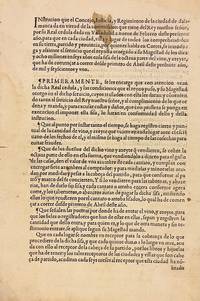
1601ref. 3683Salamanca: S.n. 1601. First edition. Signed at foot by a municipal officer Diez de la Puente. One-page contemporary manuscript on p. 3 relating to the administration of the tax. Unbound as issued. Pinholes at gutter some edge chipping and small dents brown stain affecting the upper portion throughout. Otherwise a good well-preserved copy. First edition. Signed at foot by a municipal officer Diez de la Puente. One-page contemporary manuscript on p. 3 relating to the administration of the tax. Unbound as issued. 4 last 2 blank p. Unrecorded 1601 ordinance from Salamanca enforcing the Armada-era servicio de millones Spain’s foundational fiscal levy. Printed ordinance issued by the municipal council of Salamanca implementing the royal tax known as the servicio de los dieciocho millones. In accordance with the royal cédula of 9 February 1601 the Concejo Justicia y Regimiento instructs subordinate towns and villages to collect an eighth part of all wine and olive oil sold to be remitted through a chain of local receivers. The text regulates how wine and oil must be measured recorded and taxed forbids additional repartimientos and orders prompt transfer of funds to the city’s main treasury. Dated at Salamanca 10 March 1601 and naming four municipal commissioners appointed for its execution it represents the earliest stage of local enforcement of Philip III’s fiscal scheme transforming the national levy into a functioning municipal excise. A contemporary handwritten endorsement below the text signed by Diez de la Puente attests its execution. Accompanying the printed ordinance is a contemporary manuscript headed on p. 3 “Dudas que se ofrecen en la administración de las sisas” listing practical questions concerning the execution of the tax—registration and measurement of goods roles of administrators and receivers form of payment penalties and conditions of tax farming arrendamiento. The servicio de los dieciocho millones formed part of the broader system of millones taxes created by the Cortes of Castile to meet the Crown’s desperate financial needs after the prolonged wars of Philip II. The servicio de millones had first been introduced by royal request and approved by the Cortes on 4 April 1590 conceived to raise eight million ducats over six years to finance the royal expenditure associated with the Armada campaign against England and other military commitments. Rather than remaining temporary it evolved into a regular levy on six staple items—wine oil vinegar meat soap and tallow candles—collected through local sisas and eventually forming the backbone of Castile’s fiscal structure. By 1600–1601 under Philip III the scheme was renewed and expanded to eighteen million ducats its collection entrusted to municipal governments such as Salamanca’s Concejo Justicia y Regimiento. As described in Bartolomé Yun Casalilla’s Sobre la transición al capitalismo en Castilla this marked a transition from feudal income to a centralized fiscal system financed through municipal taxation embedding local economies within the machinery of the Habsburg war state. The present ordinance captures this process of consolidation—when the monarchy sought tighter control over municipal revenues demanded proper accounting and remittance of surpluses and aimed to prevent arbitrary over-taxation—reflecting both the fiscal strain and administrative centralization characteristic of early-seventeenth-century Spain. Reference: Yun Casalilla B. 1987. Sobre la transición al capitalismo en Castilla: Economía y sociedad en Tierra de Campos 1500–1830. Valladolid: Junta de Castilla y León Consejería de Educación y Cultura. . [S.n.] unknown
ref. 223237[Paris], Imprimerie nationale, mai 1871 (vers 1950) in-8, en feuille, contrecollé sur papier fort.
ref. 219693[Paris], Imprimerie nationale, mai 1871 placard in-folio (56 x 45 cm), en feuille.
ref. 219708Paris, Edouard Blot, s.d. (1871) placard in-folio (52 x 35 cm), texte sur trois colonnes, anopisthographe, en feuille. Des bords ébarbés.
ref. 172891Paris, Publication du Journal Le Grelot, s.d. 64 X 50 cm,
ref. 172889Paris, En vente chez M. Pigeol, s.d. 50,5 x 33 cm,
ref. 172890Paris, Em. Voitelain, s.d. 52 x 39,5, recto-verso. Qqs renforts de scotch aux pliures et en marge.
ref. 226723Versailles, Imprimerie du Journal officiel, A. Wittersheim, s.d. (1871) placard grand in-folio (63 x 45 cm), texte sur 6 colonnes, en feuille.
ref. 23905P., Pierre Téqui, Libraire-Editeur, 1924, in 12 broché, VIII-296 pages ; frontispice.
1880ref. 25180Lisbonne 1880 une photographie originale albuminée en noir, trés Animée, format : 17 x 24 cm pour la photo, 22,5 x 28,7 cm avec le carton ou la photo est contrecollée, noté à l'envers dans la photo avec une pointe fine en bas à droite : Paços do Concelho de Lisboa, noté à l'encre brune sous la photo au centre : Palais de Counche Lisbonne, sans date (1880) sans nom d'auteur,
ref. 238829Paris, E. Lachaud, 1872 in-12, [2] ff. n. ch., 248 pp., demi-basane noire, dos lisse orné de filets dorés, tranches mouchetées (reliure de l'époque). Dos très frotté.
ref. 234530Paris, Honoré Champion [Imprimerie Jouve], juillet 1910 in-8, titre, pp. 219-312, avec quelques illustrations dans le texte, demi-toile bleue, première couverture conservée (reliure postérieure).
ref. 245527Paris, 1871, 27 livraisons en un vol. in-folio, pagination multiple, texte sur trois colonnes, demi-toile chagrinée cerise modeste, dos lisse muet (reliure de l'époque). Dos légèrement insolé, larges réparations de papier angulaires aux deux ff. du numéro 27, avec perte de texte,
ref. 29030801Shaoshan n.d. ca.1950. Indigo blue stitched cloth binding in the Yao minority style 21 x 35 cm. covers very goodold dusty contents first page lower corner restored some old pencil marks seven hand-color outline illustrations plus 5 hand-painted lotus flowers and 6 color brushed Mao slogans on the verso of illustrated pages. The work appears to be a kind of minority color painted book stitched in a fascinating and unusually beautiful style commonly used by minority peoples. The book illustrations seems to have been black-outline printed first then later hand-colored with gouache type colors brushed in. Facing each illustration are found the slogans. On previously blank pages there are lovely lotus flowers a symbol of Buddhism. BINDING: The work was obviously hand-bound using indigo blue looks black and red cloth both appear to be hand dyed the indigo piece could be home-woven rough cotton. The white spine stitching is of a heavy thread and double stitched with extra "x" stitches to give a more "stunning" look. The corners are pre-bound with red after which over-layed with the indigo then stitched. This corner treatment gives the book a more protective binding and prevents wear. Obviously the book was bound with much attention and respect to protect the sayings of Mao. The covers are closed with red and green thick string tied into "frogs" to lock the cover when closed. This is a traditional clothing replacement for buttons. The work is in a limp cloth binding with a lovely feel and has quite charming looks. The book is 20 x 35 cm. when closed. CONDITION: The work has some old pencil scribbles on a couple of page corners as well as some old penned name/small note these do not detract from the whole and are minimal. There is a faint bit of old damp on some pages or their versos. Covers have some old dust on the front with a couple small light colored stains. We are overly critical surely the new owner will be pleased to acquire this one ! UNIQUE HANE-MADE HAND-DRAWN WORK: All in all an unusual item from the beginning of communism in China. The book was found in Changsha Honan province at the site of the Mao Museum open market. The seller looked like a minority Yao and stated she brought it from home which was also Mao's home town in Shaoshan. Regardless of the story the book appears to be precisely what she described it to be. In an effort to convince others of their devotion to Mao especially in small communities throughout China many minorities continued their handi-crafts and made Mao tribute pieces. Such favorite slogans as "LONG LIVE MAO 10000 YEARS" "DONT EAT TOO MUCH RICE" "SAVE COAL" DONE USE TOO MUCH COOKING GAS" "WORK TOGETHER" "BE POLITICALLY CORRECT." . unknown