1.951 Ergebnisse
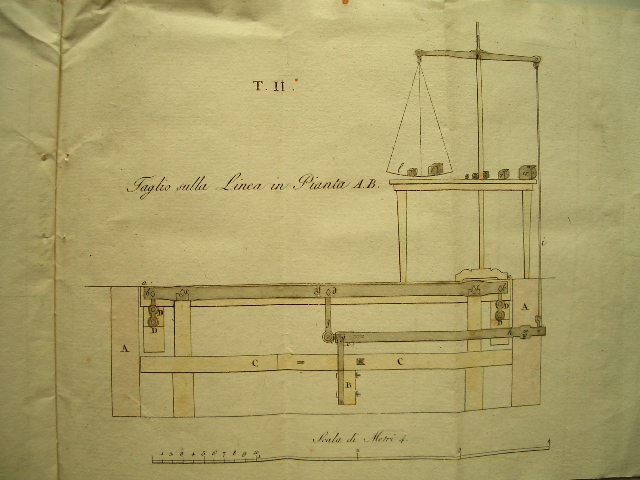
1764Best.-Nr. W88555London, printed for A.Millar, in the Strand 1764 vii + [i] + 252 + [iv] pp.+ 23 folding engraved plates (depicting many scientific and mechanical instruments), 1st edition, 26cm., contemporary full-leather binding (joints with some old profesionnal repairs, back joint slightly broken at lower end), pages with some browning though text is still bright, some occasional foxing, handwritten ex-libris on title page: "de Schuldorff, London 1778", good condition, W88555
1764vii + [i] + 252 + [iv] pp.+ 23 folding engraved plates (depicting many scientific and mechanical instruments), 1st edition, 26cm., contemporary full-leather binding (joints with some old profesionnal repairs, back joint slightly broken at lower end), pages with some browning though text is still bright, some occasional foxing, handwritten ex-libris on title page: "de Schuldorff, London 1778", good condition, W88555
Best.-Nr. 27852Paris Bachelier, librairie. Janvier 1824 1824 in 4 (27x21) 1 volume reliure pleine basane fauve racinée de l'époque, dos lisse orné, tranche marbrées, faux-titre, , titre, portrait gravé en frontispice, VIII et 418 pages, et un faux-feuillet d'errata non chiffré, rousseurs et brunissures habituelles, toutes petites usures sur les coins. Notre exemplaire porte l'ex-libris manuscrit de Louis Alcide S. (Sanial) du Faÿ, dans la marge de la page de titre. Louis Alcide Sanial du Faÿ, ingénieur de marine, 1812-1886, auteur de: Note sur les foyers clos appliqués aux machines à vapeur, études théoriques et expériences ( Paris, 1870). Dernière réédition augmentée publiée du vivant de l'auteur. Important ouvrage relatif à la mécanique céleste et au système solaire. Marquis Pierre-Simon de Laplace, 1749-1827, astronome, mathématicien et physicien français. Bon exemplaire ( Photographies sur demande / We can send pictures of this book on simple request )
Second edition, corrected, and very much enlarged, 4to (245 x 185 mm), [2], viii, [2], 284p., 43 copper-engraved plates, cont. calf, rebacked, corners rubbed. "William Emerson (1701-1782), an English amateur scientist who spent most of his life in seclusion at Hurworth in Durhamshire, Emerson was mainly interested in mathematics, astronomy, physics, and medicine. He is known for his so-called "Emerson Paradox"... the Mechanics was very popular and went through several editions. It deals with the general laws of motion, descent of bodies, centers of gravity, mechanical powers, comparative strength of timber and its failure, forces of engines and their motion, as well as friction, hydrostatics, and pneumatics. The volume also poses the Emerson Paradox..."?Roberts & Trent. Robert & Trent, Bibliotheca Mechanica, pp. 101-02.
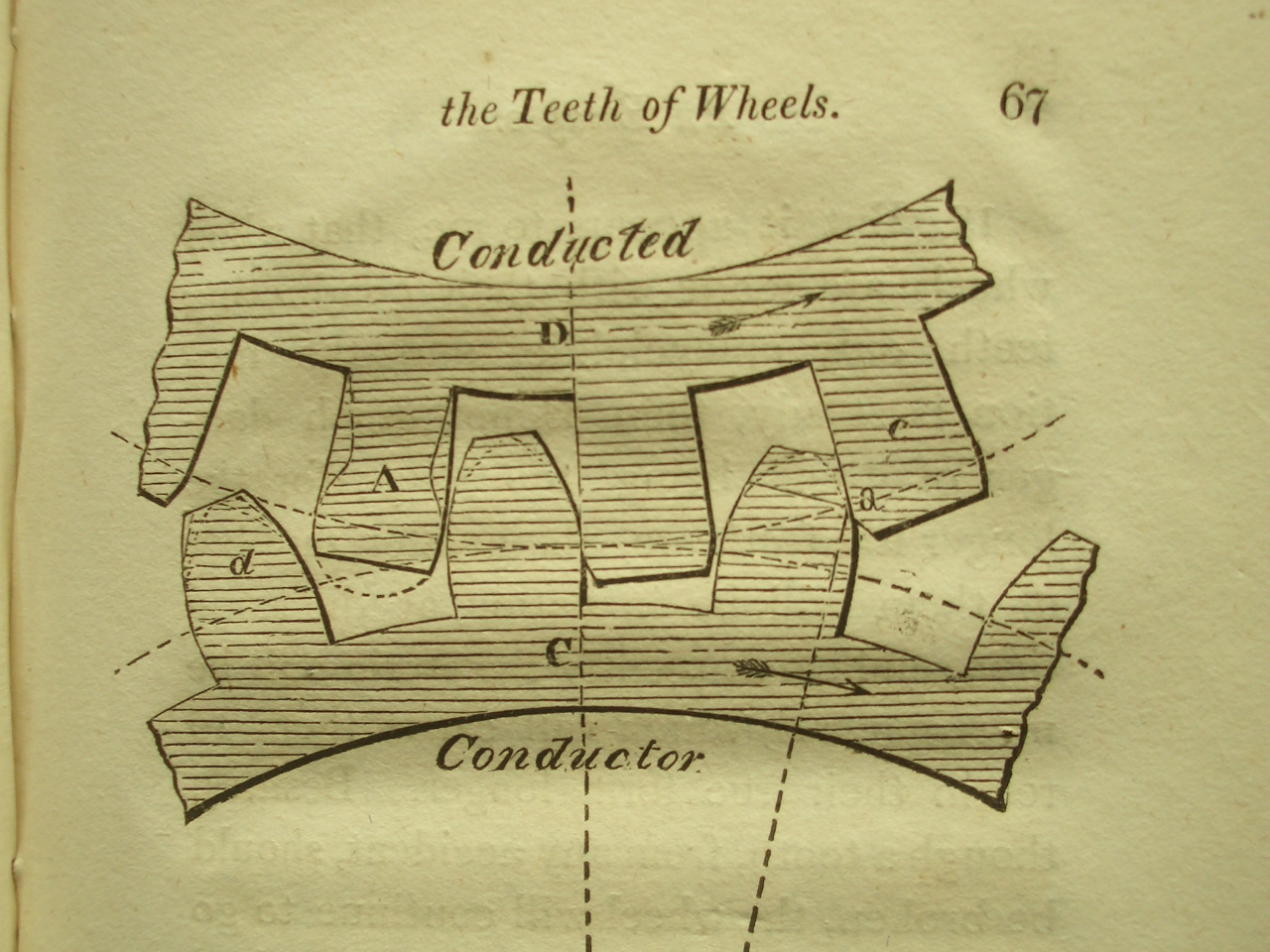
18742 vol. in-folio relié demi-chagrin noir, plats de percaline bordeaux avec mention au plat sup. "Ecole Polytechnique 1874-1875 ou 1875-1876 - P. J. Gaillac", 44 ff. et 33 ff. (en grand nombre de dessins et de lavis sont en double page) Rare et beau recueil de dessins et de lavis réalisés par P. J. Gaillac durant ses études à l'Ecole Polytechnique. On trouve dans le premier recueil des dessins d'architecture (soubassement du Palais de la Chancellerie à Rome), de beaux lavis techniques (Théorie du Lavis des volumes, Tore en saillie, tore en creux, tores composés), des dessins du Cours de géométrie descriptive (Exercices d'ombres, Projections côtées, Perspective, Perspective linéaire, Ombres linéaires d'un tore Ombre du piédouche, Vis à filet triangulaire) des dessins du Cours de stéréotomie (Croupe biaise, Limon d'escalier en courbe rampante, Coupe des Pierres avec descente biaise, Arche biaise, Voûte sphérique, Berceau coudé, Escalier suspendu), et une dizaine de dessins d'art. Dans le second recueil, on peut découvrir des dessins techniques réalisés dans le cadre des Cours de mécanique et de machines (Engrenages, Engrenages coniques) dont quelques belles aquarelles (Boulons, Pivot et Crapaudine, Meule, Palier graisseur), des dessins d'architecture (les différents ordres, un beau lavis intitulé Projet de Bibliothèque, lavis de Corps de garde, Projet de restaurant, de mairie, de gare), ou des oeuvres réalisées dans le cadre des cours de dessin ou librement (d'après l'antique, un écorché, et se termine avec trois beau lavis de militaires (un cuirassier, un artilleur et un fantassin). Bon état (dos et mors frottés, 1 f. faible, bel état intérieur) pour ce beau et rare témoignage des études à l'Ecole Polytechnique au lendemain de la défaite de 1870. Français
1926Best.-Nr. 47172Minneapolis, Minn., The Physicalreview, 1926. 4to. Contemp. full buckram. Small tear to first hinge at foot. A stamp in upper right corner on titlepage and 2 other pages. In: ""The Physical Review. Conducted by the American Physical Society"", Vol. 28, Second Series. VI,1343 pp. (Entire volume offered).Schrödinger's paper: pp. 1049-1070. Internally clean and fine.
1926Best.-Nr. 47172Minneapolis Minn. The Physicalreview 1926. 4to. Contemp. full buckram. Small tear to first hinge at foot. A stamp in upper right corner on titlepage and 2 other pages. In: "The Physical Review. Conducted by the American Physical Society" Vol. 28 Second Series. VI1343 pp. Entire volume offered.Schrödinger's paper: pp. 1049-1070. Internally clean and fine. First appearance of the first treatment of Wave Mechanics in English.The paper reviews Schrödinger's own wave-mechanics and De Broglie's "phase waves" and covers all the results Schrödinger had hitherto obtained in his main communications of 1926 the 3 papers in German. An English translation of Schrödinger's main papers was not published until 1928."The paper gives an account of the author's work on a new form of quantum theory. §1. The Hamiltonian analogy between mechanics and optics. §2. The analogy is to be extended to include real "physical" or "undulatory" mechanics instead of mere geometrical mechanics. §3. The significance of wave-length; macro-mechanical and micro-mechanical problems. §4. The wave-equation and its application to the hydrogen atom. §5. The intrinsic reason for the appearance of discrete characteristic frequencies. §6. Other problems; intensity of emitted light. §7. The wave-equation derived from a Hamiltonian variation-principle; generalization to an arbitrary conservative system. §8. The wave-function physically means and determines a continuous distribution of electricity in space the fluctuations of which determine the radiation by the laws of ordinary electrodynamics. §9. Non-conservative systems. Theory of dispersion and scattering and of the "transitions" between the "stationary states." §10. The question of relativity and the action of a magnetic field. Incompleteness of that part of the theory." From the Abstract in front of the paper. hardcover
Best.-Nr. 50531P., Mme Veuve Courcier, 1811, 2 volumes in 8 reliés demi-basane ancienne, dos lisses ornés, étiquettes de titre et de tomaison vertes, XXVIII-507 et XXVIII-500 pages ; 8 planches dépliantes ; des rousseurs ; cachets ; petits défauts d'usage.
1804In -8°, pp. (4), XII, 284; cartonato. Prima edizione. Crespe era un orologiaio ginevrino: l’orologio a ripetizione è un tipo di orologio che suona l’ora a richiesta e che fu notevolmente migliorato da Crespe, che racconta di aver scritto questo lavoro, all’origine, a beneficio solo dei propri operai. Raro. Crespe was a watchmaker in Geneva: the repetition clock (a kind of clock that chimes on request) was strongly improved by him, who explains this treaty to be conceived only for his workers. Rare.
1990Best.-Nr. ZB394544Society for Experimental Mechanics 1990. first edition complete volume library markings textually clean & tight. - If you are reading this this item is actually physically in our stock and ready for shipment once ordered. We are not bookjackers. Buyer is responsible for any additional duties taxes or fees required by recipient's country. Photos available upon request. Society for Experimental Mechanics unknown
1928P., 1928. 2 volumes in-4 relié demi basane, premiers plat de couverture conservés, XVI-348 et 352 pp. - 3 ff. 540 planches et figures, VII hors-textes en couleur sous serpente légendée. Envoi de Gélis ( l'un ds contributeurs). EX. 56/1000 numéroté sur papier chromo. Court accroc en haut du dos au vol.II sinon très bon état. L'ouvrage débute par les automates primitifs-premières figures articulées, à l'automatisme dans l'orthopédie, en passant par les horloges, jouets,tabatières, oiseaux chantants, androïdes.. Bibliographie in fine.
1821Best.-Nr. 3579Coronata colla medaglia d'oro nella distribuzione de' Premj d' Industria nel dì 4 Ottobre 1815. Mit 4 kolor. gefalt. gest. Tafeln. Mailand, dalla tipografia di Angelo Stanislao Brambilla, 1821. 8vo. (20,8 x 13,7 cm). 19 S. Neuer Umschlag.
1858Best.-Nr. 42295(London, Richard Taylor and William Francis, 1858 and Taylor and Francis, 1866. 4to. No wrappers as extracted from ""Philosophical Transactions"" Vol. 148 - Part I. Pp. 17-37, and Vol. 156 - Part I, Pp. 25-35. Clean and fine.
1858Best.-Nr. 42295London Richard Taylor and William Francis 1858 and Taylor and Francis 1866. 4to. No wrappers as extracted from "Philosophical Transactions" Vol. 148 - Part I. Pp. 17-37 and Vol. 156 - Part I Pp. 25-35. Clean and fine. First appearance of this outstanding contribution to mathematics announcing his invention and developments of the ALGEBRA OF MATRICES what is now called the Cayley-Hamilton theorem for square matrices of any order. "The subject originated in a memoir of 1858 the paper offered and grew directly out of simple observations on the way in which the transformations linear of the theory of algebraic invariants are combined.a distinctive feature of these rules is that multiplication is not commutative.we get different results according to the order in which we do the multiplication. it seems about as far from anything of scientific or practical use as anything could possible be. Yet sixty seven years after Cayley's invented it HEISENBERG in 1925 recognized in the algebra of matrices exactly the tool which he neede for his revolutionary work in QUANTUM MECHANICS."Bell Men of Mathematics."It was in connection with the study of invariants under linear transformation that Cayley first introduced matrices to simplify the notation involved. Here he gave some basic notions. This was followed by his first major paper on the subject "A Memoir on the Theory of Matrices." the paper offered here. Kline Mathematical Thought.p. 806. unknown
1775Best.-Nr. 9634Berne, Société typographique, 1775. 3 volumes in-8 de VIII-309; VIII-315; X-351 pages, demi-maroquin beige à coins, dos lisses ornés de filets et fleurons dorés, pièces de titre et tomaison en maroquin rouge, tranches rouges.
1739Best.-Nr. 6044Leyden, Samuel Luchtmans, 1739. 2 volumes in-4 de XXV-[3]-502-8p. ; [2]-de 503 à 914-[2]p. pour l'explication de la pl. 29 - [28]p. de table - [2]p. d'errata - 63p. pour la description des machines pneumatiques par Jan van Musschenbroek, plein vélin ivoire à (petit) recouvrement, titre doré au dos (reliure du temps).
1735Best.-Nr. 42459Paris, Imprimerie Royale, 1735. 4to. Fine recent marbled boards. Printed titlelabel on frontcover. (6),144 pp. and 1 double-page folded engraved plate. Johann B's paper: pp. (1-) 91. - Daniel B's papers: pp. (93-) 122 and pp. 123-144. A few marginal brownspots.
1735Best.-Nr. 42459Paris Imprimerie Royale 1735. 4to. Fine recent marbled boards. Printed titlelabel on frontcover. 6144 pp. and 1 double-page folded engraved plate. Johann B's paper: pp. 1- 91. - Daniel B's papers: pp. 93- 122 and pp. 123-144. A few marginal brownspots. First edition of these prize winning papers by father Jean and son Daniel. - Both papers deals with the cause of the inclination of the planetary orbits relative to the solar equator. - In Daniel's paper he put foreward the hypothesis of the existence of an atmosphere resempling air and rotating around the solar axis resulting in an increasing inclination of the planetary orbits toward the equator of the sun. Daniel was the first importent Newtonian outside Great Britain. The problems faced here by Daniel are treated in Newtonian manner.The publication of these papers by father and son resulted in a controversy between the two forcing Daniel to leave his fathers house. - Poggendorff I:161. hardcover
1808Best.-Nr. 5856With numerous figures. Revised by Peter Nicholson, architect. Mit zahlr. Holzschnitten im Text u. 2 (1 gest.) gefalt. Tabellen. London, Printed by and for William Savage, 1808. Kl.-4to. (20,1 x 12,6 cm). 2 Bl., II S. "Contents of essay I.", (V)-IX, (11)-184 S. Blauer Pappband d. Zt. mit rotem Rückenschild.
Best.-Nr. ORD-2947Suite de la Mesure des Surfaces et des Solides. Paris. Jombert. 1741. In-4 (205 x 262mm) pleine basane brune, dos à 5 nerfs orné, pièce de titre maroquin brun, tranches rougies, gardes peignées (reliure de l'époque), 4ff.n.ch., XXXIV, (II), 632 pages, bien complet des gravures et des planches. Coiffes lgt émoussées, rousseurs éparses mais bon exemplaire.
Best.-Nr. 97587A Lyon, chez David Forey, Libraire ruë Merciere proche la mort qui Trompe, 1719, 1 in-4 de 255x190 mm environ, (14) ff. (titre en rouge et noir, epitre, préface, table, approbation), 101 pages, (5) ff. (table, avis au relieur, errata), pleine reliure d'époque en basane brune, dos à 5 nerfs portant titres dorés sur pièce de titre en maroquin bordeaux, orné de caissons motifs dorés, coupes dorées, tranches rouges, gardes marbrées. Complet des 85 planches : dont titre imprimé en deux couleurs, bandeau et belle lettrine, en tête de l'Epître au Duc d'Orléans, erreur de numérotation dans les planches justifiée dans le texte en regard (Quoiqu'il n'y ait point de planches 39, 48 et 76, il ne manque rien, & les figures ne laissent pas de suivre dans leur ordre). Cette méprise vient du Graveur qui a mis le nombre 40, 49, et 77, immédiatement après le 38, 47 et 75). Edition originale. Quelques épidermures et petites taches sur le cuir, frottements légers, sinon bon état.
1745In -folio, pp. (16), 204, 12 grandi tavole di cui una doppia; cartonato coevo. Si tratta della seconda edizione aumentata, con un bell’obelisco inciso all’antiporta. In –folio, 12 big plates of mechanics (one is double), this is the second edition (increased), with a beautiful obelisk engraved on frontispiece, contemporary boards.
Best.-Nr. 57701Providence: January 30 1837. 4to approx. 10" x 8 5 leaves of ruled stationery with manuscript in ink on rectos only in a neat secretarial hand bound with blue silk ribbon; previous folds very light staining otherwise near fine. Interesting chapter in the historical evolution of the Providence school system. The Providence Association of Mechanics and Manufacturers was politically involved in city affairs as early as 1799 when "the want of a better system of school instruction being deeply felt by the members a memorial was prepared and presented to the General Assembly urging the establishment of free schools throughout the State and reminding that body that liberty and security under a republican form of government depend on a general diffusion of knowledge amoug the people" A History of Public Education in Rhode Island: from 1636 to 1876 byThomas B. Stockwell 1876 In 1837 the association under President George Baker and Samuel Tingley Jr. Secretary whose names appear on page four presented the petition: "Your memorialists have been struck with one fact . that the instruction of youth in the public schools is a heavy tax upon the middling classes without an adequate return as they do not participate in the benefit of this public instruction. This argument which is evidently weighty in the present condition of these schools would be destroyed if they were raised to the condition desired by your memorialists. "Why is it that the middling classes do not become participants in this instruction There is evidently but one reason. They perceive that the crowded state of the schools alone would prevent proper attention to the pupil; and they are aware that with the small sum which the instructors receive it is difficult to procure and retain the services of competent persons to fill the station. But let the schools be made so numerous that the scholars may receive as much attention as they do in the private schools and let the salaries be so large as to induce men of equal ability to take charge of them and that which is now considered as a tax would then be viewed as an alleviation of one of the heaviest burdens put upon the middling classes. "Your honorable body have no doubt . perceived how far we are behind our neighboring cities in this particular. Whilst they are constantly aiming at perfection in their free school system we have been at a stand or retrograding . To remedy the defect in our present system your memorialists would suggest that a grade of schools be established between the primary and writing schools for reading writing and arithmetic only the design of which is to give a thorough instruction in these branches to those children whose parents need their services at as early an age as twelve or thirteen years and who under the present arrangement are compelled to leave school with a very superficial knowledge of those branches which are so necessary for obtaining a livelihood in any business . To effect an essential reform in our public school system great expense must necessarily be incurred; and your memorialists who represent a large portion of the heads of families of the city would meet this increased expense with hearty encouragement." The document is signed "George Baker President. Samuel Tingley Jr. Secretary." Page 5 is entitled "Resolutions" and includes a list of seven statements relative to the Association's petition beginning with "Resolved that no subject can be of more importance to the inhabitants of this city than the education of the rising generation" and that "the members of this association were the pioneers in the establishment of the Public Schools." "This petition or memorial was referred to a committee who subsequently reported a plan for the improvement of the schools; but the provisions of it were deemed unsatisfactory. A second plan was presented comprising twelve primary eight intermediate and four upper schools. With these modifications the bill was returned to the common council who refused to concur. After frequent meetings and protracted debates with no unity the board of aldermen devised a plan embracing ten primary schools six intermediate schools two upper schools and two schools for colored children. This when presented to the common council was voted down by a large majority and without any final decision the municipal year closed. The feeling on the school question was now stronger than ever" Stockwell. January 30, 1837 unknown
Best.-Nr. 57701Providence: January 30 1837. 4to approx. 10" x 8 5 leaves of ruled stationery with manuscript in ink on rectos only in a neat secretarial hand bound with blue silk ribbon; previous folds very light staining otherwise near fine. Interesting chapter in the historical evolution of the Providence school system. The Providence Association of Mechanics and Manufacturers was politically involved in city affairs as early as 1799 when "the want of a better system of school instruction being deeply felt by the members a memorial was prepared and presented to the General Assembly urging the establishment of free schools throughout the State and reminding that body that liberty and security under a republican form of government depend on a general diffusion of knowledge amoug the people" A History of Public Education in Rhode Island: from 1636 to 1876 byThomas B. Stockwell 1876 In 1837 the association under President George Baker and Samuel Tingley Jr. Secretary whose names appear on page four presented the petition: "Your memorialists have been struck with one fact . that the instruction of youth in the public schools is a heavy tax upon the middling classes without an adequate return as they do not participate in the benefit of this public instruction. This argument which is evidently weighty in the present condition of these schools would be destroyed if they were raised to the condition desired by your memorialists. "Why is it that the middling classes do not become participants in this instruction There is evidently but one reason. They perceive that the crowded state of the schools alone would prevent proper attention to the pupil; and they are aware that with the small sum which the instructors receive it is difficult to procure and retain the services of competent persons to fill the station. But let the schools be made so numerous that the scholars may receive as much attention as they do in the private schools and let the salaries be so large as to induce men of equal ability to take charge of them and that which is now considered as a tax would then be viewed as an alleviation of one of the heaviest burdens put upon the middling classes. "Your honorable body have no doubt . perceived how far we are behind our neighboring cities in this particular. Whilst they are constantly aiming at perfection in their free school system we have been at a stand or retrograding . To remedy the defect in our present system your memorialists would suggest that a grade of schools be established between the primary and writing schools for reading writing and arithmetic only the design of which is to give a thorough instruction in these branches to those children whose parents need their services at as early an age as twelve or thirteen years and who under the present arrangement are compelled to leave school with a very superficial knowledge of those branches which are so necessary for obtaining a livelihood in any business . To effect an essential reform in our public school system great expense must necessarily be incurred; and your memorialists who represent a large portion of the heads of families of the city would meet this increased expense with hearty encouragement." The document is signed "George Baker President. Samuel Tingley Jr. Secretary." Page 5 is entitled "Resolutions" and includes a list of seven statements relative to the Association's petition beginning with "Resolved that no subject can be of more importance to the inhabitants of this city than the education of the rising generation" and that "the members of this association were the pioneers in the establishment of the Public Schools." "This petition or memorial was referred to a committee who subsequently reported a plan for the improvement of the schools; but the provisions of it were deemed unsatisfactory. A second plan was presented comprising twelve primary eight intermediate and four upper schools. With these modifications the bill was returned to the common council who refused to concur. After frequent meetings and protracted debates with no unity the board of aldermen devised a plan embracing ten primary schools six intermediate schools two upper schools and two schools for colored children. This when presented to the common council was voted down by a large majority and without any final decision the municipal year closed. The feeling on the school question was now stronger than ever" Stockwell. January 30, 1837 unknown books
1786P., Mérigot, Didot, 1786. 2 volumes in-4 (18 x 24 cm), reliure pastiche demi-basane, dos long orné, p. de t.-LIV-1 f.- 477 pp.ch.-5 ff..-19 planches dépliantes pour le premier volume ; p. de fx-t.-p;de t.-VIII- 451 pp.- 19 planches dépliantes num. (20-38) pour le second volume. Seconde édition (la première est de 1763). Le texte "Eclaircissements..."est publié par P., Muselier, 1773. VIII-164 pp. Rousseurs, restauration complète du dos de la reliure avec les plats d'origine conservés, salissures. Orné de 38 planches gravées par Choffard d'après Goussier exposant toutes sortes de montres, horloges, pièces, mécanismes, engrenages, etc. Peu courante réunion des 2 textes (les "Eclaircissemens" constituent une justification de l'ancienneté et de la paternité du travail de Berthoud sur la longitude en mer). Né à Neuchâtel, Ferdinand Berthoud (1727-1807) devint en France horloger du roi et de la Marine, avant d'être reçu à l'Académie des Sciences en 1795. Il est l'inventeur de l'horloge marine permettant de connaître la longitude en mer.