La Vie Automobile - Charles Faroux (Rédacteur en Chef)Livre Rare Book

2 052 résultats
réf. 1195731947 / 1948 Années 1947 et 1948 complètes (Deux années reliées en un volume) - 43e et 44e année - Dunod, Editeur - Revue mensuelle illustrée - Fort in-folio, demi chagrin bordeaux; 4 nerfs, pièces de titre et d'année, et fleuron dorés au dos - Pagination non continue - Très nombreuses illustrations et reproductions photographiques en N&B - Années complètes avec les Suppléments aux livraison N° 1361-1362 (1947) et aux N° 1385-1386 (1948) - Relié avec les pages de publicités et les couvertures d'origine
réf. 1195741949 / 1950 Années 1949 et 1950 complètes (Deux années reliées en un volume) - 45e et 46e année - Dunod, Editeur - Revue mensuelle illustrée - Fort in-folio, demi chagrin bordeaux; 4 nerfs, pièces de titre et d'année, et fleuron dorés au dos - Pagination non continue - Très nombreuses illustrations et reproductions photographiques en N&B - Années complètes reliées avec les pages de publicités et les couvertures d'origine, avec les Suppléments contenant les tables des matières pour les deux années
réf. 1195771951 / 1952 Années 1951 et 1952 complètes (Deux années reliées en un volume) - 46e et 47e année - Dunod, Editeur - Revue mensuelle illustrée - Fort in-folio, demi chagrin bordeaux; 4 nerfs, pièces de titre et d'année, et fleuron dorés au dos - Pagination non continue - Très nombreuses illustrations et reproductions photographiques en N&B - Années complètes reliées avec les pages de publicités et les couvertures d'origine, avec les Suppléments contenant les tables des matières pour les deux années
1925réf. 1196191925 Année 1925 complète, reliée en deux volumes - 21e année - Dunod, Editeur - Revue bimensuelle illustrée - 2 volumes fort in-folio, demi chagrins bordeaux; 4 nerfs, pièces de titre et d'année, et fleurons dorés aux dos - Pagination non continue - Très nombreuses illustrations et reproductions photographiques en N&B - Année complète reliée avec les pages de publicités et les couvertures d'origine - Le volume 1 va du N° 817, du 10 janvier, au N° 828, du 25 juin. Le deuxième volume va du N° 829, du 10 juillet, au N° 840 du 25 décembre - Relié avec le Supplément à la livraison N° 840 du 25 décembre 1925 en fin d'ouvrage, comprenant les tables des matières
1824réf. GITe745A Paris de l'Imprimerie Royale 1824. In-4 2 feuillets non chiffrés 2-290pp 1 feuillet corrections et additions. Demi basane bleu nuit, dos lisse orné de filets et chaînettes finement dorés en queue, beau papier marbré bleu nuit et vert sur les plats, relié vers 1860. Avec de nombreux tableaux dans le texte et à pleine page. Pâles rousseurs en bordure des 5 premiers feuillets et des 5 derniers, intéressantes annotations marginales anciennes au crayon sur quelques feuillets. SANS L'ATLAS. Bel exemplaire, fort bien relié vers 1860, bien complet de son texte mais sans son atlas.
1842réf. 1679Mit einem Anhange über den Erdendruck und die Strebepfeiler. 2 Lieferungen in 1 Bd. (Alles). Prag, Gedruckt bei J. Spurny, 1842. 8o. (18,5 x 11,7 cm). 1: 128 S. 2: 1 Bl., 66 S. Grüner Pappband d. Zt. mit Rückenvergoldung (5 Bll. Orig.-Umschläge eingebunden).
1927réf. 1191811927 N° 80 à N° 91 - Nouvelle série - Année 1927 - Revue mensuelle illustrée - Fort in-folio, demi percaline bordeaux; titre et année au dos - Pagination continue p. 679 à 1010, puis reprise en Juin 1927 p. 1 à 568 (saut de page 242 à 248) - Très nombreuses illustrations et reproductions photographiques en N&B et en couleurs - Reliée avec les couvertures d'origine
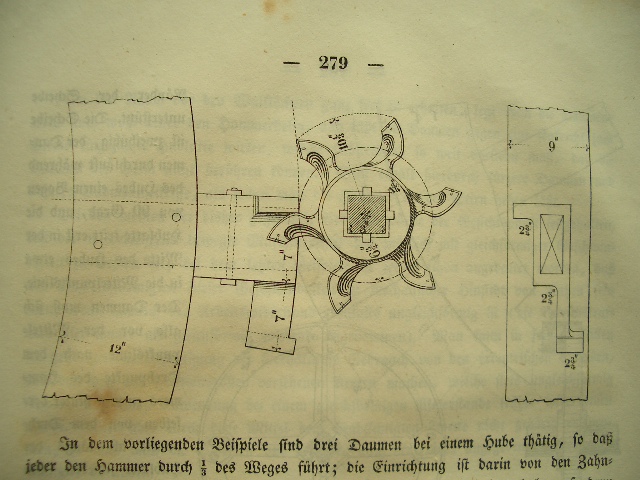
1842réf. 3622Im Auftrage des Finanz-Ministerii für den Unterricht in der Königl. Allgemeinen Bauschule und im Königl. Gewerbe-Institut bearbeitet. Mit zahlr. Illustrationen im Text. Berlin, 1842. 4to (25,1 x 19,0 cm). Titel, XII, 340 S. Halblederband d. Zt. mit reicher Rückenvergoldung.
3 volumes In-4, 623-627-566p. très bel exemplaire en excellente condition. Avec plus de 4200 figures dans le texte et de nombreuses planches en couleurs hors texte, certaines dépliantes, d'autres animées.
1990Fine Fine Turkmen Original bdg. Dust wrapper. Roy. 8vo. (24 x 17 cm). Introduction in Turkmen, facsimile in Arabic. [2], 28, 256 p., color facsimiles of the earliest of all copies, dating 1206 (preserved in the Library of Topkapi Serai, Istanbul, No. 3472), color ills. [The book of knowledge of ingenious mechanical devices] Adatdan dasari mehanik gurallayn maglumaty hakda kitap. Al-Jazari was a Muslim polymath: a scholar, inventor, mechanical engineer, artisan, artist and mathematician. He is best known for writing 'The Book of Knowledge of Ingenious Mechanical Devices'. Kitab fi ma'rifat al-hiyal al-handasiya, (lit. 'Book in knowledge of engineering tricks') in 1206, where he described 100 mechanical devices, some 80 of which are trick vessels of various kinds, along with instructions on how to construct them. The only biographical information known about him is contained in his famed Book of Knowledge of Ingenious Mechanical Devices. Like his father before him, he served as chief engineer at the Artuklu Palace, the residence of the Mardin branch of the Artuqids which ruled across eastern Anatolia as vassals of the Zengid dynasty of Mosul and later of Ayyubid general Saladin. Al-Jazari was part of a tradition of artisans and was thus more a practical engineer than an inventor who appears to have been "more interested in the craftsmanship necessary to construct the devices than in the technology which lay behind them" and his machines were usually "assembled by trial and error rather than by theoretical calculation." His Book of Knowledge of Ingenious Mechanical Devices appears to have been quite popular as it appears in a large number of manuscript copies, and as he explains repeatedly, he only describes devices he has built himself. According to Mayr, the book's style resembles that of a modern "do-it-yourself" book. Some of his devices were inspired by earlier devices, such as one of his monumental water clocks, which was based on that of a Pseudo-Archimedes. He also cites the influence of the Banu Musa brothers for his fountains, al-Saghani for the design of a candle clock, and Hibatullah ibn al-Husayn (d. 1139) for musical automata. Al-Jazari goes on to describe the improvements he made to the work of his predecessors, and describes a number of devices, techniques and components that are original innovations which do not appear in the works by his precessors. The most significant aspect of al-Jazari's machines are the mechanisms, components, ideas, methods, and design features which they employ. (Source: Wikipedia). There are 50 devices that Al Jazari designed and explained how they function in his book and created technical drawings of them in such detail that allow to reconstruct in its original size, make, model and full functionally. This nice facsimile edition, fully executed in color, is based on a manuscript present in the Library of Topkapi Palace, (ms. no. 3472). It is dated 1206, andaccording to the foreword, is the earliest extant copy of al-Jazarî's work.
1878réf. 6291878 Paris, Dejey & Cie, 1878-1904. Treize volumes in-8 demi chagrin (reliures dépareillées), comprenant les semestres suivants: divers (quelques mois de 1878 à 1890), juillet-décembre 1890, janvier-décembre 1891, janvier-juin 1892, janvier-juin 1893, janvier-juin 1896, juillet-décembre 1897, juillet-décembre 1899, janvier-juin 1901, janvier-juin 1902, janvier-juin 1903, juillet-décembre 1904. Environ 110 pages par bulletin, nombreuses planches (tableaux, plans, croquis ...) in-fine et nombreuses figures in-texte. Rousseurs, légères épidermures.
1706réf. 44383Paris, Jean Boudot, 1706. 4to. Without wrappers. Extracted from ""Mémoires de l'Academie des Sciences. Année 1705"". Pp. 176-186 and 1 folded engraved plate.
1706réf. 44383Paris Jean Boudot 1706. 4to. Without wrappers. Extracted from "Mémoires de l'Academie des Sciences. Année 1705". Pp. 176-186 and 1 folded engraved plate. First appearance of a founding paper in the theory of elastic curves. "Importent also is his last work on the resistance of elastic bodies 1705." DSB II p.49 s."During the last quarter of the seventeenth century and the beginning of the eighteenth centuries a rapid development of the infinitesimal calculus took place. Started on the Continent by Leibnitz.it progresssed principally by the work of Jacob and John Bernoulli. In trying to expand the field of application of this new mathematical tool they discussed several examples from mechanics and physics. One such example treated by Jacob Bernouilli.concerned the shape of the deflection curve of an elastic bar and in this way he began an importent chapter inthe mechanics of elastic bodies."Timoshenko "History of Strenght of Materials" p. 25-26. unknown
1832xxviii, 237 p., 1 l. diagrs. on 4 fold. pl. 22 cm. Hardcover Very good condition in full calf Armorial binding: Academia Jacobi VI, Scotorum Regis Edinensis
réf. 26225aafWien, L.W. Seidel (für K.K. Kriegsschule), 1878, in-4° et in-4° oblong, XVI + 426 S. / 22 Tafeln davon 20 lithogr. Tafeln mit zahlr. gestoch. Fig. (Tafel 1 mit Stempel und staubfleckig), 1 Lichtdrucktafel, und 1 Karte in photolithogr. Farbendruck, im Mitte gefalten, einige Stempel, Original-Broschüre, fleckig, Stempel und Etikette / broschiert, Titeletikette uaf Umschlag vorne, Umschlag etwas beschädigt.
1885réf. 10151885 rel. éd. toil. in-4 à l'italienne, 1er plat décoré, tr. lisses, 77 fig. (clichés de tramway et train equipés de ce moteur et dess. techn. / le moteur à air comprimé), sans pagination, 1885 Paris hinstin Frères Editeurs,
2012réf. x-3642623824Springer Verlag 2012. Paperback. New. multilingual edition. 591 pages. German language. 9.30x6.20x1.00 inches. Springer Verlag paperback
1908réf. wq826La Machine Moderne Relié 1908 RARE ENSEMBLE DE CETTE REVUE TRÈS TECHNIQUE DÉCRIVANT LES MACHINES EN USAGE À L'ÉPOQUE. Reliure comprenant du n° 14 de 1908 au n° 25 de 1908 sauf le n° 20 de juillet, puis du numéro 27 de février 1909 au numéro 37 de décembre 1909, ensuite nous trouvons dans cette reliure les numéros suivants : du n°48 de novembre 1910 au n° 66 de mai 1912. environ 20 pages par numéro sur papier glacé. Le volume fait 4.5 cm d'épaisseur. Format in-4° (20.5 * 26 cm). Très nombreux croquis techniques, plans et photographies en noir et blanc dans le texte. Revue fondée en 1906 par Georges Lévy ; reliure de travail non titrée, intérieur frais, bon état. Livraison a domicile (La Poste) ou en Mondial Relay sur simple demande.
1935réf. 1191351935 N° 28 - Septembre 1935 - Revue bimestrielle illustrée - In-4, broché couverture illustrée ("Sur la route de Saverne. Borne limite des Marches d'Alsace", illustration de Paul Iribe) - 38 pages - Nombreuses illustrations et reproductions photographiques en couleurs et en N&B in et hors texte - Belle illustration couleur, V8 de Paul Iribe, en double page centrale
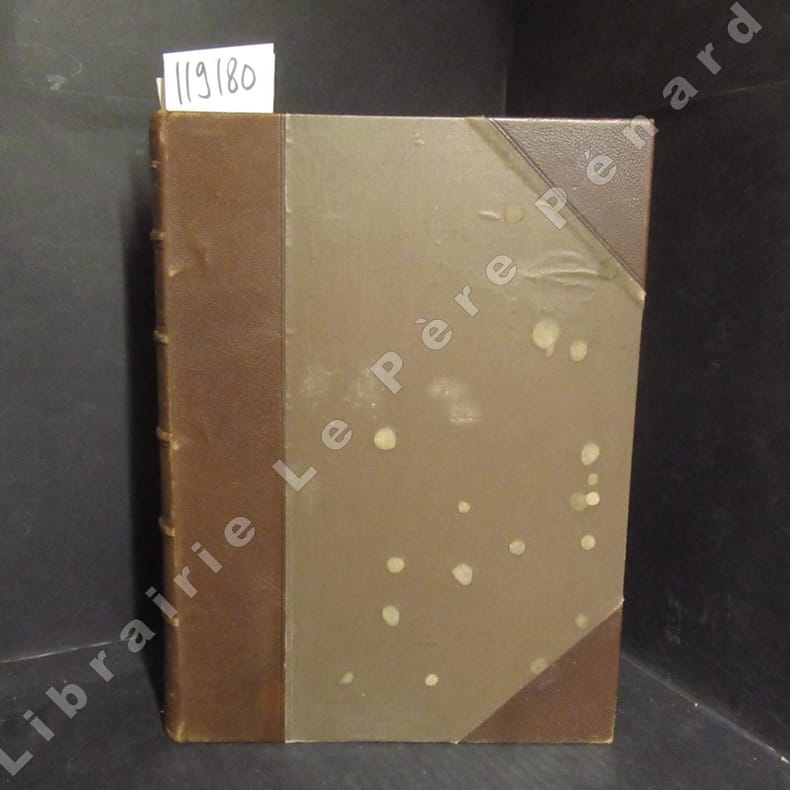
1927réf. 1191801927 N° 80 à N° 91 - Nouvelle série - Année 1927 complète - Revue mensuelle illustrée - Fort in-folio, demi chagrin marron à coins; 5 nerfs, titre,année, et fleuron dorés au dos - Pagination continue p. 679 à 1010, puis reprise en Juin 1927 p. 1 à 568 - Très nombreuses illustrations et reproductions photographiques en N&B et en couleurs - Année complète reliée avec les pages de publicités et les couvertures d'origine
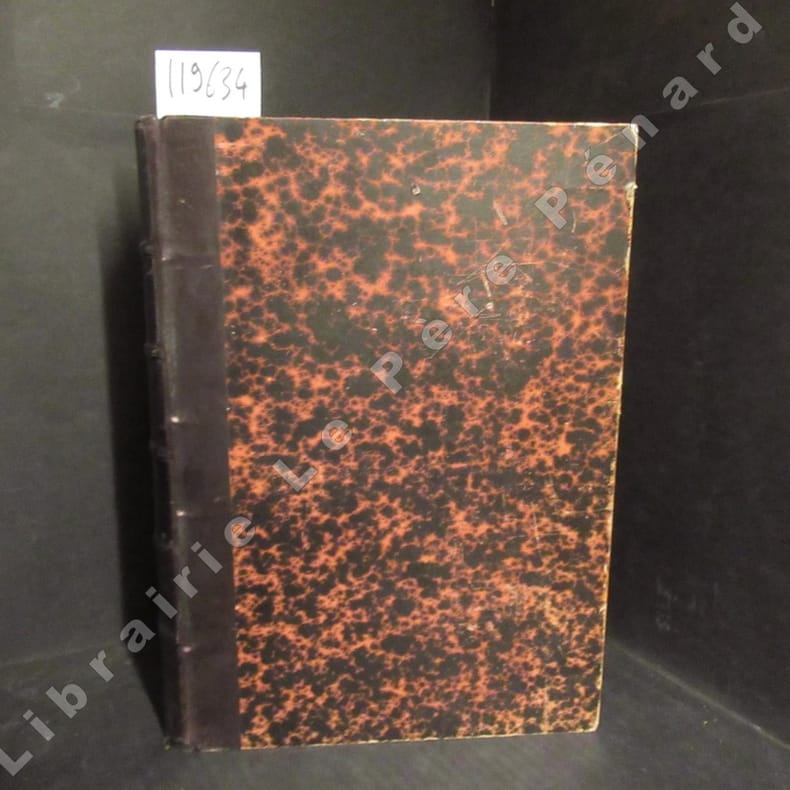
réf. 1196341921 / 1922 Années 1921 (Second semestre) et 1922 (Premier semestre) (Deux années reliées en un volume) - Nouvelle série - Dunod, Editeur - Revue mensuelle illustrée - Fort in-folio, demi basane noire; 5 nerfs, avec titre et années dorées au dos (notées 1921-22) - p. 1 à 982 (Pagination continue) - Très nombreuses illustrations et reproductions photographiques en N&B - Semestres complets reliés avec les pages de publicités et les couvertures d'origine - Relié avec le Supplément au N° 24, contenant la table des matières de ce Tome II (Mai 1921 à Mai 1922)
réf. 8092Revue mensuelle in-4°, couverture en couleur, 36pp. ou plus par numéro, illustrée de très nombreux schémas dans ou hors texte en noir, avec publicités en noir ou en couleurs. Ensemble de 60 numéros ( dont 1 double) conservés en 5 reliures cartonnées à crochets, de l'éditeur, de couleur grenat, titre doré au dos.
1990New English Paperback. Roy. 8vo. (24 x 17 cm). Introduction in English and Turkish; [360] p. color facsimiles of the earliest of all copies, dating 1206 (preserved in the Library of Topkapi Serai, Istanbul, No. 3472), color ills. The book of knowledge of ingenious mechanical devices.= Olaganüstü mekanik araçlarin bilgisi hakkinda kitap. [FACSIMILE]. Al-Jazari was a Muslim polymath: a scholar, inventor, mechanical engineer, artisan, artist and mathematician. He is best known for writing 'The Book of Knowledge of Ingenious Mechanical Devices'. Kitab fi ma'rifat al-hiyal al-handasiya, (lit. 'Book in knowledge of engineering tricks') in 1206, where he described 100 mechanical devices, some 80 of which are trick vessels of various kinds, along with instructions on how to construct them. The only biographical information known about him is contained in his famed Book of Knowledge of Ingenious Mechanical Devices. Like his father before him, he served as chief engineer at the Artuklu Palace, the residence of the Mardin branch of the Artuqids which ruled across eastern Anatolia as vassals of the Zengid dynasty of Mosul and later of Ayyubid general Saladin. Al-Jazari was part of a tradition of artisans and was thus more a practical engineer than an inventor who appears to have been "more interested in the craftsmanship necessary to construct the devices than in the technology which lay behind them" and his machines were usually "assembled by trial and error rather than by theoretical calculation." His Book of Knowledge of Ingenious Mechanical Devices appears to have been quite popular as it appears in a large number of manuscript copies, and as he explains repeatedly, he only describes devices he has built himself. According to Mayr, the book's style resembles that of a modern "do-it-yourself" book. Some of his devices were inspired by earlier devices, such as one of his monumental water clocks, which was based on that of a Pseudo-Archimedes. He also cites the influence of the Banu Musa brothers for his fountains, al-Saghani for the design of a candle clock, and Hibatullah ibn al-Husayn (d. 1139) for musical automata. Al-Jazari goes on to describe the improvements he made to the work of his predecessors, and describes a number of devices, techniques and components that are original innovations which do not appear in the works by his precessors. The most significant aspect of al-Jazari's machines are the mechanisms, components, ideas, methods, and design features which they employ. (Source: Wikipedia). There are 50 devices that Al Jazari designed and explained how they function in his book and created technical drawings of them in such detail that allow to reconstruct in its original size, make, model and full functionally. This nice facsimile edition, fully executed in color, is based on a manuscript present in the Library of Topkapi Palace, (ms. no. 3472). It is dated 1206, andaccording to the foreword, is the earliest extant ccopy of al-Jazarî's work.
1882réf. 287Paris, Imprimerie Nationale, 1882-1886. 5 parties en 1 volume grand in-8 de 192 pp. 128 pp. 22 pp. XIII pp. 1 f.n.ch. 135 pp. 216 pp., demi-toile verte. Trace de cachet.
1910réf. 028294Bruxelles 1910 J. Lebègue & Cie. Hardcover