[Meltzer, Adam (auch: Melzer)]Antiquariat.de
2 516 résultats
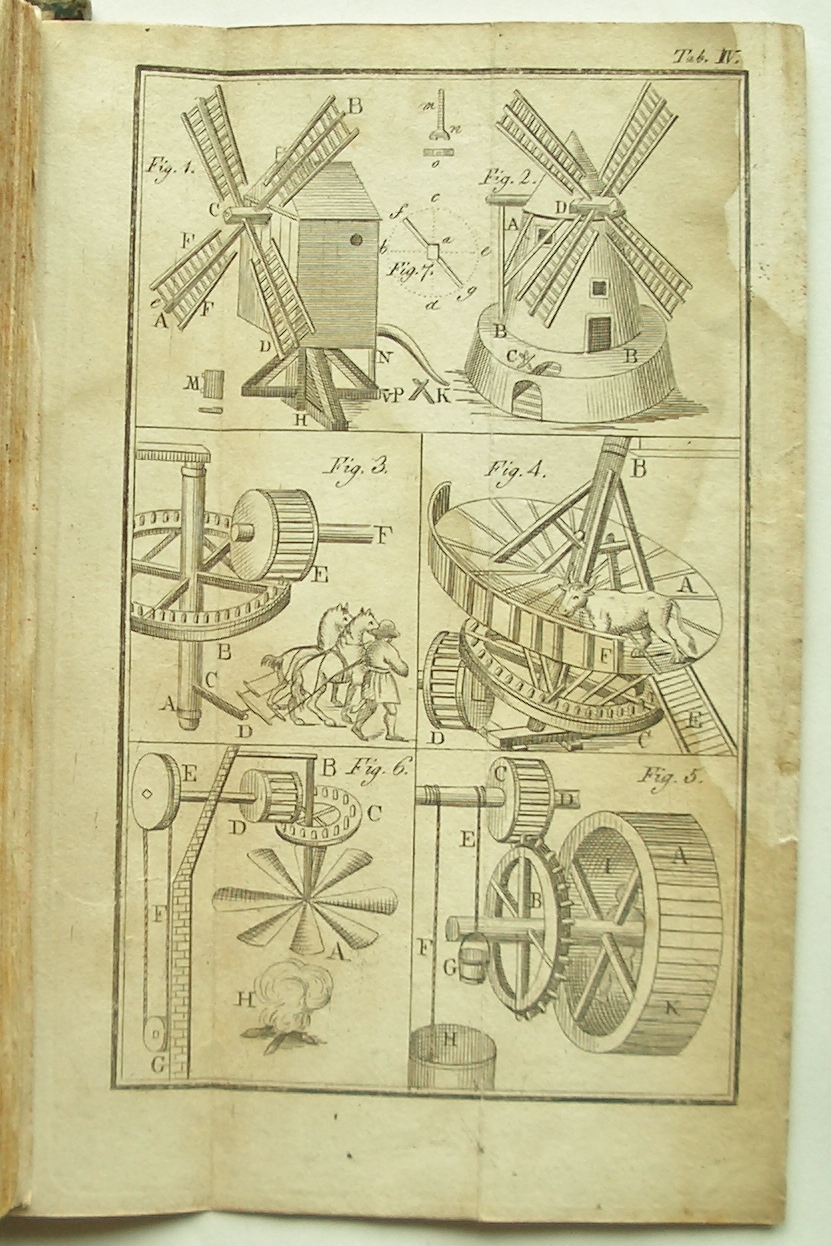
1788réf. 61826 Teile in 1 Band. Mit gest. Titel (in der Paginierung), 4 gefalt. Bl. mit Tabellen u. 15 gest. Tafeln auf 13 gefalt. Bl. Ohne Ort u. Jahr, [nach 1788]. 8vo. (17,0 x 10,1 cm). 24 S., Zwischenblatt, 64 S., 8 S., Zwischenblatt, 56, 16, 8 S. Blau marmorierter Pappband d. Zt.
réf. 5401Paris, M. Armengaud Aîné / MM. Ve A. Morel & Cie, 1875. In-4, demi-reliure, dos à 5 nerfs, figures et tableaux.
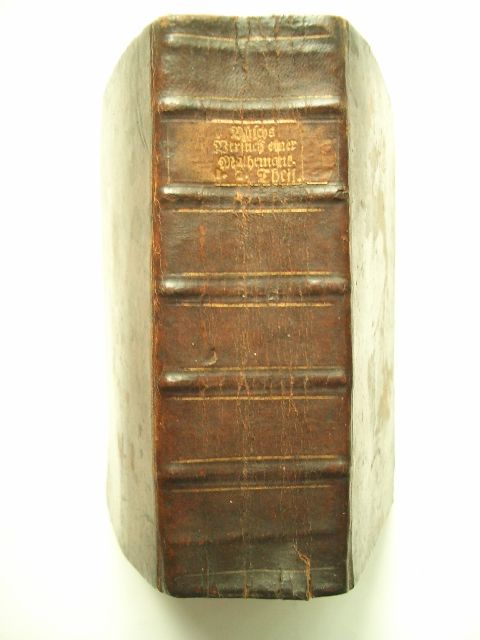
1791réf. 4383(Erster und) Zweiter Theil in 1 Band. Mit zus. 25 auffaltbaren gest. Tafeln. Hamburg, B. G. Hoffmann, 1790 u. 1791. 8vo. (18,3 x 11,0 cm). 1: VIII, 295; 344 S. 2: VIII, 464 S. Lederband d. Zt. mit Rückenschild.
1914réf. 111351914 percale bleu-marine éditeur (hard-back percale editor) petit in-quarto, titre frappé or sur le dos et le premier plat (gilt title on the spine and the front cover), percale décorée à froid sur les plats (blind-stamping percale on the cover), tranches lisses (edges smooth), illustrations : 55 planches (plates - tafeln) et 718 figures in texte (pictures in text - textfiguren), XXVII+577 pages, 1914 à Leipzig und Berlin Verlag von Wilhelm Engelmann,
réf. 100152145E.T.A.I in4. Sans date. Broché. 16 volume(s).
1950réf. 2482281950 in8. 1950. Broché.
1830réf. 6151Mit 1 gefalt. lithogr. Tafel. Paris, Anselin, successeur de Magimel, 1830. 8vo. (19,8 x 12,5 cm). VIII, 160 S. Marmorierter Halblederband d. Zt. mit etwas Rückenvergoldung.
1828P., Bachelier, 1828 pour le premier et 1826 pour les autres. Trois volumes in-8, reliés demi basane blond, dos à nerfs (reliure moderne) pour les deux premiers, et plein veau d'époque avec dos long orné pour le 3°, couvertures conservées pour les 2 premiers volumes ; VIII-2 pp-432 pp-15 planches, XV-509 pp-2 ff-13 planches, 6 pp-1 ff-516 pp-14 planches. Quelques rousseurs sur les toutes premières pages du troisième tome. Très bon papier pour les autres. Hauteur des deux premiers vol : 21 cm et du troisième : 20 cm. Le premier vol. est en deuxième édition, les autres en 1° édition.
1873In -8°, pp. 152; manca legatura.
18601 foglio sciolto , cm 50x36, che contiene la spiegazione di come regolare gli orologi pubblici in Toscana e a Firenze, con una Tavola del tempo medio a mezzodi vero per l’anno 1861.
1933réf. 1036791933 Année 1933 complète - 29e année - Dunod, Editeur - Revue bimensuelle illustrée - Fort in-folio, demi chagrin bordeaux; 4 nerfs, pièces de titre et d'année, et fleuron dorés au dos - Pagination non continue - Très nombreuses illustrations et reproductions photographiques en N&B - Année complète reliée avec les pages de publicités et les couvertures d'origine
1935réf. 1195721935 Année 1935 complète - 31e année - Dunod, Editeur - Revue bimensuelle illustrée - Fort in-folio, demi chagrin bordeaux; 4 nerfs, pièces de titre et d'année, et fleuron dorés au dos - Pagination non continue - Très nombreuses illustrations et reproductions photographiques en N&B - Année complète avec le Supplément à la livraison N° 1080, en fin de volume - Relié avec les pages de publicités et les couvertures d'origine, excepté le N° 1071 (10 août 1935)
1938réf. 1195761938 Année 1938 complète - 34e année - Dunod, Editeur - Revue bimensuelle illustrée - Fort in-folio, demi chagrin bordeaux; 4 nerfs, pièces de titre et d'année, et fleuron dorés au dos - Pagination non continue - Très nombreuses illustrations et reproductions photographiques en N&B - Année complète avec le Supplément à la livraison N° 1152, volant, en fin de volume - Relié avec les pages de publicités et les couvertures d'origine
1936réf. 1195871936 Année 1936 complète - 32e année - Dunod, Editeur - Revue bimensuelle illustrée - Fort in-folio, demi chagrin bordeaux; 4 nerfs, pièces de titre et d'année, et fleuron dorés au dos - Pagination non continue - Très nombreuses illustrations et reproductions photographiques en N&B - Année complète avec le Supplément à la livraison N° 1088 d'avril, volant - Relié avec les pages de publicités et les couvertures d'origine
1937réf. 1195881937 Année 1937 complète - 33e année - Dunod, Editeur - Revue bimensuelle illustrée - Fort in-folio, demi chagrin bordeaux; 4 nerfs, pièces de titre et d'année, et fleuron dorés au dos - Pagination non continue - Très nombreuses illustrations et reproductions photographiques en N&B - Année complète reliée avec les pages de publicités et les couvertures d'origine
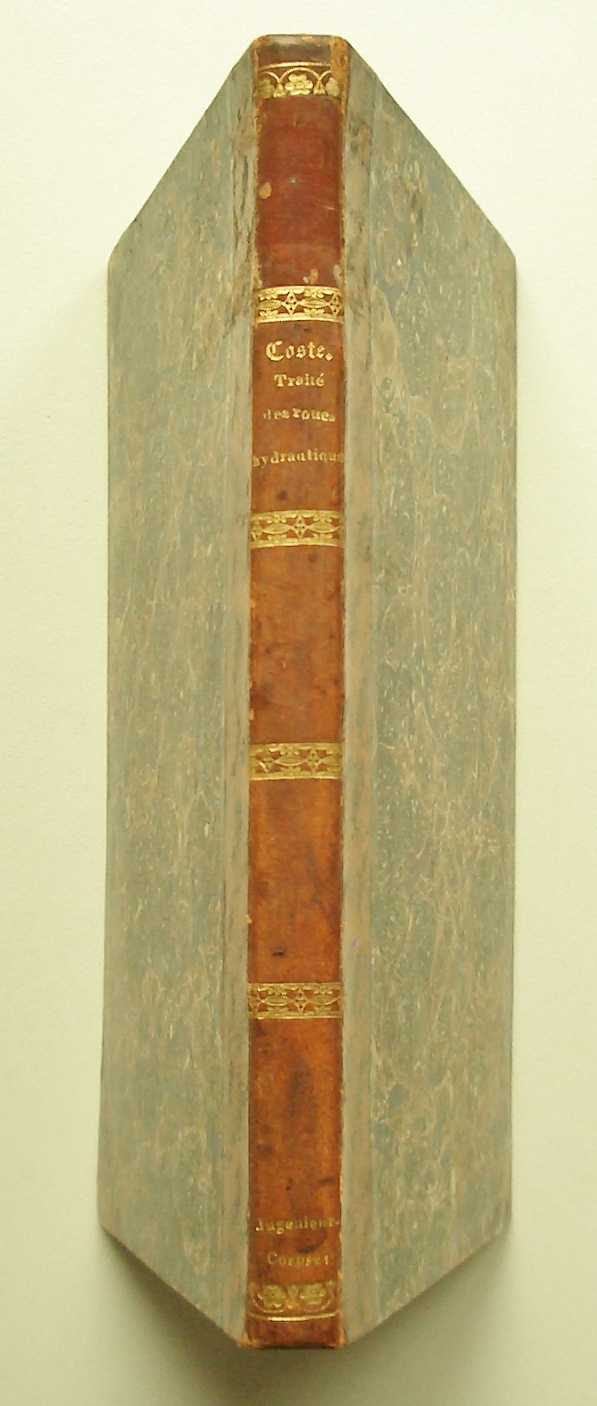
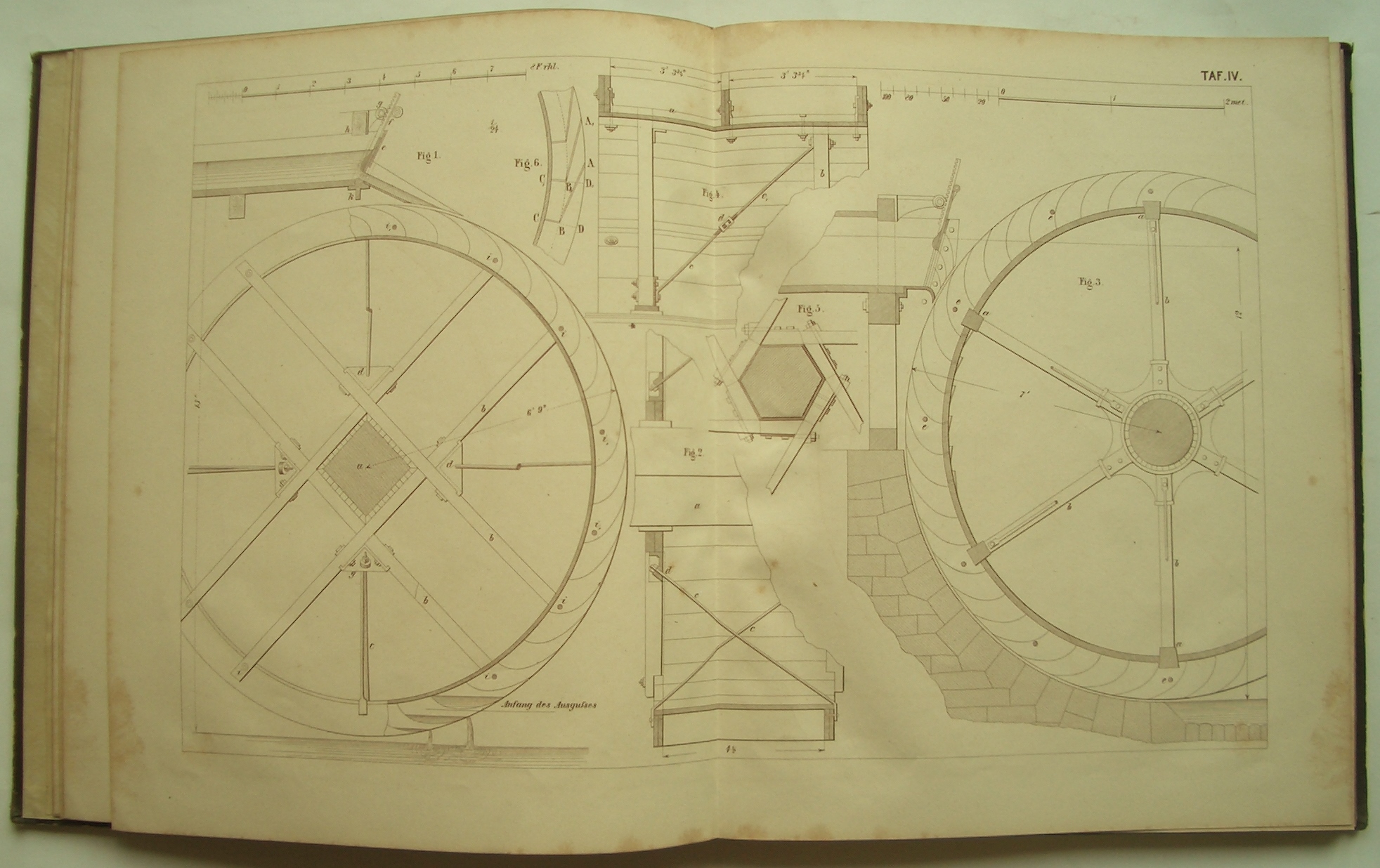
1868réf. 6047Bau und Anlage der wichtigsten vom Wasser getriebenen Maschinen, dargestellt durch Zeichnungen mit Beschreibung und Berechnung von Turbinen, Wasserrädern und Wassersäulenmaschinen. Mit Rücksicht auf Terrainverhältnisse für Fabriken, Mühlen, Berg- und Hüttenwerke. Nur: Atlas. Mit 26 doppelblattgr. lithogr. Tafeln. [Weimar, B. F. Voigt, 1868] 4to. (27,5 x 23,0 cm). 2 S. Inhalt. Bibl.-Halbleinwandband d. Zt. mit eingebundenem Orig.-Vorderumschlag als Titel.
1833696pp + 4 fldg plates + 782pp + 3 fldg plates VG/none 2nd edition, 2 vols, quarter vellum, covers rubbed, small owner stamps on endpapers and titles, traces of rubber erasure on title of vol 1 with minimal loss not affecting printing. Some foxing throughout but overall a very good set. Classic treatise on mechanics, Poisson's most famous work, in French. 2a edizione, 2 voll, quarto pergamena, copertine sciupate, piccoli timbri ex-proprietario alle sguardie e frontespizi, abrasione da cancellatura sul frontespizio del volume 1 con minima perdita non intaccante la stampa. Fioriture all'interno ma nel complesso in condizioni piu' che buone. Famoso trattato di meccanica di Poisson, in francese.
1884réf. 33031884 Paris, Gauthier-Villars, 1884. 2. édition. XX, 468 pages. In-4. Broché , non coupé , parfait etat photos sur demande
réf. 89211Gauthier-Villars, 1884, 467 p., demi-basane, environ 28x22cm, cuir de la reliure frotté, coins émoussés, un mors fendu mais structure solide, intérieur propre.
1949In-8°, XII, pp.404 (1), legatura in tela, prima edizione. Schiff era un fisico teorico che, dopo aver completato il dottorato, lavorò come ricercatore associato per due anni presso l'Università della California e il California Institute of Technology. Dal 1940 al 1945 fu membro della facoltà dell'Università della Pennsylvania. Dal 1945 al 1947, ha lavorato presso il Los Alamos Scientific Laboratory e si è unito alla facoltà di fisica presso la Stanford University nel 1947. Nel 1948, Schiff divenne uno dei direttori iniziali di Varian Associates che fornì supporto tecnico alla compagnia, insieme a Edward Ginzton, William Hansen e Marvin Chodorow. Alla fine del 1959 e del 1960 Schiff e il collega fisico George Pugh scrissero articoli che sostenevano l'uso di giroscopi orbitanti per testare la relatività generale. Schiff ha collaborato con i colleghi docenti di Stanford Bob Cannon e Bill Fairbank per condurre ricerche che hanno fornito parte della fondazione della Gravity Probe B (GP-B) per testare la teoria della relatività di Einstein. Fu il primo preside del Senato della Facoltà a Stanford. In-8°, XII, pp. 404 (1) cloth binding, first edition Schiff was a theoretical physicist who, after completing his doctorate, worked as a research associate for two years at the University of California and the California Institute of Technology. From 1940-1945 he was a faculty member at the University of Pennsylvania. From 1945-1947, he worked at Los Alamos Scientific Laboratory and joined the physics faculty at Stanford University in 1947. In 1948, Schiff became one of the initial directors of Varian Associates who provided technical support to the company, along with Edward Ginzton, William Hansen, and Marvin Chodorow. In the late 1959 and 1960 Schiff and fellow physicist George Pugh wrote papers which advocated using orbiting gyroscopes to test general relativity. Schiff teamed with fellow Stanford faculty Bob Cannon and Bill Fairbank to conduct research that provided part of the foundation for the Gravity Probe B (GP-B) to test Einstein's theory of relativity. He was the first chairman of the Faculty Senate at Stanford.
1906réf. W100209Louvain, Uytspruyt-Dieudonné 1906 Complet en 2 tomes, Tome I: 323pp + 36 planches dépliantes, Tome II: 303pp.+ 15pp. de tableaux + 20 planches dépliantes, 4e édition, 25cm., reliures cart. d'époque uniformes et en bon état (plats marbrés, dos en cuir avec titre doré), feuilles de garde marbrées, peu de rousseurs, bon état, W100209
1906Complet en 2 tomes, Tome I: 323pp + 36 planches dépliantes, Tome II: 303pp.+ 15pp. de tableaux + 20 planches dépliantes, 4e édition, 25cm., reliures cart. d'époque uniformes et en bon état (plats marbrés, dos en cuir avec titre doré), feuilles de garde marbrées, peu de rousseurs, bon état, W100209
1926réf. 47142Paris, Gauthier-Villars et Cie, 1926. 4to. Without wrappers. In: ""Comptes Rendus Hebdomadaires des Séances de L'Academie des Sciences"", Tome 183, No 1. Pp. (5-) 100. (Entire issue offered). Brillouin's paper: pp. 24-26.
1926réf. 47142Paris Gauthier-Villars et Cie 1926. 4to. Without wrappers. In: "Comptes Rendus Hebdomadaires des Séances de L'Academie des Sciences" Tome 183 No 1. Pp. 5- 100. Entire issue offered. Brillouin's paper: pp. 24-26. First appearance of Brillouin's importent paper in which he introduced the WKB-method in quantum Mechanics."In 1925 Brillouin was the only French theoretician to react competently to Werner Heisenberg’s new matrix mechanics. In two papers published in 1926 he contributed to the exploration of the mathematical content of Heisenberg’s theory. Brillouin’s first contribution in this field was important the paper offered. Through a new method of semiclassical approximation he discovered the relation between Schrodinger’s mechanics and the quantum theory of Niels Bohr and Sommerfeld. Presumably inspired by de Broglie’s early analogies between mechanics and optics he found this approximation as the quantum mechanical countet of the approximation. In this procedure stationary solutions of the Schrödinger equation are sought in the form eiS/h as in the eikonal approximation of optics. In the first approximation h small S must be a solution of the Hamilton-Jacobi equation of classical mechanics and the Bohr-Sommerfeld conditions S = 2pnh on a closed trajectory must be satisfied for the W function to be defined and singlevalued in all space. Subsequent corrections are proportional to successive powers of h. They intermix the various Bohr trajectories. thereby reintroducing the complex interplay of quantum states found in matrix mechanics This method published by Brillouin in July 1926 - anticipated by Harold Jeffreys in 1923 in a purely mathematical context reinvented by Gregor Wentzel in September 1926. and perfected by Hendrik Kramers in November 1926 - is now called the J BWK method and is widely used in many quantum mechanical problems."DSB.See also Max Jammer "The Conceptual development of Quantum Mechanics" pp. 277 ff. unknown
réf. DADAX0072380411New unknown