Buchanan, RobertsonAntiquariat.de
3 236 résultats
1808réf. 5856With numerous figures. Revised by Peter Nicholson, architect. Mit zahlr. Holzschnitten im Text u. 2 (1 gest.) gefalt. Tabellen. London, Printed by and for William Savage, 1808. Kl.-4to. (20,1 x 12,6 cm). 2 Bl., II S. "Contents of essay I.", (V)-IX, (11)-184 S. Blauer Pappband d. Zt. mit rotem Rückenschild.
réf. ORD-2947Suite de la Mesure des Surfaces et des Solides. Paris. Jombert. 1741. In-4 (205 x 262mm) pleine basane brune, dos à 5 nerfs orné, pièce de titre maroquin brun, tranches rougies, gardes peignées (reliure de l'époque), 4ff.n.ch., XXXIV, (II), 632 pages, bien complet des gravures et des planches. Coiffes lgt émoussées, rousseurs éparses mais bon exemplaire.
réf. 97587A Lyon, chez David Forey, Libraire ruë Merciere proche la mort qui Trompe, 1719, 1 in-4 de 255x190 mm environ, (14) ff. (titre en rouge et noir, epitre, préface, table, approbation), 101 pages, (5) ff. (table, avis au relieur, errata), pleine reliure d'époque en basane brune, dos à 5 nerfs portant titres dorés sur pièce de titre en maroquin bordeaux, orné de caissons motifs dorés, coupes dorées, tranches rouges, gardes marbrées. Complet des 85 planches : dont titre imprimé en deux couleurs, bandeau et belle lettrine, en tête de l'Epître au Duc d'Orléans, erreur de numérotation dans les planches justifiée dans le texte en regard (Quoiqu'il n'y ait point de planches 39, 48 et 76, il ne manque rien, & les figures ne laissent pas de suivre dans leur ordre). Cette méprise vient du Graveur qui a mis le nombre 40, 49, et 77, immédiatement après le 38, 47 et 75). Edition originale. Quelques épidermures et petites taches sur le cuir, frottements légers, sinon bon état.
1745In -folio, pp. (16), 204, 12 grandi tavole di cui una doppia; cartonato coevo. Si tratta della seconda edizione aumentata, con un bell’obelisco inciso all’antiporta. In –folio, 12 big plates of mechanics (one is double), this is the second edition (increased), with a beautiful obelisk engraved on frontispiece, contemporary boards.
réf. 57701Providence: January 30 1837. 4to approx. 10" x 8 5 leaves of ruled stationery with manuscript in ink on rectos only in a neat secretarial hand bound with blue silk ribbon; previous folds very light staining otherwise near fine. Interesting chapter in the historical evolution of the Providence school system. The Providence Association of Mechanics and Manufacturers was politically involved in city affairs as early as 1799 when "the want of a better system of school instruction being deeply felt by the members a memorial was prepared and presented to the General Assembly urging the establishment of free schools throughout the State and reminding that body that liberty and security under a republican form of government depend on a general diffusion of knowledge amoug the people" A History of Public Education in Rhode Island: from 1636 to 1876 byThomas B. Stockwell 1876 In 1837 the association under President George Baker and Samuel Tingley Jr. Secretary whose names appear on page four presented the petition: "Your memorialists have been struck with one fact . that the instruction of youth in the public schools is a heavy tax upon the middling classes without an adequate return as they do not participate in the benefit of this public instruction. This argument which is evidently weighty in the present condition of these schools would be destroyed if they were raised to the condition desired by your memorialists. "Why is it that the middling classes do not become participants in this instruction There is evidently but one reason. They perceive that the crowded state of the schools alone would prevent proper attention to the pupil; and they are aware that with the small sum which the instructors receive it is difficult to procure and retain the services of competent persons to fill the station. But let the schools be made so numerous that the scholars may receive as much attention as they do in the private schools and let the salaries be so large as to induce men of equal ability to take charge of them and that which is now considered as a tax would then be viewed as an alleviation of one of the heaviest burdens put upon the middling classes. "Your honorable body have no doubt . perceived how far we are behind our neighboring cities in this particular. Whilst they are constantly aiming at perfection in their free school system we have been at a stand or retrograding . To remedy the defect in our present system your memorialists would suggest that a grade of schools be established between the primary and writing schools for reading writing and arithmetic only the design of which is to give a thorough instruction in these branches to those children whose parents need their services at as early an age as twelve or thirteen years and who under the present arrangement are compelled to leave school with a very superficial knowledge of those branches which are so necessary for obtaining a livelihood in any business . To effect an essential reform in our public school system great expense must necessarily be incurred; and your memorialists who represent a large portion of the heads of families of the city would meet this increased expense with hearty encouragement." The document is signed "George Baker President. Samuel Tingley Jr. Secretary." Page 5 is entitled "Resolutions" and includes a list of seven statements relative to the Association's petition beginning with "Resolved that no subject can be of more importance to the inhabitants of this city than the education of the rising generation" and that "the members of this association were the pioneers in the establishment of the Public Schools." "This petition or memorial was referred to a committee who subsequently reported a plan for the improvement of the schools; but the provisions of it were deemed unsatisfactory. A second plan was presented comprising twelve primary eight intermediate and four upper schools. With these modifications the bill was returned to the common council who refused to concur. After frequent meetings and protracted debates with no unity the board of aldermen devised a plan embracing ten primary schools six intermediate schools two upper schools and two schools for colored children. This when presented to the common council was voted down by a large majority and without any final decision the municipal year closed. The feeling on the school question was now stronger than ever" Stockwell. January 30, 1837 unknown
réf. 57701Providence: January 30 1837. 4to approx. 10" x 8 5 leaves of ruled stationery with manuscript in ink on rectos only in a neat secretarial hand bound with blue silk ribbon; previous folds very light staining otherwise near fine. Interesting chapter in the historical evolution of the Providence school system. The Providence Association of Mechanics and Manufacturers was politically involved in city affairs as early as 1799 when "the want of a better system of school instruction being deeply felt by the members a memorial was prepared and presented to the General Assembly urging the establishment of free schools throughout the State and reminding that body that liberty and security under a republican form of government depend on a general diffusion of knowledge amoug the people" A History of Public Education in Rhode Island: from 1636 to 1876 byThomas B. Stockwell 1876 In 1837 the association under President George Baker and Samuel Tingley Jr. Secretary whose names appear on page four presented the petition: "Your memorialists have been struck with one fact . that the instruction of youth in the public schools is a heavy tax upon the middling classes without an adequate return as they do not participate in the benefit of this public instruction. This argument which is evidently weighty in the present condition of these schools would be destroyed if they were raised to the condition desired by your memorialists. "Why is it that the middling classes do not become participants in this instruction There is evidently but one reason. They perceive that the crowded state of the schools alone would prevent proper attention to the pupil; and they are aware that with the small sum which the instructors receive it is difficult to procure and retain the services of competent persons to fill the station. But let the schools be made so numerous that the scholars may receive as much attention as they do in the private schools and let the salaries be so large as to induce men of equal ability to take charge of them and that which is now considered as a tax would then be viewed as an alleviation of one of the heaviest burdens put upon the middling classes. "Your honorable body have no doubt . perceived how far we are behind our neighboring cities in this particular. Whilst they are constantly aiming at perfection in their free school system we have been at a stand or retrograding . To remedy the defect in our present system your memorialists would suggest that a grade of schools be established between the primary and writing schools for reading writing and arithmetic only the design of which is to give a thorough instruction in these branches to those children whose parents need their services at as early an age as twelve or thirteen years and who under the present arrangement are compelled to leave school with a very superficial knowledge of those branches which are so necessary for obtaining a livelihood in any business . To effect an essential reform in our public school system great expense must necessarily be incurred; and your memorialists who represent a large portion of the heads of families of the city would meet this increased expense with hearty encouragement." The document is signed "George Baker President. Samuel Tingley Jr. Secretary." Page 5 is entitled "Resolutions" and includes a list of seven statements relative to the Association's petition beginning with "Resolved that no subject can be of more importance to the inhabitants of this city than the education of the rising generation" and that "the members of this association were the pioneers in the establishment of the Public Schools." "This petition or memorial was referred to a committee who subsequently reported a plan for the improvement of the schools; but the provisions of it were deemed unsatisfactory. A second plan was presented comprising twelve primary eight intermediate and four upper schools. With these modifications the bill was returned to the common council who refused to concur. After frequent meetings and protracted debates with no unity the board of aldermen devised a plan embracing ten primary schools six intermediate schools two upper schools and two schools for colored children. This when presented to the common council was voted down by a large majority and without any final decision the municipal year closed. The feeling on the school question was now stronger than ever" Stockwell. January 30, 1837 unknown books
1786P., Mérigot, Didot, 1786. 2 volumes in-4 (18 x 24 cm), reliure pastiche demi-basane, dos long orné, p. de t.-LIV-1 f.- 477 pp.ch.-5 ff..-19 planches dépliantes pour le premier volume ; p. de fx-t.-p;de t.-VIII- 451 pp.- 19 planches dépliantes num. (20-38) pour le second volume. Seconde édition (la première est de 1763). Le texte "Eclaircissements..."est publié par P., Muselier, 1773. VIII-164 pp. Rousseurs, restauration complète du dos de la reliure avec les plats d'origine conservés, salissures. Orné de 38 planches gravées par Choffard d'après Goussier exposant toutes sortes de montres, horloges, pièces, mécanismes, engrenages, etc. Peu courante réunion des 2 textes (les "Eclaircissemens" constituent une justification de l'ancienneté et de la paternité du travail de Berthoud sur la longitude en mer). Né à Neuchâtel, Ferdinand Berthoud (1727-1807) devint en France horloger du roi et de la Marine, avant d'être reçu à l'Académie des Sciences en 1795. Il est l'inventeur de l'horloge marine permettant de connaître la longitude en mer.
réf. Z1-V-027-01568Kessinger Publishing. Used - Like New. Used - Like New. Book is new and unread but may have minor shelf wear. Ships from UK in 48 hours or less usually same day. Your purchase helps support Sri Lankan Children's Charity 'The Rainbow Centre'. 100% money back guarantee. We are a world class secondhand bookstore based in Hertfordshire United Kingdom and specialize in high quality textbooks across an enormous variety of subjects. We aim to provide a vast range of textbooks rare and collectible books at a great price. Our donations to The Rainbow Centre have helped provide an education and a safe haven to hundreds of children who live in appalling conditions. We provide a 100% money back guarantee and are dedicated to providing our customers with the highest standards of service in the bookselling industry. Kessinger Publishing unknown
réf. SONG1259169928Used: Good unknown
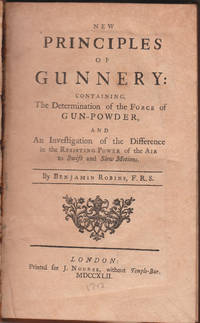
1742réf. 5471London: J Nourse 1742. First Edition. Full contemp. calf. Very good; front endpaper excised; one leaf loose; some light toning. 8vo. There is one fldg. plate and text illus. . The book that founded a new science.Contemporaries felt Robins was '. in gunnery what immortal Newton was in philosophy .' This obscure British mathematician and engineer invented new instruments undertook original field trials and experiments with high velocity projectiles and made the first observations on the sound barrier. He conducted theoretical and thermodynamic analysis of interior ballistics discovered the Magnus Robins effect of fluid mechanics and established a rational explanation for the rifling phenomenon. He is also responsible for resolving the crucial and complex function of air-resistance force encountered by high speed projectiles and thereby illustrated the inadequacy of Galileo's projectile theory and the oversimplification of Newton and Huyghens' air resistance theory of projectile motion. A direct result of these experiments is that he has come to be recognized as one of the founders of modern aerodynamics. It is impossible to overstate the importance of this book to the scientific study of ballistics and the development of fluid mechanics. A landmark in the literature of mechanics. See Roberts citing only a later edition; Steele Muskets and Pendulums. J Nourse unknown books
1845réf. 59278Kington Herefordshire: Charles Humphreys . 1845. Hardcover. Very Good. Vii 303pp sl foxng to prelims bound in red cloth new endpapers The first history of this small market town in Herefordshire it also has the distinction of containing the first published work of famous naturalist Alfred Russell Wallace ' An Essay on the Best Way of Conducting the Kington Mechanics' Institution. Wallace was born in 1823 and wrote this article in 1840 and was at the time a member of the Mechanics Institute as was Richard Parry the author. ; Octavo . Charles Humphreys hardcover
1845réf. 051667Kington Herefordshire: Charles Humphreys . Very Good with no dust jacket. Hardcover. vii 303pp folding pedigree which has a repair recently rebound in half brown leather/marbled boards gilt bands and lettering to spine. The first history of this small market town in Herefordshire it also has the distinction of containing the first published work of famous naturalist Alfred Russell Wallace ' An Essay on the Best Way of Conducting the Kington Mechanics' Institution. Wallace was born in 1823 and wrote this article in 1840 and was at the time a member of the Mechanics Institute as was Richard Parry the author.; Octavo . 1845. Charles Humphreys hardcover
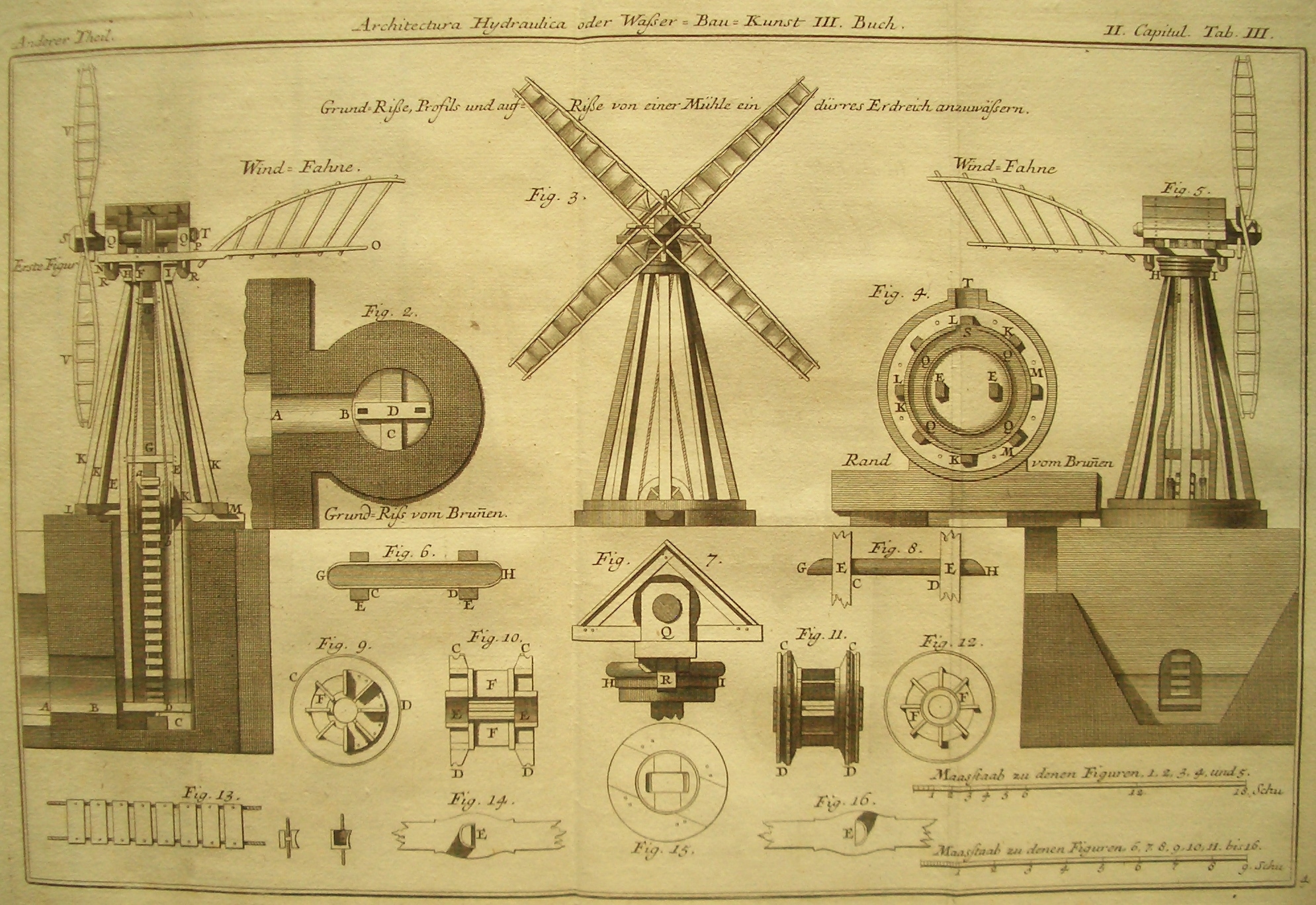
1771réf. 6180Oder: Die Kunst, Das Gewässer Zu denen verschiedentlichen Nothwendigkeiten des menschlichen Lebens zu leiten, in die Höhe zu bringen, und vortheilhafftig anzuwenden ... Aus dem Frantzösischen ins Teutsche übersetzet. 2 Teile mit 22 (statt 24) Lieferungen in 4 Bänden. Mit 6 gest. Kopfvignetten u. 203 (statt 219) meist gefalt. gest. Tafeln. Augsburg, J. G. Mertz u. E. Klett, Witwe, 1740-1771. Folio (ca. 33-35 x 21,5-22,5 cm). Etwa 1220 S. 2 Lederbände d. Zt. u. 2 neue Lederbände im Stil d. Zt. alle mit reicher Rückenvergoldung.
1971réf. 18601971 Stuttgart, Belser-Presse, 1971. 39,5 x 30 cm, in-folio, 79 pp. - 3 lithographies en couleurs hors texte, cartonnage et étui de l'éditeur en pleine toile bise, pièces de titre.
1800réf. 57912 Bände. Mit 12 gefalt. gest. Tafeln. Leipzig, Sommer, 1799-1800. 8vo. (20,5 x 12,0 cm). 1: XX, 412 S. 2: Titel, 530 S. Pappbände d. Zt. mit rotem Rückenschild. [4 Warenabbildungen]
réf. DADAX0080291406New unknown
réf. 17762Urbin, s.n. 1575. Petit in-4; [2]-0 ff., basane mouchetée brune postérieure, dos à nerfs orné de caissons et fleurons dorés, tranches mouchetées, (épidermures, petits manques, taches, ex-libris gratté au titre avec petit manque, galeries de ver marginales, quelques petites rousseurs et taches).
1878réf. 215461878. EngineeringPhysics Three manuscript volumes 1878-1879 compiled in Germany notes on nineteenth-century study of applied physics mechanics thermodynamics and fluid engineering at a moment when the German states were consolidating their position as leaders in industrial science and technical education. Produced during the height of Imperial Germany's expansion of polytechnic institutes and research universities these notebooks reflect the rigorous mathematical formalism and applied design training that undergirded the nation's rapid industrialization. The systematic integration of theoretical mechanics with detailed machine drawings situates the work within the educational culture that supported advances in steam power turbine development and precision engineering in the decades following unification in 1871. As working instructional volumes they provide primary evidence of how Newtonian mechanics thermodynamic principles and mechanical design were taught to engineers in the late nineteenth century. Three handwritten volumes titled "I. Band" "II. Band" and continuation volume. Germany 1878-1879. The first volume opens with "Allgemeine Mechanik" outlining foundational principles including "Zusammensetzung und Zerlegung der Kräfte" and a carefully drafted "Parallelogramm der Kräfte" accompanied by geometric constructions and vector decompositions central to applied statics. Subsequent sections demonstrate lever calculations and force polygons rendered with precision technical drafting. The second volume advances into applied mechanics addressing "elastische Körper" rotational dynamics and "Zentripetalkraft" with formula derivations and diagrams of circular motion. Detailed gear assemblies and meshing systems indicate practical engagement with machine design while a section devoted to "Schmidt'scher Wassermotor" includes a sectional rendering of a turbine mechanism. The third volume transitions to thermodynamic systems including extended treatment of heat exchangers "Caloriferes" and a large fold-out "Schieberdiagramm für variable Expansion" attributed to G. Huber illustrating valve timing in steam engines through radial plotting. A further fold-out cross-section of a high-pressure steam engine demonstrates piston-cylinder interaction and valve actuation accompanied by efficiency calculations and pressure analyses. The presence of fold-out engineering plates systematic red and black ink notation and sequential theoretical development strongly suggests production within a university or technical institute environment. Three volumes. Extensive manuscript text with numerous diagrams and multiple fold-out plates. Original marbled paper boards with manuscript title labels. Bindings intact; minor hinge wear; spine cracking on one volume; pages clean and bright; fold-outs crisp with slight fraying at some edges. Overall very good. As a comprehensive and internally coherent set of engineering study notebooks from the period when German technical education shaped global industrial practice these volumes offer substantive insight into the pedagogical transmission of classical mechanics and steam engineering at a formative moment in modern industrial history. unknown
1878réf. 215461878. EngineeringPhysics Three manuscript volumes 1878-1879 compiled in Germany notes on nineteenth-century study of applied physics mechanics thermodynamics and fluid engineering at a moment when the German states were consolidating their position as leaders in industrial science and technical education. Produced during the height of Imperial Germany's expansion of polytechnic institutes and research universities these notebooks reflect the rigorous mathematical formalism and applied design training that undergirded the nation's rapid industrialization. The systematic integration of theoretical mechanics with detailed machine drawings situates the work within the educational culture that supported advances in steam power turbine development and precision engineering in the decades following unification in 1871. As working instructional volumes they provide primary evidence of how Newtonian mechanics thermodynamic principles and mechanical design were taught to engineers in the late nineteenth century. Three handwritten volumes titled "I. Band" "II. Band" and continuation volume. Germany 1878-1879. The first volume opens with "Allgemeine Mechanik" outlining foundational principles including "Zusammensetzung und Zerlegung der Kräfte" and a carefully drafted "Parallelogramm der Kräfte" accompanied by geometric constructions and vector decompositions central to applied statics. Subsequent sections demonstrate lever calculations and force polygons rendered with precision technical drafting. The second volume advances into applied mechanics addressing "elastische Körper" rotational dynamics and "Zentripetalkraft" with formula derivations and diagrams of circular motion. Detailed gear assemblies and meshing systems indicate practical engagement with machine design while a section devoted to "Schmidt'scher Wassermotor" includes a sectional rendering of a turbine mechanism. The third volume transitions to thermodynamic systems including extended treatment of heat exchangers "Caloriferes" and a large fold-out "Schieberdiagramm für variable Expansion" attributed to G. Huber illustrating valve timing in steam engines through radial plotting. A further fold-out cross-section of a high-pressure steam engine demonstrates piston-cylinder interaction and valve actuation accompanied by efficiency calculations and pressure analyses. The presence of fold-out engineering plates systematic red and black ink notation and sequential theoretical development strongly suggests production within a university or technical institute environment. Three volumes. Extensive manuscript text with numerous diagrams and multiple fold-out plates. Original marbled paper boards with manuscript title labels. Bindings intact; minor hinge wear; spine cracking on one volume; pages clean and bright; fold-outs crisp with slight fraying at some edges. Overall very good. As a comprehensive and internally coherent set of engineering study notebooks from the period when German technical education shaped global industrial practice these volumes offer substantive insight into the pedagogical transmission of classical mechanics and steam engineering at a formative moment in modern industrial history. unknown books
réf. SONG3540441603Used: Good unknown
réf. Z1-A-010-03936Elsevier Science Ltd. Used - Good. Ships from UK in 48 hours or less usually same day. Your purchase helps support Sri Lankan Children's Charity 'The Rainbow Centre'. Ex-library so some stamps and wear but in good overall condition. 100% money back guarantee. We are a world class secondhand bookstore based in Hertfordshire United Kingdom and specialize in high quality textbooks across an enormous variety of subjects. We aim to provide a vast range of textbooks rare and collectible books at a great price. Our donations to The Rainbow Centre have helped provide an education and a safe haven to hundreds of children who live in appalling conditions. We provide a 100% money back guarantee and are dedicated to providing our customers with the highest standards of service in the bookselling industry. Elsevier Science Ltd unknown
1615In -4°; mezza pergamena; cc. (4) + 104 + cb. Numerose illustrazioni nel testo. Frontespizio rifoderato con fori marginali di tarlo che si estendono alle prime quattro pagine (non incidono sul testo, così come gli strappetti sugli angoli); le prime pagine piuttosto abrase. Il pesarese Guidobaldo Del Monte (1545-1607), matematico, scienziato e astronomo, fu tra i più importanti sostenitori di Galileo: proprio grazie a Dal Monte, che lo segnalò al proprio fratello Cardinale, Galilei ottenne nel ’29 la cattedra universitaria di matematica all’Università di Pisa. La prima edizione di questo trattato di meccanica del 1577 fu considerata il più importante trattato di statica dai tempi dell’antica Grecia. Restored title, marginally damaged by bookworms, as like the first six pages (text is not touched); first pages are not very fresh. Many illustrations framed in the text. Dal Monte (1545-1607) was a big supporter of Galileo; thanks to Dal Monte, who recommended him to his brother (a Cardinal), Galilei obtained it’s first academic chair at Pisa university. The first edition of this work, in 1577, was considered the most important dissertation on statics, since ancient Greeks.
1735réf. 6197... Ausgefertiget und zusammen getragen von Johann Matthias Beyer und Consorten. 2 Teile in 1 Band. Mit gest. Kopfvign. u. 43 ausfaltbaren gest. Tafeln. Leipzig, W. Deer, 1735. Folio (38,0 x 25,0 cm). (16), 125, (7) S.; (12), 206 (recte 204), 49, (3) S. Neuer Lederband mit blindgeprägtem Rücken.
1680réf. 44489Paris, Jean Baptiste Coignard, 1680-1688. 4 vol. in-12 de (24)-351 pp. 2 planches hors texte ; (16)-402 pp., 8 planches hors texte ; (12)-360 pp., 20 planches hors texte ; (16)-438-(2) pp. 2 planches dans le texte, veau brun granité, dos orné à nerfs, tranches mouchetées (reliure de l'époque).
1657In-4°, (10cc), 46pp, 1carta ripiegata; 38pp, 4 carte di tavola, due ripiegate; 55pp, due carte di tavv, 16pp, 12pp, una carta ripiegata; 56pp, una carta ripiegata; 16pp, una carta ripiegata. Prima edizione, buone condizioni, legatura in pergamena con titolo manoscritto al dorso. La prima prefazione è di Dilherr, la seconda dell’autore. Poggendorff, II, col. 1133; Houzeau & Lancaster. Astronomie (1964 ed.), 9322, NUC pre-1956, NT In-4° (10cc), 46pp, 1 folded table; 38pp, 4 tables, two folded; 55pp, two folded tables; (2), 16pp, 12pp, one folded table; 56pp, one folded table; 16pp, one folded table. First edition, good copy, contemporary vellum binding, manuscript title at the spine. The first preface is by Dilherr, the second by the author The initial foreword is by Dilherr, the second one by the author. Poggendorff, II, col. 1133; Houzeau & Lancaster. Astronomie (1964 ed.), 9322, NUC pre-1956, NT"