3 691 résultats
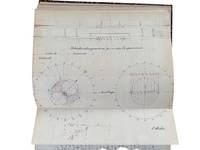
1878réf. 215461878. EngineeringPhysics Three manuscript volumes 1878-1879 compiled in Germany notes on nineteenth-century study of applied physics mechanics thermodynamics and fluid engineering at a moment when the German states were consolidating their position as leaders in industrial science and technical education. Produced during the height of Imperial Germany's expansion of polytechnic institutes and research universities these notebooks reflect the rigorous mathematical formalism and applied design training that undergirded the nation's rapid industrialization. The systematic integration of theoretical mechanics with detailed machine drawings situates the work within the educational culture that supported advances in steam power turbine development and precision engineering in the decades following unification in 1871. As working instructional volumes they provide primary evidence of how Newtonian mechanics thermodynamic principles and mechanical design were taught to engineers in the late nineteenth century. Three handwritten volumes titled "I. Band" "II. Band" and continuation volume. Germany 1878-1879. The first volume opens with "Allgemeine Mechanik" outlining foundational principles including "Zusammensetzung und Zerlegung der Kräfte" and a carefully drafted "Parallelogramm der Kräfte" accompanied by geometric constructions and vector decompositions central to applied statics. Subsequent sections demonstrate lever calculations and force polygons rendered with precision technical drafting. The second volume advances into applied mechanics addressing "elastische Körper" rotational dynamics and "Zentripetalkraft" with formula derivations and diagrams of circular motion. Detailed gear assemblies and meshing systems indicate practical engagement with machine design while a section devoted to "Schmidt'scher Wassermotor" includes a sectional rendering of a turbine mechanism. The third volume transitions to thermodynamic systems including extended treatment of heat exchangers "Caloriferes" and a large fold-out "Schieberdiagramm für variable Expansion" attributed to G. Huber illustrating valve timing in steam engines through radial plotting. A further fold-out cross-section of a high-pressure steam engine demonstrates piston-cylinder interaction and valve actuation accompanied by efficiency calculations and pressure analyses. The presence of fold-out engineering plates systematic red and black ink notation and sequential theoretical development strongly suggests production within a university or technical institute environment. Three volumes. Extensive manuscript text with numerous diagrams and multiple fold-out plates. Original marbled paper boards with manuscript title labels. Bindings intact; minor hinge wear; spine cracking on one volume; pages clean and bright; fold-outs crisp with slight fraying at some edges. Overall very good. As a comprehensive and internally coherent set of engineering study notebooks from the period when German technical education shaped global industrial practice these volumes offer substantive insight into the pedagogical transmission of classical mechanics and steam engineering at a formative moment in modern industrial history. unknown books
1878réf. 215461878. EngineeringPhysics Three manuscript volumes 1878-1879 compiled in Germany notes on nineteenth-century study of applied physics mechanics thermodynamics and fluid engineering at a moment when the German states were consolidating their position as leaders in industrial science and technical education. Produced during the height of Imperial Germany's expansion of polytechnic institutes and research universities these notebooks reflect the rigorous mathematical formalism and applied design training that undergirded the nation's rapid industrialization. The systematic integration of theoretical mechanics with detailed machine drawings situates the work within the educational culture that supported advances in steam power turbine development and precision engineering in the decades following unification in 1871. As working instructional volumes they provide primary evidence of how Newtonian mechanics thermodynamic principles and mechanical design were taught to engineers in the late nineteenth century. Three handwritten volumes titled "I. Band" "II. Band" and continuation volume. Germany 1878-1879. The first volume opens with "Allgemeine Mechanik" outlining foundational principles including "Zusammensetzung und Zerlegung der Kräfte" and a carefully drafted "Parallelogramm der Kräfte" accompanied by geometric constructions and vector decompositions central to applied statics. Subsequent sections demonstrate lever calculations and force polygons rendered with precision technical drafting. The second volume advances into applied mechanics addressing "elastische Körper" rotational dynamics and "Zentripetalkraft" with formula derivations and diagrams of circular motion. Detailed gear assemblies and meshing systems indicate practical engagement with machine design while a section devoted to "Schmidt'scher Wassermotor" includes a sectional rendering of a turbine mechanism. The third volume transitions to thermodynamic systems including extended treatment of heat exchangers "Caloriferes" and a large fold-out "Schieberdiagramm für variable Expansion" attributed to G. Huber illustrating valve timing in steam engines through radial plotting. A further fold-out cross-section of a high-pressure steam engine demonstrates piston-cylinder interaction and valve actuation accompanied by efficiency calculations and pressure analyses. The presence of fold-out engineering plates systematic red and black ink notation and sequential theoretical development strongly suggests production within a university or technical institute environment. Three volumes. Extensive manuscript text with numerous diagrams and multiple fold-out plates. Original marbled paper boards with manuscript title labels. Bindings intact; minor hinge wear; spine cracking on one volume; pages clean and bright; fold-outs crisp with slight fraying at some edges. Overall very good. As a comprehensive and internally coherent set of engineering study notebooks from the period when German technical education shaped global industrial practice these volumes offer substantive insight into the pedagogical transmission of classical mechanics and steam engineering at a formative moment in modern industrial history. unknown
réf. DADAX0131721518New unknown
réf. DADAX0412341409New unknown
réf. SONG0131721518Used: Good unknown
réf. DADAX0548810494New unknown
réf. SONG9048168686Used: Good unknown
réf. DADAX9048168686New unknown
réf. SONG084932551XUsed: Good unknown
réf. DADAX0071800042New unknown
réf. DADAX0131146807New unknown
réf. SONG0070324921Used: Good unknown
réf. DADAX0071828699New unknown
réf. DADAX0824758315New unknown
réf. SONG0071472177Used: Good unknown
réf. DADAX1498766978New unknown
réf. DADAX0367026430New unknown
réf. DADAX0306400405New unknown
réf. SONG9024729580Used: Good unknown
réf. SONG0871701367Used: Good unknown
1941Paris, Gauthier Villars 1941. 3 forts volumes in-8 brochés de 635 + 574 + 674 pages. Nombreuses figures. Tome 1 : Statique, dynamique du point. Tome 2 : Dynamique des sytèmes, mécanique analytique. Tome 3 : Equilibre et mouvement des milieux continus. Collection Cours de mécanique de la faculté des sciences. Déchirure sans manque sur le haut du tome 2, sinon bel exemplaire.
1921With charts and illustrations. 230X145 mm. 530 pages. Soft cover. Cover yellowing. Cover corners and edges worn. Stamp on back cover. Spine yellowing and worn. Text block edges age stained. Pages yellowing. Else in good condition.
réf. 96575Paris, Gauthier-Villars 1912, 220x145mm, 527pages, reliure demi-chagrin à coins. Titre et auteur dorés au dos. Plats papier marbré. Etiquette de cotation sur le bas du dos. Reliure plastifiée. Cachet de bibliothèque sur page de titre, autrement bel exemplaire.
réf. 650P., Gauthier-Villars, 1930 ; in-16, broché, non coupé.
réf. 39422Paris, Gauthier-Villars 1910, 250x155mm, 729pages, reliure demi-basane. Auteur, titre et décoration dorés au dos. Plats papier marbré. Cachet de bibliothèque sur la page de titre. Coiffe et charnières frottées. Intérieur en très bon état.

