Press, Popular MechanicsBiblio.com

3 045 résultats
réf. 1016335369.Ghardcover. Good. Access codes and supplements are not guaranteed with used items. May be an ex-library book. hardcover
réf. 1016340141.Gpaperback. Good. Access codes and supplements are not guaranteed with used items. May be an ex-library book. paperback
2008réf. Q-1588167038Hearst 2008-06-03. Paperback. New. In shrink wrap. Looks like an interesting title! Hearst paperback
1990New English Paperback. Roy. 8vo. (24 x 17 cm). Introduction in English and Turkish; [360] p. color facsimiles of the earliest of all copies, dating 1206 (preserved in the Library of Topkapi Serai, Istanbul, No. 3472), color ills. The book of knowledge of ingenious mechanical devices.= Olaganüstü mekanik araçlarin bilgisi hakkinda kitap. [FACSIMILE]. Al-Jazari was a Muslim polymath: a scholar, inventor, mechanical engineer, artisan, artist and mathematician. He is best known for writing 'The Book of Knowledge of Ingenious Mechanical Devices'. Kitab fi ma'rifat al-hiyal al-handasiya, (lit. 'Book in knowledge of engineering tricks') in 1206, where he described 100 mechanical devices, some 80 of which are trick vessels of various kinds, along with instructions on how to construct them. The only biographical information known about him is contained in his famed Book of Knowledge of Ingenious Mechanical Devices. Like his father before him, he served as chief engineer at the Artuklu Palace, the residence of the Mardin branch of the Artuqids which ruled across eastern Anatolia as vassals of the Zengid dynasty of Mosul and later of Ayyubid general Saladin. Al-Jazari was part of a tradition of artisans and was thus more a practical engineer than an inventor who appears to have been "more interested in the craftsmanship necessary to construct the devices than in the technology which lay behind them" and his machines were usually "assembled by trial and error rather than by theoretical calculation." His Book of Knowledge of Ingenious Mechanical Devices appears to have been quite popular as it appears in a large number of manuscript copies, and as he explains repeatedly, he only describes devices he has built himself. According to Mayr, the book's style resembles that of a modern "do-it-yourself" book. Some of his devices were inspired by earlier devices, such as one of his monumental water clocks, which was based on that of a Pseudo-Archimedes. He also cites the influence of the Banu Musa brothers for his fountains, al-Saghani for the design of a candle clock, and Hibatullah ibn al-Husayn (d. 1139) for musical automata. Al-Jazari goes on to describe the improvements he made to the work of his predecessors, and describes a number of devices, techniques and components that are original innovations which do not appear in the works by his precessors. The most significant aspect of al-Jazari's machines are the mechanisms, components, ideas, methods, and design features which they employ. (Source: Wikipedia). There are 50 devices that Al Jazari designed and explained how they function in his book and created technical drawings of them in such detail that allow to reconstruct in its original size, make, model and full functionally. This nice facsimile edition, fully executed in color, is based on a manuscript present in the Library of Topkapi Palace, (ms. no. 3472). It is dated 1206, andaccording to the foreword, is the earliest extant ccopy of al-Jazarî's work.
1794réf. 1801060006New York: John Buel--for the Society 1794. Paperback. Good. Unbound. 32 pages. Perforated stamp on dedication page. Signed Gardiner Baker 1974. An early American sermon preached for the July 4th holiday. "Fair Library is ours!" Evans 27525. John Buel--for the Society paperback
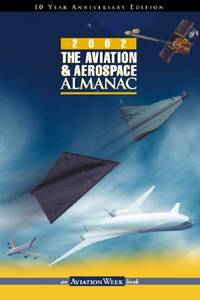
2002réf. AE-43: Aviation Week/McGraw-Hill 2002. Comprehensive reference text contains new info on the Chinese military and commercial status; detailed transportation indicators for market analyst general aviation specs of every national international military and civilian aircraft government agency phone directories complete inventory of military aircraft and missles worldwide etc. 1047 pgs. Illustrated including 580 tables. NOTE: Heavy Item. . Soft Cover. As New. 4to - over 9¾" - 12" tall. Aviation Week/McGraw-Hill Paperback
réf. 1341459470.Ghardcover. Good. Access codes and supplements are not guaranteed with used items. May be an ex-library book. hardcover
2010No marks or inscriptions. No creasing to covers or to spine. A very clean very tight copy with bright unmarked boards and no bumping to corners. 318pp. Using examples from comics and magazines from the 1950s, the author, a professor of physics, explains the real-life scientific breakthroughs that led to some of the incredible technologies prediced in the 1950s.
1991réf. AE-45: Krieger Publishing 1991. Comprehensive text contains detailed sections on total planning and design including Airport Systems; Apron Terminal Geometry; Flow and Function; Forecasts Master Plan and Project Development; Space Calculations and Functional Layout; etc. 248 pgs. Illustrated. Minimal shelfwear. Oversized. . First Edition. Hard Cover. Very Good/ . 4to - over 9¾" - 12" Tall -Oblong. . Krieger Publishing Hardcover
1924réf. 47166Corning, N.Y., and Menasha, Wisc., The Physical Review, 1924. Royal8vo. Full buckram. Gilt lettering to spine. A stamp to top of titlepage and to front free endpaper. In: ""The Physical Review. A Journal of Experimental and theoretical Physics"", Vol. 24, Second Series. V,704 pp., textillustr. Van Vleck's papers: pp. 330-346 a. pp. 347-365. Internally clean and fine.
1924réf. 47166Corning N.Y. and Menasha Wisc. The Physical Review 1924. Royal8vo. Full buckram. Gilt lettering to spine. A stamp to top of titlepage and to front free endpaper. In: "The Physical Review. A Journal of Experimental and theoretical Physics" Vol. 24 Second Series. V704 pp. textillustr. Van Vleck's papers: pp. 330-346 a. pp. 347-365. Internally clean and fine. First appearance of Van Vleck's two importent papers in which he clarifies and extends the Principle of Correspondence."Van Vleck made his greatest contribution to the old quantum theory in 1924 when he conceived his correspondence principle for absorption. He demonstrated that in the limit of high quantum numbers there would be a correspondence between absorption by classical multiply periodic systems and by their quantum analogues. His proof depended on interpreting net absorption in the quantum theory as the difference between gross absorption and stimulated emission of radiation an interpretation prompted by a remark of Breit’s. Van Vleck was particularly pleased that his classical theory reproduced the quantum result without the need for stimulated emission which he referred to as "negative absorption." DSB."Van Vleck’s theory of absorption by multiply periodic systems was consistent with the newly derived Kramers theory of dispersion and it convinced Bohr that his correspondence principle applied not only to emission but also to absorption. Further Van Vleck’s 1924 calculation made use of several of the ideas that Werner Heisenberg used in his matrix mechanics a year later. Van Vleck’s work however did not lead in the direction of matrix mechanics. His intent was to explain quantum phenomena especially "negative absorption" in classical terms rather than to devise an internally consistent quantum theory." DSB.In 1977 he shared the Nobel Prize with Philip Anderson and N. F. Mott.Van der Waerden "Sources of Quantum Mechanics" pp. 203 ff. hardcover
réf. 66209aafRoma, Edizioni Italiane, 1940, gr. in-8vo, XII + 375 p., ill., brochure originale.
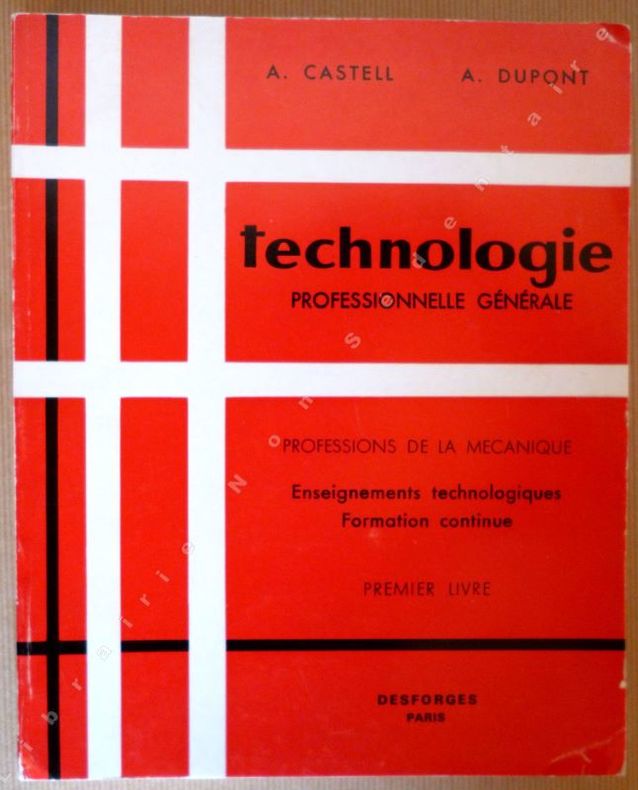
réf. 15364Editions Desforges, 1957 - Volume au format d'un cahier d'écolier, 182 pages, 321 figures dans le texte, bon exemplaire de seconde main.
réf. 15363Desforges Paris, 1975 - Livre au format cahier d'écolier, 167 pages,246 figures dans le texte, très agréable exemplaire.
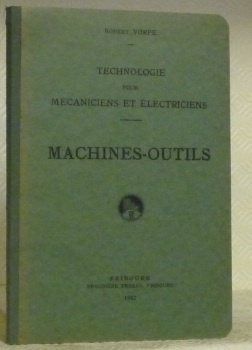
réf. 36335Fribourg, Fragnière 1942, 205x140mm, 176pages, broché. Bon état.
1949réf. 124040Couverture souple. En bon état. Broché. 208 pages. Papier légèrement bruni. Couverture légèrement défraîchie.
1977réf. 130614Couverture rigide. 2 volumes cartonnés. 22 x 27 cm. 210 + 226 pages.
1970réf. LFA-1267165742 volumes de 210 et 226 pages, format 230 x 275 mm, illustrés, reliés toile, publiés en 1970 et 1971, Peladan et Le Cannelier - Editions de la Capitelle, bon état
1961réf. 41DhParis Dunod 1961 14x20,5 172 pages - broché - trés nombreuses illustrations - bon etat general
1961réf. 41DhParis Dunod 1961 14x20,5 172 pages - broché - trés nombreuses illustrations - bon etat general
1936réf. 87358Couverture souple. Broché. 91 pages. 10 x 15 cm. Quelques rousseurs.
Hardcover 564 S. mit 295 Textabb., Hln. VG+. [CA29-4]
1955réf. 673081955 P., Baillière, 1955, grand in 8° broché, 526 pages.
1983réf. GIT00c62München Bernard und Graefe Verlag 1983. Petit in-8 827pp. Rel éditeur plastique noir souple, titre en gris sur le dos et le 1er plat. Innombrables illustrations (photographies, schémas techniques).