EINSTEIN, AlbertBiblio.com
2.534 Ergebnisse
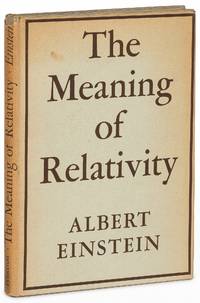
1945Best.-Nr. 617621Princeton New Jersey: Princeton University Press 1945. Hardcover. Near Fine/Very Good. Second edition with a new appendix by Einstein and translated by Ernst G. Straus. Octavo. 135pp. Tiny owner name on front fly else fine in uniformly and modestly spine-toned very good dust jacket with nominal soiling. Princeton University Press hardcover
1908Best.-Nr. 003221Leipzig: J. A. Barth 1908. First Edition. Contemporary Cloth. Very Good. J. A. Barth Hardcover
1906Best.-Nr. 003218Leipzig: J. A. Barth 1906. Several small dents in cover edges. First Edition. Contemporary Cloth. Very Good. J. A. Barth Hardcover
1945Best.-Nr. 617621Princeton New Jersey: Princeton University Press 1945. Hardcover. Near Fine/Very Good. Second edition with a new appendix by Einstein and translated by Ernst G. Straus. Octavo. 135pp. Tiny owner name on front fly else fine in uniformly and modestly spine-toned very good dust jacket with nominal soiling. Princeton University Press hardcover books
1914Best.-Nr. 1199Braunschweig: Friedr. Vieweg & Sohn 1914. 1st Edition. FIRST EDITION FULL VOLUME OF THE FRANCK-HERTZ EXPERIMENT: THE FIRST ELECTRICAL MEASUREMENT TO CLEARLY SHOW THE QUANTUM NATURE OF ATOMS - PROOF OF THE QUANTIZED MODEL OF THE BOHR ATOM & OF PLANCK'S QUANTUM THEORY. Note that this volume includes both the first and second Franck-Hertz experiment. In the first they demonstrate that atoms can only absorb and be excited by specific amounts of energy; in the second experiment performed the same year they demonstrate that the frequency of the light emitted following the collision of electrons with mercury atoms corresponds precisely with the energy lost by the electrons in the collision. Franck and Hertz received the Nobel Prize for this work specifically "for their discovery of the laws governing the impact of an electron upon an atom" Nobel Prize Committee. Of equal import this volume also contains a paper by Einstein in which he uses the light quantum hypothesis to give new derivations of Planck's radiation law and Nernst's third law of thermodynamics. His "proofs introduced the quantum hypothesis" Calaprice The Einstein Almanac 40. In 1914 James Franck and Gustav Hertz were working together in the Physics Institute of Berlin and were "particularly interested in ionization i.e. in the process in which an electron is removed from an atom" The Harvest of a Century" p. 102-103. The experiment they devised now known commonly as the Franck-Hertz experiment is "a vivid illustration of the quantization of energy" that relied on methodology so simple "that it is now carried out regularly by undergraduates. They accelerated electrons through a low-pressure gas of mercury. When the electrons' energy reach the energy of a stationary state of mercury they gave up a quantum of energy to the mercury resulting in a stepwise shape to the curve of current through the apparatus. This demonstrated that atoms could absorb energy only in discrete amounts" Peacock The Quantum Revolution 40. "Franck and Hertz had not only shown for the first time that electrons lose their kinetic energy to mercury atoms in energy quanta but also that these energy quanta are equal to the energy of the light emitted by the same atoms if interpreted with Einstein's light-quantum hypothesis.This was the first experimental determination of Planck's constant not using blackbody radiation" Brandt 103. CONDITION & DETAILS: Braunschweig: Friedr. Vieweg & Sohn. 8vo. Unobtrusive stamp on front paste down and title page. In-text figures throughout. Tightly bound in leather over marbled paper boards; gilt-lettered and tooled at the slightly faded and spotted spine which looks worse in the image due to the bright light than it does to the eye. Unusually beautiful marbled paper edges. Bright and very clean throughout. Near fine. Friedr. Vieweg & Sohn hardcover
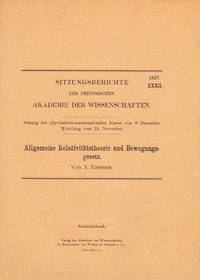
1927Best.-Nr. 5736KBerlin: Verlag der Akademie der Wissenschaften in commission at Georg Reimer Reichsdruckerei 24th February 1927; 14th February 1928. Near Fine. Imperial 8vo 25 4: 18 2 cm. 12 pages numbered 2-13; 12 pages numbered 235-245 1. Letterpress on machine paper in original publisher’s brochures on orange stock with black title printing. First offprints in the original wrappers of two of Einstein's papers about the interrelations of the General Theory of Relativity and the Law of Motion the 2nd paper conducted with his assistant Jakob Grommer. - Condition: Mint. - Reference: Boni-Russ-L. 171; Schilpp-Shields 212; Weil 155 and 160. Verlag der Akademie der Wissenschaften (in commission at Georg Reimer [Reichsdruckerei]) unknown
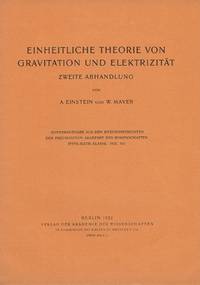
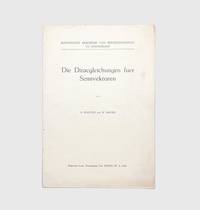
1931Best.-Nr. 5745KBerlin: Verlag der Akademie der Wissenschaften in commission at Georg Reimer Reichsdruckerei 2nd December 1931; 30th April 1932. Near Fine. Imperial 8vo 25 4: 18 2 cm. 19 1 pages; 12 pages numbered 235-245 1. Letterpress on machine paper in original publisher’s brochures on salmon-coloured and orange stock with black title printing. First offprints in the original wrappers and new pagination of this important two-part paper by Einstein formulating new developments towards Unified Field Theories. - Content: Einstein made several attempts at a five-dimensional unified field theory including this two-part collaboration with Austrian mathematician Walther Mayer nicknamed „Einstein's calculator“ ""in which a new unified field theory was proposed one based on a four-dimensional space-time continuum with a five-dimensional tangent space attached at each point"" Pais Subtle is the Lord p. 492. - Condition: Very well preserved. - Reference: Boni-Russ-L. 207; Printing and the Mind of Man 416 „Principal Work“; Schilpp-Shields 251 and 261; Weil 182 and 185 quotes the paginations of the first separate printings p. 541-557 and 130-137. Verlag der Akademie der Wissenschaften (in commission at Georg Reimer [Reichsdruckerei]) unknown
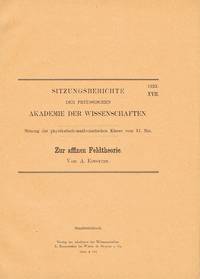
1923Best.-Nr. 5730KBerlin: Verlag der Akademie der Wissenschaften in commission at Walter de Gruyter Reichsdruckerei 28th June 1923. Near Fine. Imperial 8vo 25 4: 18 2 cm. 4 pages numbered 137-140. Letterpress on machine paper in original publisher’s brochure on orange stock with black title printing. First offprint in the original wrappers of this first attempt of Einstein to formulate a unified field theory. - Content: In this important paper Einstein gives his first investigation of ""Affine geometries"" and introduces the notion of ""Distant parallelism"" thus for the first time attempting to formulate a unified field theory based on the research of the German mathematician theoretical physicist and philosopher Hermann Weyl. - Condition: Mint. - Reference: Alicke 113; Norman Library 698; Schilpp-Shields 175; Weil 132. Verlag der Akademie der Wissenschaften (in commission at Walter de Gruyter [Reichsdruckerei]) unknown
1934Best.-Nr. 180324Princeton: Princeton University Press 1934. First edition offprint issue of the fourth and final paper on Einstein and Mayer's semi-vectors in which they aimed to incorporate the Dirac equation into the general theory of relativity. This last article "was presented foremost as an exercise with exclusively mathematical appeal" Van Dongen p. 106. Large octavo pp. 7. Disbound from wrappers wire-stitched. Nicks and a handful of short closed tears to extremities: a very good copy. Boni 225; Weil 193. Jeroen van Dongen Einstein's Unification 2010. unknown
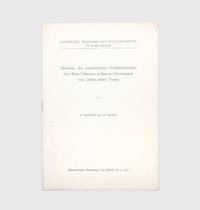
1933Best.-Nr. 180322Amsterdam: Koninklijke Akademie van Wetenschappen 1933. First edition offprint issue of the second of Einstein and Mayer's four classic papers on semi-vectors in which they aimed to incorporate the Dirac equation into the general theory of relativity. "By introducing semi-vectors Einstein wanted to arrive at a mathematically simpler and more general formulation of spinors. The semi-vector generalization of the Dirac equation was thought to give a unified description of charged elementary particles in particular of the electron and proton. In their second semi-vector paper Einstein and Mayer were on the lookout for the most general Dirac system possible for the semivector" Van Dongen pp. 103-11. Large octavo pp. 20. Original cream wrappers front wrapper printed in black. Wire-stitching sometime removed front wrappers lightly soiled: a very good copy. Boni 222; Weil 191. Jeroen van Dongen Einstein's Unification 2010. unknown
1933Best.-Nr. 180318Amsterdam: Koninklijke Akademie van Wetenschappen 1933. First edition offprint issue of the third of Einstein and Mayer's four classic papers on semi-vectors in which they aimed to incorporate the Dirac equation into the general theory of relativity. "By introducing semi-vectors Einstein wanted to arrive at a mathematically simpler and more general formulation of spinors. The semi-vector generalization of the Dirac equation was thought to give a unified description of charged elementary particles in particular of the electron and proton" Van Dongen pp. 103-5. Large octavo pp. 4. Original cream wrappers front wrapper printed in black wire-stitched as issued. Extremities gently creased short closed tears at spine ends occasional light foxing: a very good copy. Boni 223; Weil 192. Jeroen van Dongen Einstein's Unification 2010. unknown
1931Best.-Nr. 38732Berlin, Akademie der Wissenschaften, 1931-32. 4to. Both papers with orig. printed orange wrappers. Offprints (Sonderausgabe) ""Sitzungsberichten der Preussischen Akademie der Wissenschaften"". 19"10 pp. Fine and clean.
1921Best.-Nr. 46469Berlin, Julius Springer, 1921. Lex8vo. Orig. printed wrappers. Offprint/Sonderdruck from ""Der Festschrift der Kaiser Wilhelm Gesellschaft zur Förderung der Wissenschaften zu ihrem 10jährigen Jubiläum"". Pp. 50-52. A small tear to right margin (1 cm), otherwise fine and clean. At foot frontwrapper ""Nicht im Handel"".
1925Best.-Nr. 39308Paris, Gauthier-Villars et Cie, 1925. Small8vo. Uncut in orig. printed wrappers. Portrait. (4),56,(2) pp. + Publisher's Cat. (6 pp.). 2 leaves with an insignificant small loss of upper right corner. A fine copy.
1929Best.-Nr. 28362Berlin, Gruyter & Co., 1929. 4to. Orig. orange printed wrappers. Offprint/Sonderabdruck aus Sitzungsberichten...pp. (1)-8. Fine fresh copy.
1917Best.-Nr. 46895Leipzig, S. Hirzel, 1917. Royal8vo. Bound in contemporary half calf with gilt lettering to spine and 5 raised bands with ornaments in gilt. In ""Physikalische Zeitschrift"", Bd. 18, 1917. Spine and hinges with wear, otherwise a fine and clean copy. Pp. 121-128. [Entire volume: XI, (1), 604 pp. + 14 plates.
1911Best.-Nr. 38841Leipzig, J.A. Barth, 1911. Contemp. hcalf, spine gilt. ""Annalen der Physik. Vierte Folge. Band 34. Hrsg. von W.Wien und Max Planck."" VIII,1032 pp., 6 plates. Einstein papers: pp. 165-169" pp. 170-174 pp. 175-176 p. 590" pp. 591-592. Fine and clean. The whole volume offered.
1906Best.-Nr. 39057Leipzig, Johann Ambrosius Barth, 1906). Bound in a fine recent hmorocco. Gilt lettering on spine. ""Annalen der Physik"", Bd. 20, Heft 8, pp. 433-640. The Einstein paper pp. 627-633.
1903Best.-Nr. 38800Leipzig, Johann Ambrosius Barth, 1903. Contemp. hcloth. Some small nicks to spine. (=) Annalen der Physik. Vierte Folge. Band 11. Herausgegeben von Paul Drude."". VIII,1144pp. and 6 plates. The Einstein paper: pp. 170-187. Internally fine and clean.
1915Best.-Nr. 38835Braunschweig, Vieweg & Sohn, 1915. Contemp. hcalf, gilt. Spine with a few scratches and light wear to spine ends. ""Verhandlungen der Deutschen Physikalischen Gesellschaft im Jahre 1915. 17. Jahrgang. Im Auftrage der Gesellschaft herausgegeben von Karl Scheel."" VI,489 pp. textillustr. Einstein/Haas papers: pp. 152-170 a. p. 203 a. p. 420. - Planck paper: pp. 407-418 a. 418-19 a. 438-51. - Laue paper: pp. 198-202. Internally clean and fine. The whole volume offered.
1904Best.-Nr. 38818Leipzig, J.A. Barth, 1904. Contemp. hcloth, tears to hinges at upper part of spine. ""Annalen der Physik. Vierte Folge. Band 14. Herausgegeben von Paul Drude"". VIII,1040 pp. and 3 plates. The Einstein paper: pp. 354-362. Internally clean and fine. The whole volume offered.
1910Best.-Nr. 38842Leipzig, J.A. Barth, 1910. Contemp. hcalf. Spine gilt, a fs scratches to spine. VIII,1584 pp. and 6 plates. Einstein papers: pp. 1096: pp. 1105-1115" pp. 1275-1298. Fine and clean. The whole volume offered.
1911Best.-Nr. 38841Leipzig J.A. Barth 1911. Contemp. hcalf spine gilt. "Annalen der Physik. Vierte Folge. Band 34. Hrsg. von W.Wien und Max Planck." VIII1032 pp. 6 plates. Einstein papers: pp. 165-169; pp. 170-174; pp.; 175-176; p. 590; pp. 591-592. Fine and clean. The whole volume offered. First edition of all 5 papers. In "Relation between elastic behaviour and specific heat of solid bodies with monatomic molecules" Einstein comments Sutherlands importent paper in Philosophical Magazine from 1910. Sutherland made the importent remark that the infrared eigenfrequencies of solid bodies have their origin possibly in the elastic vibrations of these bodies. Einstein impressed by this remark adds that electrically charged ions are the sources of optical vibrations whreas elastic vibrations are caused by the mutual motion of the entire molecule. Hence he prefers to test the hypothesis of Sutherland by solid bodies which are composed of monatomic molecules."Lanczos. - Weil Nos 38 39 this with an asterix denoting major work40 1-2 and 41. unknown
1906Best.-Nr. 39057Leipzig Johann Ambrosius Barth 1906. Bound in a fine recent hmorocco. Gilt lettering on spine. "Annalen der Physik" Bd. 20 Heft 8 pp. 433-640. The Einstein paper pp. 627-633. First edition of this paper in the periodical form in which Einstein shows that the conservation of mass is a special application of his energy principle E= Mc2 - "Einstein considers a weightless horizontal cylinder filled with electromagnetic radiation and closed to the external world. A certain amount of radiating energy E moves from the left end of the cylinder to the right end transferring a certain amount of momentum due to radiation pressure to the left end which translates the cylinder to the left. When the radiation arrives at the right end the motion stops. We now imagine that a practically massless body absorbs this radiation moves back to the left and deposits it to its original state. Then the body moves back to right end into its original position. Now a complete cycle has taken place the system is back in its original state but the center of mass has moved by a certain amount to the left. This process can be repeated any number of times with the result that a body all by itself without any external forces can change its centre of mass by an arbitrary amount in contradiction to all physical evidence. This conclusion is avoided if we assume that the energy E is associated with the mass M=E/c2 in which case the centre of mass remains permanently at rest in agreement with our ecpectations." Cornelius Lanczos. - Weil: 13. unknown
1921Best.-Nr. 46469Berlin Julius Springer 1921. Lex8vo. Orig. printed wrappers. Offprint/Sonderdruck from "Der Festschrift der Kaiser Wilhelm Gesellschaft zur Förderung der Wissenschaften zu ihrem 10jährigen Jubiläum". Pp. 50-52. A small tear to right margin 1 cm otherwise fine and clean. At foot frontwrapper "Nicht im Handel". First edition the offprint issue of this pioneerwork in globular cluster physics."In his paper on M13 Einstein 1921 concluded that the non-luminous mass contributes no higher order of magnitude to the total mass than does the luminous mass.To my knowledge this has been Einstein's only contact with globular clusters. As in other issues his claim still holds."Tom Richtler.Weil:117 - Boni:123. unknown