2.534 Ergebnisse
1929Best.-Nr. 374191929. Einstein Albert 1879-1955. Zur einheitlichen Feldtheorie. Offprint from Sitzungsberichten der preussischen Akademie der Wissenschaften 1 1929. 8vo. 8pp. Berlin: Verlag der Akademie der Wissenschaft 1929. 256 x 183 mm. Original printed wrappers slightly soiled and creased. Very good. First Separate Edition. "In 1928 Einstein embarked on a new approach to a unified field theory . . . involving what he called 'distant parallelism'. . . . By early 1929 he had solved the main problems involved in writing down field equations for his unified theory. On the day of official publication of the third of a formidably technical series of nine articles on the theory . . . excited headlines appeared in foreign newspapers throughout the world. . . . In this frenzied unscientific atmosphere Einstein's new theory was hailed in the press as an outstanding scientific advance. Yet Einstein had stated in his article that it was still tentative; and soon he found he had to abandon it Hoffman Einstein pp. 225-26. This paper is included on Shields's list of Einstein's most significant papers; see Albert Einstein Philosopher-Scientist 1949 p. 758. Weil 165. Pais Subtle is the Lord pp. 344-46. . unknown
1921Best.-Nr. 433161921. Offprint from Sitzungsberichte der preussischen Akademie der Wissenschaften 1921. Single sheet pp. 882-883. 256 x 184 mm. Minor marginal tears one corner chipped but very good. First ediiton offprint issue. "Since after 1917 Einstein firmly believed that light-quanta were here to stay it is not surprising that he would look for new ways in which the existence of photons might lead to observable devations from the classical picture. In this he did not succeed. At one point in 1921 he thought he had found a new quantum criterion published in the present paper but it soon turned out to be a false lead" Pais Subtle is the Lord pp. 412-413. Weil Albert Einstein Bibliography 118. unknown
1921Best.-Nr. 32433Berlin: Akad. Wiss. Berl. 1921 Berichte 51-53 1921. First Edition. Soft cover. First Edition. Soft cover. ALBERT EINSTEIN. Über eine naheliegende Ergänzung des Fundamentes der allgemeinen Relativitätstheorie Berlin 1921 8vo. 26.5 x 18.5 cms Akad. Wiss. Berl. 1921 Berichte 51-53 pp.261-264. Original printed wrappers. NEAR MINT CONDITION. A fine fresh example small pencil mark to upper wrapper of THIS RARE PAPER!! - ."Although Einstein could not accept Weyl's theory as a physical theory he cherished "its courageous mathematical construction" and thought intensively about its conceptual foundation. This becomes clear from his paper "On a complement at hand of the bases of general relativity" of 1921. In it he raised the question whether it would be possible to generate a geometry just from the conformal invariance of Equation without use of the conception "distance" i.e. without using rulers and clocks. He then embarked on conformal invariants and tensors of gauge-weight 0 and gave the one formed from the square of Weyl's conformal curvature tensor" Hubert F.M. Goenner On the History of Unified Field Theories. Reference: Weil N. 116; Schlipp-Shields No.145. Akad. Wiss. Berl., 1921, Berichte 51-53 unknown
1920Best.-Nr. 43308Berlin: Springer 1920. 15pp. 221 x 146 mm. Original printed wrappers foxed. Minor internal foxing but very good. First edition cover title does not include the date Einstein delivered his lecture; see Weil. "By royal decree of June 24 1920 a special chair in Leiden University was created for Einstein enabling him to come to that university for short periods of his choosing. On October 27 1920 Einstein began his new position with an inaugural address on aether and relativity theory" Pais Subtle is the Lord p. 313. Weil Albert Einstein Bibliography 111. Springer unknown books
1930Best.-Nr. 433061930. Offprint from Mathematische Annalen 102 1930. 685-697pp. Original printed self-wrappers. 233 x 157 mm. Very good apart from small split in lower spine. Weil Albert Einstein Bibliography 171. unknown books
1923Best.-Nr. 374081923. Offprint from S. preuss. Akad. Wiss. Weil 137. unknown books
1923Best.-Nr. 433181923. Offprint from Zeitschrift für Physik 16 1923. Single sheet unpaginated. 230 x 155 mm. One corner creased but very good. First edition offprint issue. Einstein's second response to Friedmann's groudbreaking paper on equations governing the expansion of space which made a valuable contribution to Einstein's theory of relativity and admitted the possibility of an expanding universe. Einstein at first believed that Friedmann's reasoning was incorrect then corrected his own objection in the present brief "Notiz" and called Friedmann's results "clarifying." Pais Subtle is the Lord p. 288. Weil Albert Einstein Bibliography 130. unknown books
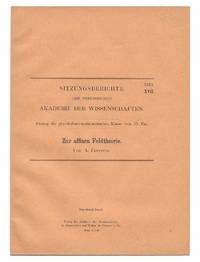
1923Best.-Nr. 374071923. Einstein Albert 1879-1955. Zur affinen Feldtheorie. Offprint from Sitzungsberichte der preussischen Akademie der Wissenschaften 17 1923. 137-140pp. 256 x 185 mm. Original printed wrappers. Fine. First Edition Offprint Issue. In 1923 Einstein published four short papers of which "Zur affinen Feldtheorie" is the third on Eddington's attempt at a unified field theory marking the beginning of a scientific passion that would dominate the remainder of his career. In 1921 British physicist Arthur Eddington had proposed a unified field theory inspired by the work of Hermann Weyl. "Einstein's own initial reaction was that Eddington had created a beautiful framework without content. Nevertheless he began to examine what would be made of these ideas and finally decided that 'I must absolutely publish since Eddington's idea must be thought through to the end.' That was what he wrote to Weyl. Three days later he wrote to him again about unified field theories: 'Above stands the marble smile of implacable Nature which has endowed us more with longing than with intellectual capacity.' Thus romantically began Einstein's adventures with general connections adventures that were to continue until his final hours" Pais Subtle is the Lord p. 343. This paper is included on Shields's list of Einstein's most significant papers; see Albert Einstein Philosopher-Scientist 1949 p. 758. Shields 175. Weil 132. . unknown books
1929Best.-Nr. 374191929. Einstein Albert 1879-1955. Zur einheitlichen Feldtheorie. Offprint from Sitzungsberichten der preussischen Akademie der Wissenschaften 1 1929. 8vo. 8pp. Berlin: Verlag der Akademie der Wissenschaft 1929. 256 x 183 mm. Original printed wrappers slightly soiled and creased. Very good. First Separate Edition. "In 1928 Einstein embarked on a new approach to a unified field theory . . . involving what he called 'distant parallelism'. . . . By early 1929 he had solved the main problems involved in writing down field equations for his unified theory. On the day of official publication of the third of a formidably technical series of nine articles on the theory . . . excited headlines appeared in foreign newspapers throughout the world. . . . In this frenzied unscientific atmosphere Einstein's new theory was hailed in the press as an outstanding scientific advance. Yet Einstein had stated in his article that it was still tentative; and soon he found he had to abandon it Hoffman Einstein pp. 225-26. This paper is included on Shields's list of Einstein's most significant papers; see Albert Einstein Philosopher-Scientist 1949 p. 758. Weil 165. Pais Subtle is the Lord pp. 344-46. . unknown books
1907Best.-Nr. 50420Leipzig: Johann Ambrosius Barth 1907. Einstein explicitly establishes E=mc2. Einstein Albert 1879-1955. 1 Über die Möglichkeit einer neuen Prüfung des Relativitätsprinzips. In Annalen der Physik 23 6: pp. 197-8. 2 Bemerkungen zu der Notiz von Hrn. Paul Ehrenfest: "Die translation deformierbarer Elektronen und der Flächensatz." In Annalen der Physik 23 6: pp. 206-8. 3 Über die vom relativitätsprinzip geforderte Trägheit der Energie. In Annalen der Physik 23 7: pp. 371-384. 8vo. Red cloth gilt lettering on spine. 214 x 140 mm. Whole volume: viii 1000 pp. 4 plates numbered Taf. I - IV. Tafs. I II and IV are folding Taf. III is b/w silver photograph tipped to sheet. Foot of the spine is repaired. Very good. Approximate English translations of titles: 1 "On the possibility of a new test of the principle of relativity." 2 "Remarks on Mr. Paul Ehrenfest's note: 'The translation of deformable electrons and the surface theorem.'" 3 "On the inertia of energy required by the principle of relativity." In "On the inertia of energy required by the relativity principle" May 1907 "Using rather than m V rather than c and 0 rather than E0 Einstein wrote his famous equation for the first time as V2= 0 and he did it in a footnote. At the end of that paper he introduced the symbol E0 to denote energy in the rest frame and wrote the famous expression again this time as =E0/V2." -Eugene Hecht How Einstein confirmed E0 = mc2 In the third paper Einstein explicitly establishes his famous equation E=mc2 although with different symbols. In this paper Einstein discussed the relationship between inertial mass and energy arguing for their complete equivalence namely that every mass has an equivalent energy just as every form of energy has an equivalent mass. This relation says that a photon can convert for the equivalence of mass and energy his celebrated equation E = mc2 Calaprice The Einstein Almanac. Weil's Einstein Bibliography nos. 17 18 and 19 respectively. Boni's Einstein Checklist nos. 17 18 and 19 respectively. . Johann Ambrosius Barth unknown books
1921Best.-Nr. 433161921. Offprint from Sitzungsberichte der preussischen Akademie der Wissenschaften 1921. Single sheet pp. 882-883. 256 x 184 mm. Minor marginal tears one corner chipped but very good. First ediiton offprint issue. "Since after 1917 Einstein firmly believed that light-quanta were here to stay it is not surprising that he would look for new ways in which the existence of photons might lead to observable devations from the classical picture. In this he did not succeed. At one point in 1921 he thought he had found a new quantum criterion published in the present paper but it soon turned out to be a false lead" Pais Subtle is the Lord pp. 412-413. Weil Albert Einstein Bibliography 118. unknown books
1930Best.-Nr. 510131930. Einstein Albert 1879-1955. Théorie unitaire du champ physique. In Annales de l'Institut Henri Poincaré 1 fasc. 1 1930: 1-24. With: Fermi Enrico 1901-54. La théorie du rayonnement. In ibid.: 25-52. Whole number. 2 74 2pp. 285 x 197 mm. uncut and unopened. Original printed wrappers a bit sunned lower corner of front wrapper chipped and creased. Very good. First Edition. This issue of the Annales de l'Institut Henri Poincaré contains the texts of Einstein's lecture on unified field theory and Fermi's lecture on the theory of radiation both delivered at the Institut in 1929. Weil Albert Einstein Bibliography 174. Not in Fermi Collected Papers. . unknown books
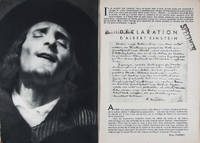
1933Best.-Nr. 45000Paris: Société Anonyme Les Illustrés Français 1933. First edition. Softcover. g- to vg. Large quarto 11 1/2 x 8". 105 3pp. Original photo-illustrated wrappers with white lettering to front cover. This scarce issue of "Témoignages de Notre Temps" Witness to our Time is a loving and moving tribute to Jewish life and culture that spans ancient times to the early 1930s with the spectre of Hitler and the early persecutions of Jews in Nazi Germany Hitler became chancellor a few months prior on January 30th. Includes texts by Albert Einstein Dr. Chaïm Weizmann and others along with hundreds of splendid black-and-white photogravures many full page including Helmar Lerski's impressive series on Jews in Palestine. "Témoignages de Notre Temps" was edited by noted French photographer and publisher Lucien Vogel. Wrappers partly creased along edges. Page 5 with four "Spécimen" stamps not affecting lettering. Lower corner of the first 18 pages slightly creased. Lower front corner bumped thus slightly affecting pages throughout. Text in French. Wrappers in overall good- to good interior in good to very good condition. Société Anonyme Les Illustrés Français unknown
1933Best.-Nr. 45000Paris: Société Anonyme Les Illustrés Français 1933. First edition. Softcover. g- to vg. Large quarto 11 1/2 x 8". 105 3pp. Original photo-illustrated wrappers with white lettering to front cover. This scarce issue of "Témoignages de Notre Temps" Witness to our Time is a loving and moving tribute to Jewish life and culture that spans ancient times to the early 1930s with the spectre of Hitler and the early persecutions of Jews in Nazi Germany Hitler became chancellor a few months prior on January 30th. Includes texts by Albert Einstein Dr. Chaïm Weizmann and others along with hundreds of splendid black-and-white photogravures many full page including Helmar Lerski's impressive series on Jews in Palestine. "Témoignages de Notre Temps" was edited by noted French photographer and publisher Lucien Vogel. Wrappers partly creased along edges. Page 5 with four "Spécimen" stamps not affecting lettering. Lower corner of the first 18 pages slightly creased. Lower front corner bumped thus slightly affecting pages throughout. Text in French. Wrappers in overall good- to good interior in good to very good condition. Société Anonyme Les Illustrés Français unknown books
1941Best.-Nr. 46477Tucuman, Argentina, 1941. Royal8vo. Orig. printed wrappers. Offprint from ""Revista. Universidad Nacional de Tucuman"", Series A Matematicas y Fisica Teorica, Vol. 2, Diciembre de 1941, Nos 1 y 2. Pp. 11-15. Fine and clean.
1908Best.-Nr. 39155Leipzig, J.A. Barth, 1908. 2 contemp. hcalf and hcloth. Spines slightly rubbed. In ""Annalen der Physik. Hrsg. von W. Wien und M. Planck"", vol. 26 and 27. VI,1032 and plates, pp. VIII,1112 pp. and plates.- Einstein & Laub papers: pp.532-541, pp. 541-550, pp. p. 232. Whole volumes offered.
1941Best.-Nr. 46477Tucuman Argentina 1941. Royal8vo. Orig. printed wrappers. Offprint from "Revista. Universidad Nacional de Tucuman" Series A Matematicas y Fisica Teorica Vol. 2 Diciembre de 1941 Nos 1 y 2. Pp. 11-15. Fine and clean. First edition of a scarce paper in the offprint version. The paper "represents the basis of the one written by the same author in collaboration with Wolfgang Pauli in 1943 in which by following analogous lines the proof of the non-existence of regular particle-type solutions was generalized to the case of cilyndrical geometries in Kaluza-Klein theory Einstein & Pauli 1943. Besides other generalizations were subsequently presented. The non-existence of such solutions in classical unified field theory was undoubtedly an important criterion leading Einstein's investigations."Galvagno and Giribet."In his search for a unified field theory that could undercut quantum mechanics Einstein considered five-dimensional classical Kaluza-Klein theory. He studied this theory most intensively during the years 1938-1943. One of his primary objectives was finding a non-singular particle solution. In the full theory this search got frustrated and in the x5-independent theory Einstein together with Pauli argued it would be impossible to find these structures." Jeroen van Dongen.Weil: 208. - Boni: 243. unknown
1908Best.-Nr. 39155Leipzig J.A. Barth 1908. 2 contemp. hcalf and hcloth. Spines slightly rubbed. In "Annalen der Physik. Hrsg. von W. Wien und M. Planck" vol. 26 and 27. VI1032 and plates pp. VIII1112 pp. and plates.- Einstein & Laub papers: pp.532-541 pp. 541-550 pp. p. 232. Whole volumes offered. First editions of all three papers.- Volume 26 contains also a first printing of Max Planck. "Zur Dynamik bewegter Systeme". Pp. 1-34. Planck Akademie No 76. - Weil: 22 1-2 and 23. hardcover
1920Best.-Nr. 33265-52Berlin E. S. Mittler for Julius Springer 1920. 15 1 pp. 8vo. Orig. wrappers. Berlin E. S. Mittler for Julius Springer 1920. First edition. Einstein discusses the concept of the aether in relation to his theory of relativity. This lecture examines the historical role of the aether in physics and its transformation under relativity. His conclusion is that relativity does not bring back the classical aether but introduces a new understanding of space as an active structured entity. The text of this speech delivered at Leiden University was also translated into French in 1921. The English translation appeared in Einstein's "Sidelights of Relativity" published at London in 1922. Einstein's manuscript is now kept in the Bibliotheca Bodmeriana Geneva. - Weil 111; Boni Russ and Laurence 115; Roller/Goodman I 354; Seelig 131; Schilpp-Shields 131. SCIENCE: PHYSICS ; Berlin, (E. S. Mittler for) Julius Springer unknown
1980Best.-Nr. 2610130008Dover 1980. Paperback. Good. An extremely large collection of foundational mathematical texts from a mathematical professor's library 68 volume set. Softcover. Most volumes are in good condition. Clean unmarked pages. Some volumes have reading creases down the spine various wear and are only fair condition. Various dates most volumes are from the late 1970s-1980s. Includes: 1. Handbook of Mathematical Functions: With Formulas Graphs and Mathematical Tables Milton Abramowitz; Irene A. Stegun2. Lectures on Ordinary Differential Equations Witold Hurewicz; 3. The Divine Proportion: A Study in Mathematical Beauty H E Huntley; 4. Infinite Sequences and Series Knopp Konrad; 5. Functional Analysis Frigyes Riesz; Bela Sz.-Nagy;6. Lectures on Classical Differential Geometry: 2nd Ed Struik Dirk J.;7. Advanced Number Theory Cohn Harvey; 8. Contributions to the Founding of the Theory of Transfinite Numbers Cantor Georg; 9. Geometry of Complex Numbers Hans Schwerdtfeger;10. Introduction to Partial Differential Equations with Applications Zachmanoglou E. C.; Thoe Dale W.;11. Thirty Years That Shook Physics: The Story of Quantum Theory Gamow George;12. Information Theory Robert Ash; 13. Introduction to Bessel Functions Frank Bowman; 14. Mathematical Foundations of Information Theory A Ya Khinchin; 15. Vector and Tensor Analysis with Applications Borisenko A. I. Tarapov I. E.; 16. On Formally Undecidable Propositions of Principia Mathematica and Related Systems Godel Kurt; 17. Tensor Calculus Synge J. L.; Schild A.; 18. Differential Geometry Kreyszig Erwin; 19. A Collection of Problems on Complex Analysis Volkovyskii L. I.; Lunts G. L.; Aramanovich I. G.;20. Introduction to Difference Equations Samuel Goldberg;21. Distribution Theory and Transform Analysis: An Introduction to Generalized Functions with Applications Zemanian A. H.; 22. Physics of Waves Elmore William C.; Heald Mark A.; 23. Orthogonal Functions G. Sansone; 24. Lie Algebras Jacobson Nathan; 25. Topology John G Hocking; 26. Mathematical Recreations and Essays Ball W. W. Rouse; Coxeter; 27. An Introduction to Algebraic Structures Landin Joseph28. Differential Forms with Applications to the Physical Sciences Harley Flanders;29. The Theory of Groups and Quantum Mechanics Hermann Weyl; 30. Nonlinear Mathematics Thomas L. Saaty; Joseph Bram; 31. An Introduction to Information Theory Symbols Signals and Noise John R Pierce; 32. Introduction to the Theory of Fourier's Series and Integrals Carslaw H. S.; 33. Quantum Theory David Bohm; 34. Introduction to Differentiable Manifolds Auslander Louis Mackenzie Robert E.; 35. An Introduction to Harmonic Analysis Katznelson Yitzhak; 36. Conformal Mapping on Riemann Surfaces Harvey Cohn; 37. Conformal Mapping Nehari Zeev; 38. Axiomatic Set Theory Suppes Patrick; 39. Differential Geometry Heinrich W. Guggenheimer; 40. Challenging Mathematical Problems With Elementary Solutions Vol. 1 A. M. Yaglom;41. Group Theory W. R. Scott; 42. An Introduction to the Calculus of Variations Fox Charles; 43. Tensor Analysis on Manifolds Goldberg Samuel I. Bishop Richard; 44. Non-Euclidean Geometry Bonola Roberto; 45. The Philosophy of Mathematics Korner Stephan; 46. Computational Methods of Linear Algebra Faddeeva V. N.; 47. Tensors Differential Forms and Variational Principles Lovelock David Rund Hanno;48. Metric Affine Geometry Snapper Ernst & Troyer Robert J.; 49. Fourier Series and Orthogonal Functions Harry F Davis;50. Unbounded Linear Operations Goldberg Seymour; 51. Geometry Relativity and the Fourth Dimension Rudolf Rucker; 52. Banach Spaces of Analytic Functions Hoffman Kenneth; 53. Topological Uniform Structures Page Warren; 54. The Higher Arithmetic: An Introduction to the Theory of Numbers Harold Davenport;55. The Thirteen Books of the Elements Vol. 2 Euclid; 56. The Theory of the Properties of Metals and Alloys Jones Mott Neville; 57. Asymptotic Expansions of Integrals Norman Bleistein; 58. Investigations on the Theory of the Brownian Movement Einstein Albert; 59. The Principle of Relativity Albert Einstein; 60. The Theory of Spinors Bagemihl Bagemihl; 61. Selected Papers on Quantum Electrodynamics Julian Schwinger; 62. About Vectors Banesh Hoffmann; 63. Fads and Fallacies in the Name of Science Martin Gardner; 64. Theory of Sets Kamke E.; 65. First Order Mathematical Logic Angelo Margaris; 66. Essays on the Theory of Numbers Dedekind Richard; 67. Modern Nonlinear Equations Thomas Saaty; 68. Theory of Groups of Finite Order Burnside. This is an oversized or heavy book which WILL require additional postage for Priority Mail or International delivery outside the US. Dover paperback
1923Best.-Nr. 32429Berlin: Berlin: Sitzungsberichte der Preussischen Akademie der Wissenschaften XVIII 1923. First Thus. Soft cover. First Thus. Soft cover. Einstein Albert 1879-1955. Zur affinen Feldtheorie. Offprint from Sitzungsberichten der Preussischen Akademie der Wissenschaften 1923. XVIII. 8vo.4 137-140 First edition. Orange wrappers. A fine fresh copy in the rare off-print form marked with an asterisk by Weil denoting a major paper "Sonderabdruck" & deemed of sufficient interest that a translation was published in Nature Magazine. "Einstein's attempts to formulate a unified field theory the theoretical framework to account for the fundamental forces of nature. stemmed from his dissatisfaction with the general relativity theory which did not adequately incorporate the electromagnetic field into the geometry of space-time". Einstein's first investigation of Weyl's ideas published in the present paper which Weyl had begun working on in 1918. Weyl was investigating the possibility of constructing a unified field theory preserving the dimensionality of space-time while formally altering its geometry making it a special case of the class known as affine geometries. However Einstein later rejected Weyl's theory. "Weil No. 132; Schilpp--Shields No. 171; Alicke No.113; Norman Library 698; Boni 141. Affine Geometry is not concerned with the notions of circle angle and distance. It's a known dictum that in Affine Geometry all triangles are the same. In this context the word affine was first used by Euler affinis. In modern parlance Affine Geometry is a study of properties of geometric objects that remain invariant under affine transformations mappings. Affine transformations preserve collinearity of points: if three points belong to the same straight line their images under affine transformations also belong to the same line and in addition the middle point remains between the other two points." The early Offprints from "Sitzungsberichten." are called "Sonderabdruck" up to Weil No.165 including this. From Weil 166 they are called "Sonderausgabe.". - Before 161 up to 160 the Offprints do not have separate title and pagination the pagination follows the numbering in the periodical. From 166 the Offprint has both separate printed title and pagination. - So Weil Nos 161-165 is still "Abdruck" but with separate title and pagination. Berlin: Sitzungsberichte der Preussischen Akademie der Wissenschaften, XVIII unknown
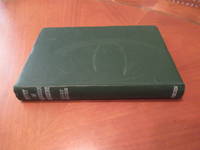
1926Best.-Nr. 043474London: Methuen & Co. 1926. 1st Edition 1st Printing. Hardcover. Near Fine/No Jacket. Viii 124 Pp. Green Cloth White Spine Lettering. First Printing In Secondary Binding With White Lettering The First Binding Was Lettered In Gilt. Book Used But Still Near Fine Very Slight Rubbing Lettering Complete With Some Wear Small Areas Of Lightening Of Color On Front Cover Darkening To Lower Corner Of Page "V" First Page Of Preface. No Marks. Lacking The Very Scarce Dust Jacket. Methuen & Co. hardcover
1966Best.-Nr. WMCE001New York: E. P. Dutton & Co. 1966 First edition first printing. Signed and inscribed by Mays on front free endpaper: "To Joe / Best Wishes / Willie Mays." Publisher's green and orange cloth with "Willie Mays" in blind to front board and spine lettered in black and orange; in its original unclipped dust jacket designed by Bob Korn with white front panel lettered in brown orange and green and a green spine. About fine book with light fading to spine and a hint of rubbing to foot of spine; very good price-clipped dust jacket with light wear to spine ends and some edgewear. With Beckett Letter of Authenticity. Overall a great boldly inscribed copy. Presentation copies from Mays are exceedingly scarce. In this book Willie Mays tells his life story with the help of prolific sportswriter Charles Einstein. Mays started playing professional baseball at 16 in the Negro Leagues and was soon drafted by the New York Giants. He went on to play 21 seasons with the Giants winning a World Series with the team in 1954. His over-the-shoulder catch in that World Series is one of the most iconic moments in sports history. A 24x All-Star and a 12x Gold Glove award winner Mays was inducted into the Hall of Fame in 1979 and was voted to the Major League Baseball All-Century Team in 1999. . Signed. First Edition. Hard Cover. Fine/Dust Jacket Included. New York: E. P. Dutton & Co. hardcover
1966Best.-Nr. WMCE001New York: E. P. Dutton & Co. 1966 First edition first printing. Signed and inscribed by Mays on front free endpaper: "To Joe / Best Wishes / Willie Mays." Publisher's green and orange cloth with "Willie Mays" in blind to front board and spine lettered in black and orange; in its original unclipped dust jacket designed by Bob Korn with white front panel lettered in brown orange and green and a green spine. About fine book with light fading to spine and a hint of rubbing to foot of spine; very good price-clipped dust jacket with light wear to spine ends and some edgewear. With Beckett Letter of Authenticity. Overall a great boldly inscribed copy. Presentation copies from Mays are exceedingly scarce. In this book Willie Mays tells his life story with the help of prolific sportswriter Charles Einstein. Mays started playing professional baseball at 16 in the Negro Leagues and was soon drafted by the New York Giants. He went on to play 21 seasons with the Giants winning a World Series with the team in 1954. His over-the-shoulder catch in that World Series is one of the most iconic moments in sports history. A 24x All-Star and a 12x Gold Glove award winner Mays was inducted into the Hall of Fame in 1979 and was voted to the Major League Baseball All-Century Team in 1999. . Signed. First Edition. Hard Cover. Fine/Dust Jacket Included. New York: E. P. Dutton & Co. hardcover books
1922Best.-Nr. C106668London: Methuen 1922. First Edition. Hardback. Hardcover Hardcover. Very Good. First Edition. Hardback. 8vo. Original publisher's orange/brown buckram boards gilt lettering to spine blind stamp lettering to front board unpaginated prelims 123pp sound clean very good indeed copy with three ownership signatures on the first blank with addresses in Norfolk and Cyprus variously from 1929 to 1989 and on verso of the contents page a 1929 press cutting showing Einstein in Berlin offering congratulations 'over the radio phone' to Thomas Edison in New York on the 50th anniversary of the discovery of electric light. Slight offsetting to opposite page from the cutting. Apart from these slight distractions a very decent copy of what has become a rare and important book. Methuen, hardcover