2.535 Ergebnisse
1906Best.-Nr. 46962Leipzig, Johann Ambrosius Barth, 1906. Bound together in one contemp. halfcalf. Spine gilt. Minor scratches to spine. A stamp to titlepage and htitle. ""Annalen der Physik. Vierte Folge. Band 20. Herausgegeben von Paul Drude."" , Portrait (Paul Drude), VIII,1048 pp. and 6 plates. Einstein papers: pp. 199-206 and 627-33. The entire volume offered.
1906Best.-Nr. 59121Leipzig, Johann Ambrosius Barth, 1906. Full cloth. Spine with gilt lettering. In: ""Annalen der Physik. Vierte Folge. Band 20. Herausgegeben von Paul Drude."" , Portrait (Paul Drude), VIII,1048 pp. and 6 plates. Einstein papers: pp. 199-206 and 627-33. Internally fine and clean. The entire volume offered. Broad margins.
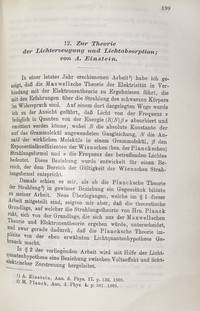
1906Best.-Nr. 59121Leipzig Johann Ambrosius Barth 1906. Full cloth. Spine with gilt lettering. In: "Annalen der Physik. Vierte Folge. Band 20. Herausgegeben von Paul Drude." Portrait Paul Drude VIII1048 pp. and 6 plates. Einstein papers: pp. 199-206 and 627-33. Internally fine and clean. The entire volume offered. Broad margins. Both papers first edition. It was for the papers "Ueber einen die Erzeugung und Verwandlung des Lichtes betreffenden heuristischen Gesichtspunkt" of 1905 and "Zur Theorie der Lichterzeugung. Theory of light emission and absorption the offered item that Einstein was awarded the Nobel Prize in 1921. "The quantum theory has affected virtually every branch of physics. Its earliest and one of its most significant developments was Einstein's application of the theory to what is known as the 'photo-electrical effect'.Einstein explained this effext by suggesting that the classical view that light is emitted in the form of continous waves must be abandoned. The photo-electrical effect could be explained only as an example of quantum action where the waves of light or X-rays are emitted in minute particles or bullets. It is he size of the bullet the wave-lenght of the radiation which determines the number of electrons ejected. It was for this and not for the theory of relativity that Einstein was awarded the Nobel Prize in 1921. Einstein's two fundamental papers on this subject are "Ueber einem Erzeugung." 1905 and Zur Theorie der Lichterzeugung the paper offered here" PMM the note to 391. In the second paper Principle of the conservation of the centre of mass motion and the inertia of energy he shows that the conservation of mass is a special application of his energy principle E= Mc2 - Weil: 12 & 13.Among the many papers in this volume we have Max von Laue: Zur Thermodynamik der Inteferenzerscheinungen. pp. 365-378. hardcover
1906Best.-Nr. 38794Leipzig Johann Ambrosius Barth 1906. Bound together in one contemp. hcloth. Small tears to spine ends. = "Annalen der Physik. Vierte Folge. Band 20. Herausgegeben von Paul Drude." Portrait Paul Drude VIII1048 pp. and 6 plates. Einstein papers: pp. 199-206 and 627-33. Internally fine and clean. The whole volume offered. Both papers first edition. It was for the papers "Ueber einen die Erzeugung und Verwandlung des Lichtes betreffenden heuristischen Gesichtspunkt" of 1905 and "Zur Theorie der Lichterzeugung. Theory of light emission and absorption the offered item that Einstein was awarded the Nobel Prize in 1921."The quantum theory has affected virtually every branch of physics. Its earliest and one of its most significant developments was Einstein's application of the theory to what is known as the 'photo-electrical effect'.Einstein explained this effext by suggesting that the classical view that light is emitted in the form of continous waves must be abandoned. The photo-electrical effect could be explained only as an example of quantum action where the waves of light or X-rays are emitted in minute particles or bullets. It is he size of the bullet the wave-lenght of the radiation which determines the number of electrons ejected. It was for this and not for the theory of relativity that Einstein was awarded the Nobel Prize in 1921. Einstein's two fundamental papers on this subject are "Ueber einem Erzeugung." 1905 and Zur Theorie der Lichterzeugung the paper offered here" PMM the note to 391. In the second paper Principle of the conservation of the centre of mass motion and the inertia of energy he shows that the conservation of mass is a special application of his energy principle E= Mc2 - Weil: 12 & 13.Among the many papers in this volume we have Max von Laue: Zur Thermodynamik der Inteferenzerscheinungen. pp. 365-378. hardcover
1906Best.-Nr. 46962Leipzig Johann Ambrosius Barth 1906. Bound together in one contemp. halfcalf. Spine gilt. Minor scratches to spine. A stamp to titlepage and htitle. "Annalen der Physik. Vierte Folge. Band 20. Herausgegeben von Paul Drude." Portrait Paul Drude VIII1048 pp. and 6 plates. Einstein papers: pp. 199-206 and 627-33. The entire volume offered. Both papers first edition. It was for the papers "Ueber einen die Erzeugung und Verwandlung des Lichtes betreffenden heuristischen Gesichtspunkt" of 1905 and "Zur Theorie der Lichterzeugung. Theory of light emission and absorption the offered item that Einstein was awarded the Nobel Prize in 1921."The quantum theory has affected virtually every branch of physics. Its earliest and one of its most significant developments was Einstein's application of the theory to what is known as the 'photo-electrical effect'.Einstein explained this effext by suggesting that the classical view that light is emitted in the form of continous waves must be abandoned. The photo-electrical effect could be explained only as an example of quantum action where the waves of light or X-rays are emitted in minute particles or bullets. It is he size of the bullet the wave-lenght of the radiation which determines the number of electrons ejected. It was for this and not for the theory of relativity that Einstein was awarded the Nobel Prize in 1921. Einstein's two fundamental papers on this subject are "Ueber einem Erzeugung." 1905 and Zur Theorie der Lichterzeugung the paper offered here" PMM the note to 391. In the second paper Principle of the conservation of the centre of mass motion and the inertia of energy he shows that the conservation of mass is a special application of his energy principle E= Mc2 - Weil: 12 & 13.Among the many papers in this volume we have Max von Laue: Zur Thermodynamik der Inteferenzerscheinungen. pp. 365-378. unknown
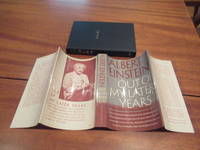
1950Best.-Nr. 060426New York: Philosophical Library 1950. 1st Edition 1st Printing. Hardcover. Fine/Fine. 282 Pp. Dark Blue Cloth Gilt. First Edition By Basic Points But Issued In A Variety Of Bindings And Dust Jackets Priced $4.75. Pages Of This Copy Are Same As Issue In Light Blue Boards Including Title And Copyright Pages "1" On Copyright Page But Binding Is Cloth. No Frontispiece; That Portrait Is Printed In Red On The Rear Panel Of The Dust Jacket. Dj On Heavy Paper Priced $4.75 Same As Issue In Blue Boards But Dj Is Gray Red-Brown And White With Author In Red-Brown And Title In White. Book Is Fine No Damage Bookplate Of A Prominent Military Cryptographer. Dj Is Also Fine. A Review By Harlow Shapley Is Discussed On The Front Flap Of The Dj; Note That W We Had Another Exactly Similar Fine Copy In Original Dust Jacket Which Came With A Book Club News Brochure Also Discussing The Harlow Review; It Is Possible That This Is A Book Club Issue Simultaneous Or Nearly So With Other Issues But Definitive Information Is Not Available To Us. Philosophical Library hardcover
1926Best.-Nr. 029292New York: E. P. Dutton and Company 1926. First American Edition 1st Printing. Hardcover. Very Good/Fair DJ. 124 Pp. Brown Cloth Gilt. First American Edition No Date Printing Statement Indicates 1926 British Sheets Were Used. Book Is Somewhat Worn And Has Small Areas Of Fraying At Corners Hinges Solid Small Previous Owner's Name On Front Free Endpaper. Dj Worn Bottom 40% Of Spine Chipped Away But Title And Author Remain Small Edge And Corner Chips. E. P. Dutton and Company hardcover
1912Best.-Nr. 008413Leipzig: Johann Ambrosius Barth 1912. Small pieces missing from spine; rear wrapper carefully reattached; ink stamp on front wrapper; small piece of paper stuck to first page. . First Edition. Original Printed Wrappers. Good. Johann Ambrosius Barth Paperback
Best.-Nr. H3988Berlin Akademie der Wissenschaften 1915 In: Sitzungsberichte der Königl.Preuss. Akademie der Wissenschaften Band 1916/2. 4to. S.1111-1117. Weitere Berichte von Born M.; Schroeder Tangl Struve u.a. Halbleinenband der Zeit leicht berieben Bibl.-Nr.am Rücken Original-Broschur miteingebunden unaufgeschnitten gutes Exemplar. unknown
Best.-Nr. 11414Lausanne, André et Pierre Gonin, sans date. In-4 en feuilles de 108-[6] pages, chemise blanche gaufrée de formules d'algèbre, sous chemise de soie bleue et étui de soie violette, un brin insolée, titre en bleu au dos de la chemise.
1922Best.-Nr. EINSTEIN017518Methuen London. 1922. First English edition. Translated by G.B. Jeffery and W. Perrett. Octavo. pp iv 56 8 adverts. Contains two addresses "Ether and Relativity" and "Geometry and Experience'. Spine and cover edges a little faded. Lower corners slightly bruised. Endpapers and edges spotted. Very good in the scarce and fragile dustwrapper which is good chipped at edges a bit rubbed starting to split at the joints and missing a piece of about an inch in the centre of the spine. Methuen, London. unknown
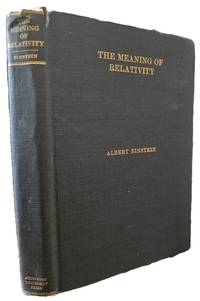
1923Best.-Nr. 7029The Meaning Of Relativity by Albert Einstein first edition hardcover Publisher: Princeton University Press 1923 Condition: Very Good- - some wear to the spine and covers name written on the front end paper no other writings tight binding Princeton University Press hardcover
1933Best.-Nr. 144376Société des Nations Institut Société des Nations Institut de Coopération Intellectuelle, 1933. Collection correspondance à tirage limité, In-8 broché, couverture à rabats de 63 pages. Exemplaire N° 113 imprimé sur papier de Châtaignier. Très petite déchirure sans manque à la charnière en queue et infimes salissures sans aucune gravité, corps de l'ouvrage en très bel état, absence totale de taches ou rousseurs.. Correspondance entre les deux grands hommes à la demande de l'Institut de Coopération Intellectuelle pour le dialogue au service de la paix. Le titre de la publication fût choisi par S. Freud. Bel exemplaire, rare dans cette condition
1938Best.-Nr. 46954Baltimore, Princeton University Press, 1938 a.1940. Royal8vo. Bound in 2 full cloth, gilt lettering to spines. In: Annals of Mathematics"", Series 2, Vol. 39 and vol. 40. (Entire volumes offered). The papers: pp. 65-100 a. pp. 455-464. Clean and fine.også on a generalization...... pais p. 496
1912Best.-Nr. 29311(Leipzig, Barth, 1912). 8vo. Orig. printed wrappers. Backstrip taped. Kept in a cloth-box. In: ""Annalen der Physik IV, Bd. 38"" pp. 355-369 and pp. 443-458. (The whole issue present= Bd. 38, Heft 2, pp.249-472).
1912Best.-Nr. 29311Leipzig Barth 1912. 8vo. Orig. printed wrappers. Backstrip taped. Kept in a cloth-box. In: "Annalen der Physik IV Bd. 38" pp. 355-369 and pp. 443-458. The whole issue present= Bd. 38 Heft 2 pp.249-472. Both papers in first edition and they are considered as the first appearance of a Nonlinear Field Equation for Gravitation. - "Einstein published two remarkable memoirs in 1912 which were efforts to construct a complete theory of gravitation incorporating the equivalence principle. In these memoirs Einstein supposed that the gravitational field can be characterized completely by one function the local speed of light analogous to the Newtonian description where only the gravitational potential appears. By an extraordinary argument he extended the potential equation of Newton.In his second Memoir in 1912 he used the equivalence principle to show the influence of a static gravitational field on electromagnetic and thermal processes." DSB IV p.320 ff. - Weil No. 47 and 48. hardcover
1938Best.-Nr. 46954Baltimore Princeton University Press 1938 a.1940. Royal8vo. Bound in 2 full cloth gilt lettering to spines. In: Annals of Mathematics" Series 2 Vol. 39 and vol. 40. Entire volumes offered. The papers: pp. 65-100 a. pp. 455-464. Clean and fine.også on a generalization. pais p. 496 First appearance of these two importent papers on the General theory of Relativity in which is shown that the equation of motion follows directly from the field equation that defined the geometry."Einstein's last importent contribution to general relativity deals again with the problem of motion. It is the work done with Leopold Indfeld and Banesh Hoffmann on the N-body problem of motion. In these papers the gravitational field is no longer treated as external. Instead it and the motion of its singular sources are treated simultaneously. A new approximation scheme is introduced in which the fields are no longer necessarily weak but in which the source velocities are small compared with the light velocity. These equations are widely used in analyses of planetary orbits in the solar system."Pais "Subtle is the Lord" pp. 290-91.Weil: 202 a. 205 both with an asterix denoting a major paper. - Boni: 236 a. 236.1. hardcover
Best.-Nr. 128800aaf(Braunschweig, Vieweg), 1916, in-8vo, 18 S. (315-332 aus Verhandl.). Mit Abbildung, Rckn.-Broschüre.
1906Best.-Nr. 32820369Contemporary half dark green roan. Rubbed some chipping separation at upper joint. Library markings. FIRST EDITION of "On the Theory of Light Production and Light Absorption" pp. 199-206. This classic in the history of physics is Einstein's second paper on the photoelectric effect. Einstein reconciles his and Planck's independent derivations of the blackbody formula E=hν. Planck's derivation of this formula ascribed it to a restriction on the energy changes possible when radiation is produced or absorbed by matter which implied no restriction on the energies of either matter or radiation. Einstein's 1905 derivation ascribed it to a restriction on the energy of radiation alone but in this paper he proposes the modern idea that the energies of both matter and radiation are quantized which led to his work on quantum specific heats. and FIRST EDITION of "The Principle of Conservation of Motion of the Center of Gravity and the Inertia of Energy" pp. 627-633. In this "ingenious thought experiment involving energy transport in a hollow cylinder Einstein returned to the relationship between inertial mass and energy giving more general arguments for their complete equivalence" Calaprice The Einstein Almanac. This is the first statement that the conservation of mass is a special case of the conservation of energy. Annalen der Physik
1926Best.-Nr. 043114London: Methuen & Co. 1926. 1st Edition 1st Printing. Hardcover. Fine/No Jacket. Viii 124 Pp. Green Cloth White Spine Lettering. First Printing In Secondary Binding With White Lettering The First Binding Was Lettered In Gilt. Book Used But Still Fine No Rubbing Lettering Complete And Entirely Strong. Spanish Owner's Name With His 1948 Receipt From H. K. Lewin For The Book Laid In Loosely. Lacking The Scarce Dust Jacket. Methuen & Co. hardcover
1950Best.-Nr. 046941New York: Philosophical Library 1950. 1st Edition 1st Printing. Hardcover. Near Fine/Very Good. Frontispiece. 282 Pp. Green Cloth Lettered In Gilt On Front CoverAlso Lettered In Gilt In Spine Stamped On Two Blocks Of Dark Blue Background. Dust Jacket Priced $4.75 With Only 15 Titles On Rear Panel Two First Published In 1950 The Others First Published By Philosophical Library 1942 To 1949. Frontispiece Portrait Of Einstein By Lotte Jacobi. There Are Many Issues With Identical Pagination In Cloth Or Boards Of Various Colors All With Later Post-1950 Publications Indicated On The Rear Panel In Both The Plainer Dust Jacket As On This Copy And In A More Elaborate Jacket; We Believe This Is The First Issue Only By A Process Of Elimination Not Having Seen Many Different Bindings And Dust Jackets. Book With Light Wear Gilt Brilliant No Marks. Dust Jacket With Wear Small Losses/Chips At Corners Not Price Clipped Slight Browning To Spine Panel. Philosophical Library hardcover
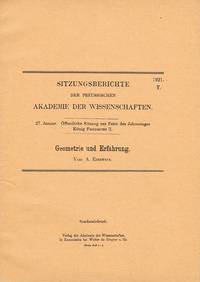
1921Best.-Nr. 5726KBerlin: Verlag der Akademie der Wissenschaften in commission at Walter de Gruyter Reichsdruckerei 3rd February 1921. Near Fine. Imperial 8vo 25 4: 18 2 cm. 8 pages. Letterpress on machine paper in original publisher’s brochure on orange stock with black title printing. First offprint in the original wrappers of Einstein's Celebratory Lecture given at the Prussian Academy on the occasion of the anniversary of King Frederick II it's founder. – Edition: Given in the year when he was awarded the Nobel Prize Einstein in this lecture summarised his views on the geometrization of physics. According to Pais Einstein in present lecture in particular explained why in 1912 he had abandoned Euclidean geometry in favour of Riemannian to proceed successfully with his theory of general relativity. Furthermore Einstein in this lecture presented his view on the place of mathematics in physics. He questioned whether human reasoning even without direct experience could lead to an understanding of the properties of real things merely through thought. Regarding the question of why mathematics should be so well adapted to describing the physical world he concluded 'As far as the laws of mathematics refer to reality they are not certain; and as far as they are certain they do not refer to reality.' – Condition: Mint very probably unread. - Rarity: Very rare. According to Weil early offprints of Einstein’s papers may also be qualified as original and also highly collectable editions however they were printed in a certain but still small print run for commercial use mainly to sell them to fellow natural scientists: „No doubt the first appearance in a periodical is the „original edition“ but I have to leave it open for collectors librarians and others to decide whether these offprints in wrappers mostly with a printed title on them especially in the »Sitzungsberichte der Königlich Preussischen Akademie der Wissenschaften« are also „original editions“. These offprints are printed from the same setting as the text but often with new pagination.“ p. 4 As of March 2nd 2024 no other copy of this offprint is for sale. – Reference: Reference: Boni N.: A bibliographical checklist and index to the published writings of Albert Einstein 136; The Collected Papers of Albert Einstein. Volume 7 52 also referred to as Einstein 1921b; Shields M. C.: Bibliography der Schriften Einsteins. In: Schilpp P. A.: Albert Einstein als Philosoph und Naturforscher 122; Weil E.: Albert Einstein. A bibliography of his scientific papers 1901-1930 114; Pais A.: Subtle is the Lord. The Science and Life of Albert Einstein 2005 ed. p. 214. Verlag der Akademie der Wissenschaften (in commission at Walter de Gruyter [Reichsdruckerei]) unknown
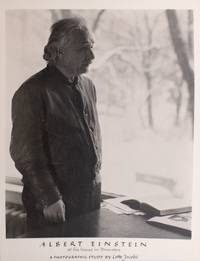
1940Best.-Nr. 3293321940. Black and white photographic print. 6 1/2 x 4 7/8 in. Fine. Black and white photographic print. 6 1/2 x 4 7/8 in. unknown
1940Best.-Nr. 3293321940. Black and white photographic print. 6 1/2 x 4 7/8 in. Fine. Black and white photographic print. 6 1/2 x 4 7/8 in. unknown books
1949Best.-Nr. 140941039Evanston IL: The Library of Living Philosophers Inc 1949. First Edition. Near Fine/Very Good. First edition first printing. Bound in publisher's original dark blue cloth stamped in gilt. Near Fine with toning to pages offsetting to endsheets former owner name to front free endpaper and small sticker ghost to front paste down. In a Very Good dust jacket with fraying and chip at bottom spine end and short closed tear at head light edge wear toning and soiling to rear panel. The Library of Living Philosophers, Inc unknown