EINSTEIN, AlbertBiblio.com
2.557 Ergebnisse
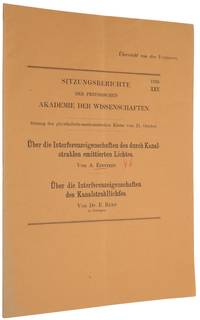
1926Best.-Nr. 6414Berlin: Akademie der Wissenschaften 1926. First edition. First edition very rare author's presentation offprint extremely rare author's presentation offprint not to be confused with the much more common trade separate - see below from the library of the great German physicist Arnold Sommerfeld of the notorious Einstein/Rupp experiments which demonstrated the wave-theory of light contrary to Einstein's expectations. . SCIENTIFIC FRAUD: THE EINSTEIN-RUPP EXPERIMENTS. First edition extremely rare author's presentation offprint not to be confused with the much more common trade separate - see below from the library of the great German physicist Arnold Sommerfeld of the notorious Einstein/Rupp experiments. "In the fall of 1926 Albert Einstein published the outline of two experiments in the Proceedings of the Berlin Academy. They addressed one of the most urgent questions in physics at the time: the experiments were to show if the emission of light was a process that was extended in time or if instead light emission occurred in an instantaneous act. Of course the first possibility would confirm a traditional oscillator-and-wave-like view whereas the second possibility would cohere well with Einstein's own ideas on light quanta. It is quite surprising that these experiments are so unfamiliar today. Apart from addressing a central question and being proposed by no lesser figure than Einstein they also circulated at a crucial moment in the history of quantum theory. Still the experiments are not mentioned in any of the standard Einstein biographies and there is no substantial treatment of them in histories of the quantum theory . The likely cause for this lack of attention is at least as surprising: the experiments were-supposedly-conducted by Emil Rupp yet a decade later Rupp was exposed as a scientific fraudster; the results obtained by Rupp in close consultation with Einstein and published back-to-back with the latter's theoretical paper were in the end generally believed to have been fabrications" Van Dongen. As Walter Gerlach of Stern-Gerlach fame said in an interview with Thomas Kuhn in 1963 "Rupp in the late twenties early thirties was regarded as the most important and most competent physicist. He did incredible things. . Later it turned out that everything that he had ever published everything was forged. This had gone on for ten years ten years!" Nevertheless "these experiments played a substantial role in developments in 1926. Most importantly they confirmed a wave picture of light when many including Einstein himself initially expected a particle-like instantaneous picture of light emission to be confirmed. After all only a few years before Compton scattering had been shown and as little as a year before the Einstein-Rupp experiments Walther Bothe and Hans Geiger had done the experiments that dismissed the BKS theory. But the experiments of Einstein and Rupp also influenced events in other ways. For instance their initial interpretation was most likely of direct importance for Max Born when he proposed the probabilistic interpretation of the wave function. The experiments further played a role in the thinking of Werner Heisenberg as he formulated his uncertainty relations . these experiments deserve renewed attention and their current obscure status is not warranted by their historical importance" Van Dongen. OCLC locates only three copies two in Switzerland one in Germany but it is unclear which of these if any are author's presentation offprints. The presentation offprint was not present in the collection of Einstein's son Hans Albert Christie's 2006 but it was in Einstein's own collection of his offprints Christie's 2008. Provenance: Arnold Sommerfeld 1868-1951 his characteristic numbering '46' in red pencil on front cover. "The son of a physician Sommerfeld was educated at the University of Königsberg. After teaching briefly at the universities of Göttingen Clausthal and Aachen he was appointed professor of physics at the University of Münich in 1906. Sommerfeld should have retired in 1936 in favour of his pupil Werner Heisenberg. Opposition from the Nazi party to Heisenberg's appointment prolonged Sommerfeld's tenure and it was not in fact until late 1939 that he finally retired to be succeeded not by Heisenberg but by Wilhelm Müller a Nazi aerodynamicist without a single publication in physics to his credit. Although Sommerfeld and Heisenberg were not Jewish they were regarded by the Nazis as Jewish sympathizers. Sommerfeld however survived the war and returned to his Münich chair in 1945 continuing to work at physics until he died in a car accident in 1951" Oxford Reference. "Arnold Sommerfeld was one of the most distinguished representatives of the transition period between classical and modern theoretical physics. The work of his youth was still firmly anchored in the conceptions of the nineteenth century; but when in the first decennium of the century the flood of new discoveries experimental and theoretical broke the dams of tradition he became a leader of the new movement and in combining the two ways of thinking he exerted a powerful influence on the younger generation. This combination of a classical mind to whom clarity of conception and mathematical rigour are essential with the adventurous spirit of a pioneer are the roots of his scientific success while his exceptional gift of communicating his ideas by spoken and written word made him a great teacher" Max Born p. 275. "Born in 1898 Rupp began his career in the 1920s studying canal rays beams of positive ions and atoms formed between an anode and cathode the latter punctured with holes or "canals" in a gas discharge tube. When these rays shoot through the canals and into a vacuum chamber the ions rapidly lose and gain charge emitting visible light that becomes less intense at the other end of the canal. "In his first experiments in the mid-1920s Rupp measured the coherence length of light - the distance over which the light maintains a consistent phase - emitted by hydrogen and mercury atoms in the canal rays. He measured these lengths as 62 centimeters for hydrogen and 15.2 centimeters for mercury. These were blockbuster results: A moving hydrogen atom was expected to stay coherent over a much smaller distance. "What's more Rupp's extra-long hydrogen canal ray seemed like it could be used to test one of physics' biggest questions at the time: Is light a particle or a wave Einstein had devised experiments to test if light was emitted instantaneously or over time but he needed a light with an extra-long coherence length - and only Rupp had achieved it. "After reading Rupp's 1926 paper Einstein published his own "Proposal for an Experiment on the Nature of the Elementary Process of Radiation Emission" and reached out to Rupp directly to discuss a collaboration. But because Rupp's boss at Heidelberg University the physicist Philipp Lenard was "a fervent anti-relativist - and anti-Semite" writes van Dongen Einstein chose to forgo a visit to the institution and sent instructions for Rupp to do the experiments on his own. "There were red flags from the start. In one instance Rupp appeared to have altered the mirrors in his interferometer the instrument he used to study interference just so into an arrangement that would obtain desired outcomes. In another instance when Einstein corrected the settings Rupp reported using for another instrument Rupp chalked the mistake up to a typo. There were other 'alarming discrepancies' in Rupp's calculations van Dongen writes and Einstein's letters show that he pushed back on several occasions. Each time Rupp responded with new results that perfectly explained the oddities Einstein questioned. "Initially Einstein expected to find that light was emitted instantaneously. But as the collaboration stretched on he began to expect the experiments would confirm the alternative the 'classical' theory. 'One of the reasons for his changing position likely was that that outcome had inadvertently already been corroborated by Rupp' van Dongen writes. "When Rupp furnished Einstein with a final set of results supporting the classical emission picture Einstein facilitated their publication in the proceedings of the Prussian Academy of Sciences. They were published back-to-back with a paper by Einstein explaining the theory behind the experiments in which Einstein cited Rupp's work. Einstein even helped Rupp draft his paper's abstract. "The association with Einstein rocketed Rupp to scientific prominence and in 1928 he accepted a position in the research labs of German electronics company AEG 'a kind of counterpart to General Electric' writes MIT physicist Anthony French in his 1999 retrospective of Rupp's case. "However scientists had begun voicing skepticism about Rupp's canal ray work. Among them were British spectroscopist Robert d'Escourt Atkinson who doubted Rupp's extraordinary coherence lengths and a researcher named Harald Straub who tried and failed to replicate Rupp's measurements in 1930. Rupp came down hard on Straub with a rebuttal sending photographs that supposedly showed his interference fields and forcefully defending his work in the same journal where Straub published his. Straub wrote that he had nothing else to add and the matter appeared settled. "But Rupp's reputation was bruised in the episode and his letters from the time indicate that his funding at AEG was drying up. He published work on electron scattering then took up experiments with positrons producing them by pounding lithium with protons. In a 1934 paper Rupp claimed to have accelerated protons at potential differences of 500 kV. This was impossible for him to have done - he simply did not have the requisite accelerator in his lab. "In December 1934 two of Rupp's fellow scientists at AEG brought the glaring problem to the attention of the institute's director who launched an investigation and subsequently fired Rupp. In January 1935 Rupp published the retraction statement appended to his doctor's note claiming he had no knowledge of or control over the fabrications. And later that year experimentalists Walther Gerlach and Eduard Rüchardt published 'On the Coherence Length of Light emitted by Canal Rays' which essentially confirmed that Rupp's early canal ray work was also erroneous. Amid this public humiliation Rupp experienced a nervous breakdown and spent time in a sanatorium. He never worked in physics again. "Einstein however escaped from the episode unscathed. Historians like van Dongen think his credulousness was an honest mistake underpinned by his desire to see his theories confirmed by experiments. Rupp's work and life are now a footnote but following his downfall it appears that German scientists mentioned his name often. According to French 'for a number of years afterward the word 'geruppt' became an epithet among German physicists to describe questionable work'" Jooss. This author's presentation offprint is of extreme rarity and must be distinguished from other so-called 'offprints' of papers from the Berlin Sitzungsberichte many of which are commonly available on the market. The celebrated bookseller Ernst Weil 1919-1981 in the introduction to his Einstein bibliography wrote: "I have often been asked about the number of those offprints. It seems to be certain that there were few before 1914. They were given only to the author and mostly 'Überreicht vom Verfasser' Presented by the Author is printed on the wrapper. Later on I have no doubt many more offprints were made and also sold as such especially by the Berlin Academy." If the term 'offprint' means as we believe it should a separate printing of a journal article given only to the author for distribution to colleagues then 'offprints' were not commercially available. Although there is certainly some truth in Weil's remark in our view it requires clarification and explanation. Until about 1916 most of Einstein's papers were published in Annalen der Physik; from 1916 until he left Germany for the United States in 1933 most were published in the Berlin Sitzungsberichte. The Sitzungsberichte differed from other journals in which Einstein published in that it made separate printings of its papers commercially available. These separate printings have 'Sonderabdruck' printed on the front wrapper the usual German term for offprint but they are not offprints according to our definition. They were available to anyone; indeed a price list of these 'trade offprints' is printed on the rear wrapper. True author's presentation offprints can be distinguished from these trade separates by the presence of 'Überreicht vom Verfasser' on the front wrapper. In the period 1916 to 1919 or 1920 the Sitzungsberichte trade separates are themselves rare. After 1919 or 1920 however the trade separates become much more common although the author's presentation offprints are still very rare. The reason for this change is that it was only in 1919 that Einstein became famous among the general public. It might seem obvious that Einstein's fame dates from 1905 his 'annus mirabilis' in which he published his epoch-making papers on special relativity and the light quantum. However these works did not make him immediately well known even in the physics community - many physicists did not understand or accept his work and it was two or three years before his genius was fully accepted even by his colleagues. Einstein did not secure an academic position until 1908. Among the general public Einstein became well known only in late 1919 following the success of Eddington's expedition to observe the bending of light by the Sun which confirmed Einstein's general theory of relativity. This was front-page news and made Einstein universally famous. See Chapter 16 'The suddenly famous Doctor Einstein' in Pais Subtle is the Lord for an account of these events. Before 1919 the trade separates of Einstein's papers would probably only have been purchased by professional physicists; after 1919 everyone wanted a memento of the famous Dr. Einstein whether or not they understood anything of theoretical physics and the trade separates of his papers were printed and sold in far greater numbers than before to meet the demand. It is telling that when these post-1919 trade separates appear on the market they are often in mint condition - they were never read simply because their owners were unable to understand them. BRL 160; Weil 153. Born 'Arnold Johannes Wilhelm Sommerfeld 1868-1951' Obituary Notices of Fellows of the Royal Society 8 1952 pp. 275-296. French 'The strange case of Emil Rupp' Physics in Perspective 1 1999 pp. 3-21. Joosse 'December 1934: Emil Rupp's research which fooled even Einstein is exposed as fraud' APS News Nov. 14 2023. Van Dongen 'Communicating the Heisenberg uncertainty relations: Niels Bohr complementarity and the Einstein-Rupp experiments' Scientia Danica. Series M Mathematica et physica 1: One Hundred Years of the Bohr Atom Proceedings 2015 pp. 310-343. 8vo 252 x 180 mm pp. 334-340; 341-351. Original printed wrappers portion of ink postmark stamp on lower cover just into text of publisher's advertisements light vertical crease for posting. Akademie der Wissenschaften unknown
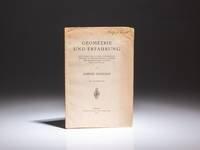
1921Best.-Nr. 17649Berlin: Verlag Von Julius Springer 1921. First Trade Edition. Wraps. Very good. The first trade edition of Geometrie Und Erfahrung Geometry and Experience by Albert Einstein from the collection of Einstein's English translator Dr. Wilfrid Perrett. Octavo 20pp. Publisher's original wraps bound with two staples. Light soiling and wear on wraps internally clean. Includes two illustrations advertisements on verso of rear flap. Staples showing rust some wear to edges of original wraps. Weil 115 Schlipp-Shields 143 This copy is signed by Wilfrid Perrett on the front cover. This work first appeared in the Sitzungsberichte der Preussischen Akademie der Wissenschaften accompanied by an "author's offprint" which was bound in orange wrappers. Weil 114. This work is the first separate trade edition. The recipient of this copy Dr. Wilfrid Perrett worked with Dr. George Barker Jeffery to translate many of Einstein's most notable works into English. Perrett was a "distinguished German scholar" and would "overlook the literary side of the work" while Jeffery would oversee the mathematical translations. The two worked together on Das Relativitätsprinzip On the Relativity Principle beginning in 1922 and numerous other works by Einstein over his career. Jammer 113-114. Verlag Von Julius Springer unknown books
1955Best.-Nr. 21242781955. London: Victor Gollancz Ltd. 1955. offered with:BLACKETT Patrick Maynard Stuart. The Atom and the Charter. London and Hereford: the Hereford Times for 'Fabian Publications ltd in conjunction with Victor Gollancz Ltd'. September 1946. offered with:BLACKETT Patrick Maynard Stuart. The Atom and the Charter. London and Hereford: the Hereford Times for 'Fabian Publications Ltd in conjunction with Victor Gollancz Ltd'. September 1946.8vo. Publisher's blue cloth lettered in gilt to spine in yellow dust-jacket printed in red and black; pp. 22 2 blank; maps and tables in the text spine of jacket sunned a little spotting to back cover small closed tear to back flap hinge c. 10 mm lettering to spine rubbed small chip to upper joint; very good; contemporary Foyles label to pastedown 'P. M. S. Blackett' see below with Blackett's ownership inscription in blue ink to front free endpaper.First English edition with a preface by Einstein of this work arguing for nuclear disarmament translated by the gardener novelist and anarchist Edward Byams this copy from the library of Nobel Prize-winning physicist Patrick Blackett whose own work is discussed at length in the book.Jules Moch 1893-1985 worked as a French Resistance organiser during the war later became a senior minister in several post-war governments and was France's delegate to the UN Disarmament Committee for 1951-1960. It was this latter role that informed the principles he sets forth in Human Folly which argue for multilateral nuclear disarmament. Divided into two parts the first examines the destructive capacities of modern warfare before tracing the recent history of disarmament negotiations. Moch attempts to represent both Soviet and Western positions with fairness concluding that the divisions between the two are gradually narrowing. Though he does not regard the situation as entirely hopeless he presents it as one of pressing urgency. The preface by Albert Einstein one of Moch's most eminent supporters makes clear peace can only arise from political will: 'Those who do not believe in the possibility of the attainment of a lasting and assured peace or have not the courage to act accordingly are ripe for destruction' p. 8. Provenance: front free endpaper with the ownership inscription of Patrick Blackett 1897-1974 with his occasional underlining throughout and one word 'Target' in pencil to the top of p. 10. Blackett was awarded the 1948 Nobel Prize in Physics for his pioneering work in nuclear physics and cosmic radiation including experiments demonstrating nuclear transmutation and important early research into the positron. During the Second World War he headed Operational Research at the Admiralty where his statistical criticism of the RAF blanket bombing campaigns led to increasing ostracism from the military authority. His opposition to mass destruction later informed his belief that Britain should not develop nuclear weapons. Combined with his openly socialist views this attracted the attention of MI5 and led to his inclusion on George Orwell's list of alleged 'crypto-communists' contributing to his marginalisation by the post-war Labour government. Blackett's book The Military and Economic Consequences of Atomic Energy 1948 is discussed at length by Moch pp. 117-19. Written before the development of second-generation thermonuclear weapons Blackett had estimated that thousands of atomic bombs would be required to destroy the United States or the Soviet Union when at the time only a few dozen existed. As Moch observes on p. 121 however 'today a few dozen thermonuclear bombs would produce the same results'. It is particularly notable that Blackett has not annotated the passages explicitly discussing his work. This copy of Human Folly is offered with Blackett's pamphlet The Atom and the Charter which discusses the extent to which 'the advent of atomic bombs necessitates changes in the procedure for the application of sanctions under the Charter of the United Nations Organisation' issued by Victor Gollancz and the socialist Fabian Society on behalf of the Association of Scientific Workers a scientific trade union of which Blackett was president. hardcover
1887Best.-Nr. 48810Leipzig, Barth, 1887-91. 8vo. No wrappers. 4 papers. In: ""Annalen der Physik und Chemie. Hrsg. von G. Wiedemann"", Neue Folge, Bd. XXX, No. 4, XXXI, No 6, XXXII, No. 11, XLIV, No. 11. - Pp. 545-704 a. 1 plate, pp. 145-336 a. 1 plate, pp. 337-528 a. 1 plate, pp. 385-576 a. 1 plate. With titlepge to vol. XXX, htitlepage to vol. XXXI, titlepage to vol. XXXII and titlepage to vol. XLIV. Titlepages with a stamp and on verso. Planck's papers: pp. 562-582, pp. 189-203, pp. 462-503 and pp. 385-428. Clean copies.
1887Best.-Nr. 48810Leipzig Barth 1887-91. 8vo. No wrappers. 4 papers. In: "Annalen der Physik und Chemie. Hrsg. von G. Wiedemann" Neue Folge Bd. XXX No. 4 XXXI No 6 XXXII No. 11 XLIV No. 11. - Pp. 545-704 a. 1 plate pp. 145-336 a. 1 plate pp. 337-528 a. 1 plate pp. 385-576 a. 1 plate. With titlepge to vol. XXX htitlepage to vol. XXXI titlepage to vol. XXXII and titlepage to vol. XLIV. Titlepages with a stamp and on verso. Planck's papers: pp. 562-582 pp. 189-203 pp. 462-503 and pp. 385-428. Clean copies. First appearance of all 4 papers constituting Planck's seminal papers on entropy carrying the general title "On the principles of Increase of Entropy" in which he applied the second law of thermodynamics to chemical problems."His goal was as he said in the first paper of the series to carry further the "grand generalization" of Helmholtz Josiah Willard Gibbs and others: like the first principle of the mechanical heat theory the second the "Carnot-Clausius" principle applies not only to heat phenomena but to all kinds of physical and chemical phenomena; and because the second principle applies not only to reversible processes but also to irreversible or "natural" processes it applies to all processes whatsoever."Jungnickel and McCormach "Intellectual Mastery of Nature vol. 2 pp. 52 ff.What Einstein admired and called Planck's "first great scientific discovery" was the generality of its formulas which contain all that can be derived from pure thermodynamic principles. Einstein referred to the third paper in this series with the title "Gesetze des Eintritts beliebiger thermodynamischer und chemischer Reactionen"Akademie Nos. 8910 and 20. unknown
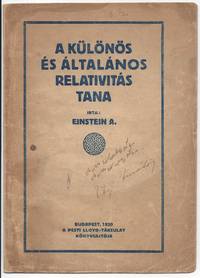
1920Best.-Nr. 1870Budapest: A Pesti Lloyd-Társulat Könyvsajtója 1920. First separate edition. Offprint of Természettudományi Közlöny. In publisher’s printed wrappers. Cover chipped at extremities. Restored rear panel replaced with cardboard similar to original. Old ownership inscriptions on front panel. Contemporary notes and underlines throughout in pen and pencil. Pages discolored due to the acidic paper. Overall in good condition. First separate edition. Offprint of Természettudományi Közlöny. In publisher’s printed wrappers. 2 19 1 p. First Hungarian edition of Einstein’s Über die spezielle und allgemeine Relativitätstheorie Braunschweig 1917 published as an extract. Offprint of Természettudományi Közlöny. One of the earliest Hungarian publications of Einstein’s works. . A Pesti Lloyd-Társulat Könyvsajtója unknown
1944Best.-Nr. 182569London: The Jewish Agency for Palestine 1944. First separate edition of Einstein's appeal for Zionism. Einstein was one of the most prominent international supports of Zionism. He argues Palestine is the only place historically spiritually and culturally tied to the Jewish people. Whereas the Arabs with many homelands the Jews have nowhere else to go. Their claims are rooted not in conquest or nationalism but in justice and survival. The article was originally published in the Princeton Herald earlier that year. This publication prints the article alongside other speeches and letters by Einstein extracted from his 1930 About Zionism. Provenance: Jews' College Library London with their shelf mark to the front wrapper and their stamp to the front wrapper verso. Octavo. Original wrappers. Library markings see note a little creased and spotted. A good copy. unknown
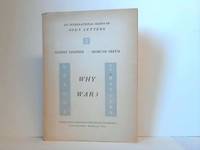
Best.-Nr. 1k7854Institut International de Coopèration Intellectuelle Paris 1933. 56 Seiten kartoniert etwas gebräunt und teils unaufgeschnitten. - Text in Englisch/Nr. 797 von 2000 numerrierten Exemplaren - unknown
1913Best.-Nr. 76293Leipzig ; Berlin : Teubner 1913. 1st Edition 1st Edition 38 S. ; 25cm Halbleinen [3 Warenabbildungen] 0
1921Best.-Nr. 2827000Madrid.: S.n. 1921. Paperback. Good. 24 cm. 79 p. Encuadernación en tapa blanda artesanal. Einstein Albert 1879-1955. Über die spezielle und die allgemeine Relativitätstheorie. Traducida de la 12ª ed. alemana por F. Lorente de Nó. Imp. de Suc. de S. Peláez. Relatividad Física . Física.530.12 530 [S.n.]. paperback
1906Best.-Nr. 003208Leipzig: J. A. Barth 1906. First Edition. Contemporary Red Cloth. Very Good. J. A. Barth Hardcover
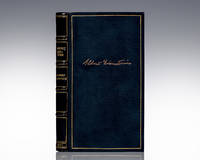
1931Best.-Nr. 150006New York: The MacMillan Company 1931. First edition of this volume of Einstein's speeches and letters concerning his views on Zionism. Octavo bound in full morocco by the Harcourt Bindery with gilt titles and tooling to the spine in five compartments within raised gilt bands gilt ruling to the front and rear panel gilt signature to the front panel gilt inner dentelles stamp-signed by the Harcourt Bindery marbled endpapers all edges gilt. In fine condition. Translated and edited with an introduction by Leon Simon. An exceptional presentation. Einstein was a prominent supporter of both Labor Zionism and efforts to encourage Jewish-Arab cooperation. He supported the creation of a Jewish national homeland in the British mandate of Palestine but was opposed to the idea of a Jewish state "with borders an army and a measure of temporal power." In a letter to Jawaharlal Nehru dated June 13 1947 he asserted "Long before the emergence of Hitler I made the cause of Zionism mine because through it I saw a means of correcting a flagrant wrong.The Jewish people alone has for centuries been in the anomalous position of being victimized and hounded as a people though bereft of all the rights and protections which even the smallest people normally has.Zionism offered the means of ending this discrimination." Einstein's speeches lectures and letters concerning Zionism were first published in 1930 by The Soncino Press and eleven of these essays were later collected in The World as I See It published in 1933 which Einstein dedicated "to the Jews of Germany". The MacMillan Company unknown
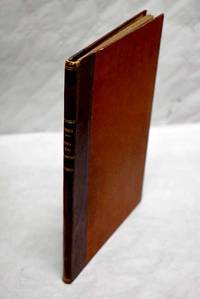
1921Best.-Nr. 2545920Madrid. 1921. Hardcover. Cubierta deslucida. Good. 24 cm. 79 p. Encuadernación en tapa dura artesanal con lomo en piel. Einstein Albert 1879-1955. Über die spezielle und die allgemeine Relativitätstheorie. Traducida de la 12ª ed. alemana por F. Lorente de Nó. Imp. de Suc. de S. Peláez. Relatividad Física . Cubierta deslucida. Física.530.12 530 hardcover
1907Best.-Nr. 47020Berlin, J.A. Barth, 1907. 8vo. 2 issues, to both the original printed yellow wrappers. No backstrip. Wrappers loose. In: ""Annalen der Physik. Vierte Folge. Band 22"", No. 1. and No. 4. Pp. 1-208, 1 fold. plate a. 1 portrait (P. Curie) a. pp. 609-800, 1 plate. (Entire issues offered). Einsteins paper: pp. 180-190 and p. 800. Astamp to verso of plates and a few leaves. THE PRINTED WRAPPERS LOOSE.
1907Best.-Nr. 47020Berlin J.A. Barth 1907. 8vo. 2 issues to both the original printed yellow wrappers. No backstrip. Wrappers loose. In: "Annalen der Physik. Vierte Folge. Band 22" No. 1. and No. 4. Pp. 1-208 1 fold. plate a. 1 portrait P. Curie a. pp. 609-800 1 plate. Entire issues offered. Einsteins paper: pp. 180-190 and p. 800. Astamp to verso of plates and a few leaves. THE PRINTED WRAPPERS LOOSE. First printing of a major paper in Quantum Theory introducing the first systematic introduction of probability factors in Quantum Theory."From 1905 through 1909 Einstein published five major papers on the hypothesis of energy quanta its theoretical implications and its use in the explanation of various phenomena. Among these papers we have his importent paper "Die Plancksche." and in his second paper from 1906d he asserted that Planck's derivation implicitly assumes quantification of the enrgies of charged oscillators. Now in the paper offered he returned to this question showing that if the structure function in phase space he had introduced earlier is assumed to restrict the oscillators to orbits with energies that are integral mulætiples of 'hv' then the average oscillator energy in a canonical ensemble yealds Planck's law when substituted in eg. The works contains the first systematic introduction of probability factors in the mathematics of Quantum Theory." Weil: nos 15 1-2 with an asterix denoting a major paper. - Boni: 15. unknown
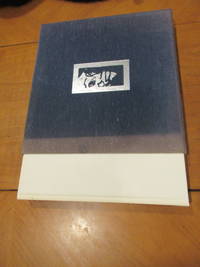
1982Best.-Nr. 059692Harry N. Abrams Inc. 1982. 2nd Edition . Hardcover. Fine/Slipcase. 296 Pp. Beige Cloth Stamped In Silver And In Blind. Second Edition. The Deluxe Issue #57 Of 150 Copies Numbered Signed By Sam Francis And In Special Slipcase Of Thick Tsumugi Silk. Fine With A Few Faint And Tiny Spots Of Foxing Around Fore Edges Of Front And Rear Covers Of Book. Slipcase Shows Fading Of Blue Silk Around Both Ends. Harry N. Abrams, Inc. hardcover
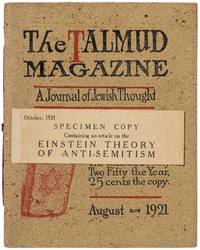
1921Best.-Nr. 553355Boston: Talmud Society 1921. Softcover. Fine. First edition. 12mo. 64pp. Original cord-tied wrappers printed in red and black. The first and last leaf toned from interaction with the wrappers else about fine. An August issue of the magazine apparently used in October to promote the short-lived magazine this copy with a printed slip affixed to the front wrap: “October 1921. Specimen Copy. Containing an article on the Einstein Theory of Anti-Semitism.” Photographic portrait of Einstein on page 14; along with an English translation of his essay: "Jewish Nationalism and Anti-Semitism: Their Relativity" which originally appeared in the London Jewish Chronicle. Talmud Society unknown books
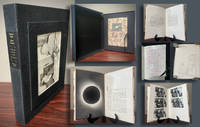
1955Best.-Nr. 33706New York: The Ram Press 1955. 1st Edition - Limited. 1st Edition - Limited. We are going to experience another full Solar Eclipse April 8 2024. This volume was to celebrate Albert Einstein and the Solar Eclipse of Jun 30 1954 and June 20 1955. Unusual Signed Kilfitt/Zoomar Eclipse Book with original Einstein Frank Back Photo. 8vo 5 1/2" x 8 1/2" 40pp signed and inscribed by Dr. Back on the second free endpaper. "To Leslie and Duke. We should never make statements witch are not planned correct and checked by us .we should not impress by telling sometime .stories in order to make contributions or to say something. Talking is silence. "Silence is gold" Wish you the very best from the heart. T F Back sept 11 1965" A fine copy in handmade decorative paper covered boards printed glossy paper label on the upper cover limited edition of 3000 copies in the original glassine outer wrapper showing some light sunning. This volume was dedicated to Albert Einstein and is the only book that was ever written by "The Father of the Zoom Lens". With / An original black & white silver gelatin 5 x 7 photograph of Dr. Albert Einstein and Dr. Frank Gerald Back seated together in very fine condition acquired directly from Dr. Back's estate. This photograph was taken circa 1954 and is one of the images published in this limited edition. With An 18" x 22" blueprint folded of the Solar Eclipse Spectrograph size "C" drawing. It was made from the original drawing dated 4/1/55 drawn by Zoomar's Chief Designer Alfred Joseph Quittner "AJQ" & approved by Dr. Back "FGB". A very interesting package indeed. Dr. Back was a very close friend of Albert Einstein. Dr. Einstein persuaded the author to take the trip commemorated in this beautifully produced volume in order to capture the total eclipse of the sun which occurred on June 20 1955. Dr. Back intended to provide conclusive evidence for Einstein's theory of relativity by calculating the optical distortion if any of starlight caused by the sun's gravity. Earlier in 1919 Einstein's general relativity principles were supported by observations of a solar eclipse. The two scientists conferred on the project for over a year. Armed with a special Zoomar designed & built wide-angle solar-eclipse spectrograph Dr. Back was off to the Philippine Islands to board a military jet & chase the eclipse. Einstein however died while Back was on his way to Manila. Unable to report the excursion to his friend Dr. Back dedicated this book to his memory. Dr. Frank Back held over 200 patents directly relating to photographic equipment. He was the founder & president of Zoomar Inc. The photographic term " zoom" was derived from Zoomar. Dr. Back created the first widely used zoom lenses for motion picture and television; then in 1959 introduced the first zoom lens for still cameras with the introduction of the 36-82mm/f2.8 Voigtlander Zoomar. Dr. Back & Zoomar purchased the great Heinz Kilfitt optical factory of Munich Germany in 1966 & it became a subsidiary of Zoomar Inc. This volume was never widely distributed & when Zoomar Inc. ceased operations at Glen Cove Long Island many cases of this book were discovered & unceremoniously trashed. The existing number of copies is unknown but the book is not frequently encountered. This copy came from the personal estate of Dr. Frank Gerald Back & it is one of the few copies signed by him. An excellent example suited for collectors of Science Astronomy Einstein Zoomar or Photographic History in general. In a lovely custom clamshell case with a window insert displaying the original Einstein/Back photo. On page 13 there is a typo. He wrote July 301954 instead of June 30 1954 and was never changed. The Ram Press unknown
1931Best.-Nr. 345H4370New York: The Macmillan Company of Canada Limited. Good. 1931. First American Edition. Hardcover. 8 9-94 pages. Select Bibliography. First published in London in 1930. "Professor Einstein is better known as a physicist than as a Zionist. Yet for many years he has given abundant proof both of a keen interest in Zionism and of a penetrating insight into its underlying ideas. He is impelled to Zionism by his acute consciousness of the excessive price at which the blessings of assimilation are bought by the Jewish communities of the Western world which for him are mainly represented by that of Germany. The price is a loss of solidarity of moral independence and self-respect. These in his view can be regained only if assimilated Jews find some common task of absolute human value to which they can bend their corporate energies as Jews. Such a task is to be found in the restoration of Jewish national life in Palestine." - Introduction. Unmarked with average wear. Backstrip lettering faded. Binding tight. A sound copy of this important compilation. Emanuel p.51. Boni Russ & Laurence 306.; 8vo - over 7¾" - 9¾" tall; Zionism Albert Einstein Politics Israel Palestine Theodor Herzl Zionist Organisation Jewish Colonial Trust Balfour Declaration Keren Hayesod Palestine Foundation Fund . The Macmillan Company of Canada Limited hardcover
1907Best.-Nr. 432971907. Einstein Albert 1879-1955. Berichtigung zu meiner Arbeit: "Die Plancksche Theorie der Strahlung etc." Offprint from Annalen der Physik 22 1907. Single sheet p. 800. Unbound as issued. 223 x 145 mm. Lower corner lightly creased but very good. First Edition Rare Offprint Issue. Einstein's important correction to his paper on specific heats "Die Plancksche Theorie der Strahlung und die Theorie der spezifischen Wärme" 1907; see Weil 15 which "made clear for the first time that quantum concepts have a far more general applicability" Pais p. 394. "Einstein initially believed that his oscillating lattice points in a three-dimensional crystal lattice were electrically charged ions. A few months later he published a correction to his paper in which he observed that this was an unnecessary assumption . . . Einstein's correction freed the quantum rules in passing one might say from any specific dependence on electromagnetism" Pais p. 396. Pais Subtle is the Lord pp. 394-396. Weil 15n. . unknown
1906Best.-Nr. 38892Leipzig 1906. Einstein Albert 1879-1955. 1 Eine neue Bestimmung der Molekuldimensionen. In Ann. d. Physik 4th series 19 1906: 289-306. 2 Zur Theorie der Brownschen Bewegung. In ibid.:371-381. Whole volume 8vo. viii 1080pp. 5 plates. 213 x 143 mm. Original cloth spine faded split in upper half of spine inner hinge cracking. Very good. 1 First Edition in Journal Form Revised of Einstein's doctoral thesis ranked by his biographer as being on the same level as his 1905 papers on relativity the light quanta and Brownian motion. In his thesis Einstein presented a new theoretical method for determining molecular radii and Avogadro's number the number of atoms or molecules needed to make up a mass equal to a substance's atomic or molecular weight in grams. The thesis appeared in print in the spring of 1905; in the journal version published at the beginning of 1906 Einstein added a brief appendix containing an improved value of Avogadro's number. Einstein's biographer Abraham Pais wrote of Einstein's thesis as follows: "It is not sufficiently realized that Einstein's thesis is one of his most fundamental papers. Histories and biographies invariably refer to 1905 as the miraculous year because of his article on relativity the light-quantum and Brownian motion. In my opinion the thesis is on a par with the Brownian motion article. In fact in some-not all-respects his results on Brownian motion are by-products of his thesis work emphasis ours. This goes a long way toward explaining why the paper on Brownian motion was received by the Annalen der Physik on May 11 1905 only eleven days after the thesis had been completed. "Three weeks after the thesis was accepted this same journal received a copy of the thesis for publication. It was published only after Einstein supplied a brief addendum in January 1906. . . . As a result of these various delays the thesis appeared as a paper in the Annalen der Physik only after the Brownian motion article had come out in the same journal. This may have helped create the impression in some quarters that the relation between diffusion and viscosity-a very important equation due to Einstein and Sutherland-was first obtained in Einstein's paper on Brownian motion. Actually it first appeared in his thesis . . . ." "Quite apart from the fundamental nature of some results obtained in the thesis there is another reason why this paper is of uncommon interest: it has had more widespread practical applications than any other paper Einstein ever wrote . . . . The thesis dealing with bulk rheological properties of particle suspensions contains results which have an extraordinarily wide range of applications. They are relevant to the construction industry the motion of sand particles in cement mixes to the dairy industry the motion of casein micelles in cow's milk and to ecology the motion of aerosol particles in clouds to mention but a few scattered examples. Einstein might have enjoyed hearing this since he was quite fond of applying physics to practical situations" Pais Subtle is the Lord pp. 89-90. Pais notes that during the period 1970-1974 the 1906 journal version of Einstein's thesis was cited four times more often than his 1916 paper on general relativity and eight times more often than his 1905 paper on light quanta. 2 First Edition of Einstein's second paper on Brownian motion containing two further methods for finding Avogadro's number. This was the first of his papers on the subject to include the term "Brownian motion" in the title. Pais pp. 95 98. . unknown
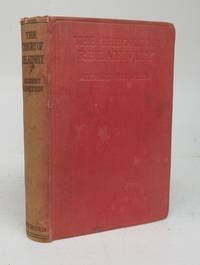
1920Best.-Nr. 134847London: Methuen & Co 1920. First UK Edition. Hardcover. Good. xiii 3 138 2 8 p. 20 cm. 5 diagrams and frontispiece portrait of the author. Red cloth with blank impressing on front black print on spine. Some soiling to covers corners bumped spine faded small tears in spine head. Front pastedown has bookplate for Brenda Mary O'Keefe and small chip to edge. Offsetting to free endpapers. Front hinge cracking internally. A few stains within. 8 p. of Methuen publications listed at rear. First edition of the authorized translation into English of the "popular exposition" of Einstein's theory of relativity. Includes third appendix on "The Experimental Confirmation of the General Theory of Relativity" written by Einstein specially for this edition at the request of the translator. First published in German in 1916 "Relativity" gives readers an insight into the thought processes of one of the greatest minds of the 20th century. Methuen & Co hardcover
Best.-Nr. dola813New York: Henry Holt And Company 1920. First American Edition. The English translation contains an additional chapter 'Appendix III The Experimental Confirmation of the General Theory of Relativity.' See Printing and the Mind of Man 408. 8vo. pp. xiii 168. frontis. portrait. biblio. index. cloth spine ends just beginning to fray. Very good copy New York: Henry Holt And Company, 1920 hardcover
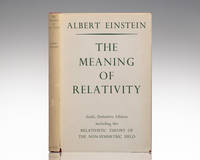
1956Best.-Nr. 149754London: Methuen & Co. Ltd 1956. Sixth edition of Einstein's clear and systematic exposition of the theory of relativity with the ownership stamp on the front and rear pastedowns "Stephen Hawking Newton Institute University of Cambridge Cambridge England." Octavo original cloth. Translated By Edwin Plimpton Adams and Ernest G. Straus. Fine in a very good dust jacket. An exceptional association. In the book Einstein outlines both the special and general theories of relativity explaining their mathematical foundations and physical implications particularly regarding the nature of space time and gravitation. Designed for readers with a background in physics and mathematics the text serves as both a summary of Einstein’s groundbreaking contributions and an accessible guide to the conceptual shifts his theories introduced to modern science. The work remains a significant historical and intellectual document illustrating Einstein’s effort to communicate complex scientific ideas with clarity and precision. Methuen & Co. Ltd hardcover
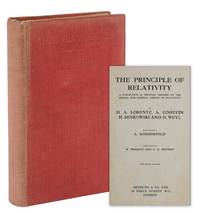
1923Best.-Nr. 140949178London: Methuen & Co 1923. First Edition. Very Good. First British edition first printing. viii 216 8 ads pp. Bound in publisher's red cloth lettered in blind on front board and in gilt on spine; lacking the dust jacket. Very Good with fading light wear and soiling to covers. Evidence of bookplate removal to front pastedown offsetting to free endpapers rear hinge starting. Contents lightly toned with foxing to first and last few pages and textblock edges. An influential collection of eleven papers on relativity. Seven are authored by Einstein two by Henrik Lorentz and one each by Hermann Minkowski and Hermann Weyl. The first edition of this translation of Das Relativitaetsprinzip taken from the fourth German edition. Methuen & Co unknown