99 906 résultats
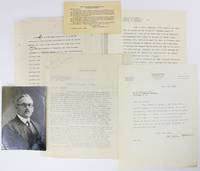
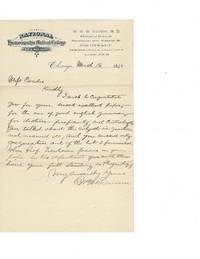
1890réf. 162101890. Cowles Clara S. Two letters and associated professional cards 1893-1896 document Cowles's medical education through examination results and written commendations from physicians and instructors. The earliest records place her at the National Homeopathic Medical College of Chicago where W. M. W. Davison M.D. congratulated her on an academic paper and separately certified scores of 90 in Histology and Physiology and 100 in another recorded subject. A second surviving card signed by E. S. Reed Professor of Dental Surgery records a standing of 98 in Dental Surgery for the 1892-1893 session. Three years later physicians L. D. Rogers and Ida Wright Rogers corresponded with Cowles at El Dorado Kansas concerning additional examination papers. The documents preserve named instructors subjects scores and evaluations from a woman's professional medical training during the 1890s. The group comprises two letters and six associated business cards. 1 Davison W. M. W. March 16 1893. Autograph letter signed on National Homeopathic Medical College of Chicago letterhead. One page 9 x 5¾ inches. Davison writes "Miss Cowles Kindly I wish to congratulate you for your most excellent paper." An accompanying Davison business card also dated March 16 1893 certifies that "Miss C S Cowles has passed the examination in Histology and Physiology" and records her standings as "90 in the former and 100 in the latter." Another card from E. S. Reed is inscribed and signed on the verso: Miss C. S. Cowles "has a standing of 98 in Dental-Surgery for the session of 1892 & '93." 2 Rogers L. D. M.D. and Ida Wright Rogers M.D. January 24 1896. Typed letter signed on The People's Health Journal letterhead. One page 8½ x 11 inches. Addressing "Miss Clara Cowles El Dorado Kas." the physicians acknowledge receipt of her "first examination papers" and report "We have returned the papers. They were excellent." They also thank Cowles for supplying the names of two friends and encourage continued correspondence: "Let us hear from you often." A joint business card for Drs. Rogers & Rogers and four additional physicians' cards accompany the correspondence; one bears a penciled address for dentist E. S. Reed. The surviving papers trace Cowles through several forms of professional evaluation rather than merely identifying her as a medical student. Davison's congratulations the numerical results in histology physiology and dental surgery and the Rogerses' assessment of her later examination papers record specific measures of her academic performance between 1893 and 1896. They also identify a network of physicians and medical educators who corresponded with her as she pursued professional training. The Davison letter is in excellent condition with two horizontal folds. The Rogers letter has two vertical folds and one horizontal center fold with a small tear at the upper-left crease; otherwise very good condition. A compact documentary record of a woman's medical education in the 1890s preserving her examination performance and direct commendations from the physicians and instructors evaluating her work. unknown books
1910réf. 166721910. Women in Science Medicine Original Gelatin silver print photograph of a Rustic pharmacological laboratory with female technician c. 1910. Three individuals pose amongst dozens of glass vials containing medical powders and remedies. 3.5 x 5 in. Original black and white photograph. Two figures wear white aprons or smocks indicating their important role in mixing and measuring different medicines. The first university Pharmacology department was established in 1847 and thus began the formalization of this field of scientific research as the 20th century witnessed a steady increase in the number of new drugs that would improve the human condition tremendously. Verso inscription in pencil and pen in European language. Very good condition. unknown books
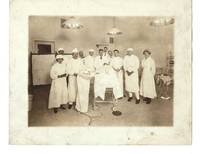
1900réf. 162081900. Original photograph of an operating room and surgical team early twentieth century showing two women among eleven medical personnel gathered around a patient during a surgical procedure. One woman positioned at the left wears an operating apron and rubber gloves placing her within the immediate surgical environment rather than among unidentified observers outside it. The second woman stands at the opposite edge of the group. Their precise professional roles cannot be determined from the photograph alone but their presence records women working within a medical setting during a period when women were establishing careers as physicians surgeons nurses and other hospital professionals. Original sepia photograph 8 x 10 inches. Eleven figures dressed predominantly in white surround a patient on an operating table. Most appear to be men; two women stand at the edges of the group including the woman at left wearing an apron and rubber gloves. The room clothing operating table and other visible equipment provide evidence of contemporary surgical practice and hospital procedure. No names institution location or date are supplied and the photograph does not provide sufficient evidence to identify the participants' specific medical positions. The image preserves the physical arrangement of an early modern operating room while documenting women's presence among its medical personnel. The gloved and aproned woman at left is particularly notable because her clothing associates her directly with the procedure although the photograph does not establish whether she served as a physician surgeon nurse or in another capacity. Light surface scuffing two water marks in the lower-left quadrant and dirt and staining along the image borders; light crease at upper-left corner and a small tear to the lower-right edge. Image remains crisp and clear; good condition. A detailed visual record of women working alongside men in an early twentieth-century surgical setting. unknown books
1895réf. 162091895. Houston E. C. Autograph letter signed to Dr. Lydia Bailey 1895 documents a male physician deliberately seeking a woman physician as a prospective wife and the personal scrutiny directed toward a professionally educated woman in late nineteenth-century courtship. Writing from Memphis Tennessee to Bailey in Philadelphia Houston addresses her professionally as "Dear Doctor" and explains that he wishes to correspond with a "lady physician" with marriage in mind. His stated preference is explicitly tied to professional education: he seeks a woman "educated in the same profession" because he believes he "could love her better" than a wife who did not share his medical background. The letter acknowledges Bailey first as a physician while simultaneously subjecting a prospective professional equal to detailed questions about marriage biography and physical appearance. Houston E. C. 1895. Autograph letter signed to Dr. Lydia Bailey Philadelphia. Six pages 7¾ x 5 inches. Houston supplies information about himself and asks Bailey to reciprocate with particulars about her background. His inquiries extend to her physical measurements including "height weight and measurement around hips waist & chest" placing unusually specific questions about her body alongside his expressed interest in her medical education. Accompanying the letter are the original envelope Houston's calling card identifying him as a medical doctor and a blank prescription sheet bearing his medical credentials. These supporting pieces substantiate the professional identity from which Houston writes and preserve the medical stationery associated with his Memphis practice. By 1895 women had established a sustained presence in American medical education and practice but they remained a small minority of physicians and continued to encounter institutional and social barriers within the profession. Houston's letter records one consequence of that changing professional landscape at the level of private correspondence: the possibility that a male physician might seek a spouse specifically because she possessed the same professional training. His language also shows how recognition of a woman's medical status could coexist with conventional expectations surrounding marriage and female appearance. Two worn horizontal mailing folds with separation beginning along fold edges; minor tape repairs to sheets two and three and light handling soil while the handwriting remains clean and legible. Original envelope calling card and prescription sheet present; very good condition. A direct record of professional status courtship and gender expectations addressed to an American woman physician in 1895. unknown books
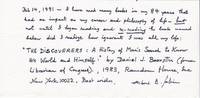
1991réf. 142191991. Sabin Albert B. Autograph note reflecting on intellectual influences late in the career of the scientist who developed the first successful oral vaccine against poliomyelitis. Albert B. Sabin became internationally known during the mid twentieth century for creating the live attenuated oral polio vaccine a development that transformed global public health by enabling mass immunization campaigns against one of the most feared diseases of the twentieth century. Written in 1991 when Sabin was eighty four years old this note records a reflective statement on the book that he regarded as having a profound influence on his understanding of scientific discovery and intellectual history. Sabin Albert B. Autograph Note Signed. February 14 1991. One page measuring 8.5 x 4 inches. In bold black fineline pen Sabin writes about the book he considered most influential in shaping his philosophical outlook late in life: "I have read many books in my 84 years that had an impact on my career and philosophy of life but not until I began reading and re reading the book named below did I realize how ignorant I was all my life: 'THE DISCOVERERS: A History of Man's Search to Know His World and Himself' by Daniel J. Boorstin former Librarian of Congress." He signs the note "Albert B. Sabin." Sabin's oral polio vaccine introduced in the early 1960s became the cornerstone of international polio eradication campaigns and remains one of the most consequential medical breakthroughs of the twentieth century. His work dramatically reduced the global incidence of poliomyelitis a disease that had caused widespread paralysis and death during the first half of the century. This late life reflection connects Sabin's own scientific career with a broader intellectual tradition of discovery and inquiry represented by Daniel J. Boorstin's historical study of scientific exploration. Original mailing folds visible; otherwise well preserved. Overall very good to near fine condition. A reflective manuscript note by the virologist responsible for one of the most important medical advances of the twentieth century. unknown books
1996réf. 281111Lincolnwood Illinois: Publications International 1996. Softcover. Near Fine. First edition. Quarto illustrated card covers 400pp. Near fine with pages age-toned. Publications International unknown books
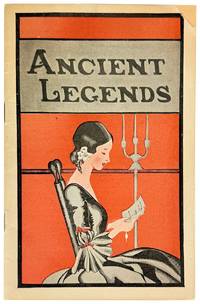
1920réf. 50039Lynn MA: Lydia E. Pinkham Medicine Company 1920. Very Good Condition. Lynn MA: Lydia E. Pinkham Medicine Company n.d. ca. 1920s. 12mo 17.5cm; pictorial wrappers; 32pp.; illus. throughout. Light wear to wrappers with tiny loss at top fore-edge corner of upper cover stock uniformly browned and brittle due to poor paper stock. Very Good overall. Small promotional pamphlet from the makers of Lydia E. Pinkham's Herb Medicine and other remedies. Pinkham 1819-1883 began heavily marketing her Vegetable Compound in the 1870s which promised to cure most female "ailments." The company continued manufacturing even after Pinkham's death in 1883 and by the early 20th century her Vegetable Compound "was one of the most trusted well-known patent medicines" Mary Cross A Century of Icons: 100 Products and Slogans from the 20th-Century Consumer Culture p. 17. This little booklet marketed to adolescent girls who were just starting to need medicinal intervention for their ailments mixes well-known Greek myths and simple line drawings with promotional spots for different products and consumer testimonials from around the world. In San Francisco Mrs. Frater's 13-year-old daughter's acne was cleared up with Pinkham's Herb Medicine while Mrs. Hubbard in Kent England "driven near mad with depression" has taken the Herb Medicine Vegetable Compound and Pills for Constipation. "They have done wonders for me. Lydia E. Pinkham Medicine Company unknown books
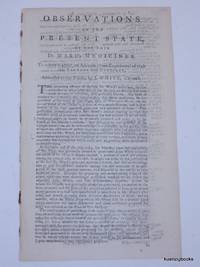
1775réf. 25679London : np 1775. First Edition. Disbound. Very Good. First Edition. 1-4 pp. 8vo. Extracted from a bound volume with offsetting on the last page indicating it was bound opposite the September 1770 issue title page of Gentleman's Magazine. Small marginal hole not affecting text. Disbound. Caption title from page one. English Short Title Catalog N12918. Blake J. NLM 18th cent.; p. 488 both copies at NLM are extracts. While well represented in digital form this title is only found at the National Library of Medicine from what we have been able to determine which guesses that the publication date is 1775. Our copy with the offsetting from a September 1770 title page may help in further scholarship on the date of publication. np unknown books
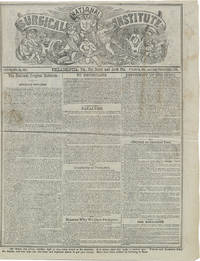
1876réf. 1115Philadelphia: National Surgical Institute ca. 1876-1880. Softcover. Very good. Broadsheet 14 x 10 3/4 inches. 4 pp. In-text illustrations. Half-inch closed tear at vertical fold affecting a few characters of text. Contemporary folds. Mild light staining. Very good. Advertising circular of the National Surgical Institute promoting - in breathless nineteenth-century fashion - its treatment of paralysis spine hip eye and "private" diseases tumors and various injuries and congenital deformities richly illustrated with wood-engravings of infirmities orthopedic apparatuses and the Institute's buildings in Indianapolis Philadelphia Atlanta and San Francisco. Founded in Indianapolis by Dr. H. R. Allen in 1858 the National Surgical Institute was one of the earliest American specialty hospitals devoted to the treatment of orthopedic deformities and the manufacture of corrective surgical appliances. By the 1870s it operated branches in Atlanta San Francisco and Philadelphia where the present broadsheet was likely printed. No copies located on OCLC. Rare. National Surgical Institute paperback books
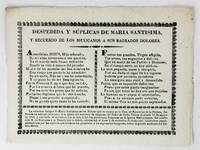
1833réf. 6283Mexico City 1833. Near fine. Broadside 6.25 x 8.5 inches. Very minor soiling and wear. Cholera was a genuine scourge in 19th-century Mexico and the present work comes out of the epidemic that broke out in August of 1833. According to parish records it is estimated that a total of five percent of the population of Mexico City died as a result with the number of deaths causing overcrowding in both hospitals and cemeteries. The present document describes how the image of Our Lady of Sorrows was venerated in the Casa de los Ejercicios de la Profesa and carried in solemn procession to the church of the convent of the nuns of the Lord of Santa Teresa on Saturday August 17 1833 only eleven days after the first case of cholera was detected in Mexico City. After the conclusion of the novena held in the Metropolitan Church the image of the Most Holy Mary was returned to its temple on September 9 1833; through the supplications made by the faithful to the aforesaid images the great epidemic of cholera morbus was thereby calmed. An ephemeral piece not traced in OCLC. unknown books
1946réf. 0213181946. First Edition. Poster. Very light soiling. About Fine. A 15" x 19-1/2" poster in color apparently produced in 1946 when the U.S. military was trying to enforce a policy of non-fraternization in the occupation zones between the troops and European women. It depicts a sullen soldier sitting on his bunk in uniform above the title of the poster and the caption "Prophylaxis Prevents Venereal Disease!" In the lower left corner in small letters: "VDgraphic--76." unknown books
1826réf. 37211Harrisburg PA 1826. Folio sheet folded to 4 pp for mailing. Addressed with Harrisburg postmark to Dr. Fairlamb in Downingtown. With tear from seal remnant affecting a single letter. Very Good. "My Dear Fairlamb In as much as the passage of the new Medical school bill will crowd our profession which is already full by offering greater facilities to the study of medicine and as the Jefferson Medical faculty have already given us an earnest that they will prostitute medical honours by conferring them on men unacquainted with medical science the interest of medical men throughout the State is consequently deeply involved. The degree of Dr. of medicine has been conferred on Jonathan Pound a book-binder by the Jefferson College after having attended one course only. Five of the six professors were in favour of conferring a degree on my neighbour Henry Zook who is almost an idiot. A letter was received last night from Dr. Hiester of Reading in which he states that "two quacks in Lebanon county have actually received from the professors of the Jefferson College a promise of the Degree of Doctor of Medicine for exertions which they have made and are still making to send forward petitions in favour of the new medical school. "From such dishonourable proceedings I am confident that your well judging mind will revolt. As the more you view this bill in all its bearings the more you will be convinced that it will interfere with our interest." Harris urges Fairlamb to use his influence by urging Representative Hunt to oppose the bill. Hon. William Harris 1799-1865 a civil engineer was the son of James Harris a Pennsylvania State Senator and cofounder of the town of Bellefonte. He was son-in-law of Dr. George Ashbridge Fairlamb 1784-1829. Dr. Fairlamb received his medical degree from the University of Pennsylvania in 1808 and practiced medicine in Downingtown for many years. He also established The Independent Journal of Downingtown a Jackson paper with George Plitt in 1827. unknown books
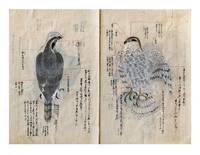
réf. 11548Four anatomical diagrams & two text illus. in Vol. I and many fine & large color paintings & diagrams in Vol. II. 47; 42 folding leaves. Two vols. 8vo 268 x 194 mm. orig. patterned semi-stiff wrappers new stitching. Japan: from colophon leaf in Vol. II in trans.: "Selected by Mori Masayuki 森正幸 age 66 April 1856 with his two seals; artist EishÅ 栄秋 artist name ChÅkosai 鳥呼斎 given on final leaf of text in Vol. II age 66 copied" with his two seals. These two finely illustrated volumes describe the art of falconry and the medical treatment of falcons as practiced by the Yoshida ryū school founded in the 17th century and one of the two most prominent schools for shogunal falconers the other being the older Suwa ryū. The shogunate granted each school official residences in Edo; the Yoshida ryū was located in Zoshigaya and Suwa ryū in Komagome. The Yoshida school established its own formal techniques and aesthetics of falconry and of the two was considered the more refined with advanced methods of training diet veterinary medicine hunting etiquette and rituals and development of specialized perching positions. Our texts were written by Mori b. 1790 a member of the Yoshida school. He wrote and edited many works on falconry all of which remained in manuscript. Our two manuscripts are part of Mori's larger work "Falconry in Four Seasons" which he compiled in 1854. Our first volume Part VIII of Mori's greater work is concerned with the medical care of falcons and includes discussions of moxibustion diet and herbal medicines. Falcons are subject to a number of respiratory parasitic and viral diseases many of which are diagnosed here; remedies using herbal medicines are provided. Falcons also suffer attacks by other birds cranes geese eagles etc. and animals and the text offers treatments for broken claws and beaks wounds and cuts bone fractures and mouth and nostril bleeding. There are instructions on the proper feeding of falcons meats of various kinds. The illustrations in the first volume depict four anatomical cross-sections of falcons. The first two show moxibustion locations and the second two show likely areas of injury. Towards the end are another two fine illustrations showing successful and unsuccessful applications of moxibustion. The text also includes many materia medica recipes dosages and proper usage. Our second volume is also part of Mori's masterwork and is beautifully illustrated with a series of seven splendid paintings of falcons. The first image identifies and names all the feathers of the bird when its wings are spread along with the parts of the legs and talons. The other paintings include a careful and detailed image of the head wings and talons and images of the bird's physique one from the posterior and and another from the front identifying all the parts of the head. The final image depicts a falcon's skeleton. This is followed by another series of 12 paintings of the falcon's prey pheasants rabbits quail heron ducks etc. Each prey animal is shown carefully hung and bled. In another series of three pages of paintings we see the equipment used for training and keeping falcons baskets and tools and the very elaborate cages used to transport the falcons. The final pages show a six-page panorama of a falconer carrying a falcon on his arm to the field prey flying in the distance the falcon in pursuit and the falconer separating the falcon from its prey. The final leaf of the second volume bears the seals of the author Mori and the artist EishÅ with the date 1856. Fine condition. There is some worming throughout carefully repaired. Preserved in a chitsu. unknown books
1936réf. 6273Various locations 1936. Very good. Twenty-nine letters and documents totaling 36pp. plus a 10pp. manuscript and additional related photos ephemera and clippings. A few items dated later or earlier. Old folds some light wear and scattered soiling. An interesting archive of items relating to the career of Amos Osborne Squire the Chief Physician at Sing Sing Prison in the 1920s and the medical examiner for Westchester County for nearly twenty-five years. Squire 1876-1949 was a graduate of the Columbia College of Physicians and Surgeons in 1899 subsequently establishing his medical practice in Ossining. He ran a private sanitarium from 1910 to 1920 and was appointed chief physician at Sing Sing prison in 1914. Though opposed to capital punishment he held this post for ten years before deciding it was too emotionally taxing. He served as the medical examiner for the county from 1925 until his death in 1949. He published a book about his experiences at Sing Sing in 1935. The centerpiece of the present archive is a ten-page typescript with annotations and corrections on the subject of capital punishment. It appears to be the text of a speech Squire gave on the subject and in it he highlights the danger of condemning an innocent man. He proceeds to provide the details of a particular death penalty case that illustrated his concerns writing in part: "I thought for a good many years that it might be necessary to have capital punishment in order to deterr sic murder but being connected with Sing Sing Prison and having had an opportunity of studying more than 200 men condemned to death and taking part in 138 electrocutions.I have come to the conclusion for some time past that the death penalty does not lessen murder. . One of the importent sic factors in the conviction of Steilow was expert testimony and where expert testimony is received.I do not feel that too much weight should be given to such testimony unless it is corroborated by more exact facts. . It may be well enough to send a man to prison on expert testimony for a period of years but no one who has stood by the side of.the rigid form of the person being electrocuted will believe that the extreme penalty of death should be imposed on such expert testimony." Correspondence within the archive concerns legal cases autopsies and Squire's career with the New York Naval Reserves. Some of the legal letters concern worker's compensation or insurance claims. One of these from 1944 concerns an electrocution -- something with which Squire was all too familiar. He reviews the details of the case his research on the subject and concludes "I personally autopsied 138 men who were legally electrocuted at Sing Sing Prison. I have read the report by Dr. Brian Stookey and I agree with him in every respect.that the claimant in this case could not have been injured by 15000 volts and a half milliampere of current which would have produced progressive muscular atrophy." There are likewise some travel receipts and medical receipts as well as four photographs which depict Dr. Squire and his wife. A wonderful and interesting archive of an important medical figure in New York State. unknown books
1829réf. 26007Lancaster PA: H W Villee 1829. Second expanded edition. Original half-calf over marbled boards. Very good; some occasional internal spotting; small tide mark to the upper fore corner of the title page. 12mo 6 7 - 192 pp. A compilation of medical cures professing to be more effective than any extant. The first edition quickly sold out. There are several appendices to the text.The first provides recommendations for fruits herbs and roots to be kept in the house 22 pp.; useful formulae for all kinds of colors preservatives and "secrets" 10 pp.; controlling harmful insects 4 pp.; hints for hunters and fishermen 4 pp.; two separate lists of medicines and pharmaceutical ingredients to be had off the land 6 pp.There are an additional 30 pages of text in this edition. Arndt #3025 variant A - with a full page illus. of the title; S&S #40361. H W Villee hardcover books
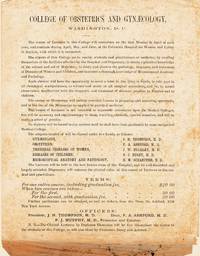
1873réf. 25031Washington DC: College of OB-GYN. 1873. Unknown edition. As issued. Very good; lower blank margin dust soiled and rumpled. 4to sheet printed recto only; meas. appx. 260 x 200 mm. The college was first incorporated in 1873. The proposed courses listed were to be offered April through June at the Columbia Hospital for Women and Lying-in Asylum. Staff is listed; objectives outlined - to gain practical experience in the hospital in order to supplement a formal medical college degree. Fees ranged from $20. to $40. Absent from OCLC. College of OB-GYN. unknown books
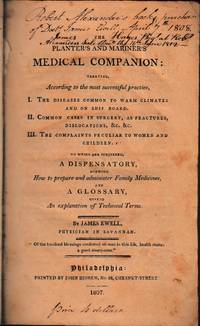
1807réf. 24136Philadelphia: Printed by John Bioren 1807. First Edition. Full contemporary leather and marbled endpapers. Good with toning and spotting; first 50 pp with small marginal tide marks and intermittent damp. The front joint is partially split; joints chafed; leather scuffed. 8vo xvi numbered with an insertion of 4 unnumbered pages of 'Recommendations' thereby making 20 total 1 - 328 2 - advert. for Robert Harris Druggist pp. This copy with an interesting autograph note on the title page: Robert Alexander's books purchased of Doctor James Ewell April 7 1808. James Hayes Bght. at Rob't. Alexander's sale Doc. the 14th June 1812. "And to whom am I so bound by the tenderest ties of affection and gratitude as to Mr. Jefferson" from the Dedication. The author's father Jesse was a school classmate - at William & Mary - and life long friend of Thomas Jefferson. Ewell sent Jefferson a copy of the book Sowerby Catalog #893 and in response March 1808 Jefferson wrote: I return you my thanks for the copy of the Medical Companion you have been so kind as to send me and must particularly express my sense of the favorable sentiments expressed towards me in the beginning of the work; especially too where it recalls to my recollection the memory of your respectable father who was the friend & companion of my youth and for whom I retained through life an affectionate attachment. the plan of your work is certainly excellent and its execution as far as I am a judge worthy of the plan. it brings within a moderate compass whatever is useful levels it to ordinary comprehension and as a Manual will be a valuable possession to every family . . . . Ewell was the first to: " . use ice internally in dysentery cases. He established himself in Savannah Georgia with the help of Thomas Jefferson and there introduced vaccination for small-pox Sowerby" His book ran to 10 editions in post-colonial America. The first however is uncommon in the market. The text is divided into three sections: ship board injuries; common cases; ailments of women and children. The 'Table of Medicines' subjoined to the text likely received the most frequent use. It is laid out in a series of charts with dosages and compositions noted matched to the recommendations in the body of the text. Being located in the heart of South the planter's companion was a sure sell encouraging the preservation of valuable assets with minimal cost. As the autograph note illustrates and confirms it was not uncommon in this period for the handful of southern authors to have their books printed "up north" and distributed locally. In this instance recording a copy sold by Ewell himself. The book also manifests signs of hasty "job printing" by Bioren e.g. the awkward insertion of the 4 unnumbered pages of Recommendations printing letters of B Barton N Chapman among others in the introduction; an overlarge typeface selected to print the dedication. Sowerby #893; Austin #742; see BSA Papers vol. 43 #3 321-334 pp. for an article on Bioren. Printed by John Bioren hardcover books
1771réf. 24054Philadelphia: Henrich Miller 1771. First Edition. Contemporary half-leather on paper covered boards. Some wear around the upper front joint of the binding; boards chafed; there is a loss of several letters and 4-5 words along the gutter of the last page of the Contents; the running title is also affected; on the verso an ornamental ruling line and the final letter "r" in the word Herausgeber. There is overall toning and some finger soiling to the first 5 leaves. Front free endpaper is torn; several pages loose in the first signature. 8vo 10 2 3 -184 pp. Vignette title the second title page with the frequently reproduced woodcut of a horse. Rare. One of the earliest American veterinary books in the colonial era. Though the horse is main subject the inclusion of all kinds of domestic farm animals insured its use in the rural Pennsylvania German farming towns. The medicinal recipes are presented in a thoroughgoing fashion with the admonition from the author that many botanical remedies in the available literature mainly the Philadelphischen Calender that always contained a section devoted to botanical cures and practice bear multiple names but are identical. Something his readers should be aware of when following the recipes. He also warns that general treatment and care of animals is as important as the suggested remedies on offer. Austin #2085; Evans #12692; Arndt #403; Tucher #2206 copy located apparently not complete. Henrich Miller hardcover books
1855réf. 24076Europe 1855-1875. Mid 19th century half leather. Very good. Thick 8vo. A remarkable collection of uncommon works on military medicine in French Italian German and Dutch covering gunshot wounds hospitals the Red Cross Florence Nightingale ambulances first aid etc. Several have the ownership marks of Felix Hippolyte Larrey and numerous presentation inscriptions from their respective authors. The contents of the volume are as follows: 1 Charles Shrimpton - La guerre d'orient. L'armée anglaise et Miss Nightingale Paris Germer-Baillière 1864 4 iv 68 pp. with an inscription from the baron Larrey at the foot of the title page; OCLC - NYAM. 2 Giovanni Melchior - Ferita da arma da Fuoco alla regione deltoidea . Milan 1867 6 2 pp.; not in OCLC. 3 Henry van Holsbeek - Souvenir de la guerre franco-allemande. Consideration au point de vue hospitalier et chirurgical . Deuxieme édition Brussels Muqardt . 1872 71 1 - blank large folding plate of a hospital/barracks; upper fore-corner of half-title torn away with some loss to the autograph presentation; OCLC - NLM. 4 Andre Uytterhoeven - Institution en Belgique d'une Société internationale et permanente pour concourir en temps de guerre au service de santé des armées Brussels 1864 26 pp.; not in OCLC. 5 Printed Form - Bulletin d'adhésion . Brussels 1864 1 leaf printed recto only; not in OCLC. 6 Onésime Lecomte - De l'exploration des balles dans les plaies par armes á feu des os et des articulations Paris Rozier 1863 58 pp. plate; OCLC - BL only. 7 Marinus W C Gori - De militaire chirurgie en de geneeskundige dienst te velde . Amsterdam Post 1875 viii 1 - 63 64 - blank pp. with an inscription from baron Larrey at the foot of the title; not in OCLC. 8 Alfred-Auguste Touraine - Note sur quelques moyens de déligation chirurgicale tres utiles en campagne et quand on est privé des ressources de hôpitaux . Paris Rozier 1875 28 pp. 7 plates; not in OCLC. 9 Cesare Fumagalli - Aforismi di chirurgia militaire Milan 1866 15 1 - blank pp. inscribed by the author; not in OCLC. 10 Amédée Tardieu - 8me ambulance de campagne . Août 1870 - Février 1871 . Paris Delahaye 1872 105 3 pp. with an author inscription on the half title; OCLC - NLM. 11 René Briau - Du service de santé militaire chez les Romains Paris Masson 1866 96 2 pp. with an insciption of baron Larrey at the foot of the title; OCLC - BL; Bodleian. 12 André Uytterhoeven - Encore un mot sur les moyens de porterimmédiatment . Brussels Tircher 1855 24 pp.; not in OCLC. 13 Z. Merchie - Des secours à porter . Brussels Lelong 1855 42 pp.; not in OCLC. 14 Wilhelm Roth - Militairärtzliche Studien . Berlin Vossische Buchhandlung 1864 124 2 pp. 7 plates with an inscription from Larrey; OCLC - BL & RCS. 15 Arena Gaetano - Descrizione d'una vettura di ambulanza . Turin Cassone 1867 11 1 - blank pp.; not in OCLC. 16 Anon. - Le présent et l'avenir du corps de santé des armées de terre Paris Bracke 1860 56 pp.; OCLC - BL. 17 Félix Rochard - Projet de creation d'une ambulance sur la Seine 1871 2 28 pp. lithographed; not in OCLC. 18 Felix Rochard - Projet de création d'un hôpital sur l'eau Paris Renau et Maulde 1872 23 1 - blank two large folding plates; OCLC - Yale NLM Wellcome & Chicago. 19 Benjamin Milliot - Du diagnostic et de l'extraction des projectiles . Paris Asselin 1872 20 pp. text illustrations; not in OCLC. hardcover books
1911réf. 24101Shanghai: American Presbyterian Mission Press 1911. Second revised edition. Publisher's cloth binding. Very good. 8vo 2 ii 2 - errata 1 - 558 vi - errata pp. An elaborate and erudite revision of F Porter Smith's original book. Successive volumes on the animal and mineral parts of the materia medica were never written. American Presbyterian Mission Press hardcover books
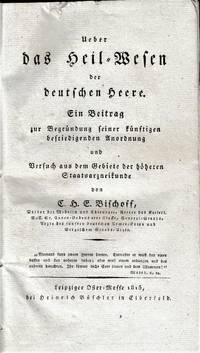
1815réf. 23038Elberfeld: Leipziger Oster-Messe bei Heinrich Buschler . 1815. First Edition. Contemporary pressed paper boards with blue glazed paper covering and gilt stamping. Very good; some spotting to the front board; some wear along the front joint. 8vo xlii 1 - 620 2 - errata pp. 5 large folding charts & tables. A handsome little known book; printed for the military. Bischoff presents a minute analysis of the army's medical practices and organization during the Napoleonic period something he feels had spanned 30 yrs. with suggestions for qualitative and quantitative changes in the post war era. This is in preparation for making fundamental changes and suggestions to practices and organization now that German independence had been re-established. Rarely are such plans presented in print and with such scale and organization. The imprint is most unusual hinting at a limited distribution and print run. See Hirsch I 550; OCLC has a handful of copies in European institutions none in America. Leipziger Oster-Messe bei Heinrich Buschler .... hardcover books
1800réf. 22099Paris ca1800. Contemporary half-leather. Good; some modest stains; ownership stamp; occasional close margin. 8vo appx. 300 pp. with assorted numeration. The following items are in the volume: 1 Précautions relatives a la dyssenterie . 8 pp. Imp. du dept. de la Guerre; 2 Instruction relative a la slaubrité des camps . 8 pp. Imp.de la Republique 1795; 3 Instruction sommaire sur les eaux minérales . 10 pp. 1795; 4 Loi. Qui fixe le traitement des Officiers de santé des armées 4 pp. Imp. de la Republique 1795; 5 Instruction sur les eaux minérales a l'usage des troupes 16 pp. Imp. de la Republique 1797; 6 Bulletin de lois de la republique #310 16 pp. nd; 7 Arrêté . concernant les hôpitaux militaires 104 pp. 1798; 8 Extract Journal Militaire 99pp. 1799; 9 Dept. de la Guerre . Conseil de santé des Armées. Aux Officiers de santé en chef des hôpitaux . 10 pp.; 1801; 10 . Conseil de santé aux officiers de santé . et aux chirurgiens-majors . 12 pp. Imp. de la Republique 1801; 11 Formulaire Pharmaceutique . 112 pp. Paris Méquignon 1804. There was an inadequate formulary of 63 pp. printed in 1793 another in 1799 - apparently a reprint. The balance of the contents covers the governance of military hospitals surgeons and physicians. Rare. hardcover books
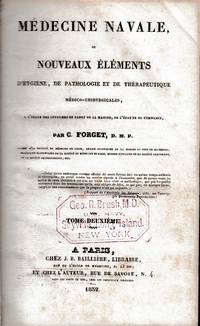
1832réf. 21142Paris: J B Bailliere 1832. First Edition. Contemporary half-leather. Very good; some toning throughout; spotting on pp. 163 & 177; prominent 19th century private ownership stamp on the titles. 8vo I - 6 v 7 1 - 543 pp.; II - 4 1 - 578 2 - errata pp. 2 folding tables. The copy of Dr. George R Brush US Navy. A remarkably uncommon book in trade. The text is divided into three large sections: naval hygiene diseases naval surgery. The book was intended for use aboard military and commercial vessels. One of the tables that accompany the text provides the progress of various ailments through the body of the crew aboard a French frigate in 1828/29. The author was prolific in publishing. Hirsch II 569-570. J B Bailliere hardcover books
1816réf. 22014Dedham: H Mann & Co. 1816. First Edition. Original publisher's boards. Very good; paper spine abraded in places affecting the label; some toning but internally a clean copy; front board present but detached; verso of the title page with a library release - but no accessioning. 8vo xiv - mis-numbering in the Preface where a number sequence repeats; text is complete and correct 11 - 318 pp. Rutkow describes this book as the best and most vivid account of early 19th century American military life. The chapters on surgery are invaluable for the first hand descriptions of the treatment of wounds. Mann was an army surgeon during the War of 1812. The book offered here is a memoir of his experiences. The sections dealing with military hospitals are especially informative about techniques and care of the wounded. G-M #2161.1; Austin #1190; Kelly & Burrage 805-'06; Rutkow GS4. H Mann & Co. hardcover books
1816réf. 22029Dedham: H Mann & Co. 1816. First Edition. Original publisher's boards. Fine bright copy with no foxing or spotting; a superb copy. 8vo xiv - mis-numbering in the Preface where a number sequence repeats; text is complete and correct 11 - 318 pp. Rutkow describes this book as the best and most vivid account of early 19th century American military life. The chapters on surgery are invaluable for the first hand descriptions of the treatment of wounds. Mann was an army surgeon during the War of 1812. The book offered here is a memoir of his experiences. The sections dealing with military hospitals are especially informative about techniques and care of the wounded. G-M #2161.1; Austin #1190; Kelly & Burrage 805-806; Rutkow GS4. H Mann & Co. hardcover books