VUE D'OPTIQUEBiblio.com
3,137 results
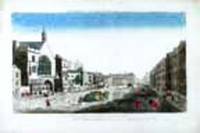
1760ref. 103861760. Engraving with original colour. Printed on laid paper. In good condition with the exception of some creases within the image. Sides have been remargined with laid paper and bottom edge is trimmed within the platemark. Surface soiling within image. Image size: 11 x 16 1/4 inches. A wonderful "vue d'optique" of Somerset House on the Strand in London. During the eighteenth century "vues d'optique" or "perspective views" became extremely popular in England and Europe. Like other optical prints they capitalized on a connoisseur market eager for the latest novelty. English publishers such as John Bowles and Robert Sayer had great success with these optical views which quickly developed into a collecting craze that swept through print shops on both sides of the Channel. "Vues d'optiques" were specifically designed to create the illusion of perspective when viewed with a zograscope or perspective glass. These viewing devices used a series of reflecting mirrors to enhance the illusion of depth in the print creating a veritable "view" for the onlooker. Typically these prints depicted city or landscape views and were horizontal in format. They had roughly the same dimensions and were sold with heavy opaque colouring so as to show the tints when viewed through the lens. In their heyday optical prints were a technical revolution; they could be seen in almost every fashionable drawing room and were enjoyed by the poorer classes in print shops or at traveling fairs. For a small fee the citizens of Europe and England could travel the world without leaving their village. The "vue d'optique" was the first medium to bring the visible appearance of the wider world to a large European public. Ironically the artists and engravers who created these prints rarely had first hand knowledge of the scenes depicted hence the views were often not as accurate as they were advertised to be. As a result of their constant handling optical prints such as these are rare especially in good condition. They are not only beautiful images but a fascinating glimpse into the history of printmaking. Clayton The English Print 1688-1802 140-141. unknown
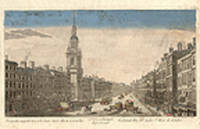
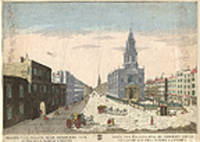
1760ref. 10384Paris: chez Daumont rue St. Martin 1760. Engraving with original colour. Printed on watermarked laid paper. In excellent condition with the exception of some surface soiling in the upper section of the image. Image size: 8 7/8 x 15 13/16 inches. A wonderful "vue d'optique" of St. Mary's Church in London During the eighteenth century "vues d'optique" or "perspective views" became extremely popular in England and Europe. Like other optical prints they capitalized on a connoisseur market eager for the latest novelty. English publishers such as John Bowles and Robert Sayer had great success with these optical views which quickly developed into a collecting craze that swept through print shops on both sides of the Channel. "Vues d'optiques" were specifically designed to create the illusion of perspective when viewed with a zograscope or perspective glass. These viewing devices used a series of reflecting mirrors to enhance the illusion of depth in the print creating a veritable "view" for the onlooker. Typically these prints depicted city or landscape views and were horizontal in format. They had roughly the same dimensions and were sold with heavy opaque colouring so as to show the tints when viewed through the lens. In their heyday optical prints were a technical revolution; they could be seen in almost every fashionable drawing room and were enjoyed by the poorer classes in print shops or at traveling fairs. For a small fee the citizens of Europe and England could travel the world without leaving their village. The "vue d'optique" was the first medium to bring the visible appearance of the wider world to a large European public. Ironically the artists and engravers who created these prints rarely had first hand knowledge of the scenes depicted hence the views were often not as accurate as they were advertised to be. As a result of their constant handling optical prints such as these are rare especially in good condition. They are not only beautiful images but a fascinating glimpse into the history of printmaking. Clayton The English Print 1688-1802 140-141. chez Daumont rue St. Martin unknown
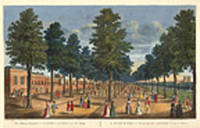
1800ref. 10694London: Printed for Bowles & Carver No. 69 St. Pauls Church Yard 1800. Engraving with beautiful hand-colour. In excellent condition with the exception of tape on the verso of sheet. Image size: 9 3/8 x 15 3/4 inches. Vue d'Optique of the Royal Palace in St. James' Park in London During the eighteenth century "vues d'optique" or "perspective views" became extremely popular in England and Europe. Like other optical prints they capitalized on a connoisseur market eager for the latest novelty. English publishers such as John Bowles and Robert Sayer had great success with these optical views which quickly developed into a collecting craze that swept through print shops on both sides of the Channel. "Vues d'optiques" were specifically designed to create the illusion of perspective when viewed with a zograscope or perspective glass. These viewing devices used a series of reflecting mirrors to enhance the illusion of depth in the print creating a veritable "view" for the onlooker. Typically these prints depicted city or landscape views and were horizontal in format. They had roughly the same dimensions and were sold with heavy opaque colouring so as to show the tints when viewed through the lens. In their heyday optical prints were a technical revolution; they could be seen in almost every fashionable drawing room and were enjoyed by the poorer classes in print shops or at traveling fairs. For a small fee the citizens of Europe and England could travel the world without leaving their village. The "vue d'optique" was the first medium to bring the visible appearance of the wider world to a large European public. Ironically the artists and engravers who created these prints rarely had first hand knowledge of the scenes depicted hence the views were often not as accurate as they were advertised to be. As a result of their constant handling optical prints such as these are rare especially in good condition. They are not only beautiful images but a fascinating glimpse into the history of printmaking. Clayton The English Print 1688-1802 140-141. Printed for Bowles & Carver, No. 69 St. Pauls Church Yard unknown
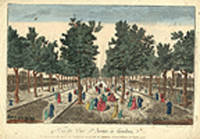
1780ref. 10559Paris: Chez. Daumont rue St. Martin. Presentement chés Lachaussée rue S. Jacques 1780. Engraving with original colour. Printed on wove paper. This is a later copy of the earlier print of St. James' published by Daumont. In good condition with the exception of some scattered brown marks. Trimmed within the platemark. Image size: 9 1/4 x 14 1/2 inches. Vue d'Optique of St. James' Park in London During the eighteenth century "vues d'optique" or "perspective views" became extremely popular in England and Europe. Like other optical prints they capitalized on a connoisseur market eager for the latest novelty. English publishers such as John Bowles and Robert Sayer had great success with these optical views which quickly developed into a collecting craze that swept through print shops on both sides of the Channel. "Vues d'optiques" were specifically designed to create the illusion of perspective when viewed with a zograscope or perspective glass. These viewing devices used a series of reflecting mirrors to enhance the illusion of depth in the print creating a veritable "view" for the onlooker. Typically these prints depicted city or landscape views and were horizontal in format. They had roughly the same dimensions and were sold with heavy opaque colouring so as to show the tints when viewed through the lens. In their heyday optical prints were a technical revolution; they could be seen in almost every fashionable drawing room and were enjoyed by the poorer classes in print shops or at traveling fairs. For a small fee the citizens of Europe and England could travel the world without leaving their village. The "vue d'optique" was the first medium to bring the visible appearance of the wider world to a large European public. Ironically the artists and engravers who created these prints rarely had first hand knowledge of the scenes depicted hence the views were often not as accurate as they were advertised to be. As a result of their constant handling optical prints such as these are rare especially in good condition. They are not only beautiful images but a fascinating glimpse into the history of printmaking. Clayton The English Print 1688-1802 140-141. Chez. Daumont rue St. Martin. Presentement chés Lachaussée rue S. Jacques unknown
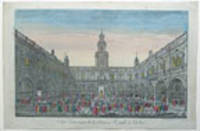
1770ref. 15059Paris: Chez Daumont rue St. Martin 1770. Engraving with beautiful early colour. Printed on watermarked laid paper. In excellent condition with the exception of being trimmed within the platemark on the lower margin. Small tear on upper margin. Small puncture mark on left margin. Image size: 10 1/8 x 16 1/8 inches. This is a beautiful perspective view of the courtyard of the Royal Stock Exchange in London published by a Parisian printseller at the close of the eighteenth century. During the eighteenth century "vues d'optique" or "perspective views" became extremely popular in England and Europe. Like other optical prints they capitalized on a connoisseur market eager for the latest novelty. English publishers such as John Bowles and Robert Sayer had great success with these optical views which quickly developed into a collecting craze that swept through print shops on both sides of the Channel. "Vues d'optiques" were specifically designed to create the illusion of perspective when viewed with a zograscope or perspective glass. These viewing devices used a series of reflecting mirrors to enhance the illusion of depth in the print creating a veritable "view" for the onlooker. Typically these prints depicted city or landscape views and were horizontal in format. They had roughly the same dimensions and were sold with heavy opaque colouring so as to show the tints when viewed through the lens. In their heyday optical prints were a technical revolution; they could be seen in almost every fashionable drawing room and were enjoyed by the poorer classes in print shops or at traveling fairs. For a small fee the citizens of Europe and England could travel the world without leaving their village. The "vue d'optique" was the first medium to bring the visible appearance of the wider world to a large European public. Ironically the artists and engravers who created these prints rarely had first hand knowledge of the scenes depicted hence the views were often not as accurate as they were advertised to be. As a result of their constant handling optical prints such as these are rare especially in good condition. They are not only beautiful images but a fascinating glimpse into the history of printmaking. Clayton The English Print 1688-1802 140-141. Chez Daumont rue St. Martin unknown
1766ref. 18808London and Paris: a Londres ches Wichnyther A Paris chez J. Chereau rue St. Jacques au dessus de la Fontaine St. Severin aux 2 Colonnes No. 257 1766. Engraving with original colour. Printed on laid paper. In good condition with mild soiling and creasing. A beautiful Vue d'Optique with strong early colour depicting the old Palace of Westminster where the Lords and Commons met. An interesting late 18th century view of Westminster prior to the great fire of 1834 which brought into being the present Houses of Parliament. Westminster had been a royal residence until Henry VIII left it after a fire to reside at Whitehall. After that the Houses of Parliament met there. During the eighteenth century "vues d'optique" or "perspective views" became extremely popular in England and Europe. Like other optical prints they capitalized on a connoisseur market eager for the latest novelty. English publishers such as John Bowles and Robert Sayer had great success with these optical views which quickly developed into a collecting craze that swept through print shops on both sides of the Channel. "Vues d'optiques" were specifically designed to create the illusion of perspective when viewed with a zograscope or perspective glass. These viewing devices used a series of reflecting mirrors to enhance the illusion of depth in the print creating a veritable "view" for the onlooker. Typically these prints depicted city or landscape views and were horizontal in format. They had roughly the same dimensions and were sold with heavy opaque colouring so as to show the tints when viewed through the lens. In their heyday optical prints were a technical revolution; they could be seen in almost every fashionable drawing room and were enjoyed by the poorer classes in print shops or at traveling fairs. For a small fee the citizens of Europe and England could travel the world without leaving their village. The "vue d'optique" was the first medium to bring the visible appearance of the wider world to a large European public. Ironically the artists and engravers who created these prints rarely had first hand knowledge of the scenes depicted hence the views were often not as accurate as they were advertised to be. As a result of their constant handling optical prints such as these are rare especially in good condition. They are not only beautiful images but a fascinating glimpse into the history of printmaking. Clayton The English Print 1688-1802 140-141. a Londres ches Wichnyther (?) A Paris chez J. Chereau rue St. Jacques au dessus de la Fontaine St. Severin aux 2 Colonnes No. 25 unknown books
1760ref. 103861760. Engraving with original colour. Printed on laid paper. In good condition with the exception of some creases within the image. Sides have been remargined with laid paper and bottom edge is trimmed within the platemark. Surface soiling within image. Image size: 11 x 16 1/4 inches. A wonderful "vue d'optique" of Somerset House on the Strand in London. During the eighteenth century "vues d'optique" or "perspective views" became extremely popular in England and Europe. Like other optical prints they capitalized on a connoisseur market eager for the latest novelty. English publishers such as John Bowles and Robert Sayer had great success with these optical views which quickly developed into a collecting craze that swept through print shops on both sides of the Channel. "Vues d'optiques" were specifically designed to create the illusion of perspective when viewed with a zograscope or perspective glass. These viewing devices used a series of reflecting mirrors to enhance the illusion of depth in the print creating a veritable "view" for the onlooker. Typically these prints depicted city or landscape views and were horizontal in format. They had roughly the same dimensions and were sold with heavy opaque colouring so as to show the tints when viewed through the lens. In their heyday optical prints were a technical revolution; they could be seen in almost every fashionable drawing room and were enjoyed by the poorer classes in print shops or at traveling fairs. For a small fee the citizens of Europe and England could travel the world without leaving their village. The "vue d'optique" was the first medium to bring the visible appearance of the wider world to a large European public. Ironically the artists and engravers who created these prints rarely had first hand knowledge of the scenes depicted hence the views were often not as accurate as they were advertised to be. As a result of their constant handling optical prints such as these are rare especially in good condition. They are not only beautiful images but a fascinating glimpse into the history of printmaking. Clayton The English Print 1688-1802 140-141. unknown books
1760ref. 10384Paris: chez Daumont rue St. Martin 1760. Engraving with original colour. Printed on watermarked laid paper. In excellent condition with the exception of some surface soiling in the upper section of the image. Image size: 8 7/8 x 15 13/16 inches. A wonderful "vue d'optique" of St. Mary's Church in London During the eighteenth century "vues d'optique" or "perspective views" became extremely popular in England and Europe. Like other optical prints they capitalized on a connoisseur market eager for the latest novelty. English publishers such as John Bowles and Robert Sayer had great success with these optical views which quickly developed into a collecting craze that swept through print shops on both sides of the Channel. "Vues d'optiques" were specifically designed to create the illusion of perspective when viewed with a zograscope or perspective glass. These viewing devices used a series of reflecting mirrors to enhance the illusion of depth in the print creating a veritable "view" for the onlooker. Typically these prints depicted city or landscape views and were horizontal in format. They had roughly the same dimensions and were sold with heavy opaque colouring so as to show the tints when viewed through the lens. In their heyday optical prints were a technical revolution; they could be seen in almost every fashionable drawing room and were enjoyed by the poorer classes in print shops or at traveling fairs. For a small fee the citizens of Europe and England could travel the world without leaving their village. The "vue d'optique" was the first medium to bring the visible appearance of the wider world to a large European public. Ironically the artists and engravers who created these prints rarely had first hand knowledge of the scenes depicted hence the views were often not as accurate as they were advertised to be. As a result of their constant handling optical prints such as these are rare especially in good condition. They are not only beautiful images but a fascinating glimpse into the history of printmaking. Clayton The English Print 1688-1802 140-141. chez Daumont rue St. Martin unknown books
1800ref. 10694London: Printed for Bowles & Carver No. 69 St. Pauls Church Yard 1800. Engraving with beautiful hand-colour. In excellent condition with the exception of tape on the verso of sheet. Image size: 9 3/8 x 15 3/4 inches. Vue d'Optique of the Royal Palace in St. James' Park in London During the eighteenth century "vues d'optique" or "perspective views" became extremely popular in England and Europe. Like other optical prints they capitalized on a connoisseur market eager for the latest novelty. English publishers such as John Bowles and Robert Sayer had great success with these optical views which quickly developed into a collecting craze that swept through print shops on both sides of the Channel. "Vues d'optiques" were specifically designed to create the illusion of perspective when viewed with a zograscope or perspective glass. These viewing devices used a series of reflecting mirrors to enhance the illusion of depth in the print creating a veritable "view" for the onlooker. Typically these prints depicted city or landscape views and were horizontal in format. They had roughly the same dimensions and were sold with heavy opaque colouring so as to show the tints when viewed through the lens. In their heyday optical prints were a technical revolution; they could be seen in almost every fashionable drawing room and were enjoyed by the poorer classes in print shops or at traveling fairs. For a small fee the citizens of Europe and England could travel the world without leaving their village. The "vue d'optique" was the first medium to bring the visible appearance of the wider world to a large European public. Ironically the artists and engravers who created these prints rarely had first hand knowledge of the scenes depicted hence the views were often not as accurate as they were advertised to be. As a result of their constant handling optical prints such as these are rare especially in good condition. They are not only beautiful images but a fascinating glimpse into the history of printmaking. Clayton The English Print 1688-1802 140-141. Printed for Bowles & Carver, No. 69 St. Pauls Church Yard unknown books
1780ref. 10559Paris: Chez. Daumont rue St. Martin. Presentement chés Lachaussée rue S. Jacques 1780. Engraving with original colour. Printed on wove paper. This is a later copy of the earlier print of St. James' published by Daumont. In good condition with the exception of some scattered brown marks. Trimmed within the platemark. Image size: 9 1/4 x 14 1/2 inches. Vue d'Optique of St. James' Park in London During the eighteenth century "vues d'optique" or "perspective views" became extremely popular in England and Europe. Like other optical prints they capitalized on a connoisseur market eager for the latest novelty. English publishers such as John Bowles and Robert Sayer had great success with these optical views which quickly developed into a collecting craze that swept through print shops on both sides of the Channel. "Vues d'optiques" were specifically designed to create the illusion of perspective when viewed with a zograscope or perspective glass. These viewing devices used a series of reflecting mirrors to enhance the illusion of depth in the print creating a veritable "view" for the onlooker. Typically these prints depicted city or landscape views and were horizontal in format. They had roughly the same dimensions and were sold with heavy opaque colouring so as to show the tints when viewed through the lens. In their heyday optical prints were a technical revolution; they could be seen in almost every fashionable drawing room and were enjoyed by the poorer classes in print shops or at traveling fairs. For a small fee the citizens of Europe and England could travel the world without leaving their village. The "vue d'optique" was the first medium to bring the visible appearance of the wider world to a large European public. Ironically the artists and engravers who created these prints rarely had first hand knowledge of the scenes depicted hence the views were often not as accurate as they were advertised to be. As a result of their constant handling optical prints such as these are rare especially in good condition. They are not only beautiful images but a fascinating glimpse into the history of printmaking. Clayton The English Print 1688-1802 140-141. Chez. Daumont rue St. Martin. Presentement chés Lachaussée rue S. Jacques unknown books
1770ref. 15059Paris: Chez Daumont rue St. Martin 1770. Engraving with beautiful early colour. Printed on watermarked laid paper. In excellent condition with the exception of being trimmed within the platemark on the lower margin. Small tear on upper margin. Small puncture mark on left margin. Image size: 10 1/8 x 16 1/8 inches. This is a beautiful perspective view of the courtyard of the Royal Stock Exchange in London published by a Parisian printseller at the close of the eighteenth century. During the eighteenth century "vues d'optique" or "perspective views" became extremely popular in England and Europe. Like other optical prints they capitalized on a connoisseur market eager for the latest novelty. English publishers such as John Bowles and Robert Sayer had great success with these optical views which quickly developed into a collecting craze that swept through print shops on both sides of the Channel. "Vues d'optiques" were specifically designed to create the illusion of perspective when viewed with a zograscope or perspective glass. These viewing devices used a series of reflecting mirrors to enhance the illusion of depth in the print creating a veritable "view" for the onlooker. Typically these prints depicted city or landscape views and were horizontal in format. They had roughly the same dimensions and were sold with heavy opaque colouring so as to show the tints when viewed through the lens. In their heyday optical prints were a technical revolution; they could be seen in almost every fashionable drawing room and were enjoyed by the poorer classes in print shops or at traveling fairs. For a small fee the citizens of Europe and England could travel the world without leaving their village. The "vue d'optique" was the first medium to bring the visible appearance of the wider world to a large European public. Ironically the artists and engravers who created these prints rarely had first hand knowledge of the scenes depicted hence the views were often not as accurate as they were advertised to be. As a result of their constant handling optical prints such as these are rare especially in good condition. They are not only beautiful images but a fascinating glimpse into the history of printmaking. Clayton The English Print 1688-1802 140-141. Chez Daumont rue St. Martin unknown books
ref. 1233.1aaf65.5x93 cm sous verre dans cadre doré.
ref. BN166032Lexware Fehlzeiten 2013 Version 13.00 Windows XP Windows Vista Windows 7 Lexware Fehlzeiten 2013 Version 13.00 Windows XP Windows Vista Windows 7 Lexware Fehlzeiten 2013 Version 13.00 Windows XP Windows Vista Windows 7 unknown
ref. BN166659VMware vSphere 4 - Das Video-Training auf DVD Windows 7 Windows Vista Windows XP Mac OS X Linux VMware vSphere 4 - Das Video-Training auf DVD Windows 7 Windows Vista Windows XP Mac OS X Linux VMware vSphere 4 - Das Video-Training auf DVD Windows 7 Windows Vista Windows XP Mac OS X Linux unknown
ref. BN609259Digital Pub. Business Sprachkurs English Windows XP / Windows Vista / Windows 7 Business Sprachkurs English Windows XP / Windows Vista / Windows 7 Business Sprachkurs English Windows XP / Windows Vista / Windows 7 Digital Pub. unknown
ref. BN377568Berlin de Gruyter 1995. A Multidisciplinary Approach to the Cognitive Content of Metaphor A Multidisciplinary Approach to the Cognitive Content of Metaphor From A Metaphorical Point of View Berlin, de Gruyter 1995. unknown
ref. BN675908Softcover. Helsinki Go Vista City Guide Reiseführer Sprachführer Deutsch Taschenbuch Helsinki Go Vista City Guide Reiseführer Sprachführer Deutsch Taschenbuch Go Vista paperback
ref. BN611738Großer Reiseführer mit Reise-App Edinburgh - Schottland Großer Reiseführer mit Reise-App Edinburgh - Schottland Vista Point unknown
ref. BN674916Softcover. Vista Point Reiseführer Australien: 11 Regionen 55 Routen Service A-Z Vista Point Reiseführer Australien: 11 Regionen 55 Routen Service A-Z Vista Point paperback
ref. BN641053ATPL Human Performance & Limitations Part 1 Windows XP / Windows Vista ATPL Human Performance & Limitations Part 1 Windows XP / Windows Vista ATPL Human Performance & Limitations Part 1 Windows XP / Windows Vista unknown
ref. BN611801Weserradweg von Hann. Münden nach Cuxhaven Weserradweg von Hann. Münden nach Cuxhaven Go Vista. Bike Guide unknown
ref. BN644102Digital Publishing. IS 12: Italiano Teil 2 Windows 2000 / Windows Vista / Windows XP IS 12: Italiano Teil 2 Windows 2000 / Windows Vista / Windows XP IS 12: Italiano Teil 2 Windows 2000 / Windows Vista / Windows XP Digital Publishing unknown
1997360 pages. A comprehensive review of 100 years of soccer on Vancouver Island including many archival photographs of past teams. Clean and unmarked with light wear. A nice copy. Book
1915Cover portrait of M. Poincare, President of the French Republic. The Battles of the Ourcq, Morin, and Marne Rivers. Centerfold - On the Heights above Lenharee. Photos and illustrations include: Zouaves on the march; Diagrammatic bird's-eye view of the advance of the German armies across the plains of France to the turning point on the Marne. Wreck of Red Cross Train near Lizy; Driving the Teutons beyond the Marne; and more. One inch puncture to front cover else unmarked with average wear. Book
1915Front cover portrait of Brigadier-General H.B. de Lisle, C.B., D.S.O., Commanding 2nd Brigade of Cavalry. How the British Army Crossed the Aisne. Photos and illustrations: Vandalism at Soissons; Diagrammatic view of the Aisne valley, showing how the German trenches were disposed; Human moles at Aisne; Positions of the rival armies during the closing days of September, 1914, looking northward from the city of Rheims; War life in a 3-tier deep sandpit behind the British lines in the Champagne country; 'Searchlight' fired from a gun - a parachute light-ball shell illuminates a night battle field; and more. Average wear. Unmarked. Sound copy. Book