3.143 Ergebnisse
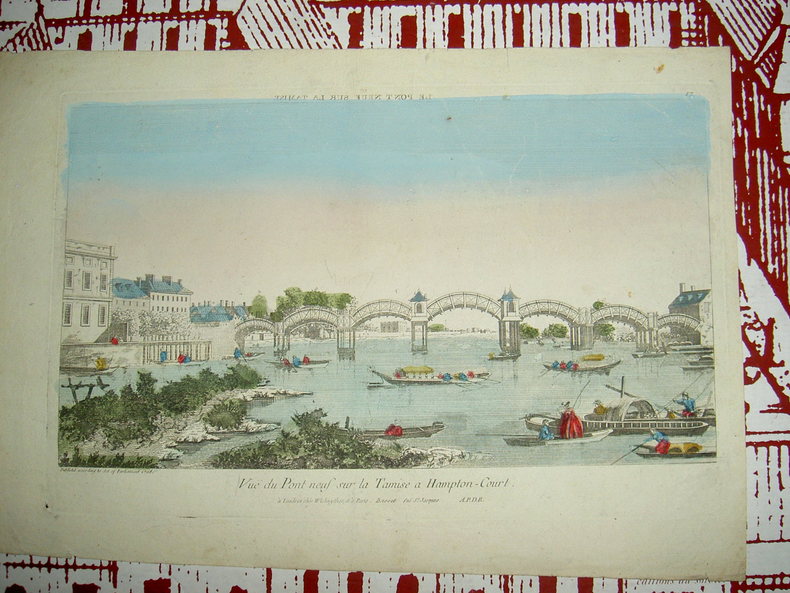
Best.-Nr. 8846P., chez Daumont, (fin du XVIIIème).
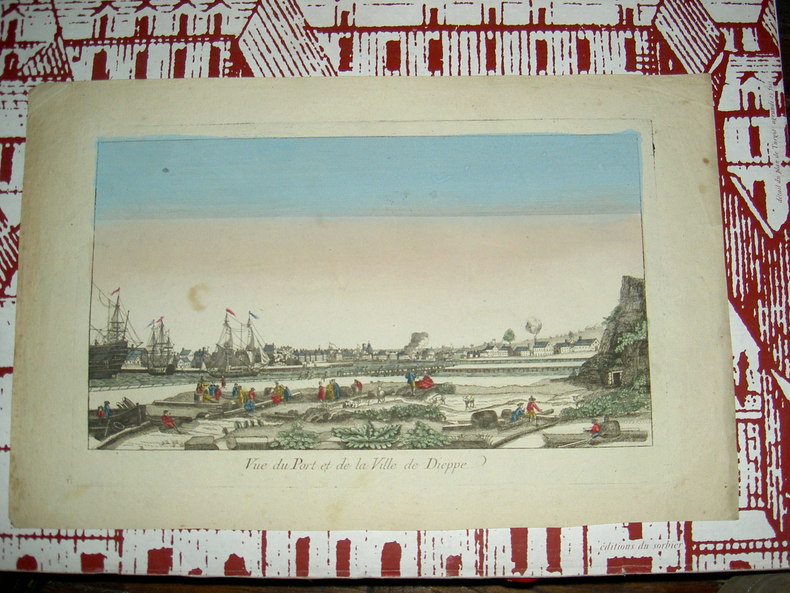
Best.-Nr. 8847P., chez Daumont, (fin du XVIIIème).
1780Best.-Nr. 10559Paris: Chez. Daumont rue St. Martin. Presentement chés Lachaussée rue S. Jacques 1780. Engraving with original colour. Printed on wove paper. This is a later copy of the earlier print of St. James' published by Daumont. In good condition with the exception of some scattered brown marks. Trimmed within the platemark. Image size: 9 1/4 x 14 1/2 inches. Vue d'Optique of St. James' Park in London During the eighteenth century "vues d'optique" or "perspective views" became extremely popular in England and Europe. Like other optical prints they capitalized on a connoisseur market eager for the latest novelty. English publishers such as John Bowles and Robert Sayer had great success with these optical views which quickly developed into a collecting craze that swept through print shops on both sides of the Channel. "Vues d'optiques" were specifically designed to create the illusion of perspective when viewed with a zograscope or perspective glass. These viewing devices used a series of reflecting mirrors to enhance the illusion of depth in the print creating a veritable "view" for the onlooker. Typically these prints depicted city or landscape views and were horizontal in format. They had roughly the same dimensions and were sold with heavy opaque colouring so as to show the tints when viewed through the lens. In their heyday optical prints were a technical revolution; they could be seen in almost every fashionable drawing room and were enjoyed by the poorer classes in print shops or at traveling fairs. For a small fee the citizens of Europe and England could travel the world without leaving their village. The "vue d'optique" was the first medium to bring the visible appearance of the wider world to a large European public. Ironically the artists and engravers who created these prints rarely had first hand knowledge of the scenes depicted hence the views were often not as accurate as they were advertised to be. As a result of their constant handling optical prints such as these are rare especially in good condition. They are not only beautiful images but a fascinating glimpse into the history of printmaking. Clayton The English Print 1688-1802 140-141. Chez. Daumont rue St. Martin. Presentement chés Lachaussée rue S. Jacques unknown
1780Best.-Nr. 10559Paris: Chez. Daumont rue St. Martin. Presentement chés Lachaussée rue S. Jacques 1780. Engraving with original colour. Printed on wove paper. This is a later copy of the earlier print of St. James' published by Daumont. In good condition with the exception of some scattered brown marks. Trimmed within the platemark. Image size: 9 1/4 x 14 1/2 inches. Vue d'Optique of St. James' Park in London During the eighteenth century "vues d'optique" or "perspective views" became extremely popular in England and Europe. Like other optical prints they capitalized on a connoisseur market eager for the latest novelty. English publishers such as John Bowles and Robert Sayer had great success with these optical views which quickly developed into a collecting craze that swept through print shops on both sides of the Channel. "Vues d'optiques" were specifically designed to create the illusion of perspective when viewed with a zograscope or perspective glass. These viewing devices used a series of reflecting mirrors to enhance the illusion of depth in the print creating a veritable "view" for the onlooker. Typically these prints depicted city or landscape views and were horizontal in format. They had roughly the same dimensions and were sold with heavy opaque colouring so as to show the tints when viewed through the lens. In their heyday optical prints were a technical revolution; they could be seen in almost every fashionable drawing room and were enjoyed by the poorer classes in print shops or at traveling fairs. For a small fee the citizens of Europe and England could travel the world without leaving their village. The "vue d'optique" was the first medium to bring the visible appearance of the wider world to a large European public. Ironically the artists and engravers who created these prints rarely had first hand knowledge of the scenes depicted hence the views were often not as accurate as they were advertised to be. As a result of their constant handling optical prints such as these are rare especially in good condition. They are not only beautiful images but a fascinating glimpse into the history of printmaking. Clayton The English Print 1688-1802 140-141. Chez. Daumont rue St. Martin. Presentement chés Lachaussée rue S. Jacques unknown books
Best.-Nr. 8659Eau-forte du XVIIIème siècle A Paris chez jacques Chereau. 290x420mm à la cuvette et 335x435mm avec la marge
Best.-Nr. 9522aafLith. Weibel-Comtesse à Neuchâtel. XIXe siècle, 40 x 29 cm l'image, 62.5 x 55 cm (cadre), lithographie colorieé à la main d'époque, encadrement baguette mérisier méplat, passepartout.
Best.-Nr. 133999aafLith. Weibel-Comtesse à Neuchâtel. XIXe siècle (vers 1830) 29x40.5 cm (Image), lithographie par Cappeler publié par Weibel-Comtesse, 1 feuille / 1 Blattgr. 41 x 54 cm.
1760Best.-Nr. 27965Augsburg: L'Academic Imperiale des Arts 1760. Print. Otherwise very good condition. A view of Westminster over the water with the bridge and many vessels in the foreground. Fine original hand color. 11.5 x 15.75" some rusted pin holes in the margin where the print was hung. L'Academic Imperiale des Arts unknown
Best.-Nr. 9514aafSe vend chez J.C. Meyer à Fribourg, s.d., vers 1837, lithographie originale, Passepartout
Best.-Nr. vue_opt_026.jpegVue d'Optique du dix-huitième siècle
Best.-Nr. 7981P., Daumont, SD (fin XVIIIème). Gravure d’Eglise collée au dos, pliée, petite fente marginale.
Best.-Nr. 1587.1aafs.d., vers 1830, Feuille 220x29.5 cm. Lithographie originale 1 feuille.
Best.-Nr. 91904aaf(Edité par Meyer à Fribourg), s.d., ca. 1835, 35x45.5 cm. Vue de Fribourg entourée des éléments archit. et techn. du pont. une feuille non pliée, montée sur carton.
Best.-Nr. 975.1aafEdité par Meyer à Fribourg. s.d., vers 1840, Feuille 35x45.5 cm. Vue de Fribourg entourée des éléments architecturales et techniques du pont suspendu en fil de fer. 1 feuille.
Best.-Nr. 973.1aafEditeur J.C.Meyer, Fribourg s.d., vers 1835, 17x24.5 cm Lithographie en couleurs, tache d’eau légère, 1 feuille 26.2x37.3 cm,
Best.-Nr. 8852P., Maillet, (fin du XVIIIème).
1830Best.-Nr. 24056(vers 1830) Format (18 x 29 cm) sous vitre et cadre doré XXe (39 x 49 cm).
Best.-Nr. 24200Format 25 x 42 cm
1750Best.-Nr. 23693(vers 1750) Format 240 x 440 mm, avec marges 320 x 460 mm.
Best.-Nr. 7999Sans lieu ni date (fin XVIIIème).
Best.-Nr. vue_opt_083.jpegVue d'Optique du dix-huitième siècle
1850Best.-Nr. 23692(vers 1850). Format 320 x 450 mm, avec marges 440 x 590 mm. (Papier uniformément jauni).
Best.-Nr. 8868P., Daumont, (1759).
Best.-Nr. 8859P., Huquier,, (fin du XVIIIème). (Petit trou de ver).
Best.-Nr. ORD-10971A Paris. Chez Chereau, rue St. Jacques au-dessus de la Fontaine St. Severin aux 2 Colonnes n°257. s.d. (XVIII°). Dimensions de la gravure 405 x 261mm, de la feuille 504 x 340mm. Feuille contrecollée sur papier bleu comme souvent pour les vues d'optique. Qq. taches claires affectant assez peu l'image, coloris soignés. Assez bon exemplaire.