5 817 résultats
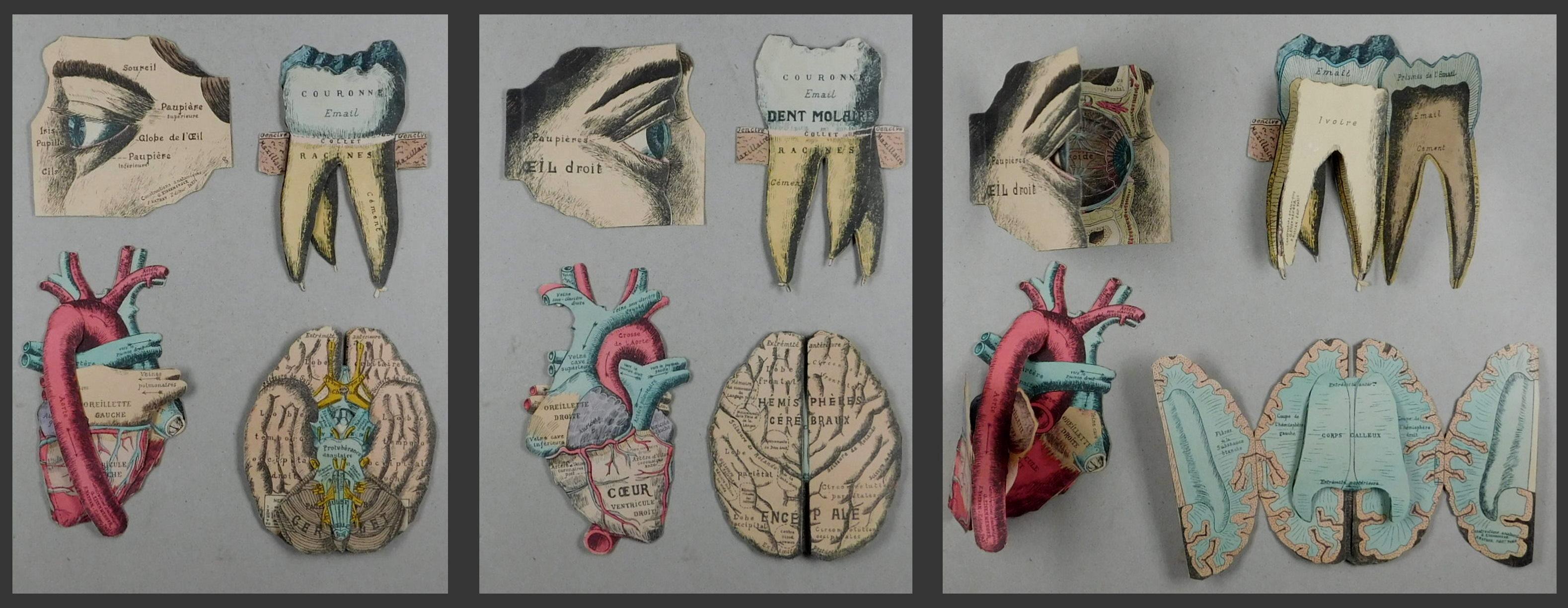
1905réf. 55674AB4 mehrteilige Klappmodelle. Paris, F. Nathan. (Um 1905). Ca. 10x15 cm. Jedes Modelle mit 5-12 Klappseiten in Farblithografie.
1905réf. 55674ABParis, F. Nathan., (Um 1905). Ca. 10x15 cm. Jedes Modelle mit 5-12 Klappseiten in Farblithografie. 4 mehrteilige Klappmodelle.
réf. 36512aafLausannæ (Lausanne), sumptibus Francisci Grasset, 1762-67-68, in-4to, XXII + 1 leaf + 608 p., 13 plates; VI + 311p. + 6 p. + p. 312-607 + 6 plates + 1 table; 388 p. + 17 plates, titles in red and black, first title with engr. medals (e.a. Haller's portrait), beautiful marbled endpaper, light mainly marginal waterstaining in last part of first vol., light browning of the paper, full calf bindings, red and green labels on spines, spines richly gilt, corners slightly scratched and bumped, small wormhole in one rear cover. Beautiful copy.
1744réf. 17912Leyde Langerak & Verbeek 1744 In-folio 280 pp et nombreuses figures en 46 planches avec la même au trait en regard, Tranches cirées, re-Relié dans un vélin moderne non vieilli. complet des planches d'après la table. il s'agit d'un commentaire sur les travaux d'Eustacchio ( 1520-1574) de Rome dont les premières planches ont seulement été publiées par Lancisi en 1714 et qui fut un adversaire de Vésale. texte en Latin, première édition.
1724In-8°. Pagine (8), 716, (2), 24, 13 cc. di tavv. Rilegatura in mezza pelle un po' sciupata e con mancanze al dorso. Stato di conservazione ottimo. Alla fine sono presenti 13 tavole anatomiche ripiegate di eccellente fattura. Rara prima edizione francese di questo celebre testo di anatomia del medico e chirurgo tedesco Lorenz Heister, assai difficile a trovarsi completo di tutte le sue 13 tavole.
réf. 3456P., Méquignon, 1825, 2 VOLUMES in 8 DE TEXTE et 1 ATLAS in 4, brochés, couvertures imprimées, (quelques rousseurs, quelques mouillures pâles dans les marges intérieures des derniers feuillets du tome 2, petites et habiles restaurations à l'angle supérieure de la page de couverture, dans la marge extérieure de la page de titre et des feuillets de texte de l'atlas, inversion de deux feuillets de texte à l'atlas), VOlUME 1 (1ère partie) : 27pp., 360pp., VOlUME 2 (2ème partie) : (2), pp. 355/801, (1), ATLAS : 12pp., 13 PLANCHES.
réf. 4179Leipzig & Heidelberg, Winter'sche Verlagshandlung, 1861, un volume de texte et un atlas in 8 reliés en demi-basane havane à coins (reliure de l'époque), (déchirure sans manque de papier dans la marge inférieure de la planche 27), Texte : 4pp., 243pp., Atlas : 50 planches lithographiées EN COULEURS
réf. 5190Amsterdam, Joannem Janssonium, 1666; un volume in 4 relié en plein veau, dos orné de fers dorés (reliure de l'époque), (restauration ancienne à la partie inférieure du dos, quelques épidermures sur les plats et à un mors, petit travail de vers dans la marge supérieure de 6 feuillets, tache d'encre dans la mage inférieure d'un feuillet, quelques cahiers uniformément roussis), 1 PORTRAIT DE BLASIUS, 1 TITRE GRAVE, (11), 558pp., (8), 52 PLANCHES à pleine page.
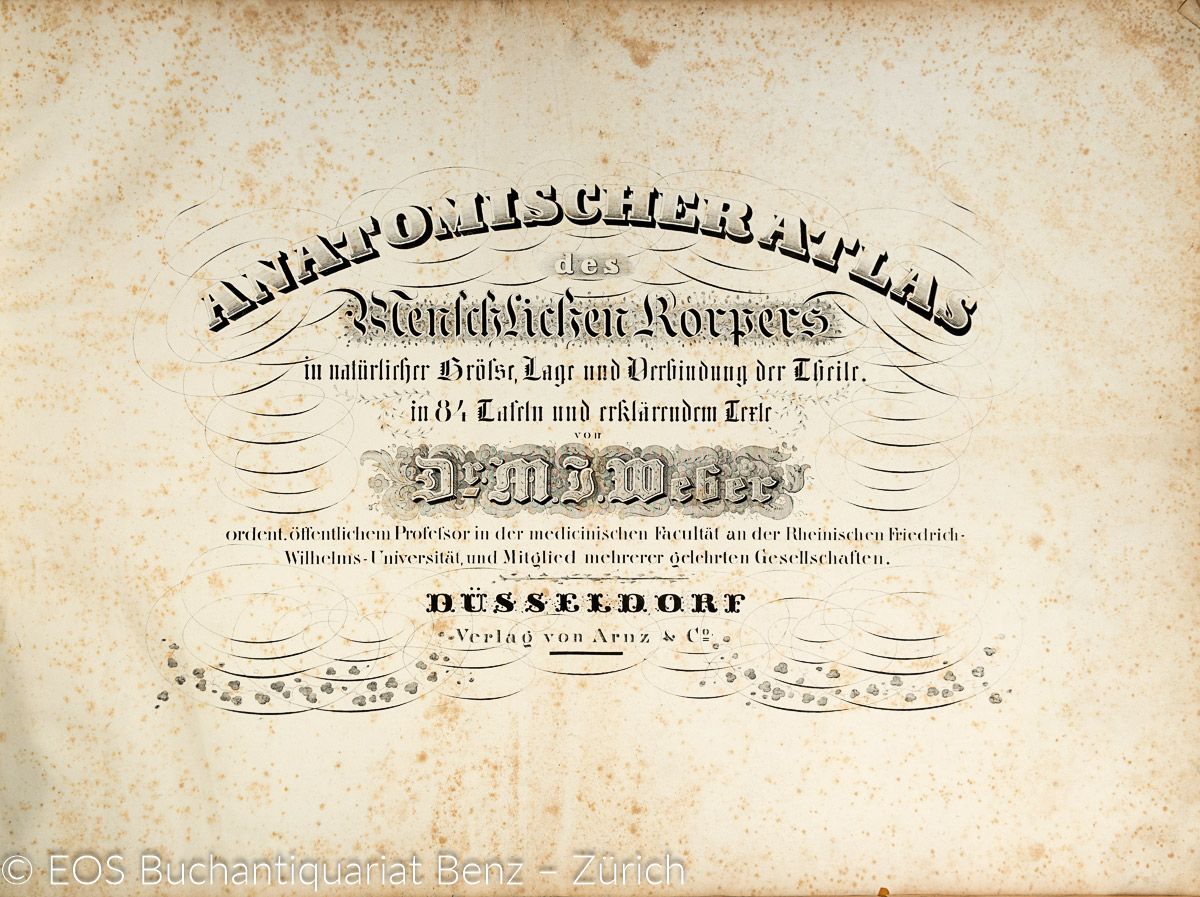
1830réf. 4759DBDüsseldorf, Arnz, )1830-1833). Doppelfolio. Titelblatt, 46 teilweise kolorierte Lithographien. Halbleinenband mit Pappdeckeln. + Wichtig: Für unsere Kunden in der EU erfolgt der Versand alle 14 Tage verzollt ab Deutschland / Postbank-Konto in Deutschland vorhanden +, 4759DB|4759DB_2|4759DB_3 [3 Warenabbildungen]
1848Rappresentazione in scala 1:1 del corpo umano in quattro fogli (660x500 mm ciascuno). Il disegno raffigura l'apparato muscolo scheletrico anteriore. Inserita nella famosa opera che riproduceva il corpo umano in grandezza naturale "Anatomischer Atlas des Menschlichen Körpers in natürlicher Größe, Lage und Verbindung der Theile in 84 Tafeln und erklärendem" descritta dal Weber. Moritz Ignaz Weber (1795-1875) fu stimato Professore di Anatomia Comparata e Patologica. Spese tutta la sua vita nel campo dell'anatomia e delle scienze associate pubblicando numerosi studi. L’Anatomischer Atlas, che raffigura il corpo umano in 84 tavole litografiche a grandezza naturale, è senza dubbio uno dei suoi lavori più importanti.
1708réf. 38094ABLeipzig Thomas Fritschen 1708. 2., deutsche Ausg. 8° 5 Bll., 742 S., 12 Bll., m. gest. Porträt u. 31 Kupfertaf. Pergament. d. Zt. Leicht stockfl. u. wasserrandig, Tit. a. unt. Rand knapp beschnitten, Vors. gestempelt u. m. Besitzvermerken. - Second German edition. Engraved portrait and 31 copperplates. Contemp. vellum. - Slightly foxed and waterstained, title on the foot of page cropped close, endpaper stamped and with ownership entries. 2
1734réf. 1408797Paris: Guillaume Cavelier 1734. Later Editions. Hardcover. Octavos Four Volumes bound as two. The first book contains a single volume; the second book contains the second volume of Anatomie Chirurgicale in addition to two other standalone works. In Good condition. In full brown leather bindings; spines paneled with elaborate gilt decoration and gilt titling on tan leather labels; gilt roll to board edges. Scuffing and wear to boards with peeling to covers. All edges and fore corners rubbed with sections of exposed board. Chipping to heads and tails of spines; heaviest at head of Vol. I with head band nearly detached. Text block edges show shelf wear and dust soiling. Lightly age toned and very sparsely foxed throughout. Splitting to hinges. Rear pastedown in Vol. I and both pastedowns in Vol. II are separating from the boards. ~2 in. closed tear in Vol. I p. 39. Splitting in gutters of several signatures throughout both volumes due to damage to end bands. Closed tears affect some fold-out plates. Tidemarks affect pages in the rear of both volumes. CONTENTS: Anatomie Chirurgicale Vol. I xxiv 514 2 pages plus plates i-xxx; Anatomie Chirurgicale Vol. II viii 313 336-352 453-465 366-403 pages plus plates xxxi-xlviii bound together with Observations Anatomiques viii 175 pages plus 8 plates and Six Observations 2 36 2 pages. Shelved in Room A. The first work in this set is the second edition of Flemish surgeon Jean Palfin's Jan Palfijn's very famous treatise on anatomy which was first published in 1726 under the title Anatomie du Corps Humain. This work and its earlier edition were very influential in the medical field for their detailed anatomical illustrations and descriptive actionable advice for surgeons becoming a widespread authoritative medical text throughout Europe and other parts of the world. The second work bound together with Vol. II of Anatomie Chirurgicale is a French translation of Frederik Ruysch's Observationum Anatomico-Chirurgicarum Centuria. Ruysch was a renowned anatomist and botanist in his own right most well-known for his anatomical museum - the Cabinet of Curiosities - and his improved embalming technique which preserved bodies for longer periods of time in a more visually life-like state. The final work also bound together with Vol. II of Anatomie Chirurgicale and Observations Anatomiques is a revised edition of Six Observations by Michel Brisseau who is notable for being the first to demonstrate the true nature of cataracts as an increased opacity of the lens of the eye rather than a film that covered the eye which was the prevailing belief at the time. Together these works comprise a collection of highly influential studies treatises and observations on anatomy and surgery by some of the most notable medical practitioners of the late 17th and early 18th centuries. 1408797. Special Collections - Upstairs. Guillaume Cavelier hardcover
First Edition, folio (470 x 290 mm), [5], 6-60pp., 10 engraved plates (4 folding on 2 sheets joined) after A. Fyfe and Thomas Donaldson, plates II and III with short tears not touching the image, plate V a little creased with short closed tears, nineteenth-century half calf, rubbed, covers detached. This was "The first serious study of this subject and the most original anatomical work by the greatest of the Monro dynasty." It contains the first full anatomical description of the sacs between the tendons and bones which Albinus had named the bursae mucosae. They are illustrated on the ten plates "which for explicit clarity and accuracy have not been improved upon." (Heirs of Hippocrates 1011). The plates depict the foot, various joints including the knee and hip, and four of the plates are life-sized representations of the entire arm and leg. Monro secundus' earlier publications were largely polemical, and it was not until he had been teaching for twenty-five years that his three main contributions to medical literature appeared. Monro's Observations on the Structure and Functions of the Nervous System (Edinburgh, 1783), a massive text and atlas on human and comparative neurology, is Monro's greatest work. His Description of All the Bursae Mucosae of the Human Body... was a practical manual for direct use in surgery. Although next to nothing was known of germ life at that time, Monro's acute observation and independent empirical judgement led him to the conclusion that the chief danger of infection in surgery of joints lay in exposure to the air. Garrison-Morton, 399.2; Blake, p.309; Heirs of Hippocrates 1011; Wellcome, IV, p.156. Russell, British anatomy, 613. Taylor, The Monro Collection, M170.
1796réf. 015628Cambridge: Printed by J. Burges Printer to the University; And Sold By W. H. Lunn and J. Deighton Cambridge; Messrs. White Fleet-Street and J. Walter Charing-Cross London; And J. Cook Oxford 1796. First Edition First Impression . Cloth Bound Boards. Very Good. 1796 First Edition. Size slim square quarto 72 pages plus 15 pages of plates at the rear. Bound in modern brown cloth Birdsall & Son of Northampton with gilt titles and vignette to the spine. Condition very good corners and spine ends a little rubbed some light spotting and dust soiling at front and rear pages including to the margins of the final plate else the contents are very clean throughout. Contains 15 full page engraved plates at the rear of the book. The plates depict skulls and other bones in the head of various different animals and birds. The title states volume I This was intended as a projected work in two volumes of five fascicules but this first fascicule was the only one ever published. Harwood was a professor of anatomy at Cambridge and an early developer of blood transfusion techniques. OCLC lists only ten copies and no copies sold at auction have been traced. Size: 4to - over 9" - 12" tall Printed by J. Burges Printer to the University; And Sold By W. H. Lunn, and J. Deighton Cambridge; Messrs. White, Fleet-Street, hardcover
1830réf. 4759DBDüsseldorf, Arnz, )1830-1833). Doppelfolio. Titelblatt, 46 teilweise kolorierte Lithographien. Halbleinenband mit Pappdeckeln.
18174 voll. in 8 grande, pp. 407 + (1b) + XII + (1) con 16 tavv. f.t. inc. all'acq.; 403 + (1b) + IX + (1) con 20 tavv. f.t. inc. all'acq. di cui alcune rip.; 412 + XV + (1) con 19 tavv. f.t. inc. all'acq. di cui alcune rip.; 389 + (1) con 8 tavv. f.t. inc. all'acq. Lievi mancanze ai d. Sporadiche fioriture e gore. Tarletto al marg. int. delle ultime 100 cc. e alle tavv. del II vol. senza lesione del testo. Legatura in cart. coeva. Rarissima raccolta completa di questa rivista scientifica bolognese pubblicata da Annesio Nobili fra 1817 e 1823. La rivista prosegui' poi il suo corso di uscite con diverso editore, Marsigli, sempre a Bologna, e diversa denominazione, 'Nuova collezione d'opuscoli scientifici', con due volumi pubblicati fra 1824 e 1825. Molti furono gli argomenti trattati: fisica, matematica, chimica, agraria, botanica, geologia, zoologia, anatomia umana, anatomia patologica, fisiologia, patologia, chirurgia, medicina pratica, ostetricia. Fra i saggi si segnalano: Lavania Giuniore, Sull'inclinazione dell'utero gravido, Mondini, Osservazioni sul nero pigmento dell'occhio, Magistrini, Tentativo intorno ad un nuovo metodo di supplire all'azione del vento nella navigazione, Ferrarini, Sopra i metodi di preparare alcuni rimedi aurifici, Orioli, Lettere critiche sul mesmerismo altrimenti detto Magnetismo animale, Atti, Della utilita' delle macchine nella riduzione delle ossa lussate, Bertoloni, Sopra due specie di nuove piante italiane, Piante del Brasile descritte, Termanini, Della situazione del feto nell'utero, etc...
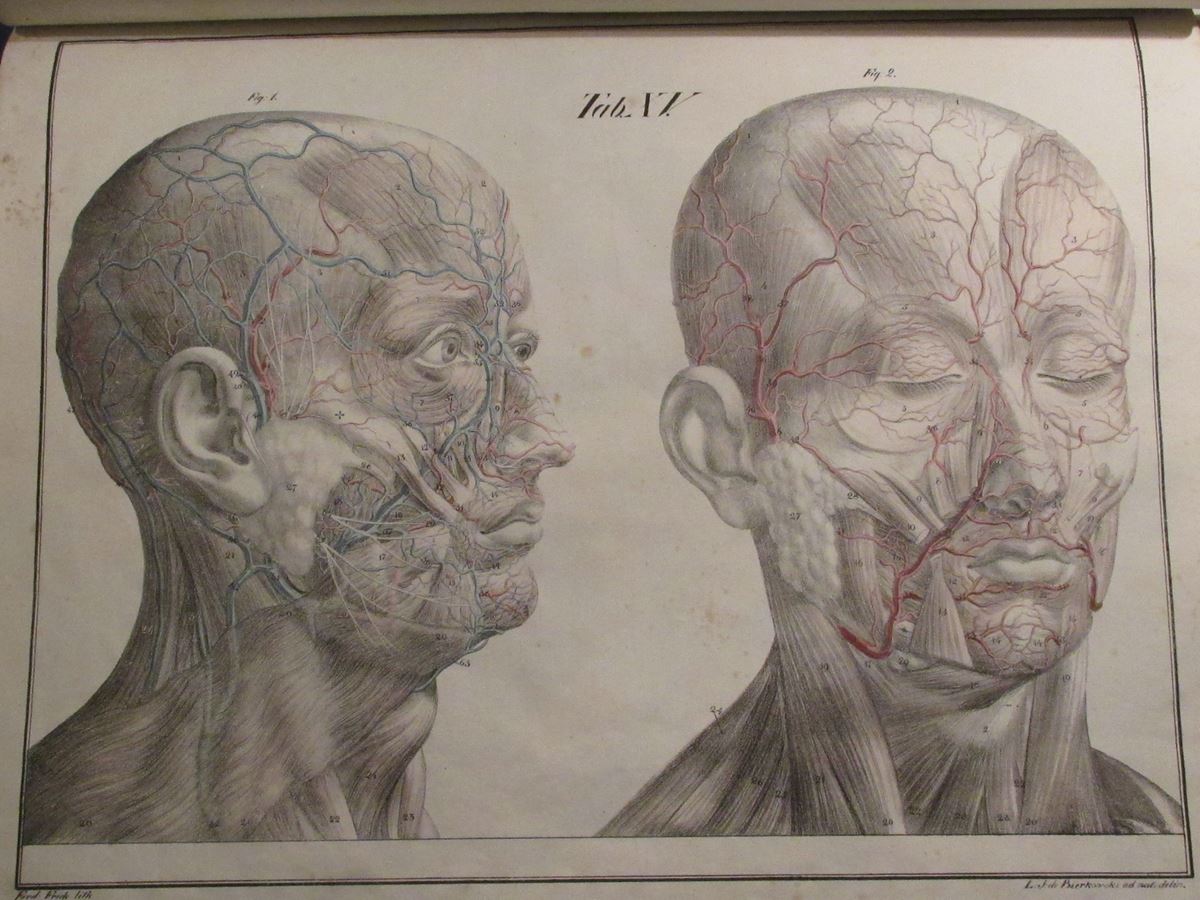
1827réf. SB-21-1029Berlin, Friedrich August Herbig, 1827. 58 Bl. Brauner Halblederband der Zeit mit mehrfarbig (rötlich) marmorierten Deckelbezügen im Format 53 x 43 cm. Anatomisch-chirurgischer Operationsatlas des polnischen Chirurgen und Hochschullehrers Ludwig Joseph (Ludwik Józef) von Bierkowski (1801 - 1860), den dieser im Alter von erst 26 Jahren veröffentlichte. Nach dem Medizinstudium an den Universitäten Berlin, Jena und Leipzig und doppelter Promotion zum Dr. phil. und Dr. med. begann Bierkowski 1831 seine Laufbahn an der Chirurgischen Klinik Krakau, begleitet von einer chirurgischen Professur an der Krakauer Jagiellonen-Universität und der Universität Warschau, wo Bierkowski auch Vorlesungen über Geschlechtskrankheiten, Augenheilkunde und Geburtshilfe abhielt. Zwei grundlegende Werke hatte Bierkowski zu diesem Zeitpunkt bereits veröffentlicht: Schon 1826 erschienen Die "Abbildungen der Puls-, Blut- und Saugadern des menschlichen Körpers", ein Jahr später folgten die - hier angebotenen - "Anatomisch-chirurgischen Abbildungen". Enthalten sind 55 durchweg handkolorierte Großfoliotafeln im Format 52 x 40 cm mit zusammen 570 Einzelabbildungen, ergänzt durch drei sog. Contur-Tafeln. Bierkowski veröffentlichte darüber hinaus zahlreiche wissenschaftliche Aufsätze in überwiegend polnischen Journalen, in denen "mannigfaltige Gegenstände der chirurgischen, ophthalmiatrischen und syphilidologischen Casuistik" (August Hirsch: Biographisches Lexikon der hervorragenden Aerzte aller Zeiten und Völker, Bd.1, Wien und Leipzig 1884) abgehandelt wurden. Auf deutsch erschien 1847 noch sein autobiographisches Werk "Chirurgische Erfahrungen" (Berlin, F. A. Herbig). Bierkowski gilt ferner als Begründer der modernen Orthopädie in Polen; außerdem führte er 1847 in Polen den ersten chirurgischen Eingriff unter ätherischer Narkose durch.
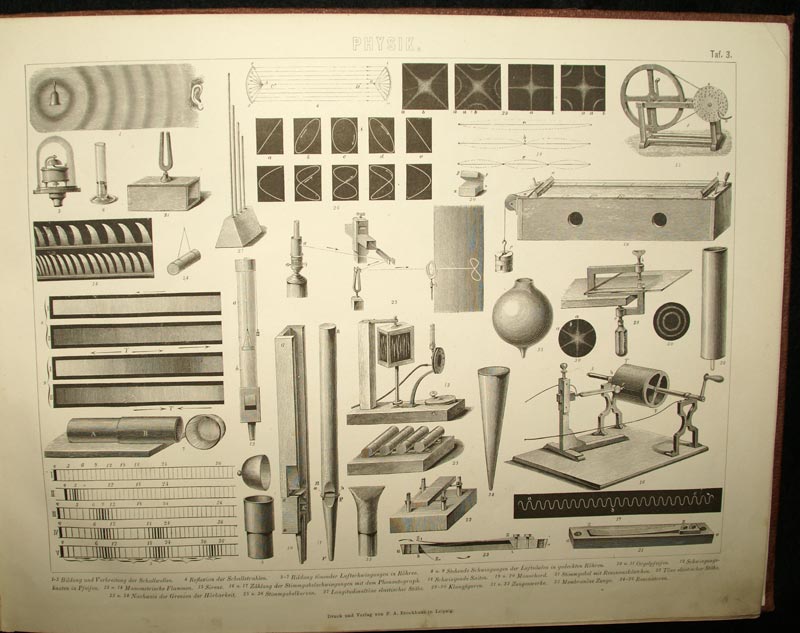
1875réf. EEzz3877Lpz., Brockhaus o. J. (ca. 1875). quer-4° (nur Band 8 in hoch-4°), insges. 499 (v. 500) Taf. (dav. 57 farb.) in Stahlstich, alle Bände in OLn. mit Blind- und Goldprägung, z. Tl auch Rückengoldprägung, restauriert, berieb., eine Lage lose, durchgeh. leicht fingerfleck.. Bd. I: Mathematik, Physik, Astronomie, Erdkunde; Bd. II: Anatomie, Zoologie, Botanik, Mineralogie; Bd. III: Mechanische Technik, Chemische Technik, Bergwesen, Bauwesen, Land- u. Hauswirtschaft; Bd. IV: Kriegswesen, Seewesen; Bd. V: Plastik u. Malerei, Arc
réf. 1422P., Didot, 1816, un volume in 4, broché, couverture muette moderne, 95pp.
1644In -8°, mezza pelle con titolo al dorso. Pp. (8), 570 (4), con numerosissime incisioni nel testo, fra cui due ritratti a piena pagina, dell’autore e del Cardinale Luigi d’Este. L’edizione comprende, con numerazione continua e come specificato nel frontespizio, la “Fisionomia naturale di Monsignor Giovanni Ingegnieri, Polemone, e la Celeste dello stesso Porta”, il “Discorso dei nei di Lodovico Settali” e il “Discorso di Livio Agrippa sopra la natura, e complessione humana”, quest’ultimo completo delle quattro tavole che chiudono il volume. The edition includes the “Fisionomia naturale...”, the “Discorso dei nei...” and the “Discorso di Livio Agrippa”, the latter complete of the four plates at the end of the volume.
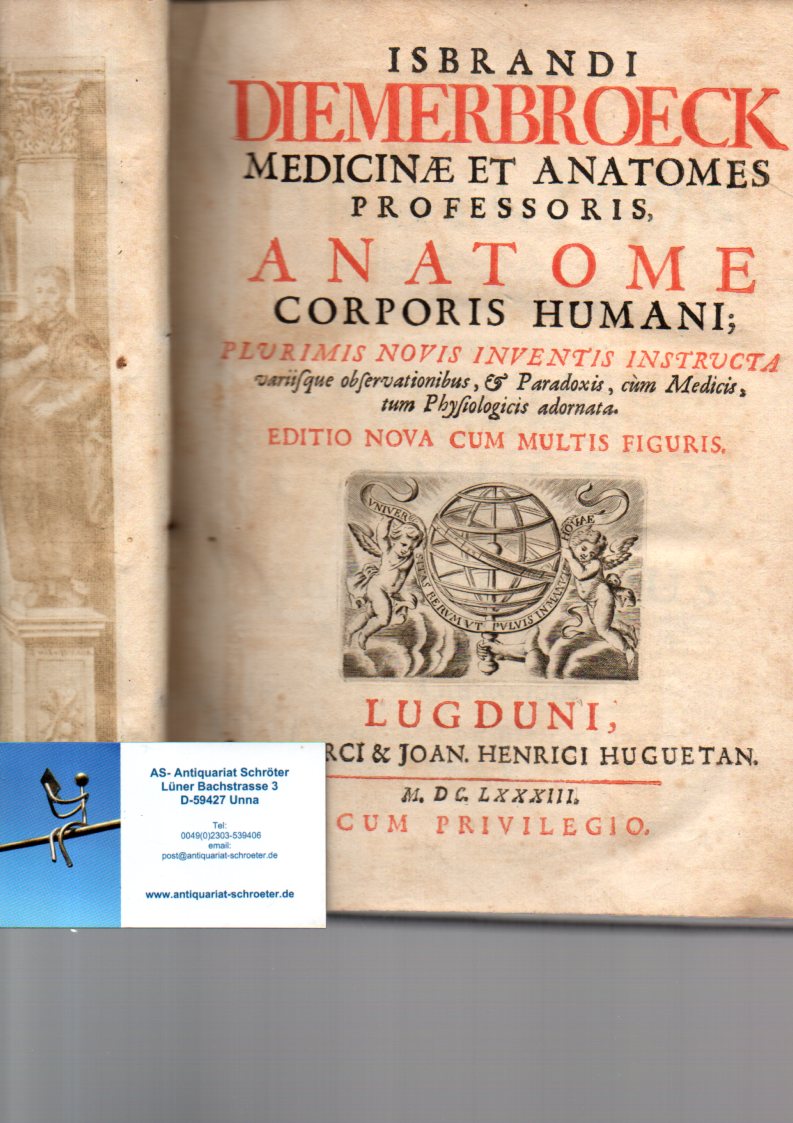
1683réf. 11565M. et J.H. Huguetan, Lugduni (Lyon), 1683. 8, 606(6) Seiten, ca 24,5x18,5 cm, Ledereinband der Zeit auf 5 echten Bünden und leicht verblasster Rückenvergoldung, gestochenes Frontispiz, Titelblatt in schwarz/rot gedruckt. Vollständiges Exemplar mit allen 13 gefalteten Kupfertafeln. Sehr selten. Das Leder an den Kanten aufgeraut. Gutes Exemplar. Das Papier zeitbedingt an den Rändern nachgedunkelt und durchgängig mit bräunlichen Flecken. Einige Seiten in der Falz mit Wurmstichen; die Seiten fest. 1 Seite mit Eckausriss ohne Textverlust; Text in Latein. Wichtiges Werk seiner Zeit. Complete copy with 13 plates. Good copy for its age.
1798réf. 63342ABAmsterdam, Elwe, 1798. Groß-Folio [ca. 150] S. zahlr. Ill. , Kupfertafeln, 46 von 47 anatomischen Tafeln.(Tafel 12 fehlt) Halbleder, Deckel mit Gebrauchsspuren, Tafeln tls etwas stockfl. oder gebräunt, sonst guter Zustand. Seltener Atlas!
Cm. 12; pp. 349, (3). Cartonato rustico coevo, titolo calligrafico al dorso, legatura con filo passante al dorso. Ex libris calligrafico al frontespizio. Tre illustrazioni anatomiche a piena pagina. Qualche piccolo tarletto al margine bianco delle ultime carte. Marca tipografica al frontespizio. Ottimo esemplare. Rara edizione 763/P
Cm. 12; pp. 349, (3). Cartonato rustico coevo, titolo calligrafico al dorso, legatura con filo passante al dorso. Ex libris calligrafico al frontespizio. Tre illustrazioni anatomiche a piena pagina. Qualche piccolo tarletto al margine bianco delle ultime carte. Marca tipografica al frontespizio. Ottimo esemplare. Rara edizione. (763/P) 862/32
1835réf. 012795Paris, Roret, Denain et Delamarre 1835 bzw. Firmin Didot 1831, 1835. XIV S., 1 Blatt, 189 S., 1 Blatt und Tafelanhang; 138 S., 1 Tafel. Großformatiger neuer Halbleinenband. Der französische Zoologe und vergleichende Anatom É. Geoffroy Saint-Hilaire (1772-1844) entdeckte zahlreiche Ähnlichkeiten unterschiedlicher Wirbeltiere und gelangte zur Überzeugung, daß die Vögel von urzeitlichen Reptilien abstammten. Er war somit der Erste, der eine fortdauernde Entwicklung zwischen fossilen und rezenten Lebewesen postulierte. Durch seine vergleichenden Untersuchungen in Anatomie, Paläontologie und Embryologie gab er der modernen Evolutionstheorie entscheidende Anstöße. Seine Untersuchungen fossiler Schädelfunde (die sein Kollege Cuvier für Krokodile hielt) veranlaßte ihn zur Benennung der neu entdeckten Gattung des urzeitlichenTeleosaurus. Die dekorativen Kupferstichtafeln seiner hier vorliegenden Studien zeigen neben dem Brustapparat der Wale auch vier unterschiedliche Opossumarten, das Wombat und die Schädelformen des Krokodils. Ein schönes (wenn auch nachgebundenes), gut erhaltenes Exemplar gleich zweier seiner späten Hauptwerke mit nur leichten Gebrauchsspuren.