Hoerle, HeinrichAntiquariat.de

9 270 résultats
1980réf. 3943BKöln, Edition Kölnischer Kunstverein, 1980. Folio (45 x 32,5 cm). 6 Tafeln mit Linolschnitten auf handgeschöpften Amberger Bütten (Wasserzeichen). Im originalen Schutzumschlag, dieser mit Titel und Impressum, in blauer Orig.-Leinenkassette.
1935réf. 2541AAux dépens des Amis de Cupidon, o.J. [Paris, ca. 1935]. 4°. 2 Bll., 1 kolorierte Orig.-Radierung und 46 S. mit Orig.-Radierungen, 2 Bll. Lose Lagen in der Orig.-Broschur mit Fronttitel und kolorierter erot. Orig.-Radierung.
1926réf. 4306BParis, 1926. 4° (32,5 x 24,9 Blattgröße). 15 Tafeln mit aquarellierten und signierten Original-Federzeichnungen und ein Doppelblatt mit handschriftl. Titelgestaltung und handschriftl. Titelverzeichnis zu den Tafeln. Leinen-Flügelmappe d. Zeit. [9 Warenabbildungen]
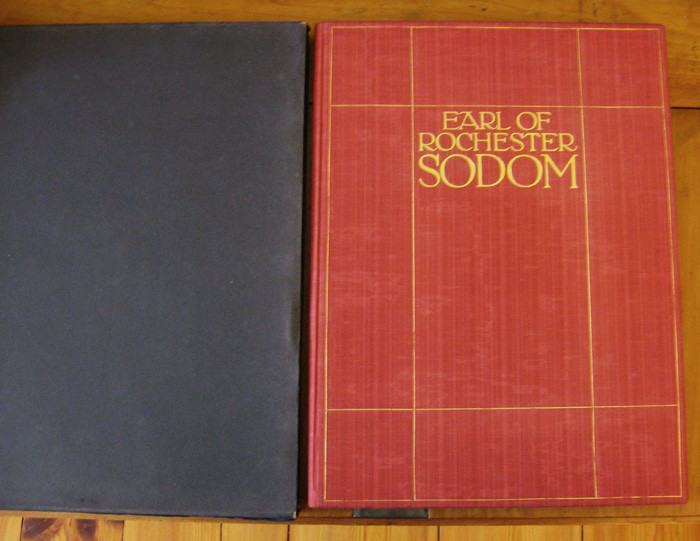
1909réf. 3264BLeipzig, Privatdruck, 1909. Folio: 39 x 29 cm. 105 Seiten mit 15 erotischen Illustrationen und illustriertem Titelblatt von Julius Klinger (geb. 1876). Original altrosa Moiréseideneinband mit goldgepr. Deckeltitel und Goldfileten im schwarzen Orig.-Pappschuber. Kopfgoldschnitt.
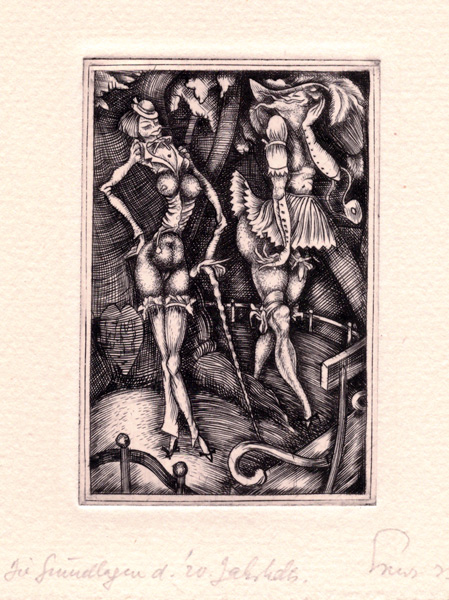
1923réf. 4265BO.O., [Berlin], 1923. 4° (24,5 x 17 cm). 10 eindeutig erotische Kupferstiche auf leicht strukturiertem Velin unter Passepartout (Größe der Kupferstiche: 9 x 6 cm / Blattgröße Velin: 13 x 10 cm / Passepartout: 24 x 16 cm). Halbpergament-Mappe mit Flügeln. [7 Warenabbildungen]
1893réf. 4264BBruxelles, Édition Privée, Revue par l'Auteur [d.i. Amsterdam, A. Brancart, impr. par F. Avonstond, 1893], 1893. 4° (28,3 x 19,5 cm). 2 Bll., 96 S. und 10 Tafeln mit Orig.-Radierungen mit eingraviertem Text (Plattengröße: 24,3 x 17,8 cm / Motivgröße: 21,4 x 14,4 cm). Dunkelrotes Halbmaroquin mit goldgepr. RTitel und goldgepr. Rückenornamenten, Deckel mit Goldfileten. Kopfgoldschnitt. (Einband sign. P. Ruban). [7 Warenabbildungen]
1920réf. 2743ASe trouve à Cythère, et ne se vend nulle part. 1917. [Paris, 1920]. 4°. Ein erotisch illustriertes Titelblatt, 3 radierte Textblätter (Text in erot. Rahmen gedruckt), 10 Tafeln mit Farbradierungen sowie ein ebenfalls radiertes und illustriertes Blatt mit Impressum. Bei der 2. Variante ersetzte Lambert die Radierung "L'Amour Astronome" (die hier als zusätzliche Beigabe vorliegt!) durch die Radierung "L'Hésitation aux Portes du Temple". Schlichte Orig.-Leinenmappe. Zusätzlich beigegeben: die Radierung "L'Amour Astronome", ebenfalls signiert.
1787réf. 5031London: Charles Eyre & Andrew Strahan 1787. First edition. 27 George III Chapter 44. A Fine copy measuring 310 x 190mm and collating complete: 2 987-988. A scarce and important piece of legal history which ESTC records at only one library Lincoln's Inn and which does not appear in the modern auction record. The present is the only example on the market. At the start of the Restoration "English church courts were revived by an act of Parliament on 27 July 1661 to resume their traditional task of correcting spiritual and moral misdemeanors. Soon thereafter parishioners across England's dioceses once more faced admonition fines excommunication and even imprisonment if they failed to conform to the laws of the restored Church of England" Aklund. As much as these courts sought to reestablish a monolithic Anglican communal identity during Charles II's reign their position in the 18th century became "a case study in the secularization of the legal system" particularly given their theoretical justification based in the problematic concept of divine right Harris. Numerous acts the present example among them "represented an important step in the direction of limiting the reach of of ecclesiastical jurisdiction" Harris. An Act to Prevent Frivolous and Vexatious Suits in Ecclesiastical Courts was passed in 1787 drawn from a bill presented in Parliament the previous year. Its major accomplishment was the removal of Church authority in the regulation of private sexual behaviors: "It shall be further enacted by the Authority aforesaid That no Suit shall be commenced in any Ecclesiastical Court for Fornication or Incontinence of for any striking or brawling." While the Church may have voiced its moral codes or enacted social shaming within its own communities it no longer had the legal authority to regulate or punish sexual behavior. Such secularization had significant benefits across a number of communities. For survivors of assault it ended the Church's ability to mandate that a woman marry her attacker; for queer communities it prevented Biblically based persecution; for sex workers it took away the risk of arrest or fines for conducting their livelihoods. Ultimately the jurisdiction of ecclesiastical courts over sexual behavior whether in the form of obscene or defamatory words sexual engagement and sensual pleasure was terminated by this act. Little to no legal regulation of sex would be enacted until the next century when the 1861 Offences Against the Person Act and a series of Contagious Diseases Acts would seek to give secular courts more control over individuals' bodies. ESTC N58717. Charles Eyre & Andrew Strahan unknown
1787réf. 5031London: Charles Eyre & Andrew Strahan 1787. First edition. 27 George III Chapter 44. A Fine copy measuring 310 x 190mm and collating complete: 2 987-988. A scarce and important piece of legal history which ESTC records at only one library Lincoln's Inn and which does not appear in the modern auction record. The present is the only example on the market. At the start of the Restoration "English church courts were revived by an act of Parliament on 27 July 1661 to resume their traditional task of correcting spiritual and moral misdemeanors. Soon thereafter parishioners across England's dioceses once more faced admonition fines excommunication and even imprisonment if they failed to conform to the laws of the restored Church of England" Aklund. As much as these courts sought to reestablish a monolithic Anglican communal identity during Charles II's reign their position in the 18th century became "a case study in the secularization of the legal system" particularly given their theoretical justification based in the problematic concept of divine right Harris. Numerous acts the present example among them "represented an important step in the direction of limiting the reach of of ecclesiastical jurisdiction" Harris. An Act to Prevent Frivolous and Vexatious Suits in Ecclesiastical Courts was passed in 1787 drawn from a bill presented in Parliament the previous year. Its major accomplishment was the removal of Church authority in the regulation of private sexual behaviors: "It shall be further enacted by the Authority aforesaid That no Suit shall be commenced in any Ecclesiastical Court for Fornication or Incontinence of for any striking or brawling." While the Church may have voiced its moral codes or enacted social shaming within its own communities it no longer had the legal authority to regulate or punish sexual behavior. Such secularization had significant benefits across a number of communities. For survivors of assault it ended the Church's ability to mandate that a woman marry her attacker; for queer communities it prevented Biblically based persecution; for sex workers it took away the risk of arrest or fines for conducting their livelihoods. Ultimately the jurisdiction of ecclesiastical courts over sexual behavior whether in the form of obscene or defamatory words sexual engagement and sensual pleasure was terminated by this act. Little to no legal regulation of sex would be enacted until the next century when the 1861 Offences Against the Person Act and a series of Contagious Diseases Acts would seek to give secular courts more control over individuals' bodies. ESTC N58717. Charles Eyre & Andrew Strahan unknown books
1928réf. 4278BParis, Aux dépens d'un amateur [Selbstverlag des Künstlers], 1928. 2 Bände. Gr.8°. 4 Bll., 79 S., 2 Bll. und 31 [sic] Radierungen, davon 11 auf Tafeln und 20 im Text. Dazu: 1 Original-Aquarell, 5 Original-Zeichnungen [statt 4 wie angegeben], eine Suite von 28 Radierungen im ersten Zustand, eine Suite von 26 Radierungen auf Japan und eine handkolorierte Suite mit 24 Radierungen sowie weitere 5 Tafeln mit Radierungen (planches refusées), die für das Werk nicht verwendet wurden. Dazu eine Original-Kupferplatte. Textteil in losen Lagen im Orig.-Umschlag mit Fronttitel und HLeinendecke. Die Orig.-Zeichnungen und Suiten in separaten, betitelten Büttenbögen in einer HLeinendecke. Im Halbleinen-Schuber. [9 Warenabbildungen]
1830réf. 9026AUm 1830. 22 x 29,5 cm. Feder und Aquarell auf Papier. Neu montiert unter Passepartout.
1932réf. 4286BBudapest [Paris, Paul Haasen], 1932. 4° (31,1 x 23,2 cm - Grösse der Tafeln). 4 S. (Titel, Introduction mit Impressum und Nummer) und 15 Tafeln mit Kaltnadelradierungen unter Masken. Orig. HLeinen-Mappe mit illustriertem Titelschild am VDeckel. Die Tafeln im kart. Orig.-Umschlag. [9 Warenabbildungen]
1920réf. 3799BOhne Ort, Privatdruck [ca. 1920]. Folio (43,5 x 34 cm). 2 Bll. (Titel, Inhalt, Colophon] und 10 erotische Original-Radierungen auf Velin lose unter Passepartout gelegt. Original-Halbpergamentmappe mit Buntpapierbezügen.
1909réf. 1787BWien, Privatdruck der Gesellschaft Österreichischer Bibliophilen, Stück XVII, 1909. 4°. 7 S. (Titel u. Einleitung) und 12 Tafeln mit Illustrationen unter betitelten Seidenhemdchen. HLeinen d. Zt. mit goldgepr. RTitel. Die Orig.-Broschur mit Fronttitel mit eingebunden.
1910réf. 2532ADeutschland oder Österreich, um 1910. Jeweils ca. 50 x 40 cm. Unter Passepartouts im Format 80 x 60 cm oder etw. kleiner.
1905réf. 4266BOhne Ort, Verlag und Jahr [vermutl. Jules Chevrel, um 1905]. Folio (39 x 29 cm). 10 Tafeln mit großformatigen Originalradierungen (Größe der Tafeln: 35 x 25,5 cm / Plattengröße: 24,3 x 17,8 cm / Motivgröße: 21,4 x 14,4 cm). Blaugrüne Orig.-Leinenmappe mit Flügeln und Titelschild. [8 Warenabbildungen]
1909réf. 4287BOhne weitere Angaben, [d.i. Paris, Charles Carrington oder Jules Chevrel, zwischen 1905 und 1909.]. 2°. Radierungen: 17,8 x 12,8 cm, Velin-Tafeln: 26,5 x 18,5 cm (1er: 29 x 19 cm). 44 Radierungen bestehend aus vier Lieferungen [= alles] mit jeweils 1 Titelradierung und 10 Radierungen auf Tafeln. In einer Halbpergament Flügelmappe d. Zt., Deckel mit Kleisterpapier bezogen. [10 Warenabbildungen]
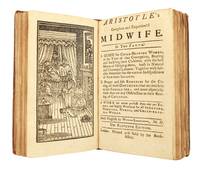
1762réf. 5539London: Printed and sold by the booksellers 1762. The Twenty-Eighth edition of the first work 1st ed. 1684. ESTC T200023. Hardcover. Fine. A composite collection of works dealing with sexuality childbirth medicine astrology and other subjects comprising four works. Each work is preceded by a woodcut frontispiece the first showing a woman whose body is entirely covered by hair and a black boy. The second has a scene showing midwives attending a woman who has just given birth. The third and fourth both show Aristotle in contemporary dress sitting in his study. The second work has a folding sheet showing the fetus' position in the womb. The first has small woodcuts showing conjoined twins and deformities. Bound in contemporary calf rebacked the boards ruled in gold corners bumped light wear to boards very subtle repairs. The text is in very good condition a bit shaken slight rounding to the corners a burn hole in one leaf occ. dog-earing some margins cut close just touching the text in a few instances. In the "Master-Piece" there is a light stain in inner margin of leaf B8 a clean tear in the lower margin of leaf C2 just entering the text without loss and a natural paper flaw in the corner of leaf C5. In the "Experienc'd Midwife" the folding leaf with the woodcut has a number of creases and folds including one along the fold in the image no loss. The same leaf has a long closed tear far from the image with no loss. The headline of the leaf is slightly shaved. There is burn hole in one leaf E9 with loss to a few words and a nickel-sized area of discoloration. In the "Book of Problems" there is a small hole in the upper margin not affecting the text. These treatises on pregnancy childbirth sexuality folk science and home medicine trading on the name of Aristotle appeared individually and then in collected editions throughout the 18th century mostly in undated editions. Due to the alluring nature of some of the texts the "Master-Piece" and "Legacy" had pornographic content and the utilitarian function of the midwives' manual all printings are uncommon and rarely found complete. Some of the collected editions also featured a general title page not called for here. The first work in the volume "Aristotle's Masterpiece" was an extraordinarily popular guide to sex and pregnancy designed for the patients who could not afford professional medical care. Originally published in 1684 it was published and pirated into the 19th century. The frontispiece was one of very few erotic images available to the common reader. The "Master-Piece" "was the most popular book about women's bodies sex pregnancy and childbirth in Britain and America from its first appearance in 1684 up to at least the 1870s. It was not written by Aristotle it was assembled from a number of popular medical works . . . and is a bizarre assortment of superstition folklore and sex facts and fancies all mixed in with the sort of common-sense medical advice that had been passed down by midwives for centuries."Fissell Mary E. "Hairy Women and Naked Truths" pp. 46-64 The second work in the volume is a childbirth manual covering the entire process from conception through pregnancy labor and birth. There are instructions for performing complicated deliveries caring for newborn babies and older children and contending with stillborn children. The folding plate shows the position of a baby in the womb. The third is a collection of pseudo-Aristotelian questions "How comes it that the heart is continually moving "Why do beasts move their ears and not man" "Why are the lips moveable" "Why do fish not make a sound" "Why do madmen's arms become slender" "Why have men not as great breasts as women" The fourth is a work on human reproduction and women's sexual health with detailed descriptions of genitalia sexual intercourse and venereal disease. Written for midwives it is a re-arrangement of relevant chapters from the "Masterpiece". Chapters include "Of Virginity. its Signs and Tokens" "Of the Organs of Generation in Women" "Of the Use and Action of the Genitals" "Of Conception; and how a Woman may know whether she has conceiv'd" "Of Barrenness with remedies against it" and "Directions to both Sexes how to manage themselves in the Act of Coition". All four works are discussed in more depth below. Bibliographical description of the other three books in the volume: Aristotle's compleat and experienc'd midwife. In two parts. I. Guide for child-bearing women in the Time of their Conception Bearing and Suckling their Children; with the best Means of Helping them both in Natural and Unnatural Labours: Together with suitable Remedies for the various Indispositions of New-Born Infants. II. Proper and safe remedies for the curing all those distempers that are incident to the female sex; and more especially those that are any Obstruction to their Bearing of Children. A Work far more perfect than any yet Extant; and highly Necessary for all Surgeons Midwives Nurses and Child-Bearing Women. Made English by W- S- M.D. The Eleventh Edition. London: Printed and sold by the booksellers N.d. 1760 One of two editions stating ELEVENTH EDITION. Duodecimo: 15.5 x 9 cm. 4 iv 156 4 p Collation: A-G12 ESTC T119636 Bound with Aristotle's book of problems with other astronomers astrologers physicians and philosophers. Wherein is contained divers questions and answers touching the state of man's body. Together with the reasons of divers wonders in the creation: the generations of birds beasts fishes and insects; and many other problems on the most weighty matters by way of question and answer. The twenty-seventh edition. London: Printed for J.W. J.K. D.M. A.B. E.R. M.R. T.L. B.M. and A.W. 1760 TWENTY-SEVENTH EDITION. Duodecimo: 15.5 x 9 cm. 156 p. Collation: A-F12 G6 ESTC T504128 Bound with Aristotle's last legacy unfolding the mystery of nature in the generation of man: treating I. Of virginity its signs and tokens and how a man may know whether he married a virgin or not. II. Of the organs of generation in woman with a description of the fabrick of the womb. III. Of the use and action of genitals in the work of generation. IV. Of conception; and how to know whether a woman has conceived and whether of a male or female. V. Of the pleasure and advantage of marriage; with the unhappy consequences of unequal matches and miseries of unlawful love. VI. Of barrenness with remedy against it; and the signs of insufficiency both in men and women. VII. Directions to both sexes how to manage themselves in the act of coition or their venereal embraces. VIII. A vade mecum for midwives and nurses containing particular directions for the faithful discharge of their several employments. IX. Excellent remedies against all diseases incident to virgins and child-bearing women: fitted for the use of midwives nurses and all such persons only as are concerned in these matters. London: Legacy C. Hitch and L. Hawes. 1761 SEVENTH EDITION. Duodecimo: 15.5 x 9 cm. 120 p. Collation: A-E12 ESTC N504342 I. The "Master-Piece": The "Master-Piece" "was the most popular book about women's bodies sex pregnancy and childbirth in Britain and America from its first appearance in 1684 up to at least the 1870s. It was not written by Aristotle it was assembled from a number of popular medical works . . . and is a bizarre assortment of superstition folklore and sex facts and fancies all mixed in with the sort of common-sense medical advice that had been passed down by midwives for centuries."Fissell Mary E. "Hairy Women and Naked Truths" pp. 46-64 "The text repeatedly suggests that women's sexual knowledge is unreliable or deceptive. In addition to proposing that a woman might cuckold her husband without detection if a child resulted the text raised profound doubts about women's honesty concerning virginity. "The frontispiece depicts two "monstrous" individuals a hairy woman and a black baby born to white parents. Each is monstrous because each was deformed by the maternal imagination. The hairy woman's mother while pregnant had looked at a picture of St. John the Baptist in the desert dressed in animal skins. The image imprinted itself on her mind and thus on the body of her unborn baby. The story emphasizes the frailty of women's understanding-the mother's poor compre- hension transformed an ascetic saint dressed in skins into a hairy animal and produced a female monster from that distorted impression. Similarly the black baby was born to a white couple who had a picture of a black man hanging in their bedroom. At the moment of conception the woman looked at the painting and the image supposedly imprinted itself on the child-to-be."Ibid. II. "Compleat and Experienced Midwife": While more affluent women may have been able to afford a doctor or trained midwife poorer people turned to these inexpensive manuals as a guide to all aspects of childbirth and reproduction and as such deserve to be studied as an important source for information on women's health in the period. The present book trades on Aristotle's name but provides much more practical and medically informed advice on the process of childbirth. The book purports to be a translation into English and the dedication is to "The Midwives" on account of the "many Persons as I saw every Day in danger of Perishing by the committing themselves into the Hands of unskilled Midwives." p.1 The initial sections set out the rudimentary process of conception with anatomical attention given to the sexual reproductive parts of both the male and female. Next follows a section on successful conception and the biological signs of pregnancy. Great detail is then given on a month-by-month basis regarding the correct preparation for childbirth including the questionable practice of anointing with duck hen or goose fat p.27. In this section the rudimentary woodcut diagram shows a child in the womb prior to delivery. The next sections are on labor and birth and provide information on the delivery of the afterbirth and the correct procedure for "labouring of a dead child" p.74. The rest of the work concentrates on the care of the newborn child medical complications after birth and the nursing of the newborn. There are also chapters on disease related to the womb. III. Aristotle's Book of Problems: A translation of a popular 14th-15th c. pseudo-Aristotelian compilation of hundreds of questions about the natural world much of it "folk science" and wider philosophical questions from "Why does a woman conceive a female child" "Why do we wonder at the eclipse of the sun and moon and not at the generation of plants and animals from seed" "Why is the flesh nearest the bone sweetest" "Why are some overcome and dismayed by drunkenness" to "Why is sneezing good". A number of the questions concern human sexuality descriptions of genitalia sexual arousal intercourse fertility pregnancy gestation birth birth defects and deformities etc. The book was first translated into English in the 16th c. with new questions added by the translator. Subsequent editions added yet more questions probably with the input of in-house staff working in the print shops that produced them see Ann Blair "Authorship in the Popular 'Problemata Aristotelis'" Early Science and Medicine 4 1999: 189-227. The book also includes questions taken from the authentic collections of Alexander of Aphrodisias fl. 200 and Marcantonio Zimara d. after 1529. IV. His Last Legacy: A work on human reproduction and women's sexual health with detailed descriptions of genitalia sexual intercourse venereal disease infertility etc. Chapters include "Of Virginity: its Signs and Tokens" "Of the Organs of Generation in Women" "Of the Use and Action of Genitals" "Of Conception; and how to know whether a Woman has conceiv'd" "Of Barrenness with Remedy against it" and "Directions to both Sexes how to manage themselves in the Act of Coition". The female genitalia is carefully described including the clitoris: "the Clytoris is a sinewy and hard Body full of spongy and black Matter within; and in form represents the Yard of a Man and is subject to Erection and Falling as that does. This is that which is the Seat of Venereal Pleasure and gives Women delight in the Act of Copulation; for without this a Woman neither desires Coition nor hath Pleasure in it nor conceives by it. The Clytoris sometimes grows out of the body two Inches but this very seldom happens." Ch. 2 The author provides "Directions to the new married Persons how to manage themselves in the Exercises of one of the greatest most natural and agreeable Pleasures thereof and that is their Nocturnal or Venereal Embraces. Ch. 8 My Rudder with thy bold Hand like a try'd And skilful Pilot thou shalt steer and guide My Bark into Love's Channel where it shall Dance as the bounding Waves do rise and fall; And my tall Pinnace in the Cyprian Streight Shall ride at Anchor and unlade her Freight. "When Coition is over some further Directions are necessary: And therefore let the vanquished Bridegroom for he must needs be vanquished that has in the Encounter loft his Artillery take heed how he retreats too soon out of the Field of Love left he should thereby leave an Entrance too open and some inimick Cold should strike into the Womb." Ch. 8 Some myths about women's bodies are refuted and explained. For instance the author explains that the presence of milk in a woman's breast is not a sign she has lost her virginity: "there is a two-fold Milk the one of Virgins is a Malady contrary to Nature . . . made of Blood that cannot get out of the Womb and so goes to the Breasts". Chapter 1. Printed and sold by the booksellers hardcover
1762réf. 5539London: Printed and sold by the booksellers 1762. The Twenty-Eighth edition of the first work 1st ed. 1684. ESTC T200023. Hardcover. Fine. A composite collection of works dealing with sexuality childbirth medicine astrology and other subjects comprising four works. Each work is preceded by a woodcut frontispiece the first showing a woman whose body is entirely covered by hair and a black boy. The second has a scene showing midwives attending a woman who has just given birth. The third and fourth both show Aristotle in contemporary dress sitting in his study. The second work has a folding sheet showing the fetus' position in the womb. The first has small woodcuts showing conjoined twins and deformities. Bound in contemporary calf rebacked the boards ruled in gold corners bumped light wear to boards very subtle repairs. The text is in very good condition a bit shaken slight rounding to the corners a burn hole in one leaf occ. dog-earing some margins cut close just touching the text in a few instances. In the "Master-Piece" there is a light stain in inner margin of leaf B8 a clean tear in the lower margin of leaf C2 just entering the text without loss and a natural paper flaw in the corner of leaf C5. In the "Experienc'd Midwife" the folding leaf with the woodcut has a number of creases and folds including one along the fold in the image no loss. The same leaf has a long closed tear far from the image with no loss. The headline of the leaf is slightly shaved. There is burn hole in one leaf E9 with loss to a few words and a nickel-sized area of discoloration. In the "Book of Problems" there is a small hole in the upper margin not affecting the text. These treatises on pregnancy childbirth sexuality folk science and home medicine trading on the name of Aristotle appeared individually and then in collected editions throughout the 18th century mostly in undated editions. Due to the alluring nature of some of the texts the "Master-Piece" and "Legacy" had pornographic content and the utilitarian function of the midwives' manual all printings are uncommon and rarely found complete. Some of the collected editions also featured a general title page not called for here. The first work in the volume "Aristotle's Masterpiece" was an extraordinarily popular guide to sex and pregnancy designed for the patients who could not afford professional medical care. Originally published in 1684 it was published and pirated into the 19th century. The frontispiece was one of very few erotic images available to the common reader. The "Master-Piece" "was the most popular book about women's bodies sex pregnancy and childbirth in Britain and America from its first appearance in 1684 up to at least the 1870s. It was not written by Aristotle it was assembled from a number of popular medical works . . . and is a bizarre assortment of superstition folklore and sex facts and fancies all mixed in with the sort of common-sense medical advice that had been passed down by midwives for centuries."Fissell Mary E. "Hairy Women and Naked Truths" pp. 46-64 The second work in the volume is a childbirth manual covering the entire process from conception through pregnancy labor and birth. There are instructions for performing complicated deliveries caring for newborn babies and older children and contending with stillborn children. The folding plate shows the position of a baby in the womb. The third is a collection of pseudo-Aristotelian questions "How comes it that the heart is continually moving "Why do beasts move their ears and not man" "Why are the lips moveable" "Why do fish not make a sound" "Why do madmen's arms become slender" "Why have men not as great breasts as women" The fourth is a work on human reproduction and women's sexual health with detailed descriptions of genitalia sexual intercourse and venereal disease. Written for midwives it is a re-arrangement of relevant chapters from the "Masterpiece". Chapters include "Of Virginity. its Signs and Tokens" "Of the Organs of Generation in Women" "Of the Use and Action of the Genitals" "Of Conception; and how a Woman may know whether she has conceiv'd" "Of Barrenness with remedies against it" and "Directions to both Sexes how to manage themselves in the Act of Coition". All four works are discussed in more depth below. Bibliographical description of the other three books in the volume: Aristotle's compleat and experienc'd midwife. In two parts. I. Guide for child-bearing women in the Time of their Conception Bearing and Suckling their Children; with the best Means of Helping them both in Natural and Unnatural Labours: Together with suitable Remedies for the various Indispositions of New-Born Infants. II. Proper and safe remedies for the curing all those distempers that are incident to the female sex; and more especially those that are any Obstruction to their Bearing of Children. A Work far more perfect than any yet Extant; and highly Necessary for all Surgeons Midwives Nurses and Child-Bearing Women. Made English by W- S- M.D. The Eleventh Edition. London: Printed and sold by the booksellers N.d. 1760 One of two editions stating ELEVENTH EDITION. Duodecimo: 15.5 x 9 cm. 4 iv 156 4 p Collation: A-G12 ESTC T119636 Bound with Aristotle's book of problems with other astronomers astrologers physicians and philosophers. Wherein is contained divers questions and answers touching the state of man's body. Together with the reasons of divers wonders in the creation: the generations of birds beasts fishes and insects; and many other problems on the most weighty matters by way of question and answer. The twenty-seventh edition. London: Printed for J.W. J.K. D.M. A.B. E.R. M.R. T.L. B.M. and A.W. 1760 TWENTY-SEVENTH EDITION. Duodecimo: 15.5 x 9 cm. 156 p. Collation: A-F12 G6 ESTC T504128 Bound with Aristotle's last legacy unfolding the mystery of nature in the generation of man: treating I. Of virginity its signs and tokens and how a man may know whether he married a virgin or not. II. Of the organs of generation in woman with a description of the fabrick of the womb. III. Of the use and action of genitals in the work of generation. IV. Of conception; and how to know whether a woman has conceived and whether of a male or female. V. Of the pleasure and advantage of marriage; with the unhappy consequences of unequal matches and miseries of unlawful love. VI. Of barrenness with remedy against it; and the signs of insufficiency both in men and women. VII. Directions to both sexes how to manage themselves in the act of coition or their venereal embraces. VIII. A vade mecum for midwives and nurses containing particular directions for the faithful discharge of their several employments. IX. Excellent remedies against all diseases incident to virgins and child-bearing women: fitted for the use of midwives nurses and all such persons only as are concerned in these matters. London: Legacy C. Hitch and L. Hawes. 1761 SEVENTH EDITION. Duodecimo: 15.5 x 9 cm. 120 p. Collation: A-E12 ESTC N504342 I. The "Master-Piece": The "Master-Piece" "was the most popular book about women's bodies sex pregnancy and childbirth in Britain and America from its first appearance in 1684 up to at least the 1870s. It was not written by Aristotle it was assembled from a number of popular medical works . . . and is a bizarre assortment of superstition folklore and sex facts and fancies all mixed in with the sort of common-sense medical advice that had been passed down by midwives for centuries."Fissell Mary E. "Hairy Women and Naked Truths" pp. 46-64 "The text repeatedly suggests that women's sexual knowledge is unreliable or deceptive. In addition to proposing that a woman might cuckold her husband without detection if a child resulted the text raised profound doubts about women's honesty concerning virginity. "The frontispiece depicts two "monstrous" individuals a hairy woman and a black baby born to white parents. Each is monstrous because each was deformed by the maternal imagination. The hairy woman's mother while pregnant had looked at a picture of St. John the Baptist in the desert dressed in animal skins. The image imprinted itself on her mind and thus on the body of her unborn baby. The story emphasizes the frailty of women's understanding-the mother's poor compre- hension transformed an ascetic saint dressed in skins into a hairy animal and produced a female monster from that distorted impression. Similarly the black baby was born to a white couple who had a picture of a black man hanging in their bedroom. At the moment of conception the woman looked at the painting and the image supposedly imprinted itself on the child-to-be."Ibid. II. "Compleat and Experienced Midwife": While more affluent women may have been able to afford a doctor or trained midwife poorer people turned to these inexpensive manuals as a guide to all aspects of childbirth and reproduction and as such deserve to be studied as an important source for information on women's health in the period. The present book trades on Aristotle's name but provides much more practical and medically informed advice on the process of childbirth. The book purports to be a translation into English and the dedication is to "The Midwives" on account of the "many Persons as I saw every Day in danger of Perishing by the committing themselves into the Hands of unskilled Midwives." p.1 The initial sections set out the rudimentary process of conception with anatomical attention given to the sexual reproductive parts of both the male and female. Next follows a section on successful conception and the biological signs of pregnancy. Great detail is then given on a month-by-month basis regarding the correct preparation for childbirth including the questionable practice of anointing with duck hen or goose fat p.27. In this section the rudimentary woodcut diagram shows a child in the womb prior to delivery. The next sections are on labor and birth and provide information on the delivery of the afterbirth and the correct procedure for "labouring of a dead child" p.74. The rest of the work concentrates on the care of the newborn child medical complications after birth and the nursing of the newborn. There are also chapters on disease related to the womb. III. Aristotle's Book of Problems: A translation of a popular 14th-15th c. pseudo-Aristotelian compilation of hundreds of questions about the natural world much of it "folk science" and wider philosophical questions from "Why does a woman conceive a female child" "Why do we wonder at the eclipse of the sun and moon and not at the generation of plants and animals from seed" "Why is the flesh nearest the bone sweetest" "Why are some overcome and dismayed by drunkenness" to "Why is sneezing good". A number of the questions concern human sexuality descriptions of genitalia sexual arousal intercourse fertility pregnancy gestation birth birth defects and deformities etc. The book was first translated into English in the 16th c. with new questions added by the translator. Subsequent editions added yet more questions probably with the input of in-house staff working in the print shops that produced them see Ann Blair "Authorship in the Popular 'Problemata Aristotelis'" Early Science and Medicine 4 1999: 189-227. The book also includes questions taken from the authentic collections of Alexander of Aphrodisias fl. 200 and Marcantonio Zimara d. after 1529. IV. His Last Legacy: A work on human reproduction and women's sexual health with detailed descriptions of genitalia sexual intercourse venereal disease infertility etc. Chapters include "Of Virginity: its Signs and Tokens" "Of the Organs of Generation in Women" "Of the Use and Action of Genitals" "Of Conception; and how to know whether a Woman has conceiv'd" "Of Barrenness with Remedy against it" and "Directions to both Sexes how to manage themselves in the Act of Coition". The female genitalia is carefully described including the clitoris: "the Clytoris is a sinewy and hard Body full of spongy and black Matter within; and in form represents the Yard of a Man and is subject to Erection and Falling as that does. This is that which is the Seat of Venereal Pleasure and gives Women delight in the Act of Copulation; for without this a Woman neither desires Coition nor hath Pleasure in it nor conceives by it. The Clytoris sometimes grows out of the body two Inches but this very seldom happens." Ch. 2 The author provides "Directions to the new married Persons how to manage themselves in the Exercises of one of the greatest most natural and agreeable Pleasures thereof and that is their Nocturnal or Venereal Embraces. Ch. 8 My Rudder with thy bold Hand like a try'd And skilful Pilot thou shalt steer and guide My Bark into Love's Channel where it shall Dance as the bounding Waves do rise and fall; And my tall Pinnace in the Cyprian Streight Shall ride at Anchor and unlade her Freight. "When Coition is over some further Directions are necessary: And therefore let the vanquished Bridegroom for he must needs be vanquished that has in the Encounter loft his Artillery take heed how he retreats too soon out of the Field of Love left he should thereby leave an Entrance too open and some inimick Cold should strike into the Womb." Ch. 8 Some myths about women's bodies are refuted and explained. For instance the author explains that the presence of milk in a woman's breast is not a sign she has lost her virginity: "there is a two-fold Milk the one of Virgins is a Malady contrary to Nature . . . made of Blood that cannot get out of the Womb and so goes to the Breasts". Chapter 1. Printed and sold by the booksellers hardcover books
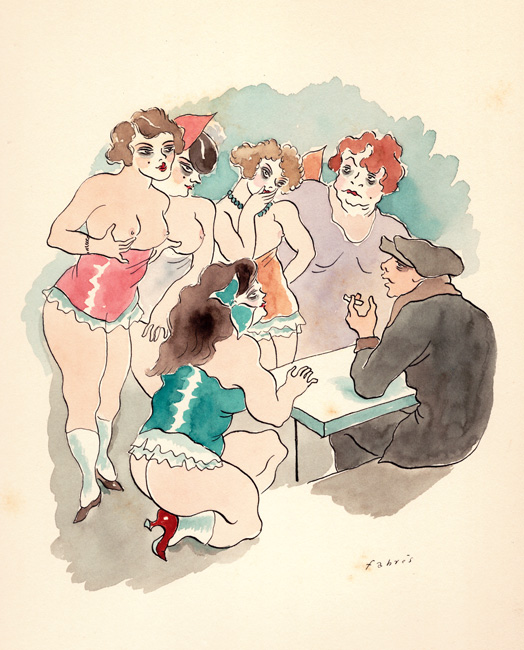
1935réf. 4174BUm 1935. Folio. 16 Aquarelle (Motivgröße von ca. 13 x 15 bis 35 x 22 cm) auf Velin unterschiedlicher Größe, je unter blassgrünem Passepartout (47,5 x 34 cm) montiert. In eigens dafür angefertigter HLeinenmappe (um 1950?), Außendeckel mit geprägtem Papier im Krokodilmuster, Vorderdeckel mit Titelschildchen ("Anonym. 16 erotische Aquarelle"), 3 Schließbändchen. Innendeckel mit Buntpapier bezogen.