8931 resultados
ref. 4368Taschen Books 2015. Limited Numbered Art Edition "B. Cloth. New. Still in the original shrinkwrap! A scarce copy of this Bowie publication this is the beautiful Limited Numbered Art Edition "B" of only 100 copies numbered 101-200 this book is numbered 110 that features an extra print 'UK Summer Tour 1973' with an original signature by photographer Mick Rock the extra print is included only in the Art Editions. THE BOOK: The set features a teal cloth hardcover volume with 3 foldouts in a clamshell box lenticular cover 31.5 x 44 cm 12.4 x 17.3 in. 310 pages. Both David Bowie and Mick Rock have signed on the limitation page which features the number of this edition. We know the number because it is printed on a label on the outside of the unopened box. The front cover features a brilliant colorful hologram which shows several views of Bowie depending on the angle you view it. Our accompanying images capture some of those views. THE PRINT: Enclosed in its own separate teal cloth cover this striking image is a pigment print 27.7 x 40 cm on 32 x 45 cm paper 10.9 x 15.7 in. on 12.6 x 17.7 in. paper and is signed by Mick Rock in black felt pen. THE CONTENT: This limited Art Edition brings together the best of Rock s Bowie portfolio with spectacular stage shots as well as intimate backstage portraits. Pictures for press album jackets and stills from promo movies sit alongside around 50 percent previously unseen images offering unprecedented access to the many facets of Bowie s personality and his fame. Through the aloof and approachable the playful and serious the candid and contrived this tribute bursts with the daring and energy of its unique and flamboyant star who defined and defied a generation. Genesis Publications Also issued in an Art Edition "A" numbers 1-100 with a different but no less brilliant signed print and a Collector's edition numbered 201-1972. A beautiful and scarce set. No discounts. Taschen Books unknown
ref. 31599Paris Gallimard mars 1953. 1 vol. 125 x 190 mm de 252 p. 1 et 1 f. Reliure souple en veau naturel teinté gris perle et estampé tranches dorées sur témoins couvertures et dos conservés reliure signée de Louise Bescond 2018. . Édition originale. Un des 55 premiers exemplaires sur vélin pur fil n° 6. . Exemple étonnant de premier roman écrit à l'âge de soixante-quatorze ans Jules et Jim a inspiré un film célèbre à François Truffaut qui adaptera également Les Deux Anglaises et le continent. « Je peux dire que la lecture en 1953 de Jules et Jim premier roman d'un vieillard de 74 ans a déterminé ma vocation de cinéaste. J'avais 21 ans et j'étais critique de cinéma. J'ai eu le coup de foudre pour ce livre et j'ai pensé : si un jour je réussis à faire des films je tournerai Jules et Jim. J'ai peu après rencontré l'auteur du livre que l'idée d'un contact avec le cinéma enchantait. Au début 61 j'ai pensé que le moment était venu de concrétiser ce vieux rêve. J'ai essayé de transposer fidèlement ce beau livre que l'éditeur Gallimard présentait ainsi : « Un pur amour à trois ». » Avant d'être élevé au Panthéon du Cinéma français le film échappe de peu à l'interdiction totale pour sa prétendue immoralité. Il sort en France avec une interdiction aux moins de 18 ans. Jules et Jim est la célèbre histoire d'un amour à trois : Jules un poète juif allemand séjournant à Paris avant la première guerre mondiale rencontre Jim poète français qui devient son inséparable ami. Ils font de concert quelques conquêtes féminines jusqu'à ce que Jules épouse Kathe allemande elle aussi en visite culturelle en France également. l'amour de Jules pour Kathe ne fonctionnant vraiment que s'il est complété par celui de Jim. Monument fondateur du polyamour il est largement autobiographique : Jules et Jim se sont rencontrés à Paris alors qu'ils étudiaient ensemble. Henri-Pierre Roché va raconter l'histoire de leur amitié et de leurs amours entre la France et l'Allemagne à 10 000 lieues des soubresauts de la Grande Guerre. Jim c'est lui ou presque ; et Jules et Kathe sont directement inspirés par l'écrivain autrichien Franz Hessel et par Helen Grund Berlinoise fille d'un banquier prussien protestant : ils sont les parents de Stéphane Hessel. Mais l'histoire remonte aussi à un peu plus loin : Henri-Pierre Roché fut un bourreau des coeurs peintre écrivain et marchand d'art qui rencontre en 1916 Marcel Duchamp. À Paris Roché se faisait le mécène des femmes artistes qu'il séduit fréquente le Montmartre du Bateau-Lavoir avant d'être missioné aux États-Unis par le Haut-commissariat de la République française chargé d'encourager l'entrée en guerre des États-Unis. C'est là qu'a lieu la rencontre avec Marcel Duchamp alors la coqueluche des élites à New York. Duchamp vient de rencontrer Beatrice Wood le 27 septembre 1916 pour laquelle il éprouve tout de suite un fort penchant. ce qui ne l'empêche pas de la présenter à Roché qui devient le premier amant - l'initiateur - de la jeune femme tout en restant officiellement avec Marcel Duchamp. Cet étrange trio franco-américain Roché s'en souviendra vraisemblablement aussi au moment de rédiger son roman comme beaucoup d'autres histoires de sa prime jeunesse où pendant ses études à Paris entre 1898 et 1900 « Hachep » comme l'appelle Duchamp mène « une double vie au cours de laquelle il enterre sa vie de garçon avec une rouerie systématique en abusant d'annonces matrimoniales . et diverses manipulations sentimentales qui resteront une constante de sa vie . L'expérience est assez déstabilisante pour qu'en mars sa mère l'envoie quelques semaines en cure hydrothérapeutique à l'institut Sonnenberg de Carspach en Alsace ». Paris, Gallimard, (mars) 1953. 1 vol. (125 x 190 mm) de 252 p., [1] et 1 f. Reliure souple en veau naturel teinté gris perle et unknown
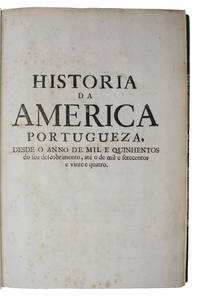
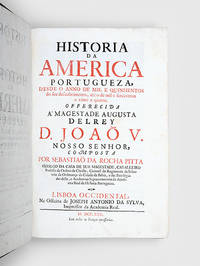
1730ref. 60026Lisboa Occidental na Officina de Joseph Antonio da Sylva 1730. Folio 29 x 195 mm. In recent green half calf with five raised bands and gilt lettering and ornamentation to spine. Title-page mounted and with repair to outer margin no loss of text. Last leaf with repair to lower outer corner also with no loss of text. First and least few leaves with brownspotting. Very light browning in margins throughout. Title printed in red and black woodcut initials and head-pieces. A fine and clean copy. 14 716 pp. Here with the often missing half title but wanting the final blank. Rare first edition here with the often missing half title of the first general history of Brazil – “This work is extremely copious in the details of its foundation as a colony its successive governors its churches its monasteries and convents” Sabin. "This first edition is becoming rare and is much sought after by Brazilians . since it is the first history of Brazil to have been printed and since it was written by a Brazilian" Borba de Moraes. The author's purpose was to narrate the events that had taken place in Brazil with the help of "truthful reports" these largely from Jesuit sources and "modern information" given by those who had traveled in the vast Brazilian territory. This was the only history of Brazil available to Pitta’s contemporaries since most of the others composed in the first two centuries of colonization remained in manuscript form until the nineteenth century. Rocha Pitta was born in Bahia in 1660 and died in the year 1738. At the age of 22 he left the University of Coimbra where he took his degree to return to Bahia where he got married. He made up his mind to write a history of Brazil and he spent years in collecting documents in the Monasteries of Brazil and Portugal where he went in order to study French Dutch and Italian for the purposes of his history. “In 1728 after 40 years of study he began to print his history which appeared in 1730. It was universally well received and King John V. appointed him a member of the household in consequence yet in a few years the Portuguese government publicly prohibited its being read under the severest penalties.” Sabin.Sabin 72300 Borba de Moraes 1983 p. 748 hardcover
1926ref. DISPLAY5RM999Various 1926-1977. Pamphlet. Very Good. Prompt shipment with tracking. we ship in CLEAN SECURE NEW boxes Offprint. First separate edition. Offprints. Original wrappers. All from the collection of Cornell Artificial insemination researcher Robert H. Foote. Various paginations. List available on request. Includes: Guttmacher's Artificial Insemination Techniques; Master's with Lampe: Problems of Male Fertility II. Effect of Frequent Ejaculation ; Hanson and Rock's Artificial Insemination with Husband's Sperm; Ketchel and Pincus' In Vitro Exposure of Rabbit Ova to Estrogenl ; and many by M.C. Chang. All in very good condition. Most with Foote's stamp. A group of rare offprints. History of Science. Medicine. Various unknown
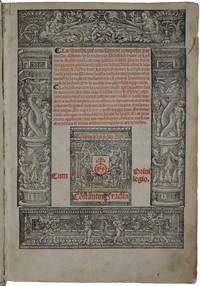
1520ref. 4636Lyon: Guillaume Huyon for Constantin Fradin 1520. First edition. First edition extremely rare. La Roche was a student of Nicolas Chuquet and published for the first time in the present work large sections from Chuquet's Le Triparty en la Science des Nombres the most original mathematical work of the fifteenth century. The work also "presented an outstanding view of contemporary methods of computation and their applications in trade" DSB. Chuquet's work of which a single manuscript survives remained unpublished until 1881. . Hardcover. THE FIRST PUBLISHED WORK ON ALGEBRA IN FRENCH. First edition extremely rare of the first published work on algebra in French. This is a fine copy in a beautiful contemporary binding. Born in Lyon then the principal commercial centre of France La Roche was a student of Nicolas Chuquet and published for the first time in the present work large sections from Chuquet's Le Triparty en la Science des Nombres the most original mathematical work of the fifteenth century. Chuquet's work of which a single manuscript survives BNF Fonds français 1346 remained unpublished until 1881. La Roche's work thus printed for the first time several important innovations in arithmetic and algebra introduced by Chuquet: the use of exponents to denote powers of a number often credited to Descartes who introduced them in his Géométrie more than a century later; the use of the 'second unknown' see below in the solution of systems of linear equations which was an important step towards the invention of symbolic algebra by Viète; the use of negative numbers in the solution of equations; and the introduction of our terms 'million' 'billion' and 'trillion' for powers of 106. La Roche also includes Chuquet's 'règle des nombres moyens' according to which a fraction could be found between any two given fractions by taking the sum of their numerators and dividing by the sum of their denominators; this rule could be used to find the solution of any problem soluble in rational numbers once an upper and a lower bound for the solution had been found. La Roche intended his work to serve the mercantile class and his account of commercial arithmetic goes considerably beyond Chuquet. "The second and greater part of La Roche's work has apart from some geometrical calculations at the end a commercial character. The author states that as a basis he used 'the flower of several masters experts in the art' of arithmetic such as Luca Pacioli supplemented by his own knowledge of business practice . La Roche's work presented an outstanding view of contemporary methods of computation and their applications in trade" DSB. OCLC lists copies at Columbia and Harvard only in North America. ABPC/RBH list only the Macclesfield copy rebound in the 19th century since Honeyman Sotheby's April 14 2005 lot 1204 £19200 = $36409. The present copy was offered by Librairie Thomas-Scheler in 1996 Catalogue Nouvelle Série No. 15 n. 296 120000F. "We do not know much about de la Roche c. 1470-1530. Tax registers from Lyon reveal that his father lived in the Rue Neuve in the 1480s and that Estienne owned more than one property in Villefranche from which he derived his nickname. De la Roche is described as a 'master of argorisme' as he taught merchant arithmetic for 25 years at Lyon. He owned the manuscript of the Triparty after the death of Chuquet 1488. It is therefore considered that de la Roche was on friendly terms with Chuquet and possibly learned mathematics from him. "The importance of the Larismethique has been seriously underestimated. There are several reasons for this. Probably the most important one is Aristide Marre's misrepresentation of the Larismethique as a grave case of plagiarism. Marre discovered that the printed work by Estienne de la Roche contained large fragments that were literally copied from Chuquet's manuscript Marre Le Triparty . par Maistre Nicolas Chuquet 1881 introduction" Heeffer pp. 1-2. But Barbara Moss argues that "the charge of plagiarism against Estienne de la Roche is largely an anachronism . Before the spread of printing academic knowledge had been disseminated through the copying of manuscripts and Chuquet like many of his contemporaries must have written down for reference a large number of examples from the work of others with or without a note of their source . De la Roche's use of citations and sources is similar to that in a number of printed arithmetics of that period. Following the usual commendation of mathematics for its 'great utility and necessity' he continues: 'I have collected and amassed the flowers of several masters expert in this art such as master Nicolas Chuquet Parisian Philippe Frescobaldi Florentine and Brother Luke of Borgo Pacioli with some small addition of what I have been able to invent and test out in my time in its practice' first unnumbered page" Moss pp. 117-9. Moreover "giving a transcription of the problem text only Marre withholds that for many of the solutions to Chuquet's problems de la Roche uses different methods and an improved symbolism. In general the Larismethique is a much better structured text than the Triparty and one intended for a specific audience. Chuquet was a bachelor in medicine educated in Paris within the scholarly tradition and well acquainted with Boethius and Euclid. On the other hand de la Roche was a reckoning master operating within the abbaco tradition. It becomes clear from the structure of the book that de la Roche had his own didactic program in mind. He produced a book for teaching and learning arithmetic and geometry which met the needs of the mercantile class. He rearranges Chuquet's manuscript using Pacioli's Summa as a model. He even adopts Pacioli's classification in books distinctions and chapters. He moves problems from Chuquet's Appendice to relevant sections within the new structure. He adds introductory explanations to each section of the book such as for the second unknown discussed below. With the judgment of an experienced teacher he omits sections and problems from the Triparty which are of less use to merchants and craftsmen and adds others which were not treated by Chuquet such as problems on exchange and barter" Heeffer p. 2. "As far as the first book of the Triparty is concerned de la Roche is reasonably faithful to his teacher. He does include an extra chapter on the connotations of the numbers 1 to 12 which he took from Pacioli and Pacioli from St Augustine's Civita Dei. He also prefers some of the more conventional names like 'rule of false position' rather than 'rule of one position' and disagrees with Chuquet's assessment that the rule of apposition and remotion for solving indeterminate equations in integers 'is a science of little recommendation'. However he includes two of the distinctive contributions of the Triparty: nomenclature in terms of the powers of 106 up to the nonillion 1069 and the rule of intermediate terms or 'rule of mediation between the greater and the less' règle des nombres moyens" Moss p. 121. "Chuquet employs the words byllion trillion quadrillion quyllion sixlion septillion octillion nonillion 'et ainsi des aultres se plus oultre ou voulait proceder' to denote the second third etc. powers of a million. Evidently Chuquet had solved the difficult question of numeration. The new words used by him appear in 1520 in the printed work of La Roche. Thus the great honour of having simplified numeration of large numbers appears to belong to the French. In England and Germany the new nomenclature was not introduced until about a century and a half later. In England the words billion trillion etc. were new when Locke wrote about 1687 Human Understanding Chap. XVI. In Germany these new terms appear for the first time in 1681 . but they did not come into general use until the eighteenth century" Cajori p. 144. "De la Roche's algebra contains several topics that are not found in the Triparty . he has chapters on algebraic fractions on the rule of quantity a mixture of algebra and the rule of false position used for solving equations in more than one unknown and on equations with more than one solution. He also gives methods for 'proving' or checking results on algebra analogous to Chuquet's proofs in arithmetic. "The four canons of the rule of the first terms one for solving generalized linear equations and three for the three acceptable forms of the generalized quadratic with all coefficients positive are stated in Chuquet's terms although de la Roche gives more elementary examples and fewer which require solution by means of compound roots or roots of high order. However special cases of cubic equations with no constant term are included among the quadratics. "The fourth canon for solving equations of the form x2 b = ax which may have two positive roots gave rise to a minor controversy. In 1559 Jean Buteon in his Logistica attacked de la Roche's rule and claimed that it is impossible for an equation to have more than one solution. De la Roche's example to the contrary should be disallowed because he gives 1 as one of the roots and 1 according to Buteon should not be considered as a number ! . "The weaknesses in de la Roche's algebra are essentially those of conservatism though his work like Chuquet's is not free from careless errors. As in the case of radicals he presents the concepts of algebra both in the terminology and notation of the Triparty and in a more traditional restricted and qualitative system involving symbols not involving numbers for powers of the unknown and he prefers to use the latter . However the index notation is presented. It attracted the attention of Michel Chasles in the nineteenth century . Chasles saw no anticipation of Viete's ideas among the Italians; but he instanced the German Stifel Arithmetica integra 1544 and the Frenchmen Peletier L'Algèbre 1554 and Buteon because they used letters for unknowns and a crude form of index notation. The development of an adequate notation for exponents had hitherto been accredited to Descartes; but Chasles claimed that such a notation is already present in de la Roche's Larismethique nouellement composee" Moss pp. 121-4. "That de la Roche made an important contribution to the emergence of symbolic algebra during the sixteenth century can best be argued by his treatment of the second unknown sometimes called 'Regula quantitatis' or 'Rule of Quantity' . The importance of the use of letters to represent several unknowns goes much further than the introduction of a useful system of notation. It contributed to the development of the modern concept of unknown and that of a symbolic equation. These developments formed the basis on which Viète In artem analyticum isagoge 1591 could build his theory of equations . De la Roche first mentions 'la regle de la quantite' in the beginning of distinction six together with 'la regle de la chose'. He properly introduces the second unknown in a separate chapter titled Le neufiesme chapitre de la regle de la quantite annexee avec le dict primier canon et de leur application in the sixth distinction of the first part f. 42v . "In the Rule of Quantity de la Roche sees a perfection of algebra itself. The use of several unknowns allows for an easy solution to several problems which might otherwise be more difficult or even impossible to solve . After this introduction de la Roche gives six examples of the rule of quantity applied to the typical linear problems though he removes the practical context. Then he presents five indeterminate problems under the heading 'questions which have multiple responses' without use of the second unknown. Finally he solves five problems using the second unknown under the heading 'other inventions on numbers'. At the end of the book there is a chapter on applications in which four more problems are given ff. 149v-150r. In total there are twenty problems solved by the regle de la quantite" Heeffer pp. 3-7. The section on commercial arithmetic provides information about the economic life of fifteenth-century Lyon which had become one of the most important commercial centres of the Western world after Louis XI gave royal protection to the fairs established there in 1464. De la Roche discusses the currencies in use the weights and measures and the financial arrangements between partners in business enterprises. The various currencies mentioned come from different parts of France and from Germany and Italy probably all to be found in the market at Lyon. From some examples one can infer that exchange rates fluctuated considerably. Other examples may relate to actual methods of counting used by money-changers. "La Roche begins the commercial section independently of Chuquet by stating that numbers can be considered in three ways according to the Bible's Book of Wisdom that God the creator ordered all in measure number and weight. And thus all the affairs of the world are governed and managed by these three things which la Roche continues to examine from the monetary perspective . Dealing with numbers la Roche returns to the basic arithmetic operations in relation to the monetary and coinage system then in relation to measure and third as weight. La Roche divides the entire second part into ten chapters each divided into a number of subsections . "La Roche first states that all countries use the £ Lire Pound the solz sous shilling and deniers penny. The Lire is always worth 20s solz and the solz is 12d denier penny. But the £ of one country has a different value from that of another country . The section 'numbers as measure' is divided into three kinds according to the three dimensions in geometry: length ell toyse cane brasse palme etc. which is used for cloth measures. The second is the square toyse pye etc. used for tapestries mural work fields. The third way number can be considered is as weight of silver copper lead saffron ginger pepper etc. The weights systems are similar but the values differ. After the introduction follow a number of examples of calculation of different monetary values by addition and subtraction. The examples la Roche mainly took from Chuquet. "La Roche proceeds to explain multiplication by taking a fraction of a fraction of a higher unit . The method is very simple and easy to explain: if you buy 1200 items at 1 Euro per item the total price will be 1200 Euro; if the price is ½ Euro 50 cents the price is half the number of items which is 600 Euro etc. . The second chapter is about merchandise sold by length or size such as linen . Similar counting methods are followed in calculating the price of merchandise sold by weight in the third chapter and in the fourth chapter which describes selling merchandise by number dozen gross hundred thousand. Subsequent chapters deal with liquid measures 5 corporations 6 barter 7 exchange of money and banking 8 profit and discount 9 and gold and silver 10" Ulff-Møller. The final section of the book on the application of the science of numbers to geometry includes the measurement of areas and volumes. There are problems on circles triangles and polygons including many examples about inscribed figures the representation of square and cube roots various simple constructions and notes on the quadrature of the circle. This last presented some results about lunes the triangulation of the circle and series of inscribed and circumscribed circles and squares. Algebra is applied to problems of volumes leading to simple cubic equations. Thus geometry is viewed as an area to which algebra can be applied rather than a means of justifying algebraic rules. "The last few pages are devoted to gauging and show the same instrument as was described by La Court La fabrique et usage de la jauge 1588" Tomash. This gauge or compass so called because of its shape was used in measuring barrels. The results achieved with this instrument were at best approximate as only the bung diameter and a diagonal distance were measured - the shape of the individual barrels was not taken into account. A second edition of la Roche's book was published at Lyon in 1538. There is no modern edition. Bechtel L-47; Brunet III 842; Hoock & Jeannin L5.1; USTC 30158; von Gültlingen Huyon 12. Cajori History of Elementary Mathematics 2007. Smith Rara Arithmetica p. 128. Ulff-Møller 'Estienne de la Roche. Larismethique nouellement compose. Lyon 1520 and second edition 1538' in Rechenmeister und Mathematiker der frühen Neuzeit Gebhardt ed. 2017. For Chuquet see Flegg Graham Hay C. Moss B. Nicolas Chuquet Renaissance Mathematician. A study with extensive translation of Chuquet's mathematical manuscript completed in 1484 1985. Folio 255 x 178 mm ff. iv 230 title printed in red and black within a beautiful woodcut border woodcut printer's device on title-page woodcut initials and diagrams small tear to head of title-page ink stains on n4v lacking front free endpaper. Contemporary binding using a fifteenth-century vellum manuscript leaf slightly soiled. / Hardcover. Guillaume Huyon for Constantin Fradin unknown
1730ref. 176140Lisbon: Joseph Antonio da Sylva Impressor da Academia Real 1730. The first history of Brazil First edition "much sought after by Brazilians" Borba de Moraes. Sebastiao da Rocha Pitta 1660-1738 was himself Brazilian having been born in Bahia. This is an attractive copy of this rare and important work in a carefully restored contemporary binding. The last copy to appear at auction was in 1985. "Though scornfully dismissed by Robert Southey as being 'a meagre and inaccurate work which has been accounted valuable merely because there is no other' the Historia does not deserve such censure. For all its Gongoric turgidity it contains some valuable and authentic information being on some points more fair-minded and accurate than Southey's better written but more prejudiced work" Boxer p. 160. Thomas Lindley writing in his Narrative of a Voyage to Brazil 1805 is less dismissive and certainly more specific in his criticisms describing Pitta as "an intelligent and well-informed Brazilian" who compiled his history "from the chronicles of the Jesuits and other authorities and some valuable local knowledge of his own. This work is copious in its details of the foundation of Brazil as a colony its successive governors its churches its monasteries and convents". However Lindley was less enthusiastic about Pitta's coverage of natural history manufacturing and commerce but the Historia is evidently more of an old-style chronicle than a practical up-to-the-minute guidebook. Lindley also remarks that the Portuguese government "publicly prohibited its being read under the severest penalties and it is now only met with carefully secluded in the cabinets of the curious". Quarto 295 x 197 mm pp. xxvi ii blank 716. Title printed in red and black woodcut headpieces; bound with the half-title and the integral blank before the main body of the text which are frequently lacking. Contemporary sprinkled sheep new dark red morocco label compartments gilt with scrolled foliate corner-pieces floral lozenge central tools edges sprinkled red and blue. Binding a little rubbed and worn in some places some stripping from the front cover. Judicious restoration to spine ends and joints expert repair to head of front board occasional professional paper repairs to margins. Short closed tear to half-title page pale tidemark in margin of last few leaves; overall a very good copy. Borba de Moraes 1983 II 678; Sabin 72300. C. R. Boxer The Golden Age of Brazil 1695-1750: Growing Pains of a Colonial Society 1962. unknown