12 011 résultats
1942réf. 774211942 Saint-Etienne, Pays et Corporations, 1942, plaquette grand in 8° brochée, 30 pages ; couverture imprimée.
1876réf. 783601876 Saint Etienne, Théolier, 1876, in 8° broché, 177 pages ; des rousseurs, mouillure claire en pied ; couverture effrangée.
1991réf. 823741991 L'Auteur, 1991, in 8° broché, 159 pages ; nombreuses cartes postales reproduites, et plans de gares ; couverture illustrée.
2010réf. 860272010 Saint-Etienne, Editions ARF, 2010, petit in 8° broché, 80 pages ; importatnte iconographie en noir et en couleurs ; couverture illustrée.
1975réf. 811941975 Paris, Bibliothèque Nationale, 1975, plaquette in 8° brochée, paginée 111 à 130.
1980réf. 835291980 Saint-Just-Saint-Rambert, Musée du Prieuré, Imprimerie Forézienne, sans date (vers 1980), plaquette in 8° brochée, 28 pages ; illustrations in et hors-texte ; couverture illustrée.
1600réf. 21626Paris 1600 un document, 1 de 2 pages (dont 1 page manuscrite) (18,5 x 25 cm), manuscrit à l'encre brune sur papier vergé crème ligné et filigrané (REP. FRA.), timbre fiscal en noir en haut à gauche de la lettre : "Rep. Fra. ille et villaine 25 cent.", fait à Paimpont, le 16 JUIN 1802,
2002réf. LFA-126730011Publication de 52 pages, format 215 x 300 mm, illustrée, brochée, bon état
2015réf. LFA-126746465Un ouvrage de 240 pages, format 165 x 215 mm, illustré, broché couverture couleurs rempliée, publié en 2015, Editions Géo, bon état
2010réf. LFA-126715251N° 32 Hors-série (2010) 140 pages, format 220 x 270 mm, illustré, broché couverture couleurs, bon état
2003réf. LFA-126746445N° 10 H - 2003 : une revue de 174 pages, format 215 x 270 mm, illustrée, brochée couverture couleurs, bon état
2004réf. LFA017d92004 : une revue de 174 pages, format 215 x 270 mm, illustrée, brochée couverture couleurs, bon état
1854réf. 61648Wien, Carl Gerold & Sohn, 1854. Qu.-Gr.-4°. Mit einer lithogr. Karte, einem lithogr. Längenprofil, 5 getönt. lithogr. Ansichten sowie einem mehrf. gefalt. Leporello-Panorama in Tonlithographie. 2 Bll., 19 S., (Text; in mod. Umschlag m. bedrucktem Deckeltitel) u. die 8 Tafeln, lose in mod. HLdr.-Kassette m. goldgepr. Ldr.-Deckelschild.
1908réf. 055962Galata - Constantinople: Imprimerie de Castro Constantinople Galata AH 1324 = 1908. 1908. 2nd Edition . Soft cover. Very Good. 4to - over 9¾ - 12" tall. Original greenish tan wrappers. 4to. 30 x 21 cm. Bilingual in Ottoman Turkish and French. 11 p. Occasional chippings on extremities of the front wrapper a couple of stamps were deleted on two pages. Else a very good copy. Scarce bilingual statutes in French and Ottoman Turkish of the Imperial Ottoman Baghdad Railway Company printed at the "De Castro" Press one of the earliest Jewish printing houses in Galata. This edition includes the second and third series together of the Emprunt Impérial Ottoman 4% du Chemin de Fer de Bagdad Ottoman Imperial Loan 4% of the Baghdad Railway and reflects the contractual framework of the railway's financing. The first series was originally issued in 1905. ON "DE CASTRO" PRINTING HOUSE: In 1808 a work titled Tikuney Zohar was printed at the Hebrew printing press established by Yitshak ben Avraham Castro in the same year. It appears that the press did not publish any works until 1823 when printing resumed. From that year onward books bore the imprint "Yitshak de Castro and Sons." The place of printing was recorded as "el Saray de Ingiliz the English Palace." Castro who did the typesetting of the books in his own home used the English Palace in Constantinople as the printing house. This press primarily published Ladino works translated from Hebrew. Among these were books such as Ben Sira Sefer ha-Yashar and Kav ha-Yashar along with various collections of responsa and sermons. The most remarkable works published by this press were two books written in opposition to Christianity and British missionary activities. The press remained active until 1848 closing after the death of Yitshak Castro. After 1849 two Hebrew printers were active in Istanbul: Nisim de Castro and Moshe de Castro. They are believed to have been the sons of Yitshak Castro and following their father's death each established his own independent printing house. Between 1849 and 1850 Nisim de Castro's press produced three books two in Hebrew and one in Ladino. Moshe de Castro's press issued two Hebrew works one in 1849 and another in 1862. This press continued to operate under the name "Castro Press" publishing two additional Ladino books in 1877 and 1925. In 1853 Leon Haim de Castro likely a descendant launched and edited Or Israël The Light of Israel the first Jewish newspaper published in Istanbul. Meral. As of May 2025 OCLC lists only two copies worldwide: one at the Staatsbibliothek zu Berlin Preußischer Kulturbesitz and another at the Universitätsbibliothek Bamberg 1158592367 and 634693982. No copies are recorded in U.S. libraries. Imprimerie de Castro, Constantinople, Galata, AH 1324 = 1908. paperback
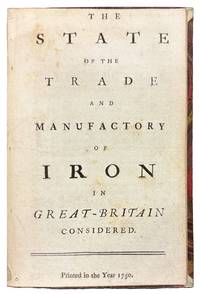
1750réf. 42149London 1750. 8vo. 6 7/8 x 4 1/4 inches. 15 pp. An abridgement of the Interest of Great Britain in supplying herself with Iron circa 1747. Half red morocco and marble paper boards. Marginal notes trimmed A conflicted call for economic protectionism on the eve of industrial transformation and a snapshot of British iron trade policy in 1750 caught between timber tariffs and transatlantic competition. An important and revealing mid-eighteenth-century pamphlet addressing the British iron industry at a moment of significant economic and technological transition. This work is considered an abridged version of The Interest of Great Britain in Supplying Herself with Iron published circa 1747 and offers a pointed critique of foreign and colonial competition in iron production. The anonymous author provides a rare quantitative estimate of domestic iron output 18000 tons annually and laments the numerous challenges facing British ironmasters including the rising cost and increasing scarcity of timber then still the primary fuel used in smelting. In a notably conflicted argument the tract decries the influx of Swedish iron while expressing even greater alarm over the growth of ironworks in Britain's North American colonies viewing both as threats to the domestic market. Strikingly the pamphlet makes no mention of the use of pit coal i.e. mineral coal in iron manufacturing a technological development that would prove pivotal. This omission is particularly curious given that Lord Dudley had patented the process in 1619 and that Abraham Darby's pioneering use of coke at Coalbrookdale had been underway for over a decade by the time of this publication. The absence of such a reference suggests either a conservative industrial perspective or a lack of awareness of emergent metallurgical practices that would soon transform the industry and pave the way for Britain's dominance during the Industrial Revolution. Referenced by J.R. McCulloch in his A Select Collection of Scarce and Valuable Tracts on Commerce 1859 who found it "curious" for its data and omissions alike this tract provides not only valuable insight into 18th-century economic policy and protectionist sentiment but also a fascinating snapshot of the iron trade on the cusp of technological upheaval. ESTC T76989; Sabin 90635. McCulloch The Literature of Political Economy 1845. unknown
1750réf. 42149London 1750. 8vo. 6 7/8 x 4 1/4 inches. 15 pp. An abridgement of the Interest of Great Britain in supplying herself with Iron circa 1747. Half red morocco and marble paper boards. Marginal notes trimmed A conflicted call for economic protectionism on the eve of industrial transformation and a snapshot of British iron trade policy in 1750 caught between timber tariffs and transatlantic competition. An important and revealing mid-eighteenth-century pamphlet addressing the British iron industry at a moment of significant economic and technological transition. This work is considered an abridged version of The Interest of Great Britain in Supplying Herself with Iron published circa 1747 and offers a pointed critique of foreign and colonial competition in iron production. The anonymous author provides a rare quantitative estimate of domestic iron output 18000 tons annually and laments the numerous challenges facing British ironmasters including the rising cost and increasing scarcity of timber then still the primary fuel used in smelting. In a notably conflicted argument the tract decries the influx of Swedish iron while expressing even greater alarm over the growth of ironworks in Britain's North American colonies viewing both as threats to the domestic market. Strikingly the pamphlet makes no mention of the use of pit coal i.e. mineral coal in iron manufacturing a technological development that would prove pivotal. This omission is particularly curious given that Lord Dudley had patented the process in 1619 and that Abraham Darby's pioneering use of coke at Coalbrookdale had been underway for over a decade by the time of this publication. The absence of such a reference suggests either a conservative industrial perspective or a lack of awareness of emergent metallurgical practices that would soon transform the industry and pave the way for Britain's dominance during the Industrial Revolution. Referenced by J.R. McCulloch in his A Select Collection of Scarce and Valuable Tracts on Commerce 1859 who found it "curious" for its data and omissions alike this tract provides not only valuable insight into 18th-century economic policy and protectionist sentiment but also a fascinating snapshot of the iron trade on the cusp of technological upheaval. ESTC T76989; Sabin 90635. McCulloch The Literature of Political Economy 1845. unknown books
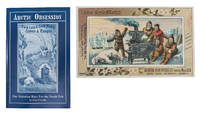
1883réf. 145427Taunton Mass: Printed for Taunton Iron Works by Geo. H. Walker & Co. Lith. Boston ca. 1883. Lithographed trade card approximately 15.3x25.3cm. Minor crease top right hand corner. Colours bright and clear. A fine example. Advertising card for Taunton Iron Works shows Lieut. Greely at the North Pole with a dead polar bear while his fellow explorers keep warm at a Quaker Range verso shows b&w image of a Quaker Range listing 22 advantages. Unlike a lot of examples that have been removed from albums and have glue residue on the back our example is clean and crisp on both sides. This example is over stamped on the back with the address's of three different agents in the Maine area. There is also a stamp on the front margin with a stamp for Atkinson House Furnishing Co. Also included is a signed copy of the Dave Cheadle's reference work "Arctic Obsession" which illustrated an example of the card. 1883 Printed for Taunton Iron Works by Geo. H. Walker & Co., Lith. Boston unknown
réf. 25053Editions Piccoli, sans date. In-8 à l'italienne, cartonnage couleurs. En belle condition et... ravissant !
1926réf. 37329Baconier, sd. 1926 Plaquette, in-8 étroit, broché, 99 pp. Photographies dans le texte, 6 reproductions d’affiches en couleurs hors-texte, carte en couleurs repliée in-fine. Couverture un peu fanée, une tache d’encre en tête au premier plat. Int. frais.
réf. 201509449Belfort, Imprimerie J. SPITZMULLER, 1883 ; in-folio, 1 pp., br. Broché en bon état exemplaire plié le 1er juillet (instruction pour les chefs de groupe).
1841réf. 105399Paris, Librairie de Charles Gosselin 1841 In-12 18 x 11 cm. Reliure demi-chagrin havane, dos à nerfs, 558 pp., table des matières, 1 carte de France repliée in fine. Reliure légèrement frottée, intérieur en bon état.
1982réf. LIQ-4778P. Herscher 1982. In folio pleine toile bleue à la Bradel sous jaquette illustrée en couleurs, 206 pages.
1989réf. 1990Paris Herscher 1989 In-4, 206 pp. reliure toilée bleu, jaquette illustrée.
réf. 201411001Paris, Michel Lafon, 2010 ; in-8, 380 pp., br. Broché comme neuf.
réf. 201901651Paris, Payot, 1983 ; in-8, 316 pp., br.