3 339 résultats
2000réf. 203966New York: Simon & Schuster 2000. First edition and first printing. Hardcover. 192 pages. Copy 780 from a limited edition of 1500 copies. Published in conjunction a traveling exhibition. Edited by Christopher Cardozo. Features a foreword by N. Scott Momaday along with essays by Cardozo and Joseph D. Horse Capture and an afterword by Anne Makepeace. Includes numerous images by Curtis. A fine copy in cloth binding with sepia toned image inset into the front board in a fine matching cloth slipcase. No dust jacket as issued. Signed by Cardozo on the limitation page. A very attractive book. Please note that this is a heavy and oversized book and will require extra shipping. Simon & Schuster unknown books
2005réf. 189212np: Verve Editions 2005. First edition thus. Hardcover. 192 pages. Text in Spanish. Edited by Christopher Cardozo. Features a foreword by N. Scott Momaday and essays by Cardozo and Joseph D. Horse Capture along with an afterword by Anne Makepeace. Includes numerous images by Curtis. A fine copy in cloth binding in a fine cloth slipcase with a gilt reproduction of Curtis' signature on the front panel. No dust jacket as issued. A very attractive book. This is a heavy and oversized book and will require extra shipping. Verve Editions unknown books
2016réf. 186350Paris: Editions Trocadero 2016. First edition. Hardcover. 55 pages. Text in English and French with a foreword by Serge Naudin and essay by Francois Cheval. Includes numerous color illustrations list of previous exhibitions and other biographical information. A close to near fine copy in illustrated boards with cloth spine with some slight fraying to the top edge of the spine. No dust jacket as issued. Editions Trocadero unknown books
1920réf. 144981920. Archive of thirteen photographs ca. 1920s records Russian military officers participating in horse racing and mounted equestrian activity on a circular racetrack. The sequence preserves views of uniformed riders on horseback and documents the place of horsemanship and organized riding within Russian military sporting culture during the early twentieth century. Thirteen vintage photographs each approximately 3.2 x 2.3 inches formerly or currently part of an album. The images show military officers riding horses around a circular track with multiple riders appearing in the racing ground. The officers wear Russian military dress identified in the supplied information as typical of the 1920s. No regiment individual rider precise location photographer or exact date is identified. The photographs record equestrian activity during a period when mounted service remained closely associated with military training and cavalry traditions despite the increasing mechanization of warfare. Their value lies particularly in the sequence of thirteen related views which provides repeated visual evidence of riders horses uniforms and the physical arrangement of the racetrack rather than a single isolated scene. Condition not stated in the supplied description. A compact photographic record of Russian military horsemanship and organized equestrian sport during the early twentieth century. unknown books
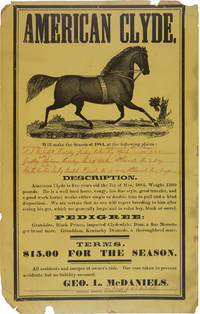
1884réf. 63586Marysville: Appeal Print 1884. Rare and Attractive California Stud Broadside An attractive illustrated broadside advertising the stud services of American Clyde "five years old the 7th of May 1884 Weighs 1300 pounds. He is a well bred horse rangy has fine style good traveler and a good work horse; works either single or double true to pull and a kind disposition." American Clyde is pictured here in a large engraved illustration trotting in a field. The broadside gives a brief review of Clyde's pedigree: "Grandsire Black Prince imported Clydesdale; Dam a fine Messenger brood mare. Granddam Kentucky Diomede a thoroughbred mare." Space is given for the locations where Clyde will "make the Season of 1884" to be accomplished in manuscript. They include "the following places" handwritten in red ink all in Sutter County: in Yuba with S.S. Mitchell April 3-5; at Gridley Station on April 8; and at the North Butte Zarlog Ranch April 10-12. The price given is $15 for the season. The broadside is signed in type by George L. McDaniels and was printed by the Appeal Print newspaper in Marysville. Apparently unrecorded we find no copies on OCLC at the time of cataloguing. An attractive rare and perhaps unique California horse stud broadside with manuscript annotations specifying the location of American Clyde's services. Printed on yellow cardstock. Chipped around the edges several closed tears some affecting text and some repaired with tape on verso. Some soiling. Pinhole at top near upper edge. Accomplished in manuscript with red ink. Good. unknown books
1994réf. 9033295New York: New Press 1994. 1st. Hardcover. Fine/fine. Bound in the publisher's original quarter creme cloth and tan paper boards with the title stamped in black on the spine. Lavishly illustrated in color. New Press hardcover books
1976réf. 158613N.p.: Warner Communications 1976. Vintage German tour poster for the four German dates March 18-21 1976 of Neil Young's Japan and Europe tour held in support of the 1975 album "Zuma." Features all nine of Young's solo releases up to that point along the bottom edge of the graphic. In 1975 Young reformed Crazy Horse replacing the late Danny Whitten with Frank Sampedro on rhythm guitar alongside Billy Talbot and Ralph Molina to record his eighth studio album "Zuma" named after Zuma Beach in LA where Young owned a home. A return to a more commercial form following Young's "Ditch Trilogy" 'Time Fades Away" 1973 "On the Beach" 1974 and "Tonight's the Night" 1975 "Zuma" contained some of the most pop-oriented tunes Young had created in years as well as the brilliant seven and a half minute epic "Cortez the Killer" which contains some of Young's most extensive solo guitar work since his 1969 album "Everybody Knows This Is Nowhere." In support of the new album Young and Crazy Horse began a tour of Japan and Europe his first full European tour as a solo artist in Nagoya Japan on March 3 1976. Following seven dates in Japan they began the European half of the tour on March 15 in Oslo Norway and played a total of 15 concerts ending on April 2 in Glasgow Scotland which included the four German dates on the poster offered here March 18 in Heidelberg March 19 in Offenbach March 20 in Cologne and March 21 in Hamburg. 30 x 23.5 inches. Folded as issued. Very Good plus with some light creasing to the far top left and diagonal crease to the top far right. Warner Communications unknown books
1784réf. 20089London: Printed for J. Walker 1784. 92 pp. 8vo. Stitched as issued. Stitching lacking loosening gatherings some light spotting or soiling of front and back leaves and general edgewear else a very good copy. A contemporary owner has annotated and underlined several sections in the Tea Act. 92 pp. 8vo. These acts passed that years were seen by the author as being the most pertinent and so included in this work the rest of the acts of Parliament were to be released shortly thereafter in a second part. The acts abstracted were the 1 Tea and Window repealing the several Duties and for granting other duties in lieu and duties on coffee and cocoa nuts Act 2 The Game Act hunting license 3 The Horse Act granting duties on riding and carriage horses 4 The Postage Act increasing postage rates 5 The Pawn Broker's Act trying to reduce the handling of stolen goods 6 The Soap and Starch Act requiring the licensing of makers of starch and instilling new laws on soapmakers 7 The Cotton and Linen Act placing duties 8 The Hatter's Act requiring licenses laying additional duties on imported hats 9 The Excise Goods Act laying duties upon licences to be taken out by the makers and delers in exciseable commodities 10 The Candle Act cancelling the duty on wax candles made in Britain 11 The Distillery Act trying to discourage home distillation by discontinuing the duties uon low wines and spirits for home consumption. 12 The Hackney Coach Act increasing the charge for Hackey license 13 The Smuggling Act trying to prevent 14 Brick and Tile Act placing duties on brick and tile made in Great Britain and additional duties on those imported 15 Wax Candle Act placing additional duties on all candles except wax and spermaceti candles. Printed for J. Walker unknown books
1886réf. 238620Cairo 1886. Each 4 pp. Some rubbing. Each 4 pp. Gezira Sporting Club is the largest multi-sport facility in Egypt. It was founded in 1882 and was originally called Khedivial Sporting Club. Both of these programs are annotated in pencil by an unknown spectator - "all that didn't run have a heavy black mark. All that won have a light one and are marked 1 2 or 3 as the call may be." As stipulated on the rear of each program pari mutuel betting was the order of the day. unknown books
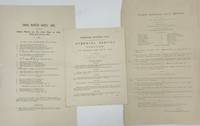
1885réf. 66644Cairo Egypt 1885. Printed broadsheet faint old fold lines. 22 cm. 2 pp. The program includes 6 races and describes a list of conditions for entries. Also names the Judge: Maj. Gen. J. C. Dormer C. B.; the Starter: Maj. Gen. Davis C. B.; and the Clerk of the Scales: Lt. Col. Hitchcock. Offered with two additional broadsides: SUAKIN DIVISIONAL RACE MEETING. First Day Saturday 16th May.Second Day Monday 18th. 5 races each. Names of the President Vice President and Stewards given. 35 cm. Old fold lines some shallow splits at margin edges. And CAIRO WINTER RACES 1885.Friday 2nd January 1885. 6 races. 33 cm. Old fold lines some shallow chipping to margins not affecting text. A few ink notes adjusting times and the order of the races. All three pieces announce races entries handicaps and conditions for betting. The President listed in the Suakin piece is Lt. Gen. Sir Gerald Graham who was a recipient of the Victoria Cross. The Khedivial Sporting Club was founded in 1882 for the use of the British Military it was later remaned the Gezira Sporting Club. It is located on the island of Zamalek in Cairo. In 1952 the club was nationalized and became a public club albeit for the Egyptian elite. Under Nasser it was opened up to the Egyptian populace at large with a membership of 43000 stated in 2012. What began as a British Officers Club became Egypts premier sporting spot which grew to include golf and tennis among a number of other sports. For the three items. unknown books
réf. 50760Crimea 1855. Broadside 13 x 8 1/8 inches printed on blue paper. Folded; some soiling. Still very good. Apparently unrecorded and a rare survival possibly printed on a field press. Each of the ten races is named e.g. The Opening Stakes "Half-mile course"; The Winter Steeple Chase "for all horses that have been at the front before Sebastopol since 1st December 1854"; The Sebastopol Grand Military Steeple Chase "for all horses the property of Officers in the Allied Forces"; The Moke States "for all mules"; etc. and each entrant was charged a fee from five shillings to two pounds; second place would generally save his stake the balance to the winner. The second day was given over to the troops with a 25 pound purse for "Foot Races and other Sports for the men of the 3rd Division." Not located on OCLC RLIN or COPAC. unknown books
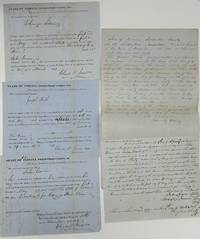
réf. 33205As recorded in a series of two manuscript documents and three partly printed documents completed in manuscript November 1850--4 April 1851. Comprising a bill of indictment against the accused John Carver an arrest warrant signed by the Switzerland County clerk of court two summonses for witnesses and a bond signed by Carver and the county sheriff guaranteeing Carver's appearance in court. 4to. and half-sheet 4to. Each 1-page 4 with docketing on verso. A very good lot. unknown books
1960réf. 23860Los Angeles: Lucian Press Fantasy House Publication 1960. Pictorial wrappers. Very Good. Uncommon bondage digest c. 1960. Part of Fantasy House's wonderful "Photo-Fiction" series. Crisp and VG in its stapled pictorial wrappers with very light soiling and streaking to the panels. Octavo suggestive black-and-white photos throughout. Lucian Press (Fantasy House Publication) unknown books
réf. 18516Archive of 12 silver gelatin photos pasted to dark grey board and clipped from original photo album of WWI era soldiers and jockeys partaking in horse racing. Measurements are 3" x 4" with the photos themselves measuring 2.5" x 3.25". Horses were vital in military usage during the First World War and played a major role economically as they reached their peak of 21.5 million by 1920. Between the First and Second World Wars the importance of the horse in commerce and agriculture began to decline. Whilst this was going on the sport of horse racing continued to grow in popularity perhaps partly as a result of this general decline. Horse racing was one an international favorite sporting pastime with dozens of courses all over the world. This photo archive shows a particular race in motion with jockeys who seem to be competing with a group of WWI soldiers in officer caps and uniform. Photos have minor wear to edges and corners. Overall in very good condition images are crisp and clear. unknown books
1890réf. 143511890. Gülmez Frères hand-colored photograph of the Sultan's Arabian horse nineteenth century documents Ottoman court ceremonial culture through an imperial horse its elaborate tack and two uniformed attendants in Constantinople. The photographer's stamp identifies Gülmez Frères as "Photographes de S.M.I. le Sultan" recording the studio's connection to the Ottoman court. The photograph also places the group at the Pera Palace Hotel linking an image of imperial service and display with one of Constantinople's best-known late Ottoman hotels. Original nineteenth-century hand-colored photograph image size 7.6 x 9.7 inches. A white horse stands in profile wearing an embellished red and gold saddle and appointments. Its groom wears a corresponding red and gold uniform and holds the horse at its head; beside him stands an aide-de-camp in a green uniform with a sheathed sword. Behind the group a broad carpeted stone staircase decorated with Arabic motifs rises to the open doors of the Pera Palace Hotel. The hand coloring emphasizes the red gold and green of the uniforms and equestrian equipment against the pale horse and masonry. Photographer's stamp on verso reads: "Photographie Apollon. Gulmez Feres Photographes de S.M.I. le Sultan. Succursale vis-a-vis le Pera Palace Hotel. Constantinoples." The photograph preserves specific evidence of late Ottoman equestrian display court dress and the presentation of an imperial horse while the Gülmez Frères stamp identifies both the photographers' claimed court appointment and their branch opposite the Pera Palace Hotel. The combination of hand coloring elaborate saddle equipment uniformed groom and aide-de-camp and identifiable Constantinople setting gives unusually detailed visual documentation of the ceremonial presentation of a horse belonging to the Sultan. Sharp image with hand coloring remaining distinct. Overall very good condition. unknown books
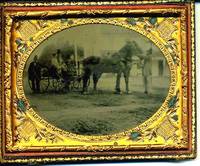
1850réf. 99561850. Horse and carriage ambrotype circa 1850-1859 documents mid-19th century American civilian transportation and rural social life during the decade immediately preceding and encompassing the early Civil War period. The image holds research value for the study of early photographic practice particularly outdoor ambrotype production as well as material culture relating to horse-drawn mobility family presentation and dress in pre-industrial and wartime America. Ambrotypes were typically produced in controlled studio environments due to technical limitations; the presence of an outdoor composition situates this image within a less common subset of early American photography. Quarter plate ambrotype photograph showing a family seated within a horse-drawn carriage accompanied by two large horses with an adult man standing at the front holding the animals. The man wears a broad-brimmed hat consistent with mid-19th century rural or frontier attire. The group is positioned outdoors likely on unpaved ground with no visible studio backdrop emphasizing natural light exposure. The composition centers the carriage and team with human figures arranged to present both transport and family unit simultaneously. The photograph is housed in its original leather presentation case with red velvet interior lining and a decorative copper mat framing the image. The ambrotype process a glass-based photographic technique introduced in the early 1850s produces a unique non-reproducible positive image distinguishing it from later paper-based photographic formats such as cartes de visite. Ambrotypes emerged during a transitional period in photographic history bridging earlier daguerreotype practices and the rise of reproducible paper photography. By the late 1850s and into the Civil War era photographic documentation expanded alongside technological shifts yet outdoor images remained comparatively uncommon due to exposure constraints and equipment limitations. This image contributes to the visual record of civilian life during a period often dominated by military imagery offering insight into transportation clothing and social presentation outside formal studio settings. Light wear to case exterior minor rubbing at edges; interior velvet intact with moderate compression; glass plate and mat remain well-preserved with clear image visibility. Overall very good condition. unknown books
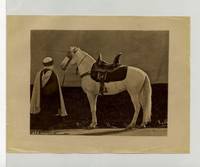
1880réf. 145821880. Colonial Era Vintage original albumen photograph of a Bedouin holding a white horse published circa 1880. Image size: 7" x 9." In this image we can see a Bedouin horseman traditionally dressed in a thoab and kufiyya with igaal. The warrior is approaching his horse from the front. His majestic white steed stands saddled and alert. Overall in very good condition. unknown books
1849réf. 144711849. D'Orbigny Charles ed. Dictionnaire Universel d'Histoire Naturelle 1849. Original hand-colored illustration of an Arabian horse published in one of the major French natural history encyclopedias of the nineteenth century. The Arabian horse developed over centuries of selective breeding on the Arabian Peninsula was renowned for its endurance agility and importance in transportation warfare and regional horse breeding. By the nineteenth century Arabian horses had also attracted considerable attention among European naturalists and breeders who studied their physical characteristics and influence on European bloodlines. The illustration belongs to this period of increasing scientific classification and documentation of domestic animal breeds. D'Orbigny Charles ed. Dictionnaire Universel d'Histoire Naturelle. Paris 1849. Original hand-colored lithograph from the illustrated natural history encyclopedia edited by French naturalist Charles d'Orbigny 1806-1876. First-edition publication. Sheet measures approximately 9.5" x 6". The illustration depicts a standing Arabian horse in shades of tan and brown its head turned slightly toward the viewer against a sparsely rendered desert landscape. The horse's upright stance alert expression and carefully delineated musculature emphasize its physical characteristics. Hand coloring distinguishes the variations in the animal's coat and the surrounding terrain. D'Orbigny's Dictionnaire Universel d'Histoire Naturelle was published in multiple volumes during the 1830s and 1840s bringing together contemporary zoological botanical geological and other natural history scholarship. Its illustrated plates accompanied descriptions of animal species and breeds providing visual references for nineteenth-century French natural history education. The Arabian horse illustration records the breed as presented in European scientific publishing in 1849 combining zoological observation with the conventions of hand-colored animal portraiture. In excellent condition. unknown books
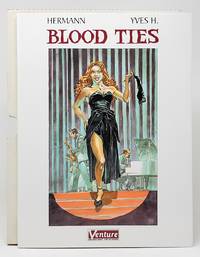
2000réf. 9641Milwaukie: Dark Horse Comics 2000. Limited Edition. Hardcover. Very Good /very good. Limited Edition. Hardcover. 13" X 9 3/4". Unpaginated. Very mild shelf wear to covers corners and edges of unclipped dust jacket. Bound in red cloth over baords with spine and front cover lettered in black. Pages are bright clean and unmarked. Binding is sound. Includes 12 1/2" X 9 1/2" full-color print numbered 32/100 and signed in pencil by Hermann. ABOUT THIS BOOK: The first in a series of European graphic novels brought to the U.S. by Dark Horse Comics Blood Ties features the stunning art of Hermann. He is one of Europe`s leading comic artists and the creator of Jeremiah The Towers of Bois-Maury Caatinga Nick Sarajevo Tango Wild Bill and many others. While investigating a series of horrible crimes junior detective Sam Leighton discovers the squalid reality of the big city. The murders are the work of Joe Beaumont -- a man as powerful as he is paranoid. Joe only appears in public to attend the shows of his beautiful wife Gladys an alcoholic and a frustrated cabaret dancer. Sam`s mysterious partner Phillip Meadows puts Gladys in Sam`s way hoping that she will lead them to Beaumont regardless of the danger to Sam!Publisher. Dark Horse Comics hardcover books
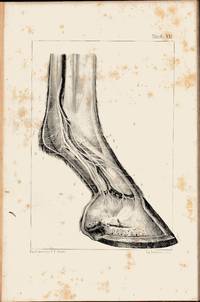
1851réf. 4369Paris: Labe 1851. First Edition. Contemporary three-quarter leather. Good; foxing; bindings worn with chipped spines. 8vo xix 1 1 - 320 pp. an atlas of 34 lithographic plates; each plate with an explanatory page of text. The author was prof. of surgery at the national vet. college at Alfort and sec' ty. of the French national association. The book offered here is detailed and important study of the horse's hoof. Excellent plates illustrate nerves blood flow etc. and are minutely detailed. See White for a mention. Labe hardcover books
1880réf. 22400Milford MA: Milford Press- Geo. W. Stacy Printer. 1880. 15 1 pp. Stitched in original printed wrappers light wear small chip at fore-edge of front wrap. Very Good. Officers are listed at page 16. The list of members dates from 1821. Another version with this title issued in 1860. OCLC 38658307 2- Stanford C/W Mars. Milford Press- Geo. W. Stacy, Printer. unknown books
1862réf. 20683Montauban: Victor Bertuot 1862. Very Good. Montauban: Victor Bertuot 1862. First Edition. Octavo; 2ix189pp; sepia-tinted frontispiece 8 plates 3 tinted; additional text illustrations throughout; contemporary calf-backed marbled boards spine in six compartments black gilt-lettered morocco spine label marbled endpapers. Extremities and spine bands rubbed leather rather dry; interior fine. Pilgrim's guide to the newly restored commune of Rocamadour situated in the Lot region of southwestern France. The village and its Chapelle de Notre Dame constructed in 1479 is today a UNESCO heritage site as part of the St. James' Way pilgrimage route. The site first gained popularity as a pilgrim destination during the Middle Ages but by the early 19th century was in ruins first with the arrival of the Huguenots in the 16th century and pillaged again during the French Revolution. Not until the mid-19th century were funds raised by the bishops of Cahors used to restore the site. This guidebook would have been produced shortly after the restoration and provides handsomely illustrated descriptions of the village the numerous Chapelles and surviving relics. Preface dated 1862; attributed to the abbé Cheval by the BNF. Victor Bertuot unknown books
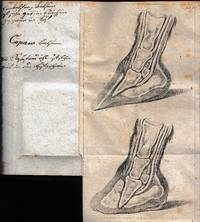
1819réf. 24052Wien und Triest: Geistinger Buchhandlung 1819 / 1820. Second / First Edition. . Contemporary marbled paper over paste paper boards. Very good; some toning and dustiness; covers somewhat chipped and worn. 8vo I - 8 1 - 182 2 - adverts pp. 6 folding copper plates on extended stubs for ease of viewing with text; II - 4 1 - 236 pp. 4 folding copper plates. Both texts focus on the importance of the horse's hoof and the maintenance of good health and practices. The title of the second tract is specfic in noting its importance for farriers. Both are extensive and well illustrated. Absent from Dingley Washington State and Billmeyer-Conant collection sale catalog; no copies of either title in America. Geistinger Buchhandlung hardcover books
1809réf. 24084Easton Pennsylvania: C J Hutter 1809. First only Edition. Contemporary half leather over blue paste paper boards. Very good; some browning. 8vo v 1 - blank 1 - 90 iv index - last page mis-numbered vi pp. An extensive compendium of veterinary cures exclusively for the horse. Arndt #1656; Austin #796; S&S #17575; Tucher #1217. C J Hutter hardcover books
1921réf. 2351929Leominster Massachusetts: The Eusey Press Inc 1921. Facsimile. Hard Cover. Near Fine/No Jacket. 1980s facsimile of 1921 original. Rear endpaper lightly soiled small dealer bookplate on rear endpaper corner. Binding tight and square text clean bright and unmarked. 587 pp. No images making it an oddity in the series other volumes include numerous photographs. The first volume of the series composed entirely after the death of the register's original author Joseph Battell he passed away shortly before the publication of volume three. The Morgan horse is one of the earliest horse breeds developed in the United States. Tracing back to the foundation sire Figure later named Justin Morgan after his best-known owner Morgans served many roles in 19th-century American history being used as coach horses and for harness racing as general riding animals and as cavalry horses during the American Civil War on both sides of the conflict. Morgans have influenced other major American breeds including the American Quarter Horse Tennessee Walking Horse and the Standardbred. During the 19th and 20th centuries they were exported to other countries including England where a Morgan stallion influenced the breeding of the Hackney horse. In 1907 the US Department of Agriculture established the US Morgan Horse Farm near Middlebury Vermont for the purpose of perpetuating and improving the Morgan breed; the farm was later transferred to the University of Vermont. The first breed registry was established in 1909 and since then many organizations in the US Europe and Oceania have developed. Popular children's authors including Marguerite Henry and Ellen Feld have portrayed the breed in their books; Henry's Justin Morgan Had a Horse was later made into a Disney movie. The Eusey Press, Inc hardcover books