281 Ergebnisse
Best.-Nr. BN370034Voices Within Carnatic Music Passing on an Inheritance Hardcover Voices Within Carnatic Music Passing on an Inheritance Hardcover Voices Within Carnatic Music Passing on an Inheritance Hardcover hardcover
1886Very Good Arabic Paperback. Contemporary marbled boards. Chipped on margins of cover papers. Added a paper to spine in its period. Slightly toned on paper. Otherwise a good copy. Demy 8vo. (21 x 14,5 cm). Bilingual in Ottoman script and Arabic. 78 p., ills. and tables. Lithograph. AH 1303 = AD 1886. First and Only Edition. Only one copy in OCLC: 463334715.; Özege 13820.; Not in Ihsanoglu -Sesen - Izgi. He was the son of Haci Ömer Agha. His family was called the Blind Halîloghuls. He did his education in various madrasahs and with famous scholars of Harput. He had his 'ijazat' by Ibrâhim Hulûsî Efendi. He worked as a teacher in Elazig Military Office for almost 30 years. Here he taught logic, religion, and Arabic philology. In addition to his profound knowledge of Arabic and Persian, he was also familiar with mathematics, science and literature. He also had the ability to determine the time by measuring the condition of the sun by using astrolabe. He made a special astrolabe. In addition he was a poet, also he was a calligrapher and he had written 25 qurans. (Türkedebiyatiisimlersözlügü). This book is the first science book printed in Mamuret al-Aziz Printing House which is written by Muallim Ibrahim Lebib Efendi from Harput includes account of 'Djem', 'Tarh', 'Taqsim', 'Zarp', 'Karrat djatwal [i.e. the multiplication table]', account marks, 'Qasrî adî', 'Qasrî âshârî', and 'Tanasub [i.e. proportioned]' as mathematical and calculus elements. Printed in Elazig vilayat. In this region where located this printing house, so Elaziz city in the Ottoman period was a city where was in addition to Turkish, Arabic was also widely spoken. (Müteferrika No: 46, Mamuretü'l-Aziz Matbaasi).
1848Fine Turkish, Ottoman (1500-1928) Original quarter leather and cloth binding with traditional flap (miklep). Roy. 8vo. (23 x 16 cm). Bilingual in Arabic and Ottoman script (Old Turkish with Arabic letters). 164 p., tables. Exceedingly scarce first and lithographed edition of one of the frequently referenced sources in Islamic law on inheritance and succession which is a bilingual edition in Arabic and Turkish. In the work, the situations of the children, brothers, sisters, and siblings, grandfather, Asabe (Ashab-i fürûz), 'Awl, Münâseha are addressed by Islamic scholars. The summaries of the subjects are first written in Arabic, and then their applications are made in Turkish, accompanied by tables. Takvîmhâne-i Amire is an innovative printing house established by Sultan Mahmud II as part of the reform movements in the Ottoman Empire after Ibrahim Müteferrika (1674-1745) established the first printing house and continued printing activities for 16 years and then passed away. The printing press was established for the purpose of publishing Takvîm-i Vekâyi [i.e. The calendar of events] as the first official newspaper in line with the purposes of informing and directing the domestic and foreign public and then continued its publication life for a long time. Typographic and lithographic sections are available separately. Özege 2958.; OCLC 40260123 (10 copies).
1902pp. ix, [1], 237, [1], [2] ads. Patten [1852-1922] was a long-serving professor and Chair of the Wharton Business School. "That many people regard life as a burden cannot be doubted, but this state of mind is due to a misuse of goods, not to a lack of them. The gap is not between effort and goods, but between goods and enduring satisfactions." - Introduction. Binding sound. Unmarked. Moderate wear to publisher's textured navy cloth. Bright gilt lettering to backstrip. Two tiny old tape repairs to page edges. Small vintage bookstore tag inside back board. A well-preserved copy of this fascinating study. Fundaburk 8407, Batson p.152, Masui p.1500. Book
1910Inscribed by author to his daughter Alice, signed "from her father, Xmas 1910" upon front free endpaper. [Documentation supporting this provenance will be provided.] xiii, [1], 375 pages. Index of Subjects. List of Authorities. Complete with 82 black and white plates, several of which fold out. Gilt lettering and decoration upon olive cloth. Top edge gilt. "Explains where we fall short, and suggests how the true remedies for individual, anti-social and collective misconduct or communal misunderstandings may be best applied". - Introductory Preface. Chapters include: Humanity, Normal and Abnormal; The Degenerate; The Criminal; How Criminals are Made; Responsibility; Sin and Crime; British Methods and Results; The Relations of Physiology to Justice; Development and Its Dangers; The Physiology of the Brain; Where is Mind?; The Physical Basis of Mind and Personality; Social Hygiene in Holland; The Treatment of Vagabonds and Crime in Belgium; Treatment; The Way Out - General William Booth of the Salvation Army offers a message for England. Wilson was "A genius before his time. The blatant truths of his observations are staggering. Political correctness was in the long distant future so he told it like it was. Open this book at random and you will find yourself drawn into the narrative, without fail." - online review. Light foxing. Unmarked with average wear. Binding intact. A special copy of this landmark study. Book
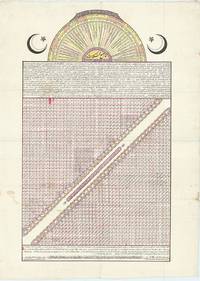
Best.-Nr. 66246Izmir 15th day of Jumada al-Akhir AH 1300 April 23 1883. Original broadside 80 x 50 cm in Ottoman Turkish and Arabic printed on laid paper with double-headed eagle watermark embellished with two crescent moon and star symbols neatly rubricated and coloured by a contemporary hand in a palette of pastel shades of pink yellow pale orange and purple. Old folds margins with some light wrinkling and a few nicks some minor losses to intersections of folds with some paper restorations a few instances of light browning generally a very good well-preserved example. This broadside presents the far id — the system of inheritance prescribed by the Qur an and elaborated over centuries of Islamic jurisprudence — in the form of a structured diagram dedicated to Sultan Abdülhamid II the thirty-fourth ruler of the Ottoman Empire and the last to exercise effective autocratic power over its domains. It was composed on the fifteenth day of Jumada al-Akhir in the year 1300 AH April 23 1883 by Kulevi Müftizade and Süleyman Hilmi the latter holding the rank of Devriyye a position in the Ottoman religious-scholarly hierarchy authorising him to teach and adjudicate at a defined level of the medrese system something approximating a licensed judge. The broadside presents the far id inheritance system in a structured diagrammatic form setting out the prescribed shares of all categories of heirs after burial expenses and debts have been settled. The extensive introductory text opens with a formal dedication to Abdülhamid II and continues with a concise historical survey of Islamic inheritance jurisprudence. The principal diagram sets out the prescribed shares of all categories of heirs: daughters widows mothers and collateral relatives. Shares are calculated after the deceased's burial expenses and outstanding debts have been settled. The system turns on a fundamental distinction between quota-heirs dhaw al-far id those entitled to fixed fractional portions of the estate one-half one-third one-sixth and so on and residuary heirs asaba who receive whatever remains after the fixed shares have been distributed. Four male quota-heirs are identified husband father paternal grandfather and maternal brother and eight females: wife daughter granddaughter mother grandmother full sister paternal sister and maternal sister. Depending on the configuration of surviving relatives certain heirs may shift between the quota and residuary categories. The chart concludes with the extended family group dhaw al-arh m who inherit only in the absence of both quota-heirs and residuaries. The far id system is among the most precisely codified elements of classical Islamic jurisprudence and its Qur anic basis has given it a sanctity and stability that have resisted modification over fourteen centuries. One of its notable features frequently observed by both Muslim jurists and later Western commentators is its explicit guarantee of inheritance rights to women at a time when most legal systems afforded them none. Daughters receive half the share of sons; widows and mothers receive defined fractions; sisters are specifically enumerated as quota-heirs. The Ayd n vilayet centered on zmir Smyrna was one of the most prosperous and cosmopolitan provinces of the Ottoman Empire — a major commercial hub with a mixed population of Muslims Greeks Armenians and Jews and a well-developed provincial administrative apparatus including its own press. That this Arabic-language inheritance law text was produced there in 1883 reflects the continuing operation of the Sharia court system in provincial Ottoman life where religious judges required authoritative reference materials for the administration of inheritance cases. Süleyman Hilmi's Devriyye rank placed him within the Ottoman ilmiye hierarchy — the class of religious scholars and jurists — and his co-authorship of a formally licensed and copyright-protected legal broadside suggests both professional standing and commercial ambition. The copyright notice is itself noteworthy: Ottoman intellectual property protection of this kind enforced through the author's personal seal was not unusual by the 1880s yet it remains a detail that surprises modern readers. The dedication to Abdülhamid II who had come to power in 1876 and was actively cultivating pan-Islamic sentiment as a tool of political legitimacy is consistent with the tone of religious-legal publication throughout his reign. The entire Ottoman legal system that this broadside served — Sharia courts far id inheritance rules the ilmiye hierarchy — would be abolished in the reforms of 1924–26. Composed April 23 1883 15 Jumada al-Akhir 1300 AH by Kulevi Müftizade and Süleyman Hilmi. Printed at the provincial press of the Ayd n vilayet presumably at Izmir through the agency of Ziya Efendi under Board of Education license 674 dated 1301. This is the first time we have encountered this place of publication. A bookseller's stamp appears at the foot. Copies not bearing the author's personal seal were declared counterfeit at the time of publication. Generally speaking large ephemeral broadsides like this tend to survive in low numbers. More specifically examples of this broadside were likely discarded when the jurisprudential tradition it represents was abolished between 1924 and 1926 when the new Turkish Republic adopted a modern civil code in its place. [Izmir], 15th day of Jumada al-Akhir, AH 1300 (April 23, 1883). unknown