82 232 résultats
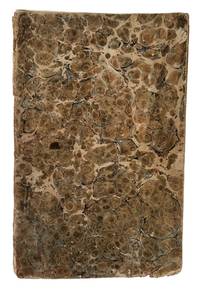
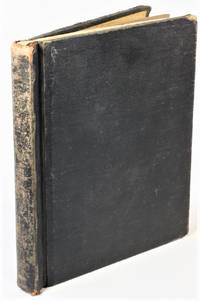
1849réf. 196951849. Wismer Henry. 19th-Century Handwritten Arithmetic Notebook from Pennsylvania is an 1849 to 1850 student manuscript documenting practical mathematics education in rural antebellum Pennsylvania. Completed in Plumstead the notebook records the arithmetic skills taught for commerce bookkeeping household accounting and everyday calculation during a period of expanding market activity. Its value lies in the student-produced evidence of how numerical instruction was practiced on the page with lessons arranged through headings worked examples and repeated computations rather than printed textbook exposition. Wismer Henry. 19th-Century Handwritten Arithmetic Notebook from Pennsylvania. Plumstead Pennsylvania 1849-1850. Manuscript arithmetic notebook 72 handwritten pages approximately 12" x 7½". The title page is inscribed "Addition of Federal Money" and the leaves are organized with subject headings followed by handwritten calculations. Topics include "Addition of Federal Money" "Addition and Subtraction of Decimal Fractions" "Simple Interest" "Compound multiplication" and related exercises showing the practical curriculum expected of a Pennsylvania student preparing to use arithmetic in trade finance and daily life. Several word problems connect classroom numeracy to ordinary social and economic situations including an age calculation beginning "Henry was born on the 20th of the 6th month June 1789 and Charles on the 18th day of the 2nd month February 1828" and a commercial problem involving corn bought and sold by the bushel. Dampstaining and foxing throughout; handwriting remains clear and legible on all pages. Overall very good. A substantial student manuscript preserving the methods subjects and practical applications of mid-nineteenth-century Pennsylvania arithmetic education. unknown books
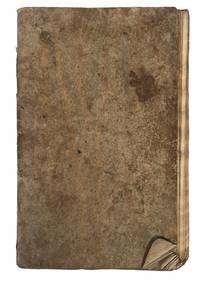
1841réf. 197091841. Pennsylvania Mathematic Education 19th-Century Handwritten Arithmetic Notebook from Bucks County Pennsylvania. Manuscript arithmetic notebook comprising 48 handwritten pages approximately 12 × 7½ inches executed by Isaac Fluck of Bucks County Pennsylvania between December 1841 and 1842. Fluck was born in 1826 making him approximately sixteen years old when he compiled these pages during his high-school education. The volume is systematically organized with clear subject headings at the top of each leaf - such as "English Money" "Cloth Measure" "Addition of Federal Money" and "Compound Division" - followed by worked examples written computations and applied problem sets. A recurring emphasis on conversions measurements and multi-step arithmetic underscores the practical education valued in mid-nineteenth-century America. The notebook is distinguished by its preservation of authentic word problems that illustrate how mathematical instruction was tied to everyday concerns. One problem asks the learner to "Subtract 36 acres 2 rods from 900 acres 3 rods 16 perches" while another records multi-digit subtraction including "Subtract fifteen thousand five hundred and nine from twenty thousand six hundred and fifty four." Other entries show Fluck reducing long measures - from leagues to miles and furlongs to poles - and calculating "simple subtraction" with large numbers evidencing both the student's increasing confidence and the curriculum's emphasis on real-world numeracy. The alternating use of black and blue ink throughout the notebook as well as the range of topics addressed indicates ongoing study over months rather than a single session. The breadth of lessons - from federal money and cloth measure to compound multiplication and time calculations - reflects the type of math education offered in preparatory schools of the period. As a student-produced manuscript this notebook offers rare primary evidence of arithmetic pedagogy prior to the widespread adoption of printed textbooks and demonstrates how young Americans were trained in the mathematical skills necessary for commerce trade and measurement in a rapidly developing nation. For institutional collections it provides direct insight into the intellectual life of a teenage student in pre-Civil War Pennsylvania and the material culture of learning in the antebellum United States. Condition: The notebook's covers are detached and some dampstaining and foxing throughout otherwise very good condition. unknown books
1808réf. 197171808. Weidner Samuel. Early 19th-Century Barter Arithmetic Notebook of Samuel Weidner of Bucks County Pennsylvania is an 1808 to 1829 manuscript documenting practical mathematics education and commercial calculation in the early Republic. Begun when Weidner was about seventeen and continued intermittently into adulthood the notebook records arithmetic as a working intellectual skill tied to trade currency conversion profit and loss partnership accounting and barter exchange. Its long span provides unusually direct evidence of how one Pennsylvania student preserved and revisited mathematical rules across the transition from schooling to adult use. Weidner Samuel. Early 19th-Century Barter Arithmetic Notebook of Samuel Weidner of Bucks County Pennsylvania. Bucks County Pennsylvania 1808-1829. Manuscript arithmetic notebook 62 handwritten pages approximately 12" x 7½". The notebook is organized into titled lessons including "Loss and Gain" "Fellowship" and "Exchange" each followed by manuscript definitions rules and worked examples. Under "Loss and Gain" Weidner writes "Loss and Gain is a method of computing the profits or loss on the purchase or sale of goods" and connects the rule to "Barter." In "Fellowship" he defines the subject as "the rule for adjusting the several quota of the loss or gain of any joint adventure of a bankruptcy effect" adding that "the sum of the several shares must equal the whole gain or loss." The "Exchange" section addresses conversion between monetary units through the "rule of three" while long division examples include extended problems such as "1265.50 divided by 165191.02" and "2000 divided by 6840912." The notebook records the commercial orientation of early nineteenth-century arithmetic instruction in rural Pennsylvania where mathematical study prepared students for market transactions bookkeeping shared ventures debt and practical financial reckoning. Light soiling and handling wear consistent with a working manuscript; handwriting remains clear and legible throughout all 62 pages. Overall very good. A substantial Bucks County student manuscript preserving the rules examples and applied logic of early American commercial arithmetic over more than two decades. unknown books
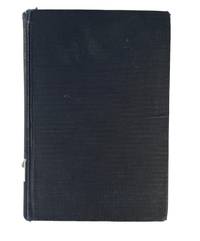
1914réf. 196171914. African American Literature Miller Kelly. Out Of The House Of Bondage. New York: The Neale Publishing Company 1914. First edition ex-library hardcover copy. No dust jacket. 242 pages. Measures 5.25" x 7.5". Out of the House of Bondage is a collection of essays by Kelly Miller a professor and administrator at Howard University and an important figure in the intellectual life of black America for close to half a century. Miller first attended Howard University on scholarship in 1882. While studying mathematics in 1886 under Captain Edgar Frisby he was recommended to attend Johns Hopkins University and became the first African-American student to attend the university and the to study graduate mathematics in the US. Miller was appointed as president of Howard in 1918 and built a new central administration. He published articles and weekly columns in black presses on education and race many of which were compiled together in this text. A sticker from Rochester Library is on the front pastedown. All pages are still attached to spine pages are very clean and neat. Overall in very good condition. Miller advanced the intellectual life of African Americans earning several advanced degrees and inspiring others to pursue education through his writings. unknown books
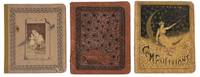
1880réf. 196981880. Fraister Belle. Iowa Schoolgirl Handwritten Notebook Archive documents the classroom work of a late nineteenth-century Iowa girl preserving evidence of women's education through manuscript exercises in history English penmanship grammar and arithmetic. The notebooks show how a schoolgirl practiced factual recall moral phrasing written style and practical calculation during a period when secondary education for girls increasingly prepared students for teaching clerical work and public intellectual participation as well as domestic life. The material provides direct evidence of everyday pedagogy handwriting discipline and curriculum formation in Iowa between 1880 and 1890. Iowa 1880-1890. Archive of 3 handwritten school notebooks belonging to Belle Fraister totaling 146 pages many blank in decorated pictorial wrappers; notebooks measure approximately 8" x 7" and 8" x 7½". The notebooks contain written work in history English penmanship and arithmetic with one history section summarizing states through structured categories such as time cause place and people. For Georgia Fraister writes "Time - 1733" "Cause - Refuge for the poor and persecuted" "Place - Savannah" "People - English" and notes "1752 - Geogia became the first Royal Province." Other pages show repeated penmanship practice including the phrases "Promise little but do much" and "Union is strength" calligraphic stroke exercises and grammar notes on pronunciation inflection pitch synonyms and related language study. One notebook includes a small newspaper clipping on the death of John G. Saxe with a brief handwritten biographical note beneath it. All notebooks bear stamps from the original stationery store. 1 Fraister Belle. History Notebook. Iowa 1880-1890. Contains structured state-history summaries including entries for Georgia organized by date motive for settlement location and people showing classroom methods for memorizing colonial and state history. 2 Fraister Belle. Penmanship Notebook. Iowa 1880-1890. Includes repeated letters words phrases and calligraphic strokes documenting handwriting instruction as both practical skill and moral exercise through maxims such as "Promise little but do much" and "Union is strength." 3 Fraister Belle. English and Arithmetic Notebook. Iowa 1880-1890. Contains notes on grammar pronunciation inflection pitch synonyms arithmetic and a clipped notice with a manuscript biography of John G. Saxe showing the combination of language study numeracy and literary awareness in Fraister's schoolwork. Decorated wrappers with light handling wear; interior pages generally legible; many pages blank as noted. Overall very good. A compact manuscript archive documenting the subjects methods and written discipline of girls' education in late nineteenth-century Iowa. unknown books
2007réf. 66161Paju: Darakwon 2007. Second printing 8vo pp. 223 1; pictorial paper wrappers; text clean and unused; fine with CD included not tested. Darakwon unknown books
1943réf. 200331943. African American Education Alexander Fred M. Education for the Needs of the Negro in Virginia. Washington DC: The Southern Education Foundation. First Edition Hardcover No Dust Jacket 1943. 297 pages. Measures 6.25" x 9.25". The book proposes that the rapid acceleration of social chance in Virginia has required the education system to make changes to accommodate the black scholars. The stated reasons for the study by the author include: "There is general concern among all classes of people for improving the social and economic conditions of all underprivileged people" "Education opportunities and facilities for Negroes in Virginia are below a reasonable standard for social effectiveness" and "Negroes are becoming increasingly conscious of their educational needs and are organizing to urge more adequate facilities." The book is broken up into different educational sections and also includes several graphs charts and other index sections. Gold gilt lettering with Title & portrait of John P. Slater in seal on boards. Gilt lettering on spine. Cloth is dark green. Binding tight and pages are clean. In very good condition. unknown books
1832réf. 200121832. American Education Society. Sixteenth Annual Report of the Directors of the American Education Society 1832 records the finances administration and ministerial training work of an organization founded to assist "indigent but pious" young men preparing for the Protestant ministry. Issued during the expansion of evangelical benevolent societies in the antebellum United States the report documents the close relationship among theological education charitable subscription and Protestant reform. Its accounting of institutional activity and financial support provides contemporary evidence of how voluntary religious organizations recruited donors and financed clerical education during the revival culture of the early nineteenth century. American Education Society. Sixteenth Annual Report of the Directors of the American Education Society Presented at the Annual Meeting. Boston: Printed for the Society by Perkins & Marvin 1832. Octavo. The report records the Society's annual activities finances governance and support for ministerial education presenting administrative information to subscribers while also arguing for continued financial and moral support. Such reports served both as institutional records and as fundraising instruments allowing the Society to account for its expenditures identify the scope of its educational work and maintain connections among officers contributors theological students and supporting congregations. Founded in 1815 the American Education Society belonged to the network of Protestant benevolent organizations that expanded alongside the Second Great Awakening and sought to increase the number of formally educated ministers available to growing communities in the United States. The 1832 report preserves the Society's own account of that work at a time when theological schools missionary organizations and voluntary associations were becoming increasingly important to Protestant institutional life. Disbound and lacking the original wrappers with moderate edge wear; text complete and legible. Good condition. An early annual record of the financial and administrative mechanisms used to support Protestant ministerial education in antebellum America. unknown books
1928réf. 189221928. Women's Education Diploma for female student at the Crouse-Irving Hospital School of Nursing. Syracuse NY. 18 October 1928. Kept in black cloth folder with gilt lettering that measures 6.5" x 4." Diploma certificate is awarded to "Louise Lowe McKeehan" and bears gold seal and school insignia. There are signatures from the President Board of Trustees the Superintendent of Hospital the Principal School of Nursing and the President of Staff which validate this document. Founded in 1887 by a group of women the Syracuse Training School for Nurses was the first hospital in the area that would admit women and children. This diploma is evidence of the school's long history of furthering women's education. Very good condition. unknown books
réf. 18976Tuskegee University felt pennant likely late twentieth century documents HBCU pride African American educational identity and Black Power visual culture through a collegiate souvenir tied to one of the most historically important Black institutions in the United States. Tuskegee was founded in 1881 as the Tuskegee Normal School for the training of Black teachers with Booker T. Washington as its first teacher and founding principal and later became closely associated with figures including George Washington Carver. Yellow felt pennant measuring 28 inches in length. The pennant displays bold red "Tuskegee" lettering and a red "Property of Black America" seal incorporating a raised Black Power fist at the center. The design combines traditional collegiate pennant format with explicit Black nationalist visual language linking campus affiliation to broader African American pride and collective ownership. The pennant is significant as a material expression of Black educational heritage rather than a standard school souvenir. Its raised-fist emblem places Tuskegee identity within the visual vocabulary of Black Power and post-civil-rights cultural assertion while its connection to an HBCU founded during Reconstruction-era struggles over Black education gives the object deeper historical resonance. Light handling wear; overall good to very good. A visually direct HBCU artifact connecting Tuskegee pride Black institutional history and African American political iconography. unknown books
1919réf. 189661919. The Marylander" 1919 yearbook from the Maryland College for Women. Contains 123 pages 11" x 8." Maryland 1919. In this profusely illustrated yearbook women students excel in their studies while pursuing active social lives. They engage in sports theatre productions and sororities. There are many full-page photographs of various campus organizations such as the Choral Club Basketball Team Baseball Team Spanish Club and a drama group called Thalia Club. Each senior-class student has her own page which includes a photo portrait nicknames hometowns club associations and cheeky descriptions: "Trissy is indeed a winsome maid. She is not as quiet as she seems or as bashful as she looks." Short stories poems and articles about school events are peppered throughout as are superlatives and advertisements for local businesses. Bound in black covers with gilt lettering. Very good condition. unknown books
1926réf. 189771926. Women's Education Elliott Vida Coe. The Social Role and Function Family as Analyzed in the Teachings of Confucius and Confucianism. Minneapolis: The University of Minnesota 1926. 97 pages of typed text. Wrapped in solid black cloth hardcovers. The title page notes that this is "A thesis submitted to the Graduate Faculty of the University of Minnesota by Vida Coe Elliott In Partial Fulfillment of the Requirements For the Degree of Master of Arts". Penciled ownership inscription by "Vida Elliott" on the front end paper. In her thesis Elliott analyzes the function of family in relation to the teachings of Confucius. She postulates that "One function of the family is the perpetuation of the race but if the race is carried on in an unwholesome way it will not be long before that race will cease to exist and another race will take its place". As a result she asserts that "The Chinese people foresaw this problem even before the time of Confucius they enacted eugenic laws in order that their race might prosper". To support her hypothesis she interweaves examples of Confucian teachings in comparison to family structures in America. Fading and chipping to the front and back cover and wear to the spine. Signs of wear to the manuscript's edges not affecting text. A compelling thesis intersecting Confucianism and eugenics overall in very good condition. unknown books
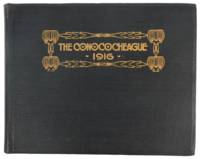
1916réf. 189641916. Women's Education Yearbook from an all-female college in 1916. Contains 181 pages 9.5" x 7.5." Pennsylvania. Founded by Presbyterian pastors in 1869 Wilson Female College was one of the first United States colleges to accept women. Its mission statement was rather progressive for its time declaring itself as an institution for women "to be leaders not followers in society." In this pristine profusely illustrated yearbook women excel in their studies while pursuing active social lives. They engage in sports theatre productions and sororities. There are many full-page photographs of various campus organizations such as The Physical Science Club Student Government basketball teams and hockey teams. Each senior-class student has her own page which includes a photo portrait a list of their club associations and a brief description: "If we were all men we would send Helen chocolate peppermints too." Short stories and poems are peppered throughout as are caricature illustrations and advertisements for local businesses. Bound in black boards with gilt lettering; a female student's name is inscribed on the front pastedown endpaper. A personal look into the history of women's education in America. Very good condition. unknown books
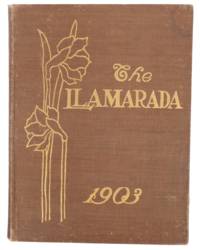
1903réf. 189671903. The Llamarada" 1903 yearbook from the Mount Holyoke College. Contains 221 pages 7" x 9.5." Massachusetts 1903. The oldest of the historic Seven Sisters colleges Mount Holyoke was founded by women's education advocate Mary Lyon. In this illustrated yearbook women students excel in their studies while pursuing active social lives. They engage in sports music clubs and sororities. There are many photographs of various campus organizations such as the Banjo Club the basketball teams and drama clubs. At the time Mount Holyoke had a strong literary presence as is reflected in these pages. There are many short stories articles and poems strewn throughout. Also included are 25 pages of advertisements from local businesses. Bound in brown boards with gilt lettering. Very good condition. unknown books
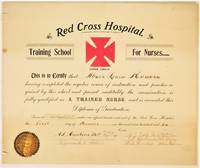
1906réf. 188971906. Women's Education Red Cross Training School for Nurses Diploma of Graduation. 1 December 1906 Minnesota. 14" x 17." Thick cardboard diploma bearing gilt seal and Red Cross "Semper Fidelis" logo. Reads "This is to certify that Maria Louisa Hamann having completed the regular course of instruction and practice required by this school and passes creditably the examination is fully qualified as a trained nurse and is awarded this diploma of graduation." Also included are six autograph signatures of various faculty validating the document. Some chipping at sides not affecting text. Otherwise in very good condition. unknown books
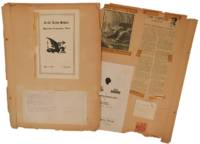
1942réf. 190201942. Women's Education Young Boston woman's personal unbound scrapbook archive with information about her Brown University scholarship. 10 oversize pages unbound each 16" x 12" pages decorated with 27 pieces of ephemera and 5 silver gelatin photographs. No covers Circa 1940s. These pieces belong to one Lois Paradise a high school senior in 1946 who attended Boston's Girls Latin School during a turbulent period in American history. She collected mementos from various points during her final year documenting everything from her Red Cross Home Nursing certification cards to opera handbills. She pasted in a column by Ernie Pyle about World War II as well as various class songs and poems. Lois received a prestigious full tuition scholarship to Brown University's Pembroke College; the notification letters are pasted beside an announcement in her local paper. Also included are newspaper clippings acknowledging her friends' acceptances to Boston University and Radcliffe. The photographs paint a vibrant picture of Lois' social life. Her friends dress up cradling baby dolls and stuffed animals; they stand shoulder to shoulder and grin at the camera. An inscription reads: "Baby day." Quite a few entries are accompanied with such captions usually providing brief identifications of place date and event. Very interesting archive of a young girl making her way in World War II -era America. Unbound edges are uneven. Missing some pieces of ephemeraand a few loose. Overall fair to good condition. unknown books
1810réf. 186861810. Wilson James. Arithmetic manuscript notebook 1810 documenting mathematical instruction and student practice in post-Revolutionary New England with direct relevance to the study of early American education numeracy and manuscript culture. The volume opens with a formal definition "Arithmetic is the art of computing by numbers." followed by systematic lessons covering numeration addition subtraction multiplication and division and extending into applied topics such as "Division of vulgar fractions" "The Rule of Three" and "Reduction of decimals." These subjects reflect the practical mathematical training expected of students in the early Republic where arithmetic supported commerce land measurement and everyday economic activity. The notebook also includes dated personal notation-"Bowdain February the 13th 1810. Tuesday morning the sky being clear."-anchoring the work within a specific time and place and illustrating how formal instruction intersected with lived experience in a rural educational setting. Wilson James. Arithmetic. Bowdoin Maine February 1810. Manuscript notebook comprising 56 handwritten pages measuring approximately 12 x 7.5 inches written entirely in ink with carefully structured headings such as "Reduction" and "Reduction continued" followed by worked examples and ruled numerical columns. The volume demonstrates a methodical approach to instruction through repetition and extended problem sets reflecting pedagogical practices prior to the widespread use of standardized textbooks. The consistent penmanship and organization indicate sustained use as a working instructional text rather than a presentation copy. Manuscript of 56 pages with dampstaining and foxing to the front cover and first leaves with occasional marginal staining; all text remains legible and the structure intact; overall good to very good condition. A student-produced primary source documenting arithmetic education and daily life in early nineteenth-century New England. unknown books
1992réf. 93464Langley Va: Central Intelligence Agency 1992. Paperback. Very Good. 43p. Softcover in original wrapper. 28 cm. TE/CSI 92-002. Central Intelligence Agency paperback books
1920réf. 192341920. Original Vintage Photograph from June 1920 of a group of young scientists including a young woman doing a dissection of a human skeletal cadaver. Black and white silver gelatin photograph. 7" x 5" photograph on 8" x 10" board. Captioned "June 1920" on verso. It is likely that this coeducational group are medical students with one older man in glasses seeming to be their instructor. In the background we can see a variety of anatomical drawings as well as bones preserved in liquid in a glass case. The students wear white lab coats except for the female student who is wearing a white gown. While women had entered the nursing profession in large numbers during the 19th century there were still very few female doctors in 1920 making this photo a depiction of a rather uncommon scene. There is a horizontal crack along the upper part of the board which is holding but delicate. The photo itself has a very small closed tear and a small blue smudge in the bottom left corner but is in very good condition overall. unknown books
1925réf. 194211925. African American family archive. Dallas photographs and Booker T. Washington High School commencement material circa 1925 documents Black education friendship courtship and family life in segregated Dallas through four vernacular photographs and two graduation-related booklets. Booker T. Washington High School opened under that name in 1922 and was then Dallas's only public high school for Black students drawing pupils from African American neighborhoods across the city. The archive records a 1925 graduating class of thirty-nine students including thirteen young men while the accompanying portraits preserve the informal social relationships surrounding school-age life beyond the classroom. Together these primary materials support research into African American education youth culture gender domestic settings and community formation under Jim Crow. Dallas Texas circa 1925. Six pieces as described: four sepia-toned black-and-white photographs and two printed Booker T. Washington High School booklets comprising a commencement program and a separate class-roll booklet; the original inventory's stated total of five items should be verified. The photographs measure between 2½ by 3 inches and 3 by 4½ inches. They show a young couple posed together a young man identified in manuscript as "my sweetheart" a girl seated outdoors beside a house and friends perched along a stone wall beneath the caption "a happy moment of my life." These images document formal and informal modes of self-presentation including romantic identification domestic surroundings and collective recreation. The printed material names the class motto as "Solidarity" identifies the class flowers as the white carnation and fern and lists thirty-nine graduates twenty-six young women and thirteen young men. The commencement address was delivered by J. F. Williams of Paul Quinn College the African Methodist Episcopal institution then located in Waco; available institutional chronologies place Williams in the college presidency during the mid-1920s although the exact beginning of his term varies among secondary accounts. 1-4 Unidentified photographers. Four family and student-life photographs. Dallas Texas circa 1925. Individual images depict a couple a young man captioned "my sweetheart" a girl seated outside a residence and several friends atop a stone wall captioned "a happy moment of my life." Their association with the graduation papers suggests a shared family or student provenance but the sitters' identities and exact dates remain unverified. 5 Booker T. Washington High School. Commencement Program. Dallas Texas 1925. Program for the graduation exercises of Dallas's segregated public high school for Black students recording the class motto "Solidarity" the white carnation and fern as class flowers and an address by J. F. Williams of Paul Quinn College. 6 Booker T. Washington High School. Class Roll. Dallas Texas 1925. Separate booklet listing thirty-nine graduates including thirteen male and twenty-six female students providing a named record of educational attainment within the city's Black community three years after the school assumed the Booker T. Washington name. Photographs removed from album leaves with residual adhesive on the versos; other individual defects are not supplied overall good. A closely associated group joining official evidence of Black educational achievement with intimate vernacular photographs of the young people and social relationships surrounding a 1925 Dallas graduating class. unknown books
1864réf. 62919Des Moines: F. W. Palmer State Printer 1864. 8vo pp. iv 118 2; fine copy in original tan printed wrappers. Includes an act to authorize the teaching of German or other language in the common schools; an act prohibiting the exclusion of the Bible from the schools of the state; and an act relative to the introduction of Webster's Dictionaries into the common schools of this state. Three in OCLC: Grinnell Harvard and Boulder. F. W. Palmer, State Printer unknown books
réf. 1887819th Century Archive of 23 School Merit Awards. These illustrated cards were each given to students as tokens of congratulations and scholastic achievement or good behavior. Sizes range from 3.5" x 2.5" to larger at 9" x 6.5." These small tokens of congratulation given to students for good behavior and scholastic accomplishments have been utilized by teachers for generations in America. The practice was most popular during the nineteenth century when printing techniques evolved to make this form of reward easily available. Rewards of merit in addition to being examples of a nineteenth century classroom tool reveal the progress of printing in America as well as the priorities of educators of the time. Illustrations include snowy scenes nature landscapes children churches flowers and birds. Many of them are signed with the student' names. Beautiful archive in very good condition. unknown books
réf. 18870Large archive of 61 School Merit Awards and other late 19th Century cards. Each card sizes range from 2.5" x 1.5" to 5" x 2.5." These small illustrated cards were given to students as tokens of congratulations and scholastic achievement. Illustrations include snowy scenes nature landscapes children dogs flowers and birds. Rewards of merit in addition to being examples of a nineteenth century classroom tool reveal the progress of printing in America as well as the priorities of educators of the time. Illustrations include snowy scenes nature landscapes children churches flowers and birds. Many of them are signed with the student' names. Beautiful archive in very good condition. A few of these cards were given in condolence to grieving relatives of a deceased loved one but the vast majority were for School Merit Awards. Beautiful and in very good condition. unknown books
1918réf. 182991918. Fairmont High School Diploma for female student. 1918. Measures 14 x 20 inches. Certificate reads in part "This diploma certifies that Edna Lillian Squires has completed the course of study prescribed by the Board of Education of this District for the High School and is entitled to all the honors and privileges of a Graduate of this Institution." Beneath the decorative text displaying the school's name across top is an illustration of the state seal of West Virginia at the time. The early 20th century saw new educational opportunities for American women who upon graduating from high school could attend integrated colleges. Educational activists like Catharine E Beecher advocated fiercely against for women's right to enter any college based on the belief that gender equality was contingent on the quality of female education and institutional opportunities to support it. Light foxing does not affect text or image. Includes state seal and original stamp from school board with ribbon still attached. Overall good condition. unknown books
1914réf. 183001914. Miss Gill's School for Girls Diploma. 1914. Measures 16 x 21.5 inches. Awarded to Constance Madeleine McFadden for satisfactory completion of the subjects of Arithmetic History of Art French Physiology English Psychology and English History. Miss Gill's School in Philadelphia was founded by Miss Elizabeth Gill an educational activist who championed small class sizes and close student-teacher collaboration a nonhierarchical classroom model rare for its time. Unlike women's "finishing schools" Miss Gill's emphasized a rigorous curriculum individualized to students' needs. Creased where folded. Light toning to edges does not affect text. Overall very good condition. unknown books