Multiple ContributorsMareMagnum

38 832 résultats
194533 pages. Features: Photo of smiling Eisenhower and an animated Patton, plus smiling Bradley and Hodges; Photo of Japanese Shrine on Saipan plus journal notes from a Japanese soldier; Photos of Juan Trippe, Lewis Douglas, Army nurses drilling at Camp Capson Colorado, Forger Alexander Thiel; Article on Okinawa; Full-page military map entitled "The Floods Come" shows positions centered around Hitler's inner fortress of Berchtesgaden; photo of U.S. armour on one of Germany's fine roads; Photo of very long column of German prisoners; Article and photo on German youth; Photo of "German Looters"; Photo of Chiang Kai Shek with General Hurley; Photo of St. Louis Browns' one-armed baseball player Pete Gray; Photo of a Brooklyn Public School classroom trashed by three young boys; Great photo of a navy bank in a quonset hut on Guam. No ads in this edition. Moderate wear. Unmarked. Binding intact. A quality copy of this excellent Patton collectible. Book
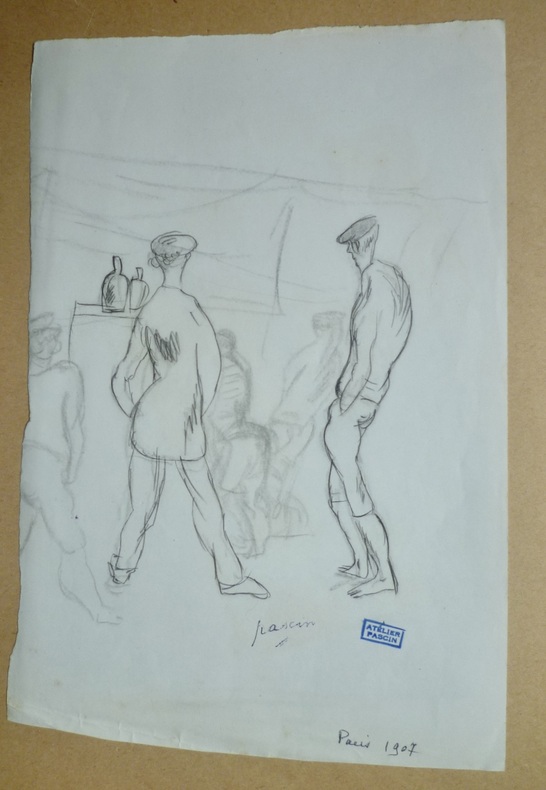
1907réf. P1Dessin crayon 24x17cm, Paris, 1907, griffe de la signature et cachet de l'atelier. Annotations manuscrites à l'encre de Lucy Krohg: "Paris 1907"
1870Acquaforte (mm 229x174; foglio: mm 335x292), monogrammata sulla lastra in basso a sinistra. Esemplare del secondo stato su due, stampato da Carlo Lovera e pubblicata su L’Arte in Italia del novembre 1870. Ottima impressione. Grandi margini, ottima conservazione. Alberto Pasini nasce a Busseto (PR) nel 1826. Iscrittosi all’Accademia di Belle Arti di Parma ha come maestro Girolamo Magnani, per la pittura. Nel 1851 si reca a Parigi dove, alla scuola dei pittori di Barbizon, si dedica alla pittura di paesaggio. Nel 1855, per interessamento del pittore Théodore Chassériau è aggregato ad una missione diplomatica diretta in Persia. Da qui la svolta nella sua vita. In questo primo e in successivi viaggi in vari paesi affacciati sul Mediterraneo, rimane conquistato dall’Oriente traendone spunti in disegni che poi svilupperà in numerosi dipinti. A Parigi dove si stabilisce espone ai numerosi Salon ottenendo prestigiosi premi. Lo Scià di Persia e il Sultano di Costantinopoli gli commissioneranno varie opere e i collezionisti si contenderanno i suoi piacevolissimi dipinti. Dal 1871 si ritira a Cavoretto, nelle colline piemontesi, non rinunciando tuttavia a continuare a viaggiare a Parigi e Venezia, città che verrà spesso ritratta nei suoi dipinti. Muore a Cavoretto nel 1899. È da considerarsi uno dei più notevoli orientalisti a livello europeo. Bibliografia G. Giubbini, L’acquaforte originale in Piemonte e in Liguria 1860 - 1875, Genova 1976, n.1. Etching (mm 229x174; sheet: mm 335x292), monogrammed on the plate at lower left. Exemplar of the second state of two, printed by Carlo Lovera and published in L'Arte in Italia - November 1870. Very good impression. Large margins, excellent conservation. Alberto Pasini was born in Busseto and attended the Academy at Parma. From 1851 to 1853 he studied under Eugène Ciceri (1803-1886) in Paris, where he completed his training in the atelier of M.E. Isabey (1813-1890). He made his Salon debut in 1853. From his first visit to Persia in 1855, as part of the suite of the French delegation to the Persian Gulf and Tehran, Pasini specialized in views of remote corners of Turkey and Persia. He travelled to Constantinople between 1868 and 1869 and to Asia Minor and Syria in 1873. Pasini was also a seasoned traveller within Europe and from 1878 visited Venice on several occasions, and made a journey to Spain with Gérôme from 1879 to 1883. "Principally a landscape and architectural painter, Pasini came under the influence of Théodore Rousseau and Fromentin in the late 1850s, though his later style reveals affinities with the Néo-grec school of painters. Apart from his Orientalist work, he painted some genre scenes and subjects taken from Turkish history and was also known for his lithographic work. "After the Franco-Prussian War (1870-71), Pasini returned to Italy, but continued to exhibit at the Salon until his death in 1899” (MaryAnne Stevens, ed., The Orientalists: Delacroix to Matisse - The Allure of North Africa and the Near East, exhibition catalogue, National Gallery of Art, Washington, DC, 1984, p. 195). References: G. Giubbini, L’acquaforte originale in Piemonte e in Liguria 1860 - 1875, Genova 1976, n.1.
1912réf. 20934Paris, Goupil et Cie, Manzi, Joyant, 1912 ; grand in-4° (323 mm), large demi-maroquin rouge, dos à nerfs, titre doré, tête dorée sur témoins, couverture et dos conservés, non rogné (reliure de l'époque) ; 171 pp., [1]f., 61 planches dont 57 hors-texte (4 en couleurs).
1767réf. 32270Paris Chez Vente 1767 in-12° 316-81 pp, avec le Catalogue Raisonné de Porcelaines de qualités supérieures, tant ancienne, première sorte, qu'ancien Japon et la Chine : d'effets précieux d'anciens lacqs, riches meubles de Boule , & bijoux , faisant partie du Cabinet de feu de M. de Julienne (...) Par C.F. Julliot , marchand au coin rue S. Honoré, au coi de celle du four, au curieux des Indes . Il manque Le Frontispice - Des côtes Manuscrites marquant peut être des prix ? des estimations ? - Carte de visite d'un expert parisien du XX ème siècle jointe - Plein veau restauré d'époque
1991375 pages. Index. Glossary. Footnotes. Black and white photographic plates. "Reveals how the strategy of indiscriminate bombings against the public was the result of secret NATO accords and was sanctioned at the highest levels of the Atlantic Alliance... Shows the crucial role played by the Hyperion Language School in Paris in the manipulation of the Red Brigades, and the role of the CIA in arming the revolutionary group. Casts a spotlight on Licio Gelli, the head of the now outlawed P2 Masonic lodge, who has been convicted of financing fascist terrorists." - dust jacket. Remainder mark to bottom edge. Some red markings to contents in first 70 pages. Bit of clear tape inside back board. Light wear to dust jacket now preserved in glossy new archival-grade Brodart. A sound copy. Book
1728Acquaforte, firmata e datata nel margine inferiore: Fran Zuccherelli Pitilianen incid. Flo. 1728. Da un disegno di Giovanni Manozzi. La stampa mostra una figura femminile in piedi che cammina verso sinistra tenendo una lampada, indicando con la mano destra. Bell’esemplare, stampato su carta vergata coeva, rifilato in prossimità della linea marginale, privo del testo contenuto nel margine inferiore. Francesco Zuccarelli studiò a Firenze nella bottega di Paolo Anesi ed in seguito si trasferì a Roma presso i pittori Giovanni Maria Morandi e Pietro Nelli. Fu inizialmente un pittore di soggetti storici ispirato dalla conoscenza della pittura di Claude Lorrain, pittore francese del Seicento vissuto a Roma che fu maestro di questo genere insieme al connazionale, ma più scenografico, Nicolas Poussin. Trasferitosi a Venezia, Zuccarelli, si rivolse alla pittura di soggetto arcadico, che coltivò in concorrenza col bellunese Giuseppe Zais. Come successe ad altri pittori veneti suoi contemporanei, quali Canaletto e Bernardo Bellotto, la sua pittura fu molto apprezzata all'estero dove fu chiamato a dipingere per ricchi mecenati come ad esempio il celebre Console Joseph Smith. Zuccarelli lavorò molto in Inghilterra dove influenzò importanti pittori locali in maniera particolare il suo stile fu ripreso dal grande Joshua Reynolds. Dopo cinque anni di permanenza a Londra, Zuccarelli ritornò a Venezia. Di nuovo a Londra nel 1765, fu uno dei fondatori della Royal Academy of Arts nel 1768. Etching, signed and dated lower margin: Fran Zuccherelli Pitilianen incid. Flo. 1728. After a drawing by Giovanni Manozzi. The print shows a standing female figure walking to the left holding a lamp, pointing with right hand. Good example, printed on contemporary laid paper, trimmed close to the marginal line, in perfect condition. Cut off the inscription in the lower margin. Francesco Zuccarelli studied in Florence in Paolo Anesi's workshop and later moved to Rome with the painters Giovanni Maria Morandi and Pietro Nelli. He was initially a painter of historical subjects inspired by his knowledge of the painting of Claude Lorrain, a 17th-century French painter who lived in Rome and who was a master of this genre together with his compatriot, but more scenic, Nicolas Poussin. After moving to Venice, Zuccarelli turned to painting Arcadian subjects, which he cultivated in competition with Giuseppe Zais from Belluno. As with other Venetian painters of his time, such as Canaletto and Bernardo Bellotto, his painting was much appreciated abroad where he was called to paint for wealthy patrons such as the famous Consul Joseph Smith. Zuccarelli worked extensively in England where he influenced important local painters, and in particular his style was taken up by the great Joshua Reynolds. After five years in London, Zuccarelli returned to Venice. Back in London in 1765, he was one of the founders of the Royal Academy of Arts in 1768. Massar - The prints of Francesco Zuccarelli (3.I) in Print Quarterly (XV) (3) (pp. 247-263).
1979635 pages. Index. Archives. Printed upon glossy stock. Covers the following school districts: Flowerdale, Blackfoot, Westminster Park, Lloydminster (rural), Spencer, Devonia Lake, Kinella, Thomasville, West Centre, Cheviot Hills, Madresfield, Golden Valley, Sunnydale, Sefton Park, Uneeda, Paradise Valley (E. Rural), Highbury, Allister, Ridgeclough, Crosslynde, Winona, Oxville, Park Valley, Woodford. Hamlets included: Rivercourse and McLaughlin. Gift greetings inside front board else contents clean and bright. Binding tight. Average external wear. A sound copy of this excellent reference. Krotki 1106. Book
1997réf. BN472132Amsterdam: IOS Press 1997. 1997. Coherent and Collective Interactions of Particles and Radiation Beams: Varenna on Lake Como Villa Monastero 11-21 July 1995 Proceedings of the International School of Physics. Coherent and Collective Interactions of Particles and Radiation Beams: Varenna on Lake Como Villa Monastero 11-21 July 1995 Proceedings of the International School of Physics. Barletta W. A. International School of Physics Enrico Fermi R. Bonifacio a. o. Amsterdam: IOS Press unknown
réf. BN370792Traité d'électricité tome 20 : Traitement numérique des signaux School & Library Binding Traité d'électricité tome 20 : Traitement numérique des signaux School & Library Binding Traité d'électricité tome 20 : Traitement numérique des signaux School & Library Binding unknown
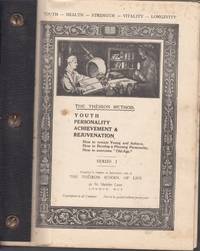
réf. 502221How to remain Young and Achieve. How to Develop a Pleasing Personality. How to overcome Old Age. Three sections in 1 bound folder. English. The Theiron School of Life. Undated. 856 & 18 pp. In solid black boards with metal screws. Good with some foxing at front and rear and on fore-edges. Book No: 502221 hardcover
1982réf. 2082402113505012Not Available 1982. Soft Cover. Fine. The book is in fine condition. Not Available paperback
1982réf. 2080202105100742Not Available 1982. Soft Cover. Fine. Number of books: 3 Not Available paperback
1938réf. 2080202105101523Kyu kura shirushi 1938. Soft Cover. Fine. Volume: 1 Kyu kura shirushi paperback
réf. h1-10-18-16-Unknown Binding. Good. Good minor cover crease no marks or highlights tracking provided. unknown
1895Very Good Greek, Modern (post 1453) Contemporary fine leather bdg. Demy 8vo. (22 x 15 cm). In Greek. 1118 p., richly illustrated (b/w ills.). Period bindery label of E. Watson in London. Ex-library copy on fourth blank page. Otherwise a very good copy. First and extremely rare translation into Greek of Taxil's 'Myste`res de la Franc-Mac?onnerie'. Mysteries of Freemasonry. Marie Joseph Gabriel Antoine Jogand-Pagès, better known by the pen name Léo Taxil was a French writer and journalist who became known for his strong anti-Catholic and anti-clerical views. He is also known for the Taxil hoax, a spurious expose of Freemasonry and the Roman Catholic Church's opposition to it. Marie Joseph Gabriel Antoine Jogand-Pagès was born in Marseille, and at the age of five, he was placed into a Jesuit seminary. After spending his childhood years in the seminary, he became disillusioned with the Catholic faith and began to see the religious ideology as socially harmful. Taxil first became known for writing anti-Clerical or anti-Catholic books, notably "La Bible amusante" (The Amusing Bible) and "La Vie de Jesus" (The Life of Jesus), in which Taxil satirically pointed out inconsistencies, errors, and false beliefs presented in these religious works. In his other books Les Debauches d'un confesseur (with Karl Milo), Les Pornographes sacrés: la confession et les confesseurs, and Les Maîtresses du Pape, Taxil portrays leaders of the Catholic Church as hedonistic creatures exploring their fetishes in the manner of the Marquis de Sade. In 1879, he was tried at the Seine Assizes for writing a pamphlet A Bas la Calotte ("Down with the Cloth"), which was accused of insulting a religion recognized by the state, but he was acquitted. In 1885, he professed conversion to Catholicism, was solemnly received into the church, and renounced his earlier works. In the 1890s, he wrote a series of pamphlets and books denouncing Freemasonry, charging their lodges with worshiping the devil and alleging that Diana Vaughan had written for him her confessions of the Satanic "Palladist" cult. The book had great sales among Catholics, although Diana Vaughan never appeared in public. In 1892, Taxil also began to publish a paper, La France chrétienne anti-maçonnique (Christian Antimasonic France), with his staunch anti-Masonic publishing friend, Abel Clarin de la Rive. In 1887, he had an audience with Pope Leo XIII, who rebuked the bishop of Charleston for denouncing the anti-Masonic confessions as a fraud and, in 1896, sent his blessing to an anti-Masonic Congress of Trent. Doubts about Vaughan's veracity and even her existence began to grow, and finally, Taxil promised to produce her at a lecture to be delivered by him on 19 April 1897. To the amazement of the audience (which included a number of priests), he announced that Diana was one of a series of hoaxes. He had begun, he said, by persuading the commandant of Marseille that the harbor was infested with sharks, and a ship was sent to destroy them. Next, he invented an underwater city in Lake Geneva, drawing tourists and archaeologists to the spot. He thanked the bishops and Catholic newspapers for facilitating his crowning hoax, namely his conversion, which had exposed the anti-Masonic fanaticism of many Catholics. Diana Vaughan was revealed to be a simple typist in his employ, who laughingly allowed her name to be used by him.The audience received these revelations with indignation and contempt. Afterwards, Taxil left the hall, where policemen escorted him to a neighboring café. He then moved away from Paris. He died in Sceaux in 1907. First Greek Edition. Rare. Only one copy in OCLC: 758917323.
2026réf. x-0443298599Elsevier - Health Sciences Division 2026. Paperback. New. 514 pages. 5.98x1.21x9.02 inches. Elsevier - Health Sciences Division paperback
réf. SONG0613829859Used: Good unknown
réf. DADAX0314906738New unknown
réf. SONG0415155592Used: Good unknown
réf. DADAX0367330458New unknown
2025réf. x-1350438677Bloomsbury Publishing Plc 2025. Hardcover. New. 3rd ed edition. 512 pages. 7.44x1.00x9.69 inches. Bloomsbury Publishing Plc hardcover
réf. DADAX0367494620New unknown
1999réf. x-0749427280Kogan Page Ltd 1999. Hardcover. New. 1st edition. 211 pages. 9.50x6.25x1.00 inches. Kogan Page Ltd hardcover
1916réf. 166221916. Carpenter Rachel A. M. Photograph album of St. Mary's School Wantage 1916 to 1918 documents the daily life of girls at an English school during the final years of the First World War. Twenty-three photographs record organized sports theatrical performance swimming leisure school uniforms faculty friends and the grounds of St. Mary's with handwritten captions and dates identifying every image. The album preserves a student's record of girls' education beyond the classroom including field hockey cricket tennis swimming and dramatic performance activities that formed an increasingly visible part of female secondary education in early twentieth-century Britain. Twenty-three gelatin silver photographs dated 1916 to 1918 mounted on 14 card-stock pages in original green cloth boards titled "Photo Sketches." Album measures 6.25 × 7.5 inches; photographs range from 2 × 2.75 inches to 3.5 × 5.5 inches. Carpenter identifies friends by full names initials and nicknames including "Tufty." Several views show students in uniform at leisure while others depict the field hockey cricket and tennis teams swimming in "the Baths" faculty members and campus grounds. Three photographs record the cast of a school production of Blue Beard performed during the summer term of 1918; the album retains a program for the production. Founded in 1873 as a girls' school St. Mary's belonged to the expansion of formal secondary education for girls in late nineteenth- and early twentieth-century England. Carpenter's photographs show how that education included organized athletics theatrical performance recreation and student social life during the wartime years of 1916 to 1918. The named and captioned photographs provide unusually specific evidence of individual pupils school activities and the rhythms of campus life. Condition not stated in the supplied description. unknown