Charrion (Et. ; ex-instituteur à Montromand(t)) :Livre Rare Book

36 548 résultats
réf. 21829St Genis-les-Ollières (Rhône), s.n., s.d. (Montromand le 30 septembre 1899) ; in-4° (26 x 21 cm), polycopié relié en percaline marron sans titre ; [1] f. de titre, 77 pp, tapuscrit.
réf. 113751Devambez, Editeur, sans date, 1 volume in-folio broché de 295x400 mm environ, 178 pages, complet du frontispice et des 61 planches protégées par des serpentes historiées. Un des 150 exemplaires sur papier de Hollande Van Gelder, n° 119/150, truffé d'un portrait de Philippe Pétain tissé sur soie, mis en carte en 1941 par l'école de tissage de Lyon. Plis, fentes et traces d'adhésif sur le dos, quelques feuillets se détachent, petites mouillures dans les marges, traces d'adhésif sur les gardes, bon état pour le reste.
1861réf. 5184Paris, Michel Lévy Frères, 1861 ; in-8 ; demi-chagrin vert sapin, dos à nerfs, caissons décorés et dorés, titre doré (reliure de l'époque) ; (4), 399 pp.
1938réf. 116131Ecole du Tissage Lyon 1938 Ouvrage entièrement manuscrit présentant de nombreux schémas et figures ainsi que 36 échantillons de tissus. Relié en pleine percaline verte sapin, dos muet, environ 39x29 cm. Quelques menus frottements d'usage sur la reliure, haut du second plat taché. Bon état pour le reste et intérieur bien propre.
réf. 230502(XIXème siècle) à vue : 17.5 x 21 cm - cadre : 32 x 36 cm, Encadrement postérieur du XXème siècle.
réf. 2315601812 à vue : 28.5 x 22 cm , cadre contemporain en bois doré
réf. 7638Grande gouache sur papier, milieu XIXème, non signée, encadrée sous verre.340 mm x 520 mm et 390 mm x 570 mm cadre et verre d'origine compris.Quelques mouillures anciennes et menus défauts, petits accidents à l'encadrement.
réf. 232938(XIXème siècle.) 48 x 64.5 cm , encadré sous verre, baguette dorée (cadre postérieur).
réf. 100098405E. de boccard. volumes 1947-1948 et 1949 en mauvais état dos défait plats séparés couvertures dans l'ensemble en état correct bords assez frottés qquelques fentes sur les charnières couvertures ternies tachées intérieurs propres rares annotations sur certains volumes. in8. Sans date. Broché. 18 volumes. Année 1947 et 1948 en un volume les autres années sont complètes et en 2 tomes chacune /// iconographie en noir et blanc E. de boccard unknown
réf. 100098410E. de boccard. Bon Etat de conservation cependant couvertures défraîchies bords frottés rousseurs sur tranche intérieur propre pages non-coupées sur certains volumes. in. Sans date. Broché. 14 volumes. iconographie en noir et blanc photographies plans schémas E. de boccard unknown
1926Puntasecca a inchiostro nero su carta vergata color crema, 1926, firmata in basso a sinistra: G. Firmato, a matita, in basso a destra: Frank Gillet. Bellissima prova, in ottimo stato di conservazione. Edward Frank Gillet, spesso accreditato come Frank Gillett, è stato un artista e illustratore britannico. Gillett lavorò a penna e inchiostro, pastello, acquerello e olio e fu notato come un abile caricaturista. Era ispirato dalla vita rurale di Norfolk e il suo lavoro spesso coinvolgeva lo sport, in particolare la caccia alla volpe e la caccia alla lepre. Il suo lavoro è stato esposto dalla Royal Academy of Arts e dalla Walker Art Gallery ed è detenuto dal British Museum e dal Victoria and Albert Museum. Drypoint in black ink on cream laid paper, 1926, signed, lower left: G. Signed, in pencil, lower right: Frank Gillet. A fine impression, very good condition. Edward Frank Gillett often credited as Frank Gillett, was a British artist and illustrator. He worked in pen and ink, pastel, watercolour, and oil. Gillett worked in pen and ink, pastel, watercolour, and oil and was noted as a skillful caricaturist. He was inspired by Norfolk's rural life and his work often involved sport, particularly fox-hunting and hare-coursing. His work has been exhibited by the Royal Academy of Arts and the Walker Art Gallery and is held by the British Museum and the Victoria and Albert Museum.
1630réf. est110t3Dimension extérieur 30,4 x 45,2 et cuvette 25,4 x 33,4 cm. Eau-forte réalisée par Giovanni Benedetto Castiglione, célèbre peintre, graveur et imprimeur italien de l'école génoise Baroque, sa ville de naissance. Gravure sur papier vergé datant environ de 1630, travail considéré comme l'un des premiers de l'artiste. En très bon état pour une œuvre de cette époque, on peut simplement noter une déchirure restaurée en bas au milieu.
1680Maniera nera, 1680-1700 circa, nella cornice ovale: “ADRIANI VAN OSTADE PICTORIS”, firmato in basso a sinistra “A. van Ostade del: Effigies”, e a destra “J. Gole exc: cum Privil: ord: Holland:”. Stato unico. Da un autoritratto di Adrian van Ostade. Jacob Gole (1660-1737) fu un incisore, editore e produttore di carte da gioco franco-olandese. Nato in Francia, figlio dell’ebanista francese Pierre Gole, come ugonotto fu costretto ad emigrare in Olanda, intorno al 1684. Sua sorella sposò un altro ugonotto emigrato, Daniel Marot. Legato a Cornelis Dusart, pubblicò stampe di Dirk Maas. Poco si sa della sua vita. È noto per i suoi ritratti alla maniera nera delle personalità più importanti del suo tempo, come Guglielmo III d'Orange-Nassau, Papa Innocenzo XI, Filippo d’Orleans, Luigi XIV, Giovanni III Sobieski, Augusto II, Federico Guglielmo I di Brandeburgo, Kara Mustafa. Fece anche un ritratto di Rembrandt, dal quale interpretò diverse incisioni. La sua stamperia ad Amsterdam aveva due indirizzi: Vijselstraat, bij de Prinse graft, Amsterdam e Leydse Straat, by de Prince graft, tot Amsterdam. Bella prova, impressa su carta vergata coeva, margini bianchi, in ottimo stato di conservazione. Mezzotint, 1680-1700 circa, circularly in the image “ADRIANI VAN OSTADE PICTORIS”, signed at bottom left “A. van Ostade del: Effigies”, at bottom right "J. Gole exc: cum Privil: ord: Holland:" Only state. After A. van Ostade. Jacob Gole (1660-1737) was a Dutch mezzotinter, engraver, publisher, and playing-card maker. Born in France, son of the French cabinet-maker Pierre Gole, emigrated as a Huguenot to Holland circa 1684. His sister married another Huguenot émigré, Daniel Marot. Linked with Cornelis Dusart, and published prints by Dirk Maas. Little is known about his life. He is known for his portraits in the black manner of the most important personalities of his time, such as William III of Orange-Nassau, Pope Innocent XI, Philip of Orleans, Louis XIV1, John III Sobieski, Augustus II, Frederick William I of Brandenburg, Kara Mustafa. He also made a portrait of Rembrandt, from whom he interpreted several engravings. His print shop in Amsterdam had two addresses: Vijselstraat, bij de Prinse graft, Amsterdam and Leydse Straat, by de Prince graft, tot Amsterdam. Good example, printed on contemporary laid paper, with margins, in good condition. Hollstein VII p. 214 (Gole); Wessely 103 (Gole)
1891Fotoincisione, circa 1891, firmata in lastra in basso al centro.Da un dipinto di Henriette Ronner (Amsterdam 1821-1909), la più grande pittrice di gatti.Prova di stampa, prima del titolo, impressa su carta cina applicata, con margini, in perfetto sttao di conservazione.Questo lavoro è parte del catalogo della mostra che esponeva i dipinti di Henriette Ronner, curato dalla stessa galleria Goupil, nle maggio del 1891.Questo l'astratto originale che annunciava il catalogo: 'Cats and kittens by Madame Henriette Ronner, May 189 ... Goupil Gallery' Catalogue includes advertisement for 'Henriette Ronner, The Painter of Cat-Life and Cat-Character' with text by M.H. Spielmann, containing a portrait and twelve full-page illustrations in photogravure by Boussod, Valadon & Co. Photogravure, circa 1891, signed at the center.After a painting by Henriette Ronner (Amsterdam 1821-1909).Proof before title on china wove paper, with full margins, perfect condition.This work is part of the exhibition catalogue of Henriette Ronner, published by Goupil Gallery.Exhibition catalogue extract: 'Cats and kittens by Madame Henriette Ronner, May 189 ... Goupil Gallery' Catalogue includes advertisement for 'Henriette Ronner, The Painter of Cat-Life and Cat-Character' with text by M.H. Spielmann, containing a portrait and twelve full-page illustrations in photogravure by Boussod, Valadon & Co.
1818réf. 628232Paris, F. Didot, 1818. 4 Bl., 275 S. Mit 2 lithographierten Porträts, 12 gefalteten Kupfertafeln u. 2 gefalteten Tabellen. Moderner Halbleder mit goldgeprägtem Rückenschild. [3 Warenabbildungen]
1718réf. 627501Breslau u. Leipzig, Blessing, 1718. 4to. 1 Bl., 8, 364 S., 3 Bl. Mit gestochenem Porträt. Moderner Pappband mit Rückenschild. [2 Warenabbildungen]
1818réf. PHO-2123Paris, [Imprimerie de Molé] pour J. Eberhardt, 1818-1819. In-4 (26,8 × 21,2 cm), 24 pages non chiffrées, texte en arabe, encadrements et séparations ornementales, non coupé tel que paru.
réf. M10365Couverture rigide Roterodami , Leers , 1657 , in 16 plein veau, dos à nerfs orné, ( 22 f ) - 517 pp ( 5 f) Gravure frontispice, trace de feu affectant le coin de la partie supérieure d' une dizaine de pages , reliiure patinée. Langue: Français
réf. 1151221 volume in-folio, demi-chagrin bordeaux, faux-nerfs et fers à froid, titres dorés. Ce recueil contient 47 dessins sur planche simple ou double : Mécanique (machines outils, moteurs), 13 planches; Teintes, 2 planches; Cartes/plans et diverses coupes architecturales (Pontcharra-sur-Turdine, études de nivellement Salans, Fort de la vitriolerie, Atelier Jules Weitz etc.) 11 planches; Projets divers (tuyauterie, chaufferie, machine à vapeur, barrages etc), 21 planches. Quelques frottements et marques sur le cuir, couleurs des dessins d'une grande fraîcheur, une tache sur le verso d'une planche sinon bon état.
réf. 9890PARIS, Lib. Mil. de L. Baudouin & Cie - 1885 - In-12 - Broché - Sixième édition augmentée d'une 8 ième partie consacrée à l'élevage et à l'entrainement des chevaux de course & de chasse d'après Digby COLLINS - Très nombreuses planches dépliantes HT - XVI, 563 pages
PARIS, Lib. Mil. de L. Baudouin & Cie - 1885 - In-12 - Broché - Sixième édition augmentée d'une 8 ième partie consacrée à l'élevage et à l'entrainement des chevaux de course & de chasse d'après Digby COLLINS - Très nombreuses planches dépliantes HT - XVI, 563 pages
1878Acquaforte, firmata e datata in lastra in alto a sinistra all’interno del soggetto. Oltre l’immagine in alto a destra numero 470, in basso “A. Piccinni pinx. et sc,” titolo e “V.ve A. Cadart Edit. Imp. 56 B.ard Haussmann. Paris”. Questa lastra fu pubblicata su L’Illustration Nouvelle, album edito dalla Maison Cadart nel marzo del 1879. Impressione eccellente con leggero effetto di tono, carta vergata. Ottimo stato di conservazione. Ampi margini oltre la battuta del rame. Il soggetto è riconducibile ad un gruppo di lavori appartenenti alle prime acqueforti di invenzione realizzate dall’artista, tutte hanno per soggetti personaggi e situazioni colti durante il soggiorno romano. In questa stampa vediamo rappresentati dodici spettatori a teatro che si sporgono dalla balconata per osservare meglio la rappresentazione. Grazie a potenti giochi chiaroscurali emergono dallo sfondo scuro e i loro volti indagati minuziosamente sono illuminati dalle luci teatrali della ribalta. Le luci imbiancano anche i due pilastri con capitelli che spezzano l’andamento lineare e prospettico volto a sinistra della superficie della balconata. Proprio l’effetto di luce e il punto di osservazione da sotto in su trasforma i volti in una serie di maschere il che suggerisce un’analisi psicologica dei “tipi da teatro”. Il Piccinni tra gli artisti europei fautori della rinascita dell’acquaforte originale. Sperimentatore delle nuove possibilità legate al mezzo fotografico è tra i primi in Italia a impiegare la fotoincisione tra il 1874 ed il 1886. I temi affrontati da Piccinni dimostrano l’attenzione costante verso i gesti più semplici della quotidianità della vita, gli individui vengono rappresentati come modelli di categorie sociali. Etching, signed and dated in plate at upper left in the image. Beyond image in upper right corner number 470, below lettered "A. Piccinni pinx. et sc," the title and "V.ve A. Cadart Edit. Imp. 56 B.ard Haussmann. Paris." This plate was published in L'Illustration Nouvelle, an album edited by Maison Cadart in March 1879. Excellent impression with slight toning effect, printed on laid paper. Very good condition. Wide margins beyond the platemark. The subject can be traced back to a group of works belonging to the first etchings of invention made by the artist, all have for subjects characters and situations captured during his stay in Rome. In this print we see twelve spectators at the theater who lean out from the balcony to better observe the representation. Thanks to powerful chiaroscuro effects they emerge from the dark background and their meticulously studied faces are illuminated by the theatrical lights of the limelight. The lights also whitewash the two pillars with capitals that break the linear and perspective trend facing left of the surface of the balcony. Just the effect of light and the point of observation from below up turns the faces into a series of masks suggesting a psychological analysis of the "theater types". Piccinni was one of the European artists who were responsible for the rebirth of the original etching. Experimenter of the new possibilities related to the photographic medium, he is among the first in Italy to use the photoengraving between 1874 and 1886. The themes addressed by Piccinni show the constant attention to the simplest gestures of everyday life, individuals are represented as models of social categories. A. Petrucci, “A. Piccinni incisore”, 1931; G. Bassi “Antonio Piccinni”, Fasano di Puglia 1978; F. Fiorani G. Scaloni, “Antonio Piccinni incisore”, Roma 2005, 1.13.a, pag.75
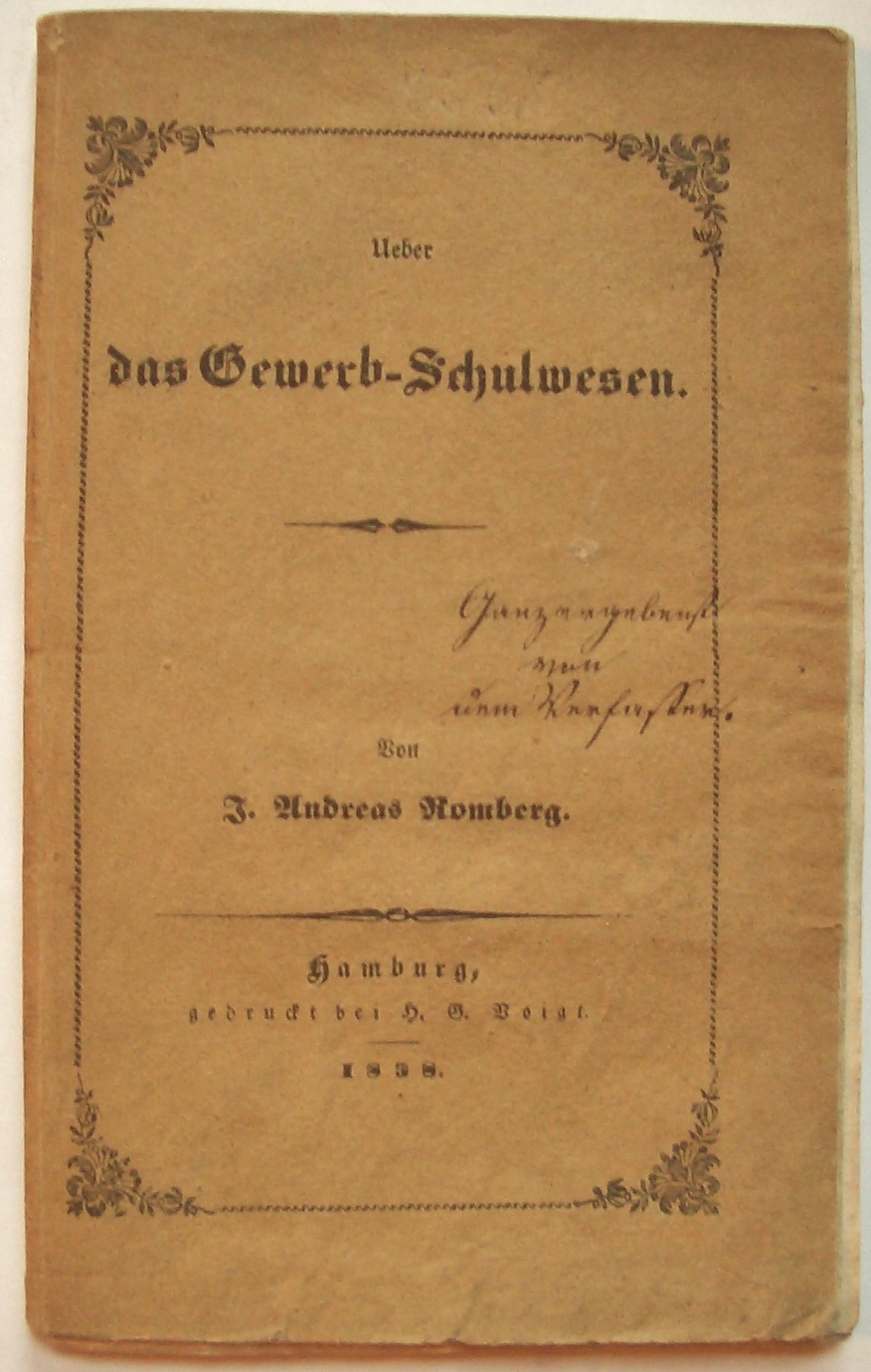
1838réf. 6370und Welche Gründe sprechen für die Errichtung von technischen Anstalten überhaupt, und insbesondere für die Errichtung einer Gewerbschule in Hamburg. Hamburg, gedruckt bei G. H. Voigt, 1838. Gr.-12mo. (18,6 x 11,5 cm). Titel, Widmungsblatt, VI, 115 S. Typographischer Orig.-Umschlag.
1844Acquaforte, 1844 circa, firmata in lastra in basso. Figlio del pittore paesaggista Jacob George Strutt (1790-1864), del quale fu allievo, girovagò attraverso la Francia e la Svizzera in compagnia del padre, prima di giungere entrambi in Italia nel 1831, per stabilirsi a Roma. Rimase per il resto della sua vita in Italia, interessandosi soprattutto agli aspetti "pittoreschi", in particolare a quelli della Campagna romana, rivolgendo la sua attenzione, in modo specifico, ai paesaggi e ai costumi degli abitanti. Nel 1841 intraprese un viaggio a piedi verso il sud dell'Italia (allora Regno delle Due Sicilie, in compagnia dell'amico William Jackson, partendo da Porta San Giovanni (Roma) il 30 aprile e giungendo a Palermo il 15 dicembre, dopo aver attraversato la Campania e la Calabria. Le sue osservazioni furono raccolte in un libro, A pedestrian tour in Calabria & Sicily (Un viaggio a piedi in Calabria e in Sicilia) che ebbe un notevole successo, soprattutto nei paesi anglosassoni, ed è considerato ancor oggi un documento molto importante per comprendere la società del Regno delle Due Sicilie nel periodo pre-unitario. Magnifica prova, impressa su carta coeva, ampi margini, in perfetto stato di conservazione. Etching, 1844 circa, signed at the bottom. Arthur John Strutt (1819, in Chelmsford – 1888, in Rome), was an English painter, engraver, writer, traveller and archaeologist. He was the son of the landscape painter Jacob George Strutt (1790–1864) and the writer and traveller Elizabeth Strutt. In 1841 he travelled on foot through central and southern Italy and in Sicily. He and his friend, the poet William Jackson, otherwise unknown, started from the Porta San Giovanni of Rome on 30 April 1841, reaching Palermo on 15 December, and arriving back at Rome in July of the following year. An account of this journey is given in his A Pedestrian Tour in Calabria & Sicily published in London, in 1842. A fine impression, on contemporary paper, large margins, very good condition.
1844Acquaforte, 1844 circa, firmata in lastra in basso al centro. Figlio del pittore paesaggista Jacob George Strutt (1790-1864), del quale fu allievo, girovagò attraverso la Francia e la Svizzera in compagnia del padre, prima di giungere entrambi in Italia nel 1831, per stabilirsi a Roma. Rimase per il resto della sua vita in Italia, interessandosi soprattutto agli aspetti "pittoreschi", in particolare a quelli della Campagna romana, rivolgendo la sua attenzione, in modo specifico, ai paesaggi e ai costumi degli abitanti. Nel 1841 intraprese un viaggio a piedi verso il sud dell'Italia (allora Regno delle Due Sicilie, in compagnia dell'amico William Jackson, partendo da Porta San Giovanni (Roma) il 30 aprile e giungendo a Palermo il 15 dicembre, dopo aver attraversato la Campania e la Calabria. Le sue osservazioni furono raccolte in un libro, A pedestrian tour in Calabria & Sicily (Un viaggio a piedi in Calabria e in Sicilia) che ebbe un notevole successo, soprattutto nei paesi anglosassoni, ed è considerato ancor oggi un documento molto importante per comprendere la società del Regno delle Due Sicilie nel periodo pre-unitario. Magnifica prova, impressa su carta coeva, ampi margini, in perfetto stato di conservazione. Etching, 1844 circa, signed at the bottom. Arthur John Strutt (1819, in Chelmsford – 1888, in Rome), was an English painter, engraver, writer, traveller and archaeologist. He was the son of the landscape painter Jacob George Strutt (1790–1864) and the writer and traveller Elizabeth Strutt. In 1841 he travelled on foot through central and southern Italy and in Sicily. He and his friend, the poet William Jackson, otherwise unknown, started from the Porta San Giovanni of Rome on 30 April 1841, reaching Palermo on 15 December, and arriving back at Rome in July of the following year. An account of this journey is given in his A Pedestrian Tour in Calabria & Sicily published in London, in 1842. A fine impression, on contemporary paper, large margins, very good condition.