36.937 risultati
2002rif. 2191180522015HARCOURT SCHOOL PUBLISHERS 2002-01-01. Hardcover. New. Brand-new unused unopened in perfect condition. HARCOURT SCHOOL PUBLISHERS hardcover
1945rif. 4-946GPO 1945 1945. 1st ed. About 500p. Photos. Illustrations. Heavy. In original Printed binder. Lower corner missing from first page. Near Fine Copy. 1st. Hardcover. Near Fine. GPO, 1945 hardcover
1924rif. 2110502151100397book series 1924. Soft Cover. Fine. Number of books: 1 book series paperback
1924rif. 2110502151100094book series 1924. Soft Cover. Fine. Number of books: 1 book series paperback
rif. 21160501Japan n.d. ca 1830's n.p. Stiff stitched wrappers vols. 2 & 3 of a 3 vol. set lacks vol. 1 18 double folded leaves Japanese text 5 double page 2 single page color platesbit of minor cover rubbing else solid & clean. FIRST EDITION . . . AN EROTIC CLASSIC BY THE UTAGAWA SCHOOL . . As usual this "SHUNPON" erotic illustrated woodblock printed book is unsigned. See below for more about this. . This and most other "SHUNGA" erotic print and "SHUNPON" were never signed by the artist using his true name. It was a common practice to use an ironic or humorous name in poking fun at the Tokugawa Shogunate who forbid erotic and anti-government publications. . ATTRIBUTION: Stylistic analysis of Japanese artists can be used to recognize the artist or his "school""style" by carefully examining a large number of examples. To that end we strongly feel this is either the work of Utagawa Kuniyoshi or the "Kuniyoshi" school meaning his followers or students. . THE SET: This set was issued in 3 volumes. We have volume 2 & 3 only. The work is nicely woodblock printed in full color. . THE CONTENTS: From volume 2 shows a girl with her vagina open and exposed. A voyeur is outside and peeps through a Fusuma sliding door most likely at the couple in the next room. . This shows a double-page illustration of a sleeping young man holding a Shamisen. He sports an enormous erection he is being held by a young girl who's vagina is exposed and she is ready to insert her lover's erect penis. . The next shows a couple preparing to make love. They are embracing each other tightly her vulva is exposed and his large erect penis is protruding from his Kimono. . The view shows the couple just after they made love. She erotically holds a wad of "Chirishi" hand-made tissue Washi toilet paper in her mouth while wiping her wet vagina. Her lover looks outside. The next shows her once again in the throes of rapture as she flows much vaginal juice while he pumps her into orgasm. . Vol. 3 begins with two young women in the public bathing house. Both are nude one is carefully washing her vagina with a cloth and using a water bucket. The other combs her hair her vulva fully exposed. . The next shows a couple preparing to make love. He is on top of his prostitute. He has inserted four fingers into her vagina while a cat observes. . Another man is shown in an adjacent room asleep. . RARITY OF "SHUNPON": Books of this subject reflect the "natural" pension and attitudes of 19th century Japan vis-a-vis nudity and sex. The Japanese have always been very "natural" open and easy going about sex and casual relationships. . The art work is ski fully executed by Kuniyoshi or one of his followers. The landscapes human anatomy and portraiture show a keen knowledge and experienced skill. . THE SIZE: These are 12 x 8 cm. . REFERENCE: NOT LISTED IN: SHIBUI Kiyoshi.: ESTAMPS EROTIQUES PRIMITIVES DU JAPON:GENROKU KOHANAGA SHU-E . It is not surprising this and a plethora of other Japanese Shunga Shunpon Erotic prints & books are not listed in Shibui. While he lists many there are even more not listed in his book or any other reference book on the subject. . Erotic books were "suppressed" by the Tokugawa Shogunate therefore the majority of these kinds of books & prints were published on the 'black market' and not distributed openly. They remain on the 'fringe' of publication. There were stiff penalties for artists block cutters and publishers of this category of woodblock printed work. . . unknown
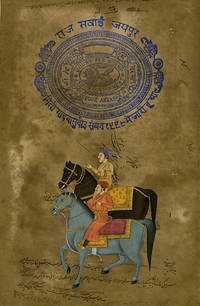
1890rif. 13431890. Good. Ink and gouache with gold heightening on fibrous brown laid paper with a Jaipur Court Fee tax stamp in blue ink on the recto as well as the Jaipur City Council blindstamp 13 1/4 x 8 1/2 inches 335 x 215 mm. Toning handling creases and minor scattered surface soiling throughout. There are scattered coeval inscriptions in ink on the recto and verso. The first revenue stamps in India were issued in the mid-nineteenth century during the Raj and they are still being issued to this day. Apart from issues for the whole of India many princely states provinces and other states also had or still have their own revenue stamp issues. Before independence Indian revenue stamps were closely modeled on similar designs from Great Britain as is the case with this carriage motif stamp from Jaipur. The stamps were issued to denote various denominations including rupees and annas. An anna or Änna was a currency unit formerly used in British India equal to 1â„16 of a rupee. It was subdivided into four old Paisa or twelve pies thus there were 192 pies in a rupee. When the rupee was decimalized and subdivided into 100 new paise one anna was therefore equivalent to 6.25 paise. This particular stamp was used as evidence of court taxes remitted for property dealings. unknown
1970rif. 84134Les Editions de l’école Estiennes, 1951, coll. « Les Editions de l’école Estiennes » 1970 20 volumes in-4 broché, couvertures illustrées rempliées. Rares rousseurs, ternissures ou menus frottements à quelques couverture, néanmoins bel état d’ensemble.
1798Acquaforte e acquatinta stampata con inchiostri blu, rosso, giallo e nero. Nel margine inferiore, sotto l'immagine, a sinistra: Schall px. a destra: Descourtis st. Due donne nude sedute in riva a un fiume, impegnate a leggere una lettera, mentre due giovani uomini nascosti nelle rocce dietro cercano di rubare i loro vestiti con una canna da pesca. Questa stampa a colori meticolosamente realizzata riproduce un dipinto a olio di Jean-Frédéric Schall, un artista meglio conosciuto per le sue scene pastorali e vagamente erotiche. Durante la Rivoluzione francese (1789-99), il mercato delle stampe a colori di lusso declinò, poiché i soggetti stuzzicanti e i segni del lusso erano considerati immorali. Quando gli atteggiamenti si rilassarono intorno al 1800, stampatori come Descourtis realizzarono alcune stampe a colori usando piastre multiple per stratificare inchiostri colorati come avevano fatto prima della Rivoluzione. Descurtis era allievo di Jean-Francois Janinet, che è considerato dalla critica artistica uno dei più importanti incisori a colori francesi e si mise in evidenza per le sue innovazioni tecniche, quali l'acquatinta in quadricromia, oltreché per lo stile caratterizzato dall'intensità dei colori Tuttavia, questo processo lungo e costoso fu presto sostituito dalla colorazione a mano che i lavoratori potevano realizzare più facilmente ed economicamente. Esemplare in ottimo stato di conservazione. Wash manner etching and engraving printed in blue, red, yellow, and black inks. In lower margin, beneath the image, at left: Schall p.x at right: Descourtis s.t Two naked woman sitting by a river and busy reading a letter, while two young men hidden in the rocks behind are trying to steal their clothes with a fishing rod. This meticulously crafted color print reproduces an oil painting by Jean-Frédéric Schall, an artist best known for his pastoral and mildly erotic scenes.During the French Revolution (1789–99), the market for deluxe color prints declined, as titillating subjects and signs of luxury were considered immoral. When attitudes relaxed around 1800, printmakers like Descourtis made a few color prints using multiple plates to layer tinted inks as they had before the Revolution. Descourtis learned his method of multiple-plate color printing from Jean Frarnçois Janinet and like him used toolwork on the plate rather than aquatint, an acid immersion process used to create general areas of shading. However, this time-consuming and expensive process was soon replaced by hand coloring that workers could more cheaply and easily accomplish. Very good example. Portalis & Béraldi 3; Model/Springer p. 50, plate 20.
1798Acquaforte e acquatinta stampata con inchiostri blu, rosso, giallo e nero. Nel margine inferiore, sotto l'immagine, a sinistra: Schall pinx. a destra: Descourtis sculp. Questa stampa a colori meticolosamente realizzata riproduce un dipinto a olio di Jean-Frédéric Schall, un artista meglio conosciuto per le sue scene pastorali e vagamente erotiche. Durante la Rivoluzione francese (1789-99), il mercato delle stampe a colori di lusso declinò, poiché i soggetti stuzzicanti e i segni del lusso erano considerati immorali. Quando gli atteggiamenti si rilassarono intorno al 1800, stampatori come Descourtis realizzarono alcune stampe a colori usando matrici multiple per stratificare inchiostri colorati come avevano fatto prima della Rivoluzione. Descurtis era allievo di Jean-Francois Janinet, che è considerato dalla critica artistica uno dei più importanti incisori a colori francesi e si mise in evidenza per le sue innovazioni tecniche, quali l'acquatinta in quadricromia, oltreché per lo stile caratterizzato dall'intensità dei colori Tuttavia, questo processo lungo e costoso fu presto sostituito dalla colorazione a mano che i lavoratori potevano realizzare più facilmente ed economicamente. Esemplare in ottimo stato di conservazione. Wash manner etching and engraving printed in blue, red, yellow, and black inks. In lower margin, beneath the image, at left: Schall pinx. at right: Descourtis sculp. A young woman surprises her sweetheart, whom she has found reading love letters in a wooded park. The love-struck fellow carries a miniature portrait of her as a keepsake. Verdant foliage, a nearby brook, and a blooming rosebush signal fertility and the bounty of life. The nude female statue sitting on a pedestal seems to watch the playful lovers. This meticulously crafted color print reproduces an oil painting by Jean-Frédéric Schall, an artist best known for his pastoral and mildly erotic scenes. During the French Revolution (1789–99), the market for deluxe color prints declined, as titillating subjects and signs of luxury were considered immoral. When attitudes relaxed around 1800, printmakers like Descourtis made a few color prints using multiple plates to layer tinted inks as they had before the Revolution. Descourtis learned his method of multiple-plate color printing from Jean Frarnçois Janinet and like him used toolwork on the plate rather than aquatint, an acid immersion process used to create general areas of shading. However, this time-consuming and expensive process was soon replaced by hand coloring that workers could more cheaply and easily accomplish. Very good example. Portalis/Béraldi 3; Model/Springer p. 50, plate 20.
rif. SONG0870994972Used: Good unknown
1910rif. 2082402113503234Not Available 1910. Soft Cover. Fine. The book is in fine condition. Not Available paperback
2008Paperback No expedite shipping. Pls. allow 4 - 6 weeks delivery being a newly release book from publishers. Ships from publishers directly.
2000rif. 410762000. UCLA Law Review. Los Angeles School of Law University of California Los Angeles. Vols. 1 to 39 42 to 46 47 part 1 51 part 1 1953-2004 Together 77 books. Sixteen 16 linear feet of shelf space. Ex-private law firm library tan buckram very good. Special $695. unknown
2000rif. 410762000. UCLA Law Review. Los Angeles School of Law University of California Los Angeles. Vols. 1 to 39 42 to 46 47 part 1 51 part 1 1953-2004 Together 77 books. Sixteen 16 linear feet of shelf space. Ex-private law firm library tan buckram very good. Special $695. unknown books
2004rif. 541752004. Lacking issue volume 101 no. 1. Lacking issue volume 101 no. 1. Yale Law Journal. New Haven: Yale Law Journal. Bound Volumes 86 to 91 1976-1982 blue buckram with silver lettering; vols. 100 no. 5 to 106 no. 8 1990-1998; 111 no.1 to 117 no.7 paper issues 2001-May 2008 Lacking issue volume 101 no. 1. Together 24 volumes. Ex-library with stamps. Very good condition. Reprint Price USD 4307. Special $695. unknown
2004rif. 541752004. Lacking issue volume 101 no. 1. Lacking issue volume 101 no. 1. Yale Law Journal. New Haven: Yale Law Journal. Bound Volumes 86 to 91 1976-1982 blue buckram with silver lettering; vols. 100 no. 5 to 106 no. 8 1990-1998; 111 no.1 to 117 no.7 paper issues 2001-May 2008 Lacking issue volume 101 no. 1. Together 24 volumes. Ex-library with stamps. Very good condition. Reprint Price USD 4307. Special $695. unknown books
1980rif. KOS01600002TBD 1980. Soft Cover. Fine. KOS01600002 TBD paperback
rif. DADAX006464071XNew unknown
2019rif. 2081502111905266Chinese Academy of Arts Publishing House 2019. Soft Cover. Fine. The book is in fine condition. Chinese Academy of Arts Publishing House paperback
1926rif. 2090202120414715Keiwakai 1926. Soft Cover. Fine. Number of books: 1 Keiwakai paperback
rif. DADAX0062306278New unknown
rif. ANAIS-1556482574Amer Hospital Pub. hardcover. Good. 8.8x0.8x11. Buy with confidence. Excellent Customer Service & Return policy. Amer Hospital Pub hardcover
rif. ANAIS-1880366185Texas School for the Blind &. other. Good. 1.8x09x2.1. Buy with confidence. Excellent Customer Service & Return policy. Texas School for the Blind & unknown
1941rif. 86279Aberdeen Proving Ground MD: The Ordnance School 1941. Presumed First Edition First printing thus. Four-hole punched and held together with two two pronged clips. Good. Format is approximately 8 inches by 13 inches four-hole punched with two two pronged clips holding the text together. 3iii-vii 250 pages. Three pages of errata sheets. 18 appendices. 50 Figures. Printed single-sided only. Cover worn torn and soiled with some page wear and soiling noted. Pencil marks and notations on cover and some pages. The major portion of this text appears to be an early version of Field Manual No. 9-10 The Ordnance Company -Medium Maintenance; The Ordnance Battalion--Maintenance. It was apparently expected to be issued in July 1941 the the date of issue is blank. FM 9-10 Ordnance Field Manual Ordnance Field Maintenance was published on April 20 1942. There are substantial differences between this text and what was officially published as FM 9-10. This publication was intended solely for use as an Ordnance School text for instruction purposes only. It was not intended for general distribution to agencies or personnel outside the Ordnance training Center at Aberdeen Proving ground Md. It is reasonable to conclude that this instructional text was also a draft text for what would eventually become FM 9-10 and that the experience gained in its use at The Ordnance School contributed to the development of material changes. As such then this early version not labeled as a draft provides a significant and perhaps unique insight into the development of Ordnance doctrine training and practice at the Company and Battalion level at the time when the United States entered the Second World War. One page on Machine Gun Repairs to the M9197A1 laid in. The purpose of this manual was to present a coordinated and complete picture of the problem of ordnance field maintenance together with a logical solution of that problem. While this manual will be found to be helpful as a reference for operation of the maintenance organizations in garrison it was intended primarily as a guide for use in field operations. There are included in the various parts of this manual a discussion of a typical ordnance field shop and a method of conducting operations; a discussion of details pertaining to a typical maintenance company; and discussions of particular problems in ordnance field maintenance as they are encountered and solved. Except where obviously necessary in the interests of uniformity throughout all ordnance service it is not intended that this manual shall impose unnecessary restrictions on the imagination and initiative of ordnance personnel responsible for the operation of the units covered by this manual. On the contrary it is intended that the thoughts and imagination of such personnel will be stimulated to evolve more satisfactory solutions to the problems of ordnance field service. The organization of ordnance maintenance in the field army is based on the principle of progressive increases in available maintenance facilities from front to rear. The equipment and personnel assigned to each echelon are designed to carry the normal load of that echelon plus a certain peak load of the subordinate echelons. In Part I. The Ordnance Company - Medium Maintenance there are Chapters on General; Organization and Equipment; Operations; Duties of Individuals; and Administrative Details. Part II. The Ordnance Battalion Maintenance has Chapters on General and Operations. A list of appendices follow and are in turn followed by the list of Figures. There are specific discussions of ordnance weapons and vehicles and materiel. There is significant discussion of the inspection of ordnance materiel especially ammunition. The Ordnance School unknown
1907rif. 187861907 Encre de Chine sur papier, découpée en forme d'éventail et collée sur carton, monogramme de l'artiste et date en bas à droite, 1907, 47.7 x 25.5 cm.