35.158 Ergebnisse
1830Best.-Nr. 6526London 1830. Aquatints coloured by hand. A fine complete series of four anonymous prints of hunting scenes possibly after the Alkens. The style and naming of these prints suggests an Alken origin for the series. Siltzer records a number of series by the Alken family in which the first plate is titled "Unkennelling." This title appears to be unique to them and supports the supposition that the present series are after the Alkens. Henry Thomas Alken was born into what became an artistic dynasty. He studied under the miniature painter J. T. Barber and exhibited his first picture a miniature portrait at the Royal Academy when he was sixteen. From about 1816 onwards he "produced an unending stream of paintings drawings and engravings of every type of field and other sporting activity. He is best remembered for his hunting prints many of which he engraved himself until the late 1830s.To many sporting art is "Alken" and to describe his work or ability is quite unnecessary." Charles Lane British Racing Prints pp. 75-76 Cf. Siltzer pp.57-76. unknown books
1850Best.-Nr. 20700Paris 1850. Pencil pen and wash drawing with numerous sub-titles in ink signed "J. Litoux" A fascinating and beautiful architectural drawing - or 'rendu' of basic elements of house construction in cluding walls floors doorways roofs and ceilings. A fine drawing from an architectural student at the Ecole des Beaux-Arts in Paris the most influential architectural school in existence during much of the 18th century the whole of the 19th century and the first part of the 20th century. 'Students were eligible for the Ecole if they were at least fifteen years old or under thirty. They began with the seconde classe in which they competed in the concours d'émulation. These alternated between an esquisse - a rough sketch for which up to twelve hours was allowed - and a rendu - the large-scale finished drawing for which one to three months were allowed. Two to four years were usually required for a student to accumulate enough credits to enter the première classe. The same system was followed again usually for two to three years after which the student should have accumulated enough credits to compete for the Grand Prix de Rome. The winner of the Grand Prix was entitled to five years study under the auspices of the French Academy in Rome. For each of his first three years he was required to submit an analytical study of an ancient monument. For his fourth year he had to submit a complete reconstruction of a major classical work. For his fifth year he was required to submit an original work designed to a program of his own invention. In the seconde classe the student was required to attend a variety of lectures in theory history and construction and learned to prepare construction drawings. Work was done at ateliers located outside the precincts of the Ecole des Beaux-Arts. These were rented and organized by the students themselves and the students had the right to invite a teacher of their own choice to serve as their maître. The teacher himself did not have to be a member of the faculty of the Ecole nor - at least in principle - did he have to be a practicing architect.' Arthur Drexler. The Architecture of the Ecole des Beaux-Arts. New York MoMA 1977 p.8-9 Arthur Drexler The Architecture of the Ecole des Beaux-Arts. New York MoMA 1977. unknown books
Best.-Nr. B70920-3New York 1979. 2 vols. 118pp.; 37pp. 25 plates. Tall 4to. Wraps. D.j. Slipcase. A record of lectures and seminars held in the spring of 1977 at the Cooper Union School of Architecture by six grantees of the school's Mellon visiting professorships. Texts by John Ashbery Jay Fellows Robert Freeman John Hawkes Aldo Rossi Joseph Rykwert. Edition limited to 1500 copies. New York, [1979]. paperback books
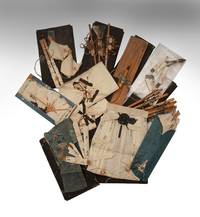
Best.-Nr. 7079Various formats and sizes. Japan: ca. 1787-96. The Ogasawara School å°ç¬ åŽŸæµ founded in the 12th century laid the foundations of etiquette for the aristocratic and samurai classes throughout Japan for many centuries. The school specialized in teaching horsemanship archery mounted archery and samurai etiquette on and off the battlefield. Over the centuries the school transitioned itself to focus on a system of courtly manners along with skills in archery for ceremonial rituals. The school continues today supervised by the 31st generation leader Kiyotada Ogasawara. The Imperial House of Japan uses Ogasawara etiquette. This fascinating collection is made up of miniature models or samples of materials and objects required and used at formal Ogasawara events in the late 18th century as well as a number of manuscript documents. We begin with ten black paper four-sided folding envelopes each labeled and containing the items below. These envelopes are constructed of thick but flexible paper with string ties. The labels describe the contents of each envelope and have seals and signatures of either “Hisanobu” or “Nobumichi”: 1. a miniature paper model of a horo which is worn on the back of a samurai’s armor. Our horo is made of folded paper with a silk brocade adornment. Measurements are given in manuscript. With this is a model of the bag to carry the horo; 2. miniature fabric samples of pleated trousers a man’s formal kimono and vest along with samples of neatly wrapped objects elaborately tied which were to be carried. They include a sword a fan and a bolt of precious brocade; 3. three miniature tachi swords each for a specific occasion. Our sample tachi are made of wood and have thick thread attachments; 4. two kinds of miniature torches taimatsu along with their holders; 5. a most remarkable miniature wooden bow mounted on a wooden board. A quiver utsubo again made of wood and decorated in gold brocade is also mounted; 6. Six miniature examples of maku gushi poles to hold banners. They are joined by ropes here represented by fine decorative cord; 7. four samples of real hair cut off and tied during genpuku the Japanese coming-of-age ceremony; 8. a miniature target — an opened fan — mounted on a board for the hikime-no-gi the archery ritual; 9. two elaborate folded paper model sacks to protect the bow when it rains kasa yumi bukuro; and 10. seven strands of hay and 12 braided strips of paper kamioki which were used in ceremonies for two- and three-year-old aristocratic and samurai male children. These are accompanied by 69 examples of very complex ceremonial origami or origata. Origata as compared to recreational origami was developed amongst the higher class of samurai who stressed formal manners and a sense of decorum. It is a method of how to wrap gifts with very precious handmade papers used for gift-giving and ceremonies in order to maintain sound human relations. Each is folded in it own way and labeled with its intended contents for example an obi belt confectioneries a brush for calligraphy shark skin for sword handles incense wood a tooth-cleaning stick a fan Chinese silk thread hair ornaments gold dust sumi ink cake perfume belts for inner garments face powder tabi socks various sizes of fine writing paper feathers from hawks and cranes for arrows etc. Some examples of highly complex ornamental ties are also present. Finally there are about 20 contemporary letters all concerned with various aspects of Ogasawara etiquette including gastronomic matters. There is a stiff thick-paper folded cover for a gift signed “Ogasawara Taizen taifu Nagamasa.” There is also a packet of miscellaneous related papers. In fine condition and a remarkable survival. unknown books
1859Best.-Nr. 25100348Philadelphia: American Sunday School Union 1859. 8 pp. wrapper with 3 woodcuts. Written for the American Sunday School Union and revised by the Committee of Publication. Apart of a series published by the American Sunday School Union called Child's Home Library. It tells the story of a little boy over coming his fear of the dark. Some wear cover is tearing at edge slight toning. Measures 4 1/4" x 2 1/2 American Sunday School Union unknown books
Best.-Nr. 21824NP: NP ND. Fine. 21 x 16 inches gouache on paper of Art Deco jewelry shop designed by R. Tailliard. NP unknown books
1967Best.-Nr. 21449Lake Forest: Prairie School Press 1967. Reprint. Stiff Wraps. Orig. printed stiff wrappers. Very good. Wright Frank Lloyd. 20 pages. 35 x 27 cm. Illustrated with drawings plans and photographs. Reprints of articles by the above named authors. Front cover slightly toned at head and margins. Prairie School Press unknown books
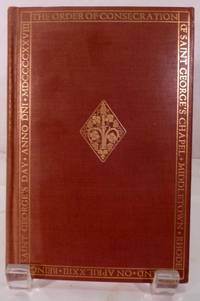
1928Best.-Nr. 20836Boston: Merrymount Press 1928. First edition. Hardcover. Orig. sandlewood cloth. Aeg. Near fine. 57 pages. 16.5 x 11.5 cm. Limited edition one of 600 published by the Merrymount Press designed by D.B. Updike. Title page and interior text printed in red and black in standard and italic type. HUTNER 93. The year 1928 was a fabled year for the Press concerned with ideas for printing `The Book of Common Prayer' There are affinities here with both trial pages for the latter work and for the prayer book itself.it is a miniature masterpiece." Double gilt front cover border panels lettered in gilt with center gilt floral motif. Faint sunning to backstrip. Merrymount Press hardcover books
Best.-Nr. B293862-1Paris 2007. 243 1pp. Prof. illus. numerous color. 4to. Wraps. Paris, 2007. paperback books
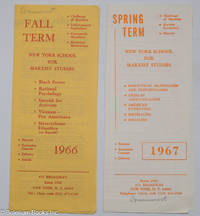
1967Best.-Nr. 315246New York: The New York School for Marxist Studies 1967. Pamphlet. Two brochures; minor penciling on front Herbert Aptheker was director of the school and teachers included William Patterson Henry Winston Benjamin J. Davis and Betty Gannett. The New York School for Marxist Studies unknown books
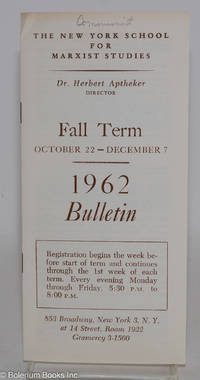
1961Best.-Nr. 288791New York: The New York School for Marxist Studies 1961. Pamphlet. 8p. including covers stapled wraps 4x8.5 inches top corner bumped "Communist" penciled on front wrap else very good condition. Herbert Aptheker was director of the school and teachers included Betty Gannett and Victor Perlo. This term also included two classes in Spanish taught by Jesús Colón. The New York School for Marxist Studies unknown books
1967Best.-Nr. 147625London: Agitator 1967. 24p. wraps 8x10 inches. Laid in is a leaflet with additional information about the situation in Canada. A history of the student movement that began as a protest against the hiring of a Rhodesian professor viewed as too friendly to the Smith regime. Agitator unknown books
2010Best.-Nr. 275284Cape Town: Self-published by the authors 2010. Paperback. 83 pg. paperback 8.5" x 5.5" very good. Poetry from ninth grade students at the LEAP school in Cape Town South Africa. Self-published by the authors paperback books
1970Best.-Nr. 279488Berkeley: Starr King School for The Ministry 1970. Spiral_bound. 31p. 1p. 5.75x8.5 inches; b&w illustrations throughout several bottom spirals broken off somewhat loosening the wraps minor edge-wear else in very good condition. [Starr King School for The Ministry] unknown books
1925Best.-Nr. 271469New York: Rand School of Social Sciences 1925. Hardcover. 82p. cover stained pencil marginalia else good condition. The director of the Department was Solon De Leon and the associate Nathan Fine. Includes some foreign language and leftist publications. Rand School of Social Sciences hardcover books
Best.-Nr. 271996Washington DC: American Association of School Administrators nd. Pamphlet. 12p. stapled wraps 3.5x8.5 inches very good condition. American Association of School Administrators unknown books
1950Best.-Nr. 249130Rochester NY: Eastman Kodak Company 1950. Pamphlet. 45p. numerous b&w photoillustrations on alkaline coated paperstock in a running text; softbound an 8.5x5.5 inch pamphlet in stapled and punchbound! wraps. A good clean copy. The punchholes are for a certain sort of permanent binder; has tips on conducting projects how to construct tables for developing trays &c. Eastman Kodak Company unknown books
1971Best.-Nr. 241398Freeland MD: The School of Living 1971. 8p. tabloid format newspaper folded in half as issued evenly toned address written in pen on front wrap else very good condition with subscription form laid in. Decentralist communitarian publication affiliated with the ideas of Ralph Borsodi. Cover story on the Bear Tribe "the first new Indian tribe in this century.the tribe was founded to make possible a movement to the land and a return to the Indian way of life The School of Living unknown books
1975Best.-Nr. 241400Freeland MD: The School of Living 1975. 22p. stapled wraps 8.5 x 11 inches vertically creased address label on rear wrap else good condition. Decentralist communitarian publication affiliated with the ideas of Ralph Borsodi. The School of Living unknown books
1975Best.-Nr. 225777San Francisco: Peoples Law School 1975. 10p. staplebound pamphlet very good. Stated third edition though the 1979 version also called itself the third edition!. Peoples Law School unknown books
1951Best.-Nr. 215511Decatur AL: Decatur Negro High School 1951. 3.75x5 inch folded invitation card and card-holder smaller 4-panel invitation bound-in with the invitation printed in script on cover school motto roll flower and color on inner panel tiny name plate printed with the name Vendetta Jackson Marks set in die-cut fold embossed cover bound with wide blue satin ribbon very good. Decatur Negro High School unknown books
1982Best.-Nr. 212118Oakland: the District 1982. Wall calendar 8.5x11 inches when folded shut a few small stains on rear wrap else very good condition; upper pages depict various cultural scenes or famous leaders while the calendar pages list ethnic holidays and proverbs from various countries. the District unknown books
1943Best.-Nr. 207789Toledo SPAIN: Talleres Graficos de Rafael G. Menor 1943. Pamphlet. 47p. line-drawn illustrations softbound stapled 6.5x4.5 inch pamphlet. Covers a little dust-soiled with faint foxing and a ballpoint circle drawn round one of the cover illustrations "Pegar mas abajo de la cintura"; no other markings; paperstock is toned throughout a sound good-only copy. Talleres Graficos de Rafael G. Menor unknown books
Best.-Nr. 202422San Francisco: Peoples Law School 197-. 8.5x11 inch handbill faint creases from having been folded for mailing mailing label of the Peace and Freedom Party branch in Oakland on verso front lightly foxed along top edge small closed tear on top edge. Cesar's Latin All-Stars was a Latin Orchestra led by Cesar Ascarrunz. Peoples Law School unknown books
1968Best.-Nr. 181783San Francisco: SFFS 1968. 8p 5.5x8.5 inches class schedules tuition application/registration very good pamphlet in stapled peach wraps. Introduction to the then-newly established school at 414 Mason and a list of courses. SFFS unknown books