37.386 Ergebnisse
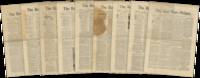
1904Best.-Nr. List3876Carlisle Pennsylvania: Carlisle Indian Industrial School 1904. Nine issues. 12 x 18 inches folio folded as issued. Generally folded vertically twice with some wear and tearing at folds; toned with wear and damage especially to margins. Very good. The Red Man and Helper a newspaper published by Carlisle Indian Industrial School had several iterations first published under the title Eadle Keatah Toh 1880-82-Lakota meaning roughly "morning star" the title was an interesting choice for the newspaper of a school where only the English language was allowed. It was published as The Morning Star then The Red Man: His Past Present and Future until "His Past" was removed in 1888; then The Red Man until 1900 when it merged with The Indian Helper running as The Red Man and Helper from 1900 to 1904.1 The contents with contributions from students educators and other publications generally concern the value of an off-reservation Euro-American education and the capabilities of Indigenous students to assimilate into the Euro-American way of life. Offered here are nine issues of The Red Man and Helper: Vol. I no. 30 Feb. 8 and 15 1901 Vol. II no. 48 July 11 1902 Vol. III no. 1 Aug. 15 1902 Vol. III no. 40 May 29 1903 Vol. III no. 42 June 12 1903 Vol. V no. 38 May 20 1904 Vol. V no. 39 May 27 1904 Vol. V no. 40 June 3 1904 and Vol. V no. 41 June 10 1904. Note that these are enumerations for The Red Man and Helper; each edition also provides a separate enumeration indexed to the first edition of The Red Man. Carlisle Indian School Digital Resource Center hosts digitized copies of the school's publications and OCLC finds physical holdings of two editions Vol. XVII no. 39 and Vol. XIX nos. 47-48 at Gettysburg College. Of interest to historians of Carlisle and the assimilationist project. 1 Jennifer Bess "Casting a Spell: Acts of Cultural Continuity in Carlisle Indian Industrial School's the Red Man and Helper" Wicazo Sa Review 26 no. 2 Fall 2011: 13-38. . Carlisle Indian Industrial School unknown books
Best.-Nr. 8493Hanoi, Imprimerie d'Extrême-Orient, 1930. 1 volume in-4, 55 pp., broché, couvertures imprimées conservées, enrichi de 16 planches photographiques à pleine page, très bon état, malgré un léger manque de papier au dos. Un autre exemplaire, relié plein cuir, est vendu 80 euros.
In-8, 82p. Quelques passages soulignés au crayon, autrement à l'état de neuf!
Best.-Nr. 140438Paris, Imprimerie Nationale, s.d. in-8, 24 pp.
Best.-Nr. 206956Paris, Impr. Nationale, s.d. in-8, 24 pp., dérelié.
Best.-Nr. 145377Paris, Chez L. Colas, 1821 in-8, 40 pp., broché, couv. muette.
Best.-Nr. 206958Paris, Impr. nationale, s.d. in-8, 16 pp., dérelié. Légère déchirure p. 5 sans atteinte au texte.
Best.-Nr. 205738Paris, Imprimerie de L. Portier de Lille, (1790) in-8, 14 pp., cousu.
Best.-Nr. 243022Paris, Imprimerie de L. Portier de Lille, (1790) in-8, 14 pp., broché, couv. papier bleu moderne.
Best.-Nr. 70608Alençon, Imp. de Malassis le Jeune, 1790 in-4, 3 pp., vignette.
Best.-Nr. 225951S.l. [Paris], [Imprimerie C. Bernard], 1967 in-8, 32 pp. broché.
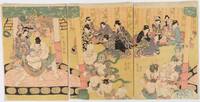
1860Best.-Nr. 218670東京. Tokyo. circa1860s. Three colour woodblock prints a triptych panels loose each approx 38.5 x 25.4cm Japanese text artist's signature publisher's seal and date in the outer margin of the centre and right-hand panels and in the inner margin of the left-hand panel slivers of paper tape strengthening the top margin to the verso of each print pin-holes to the corners from previous display with loss to the lower right corners and the inner corner of the left-hand panel paper a little dusty and soiled but overall in good condition. Wonderful satirical woodblocks with muted tonings possibly from the composition for "Sumo wrestling match of Seven Lucky Gods" replacing the gods with actors as aging sumo wrestlers surrounded by onlooking geisha and fellow actors in masks and costume. From the collection of the late John Caiger lecturer in Asian studies ANU. . unknown
1800Best.-Nr. 63904Tokyo & Kyoto Japan: Kano School ca. 1800-1810. One 4to. art sample design portfolio sized 12.5 x 14 in. which folds out into giant montage of six large original late-Edo-Period Kano School screen designs on durable handmade Japanese rice paper measuring 110 x 75 in. carefully pasted as montage some titled as well as featuring ink manuscript painting instructions ordered counter-clockwise: “Bamboo scene” 47 x 38.5 in.; King Tang of Shang court scene 36.5 x 39 in.; 2nd Court scene 38.75 x 38.75 in.; Pine tree landscape 38.75 x 38.75 in.; Crane 28.75 x 39 in.; and Island pagoda landscape & pine trees 31 x 41.75 in six w/ original colour painting some colour painting & material instructions in Japanese all arranged to compactly fold and bound with colour woodblock illustrated cloth and old bookseller labels mounted on verso some repairs to corners to reattach the boards thumbing & minor tears a fold creases w/ a few occasional paper repairs at the first most frequently used fold minor creasing & edgewear dustsoiling to fold creases interior offset toning from sizing & paint colours still an extraordinary exemplar. This exceptional late-Edo-period original Kano School painting montage incorporates many of the elements developed by the famed multi-generational painters whom over four centuries revived and shaped Chinese idealist traditions into a uniquely vigorous Japanese art style. The Kano school painters emphasized landscapes Imperial court interior & exterior architectural elements colours uses of gold animal and botanical subjects often creating crowded panoramic scenes typically used in wall & door screens as well as triptych folding wall screens. The repeated instructions on these designs in Japanese by Sasayama Tsutsumu -- one of several Sasayama painters who took that name from the 18th- to 19th-Centuries in the Kano School beginning with Sasayama Yoi d. 1743 student of Kano Sunnobu 1636-1713 and subsequently four more generations afterwards nearly all adopted and chiefly serving the Chofu domain -- specify these designs are each one of three pieces. In addition there are ink manuscript memos appearing with directions on pigments for the final design work such as adding mica flecks or other paints & dyes and these sketches captured key features of a design so that students or other Kano artists could sufficiently enlarge recreated and fully understand the steps required for the finished decorative artwork pieces. The upper right first image presents bamboo looming in the weather emphasizing their connections to architectural features; The second and third designs capture the golden age Curt of the King of Shang in 1600 B.C. memorialized later as the Xia Dynasty; the fourth presents a rugged hillside and trees shrouded in clouds; the fourth a wonderful large crane apparently intended as part of a much larger piece; and finally the sixth lower right features distant pagoda temple shrouded mountains flower-bedecked pine tree in foreground and with delicate colouring and shading. Naganobu Kano fl. 1775-1828 and his son Osanobu Seisenin Kano 1786-1846 were of the Kobikicho family which carried on the Kano School traditions from 1730 until the Meiji Period and were instrumental in producing designs and screens for the Nishinomaru and Honmaru palaces which burned down in 1838 and again in 1844. Even though the paintings no longer exist similar original design such as these do survive in the Tokyo National Museum. Seisenin Kano was especially well known for his art adapted from his studies from ancient paintings at the end of the Edo-period. See: Kano School After the Middle of the Edo Period Art Nomura 2026; Matthew P. McKelway Rediscovering the Kano School Artforum Vol. 53 No. 5 Jan. 2015; Brief Biographies of Scholars Painters and Haiku Poets of Chofu Records of the Sasayama Family Painters of the Chofu Domain 2026. Kano School, hardcover
1928Best.-Nr. 12982Honolulu 1928. 2810526pp. Original pictorial wrappers stapled with front cover stamped in black orange green blue and yellow. Moderate staining and chipping to wrappers. Text block detached between endpapers fairly regular thumb-soiling to outer margins occasional minor staining. Good condition. An informative yearbook issued for the students of Japanese High School in Honolulu in 1928 prepared by the Literary Society at the school. The book contains the requisite sections featuring portraits of the students class pictures student testimonials group shots of clubs and sports teams and more. The last section of the book is comprised of local advertisements for a variety of Honolulu businesses and other concerns including the Young Men's Buddhist Association. A rare if not unrecorded Japanese-language school yearbook from Hawaii in the interwar period. unknown
1928Best.-Nr. 12982Honolulu 1928. 2810526pp. Original pictorial wrappers stapled with front cover stamped in black orange green blue and yellow. Moderate staining and chipping to wrappers. Text block detached between endpapers fairly regular thumb-soiling to outer margins occasional minor staining. Good condition. An informative yearbook issued for the students of Japanese High School in Honolulu in 1928 prepared by the Literary Society at the school. The book contains the requisite sections featuring portraits of the students class pictures student testimonials group shots of clubs and sports teams and more. The last section of the book is comprised of local advertisements for a variety of Honolulu businesses and other concerns including the Young Men's Buddhist Association. A rare if not unrecorded Japanese-language school yearbook from Hawaii in the interwar period. unknown books
1978Best.-Nr. 2090502124300085Seiun shobo 1978. Soft Cover. Fine. Number of pages: 221 pages Size: 19 cm Number of books: 1 Seiun shobo paperback
2020Best.-Nr. 2081502111905273Chinese book office 2020. Soft Cover. Fine. The book is in fine condition. Chinese book office paperback
2016Best.-Nr. 2081502111904442old books in shanghai 2016. Soft Cover. Fine. The book is in fine condition. old books in shanghai paperback
2016Best.-Nr. 2081502111905149old books in shanghai 2016. Soft Cover. Fine. The book is in fine condition. old books in shanghai paperback
1891Best.-Nr. 72737Philadelphia: Presbyterian Board of Publication and Sabbath-School Work 1891 - 1893. First edition. A complete and continuous three-year run of this scarce Presbyterian juvenile weekly periodical. Three volumes with 52 four-page issues in each. Each volume profusely illustrated throughout with high-quality wood engravings decorative vignettes and moralizing scenes typical of the nineteenth-century Sunday School movement. The stories and poems contained herein offer a comprehensive primary-source look at the theological and social education provided to American children in the early 1890s. 8vo contemporary red half-leather bindings with marbled paper sides and gilt lettered and ruled spines. All three volumes internally bright and clean with only the occasional tiny chip or small tear. Overall a very good set with bindings showing moderate wear and covers starting to detach at hinges mostly noticeably on the 1893 volume but interiors very nearly fine. A remarkably well-preserved three-year run especially given the fragile and ephemeral nature of the issues contained herein. Presbyterian Board of Publication and Sabbath-School Work unknown
1960Best.-Nr. 2080202103705330Kagoshima Tadashi High School Alumni 1960. Soft Cover. Fine. Page number: 137p Size: 21cm A5 Kagoshima Tadashi High School Alumni paperback
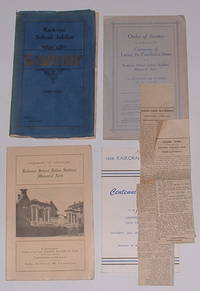
1919Best.-Nr. 17773Dunedin: Stone Son & Co. Good with no dust jacket. 1919. First Edition. Softcover. Wrappers worn and creased with small tears to margins. Owner's signature "Mary Helen Wardrop 28/11/19".; 44 pages. Blue printed wrappers. Page dimensions: 219 x 137mm. Illustrated. New Zealand regional history Kaikorai School Rosyln Dunedin. 3 others: 2 "Order of Service to be observed at the Ceremony of Laying the Foundation Stone of the Kaikorai School Fallen Soldiers' Memorial Arch. On Saturday 29th October A.D. 1921; A.L.5921 at 3 o'clock p.m." 4 pages. With two contemporary newspaper clippings. 3 "Ceremony of Unveiling - The Kaikorai School Fallen Soldiers' Memorial Arch - By His Excellency Admiral of the Fleet Viscount Jellicoe of Scapa . . . Sunday 12 February 1922 at 3 o'clock p.m." 4 pages. 4 "Centennial Dinner - Kaikorai School - 1868 - 1968". 4 pages. 22 autographs on "Autographs" page. . Stone, Son & Co. paperback
Best.-Nr. CORV-BBP-19672Kailua High School. Kailua HI. Plastic Comb. Very Good. Very good. Comb-bound 4to. This booklet is the product of work done by students in the 9th Grade GT English and Social Studies Classes. The stories are based on interviews the students did with older family members. 35pp. B/w photos illustrations. > Language: English > Size: 4to > Media/Binding: Comb Bound Kailua High School., Kailua, HI unknown
1845Best.-Nr. 2405150146xbvk[Kassel, 1845.]. 87 Seiten Gemäldebestand mit Beschreibungen, XIII S. Register; vom Register abgesehen folgt jedem bedruckten Blatt ein unbedrucktes für eintragung des 'Buchhalters' (bis ohne Einträge). - Praun-marmorierter Papperinband der Zeit mit Papierrückenschild (Inventarnummer 955); 8vo.(ca. 17 x 10 cm).
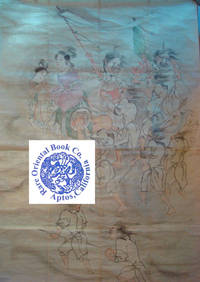
Best.-Nr. 36023801Japan 1860 n.p. Large sheet 96 x 1m 44 cm. gouachevery clean work no worming or other condition issues painted on 16 joined sheets of Washi paper to make one large sheetfine water-color painting. THIS IS AN ORIGINAL PAINTED ART WORK . . . AM ORIGINAL COLOR PAINTING IN GRAND SIZE . . . FROM JAPAN'S OLDEST MYTHOLOGY: . . . THE KOJIKI & NIHON SHOKI PANTHEON . . . THE ORIGINS OF THE EMPEROR . . . OTOHIME GYO RETSU ZU: . . . THE PROCESSION OF OTOHIME DAUGHTER OF THE SEA GOD . . A stunning color painting by Kyosai. Probably done for a temple donation or as an expression of his faith to Japan's historic heroine. . OTOHIME is a goddess in Japanese mythology and is featured in the Kojiki as well as Nihon Shoki. Also known as "Luminous Jewel". A Japanese goddess the beautiful daughter of the sea-king Ryujin. She married Hoori and gave birth to a son after which she turned into a dragon. . Per the Japanese text brushed on the verso upper left corner: "239 ban dated Ansei 7th Kanoe-Saru-doshi 2 gatsu jojun end of February OTOHIME GYO RETSU ZU" . English: "#239 dated Ansei 7th monkey zodiac year end of Feb.: 1860 . PAINTING TITLE PER VERSO: "THE FIGURE OF PRINCESS OTOHIME'S PROCESSION THE DAUGHTER OF THE SEA GOD" . "Toyotama-hime" Japanese for "Lady Bountiful Soul" better known as Otohime is a goddess in Japanese mythology and is featured in the Kojiki as well as Nihon Shoki. She is the beautiful daughter of Ryujin the "God of the Sea." . A STUNNING ORIGINAL POLYCHROME GOUACHE PAINTING: . This original color watercolor painting shows the lively procession of OTOHIME and her hand maid. She is followed by a flag and umbrella bearer. Also following is a man with a pair of deer antlers good omen a man with a small red offering table with peaches the Wind God and his thunder-drum. Another flag bearer his helper followed by two others one holds a staff the other an offering of golden egg. . The items carries are symbolic good fortune and wealth in terms of deer antlers peaches and the golden egg represent ancient Chinese also used by the Japanese of omens of good fortune and good luck. . THE PAINTING: . Per the Japanese brushed text on the verso there is a number found meaning this panel of several was part of a larger work per the chronology found in Clark see below. . This panel of several paintings was part of a restoration of Zojo-ji temple in Shiba. In 1859 KANO Toei & Kyosai "participates in a repair project at the Zojo-ji temple." See Clark. . Although Kyosai had officially left the Kano school in 1854 by participating in the restoration of Tokugawa's family temple in Shiba he was showing loyalty to the Tokugawa family a good reason to volunteer his skills to the temple. It is also noteworthy that his mentor Kano Toei also participated in the restoration and in all likelihood Kyosai joined his master in a sign of respect and loyalty to him. . Based on this chronology it is clear Kyosai was one of the painters who worked at Zojo-ji temple along with his mentor and master teacher Kano Toei. It was not uncommon at this time for schools to volunteer teachers and students to do temple restoration and art work painting replacing or enhancing paintings and large murals. . This item's date matches the restoration dates for the Zojo-ji temple which began in 1859 and continued into 1860. . This panel was unused in the restoration it may have been a precursor to the final painting which was actually used in the restoration project. It matches the scenes found in Zojo-ji temple restoration. The work is the exact style of others painted by Kyosai and his genre. The caricatures of the people in this painting reflect Kyosai's style exactly the theme of his eccentric humor expressing his love for creativity and the joy of painting. . It is entirely within Kyosai's bizarre character to undertake and devote himself to such a project as illustrating the famous myth of OTOHIME in more than 200 deluxe extra-large-size format paintings. . This restoration project could also have been a 'paying job' for Kyosai as at that time he did not seem to be employed but in 1858 he began to design "Kyoga crazy pictures. It was in 1857 he married Okyo the daughter of a Rimpa painter Suzuki Kiitsu but Okyo died in 1859 and he remarried Tose who died in 1860. . It is more than likely Kyosai being a Buddhist he felt it was his religious obligation to do pennants by contributing to and drawing Buddhist or such traditional images as a way to placate the loss of his wife. . THE STORY OF OTOHIME DAUGHTER OF THE SEA GOD: . Because this work was part of the Zojo-ji temple restoration it cannot be considered a commercial painting one that was casually drawn and put on the market for sale. This was part of a commissioned restoration financed by some benefactor to the temple and most likely supported by the Tokugawa family. . ONE OF JAPAN'S EARLIEST AND MOST FAMOUS MYTHS: . The story of OTOHIME DAUGHTER OF THE SEA GOD is one of Japan's oldest and most famous myths known to all Japanese. Treasured as one of the most important in the ancient pantheon it is found in the earliest writing about the origin of Japan and the Emperor in the KOJIKI and the NIHON SHOKI. . This kind of larger paper illustrated story would take months to complete by It would also take devotion to the subject and focus with responsibility to produce a good number of paints daily. This was something Kyosai could and would do ! . THE ARTIST/PAINTER: This work is unsigned which is expected as part of a larger series of paintings. If this was the work of Kyosai it falls entirely within the dates during his period of work produced when he was 29 years old. . The caricature in the faces and fluid bodies in motion the "flowing" style are his. Although there is no signature and it is a true reflection of Kawanabe's work we are attributing it to him. . Another convincing point is that this kind of painting and meticulous style is also found in his famous instructional showing various 'schools' of painting in his KYOSAI GADEN. See below. . WHO WAS KAWANABE GYOSAI/KYOSAI: 1831-1889: Kawanabe Kyosai was a superb artist in the words of a critic "an individualist and an independent perhaps the last virtuoso in traditional Japanese painting". . Living through the Edo period to the Meiji period Kyosai witnessed Japan transform itself from a feudal country into a modern state. Born at Koga he was the son of a Samurai. His first aesthetic shock was at the age of nine when he picked up a human head apart from a corpse in the Kanda river. . After working for a short time as a boy with Utagawa Kuniyoshi he received his artistic training in the Kano school but soon abandoned the formal traditions for the greater freedom of the popular school. During the political ferment which produced and followed the revolution of 1867 Kyosai attained a reputation as a caricaturist. His very long painting on Makimono" scroll The battle of the farts" may be seen as a caricature of this ferment. . He was arrested three times and imprisoned by the authorities of the Shogunate. Soon after the assumption of effective power by the Emperor a great congress of painters and men of letters was held at which Kyosai was present. . He again expressed his opinion of the new movement in a caricature which had a great popular success but also brought him into the hands of the police this time of the opposite party. After this time he changed his name from Kyo crazy or wild to any one of 19 other "Go" studio names he used. However after the police jailed him he avoided use of "Kyo" but returned back to it with three other "GO" that used the same character "Kyo" crazy & wild such as #7 "Baiga Kyosha" #10 "Kyosai #12 Kyosha Gaishi #16 "Shosho Kyosai" Quoted from Roberts below see that reference for more details. . Kyosai is considered by many to be the greatest successor of Hokusai as well as the first political caricaturist of Japan. His work mirrored his life in its wild and undisciplined nature and occasionally reflected his love of drink. . Color photos are posted to our website. . REFERENCE: . More on OTO HIME: heon-org/articles/o/otohime-html KAWANABE Gyosai later known as Kyosai: Is well collected by world museums I GADAN: 1887 4 vol. set: In this work he outlines and exhibits a wide variety of "styles" of painting. In this work there are several examples of this kind or school of painting. Wikipedia stated about this book: "The most important work about Kyosai's art and life was written by himself: Kyosai Gadan or "Kyosai's Treatise on Painting" half autobiography and half painting manual. WESTERN APPRECIATORS: Many westerners came to visit Kyosai and their memoirs about the artist are valuable. The two important ones both rare were: Emile Etienne Guimet Promenades Japonaises Paris 1880. Josiah Conder: "Paintings and Studies by Kawanabe Kyosai" Tokyo 1911. Conder was a serious student of Japanese art; after some initial rejections he was accepted as Kyosai's pupil and accompanied him for ten years until the master's death. Timothy Clark Demon of painting: the art of Kawanabe Kyosai p.186 chronology and the drawing #21 p.58 is very similar to the pose found in our painting of OTOHIME Toyotama-hime both in pose facial quality hair style and the general perspective. ROBERTS Laurance P.: A DICTIONARY OF JAPANESE ARTISTS: PAINTING SCULPTURE CERAMICS PRINTS LACQUER p.100 stated of him: Kyosai ".was marked by a wild eccentric humor.caricatures of full of fantasy and invention." KAWANABE KYOSAI MEMORIAL MUSEUM. KAWANABE KYOSAI DOKU HON. OTOHIME: Nihon Jinmei Daijiten Toyotama-hime. Tokyo: Shogakukan. 2012. . . unknown