[HENRY FORD TRADE SCHOOL]Biblio.com

36 937 résultats
1934réf. 56852Dearborn MI: Henry Ford Trade School 1934. Quarto 28cm. Publisher's blue tape cloth-backed pictorial card wrappers; mixed pagination; illustrated throughout. Printed mimeograph. Light wear and a hint of spotting to extremities spine faded front corner bumped contemporary ownership rubberstamp to first page else Very Good or better. With a promotional booklet for the Henry Ford Trade School a combined high school and trade school that trained boys as Ford employees. Henry Ford Trade School unknown
1934réf. 56852Dearborn MI: Henry Ford Trade School 1934. Quarto 28cm. Publisher's blue tape cloth-backed pictorial card wrappers; mixed pagination; illustrated throughout. Printed mimeograph. Light wear and a hint of spotting to extremities spine faded front corner bumped contemporary ownership rubberstamp to first page else Very Good or better. With a promotional booklet for the Henry Ford Trade School a combined high school and trade school that trained boys as Ford employees. Henry Ford Trade School unknown books
réf. 201605927Paris, Imago éditions, 1986 ; in-8, 437 pp., br.
réf. 200910559Paris, Imago éditions, 1986 ; in-8, 437 pp., broché, couverture illustrée.
réf. 201404644Paris, Hachette, 1989 ; in-8, 311 pp., br.
1911réf. 6807Seattle: Students of Broadway High School 1911. First Edition. Suede. Good. Large 8vo. Pp. 269 followed by advertising. Frontis. view of the school building. Illustrated with halftone black & white photo reproductions. Yapp edged chamois wrap blind stamped "Sealth 1911" over pale green stiff textured endpapers. Spine chipped edges crimped binding relaxed former owner signed in ink "Abe Malakoff June 21 1911." Student and staff portraits cartoons clubs proms debates sports and other contests recorded. Followed by advertisements from local firms including several funeral homes Lowman and Hanford Printers Webster & Stevens Commercial Photographers Haynes Candies etc. In subsequent years a bevy of noted Northwest artists graduated Broadway High Kenneth Callahan William Ivey George Tsutakawa Leo Kenney Fay Chong and Andrew Chinn among them. Long a fixture in the Seattle Public School system Broadway High closed in 1946; the original building is now incorporated in the Seattle Community College campus. . Students of Broadway High School unknown
1946réf. 5393Millers Falls Mass 1946. Octavo 23 x 15.5 cm. 38 pages. Cover title: Cook Book: Highland P.T.A. 1946. FIRST EDITION. A community cookbook then its one hundred thirty attributed recipes known to but a few dozen families. Alma M. Lapointe Cuff 1920-2009 was a newcomer recently arrived from distant Greenfield about seven miles away after her marriage to a metal worker and settling to raise a family in Millers Falls. Two intriguing aspects of the Cook Book she oversaw are the number of recipes identified as "sugarless"--among them Gingerbread Cream Pudding Devil's Food Cake and Alma Cuff's own Fudge and a few experimental ventures such as New Way to Prepare Stringbeans and - a Committee project - Pineapple Chicken Sandwich. Once a mill village amidst the farming communities of Franklin County in northwestern Massachusetts Millers Falls took its name in the 1860s from Millers Falls Manufacturing makers of fine tools founded in Greenfield but with factories in Millers Falls. The village is now a constituent neighborhood of Montague. Children of several generations past attended the Highland School a one-story six-room brick schoolhouse on Millers Falls Road built circa 1920. In stapled blue-titled wrapper. Lower front corner of wrapper chipped otherwise very good. OCLC locates one copy; in neither Brown nor Cagle. unknown
1946réf. 5393Millers Falls Mass 1946. Octavo 23 x 15.5 cm. 38 pages. Cover title: Cook Book: Highland P.T.A. 1946. FIRST EDITION. A community cookbook then its one hundred thirty attributed recipes known to but a few dozen families. Alma M. Lapointe Cuff 1920-2009 was a newcomer recently arrived from distant Greenfield about seven miles away after her marriage to a metal worker and settling to raise a family in Millers Falls. Two intriguing aspects of the Cook Book she oversaw are the number of recipes identified as "sugarless"--among them Gingerbread Cream Pudding Devil's Food Cake and Alma Cuff's own Fudge and a few experimental ventures such as New Way to Prepare Stringbeans and - a Committee project - Pineapple Chicken Sandwich. Once a mill village amidst the farming communities of Franklin County in northwestern Massachusetts Millers Falls took its name in the 1860s from Millers Falls Manufacturing makers of fine tools founded in Greenfield but with factories in Millers Falls. The village is now a constituent neighborhood of Montague. Children of several generations past attended the Highland School a one-story six-room brick schoolhouse on Millers Falls Road built circa 1920. In stapled blue-titled wrapper. Lower front corner of wrapper chipped otherwise very good. OCLC locates one copy; in neither Brown nor Cagle. unknown books
réf. 15306At foot of final page: '1204 WT. 39620. number of copies: 22500 date of publication i.e. July 1955: 7/55 printer: D & G Ltd.'. 39pp. small 4to. Stud-bound in brown card printed wraps. In good condition lightly aged and worn with crease to front cover to which the enamel badge is also attached beside the ownership signature of 'E J Sayer' Downing Street secretary Elizabeth Sayer later Cooper. First page dated in pencil '8th Sept' and pencil note in text of the 'permitted dose' of radiation. At head of front cover: 'ESTACIDVOL Code 5-96-0' and at foot: 'RESTRICTED The information given in this document is not to be communicated either directly or indirectly to the Press or to any person not authorised to receive it.' Printed inside the front cover: 'The accompanying notes have been prepared for your guidance. Additional information is contained in the Home Office Civil Defence Training Manuals which may be obtained on loan through your Instructor.' Divided into the main sections: Civil Defence Organisation; Fire Fighting; High Explosive Missiles; Atomic Warfare; Biological Warfare; Chemical Warfare; Protective Measures. Also present is a full-page 'Civil Defence Report Form'. The first section begins: 'Civil Defence is the responsibility of the Central Government and needs the assistance of Local Authorities Industry and public bodies of many kinds. It includes all measures short of actual combat necessary to mitigate the effects of enemy attack.' The 'Atomic Warfare' section is divided into four subsections: Features of Atomic Explosion; Delayed Radiation Risks; Radiation Sickness; Individual Dosimeter. The enamel badge is roughly 2.5 x 2cm and features red and blue enamel on brass. It consists of a crown topping a circle the latter having an image of a lion surrounded by a blue border with 'I.C.D.S.' The pamphlet is scarce: no copy on OCLC WorldCat and the only copy on COPAC at the Imperial War Museum. At foot of final page: '(1204) WT. 39620. [number of copies:] 22,500 [date of publication, i.e. July 1955:] 7/55 [printer:] D & paperback
réf. 206958Paris, Impr. nationale, s.d. in-8, 16 pp., dérelié. Légère déchirure p. 5 sans atteinte au texte.
réf. 225951S.l. [Paris], [Imprimerie C. Bernard], 1967 in-8, 32 pp. broché.
réf. 145377Paris, Chez L. Colas, 1821 in-8, 40 pp., broché, couv. muette.
réf. 205738Paris, Imprimerie de L. Portier de Lille, (1790) in-8, 14 pp., cousu.
réf. 243022Paris, Imprimerie de L. Portier de Lille, (1790) in-8, 14 pp., broché, couv. papier bleu moderne.
réf. 8493Hanoi, Imprimerie d'Extrême-Orient, 1930. 1 volume in-4, 55 pp., broché, couvertures imprimées conservées, enrichi de 16 planches photographiques à pleine page, très bon état, malgré un léger manque de papier au dos. Un autre exemplaire, relié plein cuir, est vendu 80 euros.
réf. 70608Alençon, Imp. de Malassis le Jeune, 1790 in-4, 3 pp., vignette.
réf. 140438Paris, Imprimerie Nationale, s.d. in-8, 24 pp.
réf. 206956Paris, Impr. Nationale, s.d. in-8, 24 pp., dérelié.
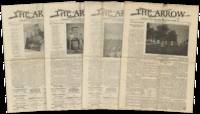
1907réf. List3875Carlisle Pennsylvania: Carlisle Indian Industrial School 1907. Four issues. 12 x 17 ¾ inches folio folded as issued. Folded again vertically with some folded vertically twice. Wear and some tears and loss at folds with toning and stains some with marginal damage. Very good to excellent. The Carlisle Indian Industrial School had a number of publications including The Indian Helper The Red Man The Red Man and Helper The Indian Craftsman and The Arrow. The latter was founded in 1904 when William A. Mercer became superintendent after the school's founder Richard Henry Pratt left the position. The paper's motto describes it as "A Paper Devoted to the Interest of the Progressive Indian" and the very first edition states that its aim is to "become a medium for the best thought obtainable upon all sides of the Indian question" Vol. I no. 1 August 25 1904. Offered here are four issues of The Arrow all Vol. III: no. 9 October 26 1906 no. 11 November 9 1906 no. 16 December 14 1906 and no. 40 May 31 1907. Contents include sports news-Carlisle was known for its football team-news from current and former students school events poetry and short articles. Football is almost always front-page news and the paper typically reports big wins for Carlisle which one article describes as "Bringing Home Another Scalp" Nov. 1906. Football news is also a place to emphasize the importance of obedience for instance "'Pop' Warner had his men under good control and as event after event was pulled off the value of efficient coaching and strict compliance with instructions was plainly manifested"; May 1907 a theme which is reiterated in a number of the articles. Students provide updates on school events both religious and secular and brief updates on individual students at home and away such as "Louise Hardin who is out in the country at Mt. Airy Penn. writes that she likes her place very much. William Garlow one of our baseball twirlers is under the weather. His friends wish him a speedy recovery." The Arrow also reprints articles from other newspapers about the school such as a November 1906 article from the New York World which describes the school: "The Indians in the school range from little tots six years of age to grown men and women who have been at the institution for a dozen years. They represent every tribe in the United States. Many of the youngsters are just entering the state of civilization while those in the graduating class are fine specimens of the modern educated Indian." Carlisle Indian School Digital Resource Center hosts digitized copies of the school's publications; we find no physical holdings on OCLC. Of interest to historians of Carlisle and the assimilationist project. . Carlisle Indian Industrial School unknown
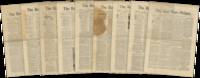
1904réf. List3876Carlisle Pennsylvania: Carlisle Indian Industrial School 1904. Nine issues. 12 x 18 inches folio folded as issued. Generally folded vertically twice with some wear and tearing at folds; toned with wear and damage especially to margins. Very good. The Red Man and Helper a newspaper published by Carlisle Indian Industrial School had several iterations first published under the title Eadle Keatah Toh 1880-82-Lakota meaning roughly "morning star" the title was an interesting choice for the newspaper of a school where only the English language was allowed. It was published as The Morning Star then The Red Man: His Past Present and Future until "His Past" was removed in 1888; then The Red Man until 1900 when it merged with The Indian Helper running as The Red Man and Helper from 1900 to 1904.1 The contents with contributions from students educators and other publications generally concern the value of an off-reservation Euro-American education and the capabilities of Indigenous students to assimilate into the Euro-American way of life. Offered here are nine issues of The Red Man and Helper: Vol. I no. 30 Feb. 8 and 15 1901 Vol. II no. 48 July 11 1902 Vol. III no. 1 Aug. 15 1902 Vol. III no. 40 May 29 1903 Vol. III no. 42 June 12 1903 Vol. V no. 38 May 20 1904 Vol. V no. 39 May 27 1904 Vol. V no. 40 June 3 1904 and Vol. V no. 41 June 10 1904. Note that these are enumerations for The Red Man and Helper; each edition also provides a separate enumeration indexed to the first edition of The Red Man. Carlisle Indian School Digital Resource Center hosts digitized copies of the school's publications and OCLC finds physical holdings of two editions Vol. XVII no. 39 and Vol. XIX nos. 47-48 at Gettysburg College. Of interest to historians of Carlisle and the assimilationist project. 1 Jennifer Bess "Casting a Spell: Acts of Cultural Continuity in Carlisle Indian Industrial School's the Red Man and Helper" Wicazo Sa Review 26 no. 2 Fall 2011: 13-38. . Carlisle Indian Industrial School unknown
1907réf. List3875Carlisle Pennsylvania: Carlisle Indian Industrial School 1907. Four issues. 12 x 17 ¾ inches folio folded as issued. Folded again vertically with some folded vertically twice. Wear and some tears and loss at folds with toning and stains some with marginal damage. Very good to excellent. The Carlisle Indian Industrial School had a number of publications including The Indian Helper The Red Man The Red Man and Helper The Indian Craftsman and The Arrow. The latter was founded in 1904 when William A. Mercer became superintendent after the school's founder Richard Henry Pratt left the position. The paper's motto describes it as "A Paper Devoted to the Interest of the Progressive Indian" and the very first edition states that its aim is to "become a medium for the best thought obtainable upon all sides of the Indian question" Vol. I no. 1 August 25 1904. Offered here are four issues of The Arrow all Vol. III: no. 9 October 26 1906 no. 11 November 9 1906 no. 16 December 14 1906 and no. 40 May 31 1907. Contents include sports news-Carlisle was known for its football team-news from current and former students school events poetry and short articles. Football is almost always front-page news and the paper typically reports big wins for Carlisle which one article describes as "Bringing Home Another Scalp" Nov. 1906. Football news is also a place to emphasize the importance of obedience for instance "'Pop' Warner had his men under good control and as event after event was pulled off the value of efficient coaching and strict compliance with instructions was plainly manifested"; May 1907 a theme which is reiterated in a number of the articles. Students provide updates on school events both religious and secular and brief updates on individual students at home and away such as "Louise Hardin who is out in the country at Mt. Airy Penn. writes that she likes her place very much. William Garlow one of our baseball twirlers is under the weather. His friends wish him a speedy recovery." The Arrow also reprints articles from other newspapers about the school such as a November 1906 article from the New York World which describes the school: "The Indians in the school range from little tots six years of age to grown men and women who have been at the institution for a dozen years. They represent every tribe in the United States. Many of the youngsters are just entering the state of civilization while those in the graduating class are fine specimens of the modern educated Indian." Carlisle Indian School Digital Resource Center hosts digitized copies of the school's publications; we find no physical holdings on OCLC. Of interest to historians of Carlisle and the assimilationist project. . Carlisle Indian Industrial School unknown books
1904réf. List3876Carlisle Pennsylvania: Carlisle Indian Industrial School 1904. Nine issues. 12 x 18 inches folio folded as issued. Generally folded vertically twice with some wear and tearing at folds; toned with wear and damage especially to margins. Very good. The Red Man and Helper a newspaper published by Carlisle Indian Industrial School had several iterations first published under the title Eadle Keatah Toh 1880-82-Lakota meaning roughly "morning star" the title was an interesting choice for the newspaper of a school where only the English language was allowed. It was published as The Morning Star then The Red Man: His Past Present and Future until "His Past" was removed in 1888; then The Red Man until 1900 when it merged with The Indian Helper running as The Red Man and Helper from 1900 to 1904.1 The contents with contributions from students educators and other publications generally concern the value of an off-reservation Euro-American education and the capabilities of Indigenous students to assimilate into the Euro-American way of life. Offered here are nine issues of The Red Man and Helper: Vol. I no. 30 Feb. 8 and 15 1901 Vol. II no. 48 July 11 1902 Vol. III no. 1 Aug. 15 1902 Vol. III no. 40 May 29 1903 Vol. III no. 42 June 12 1903 Vol. V no. 38 May 20 1904 Vol. V no. 39 May 27 1904 Vol. V no. 40 June 3 1904 and Vol. V no. 41 June 10 1904. Note that these are enumerations for The Red Man and Helper; each edition also provides a separate enumeration indexed to the first edition of The Red Man. Carlisle Indian School Digital Resource Center hosts digitized copies of the school's publications and OCLC finds physical holdings of two editions Vol. XVII no. 39 and Vol. XIX nos. 47-48 at Gettysburg College. Of interest to historians of Carlisle and the assimilationist project. 1 Jennifer Bess "Casting a Spell: Acts of Cultural Continuity in Carlisle Indian Industrial School's the Red Man and Helper" Wicazo Sa Review 26 no. 2 Fall 2011: 13-38. . Carlisle Indian Industrial School unknown books
In-8, 82p. Quelques passages soulignés au crayon, autrement à l'état de neuf!
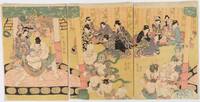
1860réf. 218670東京. Tokyo. circa1860s. Three colour woodblock prints a triptych panels loose each approx 38.5 x 25.4cm Japanese text artist's signature publisher's seal and date in the outer margin of the centre and right-hand panels and in the inner margin of the left-hand panel slivers of paper tape strengthening the top margin to the verso of each print pin-holes to the corners from previous display with loss to the lower right corners and the inner corner of the left-hand panel paper a little dusty and soiled but overall in good condition. Wonderful satirical woodblocks with muted tonings possibly from the composition for "Sumo wrestling match of Seven Lucky Gods" replacing the gods with actors as aging sumo wrestlers surrounded by onlooking geisha and fellow actors in masks and costume. From the collection of the late John Caiger lecturer in Asian studies ANU. . unknown
1800réf. 63904Tokyo & Kyoto Japan: Kano School ca. 1800-1810. One 4to. art sample design portfolio sized 12.5 x 14 in. which folds out into giant montage of six large original late-Edo-Period Kano School screen designs on durable handmade Japanese rice paper measuring 110 x 75 in. carefully pasted as montage some titled as well as featuring ink manuscript painting instructions ordered counter-clockwise: “Bamboo scene” 47 x 38.5 in.; King Tang of Shang court scene 36.5 x 39 in.; 2nd Court scene 38.75 x 38.75 in.; Pine tree landscape 38.75 x 38.75 in.; Crane 28.75 x 39 in.; and Island pagoda landscape & pine trees 31 x 41.75 in six w/ original colour painting some colour painting & material instructions in Japanese all arranged to compactly fold and bound with colour woodblock illustrated cloth and old bookseller labels mounted on verso some repairs to corners to reattach the boards thumbing & minor tears a fold creases w/ a few occasional paper repairs at the first most frequently used fold minor creasing & edgewear dustsoiling to fold creases interior offset toning from sizing & paint colours still an extraordinary exemplar. This exceptional late-Edo-period original Kano School painting montage incorporates many of the elements developed by the famed multi-generational painters whom over four centuries revived and shaped Chinese idealist traditions into a uniquely vigorous Japanese art style. The Kano school painters emphasized landscapes Imperial court interior & exterior architectural elements colours uses of gold animal and botanical subjects often creating crowded panoramic scenes typically used in wall & door screens as well as triptych folding wall screens. The repeated instructions on these designs in Japanese by Sasayama Tsutsumu -- one of several Sasayama painters who took that name from the 18th- to 19th-Centuries in the Kano School beginning with Sasayama Yoi d. 1743 student of Kano Sunnobu 1636-1713 and subsequently four more generations afterwards nearly all adopted and chiefly serving the Chofu domain -- specify these designs are each one of three pieces. In addition there are ink manuscript memos appearing with directions on pigments for the final design work such as adding mica flecks or other paints & dyes and these sketches captured key features of a design so that students or other Kano artists could sufficiently enlarge recreated and fully understand the steps required for the finished decorative artwork pieces. The upper right first image presents bamboo looming in the weather emphasizing their connections to architectural features; The second and third designs capture the golden age Curt of the King of Shang in 1600 B.C. memorialized later as the Xia Dynasty; the fourth presents a rugged hillside and trees shrouded in clouds; the fourth a wonderful large crane apparently intended as part of a much larger piece; and finally the sixth lower right features distant pagoda temple shrouded mountains flower-bedecked pine tree in foreground and with delicate colouring and shading. Naganobu Kano fl. 1775-1828 and his son Osanobu Seisenin Kano 1786-1846 were of the Kobikicho family which carried on the Kano School traditions from 1730 until the Meiji Period and were instrumental in producing designs and screens for the Nishinomaru and Honmaru palaces which burned down in 1838 and again in 1844. Even though the paintings no longer exist similar original design such as these do survive in the Tokyo National Museum. Seisenin Kano was especially well known for his art adapted from his studies from ancient paintings at the end of the Edo-period. See: Kano School After the Middle of the Edo Period Art Nomura 2026; Matthew P. McKelway Rediscovering the Kano School Artforum Vol. 53 No. 5 Jan. 2015; Brief Biographies of Scholars Painters and Haiku Poets of Chofu Records of the Sasayama Family Painters of the Chofu Domain 2026. Kano School, hardcover