Multiple ContributorsMareMagnum

29.593 risultati
1985152 pages. Features: Henry Scheel - innovation never goes out of style; The Caddo Lake Bateau - James H. Conrad and Thad Sitton; Traditional Teak Grates - how they're made at Hinckley's; Barnegat Bay's A-Cats - racing for the next century; The Scottish Fishing Fleet - Rugged enough for the North Sea; The Tahoe Yacht Club's 12th annual Concours d'Elegance; The Northwest School of Wooden Boatbuilding; An epic cruise in the New York pilot-schooner Caprice; Building the Kingfisher, Part II; Saw it yourself with a Bandmill. Average wear. Unmarked. A sound copy. Book
1941238 pages. Index. Extensively illustrated with black and white photos and diagrams. Charts and tables. A wartime text "especially written for carpenters and other woodworkers who desire to engage in boat or ship building, and as a textbook for schools." - subtitle. Amazingly, a prior owner has neatly handwritten over twenty pages of pertinent notes on and near front and back endpaper! Some additional markings to contents. Binding intact. Somewhat above-average external wear. A sound vintage copy. Book
199340 pages. Features: Initial Camber - Stabilizing Wood for Relief Woodcarving; New Works in Wood by Bayot Heer, Gerald Johnston, Tom McKenzie and Doug Haslam; Gothic Tracery; Dovetail Jig; Screws; Macrojoinery in the Maritimes; Making a Wooden Hand Plane the Fast Way; Armando's Story - Armando de Gobbo (misspelled as de Gobo) of Kingston, Ontario is a blind woodworker; Indexes to Woodworking Magazines and Newspapers; The Carvers' Quilt; Great photo of Farm Mechanics Students at the Prov. School of Technology and Art, Calgary, Jan. 25, 1926; Woodworking Incunabula; XceL multiple head wrenches, Nod and Shake goggles, and the Lunkenheimer "Universal" Glass Body Oil Pump are featured on back cover. Clean, bright and unmarked with light wear. A lovely copy of this fine Canadian woodworking publication. Book
194288 pages. Bibliography. Numerous excellent diagrams. "Contains an elementary treatment of woodcraft suitable for school craft-clubs, parks, summer camps, and the home workshop... The most elementary projects are suitable for the middle grades and the most difficult for the upper grades... Does not require the use of power tools." - from Foreward. Average wear. Binding intact. Nice illustrated endpapers. Gift greetings upon verso of front free endpaper. Book
rif. B9781013364402Hardback. New. hardcover
rif. ria9780470021729_inpHardback. New. New Book; Fast Shipping from UK; Not signed; Not First Edition; This book is exclusively concerned with wood modification although many of these processes are generic and can be applied to other lignocellulosic materials. There have been many rapid developments in wood modification over the past de hardcover
1927rif. ZB1175292Cleveland: West Technical High School ca. 1927. 4 pp. 43 wood engravings of birds each with a four or five line description original illustrated stiff paper wrappers spine worn & tattered minor soiling to the covers however internally clean and tight. - If you are reading this this item is actually physically in our stock and ready for shipment once ordered. We are not bookjackers. Buyer is responsible for any additional duties taxes or fees required by recipient's country. Photos available upon request. Cleveland: West Technical High School unknown
1999rif. AME_9780153134135saunder 1999. 1st. Unknown Binding. New/New. saunder unknown
1980Previous owner's inscription and name label inside. Interior pages clean and unmarked; tight binding. Black and white photos. 246 pages. A History of the Smith College Graduate School of Architecture and Landscape Architecture in Cambridge.
1939rif. 2083002116205067Secondary school textbook / late growth place beauty education promotion society 1939. Soft Cover. Fine. Number of books: 4 Secondary school textbook / late growth place beauty education promotion society paperback
1981rif. 2090502126902091Not Available 1981. Soft Cover. Fine. Size: B5 Not Available paperback
1926rif. 2082402113501404Dai Nihon tosho 1926. Soft Cover. Fine. Volume: 1 Dai Nihon tosho paperback
rif. 2090502113707708Not Available N.A. Soft Cover. Fine. The book is in fine condition. Not Available paperback
1841rif. 164511841. Catholic Girls' School Ugbrooke. Regulations for the Catholic Girls' School at Ugbrook 1841 a formal rule book documenting the provision and governance of Catholic education for girls from working and dependent families associated with the Ugbrooke estate in Devon. Founded in 1824 by Lady Clifford the school was principally financed by Lord Clifford with teachers reporting directly to him; surviving research indicates that tuition was effectively free for families unable to contribute and that Lord Clifford also provided medical attention and clothing for pupils. The 1841 regulations define this educational system more precisely stating that the school was intended "solely for the education of the female children" of present or former tenants servants and laborers of the Clifford family as well as tradesmen employed by the family. As such the pamphlet provides primary-source evidence for the study of girls' education Catholic schooling estate paternalism class and the institutional regulation of female childhood in early Victorian England. Catholic Girls' School Ugbrooke. Regulations for the Catholic Girls' School at Ugbrook. Chudleigh: J. E. Searle 1841. First edition. 8 2 pages. 8vo. The regulations were approved by the Right Reverend Vicar Apostolic of the Western District of England for the Catholic Girls' School at Ugbrooke Devon which was placed under the protection of the Blessed Virgin Mary and St. Joseph; the rules are dated March 25 1841. The pamphlet establishes who qualified for admission and records the formal ecclesiastical and estate framework governing the school demonstrating how educational access for girls was organized through relationships among the Catholic Church the Clifford household estate employees and their families. Ugbrooke itself had a particularly longstanding Catholic identity: the Clifford family's chapel was rededicated for Catholic worship in 1673 and Mass continued there through the period in which the girls' school operated. The regulations appeared well before universal elementary education in Britain and document a localized model in which girls from tenant servant laboring and tradesmen's families received schooling through the patronage of a Catholic landed family. The school's adoption of Joseph Lancaster's teaching system further places it within contemporary experiments in economical mass elementary instruction while its governance remained distinctly tied to the Clifford estate and Catholic religious authority. Earlier bibliographic cataloging located only two institutional copies at Emory University and the National Library of Australia although institutional holdings can change and this should not be treated as a definitive current census. No specific physical defects are supplied; overall very good. A focused primary source showing how class gender religion and estate patronage shaped access to formal education for girls in early Victorian Devon. unknown books
1903rif. 180101903. Association of Head Mistresses. List of Public Secondary Schools for Girls 1903 and 1905 records the geographic extent of secondary schooling available to girls in Britain during the early twentieth-century expansion of women's education. Founded in 1874 by Frances Mary Buss and other headmistresses of endowed and proprietary schools the Association developed from efforts to improve the standards and institutional position of girls' secondary education. These two successive lists arrange schools by county providing contemporary evidence of where public secondary education for girls was available and allowing comparison across localities and between the two publication years. Their dates follow three decades in which girls gained broader access to academically oriented schools and universities although educational equality remained contested; in 1897 Cambridge rejected a proposal granting women the titles of degrees followed by riotous celebrations by male undergraduates. Women were not admitted to full membership of Cambridge until 1948. Two pamphlets issued by the Association of Head Mistresses dated 1903 and 1905 each measuring 8.5 x 5.5 inches. Soft blue covers are printed "One Shilling Published by the Educational Supply Association 42 Holborn Viaduct E.C." Entries within each pamphlet are organized by county and identify public secondary schools open to girls at the time of publication. The format turns the changing institutional landscape of girls' education into a contemporary directory recording individual schools by place rather than describing educational reform retrospectively. Both front covers bear stamps reading "Board of Education Library" and "Supplied Public Service" each incorporating the royal crown; the back covers retain red "Board of Education Reference Library" stickers. These official library markings document their presence within a government educational reference collection. 1 Association of Head Mistresses. List of Public Secondary Schools for Girls. London: Educational Supply Association 1903. Arranged geographically by county the pamphlet enumerates secondary schools then available to girls and provides a contemporary reference point for the distribution of female secondary education at the beginning of the Edwardian period. Its Board of Education Library markings also preserve evidence of institutional reference use. 2 Association of Head Mistresses. List of Public Secondary Schools for Girls. London: Educational Supply Association 1905. Issued two years after the first pamphlet this updated county-by-county listing permits direct comparison of the provision of girls' secondary schools between 1903 and 1905. The directory appeared during the continuing expansion of educational opportunities that connected secondary schooling with women's increasing access to higher education; the University of London had begun awarding degrees to women on equal terms with men in 1878 while access elsewhere remained uneven. Textblocks tight bright and clean. Both pamphlets overall very good condition. The consecutive editions preserve a measurable record of girls' secondary education by county at a time when women educators and school leaders were establishing institutions capable of preparing girls for examinations professional training and higher education. unknown books
1940rif. 160881940. Edith Reverend Mother. Autograph letter signed to William Nourse December 22 1940 records wartime conditions at Ascot Priory while its Anglican religious community operated St. Augustine's School for girls during the Blitz. Written three months into the German bombing campaign the letter describes bombs falling near the Priory quieter nights as Christmas approached and the financial strain affecting the institution's supporters. Ascot Priory was the mother house of the Society of the Most Holy Trinity an Anglican women's religious community whose work included nursing care of orphans and education; St. Augustine's School was among the schools operated by the sisters. Edith Reverend Mother. December 22 1940. Autograph letter signed to William Nourse on Ascot Priory letterhead Ascot Berkshire England. Writing three days before Christmas Edith acknowledges the continuing support of friends despite wartime hardship: "I appreciate the kindness of our friends more than ever this year for I know how much financially hit everyone is." Her Christmas wishes immediately turn to the war: "I do hope you will have as happy a Christmas is possible Xmas 1941 bring us peace!" She then gives a direct account of the danger experienced at Ascot: "We have had some bombs unpleasantly near but lately I am glad to say the nights have been much quieter." The letter was written during the Blitz when German aerial attacks on Britain had begun in September 1940 and would continue into May 1941. Ascot Priory had housed the Society of the Most Holy Trinity since the nineteenth century; its sisters maintained religious medical charitable and educational work including the care of girls at St. Christopher's Orphanage and instruction at St. Augustine's School. Edith's December 1940 letter records how that women-led institution continued during wartime through a concise firsthand account of nearby bombing strained finances and hopes for peace. Her remarks are especially immediate because they were written during the first winter of the Blitz rather than retrospectively after the war. No condition defects are specified in the supplied description. A contemporary account of the British home front from the woman responsible for an Anglican community and girls' school during the aerial campaign of 1940. unknown books
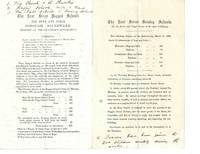
1868rif. 160851868. Newton H. Autograph letter signed on a handbill for the Lant Street Ragged Schools for Boys and Girls April 13 1868 documents free education for poor children and adults in Southwark and records substantially higher attendance among girls than boys. Newton identified as Vicar of St. Michael's Mission Schools Lant Street writes to a donor concerning the schools' work while the printed handbill describes an institution located "in the midst of the poorest population in Southwark" and reports approximately 850 attendances daily. The surviving enrollment figures give particular evidence for girls' participation: 243 girls attended the upper school room compared with 167 boys in the lower school room while afternoon attendance numbered 233 girls and 162 boys. Newton H. April 13 1868. Autograph letter signed on verso of a printed handbill for The Lant Street Ragged Schools for Boys and Girls Borough Southwark. The handbill describes the schools as "the largest with about 850 attendances daily and the most important in South London" and supplies separate attendance figures for boys and girls. It also records an evening school of approximately 65 "grown persons of both sexes" who were taught to read and write showing that the institution combined children's schooling with adult literacy instruction. Newton annotated the printed portion in his own hand including the notation "Ragged Schools male & female." His manuscript communication to a donor links the printed statistics and public appeal directly to the school's fundraising activity and administration. Ragged schools developed in nineteenth-century Britain to provide free instruction to children excluded by poverty from other forms of schooling commonly combining elementary education with religious and charitable work. The Lant Street handbill records that work before the Elementary Education Act of 1870 established a national framework for elected school boards in England and Wales. Its sex-specific figures are especially informative for the history of women's education: girls exceeded boys in both reported daytime sessions while the evening school extended literacy instruction to adult women as well as men. The handbill and Newton's signed letter preserve two aspects of the institution on the same sheet-the statistics used to describe its educational work and a clergyman's direct appeal to a supporter. No condition defects are specified in the supplied description. A contemporary record of schooling adult literacy charitable fundraising and female attendance among the poor of Victorian Southwark. unknown books
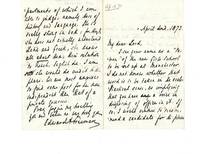
1873rif. 160861873. Freeman Edward Augustus. Autograph letter signed April 2 1873 recommends Scottish educator and historian Margaret A. R. Macarthur for appointment as headmistress of a new girls' school in Manchester explicitly arguing that her abilities warranted a position "more independent than that of a private governess." Freeman a historian who would later become Regius Professor of Modern History at Oxford had employed Macarthur as governess to his daughters for nearly five years and writes from direct experience of her teaching. His recommendation documents the professional transition available to an educated woman from domestic governess work to leadership in the expanding field of girls' secondary education and identifies history and languages as Macarthur's particular strengths. Freeman Edward Augustus. April 2 1873. Autograph letter signed to "My Dear Lord." Somerleaze Wells Somerset England. Four pages on a single folded sheet. Having seen his correspondent named as a "Patron of the new Girls School to be set up at Manchester" Freeman asks whether he has influence over appointments and recommends Macarthur for headmistress. "She is a woman of powers far above the common" he writes "and I can witness that she has practiced them well in the only two departments of which I am able to judge namely those of History and language." Freeman adds that although Macarthur did not know Latin and Greek directly "she knows all about them their relation to French English etc." As evidence of his confidence in her historical abilities he explains "I have set her to write one of my series of small histories a History of Scotland which I hope will soon be out." He concludes "I am sure she would do credit to the place. We are most anxious to find some post for her more independent than that of a private governess." Margaret A. R. Macarthur born in Scotland in 1842 subsequently published History of Scotland in Freeman's Historical Course for Schools confirming the literary project Freeman describes while it was still in preparation. The letter thus precedes publication and records Freeman using Macarthur's authorship as evidence of her qualifications for educational leadership. Although the supplied information states that Macarthur was not appointed to the Manchester position the reason given-that better-qualified candidates prevailed-cannot be established from the letter itself and is therefore omitted. Fine condition. Freeman's detailed recommendation preserves contemporary evidence of a woman educator seeking advancement beyond private governess work and of published historical scholarship being cited as a qualification for the headship of a girls' school. unknown books
1923rif. 168781923. Chamberlain Ola. The Girl Graduates Record Book 1923 to 1925 documents rural Texas girls' education adolescent friendship school ritual athletics domestic expectations and female self-expression at Goree High School. Kept by Ola Chamberlain of Goree Texas the album captures a young woman's final high school years through photographs teacher and classmate inscriptions certificates invitations press clippings and an original "Class Prophecy" providing direct evidence of how one Texas student recorded academic achievement peer culture humor courtship-inflected friendship extracurricular life and the movement "Out of school life into life's school." Kubinyi Victor de designer. The Girl Graduates Record Book. New York: Barse & Hopkins copyright 1920. Manuscript memory book and scrapbook kept by Ola Chamberlain Goree Texas 1923 to 1925. 190 pages. Original cloth boards with embossed floral motif 10.25 x 7 inches. Contains 85 silver gelatin photographs most approximately 4.5 x 2.75 inches more than 25 handwritten inscriptions from friends and teachers an original handwritten class prophecy and approximately 85 pieces of ephemera including ribbons party invitations commencement materials press clippings seven perfect-attendance certificates a Texas public school report card and a pressed sweet pea dated May 15 1925. Photographs and captions identify Goree High School called by Chamberlain "The Prison" classmates with nicknames including "Pie Face" "Preacher" "Shot Gun" "Lilliums" and "Hankie" class officers the Spanish Class Pep Club "Senior Girls" basketball players and eight images of students in colonial costume for "The Virginia Reel." The inscriptions preserve affectionate student memory and gendered academic praise including one classmate's statement that in mathematics Ola was "a wizard-ess" while teacher entries address her transition from school into adult life: "Life's School is open to you." The album's strongest research value lies in its unusually full record of a girl's educational world in small-town Texas during the 1920s including formal coursework in Geometry English Physics Civics Economics and Arithmetic alongside a parent-signed "Home Report" grading Cooking Care of Stock General Farm Work Providing Fuel Washing Dishes and Obedience. Chamberlain's manuscript "And How It All Came Out" imagines the futures of her graduating class through a supernatural vision prompted by the class flower placing classmates in roles from department-store worker to sheriff mayor and secretary and giving the album a rare sustained example of student-authored narrative. First two pages detached front hinge detached edges toned some pages brittle with small edge chips good. A substantial documentary record of women's education rural Texas youth culture school sociability athletics and the gendered expectations surrounding a young woman's graduation in the mid-1920s. unknown books
1916rif. 166221916. Carpenter Rachel A. M. Photograph album of St. Mary's School Wantage 1916 to 1918 documents the daily life of girls at an English school during the final years of the First World War. Twenty-three photographs record organized sports theatrical performance swimming leisure school uniforms faculty friends and the grounds of St. Mary's with handwritten captions and dates identifying every image. The album preserves a student's record of girls' education beyond the classroom including field hockey cricket tennis swimming and dramatic performance activities that formed an increasingly visible part of female secondary education in early twentieth-century Britain. Twenty-three gelatin silver photographs dated 1916 to 1918 mounted on 14 card-stock pages in original green cloth boards titled "Photo Sketches." Album measures 6.25 × 7.5 inches; photographs range from 2 × 2.75 inches to 3.5 × 5.5 inches. Carpenter identifies friends by full names initials and nicknames including "Tufty." Several views show students in uniform at leisure while others depict the field hockey cricket and tennis teams swimming in "the Baths" faculty members and campus grounds. Three photographs record the cast of a school production of Blue Beard performed during the summer term of 1918; the album retains a program for the production. Founded in 1873 as a girls' school St. Mary's belonged to the expansion of formal secondary education for girls in late nineteenth- and early twentieth-century England. Carpenter's photographs show how that education included organized athletics theatrical performance recreation and student social life during the wartime years of 1916 to 1918. The named and captioned photographs provide unusually specific evidence of individual pupils school activities and the rhythms of campus life. Condition not stated in the supplied description. unknown books
1841rif. 164511841. Catholic Girls' School Ugbrooke. Regulations for the Catholic Girls' School at Ugbrook 1841 a formal rule book documenting the provision and governance of Catholic education for girls from working and dependent families associated with the Ugbrooke estate in Devon. Founded in 1824 by Lady Clifford the school was principally financed by Lord Clifford with teachers reporting directly to him; surviving research indicates that tuition was effectively free for families unable to contribute and that Lord Clifford also provided medical attention and clothing for pupils. The 1841 regulations define this educational system more precisely stating that the school was intended "solely for the education of the female children" of present or former tenants servants and laborers of the Clifford family as well as tradesmen employed by the family. As such the pamphlet provides primary-source evidence for the study of girls' education Catholic schooling estate paternalism class and the institutional regulation of female childhood in early Victorian England. Catholic Girls' School Ugbrooke. Regulations for the Catholic Girls' School at Ugbrook. Chudleigh: J. E. Searle 1841. First edition. 8 2 pages. 8vo. The regulations were approved by the Right Reverend Vicar Apostolic of the Western District of England for the Catholic Girls' School at Ugbrooke Devon which was placed under the protection of the Blessed Virgin Mary and St. Joseph; the rules are dated March 25 1841. The pamphlet establishes who qualified for admission and records the formal ecclesiastical and estate framework governing the school demonstrating how educational access for girls was organized through relationships among the Catholic Church the Clifford household estate employees and their families. Ugbrooke itself had a particularly longstanding Catholic identity: the Clifford family's chapel was rededicated for Catholic worship in 1673 and Mass continued there through the period in which the girls' school operated. The regulations appeared well before universal elementary education in Britain and document a localized model in which girls from tenant servant laboring and tradesmen's families received schooling through the patronage of a Catholic landed family. The school's adoption of Joseph Lancaster's teaching system further places it within contemporary experiments in economical mass elementary instruction while its governance remained distinctly tied to the Clifford estate and Catholic religious authority. Earlier bibliographic cataloging located only two institutional copies at Emory University and the National Library of Australia although institutional holdings can change and this should not be treated as a definitive current census. No specific physical defects are supplied; overall very good. A focused primary source showing how class gender religion and estate patronage shaped access to formal education for girls in early Victorian Devon. unknown
1916rif. 166221916. Carpenter Rachel A. M. Photograph album of St. Mary's School Wantage 1916 to 1918 documents the daily life of girls at an English school during the final years of the First World War. Twenty-three photographs record organized sports theatrical performance swimming leisure school uniforms faculty friends and the grounds of St. Mary's with handwritten captions and dates identifying every image. The album preserves a student's record of girls' education beyond the classroom including field hockey cricket tennis swimming and dramatic performance activities that formed an increasingly visible part of female secondary education in early twentieth-century Britain. Twenty-three gelatin silver photographs dated 1916 to 1918 mounted on 14 card-stock pages in original green cloth boards titled "Photo Sketches." Album measures 6.25 × 7.5 inches; photographs range from 2 × 2.75 inches to 3.5 × 5.5 inches. Carpenter identifies friends by full names initials and nicknames including "Tufty." Several views show students in uniform at leisure while others depict the field hockey cricket and tennis teams swimming in "the Baths" faculty members and campus grounds. Three photographs record the cast of a school production of Blue Beard performed during the summer term of 1918; the album retains a program for the production. Founded in 1873 as a girls' school St. Mary's belonged to the expansion of formal secondary education for girls in late nineteenth- and early twentieth-century England. Carpenter's photographs show how that education included organized athletics theatrical performance recreation and student social life during the wartime years of 1916 to 1918. The named and captioned photographs provide unusually specific evidence of individual pupils school activities and the rhythms of campus life. Condition not stated in the supplied description. unknown
1868rif. 160851868. Newton H. Autograph letter signed on a handbill for the Lant Street Ragged Schools for Boys and Girls April 13 1868 documents free education for poor children and adults in Southwark and records substantially higher attendance among girls than boys. Newton identified as Vicar of St. Michael's Mission Schools Lant Street writes to a donor concerning the schools' work while the printed handbill describes an institution located "in the midst of the poorest population in Southwark" and reports approximately 850 attendances daily. The surviving enrollment figures give particular evidence for girls' participation: 243 girls attended the upper school room compared with 167 boys in the lower school room while afternoon attendance numbered 233 girls and 162 boys. Newton H. April 13 1868. Autograph letter signed on verso of a printed handbill for The Lant Street Ragged Schools for Boys and Girls Borough Southwark. The handbill describes the schools as "the largest with about 850 attendances daily and the most important in South London" and supplies separate attendance figures for boys and girls. It also records an evening school of approximately 65 "grown persons of both sexes" who were taught to read and write showing that the institution combined children's schooling with adult literacy instruction. Newton annotated the printed portion in his own hand including the notation "Ragged Schools male & female." His manuscript communication to a donor links the printed statistics and public appeal directly to the school's fundraising activity and administration. Ragged schools developed in nineteenth-century Britain to provide free instruction to children excluded by poverty from other forms of schooling commonly combining elementary education with religious and charitable work. The Lant Street handbill records that work before the Elementary Education Act of 1870 established a national framework for elected school boards in England and Wales. Its sex-specific figures are especially informative for the history of women's education: girls exceeded boys in both reported daytime sessions while the evening school extended literacy instruction to adult women as well as men. The handbill and Newton's signed letter preserve two aspects of the institution on the same sheet-the statistics used to describe its educational work and a clergyman's direct appeal to a supporter. No condition defects are specified in the supplied description. A contemporary record of schooling adult literacy charitable fundraising and female attendance among the poor of Victorian Southwark. unknown
1873rif. 160861873. Freeman Edward Augustus. Autograph letter signed April 2 1873 recommends Scottish educator and historian Margaret A. R. Macarthur for appointment as headmistress of a new girls' school in Manchester explicitly arguing that her abilities warranted a position "more independent than that of a private governess." Freeman a historian who would later become Regius Professor of Modern History at Oxford had employed Macarthur as governess to his daughters for nearly five years and writes from direct experience of her teaching. His recommendation documents the professional transition available to an educated woman from domestic governess work to leadership in the expanding field of girls' secondary education and identifies history and languages as Macarthur's particular strengths. Freeman Edward Augustus. April 2 1873. Autograph letter signed to "My Dear Lord." Somerleaze Wells Somerset England. Four pages on a single folded sheet. Having seen his correspondent named as a "Patron of the new Girls School to be set up at Manchester" Freeman asks whether he has influence over appointments and recommends Macarthur for headmistress. "She is a woman of powers far above the common" he writes "and I can witness that she has practiced them well in the only two departments of which I am able to judge namely those of History and language." Freeman adds that although Macarthur did not know Latin and Greek directly "she knows all about them their relation to French English etc." As evidence of his confidence in her historical abilities he explains "I have set her to write one of my series of small histories a History of Scotland which I hope will soon be out." He concludes "I am sure she would do credit to the place. We are most anxious to find some post for her more independent than that of a private governess." Margaret A. R. Macarthur born in Scotland in 1842 subsequently published History of Scotland in Freeman's Historical Course for Schools confirming the literary project Freeman describes while it was still in preparation. The letter thus precedes publication and records Freeman using Macarthur's authorship as evidence of her qualifications for educational leadership. Although the supplied information states that Macarthur was not appointed to the Manchester position the reason given-that better-qualified candidates prevailed-cannot be established from the letter itself and is therefore omitted. Fine condition. Freeman's detailed recommendation preserves contemporary evidence of a woman educator seeking advancement beyond private governess work and of published historical scholarship being cited as a qualification for the headship of a girls' school. unknown
1940rif. 160881940. Edith Reverend Mother. Autograph letter signed to William Nourse December 22 1940 records wartime conditions at Ascot Priory while its Anglican religious community operated St. Augustine's School for girls during the Blitz. Written three months into the German bombing campaign the letter describes bombs falling near the Priory quieter nights as Christmas approached and the financial strain affecting the institution's supporters. Ascot Priory was the mother house of the Society of the Most Holy Trinity an Anglican women's religious community whose work included nursing care of orphans and education; St. Augustine's School was among the schools operated by the sisters. Edith Reverend Mother. December 22 1940. Autograph letter signed to William Nourse on Ascot Priory letterhead Ascot Berkshire England. Writing three days before Christmas Edith acknowledges the continuing support of friends despite wartime hardship: "I appreciate the kindness of our friends more than ever this year for I know how much financially hit everyone is." Her Christmas wishes immediately turn to the war: "I do hope you will have as happy a Christmas is possible Xmas 1941 bring us peace!" She then gives a direct account of the danger experienced at Ascot: "We have had some bombs unpleasantly near but lately I am glad to say the nights have been much quieter." The letter was written during the Blitz when German aerial attacks on Britain had begun in September 1940 and would continue into May 1941. Ascot Priory had housed the Society of the Most Holy Trinity since the nineteenth century; its sisters maintained religious medical charitable and educational work including the care of girls at St. Christopher's Orphanage and instruction at St. Augustine's School. Edith's December 1940 letter records how that women-led institution continued during wartime through a concise firsthand account of nearby bombing strained finances and hopes for peace. Her remarks are especially immediate because they were written during the first winter of the Blitz rather than retrospectively after the war. No condition defects are specified in the supplied description. A contemporary account of the British home front from the woman responsible for an Anglican community and girls' school during the aerial campaign of 1940. unknown