17 results
1999ref. 219602New York: Alpha Books 1999. Softcover. Near Fine. First edition. Near fine in wrappers. Paperback Front covers outer edge lightly rubbed with small bump. Alpha Books unknown books
ref. 606810not signed on a 3/4 length shot of Madge Evans seated at a desk talking with Paul Lukas wearing a dark double breasted suit in a scene from the 1935 film "Age of Indiscretion." Photograph is on single weight stock; 10" x 8"; very good two file holes in the left margin; mounting traces on the back; minor signs of handling; 1935. Information slip on the back reads: "Paul Lukas and Madge Evans in the office sequence in Metro-Goldwyn-Mayer's 'Age of Indiscretion' directed by Edward Ludwig. With green rubberstamp on the back that reads: "APPROVED ADVERTISING ADVISORY COUNCIL MAR. 18 1935 HOLLYWOOD.". No Binding. Very Good. unknown books
1982ref. 211410Oakland CA: Parenting in a Nuclear Age 1982. Pamphlet. 14p. wraps illus. very good condition 7x8.5 inches. How to tell your kids about the prospect of nuclear annilation. Parenting in a Nuclear Age unknown books
1981ref. 381953San Francisco: No Publisher 1981. Unbound. Near Fine. Photomechanically reproduced flyer on 8.5" x 11" paper. Slight toning and a creased corner else about near fine. An original flyer promoting a gig at the San Francisco art club Generic featuring Fake Stone Age and Ritual. [No Publisher] unknown books
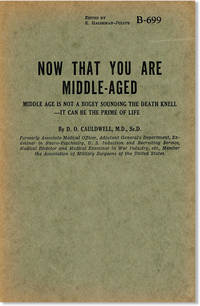
1948ref. 46590Girard KS: Haldeman-Julius Publications 1948. First Edition. Octavo 21cm.; publisher's green printed staplebound card wrappers; 32pp. Wrapper extremities toned else Ner Fine. Big Blue Book no. B-699. From the introduction: "Middle age is not heralded by an increasing waistline a few gray hairs a double chin a spot of baldness lines in the face or crowsfeet under the eyes." p. 3. The author a former Associate Medical Officer for the U.S. Induction and Recruiting Service goes on to cover such topics as "Men at 40 and the Prostate Myth" "Fallacies About the Menopause" and the age-old question "Are Middle-Aged Women Less Attractive Than Men" The latter seventeen pages reprint letters seeking advice from Cauldwell with headings like "A Failure at 35" and "Unwanted Wife." OCLC locates four separately catalogued copies as of November 2019 at UC Davis the Smithsonian Northwestern and Kansas with an additional copy at the Huntington catalogued as part of a larger collection. Haldeman-Julius Publications unknown books
ref. B297271-1Frankfurt Typos Verlag 1967. 174pp. Prof. illus. 4to. Orig. dec. stapled wraps. Lacking the loose Diter Rot insert. Frankfurt (Typos Verlag), 1967. paperback books
ref. 606580"Dick Jaeckel on Twentieth Century Fox employment form when he worked in the Fox mailroom at age 16 April 15 1943. Jaeckel signed and accomplished in his hand. 8 1/2" x 4" fine. Rare thus!. Signed by Authors. No Binding. Very Good. unknown books
1925ref. 589771925. Two black & white photo images 8" x 10" on glossy stock mounted in Crown Studio mats 11 1/4" x 13 1/4". Images are night shots of windows depicting surroundings full of architectural details. Very minimal soiling to lower fore-edge. 1 image with a bit longer exposure time still a very good pair of photos. These two commercial photos of 1920s window displays provide an invaluable historical glimpse into the marketing of men's fashions at the height of the Jazz Age. The photos include unique period elements with breathtaking flower arrangements positioned amongst the displayed clothing. The men's suits range in tints and style primarily including double-breasted and single-breasted suits with trousers carefully draped over surrounding decorative tables and stands cravats at the neck and each with a dapper cane displayed above it. Rich draperies of men's suit fabrics have been arranged below and around the displays. Frank Jacoby's store was a thriving business in Bridgeport CT. at 1083 Broad Street until the throes of the Great Depression when they were forced to close in 1933. unknown books
ref. 1424New Hampshire. Dartmouth College. 1991. Soft cover. Book Condition: Fine. 4to - over 9¾" - 12" tall. 485pp. Stiff card wrappers with full cover illustration of "Still Life with Parrots" by Jan Davidsz. de Heem; red endpapers. Catalog for exhibitions at the Hood Museum of Art 1991 North Carolina Museum of Art Raleigh 1992; The Museum of Fine Arts Houston 1992; High Museum of Art Atlanta 1993. unknown books
1940ref. 34378Berlin: Deutschen Verlag 1940. First edition. Softcover. g. Quarto. 48 pp. Original photo-illustrated wraps. Laid in: daily program accompanying exhibition of the Reichsportfeld Reichs-arena. Profusely illustrated with sepia-toned photographs throughout and one double page drawn "picture story" covering a typical morning for a young woman. Depictions of young women's deployment at East and West frontline and various scenarios of duty in society inlcuding one instance of meeting with Führer Adolf Hitler. Exhibition was curated with intention to familiarize the Berlin public with the "Reichsarbeitsdienst" for young women. Wraps lightly creased and rubbed at edges some very small chips both covers reinforced with tap on inside cover. Wraps in good- interior in very good condition. Deutschen Verlag unknown books
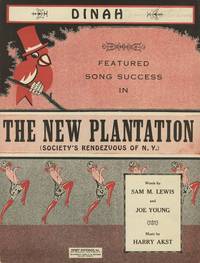
1925ref. List3672New York City: Henry Waterson Inc 1925. Folio illustrated wraps. 5 pp. Fine condition. A striking Jazz Age sheet music issue and likely first edition for “Dinah” the widely popular song composed by Harry Akst with lyrics by Sam M. Lewis and Joe Young here promoted as a “Featured Song Success” from The New Plantation Society’s Rendezvous of N.Y. a Harlem revue-style theatrical production. The revue was advertised as an all-Black production reopening the Plantation Cabaret at 50th Street and Broadway featuring prominent performers including blues singer Ethel Waters alongside Will Vodery’s Parisian Orchestra Josephine Baker Bessie Allison Leonard Harper Jimmy Ferguson and the Plantation beauty chorus.1 “Dinah” would go on to become one of the most enduring standards of the decade. Multiple versions were published in 1925 this one in June and though we are not able to establish definitive priority we guess that this is the first edition. Very scarce with three copies found institutionally at the Francis G. Spencer collection at Baylor University BYU and the British Library reference collection. 1 “Ethel Waters Is Featured In New Plantation Revue” The New York Age June 20 1925 6. Henry Waterson, Inc unknown books
1802ref. 20092Burlington NJ 1802. As issued. Very good; some old folds. Single sheet written by Josiah Foster Justice Burlington NJ Johannes Schuster the father of Hannah Schuster indentured his daughter to Mark Reeve and his heirs until she was 18 in 1814 for the price of her passage to New Jersey from Bremen Germany $45. She was to receive full lodging apparel five quarters of "day schooling" and at the end of her term of indenture her clothes and $10. in payment. Signed by Johannes Schuster and marked by his daughter with an "X". unknown books
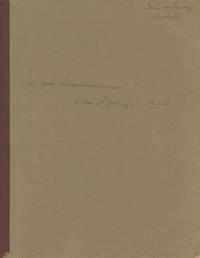
1926ref. List3141Quincy Massachusetts: unpublished 1926. 201 pp cardstock wraps. Normal wear to wraps; overall Near Fine. Alice Brackett White Coolidge 1864–1927 was a Boston socialite of the prominent Richardson family; her grandfather was merchant and Massachusetts State Legislator Jeffrey Richardson. Coolidge was also the author of three children’s books: The Bunnies of Evergreen Village 1917 The Refugees in Evergreen Village 1918 and Evergreen Village to the Rescue 1922. Offered here is Coolidge’s unpublished memoir of her early life written in 1926 titled My Early Reminiscences. The memoir recalls Coolidge’s childhood and teen years spent mainly in Massachusetts New Hampshire and Maine. Her recollections typically involve extensive descriptions of the houses at which her family stayed the scenery around them and the various families they met and visited with. Given her position in society her acquaintances are sometimes quite influential people: Princeton president John Grier Hibben enjoys Coolidge’s fishcakes; Trinity Church rector Phillips Brooks gives her grandfather an “excellent pew” in the newly-finished church; pioneering doctor Alfred Worcester mistakes red pepper for mercury in a scientific demonstration at her school; and she recalls brief correspondences with John Greenleaf Whittier and William James. Coolidge also took dance lessons from Augustus Papanti whom she describes as “one of the thinnest men I ever saw” who was “very melancholy. I hardly remember his ever smiling”; and remembers Judge Charles Devens for “his great stature his charming face his courtliness of manner and his really boyish simplicity in entering into our evening games” including a game of “mind reading” which Devens played “with zest.” One of her longtime friends was Rear Admiral John E. Pillsbury. She recalls: “Mr. Pillsbury as a young naval man a brother-in-law of my uncle Dr. Richardson used to take me out in the swan-boats on the Public Garden Pond. Later he went through all the ranks up to being retired as a Rear Admiral but time and circumstances never changed him. We always met at Thanksgiving and Christmas dinners and always talked at great length. . He was a wonderfully interesting lovable man and very modest and unassuming and shy. I always considered him one of my best friends though older by many years than I.” Another interesting New England figure Coolidge encountered was Joseph Lee. She describes Lee’s hotel in Newton: “The house where we stayed was kept by a remarkable man named Joseph Lee. He was a mulatto much above many of his kind and his wife was a handsome woman partly Indian. They did the cooking and he waited on table with a colored maid to help him. In fact there were no white women in the house. The cooking was delicious.” Lee was born enslaved in South Carolina freed in 1865 and went on to invent the automatic bread kneading and bread crumbing machines. Though nearly all of her childhood was spent in New England she also remembers being invited to visit Charles Joseph Bonaparte in Baltimore: “We had never been so far south except to Washington and I felt a curious feeling of being in a different atmosphere from any I had known. . We were met at the station by Mrs. Bonaparte in a large roomy covered vehicle with two horses. The coachman and footman were in the Bonaparte colors -- a deep wine color. The footman I well remember. He was a light-colored young negro very handsome and smiling and excited over having young ladies from the North. . All the servants were colored and lived in cabins near the house. . I never knew Mr. Bonaparte in public life so my memories of him are quite intimate and I fancy I saw much of his real self. . His mind was very active. He used to talk or listen as he walked and he moved his head in a curious way from one side to the other with a slightly rolling motion which was distinctly individual. . I never saw him irritated or excited and he was always very simple. In the group picture we had taken at the Maplewood he sat down cross-legged on the piazza floor like a boy. That was in about 1887. I suppose in public life or in law he was different but he was very equable and charming as we met him in his home and at the mountains. Most of all I admired his sweet tender ways with his flower-like wife.” This was not too long after the end of Reconstruction and Coolidge remarks on the tense atmosphere: “Mrs. Bonaparte had warned me to be careful about questions regarding the North and South as the ‘feeling’ had not yet died away. I was so glad she had warned me. A gentleman slipped in and sat down beside me to watch a parade and whispered in my ear as the bands had been playing ‘Dixie’ how glad he was to meet a Northerner. I was glad to meet him too although I remember neither his name nor face but I felt I breathed freer in his sympathetic locality. . I had no idea that this feeling still remained as far North as Baltimore and of course I remembered how our Massachusetts troops had been fired upon in Baltimore at the outset of the war but I was admonished and very wise and only returned my unremembered neighbor’s greeting with a sympathetic word and look.” Besides individuals Coolidge does cover a few historical events including the Great Boston Fire of 1872: “Oh! a horrible sight met our eyes. Back of the opposite houses in Park Square was a background of sheets of red flames and heavy black smoke rising high into the air. . On the Parade Ground all was in confusion and the sight was very sad and never-to-be-forgotten. It was literally covered with boxes and bales of furniture and sad forlorn desperate looking people crouching or sitting or standing amidst what they had saved from their homes . At night . the whole city was in darkness as there was no gas.” The family also frequently stayed at hotels in the White Mountains of New Hampshire and Coolidge recalls the “overwhelmingly tragic” effects of the 1867 sale of this land to logging companies; she writes that looking out from the Flume House in Franconia “all about were brown scarred places marking the woodchoppers’ work which was cutting away our beautiful trees for lumber”. In this memoir Coolidge supplies detailed remembrances of the private personalities of influential figures of Gilded Age New England. We find two copies of My Early Reminiscences on OCLC. Of interest to historians of the era especially as told through the perspective of a young woman. unpublished unknown books
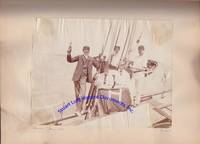
ref. 6174LONG ISLAND. This scrapbook displays photographs taken between 1887-1889 that capture a wealthy familys life on Long Island during the Gilded Age. The term The Gilded Age created by Mark Twain refers to the period of the late nineteenth century typically the 1870s through the turn of the 20th century during which rapid economic growth rapid industrialization and widespread European immigration primarily unskilled labor transformed the economies of the Northern and Western United States. According to the United States Census the era saw a real wage growth of 40% from 1860 to 1890 with the average annual wage per industrial worker including men women and children rising from $380 in 1880 $11523 in 2022 dollars to $584 in 1890 $18370 in 2022 dollars a gain of 59%. This rise in wealth resulted in the rise of a New Money elite those who made their money not through generational wealth and family connections but rather through oil the railroads and other rising industries. They are best exemplified by John D. Rockefeller Jay Gould Henry Clay Frick Andrew Mellon Andrew Carnegie Henry Flagler J. P. Morgan Leland Stanford and Cornelius Vanderbilt. New York was often at the center of the Gilded Age as the worlds dominant financial market and the nations leader in economic investment immigration political corruption and culture. This scrapbook contains 59 black-and-white photographs. They are affixed or mounted to 43 of 70 pages in the album. 29 of the photographs are 3.5 x 4.5 19 are 6.5 x 4.5 and 11 are 5.5 x 7.5. Two of these images are cyanotypes. Though the family is not named in the album and photographs with names underneath lead to nothing online there is a photograph in front of a house labeled Westbrook. The Westbrook estate on Long Island was designed in 1886 for William Bayard Cutting 18501912 by the architect Charles C. Haight in the Tudor Revival style. It contained the first private golf course in the United States and is now a part of a state park called the Bayard-Cutting Arboretum. Cutting started the sugar beet industry in the United States in 1888 was a builder of railroads operated the ferries of New York City his maternal grandfather was a partner of Robert Fulton and developed part of the south Brooklyn waterfront Red Hook. Images include a large extended family repeatedly and leisurely photographed the Harvard-Yale sailing race in 1887 at New London young men likely Yale students yachting and relaxing on a boat named the Princess and beautiful images of the scenery and waters of Long Island. Overall the album is in good shape. One photograph is damaged and several others have minor tears or chips. The scrapbook is half-leather and half-cloth so the spine is worn and the corners are rubbed and bumped. Regardless the scrapbook is a prize for anyone interested in this fascinating and relevant era in American history. It provides fantastic insight into the life of a wealthy Long Island family including what they did what they wore and how they presented themselves to each other and their neighbors. hardcover books
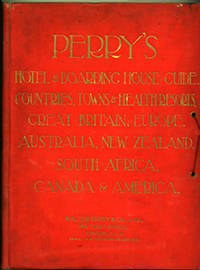
1931ref. 5466London. Walter Perry and Co. Ltd. 1931. Gilt titled crimson cloth. 4to. Edition for 1931. Profusely illustrated with photographs drawings and period advertisements. An absolute treasure depicting the grand and elegant days of travel. A complete guide to Hotels and boarding houses in Great Britain Europe Australia New Zealand South Africa Canada and the USA. Charming period advertising allows one to travel back to the heady romantic days of Somerset Maugham and the Orient Express. Indexed and tabbed this is a true gem of nostalgia. A Very Good copy Walter Perry and Co. Ltd. hardcover books
1940ref. LIST0210New York 1940. Watercolors on paper affixed to later illustration board 14 x 26 inches each. Very Good. An attractive set of images from the Robert Moses era in an unknown hand. The images show proposed intersections including two that were never built. The images include "Proposed Parkway Passing over Entrance to Fort Totten" which shows an overpass on the Cross-Island Parkway in Northeast Queens dated October 1937; "Linden Boulevard Overpass at Southern Parkway" showing an unbuilt intersection at North Conduit Avenue and Dumont Avenue perhaps in the Ozone Park neighborhood undated; "Woodbine Street Passing over Long Island RR to Metropolitan Ave & 67th St." which shows a non-existent intersection near the Middle Village stop on the M line dated August 1940. Interesting relics from the Robert Moses era which shaped the infrastructure landscape of New York City. A very good group overall though the Woodbine Street illustrations shows marginal dampstaining and all three show evidence of label removals and wear. unknown books
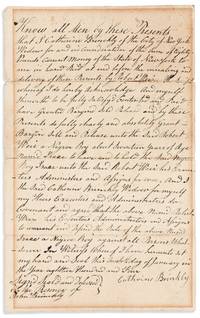
1804ref. 42382New York 1804. Single sheet written in ink script on recto. A deed 8" x 12-3/4" recording the sale of the 17-year-old "Negroe Boy Isaac" to Robert Weir by Catherine Brinckly 12 January 1804. Signed at the end "Catherine Brinkly" and witness John Brinckly. Toned old folds stabilized with text preserved by matting in a contemporary frame. Good plus. British policy in the early 17th century under the Duke of York owner of substantial interests in the Royal African Company encouraged importation of slaves to New York. By the early 18th century slavery was a cornerstone of the City's economy. Slave Codes rigidly regulated the activities and lives of slaves. But by 1804 slavery in New York was in decline thanks to tireless emancipation efforts of the New York Manumission Society Aaron Burr and Alexander Hamilton. In 1799 New York passed an Act emancipating everyone born after 1799. But "It was not until March 31 1817 that the New York legislature ended two centuries of slavery within its borders setting July 4 1827 as the date of final emancipation and making New York the first state to pass a law for the total abolition of legal slavery. When Emancipation Day finally arrived the number of emancipated men and women freed was roughly 4600." Celebrations and parades occurred throughout the state web site of Historical Society of the New York Courts. By this deed Isaac became the property of Robert Weir 1770-1825 a prosperous New York merchant from Scotland who had recently married Mary Katherine Brinckley Brinkley 1783-1840. Mary Katherine Weir is known as composer of the song "The Lord of the Castle." Their infant son Robert Walter Weir 1803-1889 just six months old when this deed was signed became a well-known Hudson River School painter; two of his sons also became famous artists. Robert Sr. declared bankruptcy in 1813 due to French confiscation of shipping goods. "Weir Robert 1770-" Robert Weir Papers Brigham Young University Library Vault MSS 511 Series 1. The grantor Catherine Brinckly was likely Weir's grandmother-in-law mother of Mary Katherine's father Thomas Brinckley born 1754; or some other close relative. We located Thomas Brinckley spelled with the "ck" listed in early New York City directories as city marshal. His name last appeared in 1794 at Cedar Street and Catherine's name began appearing in 1795 at the same street with "widow" following her name. The 1810 census shows one free person of color living with the Robert Weir family and no enslaved people suggesting that Weir had emancipated Isaac . "Weir Family Background" Chester County Historical Society website accessed August 2026; Duncan's New York City Directory and Register for 1794 1795 1800; Claghorn Charles: WOMEN COMPOSERS AND SONGWRITERS Univ. of Michigan: 1996 pp. 231; Ancestry website census and genealogical records. unknown books