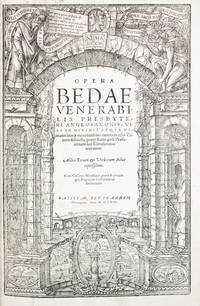
1525ref. 42822Venice: in aedibus Ioannis Tacuini Tridinensis 1525. Bede the Venerable 672/73 - 735. De computo vel loquela per gestum digitorum and De ratione unciarum. In Hoc in volumine haec continentur M. Val. Probus de notis Roma. ex codice manuscript castigatior . . . ed. Giovanni Tacuino Venice: G. Tacuino 1525 ff. LV - LVII. Whole volume 4to. 4 LXXIX i.e. LXXXI 1ff. Title in red and black. Full-page woodcut of a sibyl within an architectural setting signed "b. M." in the block probably Benedetto Montagna a few woodcut initials. 211 x 153 mm. Modern vellum. Fine. Probably the Earliest Printings of Bede's accounts of finger-reckoning and duodecimal fractions. Bede's "De computo vel loquela per gestum digitorum" On calculating and speaking with the fingers and "De ratione unciarum" On calculating duodecimal fractions form part of the introduction to his treatise De temporum ratione On the reckoning of time written around 725 A.D. The editio princeps of De temporum ratione was published by Sichardus in 1529 four years after the present work. Portions of De temporum ratione appeared in print as early as 1505 but these do not appear to have included the section on finger-reckoning. Smith in his Rara arithmetica states that the 1522 edition of Johannes Aventinus's Abacus atque vetustissima veterum latinorum per digitos manusque numerandi contains a description of Bede's finger-reckoning; however we think this may be an error since we have not been able to find any record of this edition in OCLC or the Karlsruhe Virtual Catalogue. Smith himself described only the 1532 edition of Aventinus's work see Rara arithmetica pp. 136-138. Bede's two disquisitions are contained in a collection of works on Latin abbreviations symbols weights measures and inscriptions edited by Giovanni Tacuino. The collection is devoted primarily to works on deciphering the abbreviations used in classical-era stone or bronze inscriptions a subject of great interest to humanistic scholars eager to discover more about the ancient world. Included in the collection is the editio princeps of Petrus Diaconus' De notus literarum more Romano liber which Tacuino had discovered along with a new edition of M. Valerius Probus' De notus Romanorum and several transcriptions of Roman inscriptions in quasi-facsimile. The typographic design of the title is reminiscent of an ancient text in stone. Finger-reckoning a method of computation in which numbers are represented by finger and hand gestures had been practiced since ancient times and was commonly used during the Middle Ages; however there are very few written accounts of the technique dating from these times probably because it was used primarily by "common or illiterate people" Menninger p. 201 who passed its methods on orally. Bede's account of the practice although not the first was the best and most influential. His purpose was to provide a useful method for calculating the Christian calendar most importantly the date of Easter and other movable feasts. Bede listed finger- and hand symbols for the numerals 1 through 9999; these "roughly work like a placement system. The middle ring and little fingers of the left hand denote the digits; the thumb and index fingers on the left hand express the tens; the thumb and index finger on the right hand the hundreds; and the middle ring and little fingers the thousands . . . The informal manner in which Bede explains how to flex the fingers and form gestures seems to retain traces of oral instruction" Kusukawa pp. 28-29. Prior to Europe's adoption of Arabic numerals finger-reckoning provided a rudimentary method of place-value calculation. "Neither Bede nor any of his contemporaries in Western Europe knew about place value or zero but finger reckoning enabled them to proceed as if they did. Finger joints supplied place value-one joint 10s another 100s and so on-and zero was indicated by the normal relaxed position of the fingers-by nothing so to speak. The system was even capable of simple computation" Crosby The Measure of Reality: Quantification in Western Europe 1250-1600 p. 42. Bede's explanation of the Roman system of duodecimal fractions which follows the description of finger-reckoning clarifies the terminology and provides a list of synonyms for different types of fractions. Kusukawa "A manual computer for reckoning time" in Sherman Writing on Hands: Memory and Knowledge in Early Modern Europe pp. 28-34. Menninger Number Words and Number Symbols: A Cultural History of Numbers pp. 201-8. . in aedibus Ioannis Tacuini Tridinensis unknown books
1688ref. 000011508Coloniae Agrippinae = Cologne: Ioannem Wilhelmum Friessem 1688. Later edition. Hardcover. Very Good. 4 vol. 8 vol. bound in 4. Folio. 8 2-452 2; 1-238 with a section of these leaves mispaginated; 4 2-499 2; 4 2-916 1; 2 2-815; 2 2-851; 4 2-486 1; 4 2-967 a lengthy unpaginated index of words and subjects at the end of the volume plus a blank before the rear endpaper pp. Contemporary full blind-tooled pigskin contemporary ink titling on the spines with the volumes numbers; all edges decoratively stained black. Volume one with an engraved title page and its title page printed in red and black also with several in-text woodcuts and charts. The later volumes each have their own title page all volumes with woodcut initials head and tailpieces. Brunet 276. Graesse 321. NCBEL 346. Oxford DNB J. Campbell "Bede St Bede Bæda known as the Venerable Bede 673/4–735". This edition was first published in Cologne in 1612 these volumes are the second edition printed there. Saint Bede is remembered for his contributions to ecclesiastical and British historical writings. Bede wrote analytically and was fascinated by time and the creation of life as they were written about in early Christian sources. The sources available to him included Eusebius of Caesarea Orosius Eutropius and the earlier British historian Gildas. Historians label his Historia Ecclesiastica Anglis Gentorum as the greatest culmination of his writings and some point out that it helped to create the sense of a national English identity at a time when the Angles and the Saxons were still forging intertribal unity. His history of Christianity in Britain largely focuses on the years 597-731 after a brief explanation of Christianity in Roman-controlled Britain. Bede wrote in his own autobiography that his life was devoted to "learning and letters" and he was well-beloved in his own time and long after including by Britain's first king Alfred which is largely why most of his work survives today. His translations of various religious histories and lives of the Saints into Latin made these works accessible to his fellow monks and Bede even did an Old English translation of St. John's Gospel which had it survived would be the earliest lengthy work of prose in English. Bede was an author who was influenced greatly by the writers of Late Antiquity and his career is one of the most significant among those who wrote during the early Middle Ages. With a small later bookplate and an 18th century ownership mark Signet Library on each front pastedown. No other institutional markings. Boards with a few small spots of wear and yellowing overall a lovely set. Ioannem Wilhelmum Friessem hardcover books
1563ref. 254015Basileae i.e. Basle: Per Joannem Hervagium 1563. First collected edition. Title within architectural border with device of Johann Herwagen. Profusely illustrated with iwoodcut maps music tables diagrams. Text in two columns; with Index. 4 vols. Folio. Contemporary calf rebacked new leather spine labels labels misnumbered later endpapers; covers worn but sound one joint starting but firm. Text show various degrees of slight worming and scattered light foxing but overall a very good sound set of this massive collected edition complete except for the final blank leaf of Volume VI. First collected edition. Title within architectural border with device of Johann Herwagen. Profusely illustrated with iwoodcut maps music tables diagrams. Text in two columns; with Index. 4 vols. Folio. This is the first of three continental editions of the works of Bede the others being from Cologne in 1612 and 1688. Johann Herwage a printer originally from Strassburg married the widow of the great Basel printer Johann Froben and for a while collaborated with his stepson Hieronymus Froben. From 1532 however he again started printing under his own name. RARE ON THE MARKET. Adams B-477 Per Joannem Hervagium unknown books
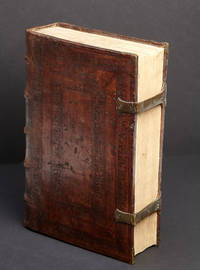
ref. 6759Numerous fine woodcut initials diagrams tables & maps in the text. Woodcut printer’s device at end. 14 p.l. 18 leaves 6 leaves 30 xxxi-cxxvi leaves 4 leaves. Folio cont. Flemish blindstamped calf binding over wooden boards rather well rebacked a few unimportant stains rolls of medallion heads & foliage forming a double panel orig. clasps and catches metal corner guards. Cologne: J. Prael for P. Quentel 1537. bound after: ANSELM ARCHBISHOP OF CANTERBURY. In Omnes Pauli Apostili Epistolas enarrationes. Title within fine woodcut border by Anton Woensam of Worms. Some fine large woodcut initials. 8 p.l. 531 pp. Folio. Cologne: E. Cervicornus for G. Hittorp 1533. A most attractive sammelband of two well-illustrated books in an attractive contemporary blind-stamped binding probably made at the Stavelot monastery in Belgium. I. First collected and illustrated edition of the scientific writings of the Venerable Bede including De Natura Rerum dealing with cosmology and natural history and De Temporum Ratione a work on chronology that still exercises a considerable influence over our daily life today. This edition was edited and commented upon by Joannes Noviomagus i.e. Jan van Bronchorst of Nijmegen 1494-1570 philosopher and mathematician then a professor of philosophy at the Collegium Montanum in Cologne. It would appear that he used the manuscript at the Dombibliothek no. 103 of Cologne to prepare this edition. The De Temporum Ratione is a significant book in several ways. Most notably “this book helped to establish the custom of counting years from the birth of Christ. When we say that Queen Elizabeth II was born in 1926 not ‘in the 16th year of the reign of George V’ or ‘in the year 2678 after the foundation of Rome’ or in the ‘2nd year of the 481st Olympiad’ we are indebted to the Venerable Bede.”–Printing & the Mind of Man 16n. “Bede’s greatest practical effect was on the Western calendar. His decisions beginning the year calculation of Easter names of days and months calculations of eras and so forth in most instances finally determined usage that was only refined not changed by Gregorian reform.”–D.S.B. I p. 565. “The De Ratione Temporum first published in 1505 is particularly important. It contains a remarkable theory of tides based upon Pliny but also upon personal observation; first mention of the establishment of a port i.e. the mean interval between the moon’s meridian passage and high water following; this interval is different in different ports.”–Sarton I p. 511. Pierre Duhem described Bede’s establishment of a port as the only original formulation of nature to be made in the West for some eight centuries. Also contained here is the De Natura Rerum 1st printing: 1529 which contains such physical science as was then known. It collects the wisdom of the ancient world on these subjects and has the special merit of referring phenomena to natural causes. It contains a particularly important section — the “De Comptu vel Loquela digitorum” — which is “our main almost our only source for the study of mediaeval finger reckoning or symbolism.”–Sarton I pp. 510-11. See also Smith History of Mathematics II p. 200. The rest of the book contains further treatises by Bede on arithmetic astronomy and the calendar and chronology. II. Very rare. PROVENANCE: Early inscription of “Antonius abbatis a Sancto Remaclo” on front flyleaf; Benedictine monastery of Stavelot Belgium inscription “Liber Monasterii Stabulensis” on title-page of Anselm; auction sale of the monastery library Catalogue d’une belle Collection de Livres et Manuscrits précieux sur vélin du VIIIe et du IXe siècle Ghent 26 April 1847 lot 42; Michel Chasles 1793-1880 the mathematician with bookplate his sale Paris 27 June-18 July 1881 lot 28; Robert B. Honeyman 1897-1987 his sale Sotheby’s 30 October 1978 lot 265. BINDING: Stavelot had its own bindery at this time and it is quite likely that this binding was executed there see Goldschmidt Gothic & Renaissance Bookbindings no. 90. Fine large copies preserved in a box. â§ I. Adams B448–calling for two additional preliminary leaves but no other collation calls for them. Smith Rara Arithmetica p. 159n. Zinner 1657. II. Adams A1174. unknown books