|
ELUARD Paul - ARAGON Louis
POÈMES POLITIQUES. Préface d'ARAGON.
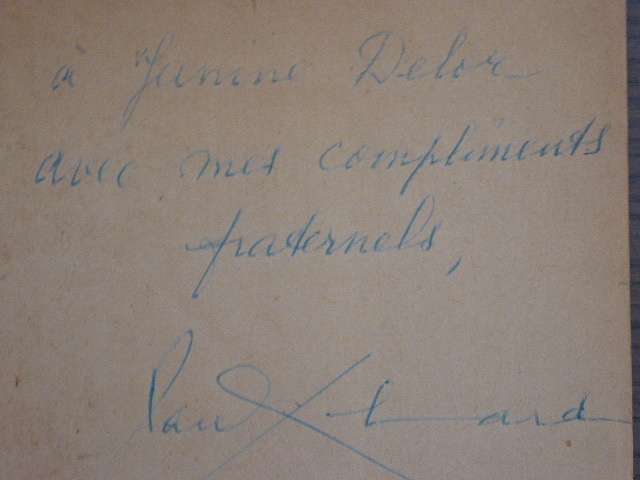
Gallimard NRF Paris 1948 In-12 ( 190 X 120 mm ) de 54 pages, broché sous couverture imprimée.EDITION ORIGINALE ( mention fictive de 4ème édition ) au bon achevé d'imprimer du 7 juin 1948. Bel exemplaire enrichi d'un bel envoi autographe signé de Paul ELUARD.
Bookseller reference : 93875
|
|
|
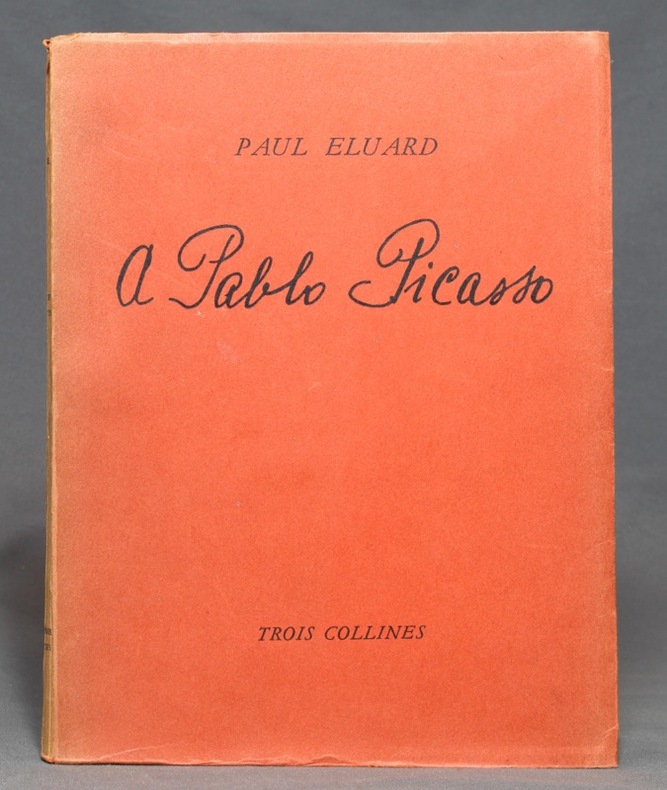
ELUARD Paul:
A Pablo Picasso.
Genève-Paris, Editions des Trois Collines, 1944. In-4 broché de 168-[14] pages, couverture orange rempliée imprimée en noir.
Bookseller reference : 13745
|
|
|
Eluard, P
Vom Horizont eines Menschen zum Horizont aller Menschen. Ausgew. u. übers. v. F. Hagen.
(Berlin), Vlg. d. Nation, (1955). M. Portr. u. 35 Ill. v. M. Schwimmer. 160 S. OLwdbd m. Deckelillustr. (Einbd. leicht angestaubt u. fl.).
Bookseller reference : 410362
|
|
|
Elvire POPESCO
Elvire POPESCO - CARTE POSTALE AUTOGRAPHE SIGNÉE 9X14CM
Elvire POPESCO. Carte postale autographe signée de sa main. Dimensions : 9 x 14,1 cm. État : B el état. Voir photos pour plus de détails. Elvira Popescu, dite Elvire Popesco, est une comédienne roumaine et française, née le 10 mai 1894 à Colentina, quartier de Bucarest et morte le 11 décembre 1993 à Paris. Wikipédia Retours acceptés à la charge du vendeur. Livraison soignée. Produits emballés avec soin dans un carton rigide et étanche. L'Art Délivré Livres anciens, lettres autographes, vieux papiers, gravures, timbres, photos anciennes, etc. Une question ? Une précision ? N'hésitez pas à me contacter au 07 82 69 98 28. Merci de votre visite, Jérôme KAYSER.
Bookseller reference : boz_006149
|
|
|
Elvire POPESCO
Photographie originale signée par Elvire Popesco
s. n. | Paris s. d. [1965] | 11.5 x 16.5 cm | Une photographie
Bookseller reference : 88425
|
|
|
Elwart, Antoine, Komponist und Musikpädagoge (1808-1877)
Eigenh. Brief mit U.
o.J. Paris, 17. VII. 1849, 17 x 15 cm. 1 Seite.
Bookseller reference : 58222
|
|
|
Elwart, Antoine, Komponist und Musikpädagoge (1808-1877)
Eigenh. musikalisches Albumblatt mit Widmung und U.
o.J. Paris, 16. IV. 1863, 11 x 24,5 cm. 1 Seite.
Bookseller reference : 58010
|
|
|
Elwenspoek, Curt, Schauspieler und Schriftsteller (1884-1959)
Eigenh. Briefkarte mit U.
o.J. Tübingen, 30. IV. 1958, Qu.-Schmal-8°. 2 Seiten.
Bookseller reference : 47796
|
|
|
Elytis, Odysseas, Schriftsteller und Nobelpreisträger (1911-1996)
Albumblatt mit eigenh. U.
o.J. (Athen, 8. I. 1980, Poststempel), 15 x 20 cm. 1 Seite. In adressiertem Umschlag.
Bookseller reference : 50708
|
|
|
ELZEAR, Pierre; [ BONNIER ORTOLAN, Elzéar ]
[ Lot de 7 lettres autographes signées et d’un portrait photographique signé dont une très intéressant sur le «féminisme littéraire» ] L.A.S. d’une page: «Mon Cher Hauser, ne trouvez-vous pas qu’il est temps que cette plaisanterie finisse? Suis-je trop exigeant en vous priant de veiller à ce que les tableaux confiés à vous ou à votre ami Mr. Bender soient [… ] chez ma mère, qui revient dans huit jours? Devrais-je faire le voyage exprès? Avec surprise, mais sans rancune»; 1 L.A.S. de 2 pages manuscrites (sur 2 ff.) datée de Paris le 20 octobre 99: «Mon cher Hauser, Vous me demandez ce que je pense du féminisme littéraire. On ne peut songer à interdire la prose et la poësie au sexe faible. Dans l’écriture la femme laide trouve parfois un soulagement, le femme âgée une consolation. Ca et là, j’en conviens, de vrais talents surgissent. On déclare alors que ces talents sont «virils». C’est ce qui fut dit pour George Sand. Mais permettez-moi de me situer à un point de vue spécial. Quand je vois une femme, que son cœur, ses sens, une enveloppe aimable ont destiné à la passion, se servir d’un porte-plume autrement que pour écrire à l’absent des phrases délicieusement incohérentes, je me sens fort attristé. Que de biens perdus! L’amour, en effet, prime toute littérature. La vie est courte, et il n’y a pas de gloire au monde qui vaille l’échange d’un baiser sincère. Or on ne peut être à la fois une femme de lettres et une femme de tendresse. Mlle de Pougy elle-même n’a pu réaliser ce double idéal. Juliette – pas plus que Roméo d’ailleurs – n’a songé à écrire un recueil de sonnets et à faire antichambre chez un éditeur. Et la femme journaliste? Je n’évoque son spectre qu’avec terreur. Elle peut devenir une force; je préfèrerais qu’elle restât une adorable faiblesse […] ».; 1 L.A.S. d’une page, datée du 20 février 1906. Il s’excuse d’avoir dû rester s’occuper de sa mère souffrante; «Le directeur du [ … ] ne paraît pas décidé absolument à faire le Peuple Souverain. Et voici pourtant l’époque des élections. Il faudrait peut-être que vous, le principal auteur, donnassiez un coup d’épaule. Qu’en pensez-vous? [… ]»; 1 L.A.S. d’une page, datée du 13 décembre 1908: «Mon cher ami, Fernand Sarnette dépasse toutes les limites de l’impudence, vis-à-vis de moi et vis-à-vis d’autres. Si vous ne l’avez pas fait, veuillez lui écrire 14 rue des Sts Pères pour lui réclamer dans un délai de quatre jours Le Peuple Souverain, sinon nous aviserons la Société des Auteurs. Emile Rochard et moi en faisons autant de notre côté [ … ]»; 1 L.A.S. d’une page, datée du 29 janvier 1909: «Mon cher Hauser, [ … ] Sarnette fait le mort. Il faudrait, comme Rochard et moi, écrire un mot à M. Gangnat, agent général des Auteurs Dramatiques, [ … ] Henner, qui va convoquer le délinquant avant de le traduire devant la Commission»; avec 2 autres L.A.S.
[ Lot de 7 lettres autographes signées et d’un portrait photographique signé dont une très intéressant sur le «féminisme littéraire» ] L.A.S. d’une page datée au crayon par une autre main de 1882: «Mon Cher Hauser, ne trouvez-vous pas qu’il est temps que cette plaisanterie finisse? Suis-je trop exigeant en vous priant de veiller à ce que les tableaux confiés à vous ou à votre ami Mr. Bender soient [… ] chez ma mère, qui revient dans huit jours? Devrais-je faire le voyage exprès? Avec surprise, mais sans rancune»; 1 L.A.S. de 2 pages manuscrites (sur 2 ff.) datée de Paris le 20 octobre 99: «Mon cher Hauser, Vous me demandez ce que je pense du féminisme littéraire. On ne peut songer à interdire la prose et la poësie au sexe faible. Dans l’écriture la femme laide trouve parfois un soulagement, le femme âgée une consolation. Ca et là, j’en conviens, de vrais talents surgissent. On déclare alors que ces talents sont «virils». C’est ce qui fut dit pour George Sand. Mais permettez-moi de me situer à un point de vue spécial. Quand je vois une femme, que son cœur, ses sens, une enveloppe aimable ont destiné à la passion, se servir d’un porte-plume autrement que pour écrire à l’absent des phrases délicieusement incohérentes, je me sens fort attristé. Que de biens perdus! L’amour, en effet, prime toute littérature. La vie est courte, et il n’y a pas de gloire au monde qui vaille l’échange d’un baiser sincère. Or on ne peut être à la fois une femme de lettres et une femme de tendresse. Mlle de Pougy elle-même n’a pu réaliser ce double idéal. Juliette – pas plus que Roméo d’ailleurs – n’a songé à écrire un recueil de sonnets et à faire antichambre chez un éditeur. Et la femme journaliste? Je n’évoque son spectre qu’avec terreur. Elle peut devenir une force; je préfèrerais qu’elle restât une adorable faiblesse […] ».; 1 L.A.S. d’une page, datée du 20 février 1906. Il s’excuse d’avoir dû rester s’occuper de sa mère souffrante; «Le directeur du [ … ] ne paraît pas décidé absolument à faire le Peuple Souverain. Et voici pourtant l’époque des élections. Il faudrait peut-être que vous, le principal auteur, donnassiez un coup d’épaule. Qu’en pensez-vous? [… ]»; 1 L.A.S. d’une page, datée du 13 décembre 1908: «Mon cher ami, Fernand Sarnette dépasse toutes les limites de l’impudence, vis-à-vis de moi et vis-à-vis d’autres. Si vous ne l’avez pas fait, veuillez lui écrire 14 rue des Sts Pères pour lui réclamer dans un délai de quatre jours Le Peuple Souverain, sinon nous aviserons la Société des Auteurs. Emile Rochard et moi en faisons autant de notre côté [ … ]»; 1 L.A.S. d’une page, datée du 29 janvier 1909: «Mon cher Hauser, [ … ] Sarnette fait le mort. Il faudrait, comme Rochard et moi, écrire un mot à M. Gangnat, agent général des Auteurs Dramatiques, [ … ] Henner, qui va convoquer le délinquant avant de le traduire devant la Commission»; avec 2 autres L.A.S.
Bookseller reference : 63944

|
|
|
EMBIRICOS, Alexandre
Physionomies. Etudes critiques [ Livre dédicacé par l'auteur ]
Exemplaire sur vélin bouffant numéroté, 1 vol. in-12 br., Collection La Phalange, Albert Messein, Paris, 1934, 124 pp. et 2 ff. Dédicace du diplomate, écrivain et essayiste Alexandre Embiricos à Madame de Wrède. Les 6 études critiques sont consacrées à Henri de Régnier, Bernard Shaw, Paul Valéry, Paul Claudel, Costis Palamas, à la poésie orientale et au Musicisme. Etat satisfaisant (mq. en coiffe sup., bon état par ailleurs). Français

|
|
|
EMBIRICOS, Alexandre
Physionomies. Etudes critiques [ Livre dédicacé par l'auteur ]
Exemplaire sur vélin bouffant numéroté, 1 vol. in-12 br., Collection La Phalange, Albert Messein, Paris, 1934, 124 pp. et 2 ff.
Bookseller reference : 60788

|
|
|
EME, André
L'art abstrait scientifique [ Livre dédicacé par l'auteur ]
1 vol. in-8 br., Imprimerie Néo Typo, 1978, 395 pp.
Bookseller reference : 69779

|
|
|
EMERSON (Ralph Waldo)
Lettre autographe signée
Londres, 25 juin 1848. In-12, 4pp. (petits manques dues à de l'encre ferro-gallique, taches).
Bookseller reference : 23183

|
|
|
Emerson, Edward Waldo, Son Of Ralph Waldo Emerson; Ownership Signature Of Moorfield Storey, National President Of The Naacp 190
The Early Years Of The Saturday Club 1855-1870 Ownership Signature Of Moorfield Storey National President Of The Naacp 1909-1929
Boston: Houghton Mifflin 1918. 1st Edition 1st Printing. Hardcover. Very Good. Plates With Tissue Guards. Xii 515 Pp. Blue Cloth Gilt. First Edition With 1918 Date On Title Page. Volume I Of What Became A 3 Volume History. The Saturday Club Established In 1855 Was An Informal Monthly Gathering In Boston Massachusetts Of Writers Scientists Philosophers Historians And Other Notable Thinkers Of The Mid-Nineteenth Century. Out Of Its Meetings Evolved What Became The Atlantic Monthly. This Copy With Ownership Signature Of Moorfield Storey A Member Of The Club Since Circa 1894/5- President In 1925 With His Address At 175 Walnut St. Brookline. Moorfield Storey 1845 - 1929 Was An American Lawyer Anti-Imperial Activist And Civil Rights Leader Based In Boston Massachusetts. Also With A Handwritten Note On Half Title "Moorfield Story Became A Member In 1894 Or 5 I Think And President In 1935"; From The Family Of Rowena Woodham-Jelliffe. According To Storey's Biographer William B. Hixson Jr. He Had A Worldview That Embodied "Pacifism Anti-Imperialism And Racial Egalitarianism Fully As Much As It Did Laissez-Faire And Moral Tone In Government." Storey Served As The Founding President Of The National Association For The Advancement Of Colored People Naacp Serving From 1909 To His Death In 1929. He Opposed United States Expansionism Beginning With The Spanish-American War. An Opponent Of Military Intervention In General Storey Spoke At The First Anti-Imperialist Mass Meeting In Boston In June 1898 Called Because Of The Spanish-American War. He Was A Vice President Of The New England Anti-Imperialist League. In Addition He Wrote A Book Brief For The Lodge Committee Summarizing The War Crimes Of The Philippine-American War. From 1905 Until Its Dissolution In 1921 Storey Was President Of The National Anti-Imperialist League. He Perceived That "National Subjugation Overseas And Racial Persecution At Home Were Related" Which Drove His Efforts At Reform In The United States. Damon W. Root Touted Storey As An Historical Role Model For Libertarian Democrats In A December 2007 Article For Reason Magazine. Wikipedia. <br/> <br/> Houghton Mifflin hardcover
Bookseller reference : 042210
|
|
|
Emerson, George Barrell, American educator and pioneer of women's education (1797-1881).
Autograph Signature ("Geo. B. Emerson"). N. p. o. d.
Oblong 12mo (85:48 mm). 1 p. The grandnephew of Ralph Waldo Emerson is considered a pioneer of women's education; Emerson promoted the natural history teaching in schools in New England and was one of the fathers of the Boston Mechanics' Institute. - Written on a piece of carton; small punching hole in the upper right margin.

|
|
|
Emerson, William, English mathematician (1701-1782).
Autograph promissory note signed. Hurworth, 29. IX. 1768.
Oblong 8vo. 1 page. With autograph address. Note payable addressed to the bookseller John Nourse in London: "At sight pay to Mr. Benj. Lumley or order the sum fourty seven pounds for value received [...]". - Emerson had a reputation for being a miser: the Encyclopedia Britannica recounts how he declined an offer to become a Fellow of the Royal Society because it would cost him too much, after all the expense of farthing candles he had been put to in the course of his life of study. - Mounted on paper, with a small engraved illustration of a maze mounted below. Accompanied by a steel-engraved portrait of Emerson, likewise mounted on paper.
|
|
|
EMERY, Benjamin V (1848-1931)
Signed Pencil Sketch
This Chicagoan was presumably a cartoonist though we find no details of his biography. Pencil sketch 1p 7½" X 10 3/4" n.p. n.d. Fine. Head and shoulders of two fellows apparently the same person: a scowling bald-headed fellow in long johns at left and the same character in hat and three-piece suit smoking a pipe. Self-portrait Signed "B.V. Emery -- / His Mark" at lower right. Affixed to lower left corner not affecting drawing is a 2½" X ½" "Chicago Daily News" obituary of Emery. unknown
Bookseller reference : 28646

|
|
|
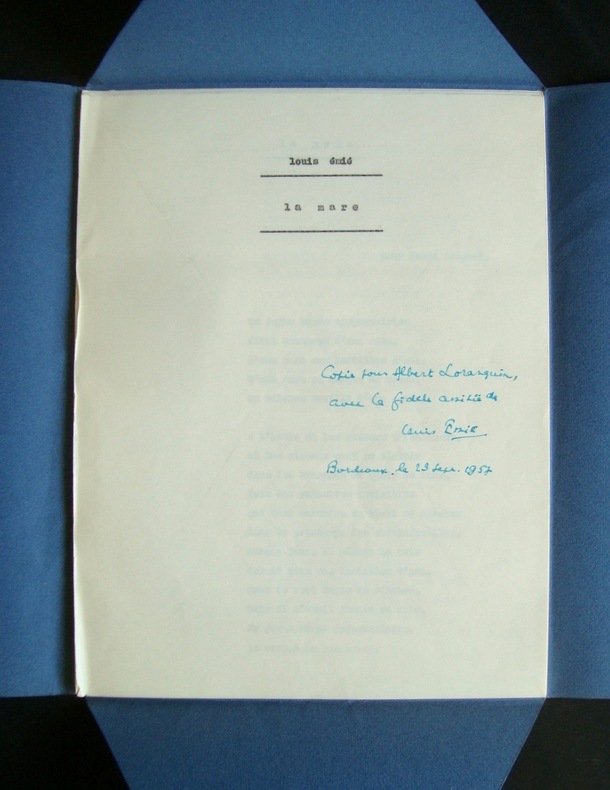
EMIE (Louis) -
La Mare -
Tapuscrit ronéoté sous chemise à rabats 20,5x27,5cm, titre et auteur manuscrit et collage de l'auteur sur le premier plat, comprenant 9 feuillets sur vélin d'Angoulême, avec un envoi autographe signé et daté du 29 septembre 1957 - bon état -
Bookseller reference : 39648
|
|
|
EMIE (Louis) -
Plaintes -
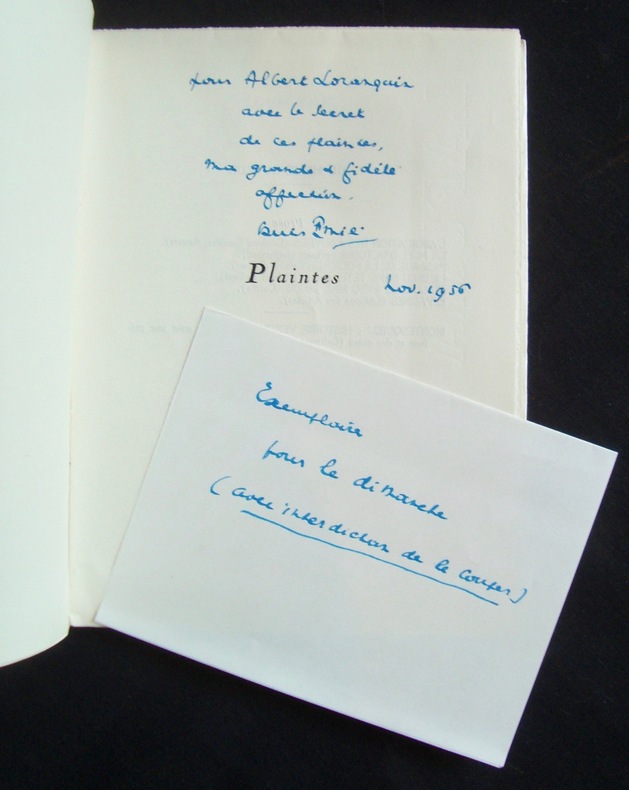
Rodez : Subervie ("Collection du miroir"), 1956 - un volume 14,2x19cm broché sous couverture à rabats, 75 pages non coupées - un des douze exemplaires nominatifs sur papier pur fil Lafuma - bon état - Bel envoi autographe signé de l'auteur adressé à Albert loranquin, critique au Bulletin des Lettres.
Bookseller reference : 39868
|
|
|
EMIE (Louis).
Romancero du profil perdu.
Paris Seghers, coll. "Poésie 51" 1951 1 vol. broché plaquette in-12, agrafée, couverture à rabats en couleurs sur fond crème, 31 pp. Edition originale. Envoi de l'auteur à G.-E. Clancier. Dos et couverture légèrement jaunis, sinon bon état.
Bookseller reference : 102036
|
|
|
EMIE (Louis).
Romancero du profil perdu.
Paris Seghers, coll. "Poésie 51" 1951 1 vol. broché plaquette in-12, agrafée, couverture à rabats en couleurs sur fond crème, 31 pp. Edition originale. Envoi de l'auteur à G.-E. Clancier. Dos et couverture légèrement jaunis, sinon bon état.
Bookseller reference : 102036
|
|
|
EMIE (Louis)]. AMOUROUX (Henri), LORANQUIN (Albert).
Louis Emié.
Paris Seghers, coll. "Poètes d'aujourd'hui" 1961 1 vol. broché in-16, broché, couverture illustrée d'un portrait, 221 pp., planches hors-texte (couverture un peu défraîchie). Exemplaire du service de presse avec un envoi autographe signé d'Albert Loranquin et Henri Amouroux "à François Mauriac, en déférent hommage" et de Louis Emié "avec le souvenir fidèle de Louis Emié". Bon état.
Bookseller reference : 101414
|
|
|
EMIE (Louis)]. AMOUROUX (Henri), LORANQUIN (Albert).
Louis Emié.
Paris Seghers, coll. "Poètes d'aujourd'hui" 1961 1 vol. broché in-16, broché, couverture illustrée d'un portrait, 221 pp., planches hors-texte (couverture un peu défraîchie). Exemplaire du service de presse avec un envoi autographe signé d'Albert Loranquin et Henri Amouroux "à François Mauriac, en déférent hommage" et de Louis Emié "avec le souvenir fidèle de Louis Emié". Bon état.
Bookseller reference : 101414
|
|
|
EMIE Louis
HAUTS DESIRS SANS ABSENCE
1953 plaquette (booklet) petit in-octavo, dos et couverture rempliée crèmes illustrés (spine and the cover illustrated), envoi autographe manuscrit de l'Auteur sur la page de faux-titre (author's autograph on the half title page), sans illustration (no illustration), 43 pages, 1953 à Paris Pierre Seghers Editeur,
Bookseller reference : 6236
|
|
|
EMIE, Louis
Dialogues avec Max Jacob [ Livre dédicacé par Louis Emié - Avec une L.A.S. de l'auteur et une photo dédicacée de l'auteur, avec Minou Drouet et Jean-Louis Simian ]
1 vol. in-8 br., Buchet Chastel, Editions Correa, Paris, 1954, 263 pp. Bel ensemble réunissant l'exemplaire dédicacé par Louis Emié "pour toi, mon cher petit José, ces dialogues qui te livreront les grands secrets de ma jeunesse, avec ma grande affection", une photo réunissant 5 personnages dont Louis Emié, la toute jeune Minou Drouet, Jean-Louis Simian, datée du mercredi 18 juin 1957 et dédicacée par Louis Emié ("Quand minuit sonne à la pendule, En rêve, en dansant je poursuis, L'ombre de cette libellule, Que je crois être & que je suis"), et une belle lettre autographe signée de Louis Emié, rédigée en couleurs au crayon : "Il n'est jamais trop tard pour bien faire et je t'adresse mes voeux en couleurs. Quand au mauvais accueil, je demande des explications ; je ne vois pas ce que tu veux dire. Amicalement". Français

|
|
|
EMIE, Louis
Dialogues avec Max Jacob [ Livre dédicacé par Louis Emié - Avec une L.A.S. de l'auteur et une photo dédicacée de l'auteur, avec Minou Drouet et Jean-Louis Simian ]
1 vol. in-8 br., Buchet Chastel, Editions Correa, Paris, 1954, 263 pp.
Bookseller reference : 54676

|
|
|
EMIE, Louis
Invention de l'Amour [ Edition originale - Livre dédicacé par l'auteur ]
Un des 475 exemplaires sur vélin offset des Papeteries Navarre, 1 vol. in-8 br., collection du Volubilis, Yves Filhol, Villeneuve-sur-Lot, 1961, 114 pp. Bel envoi de Louis Emié "pour André Pourtet, ces invocations à une croix, avec celle de mon amitié". "Dans ce livre, où se déploient tous les leitmotivs successifs de son oeuvre, le poète récapitule la quête de son propre mystère et de son idéal de clarté et de pureté" (Catalogue de l'exposition Louis Emié, p. 49). Bon état (couv. lég. frottée) Français

|
|
|
EMIE, Louis
Invention de l'Amour [ Edition originale - Livre dédicacé par l'auteur ]
Un des 475 exemplaires sur vélin offset des Papeteries Navarre, 1 vol. in-8 br., collection du Volubilis, Yves Filhol, Villeneuve-sur-Lot, 1961, 114 pp.
Bookseller reference : 56210

|
|
|
EMIE, Louis
Trois Tombeaux. Max Jacob. Paul Valéry. Jean Cocteau [ Edition originale - Livre dédicacé par l'auteur ]
Un des 5 exemplaires sur pur chiffon du Moulin du Verger, numérotés de I à V (exemplaire n° IV signé par Louis Emié), 1 vol. in-4 br. sous jaquette imprimée en papier cristal, Les Editions de Pujols, 1964, 41 pp. Bon état (petits accrocs en jaquette) pour cet exemplaire du tirage de tête (avec deux Japon) dédicacé par Louis Emié "pour Michel Suffran, ce pélerinage dans le souvenir de trois grands poètes, fidèlement & anniversaire, Louis Emié novembre 1964". Suit un poème autographe : "Dieu ne donne le droit de vivre Qu'à celui qui peut en mourir Mais le même Ange le délivre De la mort qu'il sur conquérir Vendredi 11 octobre 1963 mort de Jean Cocteau". Français

|
|
|
EMIE, Louis
Trois Tombeaux. Max Jacob. Paul Valéry. Jean Cocteau [ Edition originale - Livre dédicacé par l'auteur ]
Un des 5 exemplaires sur pur chiffon du Moulin du Verger, numérotés de I à V (exemplaire n° IV signé par Louis Emié), 1 vol. in-4 br. sous jaquette imprimée en papier cristal, Les Editions de Pujols, 1964, 41 pp.
Bookseller reference : 56207

|
|
|
Emile ABRAHAM - [Paris 1833 - 1907] - Ecrivain français
Lettre autographe signée à "Cher Monsieur" - Paris le 9 octobre 1879 -
1 page in8 - bon état - En tête: Théatre de la Renaissance -
Bookseller reference : 35521
|
|
|
Emile ALGLAVE - [1842 - 1928] - Universitaire, publiciste et archiviste paleographe français
Lettre Autographe Signée à "Cher Monsieur" - Paris Auteuil - le 18 février 1879 -
1 page in8 - bon état - En tête: "Revue Politique et Littéraire - Revue Scientifique" dont Emile Alglave était le directeur -
Bookseller reference : 34929
|
|
|
Emile AUBRY
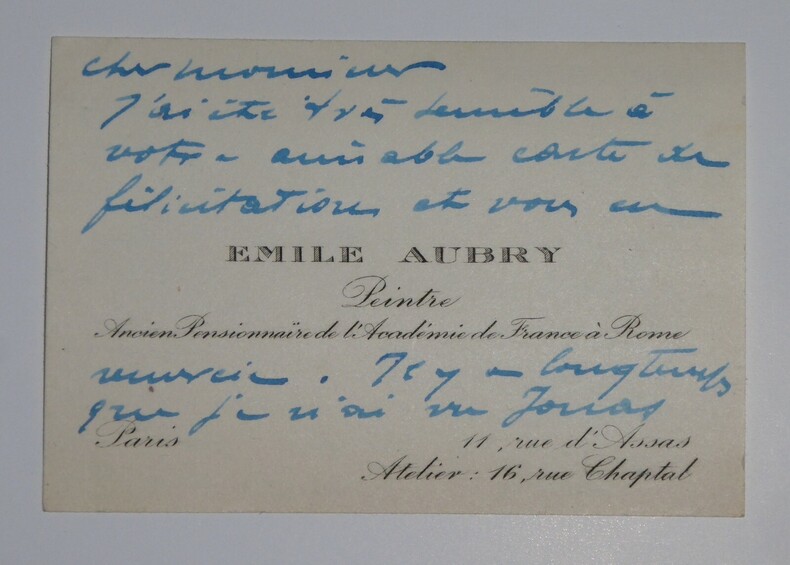
Carte de visite simple autographe - Académie de France à Rome
Emile AUBRY. Carte de visite simple, Paris. Dimensions : 8 x 5.5 cm. 1 page. Etat : Bon état de conservation.
Bookseller reference : boz_002681
|
|
|
Emile Augier
Emile AUGIER - LETTRE AUTOGRAPHE SIGNÉE
Emile AUGIER . Lettre autographe signée. Dimensions : 10,3 x 13,4 cm. État : Très bel état.
Bookseller reference : boz_004334

|
|
|
Emile Augier
Emile AUGIER - Lettre autographe signée de 4 pages à son enfant
Emile AUGIER. Lettre autographe signée de 4 pages à son enfant Poète. Dimensions : 10 x 13.1 cm. Nombre de pages : 4 pages.
Bookseller reference : boz_003902

|
|
|
Emile AUGIER
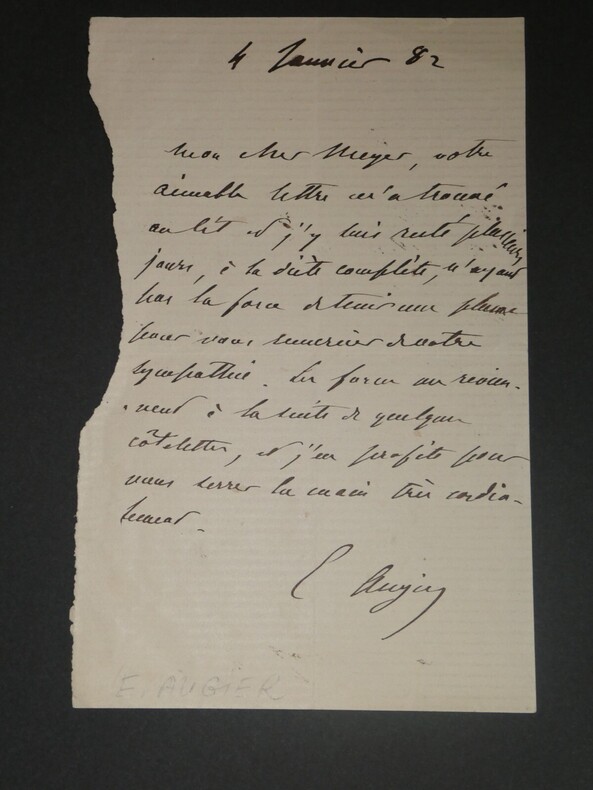
Emile AUGIER - LETTRE AUTOGRAPHE SIGNÉE À Monsieur MAYER en 1882
Emile AUGIER. Lettre autographe signée à monsieur MEYER en date du 4 janvier 1882 Dimensions : 10.6 x 16.7 cm État : Voir photos pour plus de détails. Nombre de pages : 1 page
Bookseller reference : boz_003538
|
|
|
Emile AUGIER
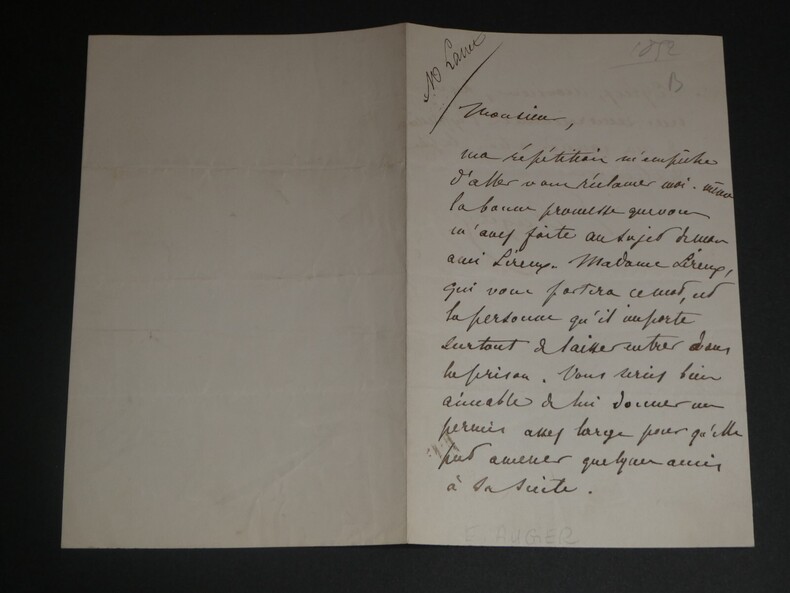
Emile AUGIER - LETTRE AUTOGRAPHE SIGNÉE, 2 pages, laissez-passer pour la prison
Emile AUGIER. Lettre autographe signée - 2 pages Poète Dimensions : 10.8 x 16.9 cm Nombre de pages : 2 pages
Bookseller reference : boz_002695
|
|
|
Emile Augier
Théatre complet de Emile Augier + LAS de l'auteur 1894-97.
Jolie série accompagnée d'une lettre autographe de l'auteur : " Monsieur, je serais fort heureux que cette stalle pour la 1ere représent. (tation) des éffrontés (..) vous rendit du plaisir que vous m'avez fait. Malheureusement une ... mais la plus belle fille...je ne le suis pas. " jolie série complet en 7 volumes in8, 180x100, reliés demi cuir, dos à nerfs, qq rousseurs, bel état intérieur. TI :504 pages :La Ciguë -Un Homme de bien - L'Aventurière - Gabrielle - Le joueur de flute - Sapho .TII, 466 pages :Philiberte - La jeunesse - Diane - Paul Forestier .TIII ,570 pages :Le gendre de M. Poirier -La pierre de touche - Ceinture dorée - Le mariage d'Olympe .TIV, 457 pages :Les lionnes pauvres - Un beau mariage - Les effrontés .TV,452 pages . Le fils de Giboyer - Le post-scriptum - L'habit vert - La contagion .TVI, 477 pages :Maitre Guérin - Lions et renards - Madame Caverlet .TVII et dernier, 428 pages :Jean de Thommeray - Les Fourchambault - Le prix Martin Paris Calmann Lévy 1894/1897 ref/192
Bookseller reference : CZC-12250

|
|
|
Emile Augier
Théatre complet de Emile Augier + LAS de l'auteur 1894-97.
Jolie série accompagnée d'une lettre autographe de l'auteur : " Monsieur, je serais fort heureux que cette stalle pour la 1ere représent. (tation) des éffrontés (..) vous rendit du plaisir que vous m'avez fait. Malheureusement une ... mais la plus belle fille...je ne le suis pas. " jolie série complet en 7 volumes in8, 180x100, reliés demi cuir, dos à nerfs, qq rousseurs, bel état intérieur. TI :504 pages :La Ciguë -Un Homme de bien - L'Aventurière - Gabrielle - Le joueur de flute - Sapho .TII, 466 pages :Philiberte - La jeunesse - Diane - Paul Forestier .TIII ,570 pages :Le gendre de M. Poirier -La pierre de touche - Ceinture dorée - Le mariage d'Olympe .TIV, 457 pages :Les lionnes pauvres - Un beau mariage - Les effrontés .TV,452 pages . Le fils de Giboyer - Le post-scriptum - L'habit vert - La contagion .TVI, 477 pages :Maitre Guérin - Lions et renards - Madame Caverlet .TVII et dernier, 428 pages :Jean de Thommeray - Les Fourchambault - Le prix Martin Paris Calmann Lévy 1894/1897 ref/192
Bookseller reference : CZC-12250
|
|
|
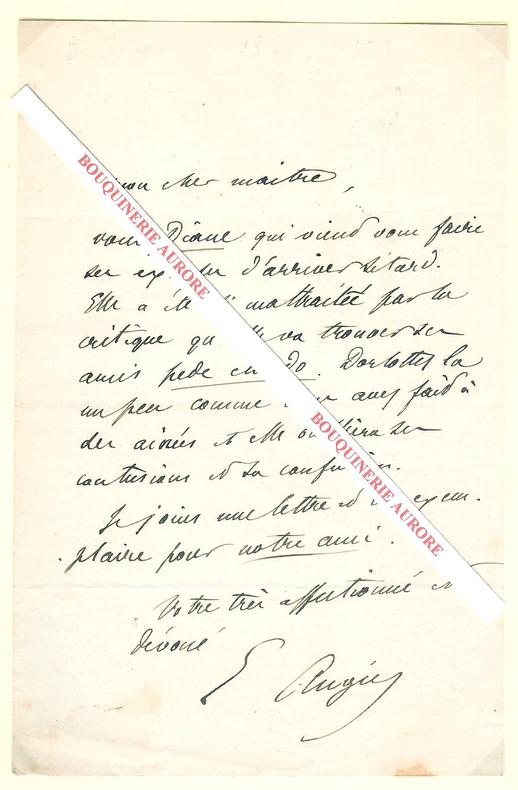
Emile AUGIER (1820-1889) - Poète et dramaturge français.
Lettre autographe signée d'Emile Augier, Poète et dramaturge français.
1 L.A.S. (200 x 130), 1 page. Très bon état.
Bookseller reference : 8479
|
|
|
Emile AUGIER - [Valence 1820 - Croissy-sur-Seine 1889] - Ecrivain français
Lettre autographe signée à "Cher Monsieur" - sd -
1 page in8 - bon état -
Bookseller reference : 35520
|
|
|
Emile Auguste WERY - [Reims 1868 - Paris 1935] - Peintre français
Manuscrit autographe signé "A propos de la peinture décorative" - Paris le 14 septembre 1923 - avec une lettre autographe signée d'accompagnement -
5 pages in4 et 1 page in4 -bon état -
Bookseller reference : 35135
|
|
|
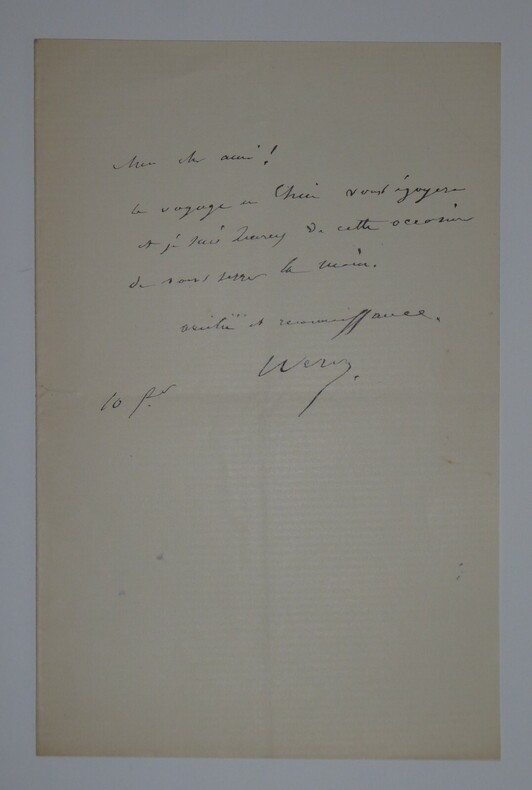
Emile Auguste Wéry
LETTRE AUTOGRAPHE SIGNÉE, ARTISTE PEINTRE
Emile Auguste WERY. Lettre autographe signée. Dimensions : 13.5 x 20.8 cm. 1 page. Etat : Bon état de conservation.
Bookseller reference : boz_005059
|
|
|
Emile BAES - [1879 - 1954] - Peintre belge
Lettre Autographe Signée à Fernand Demeure - Paris le 7 octobre 1950 -
1 page in4 - trés bon état -
Bookseller reference : 33134
|
|
|
Emile BAES - [1879 - 1954] - Peintre belge
Lettre Autographe Signée à Fernand Demeure - Paris sans date -
1 page in8 - trés bon état -
Bookseller reference : 33135
|
|
|
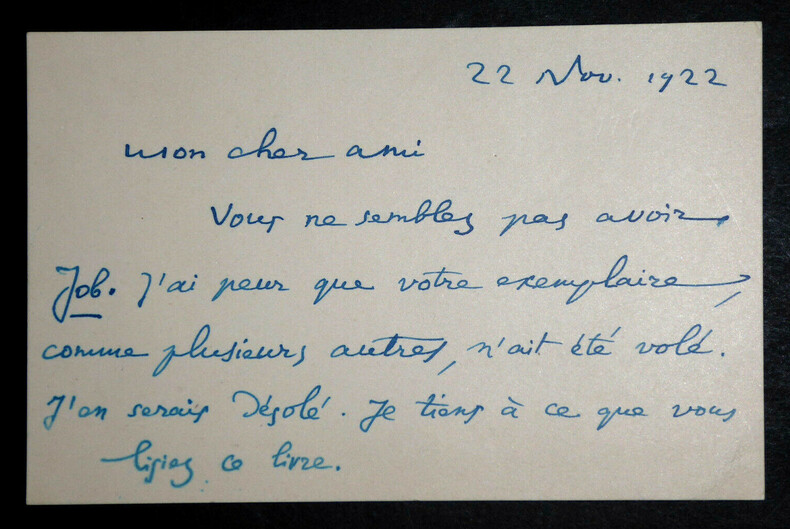
Emile Baumann
BAUMANN Emile - CARTE AUTOGRAPHE SIGNÉE À ARTUS Louis, 22 novembre 1922
Emile BAUMANN. Carte autographe signée adressée à Louis Artus. 22 novembre 1922. Dimensions : 14,1 x 9,1 cm, 2 pages. État : Bon état de conservation.
Bookseller reference : boz_002853
|
|
|
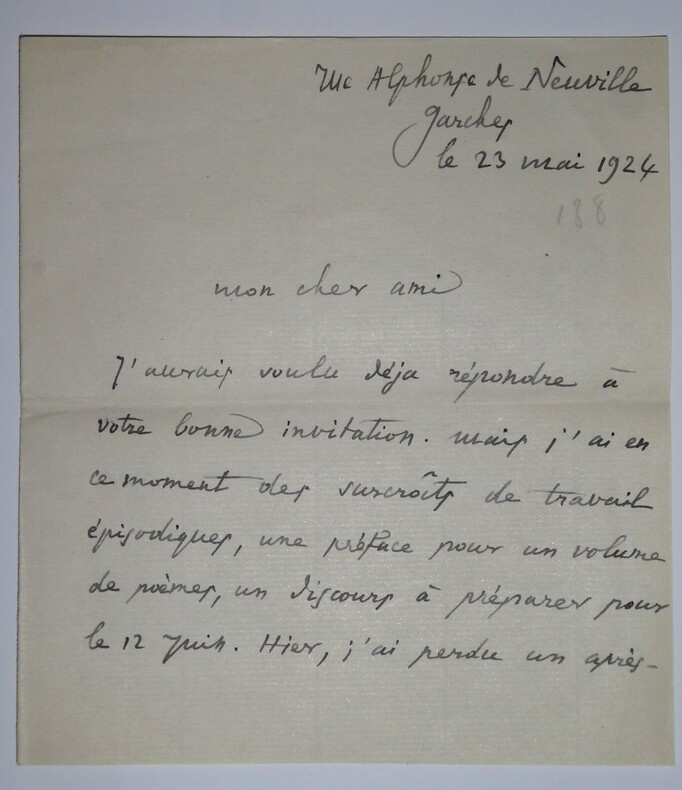
Emile Baumann
BAUMANN Emile - LETTRE AUTOGRAPHE SIGNÉE À Louis ARTUS, 1924
Emile BAUMANN. Lettre autographe signée et datée du 23 mai 1924. Enveloppe jointe. Lettre en deux pages adressée à Louis Artus, son "cher ami" afin de s'excuser de ne pouvoir répondre favorablement à son invitation car il a des "surcroîts de travail" au moment de la rédaction. Dimensions : 14 x 15.5 cm. 2 pages. Etat : Bon état. Enveloppe présentant des traces d'usure. Émile Baumann est un écrivain français d'inspiration catholique et nationaliste. Il faisait partie de la Renaissance catholique du XXᵉ siècle, dans la lignée de Léon Bloy dont il fut l'ami. Wikipédia Louis Charles Artus est un écrivain français, né le 10 janvier 1870 à Paris VIIIᵉ et mort le 11 mai 1960 à Paris VIᵉ. Wikipédia Envoi soigné dans un emballage rigide et étanche. Satisfait ou remboursé. Si vous n'êtes pas entièrement satisfait, je reprends la marchandise avec retour à ma charge pour l'Europe et à la charge de l'acheteur pour le reste du monde. N’hésitez pas à visiter ma boutique et affiner vos recherches en fonction des catégories qui vous intéressent. Ma boutique L'Art Délivré. Lettres autographes, vieux papiers, livres anciens, photographies, gravures, timbres… Nous expertisons et/ou rachetons dans toute la France vos lettres, collections de lettres et livres anciens. Merci de votre visite. Jérôme KAYSER.
Bookseller reference : boz_005797
|
|
|
Emile BAUMANN
BAUMANN Emile - LETTRE AUTOGRAPHE SIGNÉE À Louis ARTUS, 1923
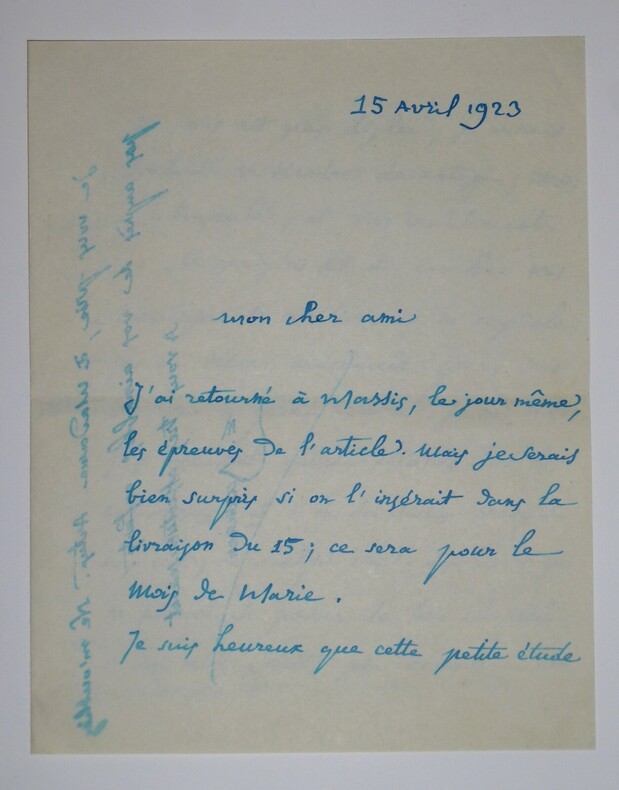
Emile BAUMANN. Lettre autographe signée et datée du 15 avril 1923. Lettre en deux pages (encre bleue) adressée à Louis Artus à propos des épreuves d'un article de journal. Il en profite pour mettre au clair et préciser quelques propos qu'il a tenu sur "le caractère aristocratique de vos livres". Dimensions : 15 x 19 cm. 2 pages. Etat : Bon état. Émile Baumann est un écrivain français d'inspiration catholique et nationaliste. Il faisait partie de la Renaissance catholique du XXᵉ siècle, dans la lignée de Léon Bloy dont il fut l'ami. Wikipédia Louis Charles Artus est un écrivain français, né le 10 janvier 1870 à Paris VIIIᵉ et mort le 11 mai 1960 à Paris VIᵉ. Wikipédia Envoi soigné dans un emballage rigide et étanche. Satisfait ou remboursé. Si vous n'êtes pas entièrement satisfait, je reprends la marchandise avec retour à ma charge pour l'Europe et à la charge de l'acheteur pour le reste du monde. N’hésitez pas à visiter ma boutique et affiner vos recherches en fonction des catégories qui vous intéressent. Ma boutique L'Art Délivré. Lettres autographes, vieux papiers, livres anciens, photographies, gravures, timbres… Nous expertisons et/ou rachetons dans toute la France vos lettres, collections de lettres et livres anciens. Merci de votre visite. Jérôme KAYSER.
Bookseller reference : boz_005871
|
|
|
Emile Baumann
Carte Lettre autographe Emile Baumann 2 aout 1929 Écrivain Français
L.A.S, format carte lettre 16x11,5cm, pliée en deux. parfait état signature bien lisible. Timbre. " 2 août 1929. Mon cher confrère, excusez mon erreur; je me demande comment j'ai pu la commettre. La dédicace du Bossuet que vous recevrez vous rendra votre exacte identité. Je vous réitère l'expression de ma gratitude et de ma dévouée sympathie. Emile Braumann " Émile Baumann (né à Lyon le 24 Novembre 1868 et mort à Vernègues le 24 Novembre 1941) est un écrivain Français d'inspiration catholique et nationaliste. Il faisait partie de la Renaissance catholique du xxe siècle, dans la lignée de Léon Bloy dont il fut l'ami. Baumann fut professeur au lycée de La Roche-sur-Yon de 1901 à 1909. Dès la parution de son premier roman il attira l'attention de Léon Bloy. Baumann était grand admirateur de Bloy, et le sera sa vie durant, écrivant plusieurs articles élogieux sur Bloy, et épousant la filleule de celui-ci à l'âge de 63 ans. Baumann écrira ensuite la biographie de son nouveau beau-père, le peintre Henry de Groux, livre dans lequel il sera souvent question de Bloy. En dehors de Bloy, il convient de mentionner Huysmans, Paul Bourget, Maurice Barrès, Jacques Maritain, et Hilaire Belloc comme écrivains catholiques ayant rapport avec Baumann. Il est souvent question de liturgie dans ses romans, comme la Messe de Communion (L'Immolé), le Mariage (La Fosse aux lions), la Confession (Le Fer sur l'Enclume), le Baptême (Le Baptême de Pauline Ardel), l'Extrême Onction (ibid.), la prise d'habit (ibid.), le De Profundis (L'Immolé), la Messe des Trépassés (Le Fer sur l'Enclume). En 1922, Baumann reçoit le prix Balzac pour Job le prédestiné, récompense qu'il partage avec Jean Giraudoux pour Siegfried et le Limousin. En 1931 Baumann épouse Élisabeth de Groux, fille du peintre belge Henry de Groux et filleule de Léon Bloy. Une rue de La Roche-sur-Yon porte son nom.
Bookseller reference : CZC-929

|
|

 Receive by email
 Download as PDF document
 RSS feed
 Permanent link


