|
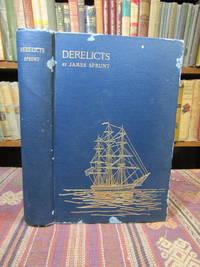
Sprunt, James
Derelicts an Account of Ships Lost at Sea in General Commercial Traffic and a Brief History of Blockade Runners Stranded Along the North Carolina Coast 1861-1865. SIGNED
Washington D.C.: The Lord Baltimore Press 1920. First Edition First Printing . Hardcover. Fair. 12mo - over 6¾ - 7¾" tall. 12mo. 304 pages indexed. Hardcover bound in original blue cloth with a front cover design of a three masted ship embossed in gilt. The binding is worn and shows heavy white spotting to the cloth. The inner hinges are secure but the frontis piece is detached and chipped about the edges. Text is toned. INSCRIBED on the front flyleaf "Mrs. Elizabeth A. Weeks / Presented by / Mr. James Sprunt / Wilmington N.C. / Jan. 1922." There are some notations on the front pastedown. Quite scarce. <br/> <br/> The Lord Baltimore Press hardcover
Referenz des Buchhändlers : 045483
|
|
|
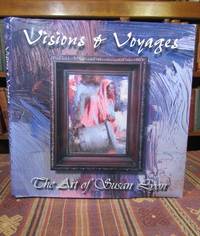
Lyon, Susan
Visions and Voyages: The Art of Susan Lyon SIGNED
Winston-Salem N. C.: Susan Lyon Studios 2008. First Edition First Printing . Hardcover. Very Good/Very Good. 4to - over 9¾ - 12" tall. Quarto. 139 pages. Hardcover with a purple pictorial dust jacket. Moderate rubbing and wear to the jacket as well as a distinct bend to the lower edge of the front cover. The book is sound and is mostly clean but there is some brown damp staining at the lower corner of the text block at the rear of the book. Illustrated in color throughout. INSCRIBED by the author / artist to a personal friend on the front flyleaf. Susan Lyon was born in Illinois but makes her home in rural North Carolina. The subjects of her painting are not North Carolina but often feature women from different cultures as well as still life and flowers. <br/> <br/> Susan Lyon Studios hardcover
Referenz des Buchhändlers : 047080 ISBN : 0615196365 9780615196367
|
|
|
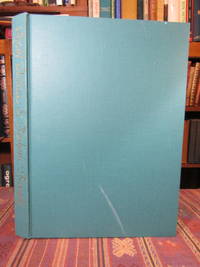
Anavian, Rahim; Anavian, George
Royal Persian and Kashmir Brocades
Kyoto Japan: Senshoku to Seikatsusha Publishing Co 1975. 1st Edition . Hardcover. Very Good/No Jacket. Folio - over 12 - 15" tall. Folio. 76 pages indexed 104 colour plates. Hardcover in green cloth. Binding has scuffs on front and rear covers. SIGNED by the author on the half title. Text is clean. Text is in English with Japanese translation on the facing page. <br/> <br/> Senshoku to Seikatsusha Publishing Co hardcover
Referenz des Buchhändlers : 047198
|
|
|
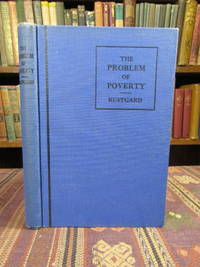
Rustgard, John
The Problem of Poverty. An Analysis of Popular and Prevailing Politico-Economic Policies. SIGNED BY SENATOR ROBERT GLASS
Minneapolis Minn.: Midwest Book Co. 1935. First Edition First Printing . Hardcover. Very Good/No Jacket. 12mo - over 6¾ - 7¾" tall. 12mo. 165 pages. Hardcover bound in blue cloth with lettering in black. Light to moderate rubbing and wear to the binding. A sound copy with secure inner hinges. Text is clean. A printed slip is pastedown onto the front flyleaf stating "Compliments of. " and then giving a host of business persons presidents and CEO's of 7 companies. SIGNED on the front flyleaf by "Senator Carter Glass." Carter Glass 1858-1946 was born in Lynchburg Virginia and was a U.S. Senator from Virginia 1920-1946. He was also the Secretary of the Treasury under Woodrow Wilson from 1918 to 1920 and helped establish the Federal Reserve. Carter Glass was a Democrat and John Rustgard was a Republican. <br/> <br/> Midwest Book Co. hardcover
Referenz des Buchhändlers : 047225
|
|
|
Crockett, S R
Sweetheart Travellers: A Child's Book for Children For Women And For Men
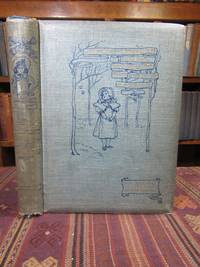
London: Wells Gardner Warton 1895. First Edition First Printing . Hardcover. Good/No Jacket. 4to - over 9¾ - 12" tall. Gordon Browne; W. H. Groome. Quarto. 310 pages. Scarce Limited Edition #127 / 150 Copies SIGNED by the author and by both artists. Hardcover in bluish-green cloth with cover designs in dark blue and lettering in gilt. The binding is rubbed and bumped. The spine is toned and has some scuff marks; the spine ends are a bit chipped. An attractive bookplate on front pastedown reads "Leonard James Shrubsall." Endpapers are foxed. There is a pencilled notation on the rear flyleaf. Text is toned has foxing throughout. <br/> <br/> Wells, Gardner, Warton hardcover
Referenz des Buchhändlers : 048006
|
|
|
Kunstler, Mort; Robertson, James I
Jackson & Lee: Legends in Gray SIGNED LIMITED EDITION #1180 oF 2000
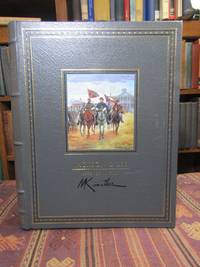
Norwalk CT: Easton Press 1995. Hardcover. Near Fine. 4to - over 9¾ - 12" tall. Quarto. 180 pages. Hardcover bound in full grey leather with a pictorial pastedown on the front cover. Raised spine bands. Minimal wear to the binding; there is a small blemish on the front cover. Silk moire endpapers and with a nice ribbon bookmark. Unused Easton Press bookplate is laid in loosely. This is #1180 of 2000 copies SIGNED by Mort Kunstler. Illustrated throughout. <br/> <br/> Easton Press hardcover
Referenz des Buchhändlers : 048325 ISBN : 1558533338 9781558533332
|
|
|
Strong, L A G
Dublin Days
Oxford: Basil Blackwell 1921. Soft cover. Fair. 12mo. 31 pages. SIGNED Softcover in green wrappers with title on white label pasted to front cover. Binding is worn. Some soiling to rear cover. Foxing to white label pastedown. There is a two inch split at headcap of spine. Text is foxed. Signed by the author on the inside of the front cover along with an inscription to Miss Joan Keigin along with two verses of handwritten poetry beneath the inscription. We're not sure if the poetry has been published but we can not find another copy of it and it does not appear printed in this volume. The first line reads "When I was as high as that." The second stanza mentioned J. M. Synge. Scarce. <br/> <br/> Basil Blackwell paperback
Referenz des Buchhändlers : 037038
|
|
|
Cheshire, Jos Blount (Bishop of North Carolina)
Milnor Jones Deacon and Missionary SIGNED BY JOS. BLUNT CHESHIRE
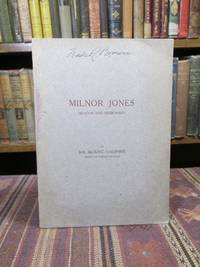
Raleigh: Mutual Publishing Company Printers 1920. First Edition First Printing . Soft cover. Very Good. 12mo. 84 pages. Soft cover bound in grey wrappers. Light wear to the binding. There is a brown splash mark on the spine. Illustrated with several photographs. Prior owner's name on the front cover is Wade R. Brown. INSCRIBED by the author to Brown on the recto of the frontis "Wade R. Brown from Jas. Blount Cheshire." Cheshire 1850-1932 was the Bishop of North Carolina for the Episcopal Church from 1893 to 1922. Wade R. Brown was the Dean of the music department at the State Normal and Industrial School now UNCG in Greensboro North Carolina and is the faculty member for whom the Brown Building is named. ~~ Milnor Jones was an itinerant Episcopal preacher from South Carolina who went to western North Carolina in the late 19th century to preach and establish churches in the remote mountain valleys. Along with Cheshire he helped re-establish and build a mission and church in Valle Crucis North Carolina near Boone. This volume contains an account of his work in South Carolina as well as in the NC counties of Watauga Mitchell and Ashe. Chapter 5 pages 54 to 66 is on the Valle Crucis Mission. Illustrated with several photos. <br/> <br/> Mutual Publishing Company, Printers paperback
Referenz des Buchhändlers : 037397
|
|
|
Moore, J Staunton
A Trans-Atlantic Itinerary
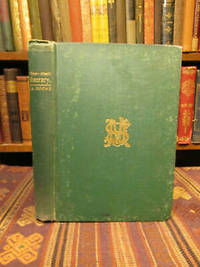
Richmond: Dispatch Printing House 1901. 1st Edition . Hardcover. Very Good. 8vo. 320 pages. SIGNED First edition hardcover in green cloth with gilt design on front cover and the title in gilt on the spine. Binding has considerable spotting. There is bumping at headcap/spine. Headcap has some fraying.There is a pencilled notation on the front flyleaf by previous owner. An inscription has been written on the front flyleaf by the author "'The Times' with compliments of the writer". Some pencilled marks in text which is lightly toned with occasional small toned spots. Josiah Staunton Moore 1843-1913 was a Private in Company B of the 15th Virginia Regiment in the Civil War. He was captured at Five Forks on April 1 1865. He made his life in Richmond Virginia and he was the author of "History of Henrico Parish adn St. John's Church." The travel in the book is European. <br/> <br/> Dispatch Printing House hardcover
Referenz des Buchhändlers : 038198
|
|
|
Merritt, Edwin A
Recollections 1828-1911
Albany NY: J.B. Lyon Company 1911. 1st Edition . Soft cover. Good. 8vo. 188 pages. SIGNED first edition softcover of flexible brown leather. Covers are rubbed at edges with wear on the spine. Foot of spine shows small tear. A newspaper clipping of General Merritt's death has been placed loosely in the front of the book. Author has SIGNED the back of the frontispiece. Text is toned but sound. <br/> <br/> J.B. Lyon Company paperback
Referenz des Buchhändlers : 029178
|
|
|
Cohen, Norman R
Don't Cry Foul Just Strike Them Out; Competing Globally and Winning.
New York: EVOKE 2010. First Edition First Printing . Hardcover. Near Fine/Very Good. 8vo. 208 pages. Hardcover with a black and tan dust jacket. Light wear to the book and jacket. INSCRIBED by the author on the title page. <br/> <br/> EVOKE hardcover
Referenz des Buchhändlers : 028925 ISBN : 0692011862 9780692011867
|
|
|
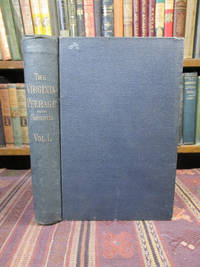
Craighill, Robt T
The Virginia Peerage; or Sketches of Virginians Distinguished in Virginia's History. Volume I All Published SIGNED
Richmond: William Ellis Jones Steam Book and Job Printer 1880. First Edition First Printing . Hardcover. Fair/No Jacket. 8vo. vi 356 pages. Hardcover bound in original brown publisher's cloth. The binding is worn and shaken and the inner hinges are cracked and holding by the cords. The book would benefit from being recased. The text is generally clean. INSCRIBED by the author on the front pastedown: "Hon. B. Johnson Barbour / With Compliments of / Rob. T. Craighill / May 23rd 1882." Contains essays on George Washington Patrick Henry Thomas Jefferson John Marshall and John Randolph of Roanoke. Rare. <br/> <br/> William Ellis Jones, Steam Book and Job Printer hardcover
Referenz des Buchhändlers : 041949
|
|
|
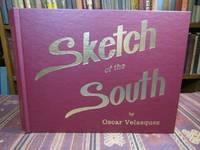
Velasquez, Oscar
Sketch of the South: Volume I
Abbeville SC: Erskine College 1986. 1st Edition . Hardcover. Near Fine/No Jacket. 4to - over 9¾ - 12" tall. Oblong Quarto. Unpaginated. INSCRIBED by the author on the front flyleaf. Hardcover in red cloth with title in gilt on front cover and spine. Binding has light wear. Illustrations throughout. <br/> <br/> Erskine College hardcover
Referenz des Buchhändlers : 048641
|
|
|
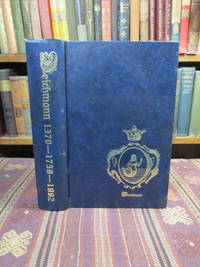
Deichmann, William B
Deichmann 1370-1758-1982
Miami Fla.: The Author 1981. Hardcover. Very Good. 8vo. 532 pages. Blue hardcover. The binding shows moderate rubbing and wear with a little surface soiling. The interior is sound and clean. INSCRIBED by the author as Bill and dated 1984 Miami Fla on the dedication page. <br/> <br/> The Author hardcover
Referenz des Buchhändlers : 032676
|
|
|
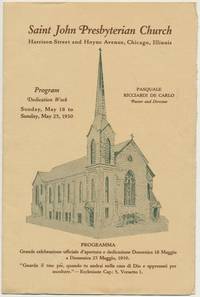
DeCARLO, Pasquale Ricciardi (1863-1947)
Signed Program
Paperback. This Roman Catholic-turned-Presbyterian clergyman emigrated to America from Italy in 1888 and was soon named evangelical pastor of The Presbyterian Institutional Church where he became influential in converting New England Italians to Presbyterianism and was named to the high office of Superintendent of the Presbytery; in 1914 he moved to Chicago where he became pastor and director of the noted Saint John Presbyterian Church. Signed Program titled "Saint John Presbyterian Church. Program Dedication Week" small 4to 6" X 9¼" stiff pictorial wrappers Chicago Illinois 1930 May 18-25. Very good. Quit minor edgewear but overall tight and attractive. Handsome 12-page program for the dedication and opening of this new church. On the large margin beneath an oval frontispiece head-and-shoulders portrait of DeCarlo he signs in full large and bold in black fountain pen. Most of program consists of special services throughout the dedication week. Quite attractive and unusual. paperback
Referenz des Buchhändlers : 22369
|
|
|
NESBITT, Lowell (1933-93)
Signed First Day Cover
American artist often associated with the American Realist school perhaps best known for enormous sensual paintings of various flowers. Signed First Day Cover 6½" X 3½" cancelled in Fort Valley Georgia on 23 April 1981 and with "First Day of Issue" boldly stamped. Group of four 18-cent Nesbitt-designed stamp at upper right "Rose USA" "Camelia USA" "Dahlia USA" and "Lily USA". Fine. No decorative cachet at left; no distracting recipient's name/address. Near the center at bottom Nesbitt signs large and bold in blue fineline. Small portion of original transmittal envelope also present. unknown
Referenz des Buchhändlers : 25841

|
|
|
Pyle, Howard
Signature and Sketch of a Man :
Fine. 32mo stiff card <br/><br/> unknown
Referenz des Buchhändlers : 4608
|
|
|
HERBERT**, JAMES:
THE GHOSTS OF SLEATH. Author SIGNED copy.
<p>UK8vo HBdw/djauthor SIGNED1st edn. FINE/FINE. No owner inscrptn but author's hand-writtenink signature to foot of title page and no price-clip to dw/dj.Colour illustrated dw/dj by Bill Gregorysimulating a distressedantique book with embossed borders and simulated part-oxidised giltembossed letters to upper wrap and spine/backstripwith minimal shelf-wear and negligible creases to edges - no nickstears or splits present.Topfore-edges bright and generally clean; contents brighttight and near pristine.Brown paper-covered boards with author's gilt initials to upper board's bottomright-hand corner and brightblocked gilt letters to spine/backstrip with clean immaculatebrownwhite map illustrated endpapers.Bottom rear corner minimally bumped with reciprocal creasing.UK 8voHBdw/djauthor SIGNED1st edn9-408pp includes half-titletitle pages41 chapters and 4pp blanks to rear. Sleath. Quietpeaceful.A small village hidden away in the Chiltern Hillsalmost forgotten by the modern world.Nothing much seems to happen here little disturbs the centuries-old tranquility.Until the ghosts begin to appear.And frighteningly bizarre events start to occur. Psychic investigator David Asha man burdened by the dark secret of his own pastis sent to Sleath to investigate the phenomena and his discoveries there drive him to the very edge of his own sanity.The incidents grow worse untilin the final night of horrorawesome and malign forces are unleashed in a supernatural storm that threatens to consume the village itself. For Sleath is not what it seems.And the dead have returned for a reason.Layer by layerJames Herbert skilfully unveils Sleath's deadly secrets building to a finale that is breathtakingly horrific in its intensity.'The Ghosts of Sleath' lays claim to being Herbert's finest work yet then 1994 and will thrill millions of readers who are familiar with his stories.See also rja2083 for another SIGNED copy and rja122rja386rja526rja529 rja530and rjaz1289 and rja2096 - rja2100 inclusive for other James Herbert titles. Please contact seller @ rpaxtonden@blueyonder.co.uk because of the value of this itemfor correctinsured shipping/Pp quotes - particularly ALL overseas buyers - BEFORE ordering through the order page! <br />N.B. ALL buyers please notestocks' actual shipping/Pp costs are adjusted and any difference is refundedafter order's receipt and before the order's despatchespecially if the items are offered either Pp included/FREE.<br /> N.B. US/Canada customers please be aware: Standard US AIRMAIL to these destinations can nowin some casescost more than the price of the book! If speed is not of the essence then Economy rate is recommended - at approx. anything from a 1/3rd to 1/2 of the standard US AIR quote/rate - sometimes arriving sooner than the 42 days - but not always. <br /><br /><br /></p> LONDON.HARPER COLLINS,1994. hardcover
Referenz des Buchhändlers : rja2095 ISBN : 0002242869 9780002242868

|
|
|
Patrick, Mary Mills
The Greek Sceptics
<p>NY: Columbia University. Very Good in Poor dust jacket. 1929. First Edition; First Printing. Hardcover. Slate Blue cloth gilt both bright.</p><p>Signed and inscribed ffep by the author "Miss Alice Morrow/From an admiring/friend/Mary Mills Patrick/New York City/October 12 1929."</p><p>Erratum slip bound in p215. Tattered unclipped 4.50 dj; 8vo; 339 pages; Signed by Author. bx133</p> Columbia University hardcover
Referenz des Buchhändlers : 4720bx123

|
|
|
McAVOY, May (1901-84)
Inscribed Photograph Signed
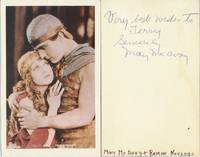
Popular silent star who co-starred with Al Jolson in "The Jazz Singer" 1927; ironically talking pictures put an end to her career. Color IPS verso 4" X 6¼" n.p. n.d. Very good. Book photograph a colorized still scene from "Ben Hur" 1925 showing her and Ramon Novarro embracing mounted to heavy white stock on the verso of which she inscribes "Very best wishes to / Terry / Sincerely / May McAvoy" in blue ballpoint. Uncommon. unknown
Referenz des Buchhändlers : 19076
|
|
|
Godfrey , Arthur
Autographed letter Arthur Godfrey
self 1969. Letter. Fine. No Binding. Signed by Authors. 2/14/1969 Hand written note from Arthur Godfrey thanking this person for the Honorary Membership. This note is on Godfrey letter head and comes with the original envelope . A scare hand written note for this legendary broadcaster & talk show host . Condition : Fine see the image . self unknown
Referenz des Buchhändlers : 081512-O

|
|
|
AUTOGRAPHS]. LEWY, Casimir, ALS A L S
A hand-written letter with envelop to author and philosopher Z. Jordan on Trinity College Cambridge letterhead and dated May 13th 1944. The letter is regarding a the typing of a paper written by Jordan in preparation for publication and is addressed to "10055 Cpl. Z. Jordan P.29 Polish Forces
Cambridge. A.L.S. May 13th 1944 1944. 17.5x 11cm 4p. post-marked envelop very good n12. ~ "I greatly hope that when this war is over we shall be able to see each other again & keep up our friendship." At the time of writing the letter Polish-born Casimir Lewy 1919-1991 was on the Faculty of Moral Science at Cambridge University 1943-1945. He became a Fellow of Trinity College in 1958 and the Casimir Library at Cambridge University is named after him. Z. Jordan is noted for his books "Karl Marx. Economic Class and Social Revolution" 1971 & "The Evolution of Dialectical Materialism" 1967 and "Philosophy and Ideology. The Development of Philosophy and Marxism-Leninism in Poland since the Second World War." The letter also includes laid-in a receipt from the Victoria League Club Edinburgh dated June 2 194 under the name "Jordan (Cambridge). A.L.S. May 13th, 1944 unknown
Referenz des Buchhändlers : 28641
|
|
|
[AUTOGRAPHS]. SAUNDERS, Marshall
Autograph Portrait Card of Saunders Signed
Private Post Card. 9x 14cm Photograph by G.H. Saunders. These cards maybe obtained from G.H. Saunders 62 Glengowan Road Toronto. Mar. 28 1933 1933. 11 manuscript lines initialed and signed on the verso under the portrait fine condtion. N12. - Margaret Marshall Saunders 1861-1947 born at Milton Nova Scotia. She became a successful author of fiction mostly stories for children about animals. These differed from the animal stories of Seton and Roberts in that they were about tame rather than wild animals. She published about twenty-five books the most famous was Beautiful Joe an autobiography of a dog a classic ran into many editions and was translated in several languages. Beautiful Joe & Black Beauty lead the way for a more human treatment of domestic animals. Private Post Card. 9x 14cm, Photograph by G.H. Saunders. (These cards maybe obtained from G.H. Saunders, 62 Glengowan Road, Toro unknown
Referenz des Buchhändlers : 25103
|
|
|
KORNER, Friedrich (1921-98)
Photograph Signed
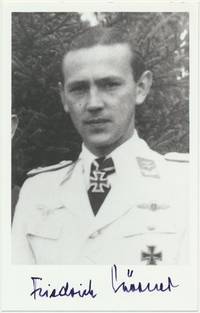
This German Luftwaffe ace downed 36 enemy aircraft and earned the Knight's Cross; he ranked as the seventh most successful ace in North Africa; he was captured late in the war and imprisoned in Canada until 1947. PS 3½" X 6 3/4" n.p. n.y. Fine. Modern high-quality black and white print of a WW2-era head-and-shoulders portrait of Korner wearing his Knight's Cross signed boldly by him later in life in black fineline across the blank lower margin. unknown
Referenz des Buchhändlers : 37975
|
|
|
KARCH, Fritz (1920-2001)
Autograph Letter Signed / Photograph Signed
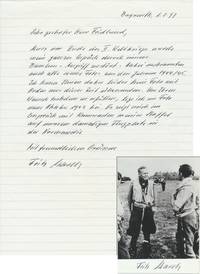
This German Luftwaffe fighter ace was the last group commander of the 2nd Jagdgeschwader II./JG2 and a Knight's Cross recipient downing 47 enemy aircraft many of them over the English Channel and in North Africa. ALS 1p 8¼" X 11" Bayreuth Germany 1 August 1997. Addressed to Gerry D. Fridlund. Fine. On lined stock Karch pens an American admirer in black ballpoint entirely in German. He notes that many of his things were destroyed in a bombing attack just before the end of World War Two and he lost all of his photographs from 1944 and 1945 and therefore can't fulfill his request for an image from this period; he encloses a photograph from October 1943 showing him conversing with officers from his unit at their air base in Normandy. Boldly signed. The photograph is included being a modern high quality print 3½" X 5". On the blank lower margin Karch signs boldly. Also present is the original mailing envelope addressed in Karch's hand and signed by him again on the verso along with his home address. unknown
Referenz des Buchhändlers : 37961
|
|
|
ANDRIEUX, Jacques (1917-2005)
Photograph Signed
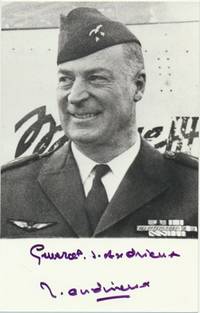
This French fighter ace served with the 130th Squadron and later the 91st Squadron of the Royal Air Force downing six enemy aircraft with several more possible victories. PS 3½" X 5½" n.p. n.y. Fine. Handsome head-and-shoulders portrait of Andrieux in uniform in later years with his typical "double signature" "Generces. J. Andrieux / J. Andrieux". In addition on the verso he pens the names of four titles he received: "Croix de le liberation / Legion d Honneur. / DFC. & Bar / Silver Star." "DFC" = Distinguished Flying Cross. A wonderful example. unknown
Referenz des Buchhändlers : 38068
|
|
|
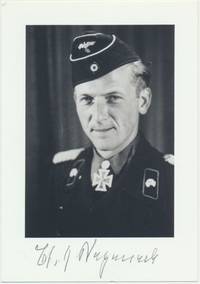
KAGENECK, Clemens-Heinrich Graf von (1913-2005)
Photograph Signed
This much-decorated Knight's Cross recipient was a major in the German army during World War Two and as commander of Panzer-Abteilung 503 he took part in the invasion of Poland the battle of France and other important engagements. PS 3½" X 5" n.p. n.y. Fine. Modern reproduction of a WW2-era head-and-shoulders closeup of Kageneck in uniform wearing his Knight's Cross signed boldly by him in black ballpoint on the blank lower margin. Uncommon. unknown
Referenz des Buchhändlers : 38058
|
|
|
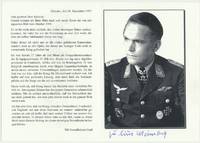
MEIMBERG, Julius (1917-2012)
Typed Letter Signed
This Knight's Cross recipient was a Luftwaffe ace who scored all of his victories on the Western Front -- 54 downed enemy aircraft in more than 250 combat missions. TLS in German heavy stock 8¼" X 5 3/4" Munster Germany 24 September 1997. Addressed to M.K. Schmidt. Near fine. On a correspondence card the right side of which bears a 3½" X 5" reproduction of a well-known WW2-era head-and-shoulders portrait of Meimberg in uniform wearing his Knight's Cross Meimberg writes to an American admirer. Below his portrait on the right side Meimberg signs boldly in blue ink. With original envelope. Though a small format letter accomplished later in life the content is exceptional and being typed alongside a likeness of Meimberg in his prime the presentation is superb. Meimberg offers "reminiscences about a time that lay more than a half century behind us." He mentions musing about fallen comrades offers some serious thoughts about his thinking as group commander of the II Jagdeschwader 53 Pik-As group when he was 27 years old "At the time it was clear to me that the war for Germany was lost. I hoped for a political solution." and remarks how he knows today that war is always the result of failed politics. He bemoans the fate of his generation but is pleased that a war among European nations is unthinkable today and that other peoples might learn from their history. A touching and provocative letter. unknown
Referenz des Buchhändlers : 38059
|
|
|
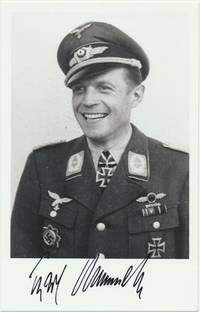
RAMMELT, Karl (1914-2009)
Photograph Signed
This German Luftwaffe fighter ace recipient of the Knight's Cross served in the Eastern front and the defense of the Reich participating in 450 combat missions and downing 46 enemy aircraft. PS 3 3/4" X 5 3/4" n.p. n.y. Fine. A high quality modern black and white print of a head-and-shoulders portrait of a smiling young Rammelt in uniform wearing his Knight's Cross signed boldly by him in black fineline on the blank lower margin. A choice example. unknown
Referenz des Buchhändlers : 37729
|
|
|
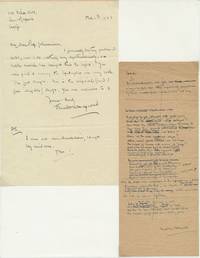
MAYNARD, Theodore (1890-1956)
Autograph Letter Signed / Autograph Manuscript Signed
English writer best known as an influential historian of Roman Catholicism in America on which topic he penned 27 volumes; also a poet and literary critic. Two items: First an ALS 1p 5" X 8" San Rafael CA 1923 March 11. Addressed to Albert Johannsen 1871-1962 a University of Chicago geology professor who authored "The House of Beadle and Adams and Its Dime and Nickel Novels" 1950 the definitive reference work and bibliography on the subject. Near fine. Cordial note to an admirer: "I generally destroy published mss. but I do nothing systematically & a little search has brought this to light. You will find it among the Epitaphs in my book 'The Last Knight. This is the original and I fear illegible draft. I am not an American except by residence." Boldly signed with an initialed postscript. Second the aforementioned draft an AMS 1p 3½" X 8¼" n.p. n.y. Very good. On cheap lightly but evenly age toned stock Maynard pens quite a few lines in his incredibly miniscule script many of his letters are a mere 1/8th" tall many 1/16ths" tall. Titled "Epitaphs" the first example goes "of a philanthropist who after a long & useful life was impartially praised even by those newspapers which he did not own." Some deletions additions and corrections throughout. Signed 1¼" long at the conclusion. Accompanied by Johannsen's original 8½" X 11" file folder bearing a printed "Collection of Albert Johannsen" label partly filled in by Johannsen. unknown
Referenz des Buchhändlers : 26745
|
|
|
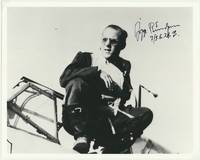
BURSCHGENS, Josef (1918-?0
Photograph Signed
This Luftwaffe ace downed ten enemy aircraft during World War Two and earned the Knight's Cross; he was captured later in the war and imprisoned. PS 10" X 8" n.p. n.y. Fine. High quality modern glossy black and white print of a WW2-era photograph of Burschgens crouched atop his plane's cockpit. In a light area at upper right he signs boldly in black fineline adding the military abbreviation "7/J.G.26S." 7 Jagdgeschwader 26 Schlageter. A great example signed later in life. unknown
Referenz des Buchhändlers : 37941
|
|
|
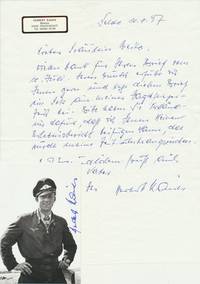
KAISER, Herbert (1916-2003)
Photograph Signed / Autograph Letter Signed
This much decorated Knight's Cross winning Luftwaffe ace participated in an extraordinary range of theatres during World War Two racking up 68 victories in an astonishing 1200 combat missions. ALS German 1p 8¼" X 11" Felde Germany 10 August 1997. Addressed to Linda Witham. Fine. Friendly letter to an American admirer in blue ballpoint thanking her and transmitting a signed photograph -- which is present 3½" X 5" a modern reproduction of a WW2-era black and white snapshot of a jaunty smiling Kaiser standing in uniform with hands on hips. Signed boldly horizontally in a light area at right in vivid blue ink. With original envelope addressed in Kaiser's hand. unknown
Referenz des Buchhändlers : 38066
|
|
|
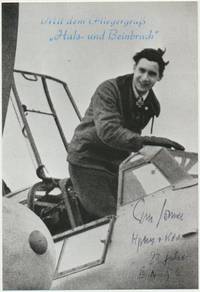
JOHNEN, Wilhelm (1921-2002)
Photograph Signed
This Knight's Cross-winning Luftwaffe ace was a night fighter recording 34 victories in more than 200 missions. PS 3½" X 5" n.p. n.y. Fine. Modern reproduction of a WW2-era black and white snapshot of Johnen in uniform and wearing his Knight's Cross emerging from his plane's cockpit. In a light area along the top he has rubberstamped in blue "Mit dem Fliegergruss / 'Hals- und Beinbruch'" With the flyer's greeting "break a leg" approximately and in a light area at lower right he signs and inscribes in black ballpoint: "Wm Johnen / Hpmn. & Kdr. / illegible / III.N.J.G. 6." With original envelope addressed in Johnen's hand. unknown
Referenz des Buchhändlers : 38061
|
|
|
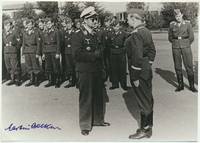
BECKER, Martin (1916-2006)
Photograph Signed
This Knight's Cross recipient was a German Luftwaffe night fighter ace who claimed 58 downed aircraft in 110 missions -- including a record-breaking 9 four-engine bombers downed the night of March 14-15 1945. PS 6¼" X 4½" n.p. n.y. Fine. Matte finish black and white reprint of a WW2-era candid shot showing Becker in uniform chatting with a soldier while a group of soldiers in the background watch -- signed boldly by him in black fineline in a light area at lower left. A superb example signed later in life. unknown
Referenz des Buchhändlers : 38323
|
|
|
BROWN, Harley L (1922-?) and KNOKE, Heinz (1921-93)
Signed Commemorative Envelope
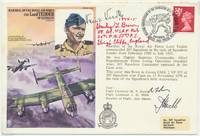
Brown was an American ace who downed six enemy aircraft in 57 missions in his P-51 Mustang; Knoke was a Knight's Cross recipient a German Luftwaffe ace who in more than 2000 missions claimed 33 downed aircraft and another 19 unconfirmed kills penning the 1953 Luftwaffe classic "I Flew for the Fuhrer." Signed Commemorative Envelope 6½" X 4¼" cancelled on the 60th anniversary of the Royal Air Force's 207 Squadron on 15 November 1976. Fine. Left half consists of a pictorial color cachet showing "Lancasters of No. 207 Squadron Northern France 1944" and inset portrait of "Marshall of the Royal Air Force the Lord Tedder of Glenguin" with text at right detailing the flight on which this envelope was flown which two of the crew have signed. Special postal cancellation. At top center Knoke signs boldly in black fineline. Beneath this Brown signs in red fineline adding "Lt. Col. USAF Ret / 20th F.G. 55th F.S. / King's Cliffe England." Limitation statement inkstamped on verso notes this is number 6 of 10 examples produced. unknown
Referenz des Buchhändlers : 38324
|
|
|
LAWLEY, William R (1920-99)
Signature / Unsigned Photograph
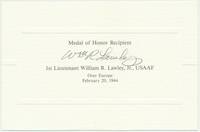
This officer with the USAAF's 364th Bomb Squadron was flying his B-17 Flying Fortress over Nazi-controlled Europe when it was attacked and disabled whereupon he ordered his crew to parachute to safety while he managed to fly the craft with two crew too injured to parachute to a crash landing in friendly territory -- for which he was awarded the Medal of Honor. Heavy stock printed "Medal of Honor Recipient" card 6" X 4" with his printed full name and rank and the date of his heroic act "Over Europe / February 20 1944". Above his name Lawley signs large and bold in pencil. Fine. This attractive card is accompanied by a heavy stock 8½" X 13½" unsigned reproduction of aviation artist J.G. Keck's head-and-shoulders portrait of a young Lawley in uniform. Fine. A superb pair. unknown
Referenz des Buchhändlers : 38964
|
|
|
Hooker, William Francis
THE PRAIRIE SCHOONER
Chicago: Saul Brothers 1918. First Edition. Original Cloth. Very Good. 156pp; full-color frontispiece 1 b&w plate 1 full-page sketch. Bound in pictorial green cloth gilt lettering cover illustration in black. 7.25" x 4.5" Inscribed on the front free-endpaper: "Presented to Nolie Dandridge by the author Wm. F. Hookersigned New York Sept. 9 1919." Decker 23:203 45:119 &c. Adams Six-Guns 1017. Saul Brothers unknown
Referenz des Buchhändlers : 038502

|
|
|
Mahn, Berthold
SOUVENIRS DU VIEUX-COLOMBIER: 55 Dessins Originaux precedes d'un texte de Jules Romains
Paris: Chez Claude Aveline 1926. First Edition. Original Wrappers. Very Good. pp: xxii 55 leaves illutrated on rectos only 7 index 3 publisher's ads colophon. Bound in stiff wrappers printed in red and black glassine dust jacket chipped at spine ends. 9" x 7.5" #35 of 35 copies on velin de rives for the author and editor this is a presentation copy with a four-line inscription inked on the half-title and signed by Berthold Mahn. Interesting aside: Mahn was a camouflage artist in World War I. Chez Claude Aveline unknown
Referenz des Buchhändlers : 038757

|
|
|
Genin, Thomas H
THE NAPOLEAD IN TWELVE BOOKS
St. Clairsville Ohio: Printed by Horton J. Howard 1833. First Edition. Full Calf. Good. 342pp with "Errors" at end. Bound in blind-tooled calf gilt spine rules and lettering sprinkled edges; corners scuffed front joint separated threads holding. 5.75" x 3.75" Presentation copy inscribed on the blank flyleaf: "Presented to Mrs. J.E. Breyer with Compliments of the Author / St. Clairsville O--- Feb 18th 1861." American Imprints 18967. Printed by Horton J. Howard unknown
Referenz des Buchhändlers : 039403

|
|
|
Boyd, Julian P
THE SCHEIDE LIBRARY: A Summary View of its History and its Outstanding Books together with an account of its two founders: William Taylor Scheide and John Hinsdale Scheide
Princeton NJ: Privately Printed 1947. First Edition. Hardcover. Very Good. pp: xv 172; 14 plates including frontispiece portrait. Bound in blue cloth and marbled boards gilt spine title. 7.5" x 4.75. Inscribed presentation copy: "For Harrison & Kitty Thomas / with all good wishes / Julian / Dec. 29th 1947." Boyd was Librarian of Princeton University at the time. Privately Printed hardcover
Referenz des Buchhändlers : 039709

|
|
|
Holden, Frank A
WAR MEMORIES.; With an introduction by Lucien Lamar Knight
Athens GA: Athens Book Co 1923. Second Edition. Pictorial Paper Covers. Very Good. 215pp; 10 plates from photographs. 7.5" x 5.5" Presentation copy inscribed on the front free-endpaper: "Presented to / Senator Peter Horbeck / by the author / Frank Attolda / Athens Ga. March 24 1924." The author served as 2nd Lieutenant in the 328th Infantry 82nd Division in World War I. Athens Book Co unknown
Referenz des Buchhändlers : 035290

|
|
|
WILLIAMS, George H (1823-1910)
Signature
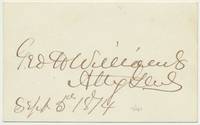
Though nominated for chief justice of the U.S. Supreme Court in 1873 an irregularity regarding election fraud kept this Territory of Oregon chief justice Grant's attorney general 1871-75 and Oregon senator 1865-71 from taking that office; ironically it was he and Lew Wallace who in 1876 examined the controversial Florida presidential vote siding with Hayes. Bold "Geo H Williams / Atty Genl / Sept 5th 1874" in brown fountain pen heavy stock 3½" X 2" n.d. Near fine. Mounting traces on verso. unknown
Referenz des Buchhändlers : 19318
|
|
|
FENN, George Manville (1831-1909)
Signature and Inscription
Prolific" doesn't even begin to describe this English novelist editor and journalist who penned a staggering number of juvenile novels -- more than 160 according to one count -- as well as plays short stories biographies anthologies and other writings. Signature and inscription on a 4¼" X 3 3/4" slip n.y. Very good. Small mounting trace on verso. Bold and sloppy "With many apologies / for my long delay / GM Fenn / Syon Lodge / Isleworth / England." Rather uncommon. Syon Lodge was Fenn's residence in Middlesex the county adjacent to London in which Fenn amassed a library of some 25000 volumes -- presumably some of them not penned by himself. unknown
Referenz des Buchhändlers : 40563

|
|
|
Gaines, Charles Kelsey
Gorgo. A Romance of Old Athens
<p>1940 presentation inscription from author to his cousin Barbara Claire Newell Menkel. Paper paste-on illus of lovely young lady looking down from circular window framed in gilt. Spine lightened top board splotchy illus VG. Frontis and 5 additional glossy b/w plates by George Varian. Endpapers heavy tanning. 2 edges untrimmed. 507 pages. 7 3/4" tall. Signed by Author.</p> Grosset & Dunlap hardcover
Referenz des Buchhändlers : 4797bx129

|
|
|
FRANCIS, Robert (1901-87)
Typed Manuscript Signed
This respected Amherst Massachusetts poet was a famously thrifty and eccentric New Englander called by Robert Frost America's most neglected poet; his first volume was "Stand With Me Here" 1936 and while he published few volumes his concise intense deeply personal verse gained him a loyal following. TMS on inner panel of a 6½" X 4½" heavy stock Christmas card n.p. n.y. Fine. Front glossy panel features color photograph of lit candles amidst sprigs of evergreen and poinsettias and "Season's Greetings" card against blue background; opening at top the lower inside panel displays a printed seasonal message in red while the blank upper panel features a greeting so carefully phrased it's not a stretch to consider it an unrhymed poem. Titled "For all the children in Mr. Bean's class" it reads: "Thank you thank you for your gifts -- the / Thanksgiving card and the Christmas card / the paperweight that you made and the stamps. / May Christmas bless you all. / With love" and boldly signed in black ballpoint. Most unusual one of a kind and quite attractive. Undated but likely of early 1980s vintage. unknown
Referenz des Buchhändlers : 41738

|
|
|
YARBOROUGH, Ralph
Sam Houston: Giant on a Postage Stamp
N.p.: The Encino Press 1971. Paperback. 8vo. Tan wrappers. 7pp. Illustration. Near fine. Christmas keepsake printed in a small quantity for distribution by Senator Yarborough 1903-96 Democratic senator from Texas who rode in the Dallas motorcade carrying President Kennedy in 1963 designed for him by Encino Press's founder William D. Wittliff better known these days as the screenwriter for "The Perfect Storm" and other films. The text consists of a speech that Yarborough gave at the unveiling of the Sam Houston five-cent commemorative stamp in where else Houston on 10 January 1964. On the front page he boldly signs and inscribes in in black fineline: "For Ralph Newman -- Who knows the many facets of Sam Houston -- and the Documents which come from each one -- May the Holidays Cheer you and 1972 improve your already enriched life" signed and dated December 1972. Ralph G. Newman 1912-2000 founded Chicago's noted Abraham Lincoln Book Shop and no doubt supplied Yarborough with Houston and other documents for his collection. With original stamped and cancelled envelope signed by Yarborough at upper left and addressed in his huge flamboyant hand. A choice presentation copy of a very uncommon Encino Press publication. The Encino Press paperback
Referenz des Buchhändlers : 40620

|
|
|
GISH, Lillian (1896-1993)
Typed Note Signed / Inscribed Photograph Signed
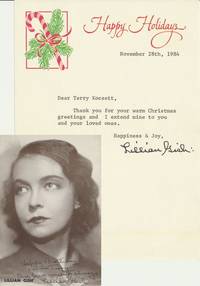
The First Lady of the Silent Screen" whose films ranged from silent classics such as "Birth of a Nation" 1915 to made-for-television dramas such as "The Whales of August" 1987. TNS 1p 5" X 7" n.p. 1984 November 28. Addressed to Terry Kocsett. Near fine. On colorful red and green candy cane and evergreen bough holiday stationery Gish sends Christmas greetings: "Thank you for your warm Christmas greetings and I extend mine to you and your loved ones." Boldly signed in black fineline. Also comes with an IPS 4" X 6" n.p. n.d. Fine. Lovely flat finish modern print of an early head-and-shoulders closeup inscribed near the bottom in black fineline: "Happy Birthday / Dear Terry / And fond wishes always / Lillian Gish. unknown
Referenz des Buchhändlers : 15616
|
|
|
W Reginald Bray, dealer in autographs, 8 Queen's Garth, Forest Hill, SE 23 [London], England: S E
W. Reginald Bray dealer in autographs Postcard signed with envelope to Philip Yale Drew American actor and suspected murderer.
Stamped 11 Nov. 1929. Printed postcard with manuscript additions minor defects. The printed heading describes him as ""The Autograph King. Unchallenged. Owner of the largest collection of Modern Autographs in the World" lists the Exhibitions at which he has displayed his stock and adds his address and a request to the recipient to write their autograph "Request Register No. 17861". The recipient of this was Philip Yale Drew who added "Young Buffalo" to his full clear signature on the reverse. In this same year 1929 Drew had been arrested as a suspect in the the murder of tobacconist Alfred Oliver. With the original envelope in which the card was returned addressed to Bray in Drew's hand. Note: I don't yet know the connection of Bonar Law with the Company. Stamped 11 Nov. 1929. unknown
Referenz des Buchhändlers : 5589
|
|
|
Horace Rayson Venables (b c1898) [AUTOGRAPHS; Montgomery of Alamein]: c 1
Horace Rayson Venables b. c.1898 AUTOGRAPHS; Montgomery of Alamein Autograph Letter Signed 'H. Rayson Venables' to Viscount Montgomery of Alamein.
3 June 1943; 28 Chalcot Square Regent's Park N.W.1 on cancelled letterhead of 44 Oakfield Court N.8. Four pages 12mo. Good on aged paper with one half-inch closed tear. Claims to be 'compiling an historic book . which has been left to the nation' and asks for his contribution. Provides a full-page list from the 'over 500 Autographs'. The collection 'could not be complete without' Montgomery's 'honoured name'. Asks for 'a few words as many others have done on the blank side so as to keep this for Gen Alexander & others who took part in your campaign'. Congratulates him on his 'brilliant Victory'. Nothing could better exemplify the tunnel-vision of the collector: at the time of writing Montgomery was in preparation for the Invasion of Sicily an operation which would result in 29000 casualties and 140000 prisoners of war. 3 June 1943; 28 Chalcot Square, Regent's Park, N.W.1, on cancelled letterhead of 44 Oakfield Court, N.8. unknown
Referenz des Buchhändlers : 5743
|
|
|
Prettyman, Barrett, Jr
Death and the Supreme Court
<p>Very Good- with no dust jacket. Trade Paperback. Inscribed by the author to novelist William Humphrey Ordways Spawning Run "For William Humphrey/ with the greatest admiration/ and respect from a would-be/ writer to a real one-/ Barrett Prettyman Jr./ November 1968/ Washington D. C." Moderate rubbing edge foxing. 311 pages. Signed by Author. 7 7/8" tall. bx 138</p> Harcourt, Brace & World paperback
Referenz des Buchhändlers : 5359bx14

|
|

 Per e-mail erhalten
 Als pdf-Dokument herunterladen
 RSS feed
 Permanenter link


