|
|
|
[German military manuscript].
Military treatises. No place, 1554-1562.
Folio (206 x 297 mm). Three parts written by two different hands on the same paper stock (watermark: hound with a collar). A total of 270 pp. including 5 full-page pen-and-ink illustrations, with geometrical footers to each page. Later half vellum over marbled boards (ca. 1900). A pretty composite manuscript of the mid-16th century, in the main following closely or styled after the gunsmith manual repeatedly printed by Christian Egenolff between 1529 and 1597. The preface (14 pp., dated "1554" at the end) consists of "Eine lehr so Keiser Maximilian in seiner Jugent durch erfarne treffliche seine Kriegsräht zugestelt ist", an instructional work for Emperor Maximilian also found in Egenolff's book from its 1534 edition onward. This is followed by the first main section: "Büchssenmeysterei von Geschoß, Büchsen, Pülver Salpether und Fewerwergk &c eigentlich zuzurichten, Büchssenmeystern und Schützen zuwissen nötigk" (70 pp.), likewise directly taken over from Egenolff's compilation. The second part is a legal treatise (as in Egenolff's book, though with different content) discussing martial law, entitled "Gerichts Hendell unnd Cautele in malefich Hendelnn Schüldtrechten unnd gastrechten" (72 pp.). The third part is an extensive treatise on a soldier's duties and the oaths to be sworn by the various ranks ("Artickel darauff die Hauptleut [...] unnd gemeine knecht der Ro. Kay. Maj. unserm aller gnedigisten Herrnn gelobenn und schwerenn sollen S. K. M. zu dienen", 114 pp.), going substantially beyond its counterpart in Egenolff's handbook. This is written in a different hand and contains copious explanations as well as five full-page illustrations showing military equipment and devices in red and black ink (fiery arrows, "Wie man eine glüende Kugell inn Holtzwerck schiessen soll", etc.). At the end the manuscript contains an index, military multiplication tables, and legal addenda by various hands, dated 1562, with elaborate geometrical borders. - Provenance: bookplate of the English explorer, horseman, and big game hunter Col. J. Hamilton Leigh (1867-1944) of Stockport. Later in the collection of the collection of Thomas Fremantle, 3rd Baron Cottesloe (1862-1956), commander of the Territorial Army and president of the Society for Army History Research. Cf. Jähns 653 (Egenolff's manual, 1597 ed.).
|
|
|
[Gewey, Franz Karl] / Blumauer, Aloys.
Komische Gedichte über die Vorstädte Wiens [...] von Aloys Blumauer. [Wohl Wien, um bzw. bald nach 1812].
4 Teile in 2 Bdn. sowie 1 Bd. weiterer Gedichte. Dt. Handschrift auf Papier. (4), 81, (1); (2), 100 (recte: 104), (2) SS. 82; 122 SS. (2), 69 (statt 71), (3) SS. 8vo. Marmorierte Pappbände d. Zt. mit goldgepr. Rückenschildchen. Zeitgenössische Privatabschrift von Geweys populärer Wientopographie in Versform sowie eine Sammlung von Gedichten Blumauers. Mit dem vielzitierten Spottgedicht auf den Wienfluss, anspielend auf dessen Verschmutzung: "Was deine Nachbarn nicht im Hause dulten [!], / Das drängen sie dir schmählich auf, / Du wirst oft lästig, ohne dein Verschulden, / Und olivfärbig ist dein Lauf. / Zum Höllenflusse ganz dich umzustallten [!], / Vermaß sich dieser Frevler Lohn, / Du bist der Stix, der Phlegeton der Alten, / Ihr schwefelreicher Acheron [...]". - Geweys humoristische Gedichtsammlung erschien 1812 bei Geistinger in vier Heften; in Zusammenarbeit mit Carl Meisl veröffentlichte er 1824 die ergänzenden Hefte V und VI. Auf der Titelseite ist die Sammlung fälschlich Aloys Blumauer (1755-98) zugeschrieben, von dem nur die Gedichte im dritten Band tatsächlich stammen. Die Werke des Freimaurers und Aufklärers Blumauer waren zur Zeit der Anfertigung dieser Abschrift in sämtlichen habsburgischen Landen polizeilich verboten, weswegen eine Verbreitung in handschriftlicher Form nicht unüblich war. Umso mehr überrascht es, wenn hier auch die Gedichte des nicht verbotenen Gewey dem behördlich verpönten Blumauer zugeschrieben werden. - Aus dem 3. Band ein Blatt (SS. 69f.) herausgetrennt, daher von dem abschließenden Gedicht "Ich und Du" nur die letzte Strophe erhalten. Einbände berieben, an Ecken und Kanten stärker bestoßen. Papier stellenweise etwas gebräunt. Die Vorderspiegel mit handschriftlichen Bibliothekssignaturen des 19. Jahrhunderts.
|
|
|
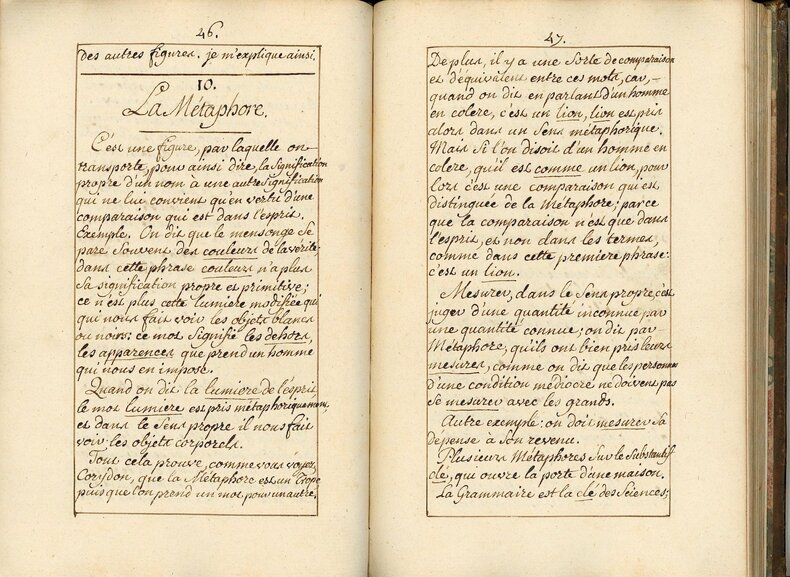
[GIRARD (Alphonse)]
Des tropes.
Dialogue entre deux bergers sur les tropes, figures de rhétorique. Sans lieu ni date [Montigny, vers 1760]. In-8 de (2) f., 89 pp., (3) ff. : veau marbré, dos à nerfs orné, pièce de titre de maroquin rouge, triple filet doré encadrant les plats, coupes filetées, tranches dorées sur marbrure (reliure de l’époque).
Bookseller reference : 53
|
|
|
[GIONO Jean]. COLONNA Etienne.-
L'Oeuvre de Jean Giono.-
Tapuscrits de 1974 et 1975. 3 volumes in-f°(200 x 297mm) brochés, soit un premier volume sans doute de premier jet, non corrigé (106 pages), un deuxième du même texte avec des corrections, des suppressions et des ajouts (106 pages), et un troisième contenant la version corrigée (130 pages). Volume de corrections un peu abîmé sinon très bon état. J'ignore si l'ouvrage a été édité.
Bookseller reference : ORD-12079
|
|
|
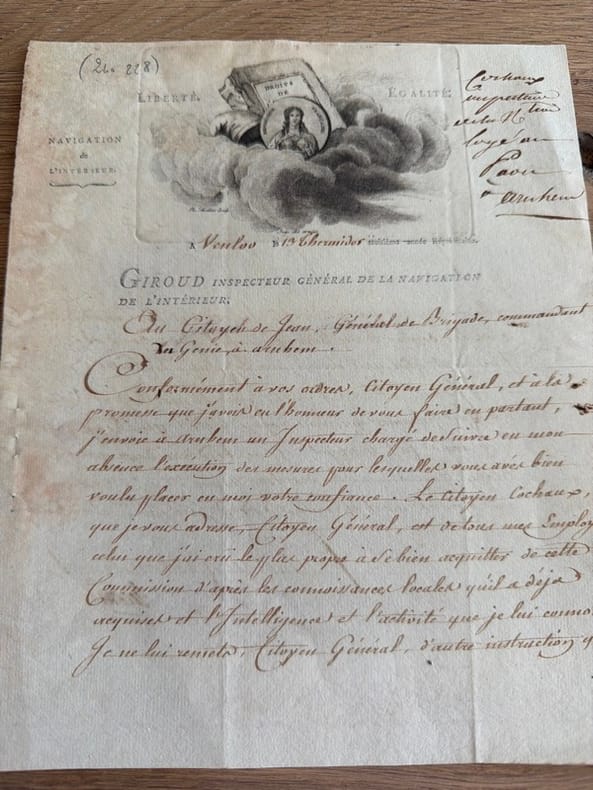
[GIROUD - MANUSCRIT]
Navigation de l'intérieur. Liberté. - Égalité. GIROUD, inspecteur général de la navigation de l'intérieur. au citoyen de Jean, général de brigade, commandant le Génie à Arnhem
Venloo [= Venlo, en Limbourg], 13 Thermidor an III (31 juillet 1795) in-8, [2] pp. n. ch., avec une belle vignette en-tête emblématique gravée par Ph. Maillart, en feuille.
Bookseller reference : 240228
|
|
|
[Gleyo, Jean-François, missionary (1734-1786).
Visions et revelations de Mr. Gleyo missionnaire en Chine. Pendant les huit années quil a eté en prison pour la cause de la religion, depuis l’an 1769 jusqu'en l’an 1777. [Probably France, ca. 1800].
Manuscript (brown ink) on paper. 2 vols. 8vo. (Title page), 445 (but: 444) pp. (Title page), 446-764 pp., 91, (2) pp. Bound in 18th-century vellum manuscript over boards. All edges red. A manuscript written in a single, unidentified hand during the last years of the 18th century, describing Gleyo's imprisonment in Ching-Tou, then Yuin-Tchang. - J.-F. Gleyo was born in Saint-Brieuc, the son of master mariner François Gleyo, and became a Priest of St. Sulpice. He sailed from Lorient to China in 1764, first arriving in Macao, where he learned Chinese and became associated with the evangelical work of the missionary Alary. In 1769 he was denounced and accused of links with the Pélén-Kiao rebels. Imprisoned and abused for several years, he owed his survival to his faith and mystical visions. He was released in 1777 after a Portuguese Jesuit mathematician intervened with the Emperor and resumed his apostolic labours. In his General History of the Foreign Missions, Launay states of Gleyo that "he recalls the great contemplatives, the most intrepid apostles, saints, and other confessors of the faith." The present manuscript recounts his encarceration and the consolations he received from heaven. It is sprinkled with Latin sentences and Chinese terms (especially in his letters written to Jean-Martin Moÿe after his release, included as a final section at the end of the second volume, with separate page numbers). The letters were published in the famous Jesuit collection of "Lettres édifiantes et curieuses". The original manuscript is kept in the Archives des Séminaires des Missions Étrangères, and a copy by various hands exists in the library of the Seminary of St. Sulpice; it is very likely that the present manuscript was copied from one of these sources. It is not listed in the catalogue of Manuscripts in the National Library and is thus of the utmost rarity. - Provenance: from the library of Jean R. Perrette with his bookplate on the pastedown.

|
|
|
[Gonzaga]. Ferdinand III, Emperor (1608-1657).
Manuscript on vellum signed. Kaiserebersdorf Castle near Vienna, 25 Aug. 1637.
Folio. Latin ms., ink on vellum. 156 unnumbered pp., 27 lines. Contemporary vellum binding with attractive giltstamped tendril border, fleuronnée corner stamps, gilt spine and two different giltstamped heraldic supralibros on the covers. All edges gilt. Inner margin shows two holes drilled through covers and interior for a decorative cord with the seal (now lost). Remains of ties. A collection of copies of Habsburgian documents relating to the Gonzaga family and the War of the Mantuan Succession, compiled by the Imperial Registry and signed by the Emperor, Ferdinand III. The ensemble, which comprises documents by Frederick III, Maximilian I, Charles V, Maximilian II, Rudolf II, Matthias, Ferdinand II, etc., was probably drawn up for Duke Ferrante III Gonzaga, Duke of Guastalla (1618-78), to record and secure his claims upon the Duchy of Mantua (claims which lay in the interest of the Imperial family), whereas the War of Succession had ended a few years previously with Mantua becoming part of the French sphere of influence. - The Gonzaga family had ruled Mantua since 1328; in 1530, Federico II Gonzaga assumed the title of a Duke of Mantua. Upon gaining control over the counties of Monferrato and Guastalla in the mid-16th century, the family reached their apogee of political, financial, and cultural importance. When Francesco IV Gonzaga died in 1612 without leaving a male successor, he was succeeded by his brothers Ferdinando and Vincenzo, both cardinals without children. Upon the death of Vincenzo II Gonzaga in 1627 the direct male line of the House of Gonzaga became extinct, causing a war of succession. Emperor Ferdinand II, husband of Eleanor Gonzaga, Vincenzo's sister, sought to re-attach the Duchy of Mantua to the Holy Roman Empire by transferring it to the Spanish-Imperial line of Gonzaga-Guastalla. This objective was opposed by the older line of Gonzaga of Nevers and Rethel, supported by France. The conflict ended when Sweden entered the Thirty Years' War and Ferdinand required his troops in the principal theatre of combat. The Duke of Nevers and Rethel became lord of the devastated and depopulated counties of Mantua and Monferrato, and France gained a foothold in Upper Italy. (Three quarters of a century later, however, the Imperial cause was to triumph after all: in 1708, the War of Spanish Succession re-attached Mantua to the Empire, while the Duke of Mantua and Monferrato sided with France.) - The present compilation is intended to document the legal succession of the House of Gonzaga-Guastalla on the basis of archival sources; this goal is underscored by the Imperial arms on the upper cover (double-headed eagle with quartered escutcheon showing the fesses of Gonzaga and the Bohemian lion, bordered by a tendril desgin enclosing the four evangelists) and Guastalla's lion rampant within a crowned shield on the back cover. The documents repeatedly invoke the feudal righty of the House of Gonzaga-Guastalla, especially in the areas of Castiglione delle Stiviere and Castel Goffredo: "Ad perpetuam rei memoriam recognoscimus, ac postum facimus tenore praesentium universis, quod cum nobis submissime exponendum curavit. Illustris Ferdinandus Gonsaga, Priceps Castilionis à Stiveriis, Consanguineus et Princeps Noster charissimus, quem ad modum maiores olim sui ab Augustissimis Romanorum Imperatoribus & Regibus Praedecessoribus Nostris sacratissime recordationis super Marchionatu Castilionis à Stiverys, & Castro Guiffredi cum omnibus suis pertinentys investiti. Pater verò suus quondam Franciscus Gonsaga de eodem Marchionatu Castilionis et permutatione Castri Giuffredi [...] Matthias Romanorum Imperator semper Augustus [...] agnoscimus & notum facimus tenore praesentium universis. Quod cum Illustris Franciscus Gonsaga Princeps Castilioni à Stiverys, consanguineus et princeps noster charissimus, demisse Nobis esponi curavit, non tantum Maiores suos, verum etiam se ipsum à Predecessoribus Nostris Divis Romanorum Imperatoribus & Regibus praeclarissimae memoriae de Marchionatu Castilioni à Stiverys, et de Castro, et Terra Castri Guiffredi cum omnibus suis pertinentys investium, alijsque insignibus privilegys ornatum fuisse [...]". Signed at the end by Emperor Ferdinand III, with counter-signatures by the Aulic Councillors Conrad Hiltprandt and Johann Walderode.

|
|
|
[GRAVURE] - CRASSILLER
5 personnages militaires.
S.l., s.e., s.d. (vers 1920) ; 160/330 mm, 1 pp., une feuille. Bon état.
Bookseller reference : A64
|
|
|
[GRAVURE] - ROUSSEAU
Au rapport!
S.l., s.e., s.d. (vers 1920) ; 315/240 mm, 1 pp., une feuille. Dessin. Bon état.
Bookseller reference : A71
|
|
|
[GRAVURE] - ANONYME
Cheval espagnol.
S.l., s.e., s.d. (vers 1900) ; 158/215 mm, 1 pp., dessin à la plume. Bon état.
Bookseller reference : A187
|
|
|
[GRAVELLE D’ARPENTIGNY]
Divers documents manuscrits du XVIIe siècle sur la famille Gravelle.
Contrat de mariage entre Jean de Gravelle, sieur d’Arpentigny, et Magdelaine de Constance. 28 janv. 1624, 2 pièces pap. gr. in-4, 16 et 19 pp. [Transcription jointe]. - Enregistrement des patentes accordant à Alexandre de Gravelle, sieur des Fourneaux, la garde noble des enfants mineurs de feu Baptiste le Tellier, et de Catherine de Gravelle, sa sœur. Lisieux, 12 mai 1635 ; belle pièce sur parch., in-fol., cachet, [Transcription jointe]. + 4 pièces diverses : Gravelle de Fontaine, etc.
Bookseller reference : 572046

|
|
|
[GRAVURE] - ANONYME
Enluminure en couleurs arabe sur papier calque. Forme géométrique ou architecturale.
S.l., s.e., s.d. (vers 1920) ; 255/220 mm, 1 pp., une feuille. Copie d'après un manuscrit ancien, Bon état.
Bookseller reference : A189
|
|
|
[GRAVURE] - ANONYME
Indien à cheval tenant une épée.
S.l., s.e., s.d. (vers 1920) ; 200/160 mm, 1 pp., dessin sur une planchette de bambous cousus comme un bois tissé. Bon état.
Bookseller reference : A191
|
|
|
[GRAVURE] - VAUDRECOURT
Paysage italien à la mine et au lavis. Vue d'une villa avec un arbre et un homme promenant son chien.
S.l., s.e., s.d. (vers 1900) ; 280/410 mm, 1 pp., une feuille. Signé de Vaudrecourt. Bon état.
Bookseller reference : A178
|
|
|
[GRAVURE] - VAUDRECOURT
Paysage d'une vallée à la mine.
S.l., s.e., s.d. (vers 1900) ; 305/395 mm, 1 pp., une feuille. Signé de Vaudrecourt. Bon état.
Bookseller reference : A177
|
|
|
[GRAVURE] - ANONYME
Porche d'entrée d'une villa italienne à la mine et au crayon.
S.l., s.e., s.d. (vers 1900) ; 360/280 mm, 1 pp., une feuille. Signé de Vaudrecourt. Bon état.
Bookseller reference : A179
|
|
|
[GRAVURE] - BROSSNERS (Pierre)
Portrait de militaire, à l'encre et au crayon bleu.
S.l., s.e., 1917 ; 200/155 mm, 1 pp., une feuille. Dessin signé Pierre Brossners? ou P.-B. Bon état.
Bookseller reference : A150
|
|
|
[GRAVURE] - ANONYME
Portrait d'homme aux lunettes rondes, au fusain noir et blanc.
S.l., s.e., s.d. (vers 1920) ; 315/240 mm, 1 pp., une feuille. Bon état.
Bookseller reference : A156
|
|
|
[GRAVURE] - PERANY
Projet ou reproduction d'affiche de la guerre 14-18. Prends-garde! Derrière ce billet l'espion se cache….
S.l., s.e., 1914 ; 325/250 mm, 1 pp., une feuille. Signé Perany. Bon état.
Bookseller reference : A151
|
|
|
[GRAVURE] - PERANY
Projet ou reproduction d'affiche de la guerre 14-18. Méfie-toi! Partout l'espion t'écoute.
S.l., s.e., 1914 ; 325/250 mm, 1 pp., une feuille. Signe Perany. Bon état.
Bookseller reference : A152
|
|
|
[GRAVURE CREUSE OU MATE SUR VERRE] auteur inconnu, graveur sur verre à Mery
RECUEIL DE 169 MODELES DE DECORS DE GRAVURES CREUSES OU MATES SUR VERRE - 1894
Mery 1894 -in-8 demi- percale un registre, reliure demi-percale bleu-roi (half hard-back percale) in-octavo (24,2 x 16,5 cm), RELIURE D'EPOQUE, dos long muet (spine without raised band), papier marbré aux plats frotté, toutes tranches lisses jaspées bleues, receuil d'images gravées en noir et blanc collées avec manuscrits à l'encre brune, le titre du dessin, le mode de gravure (creuse ou mate) et le type de verre ou ce dessin sera le mieux adapté ( Verres Brocs, Cabarets Henri II, Cabarets toutes formes, Chopes 6025, Chopes Bohème, Gobelet Bohème, Verres Jacques Coeur, Verres Nantais...etc...) avec un recapitulatif manuscrit à l'encre brune à la fin (sur 4 pages) avec la désignation des pièces (des différentes sortes de Verres) et les gravures s'appliquant sur ces pièces....123 pages, fait à Mery, le 1 Février 1894, signature illisible.
Bookseller reference : 22895
|
|
|
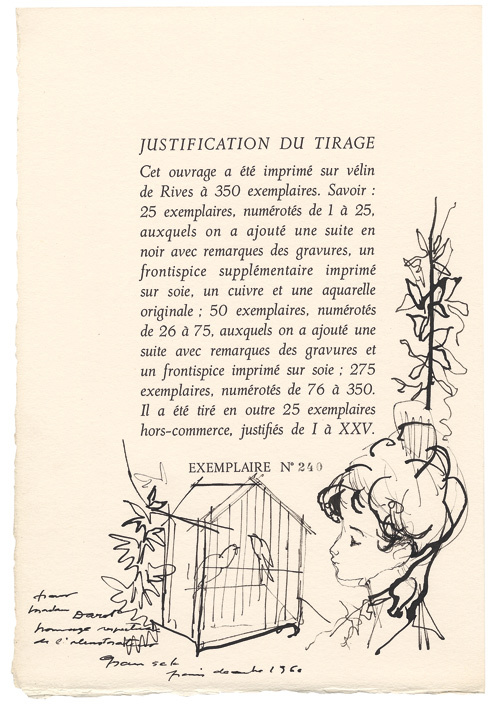
[Grau-Sala] Lorca (Frederico Garcia) :
Romancero Gitan. Gravures de Grau-Sala.
. Paris, Michel Lubineau, 1960 ; petit in-4 en feuilles sous couverture crème rempliée imprimée en rouge, gris et noir, chemise et étui de l'éditeur, titre doré en long ; 138, (4) pp., (2) ff. blancs, frontispice et 15 grandes compositions gravées à doubles pages en couleurs. Traduction de Jean Prévost, Jules Supervielle, Claude Cousson, Bernard Sesé et André Belamich.
Bookseller reference : 15362
|
|
|
[GRAVURE] - GALIPAUX
Tête d'homme.
S.l., s.e., s.d. (vers 1850) ; 130/110 mm, 1 pp., une feuille. Bon état.
Bookseller reference : A65
|
|
|
[GRAVURE] - ANONYME
Vue d'une ville à la mine, avec un arc entre deux bâtiments.
S.l., s.e., s.d. (vers 1900) ; 280/350 mm, 1 pp., une feuille. Bon état.
Bookseller reference : A180
|
|
|
[GRAVURE] - ANONYME
Cheval espagnol.
S.l., s.e., s.d. (vers 1900); 158/215 mm, 1 pp., dessin à la plume. Bon état.
|
|
|
[GRAVURE] - ANONYME
Enluminure en couleurs arabe sur papier calque. Forme géométrique ou architecturale.
S.l., s.e., s.d. (vers 1920); 255/220 mm, 1 pp., une feuille. Copie d'après un manuscrit ancien, Bon état.
|
|
|
[GRAVURE] - ANONYME
Indien à cheval tenant une épée.
S.l., s.e., s.d. (vers 1920); 200/160 mm, 1 pp., dessin sur une planchette de bambous cousus comme un bois tissé. Bon état.
|
|
|
[GRAVURE] - ANONYME
Porche d'entrée d'une villa italienne à la mine et au crayon.
S.l., s.e., s.d. (vers 1900); 360/280 mm, 1 pp., une feuille. Signé de Vaudrecourt. Bon état.
|
|
|
[GRAVURE] - ANONYME
Portrait d'homme aux lunettes rondes, au fusain noir et blanc.
S.l., s.e., s.d. (vers 1920); 315/240 mm, 1 pp., une feuille. Bon état.
|
|
|
[GRAVURE] - ANONYME
Vue d'une ville à la mine, avec un arc entre deux bâtiments.
S.l., s.e., s.d. (vers 1900); 280/350 mm, 1 pp., une feuille. Bon état.
|
|
|
[GRAVURE] - BROSSNERS (Pierre)
Portrait de militaire, à l'encre et au crayon bleu.
S.l., s.e., 1917; 200/155 mm, 1 pp., une feuille. Dessin signé Pierre Brossners ? ou P.-B. Bon état.
|
|
|
[GRAVURE] - CRASSILLER
5 personnages militaires.
S.l., s.e., s.d. (vers 1920); 160/330 mm, 1 pp., une feuille. Bon état.
|
|
|
[GRAVURE] - GALIPAUX
Tête d'homme.
S.l., s.e., s.d. (vers 1850); 130/110 mm, 1 pp., une feuille. Bon état.
|
|
|
[GRAVURE] - PERANY
Projet ou reproduction d'affiche de la guerre 14-18. Prends-garde ! Derrière ce billet l'espion se cache….
S.l., s.e., 1914; 325/250 mm, 1 pp., une feuille. Signé Perany. Bon état.
|
|
|
[GRAVURE] - PERANY
Projet ou reproduction d'affiche de la guerre 14-18. Méfie-toi ! Partout l'espion t'écoute.
S.l., s.e., 1914; 325/250 mm, 1 pp., une feuille. Signe Perany. Bon état.
|
|
|
[GRAVURE] - ROUSSEAU
Au rapport !
S.l., s.e., s.d. (vers 1920); 315/240 mm, 1 pp., une feuille. Dessin. Bon état.
|
|
|
[GRAVURE] - VAUDRECOURT
Paysage d'une vallée à la mine.
S.l., s.e., s.d. (vers 1900); 305/395 mm, 1 pp., une feuille. Signé de Vaudrecourt. Bon état.
|
|
|
[GRAVURE] - VAUDRECOURT
Paysage italien à la mine et au lavis. Vue d'une villa avec un arbre et un homme promenant son chien.
S.l., s.e., s.d. (vers 1900); 280/410 mm, 1 pp., une feuille. Signé de Vaudrecourt. Bon état.
|
|
|
[Gritti family chronicle].
Catastico priv[ato]. Arm[um] Gri[ti] MDCLXXII. - Libro di tutti li acquisti, et instromenti scritture appartinenti alla Casa Gritti, cioè di Piero Gritti fu dell’Alvise, fu dell dom[eni]co et come meglio dall’ ingiunto albero si vede 1672 in Venezia li 18 [settem]bre in S. Marcuola. Venice, ca. 1672.
Folio (240 x 355 mm). Italian and occasionally Latin manuscript by several hands, brown ink on paper. 198 numbered ff. With numerous, mostly full-page sketches, genealogical trees, and architectural drawings, some with touches of colour. Contemporary limp vellum with fore-edge flap, ruled in blind; handwritten title to spine and upper cover. Stored in modern half cloth box. Hitherto unknown, unpublished chronicle of the Gritti, a Venetian Doge family, containing a genealogy, account book, and lists of building projects from ca. 1566 to 1680. - The most famous representative of the family, which can be traced back as far as the 13th century, was probably Andrea Gritti (1455-1538), the 77th Doge of Venice. Their rise to fame and immense fortune is mostly due to the achievements of the ancestor of the very branch of the family commemorated here, namely Ludovico Alvise Gritti (1480-1534), who was closely involved in the fate of the city republic as a merchant, banker, and politician. Alvise Gritti had important trade connections throughout Ottoman Hungary and the Orient; as a minister under Sultan Suleyman I (1494-96) he worked in Istanbul, reporting directly to the Grand Vizier of the Ottoman Empire, Makbul Ibrahim Pascha (1493-1536). From 1530 to 1534 he served as Imperial Regent of Hungary. - The manuscript begins with an "arbor consanguinitatis" of the Gritti, starting in 1539 with Alvise's son Domenico Gritti di S. Marcuola and reaching as far as the fifth generation; additional descendants were pencilled in by later members of the family who inherited the volume and later consigned it to the trade. This is followed by numerous copies of relevant documents, often with a small sketch of the seal. Entries pertain to births and baptisms ("fede di Battesimo della Signora Sulpicia") with copies of the certificates, marriage documents ("copia del Sposalizio della Signora Orsetta Menegalla con il N. H. S. Antonio Gritti ... 3 Agosto 1623"), claims of ownership, purchases ("segue la nota dei beni", "divisione delli beni, et heredità ... dalla Signora Contessa Galeazzo"; "scriture per l'acquisto della casa in corte della calla"), gifts and bequests of moveables and immoveable properties as well as estates: "In Dei Eterni Nomine Amen. Anno ab Incarnatione D.N.J.C. 1675 in die xiii. die vero veneris 5. Aprilis. Patrone il S. H. E. Ottavian Gritti ... che qui sotto volerà esser referto de Sc[udi] 50 d'entrata annua perpetua sopra una casa posta in questa Città". Also mentions commissions for villas in Veneta awarded to important architects: "In Christi Nomine Amen. Anno 1543 12 Maji Gritti, Procurator d. Marei Ven., ... constitutus de D. ... Sansovino Architectus con sua fabbrica in Villa di Cessalto..., Villa Albarella...". Leaf 115v contains another family tree ("Vitturi") from Daniel to Domenico and Isabetta Gritti and onwards to the tenth generation. - Binding a little duststained, rubbed and bumped; vellum covers splitting along the edges. A large flaw to the upper cover as a result of the fastener for the flap's tie having been torn out. A unique survival.
|
|
|
[Grumbach, Wilhelm von, Franconian adventurer and knight (1503-1567)].
Wilhelm von Grumbachs fernere Handlungen wider die drey vereinte fränkische Stände [...]. Apparently Southern Germany or Austria, end of the 16th century (ca. 1600).
Folio (ca. 224 x 360 mm). German manuscript on paper. (44), 448 (but: 449), (1) pp., per extensum. Early 19th century marbled boards. Extensive, near-contemporary collection of sources on the so-called "Grumbach Feud", a conflict between Wilhelm von Grumbach and the Prince Bishop of Würzburg which came to a head with the 1558 murder of bishop Melchior Zobel von Giebelstadt and then blended into a scheme of Duke John Frederick II of Saxony to transfer the Saxon electorship to his own family's line with Grumbach's help. The extremely brutal quarrel ended with Grumbach's being drawn and quartered in the Gotha marketplace, while the Duke was imprisoned in Austria for the rest of his life. - The present manuscript treats the years 1563 to 1567, from Grumbach's capture of Würzburg to the capture of Gotha by Duke Augustus of Saxony and the subsequent execution of Grumbach and imprisonment in Wiener Neustadt of Duke John Frederick. The well-organized manuscript contains an extensive index at the beginning and boasts a wealth of document and correspondence copies. An important source collection for the history of a 16th century conflict with wide repercussions throughout the Empire. - Spine, edges and corners professionally repaired. Front flyleaf has a handwritten acquisition note by the Austrian nobleman Maximilian Baron Pilati-Thassul (1819-72), recording that he paid 24 guilders and 36 kreuzers for the book.
|
|
|
[GUIDE DE VOYAGE MANUSCRIT /MANUSCRIPT TRAVEL LOG].
Quelques notes sur PARIS. St Denis, Vincennes, EXCURSIONS, St Cloud, Versailles, Orléans.
SLND [France, 1843 [colophon]. 1843 1 vol in-12° (178 x 115 mm) de: 300 pp calligraphiées à l'encre brune, noire, rouge et or dans des encadrements tracés à l'encre bleue, têtes de chapitres ornés de compositions polychromes, 1 blason à l'aquarelle (p.20) et 1 dessin à l'encre représentant un aigle (p. 86). (légéres brunissures aux derniers feuillets). Demi-maroquin rouge à coins à grains longs d'époque, dos lisse orné et titré à l'or "Monumens de Paris", plats recouverts de papier à la colle rouge immitant le maroquin bordé d'un filet doré. (usures et défauts d'usage).
Bookseller reference : 6321
|
|
|
[Guignard, comte de Saint-Priest, François-Emmanuel, French diplomat (1735-1821)].
Mémoires sur l'ambassade de France en Turquie et sur le commerce des Français dans le Levant. No place, mid-19th century.
Small folio (243 x 301 mm). Ink scribal manuscript on paper. 373 (but: 376) pp. Sumptuous red half morocco with giltstamped spine title: "Mémoires (sur l’ambassade de France en Turquie et sur le commerce des Français dans le Levant) du Cte Emmanuel de St. Priest Ambassadeur et Pair de France 1735-1821. Revues et corrigées par le comte Alexis de Saint-Priest de l’Académie Française". Marbled endpapers. Highly interesting autobiographical account of Guignard de Saint-Priest, a French politician and diplomat during the Ancien Régime and French Revolution, and of his diplomatic career. Appointed ambassador to the Ottoman Empire in 1768, he remained in Constantinople until 1785, with a single brief interruption in 1776/78, and there married Wilhelmina von Ludolf. Roughly half of the manuscript covers these decisive years spent at the Ottoman court of Mustafa III and Abdul Hamid I, offering a history of French relations with the Porte, biographies of previous French ambassadors and envoys to Turkey, and a history of French commerce and navigation in the Levant. In spite of his long mission, Guignard clearly was not happy with his posting, complaining of the "faibles et ignorance da la Porte Ottomane", yet he shows a keen eye for detail as well as for the Ottoman Empire's manoeuverings within the broader context of European power politics. His famous portrait of Marie-Antoinette is found in chapter XIX of the manuscript (p. 271-291). His account continues as far as the year 1802, also including his time at the Russian court of Paul I and the last years of Catherine the Great, as well as his stay in Denmark and Norway. - Born in Grenoble, Guignard joined the army at the age of 15. After his mission to Constantinople he became secretary to the Royal household of Louis XVI and Minister of the Interior in Necker’s second cabinet in 1789. Later, he apparently served Russia as a spy at the Swedish court before accompanying the exiled court of Louis XVIII to Blankenburg and Mittau. - The manuscript's editor, Comte Alexis de Saint-Priest (1805-51), was the grandson of François-Emmanuel. His father was François-Emmanuel’s second son Armand-Emmanuel-Charles de Saint-Priest (1782-1863), also a diplomat who later became Governor of Poldolia and Odessa in Russia. After his return to Paris, Alexis moved in literary circles, became a member of the Académie Française, and is mentioned in the preface of the original edition of the "Mémoires" (Calmann-Lévy, 1929) by the baron de Barante. Alexis de Saint-Priest entrusted the manuscript to Prosper de Barante as the basis of a biography published in 1845. - At the beginning of the 19th century this manuscript was still in the hands of a descendant of Barante's, who was responsible for the publication. The present mid-19th century manuscript was probably copied from the original fair copy, as it contains pencil corrections in a different hand throughout and corresponds with important variants in the printed edition. - A single page repaired with tape, a small tear to another page not affecting the text, otherwise a fine and clean copy, splendidly bound. Cf. Hellwald, p. 282. Saint-Priest, Mémoires ... annotée par Nicolas Mietton (2006).
|
|
|
[Görner, Karl August, Schauspieler und Dramatiker (1806-1884)].
Ein glücklicher Familienvater, Lustspiel in 3 Acten v. Görner. Parthie: Clara. O. O., [um 1860].
Deutsche Handschrift auf Papier. 81 SS. auf 42 Bll. Blaue Interimsbroschur der Zeit. 4to. Die ausgezogene Rollenpartie der "Clara" (dazu in Bleistift vermerkt: "Gfn. Buttler") aus Görners 1854 in Berlin erschienenem Lustspiel "Ein glücklicher Familienvater" (als Bühnenmanuskript in der HAAB Weimar erhalten, Bm 1026) für eine nicht ermittelte Aufführung der Zeit. - Sauber und wohlerhalten.
|
|
|
[HAMBOURG]
Beau document manuscrit sur vélin, (33x29 cm), daté du 18 Avril 1709, avec en tête calligraphié, (texte en allemand).
"Les maire et magistrat de la ville de Hambourg confirment que Johann Säntel, bourgeois de Hambourg, déclare que le navire "Fortuna", dont Antoni Muncker est actuellement le capitaine, lui appartient comme propriétaire. Il prie de lui accorder les droits de l’article n° 3 de la confirmation accordée le 1 sept. 1647 par Sa Majesté le roi d’Espagne à toutes les villes de la Hanse". Belle pièce à l'écriture très lisible.
Bookseller reference : 578687

|
|
|
[HERBIER]
Flora Alpina
S. l. (Suisse ?) : s. n., s. d (vers 1860). « ELLE FLEURIT À CÔTÉ DE LA NEIGE FONDANTE »
Bookseller reference : 1281

|
|
|
[Hervé Claude] GUTH Paul - (Ossun 1910 - Ville d'Avray 1997) - Ecrivain français
Manuscrit autographe intitulé: "Le Désespoir des Singes par Hervé Claude (Flammarion)" -
1 page 1/5 in4 - râtures et corrections - trés bon état -
Bookseller reference : GF27055
|
|
|
[Herbarium]. Strail, Charles Antoine, theologian and botanist (1808-1893).
[Herbier]. Ière Partie. Magnée (Wallonia, Belgium), 1848.
4to (19 × 24 cm). 51 double leaves of dried plant specimens, mounted under narrow paper strips, carefully labelled and identified. (Includes:) The same. Autograph letter signed. Magnée, 18 June 1848. 8vo. 2 pp. To Mr. de Kessel. Stored loosely in contemporary marbled portfolio with heart-shaped cover label. This charming, well-preserved herbal, of whose "deux petits volumes" (as mentioned in the accompanying letter) only this present first one has survived, was compiled for the wife of Mr. de Kessel by the priest and amateur naturalist Charles Strail, a founding member of the "Société Royale de Botanique de Belgique". The plants, collected on a trip to Beaufays, are accompanied by detailed taxonomic information, such as Strail's following note on the baneberry specimen: "Le calice de cette plante tombe aussitot que sa fleur s'ouvre". Abbé Strail would later go on to publish a "Florule de Chaudfontaine et de Magnée" (1863) as well as a standard work on mints, for which he corresponded with like-minded scholars and enthusiasts throughout Europe, including members of the "Botanical Exchange Club of the British Isles". - Backing leaves slightly browned with a few short tears. Portfolio somewhat rubbed; letter wrinkled with edge tears (formerly mounted on the inside front cover, where the upper left corner with "Bath" stationery mark remains). Altogether a very well-preserved herbal, and a fine example of the 19th century's physico-theological enthusiasm for naturalism.
|
|
|
[HISTOIRE, MANUSCRIT, ENLUMINURE] - THOMAS (Marcel ) -
Histoire de la destuction de Troye la Grant.
Paris, Draeger, 1973 ; in-folio, cartonnage de l'éditeur.
Bookseller reference : 202101242
|
|
|
[HISTOIRE] - FAURE (Élie)
Lettre autographe signée à Dominique Braga.
S.l., s.e., 1929 ; in-folio, Avec l'enveloppe. Elie Faure est un historien de l'art né en 1873 et mort en 1937. Il est très reconnu dans le domaine de l'histoire de l'art. La plupart de ces ouvrages restent d'actualité encore aujourd'hui. Il était le neveu d'Elisée et de Elie Reclus et il eut Henri Bergson comme professeur de philosophie. Il fut également médecin et c'est en cette qualité qu'il rejoint le front en 1914. Bon état.
Bookseller reference : A2359
|
|
|
[Hindu Deities].
Illustrated compendium on Hindu deities. Bundi, Rajasthan, North-Western India, [ca. 1850-1870 CE].
Oblong 8vo (214 x 148 mm). Hindu manuscript on wove paper. 175 leaves, 9 lines of Devanagari script in black and red ink within double red rules at left and right. With 5 polychrome painted and gilt illustrations encclosed within black rules and bright red borders. Every chapter opening with a red ink invocation to Sri Ganesha, the Remover of Obstacles; outer borders of each page painted in light yellow, with marginal notes and index. Cardboard binding lined with silver thread-embroidered burgundy silk with floral motifs. Charmingly illustrated Indian manuscript compendium on the Hindu Deities. Includes various texts such as the list of 108 names of Lord Ganesha, the 11th Chapter of the Devi Mahatmya, a prayer to Lord Jagannath, Jagannathastakam, as well as further prayers. The vividly coloured illustrations feature Hindu and Vedic deities. - Binding rubbed and bumped; covers a bit loose. Provenance: private American collection and latterly in a private German collection.
|
|
|

 Receive by email
 Download as PDF document
 RSS feed
 Permanent link


