|
|
|
[BARJOLS]. GARCIN Isidore.-
Carnet de reçus XVIII°.-
Reçus de 1741 à 1793. In-12 (120 x 166mm) plein vélin à rabat, 59 pages de reçus signés par différents habitants de la commune et adressés pour la plupart à Isidore Garcin. Nombreuses écritures différentes plus ou moins lisibles. Etat d'usage.
Bookseller reference : ORD-777
|
|
|
[BARRIN]
Pièce manuscrite in-8 de 4 pp.
Etat des titres donné à M. d'Hozier. Signé Barrin [Achille Marc Barrin]. Paris, le 14 may 1770. Note de d'Hozier.
Bookseller reference : 596874
|
|
|
[BATAILLE (Georges)]. TRENTE (Louis)
Le Petit
Paris [Georges Hugnet] 1934 In-12 Broché
Bookseller reference : 013804
|
|
|
[BATZ - LE CROISIC] DU PLESSIS DE KERSALIOU, RECTEUR DES PAROISSES DE BATZ ET DU CROYSIC
EXTRAITS DES REGISTRES DES PAROISSES DE BATZ ET CROYSIC : EXTRAIT DE BAPTEME D'OLIVIER GUILLORÉ, FILS DE JEAN GUILLORÉ ET JEANNE LE MAUGUEN DU 30 JANVIER 1657, ET DE JEANNE GUILLORÉ DU 23 AOUT 1664 + EXTRAIT DE LA BENEDICTION NUPTIALE D'OLIVIER GUILLORÉ ET OLIVE GUELAS EN LA CHAPELLE ST NICOLAS DU POULIGUEN, LE 20 JUIN 1678 + EXTRAIT DE LA BÉNÉDICTION NUPTIALE DE JULIEN LEROY SIEUR DE POULEVRIENO DE LA PAROISSE D'HENNEBONT ET DE JEANNE GUILLORÉ FILLE DE JEAN GUILLORÉ SIEUR DE QUERLAN, LE 25 MAY 1682 + EXTRAIT DE DÉCES DE JEAN GUILLORÉ SIEUR DE QUERLAN DANS L'ÉGLISE DU CROYSIC, FAIT AU CROYSIC, LE 20 FEVRIER 1696,
le croisic 1696 un extrait des registres de baptemes, mariages et décès des Paroisses de Batz et Le Croysic , manuscrit à l'encre brune de 4 pages sur papier vergé crème, ligné et filigrané, format : 25 cm de haut par 19 cm de large, cachet fiscal en noir "BRETAGNE - 1 SOL" , FAIT AU CROYSIC, LE 20 FEVRIER 1696,, signé : LE RECTEUR DE BATZ ET DU CROYSIC : DU PLESSIS DE KERSALIOU,
Bookseller reference : 28744
|
|
|
[BATZ D'AURICE de] (Gascogne)
2 pièces manuscrites in-8.
- Lettre adressée à M. d'Hozier pour insertion dans l'Armorial général, 2 pp., cachet de cire armorié. Signé Natalie de Sèze, v(tesse) de Batz d'Aurice. - Réponse de M. d'Hozier, 1 p., Versailles, 16 août 1838.
Bookseller reference : 596879
|
|
|
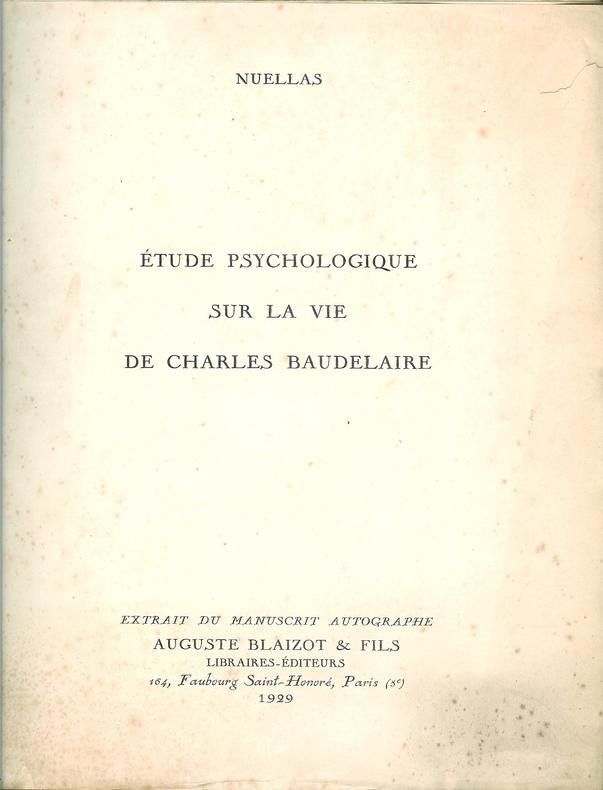
[BAUDELAIRE (Charles)] - NUELLAS (E.).
Etude psychologique sur la vie de Charles Baudelaire.
P., Auguste Blaizot & Fils, 1929, 1 plaquette in-4 (283 x 225) brochée, de 34 pp. Couverture poussièreuse et avec petites rousseurs, petite déchirure sans manque en couverture, bel exemplaire par ailleurs.
Bookseller reference : 8131
|
|
|
[BAZIGNAN de] (Gascogne)
Pièce manuscrite in-4.
Décharge pour cette famille. Texte de d'Hozier de Sérigny indiquant qu'il ne peut retenir la demande d'entrée aux Ecoles royales militaires. Signé d'Hozier de Sérigny. 11 Avril 1781.
Bookseller reference : 596882
|
|
|
[Beethoven, Ludwig van].
Grand Sonate pour le Piano-Forte composée par Louis van Beethoven oeuvre 28. O. O., nach 1802.
Notenmanuskript. Quer Folio (240 x 330 mm). 30 Bll. letzte Seite leer. 8 Doppelblätter in 2 Lagen, Fadenbindung, starke Bütte, handrastriert, 10-zeilig, die beiden letzten Seiten 8-zeilig. Zeitgenössische Abschrift des Op. 28, deren Vorlage Rätsel aufgibt: Ein Vergleich mit dem Autograph und dem Erstdruck (Bureau des Arts et d'Industrie, PN 28, Wien 1802) sowie mit Titelauflagen und frühen Nachdrucken (Autograph, Abschrift und Originalausgabe im Querformat, Simrock 240 [1802] und Zulehner 130 [ca. 1807] im Hochformat, Hummel 1321 [1805/1806] im Querformat) führt zu folgenden Resultaten: Das Manuskript hat einige Gemeinsamkeiten mit dem Erstdruck und dem Autograph, die es von späteren Drucken unterscheidet, die daher nicht als Vorlage in Frage kommen. Es gibt aber auch Gemeinsamkeiten mit dem Autograph, in denen sich dieses vom Erstdruck unterscheidet (!), sodass auch eine zwischenzeitliche Abschrift der Sonate aus dem Manuskript vor dem Erstdruck als Kopiervorlage in Frage kommen kann. - Eine mögliche Erklärung dafür wäre der verhältnismäßig lange Zeitraum zwischen Entstehung im Herbst 1801 und Veröffentlichung der Sonate im August 1802 aufgrund der personellen Veränderungen in der Gründungsphase des Verlages: 1. Gesellschaftsvertrag vom 1. 5. 1801 "Kunst- und Industrie-Comptoir" Kappeller und Holer. 2. Dem Gesuch zur Firmenprotokollierung vom 23. 10. 1801 legten die Verleger eine "Kontraktliste" bei, nach der sie bereits über eine Reihe von Kompositionen für die Veröffentlichung verfügten, darunter auch Beethovens Sonate Op. 28. 3. Die neue Firma wurde am 1. 5. 1802 protokolliert, 4. aber erst ab August 1802 die Musikalien des Verlages in der Wiener Zeitung (WZ) annonciert, wobei mit Beethovens Op. 28 (und der dazu passenden Verlags-/Plattennummer 28) ein öffentlichkeitswirksamer Paukenschlag gesetzt werden sollte: Beethovens Sonate wurde am 14.8.1802 (WZ 65) alleine vorgestellt, 4 Tage später folgte dann die Ankündigung der Werke von Krommer, Call, Albrechtsberger, Förster, Eberl, etc. mit den Verlagsnummern 1-30 (ohne die bereits vorgestellte VN 28, 18.8.1802, WZ 66, Weinmann, S. 220 f). - Gertsch/Prahia erwähnen im Vorwort zur Henle Urtext-Ausgabe (2008) zur Erklärung der ungewöhnlichen Zeitspanne zwischen Entstehung und Druck auch die - nicht belegbare - Hypothese, dass Beethoven "dem Widmungsträger Joseph Freiherr von Sonnenfels (1732-1817) auf die Sonate ein Exklusivrecht von einigen Monaten oder gar einem Jahr eingeräumt" hätte. - Das Papier ist nach Auskunft des Archivs der Gesellschaft der Musikfreunde für Wien um 1800 untypisch, und zeitlich nur grob auf die ersten beiden Jahrzehnte des 19. Jahrhunderts bestimmbar. - Etwas fingerfleckig, ansonsten sauber.
|
|
|
[BELGIQUE - MANUSCRIT.]
Navigation intérieure de la Belgique. Le Directeur-général de la navigation intérieure. au citoyen Lange, inspecteur de la navigation à Bruxelles
Paris, 20 Messidor an III (8 juillet 1795) in-8, [2] pp. n. ch., avec une belle vignette en-tête gravée par A. Cardon représentant un fleuve avec pont et écluse, en feuille.
Bookseller reference : 240227

|
|
|
[BELGIQUE - MANUSCRIT.]
République française. - Administration du département de l'Escaut. Extrait du registre aux arrêts de l'administration du département de l'Escaut.
S.l. [Anvers], 2 Floréal an IV (21 avril 1796) in-folio, [2] pp. n. ch., avec une vignette allégorique en-tête gravée, en feuille.
Bookseller reference : 240234

|
|
|
[BERNARD (Pierre-Frédéric) ?]
Catalogue des plantes indigènes à l'ancienne Principauté de Montb. et aux contrées qui l'avoisinent
Montbéliard : sans date (vers 1817). UNE ÉTUDE MANUSCRITE À SIX MAINS DE LA FLORE DE MONTBÉLIARD
Bookseller reference : 1353

|
|
|
[Bhagavadgita].
Miniature Bhagavad Gita manuscript. Probably Kashmir or Punjab / Northern India, ca. 1845 / mid-19th century CE.
Ca. 94 x 60 mm. Sanskrit manuscript on polished paper. 222 leaves, 5 lines of Devenagari script in black ink within red, orange, and black rules, some phrases picked out in red, some words gilt. With 14 charming miniature illustrations. Modern full black leather binding. A miniature Sanskrit devotional consisting of the complete text of the Bhagavadgita, the famous Hindu devotional poem. The text is written in black glossy ink with rubricated punctuation marks; significant words, such as chapter titles, are also written in red. The text is elegantly laid out with five lines per page enclosed within a black, orange and red rectangular border, surrounded by ample margins. The 18 fine miniatures in Pahari style, with opaque water-based pigments and gold, depict devotional scenes with a special emphasis on Krishna and show Lord Vishnu in his ten principal manifestations (Avatars). - The Bhagavad-Gita, considered one of the holy scriptures for Hinduism, is a 700-verse Hindu scripture that forms part of the epic Mahabharata. Dated to the second half of the first millennium BCE, it is a work typical of the Hindu synthesis. - A few very minor edge flaws near the end; the final page is annotated in English in a 19th century hand: "The mysterious Bhagavat-gita; a dialogue between Crishna and Arjuna, on the Knowledge of God, & the means of attaining reunion to the divine soul: in eighteen lectures extracted from the Mahábhárata, an epic poem". Provenance: private UK collection.
|
|
|
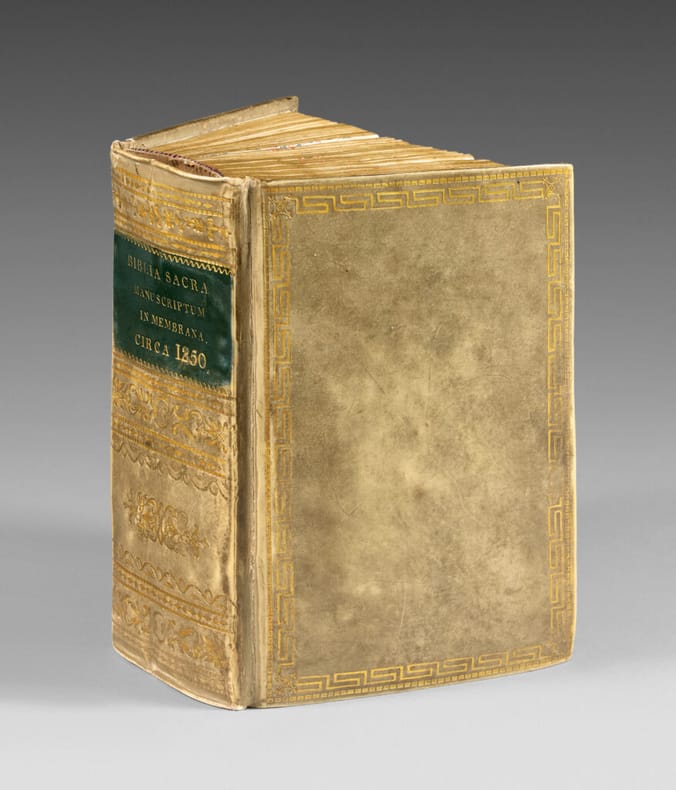
[BIBLE].
MANUSCRIT ENLUMINÉ SUR PEAU DE VÉLIN. Superbe manuscrit capétien de l’école de Paris.
Un chef-d’œuvre de l’enluminure capétienne orné de 78 miniatures d’une finesse exquise réalisé sous le règne de Saint Louis. Bible en latin, avec le Prologue attribué à St Jérôme et l’interprétation des noms hébreux. Nord de la France, probablement Paris, 1230-1250. In-12 de 1 + 658 ff.: 1-1524, 1620, 17-2224, 2310, 24-2524, 2617 (sans le f. blanc xviii), 2726, 2828, 295 (sans le f. blanc vi). Ainsi complet. Double colonne de 47 lignes écrites à l’encre brune dans une très fine écriture gothique. Justification: 92 x 60 mm. 78 initiales historiées. Cahiers numérotés en chiffres romains au pied des versos des derniers ff. et signatures au pied du coin inférieur du texte sur chaque recto de la première moitié d’un cahier, rubriques en rouge, initiales en rouge, lettres des titres courants et numéros des chapitres alternativement en rouge ou bleu, initiales des chapitres sur 2 lignes alternativement en rouge ou bleu avec un décor de la couleur opposée, initiales de 5 à 7 lignes au début des prologues du même type mais avec des décors des deux couleurs ouvrant les prologues, 78 initiales historiées, la plupart ornées de feuillage et de dragons, le prolongement de 29 d’entre elles formant des bordures décorant la marge, peintes en bleu, rose, orange-rouge et jaune (qq. trous de vers ds. le premier f., atteinte à qq. titres courants, dernier f. restauré ds. la marge extérieure). Vélin rigide du XIXe siècle, encadrement d’une roulette grecque dorée autour des plats, dos lisse orné, pièce de titre de maroquin vert, tranches dorées. 140 x 93 mm.
Bookseller reference : LCS-18358
|
|
|
[Biblia latina - NT - Epistulae Paulinae, Epistulae Catholicae, Apocalypsis]. - Petrus del Casta (scribe).
Pauline Epistles, Catholic Epistles and the Apocalypse, glossed. [Limoges, ca. 1100].
4to (220 x 155 mm). Decorated Latin manuscript on vellum. i + 168 + i ff. (collation: 1-38, 47 [of 8, lacking i], 58, 67 [of 8, lacking viii], 7-128, 136, 14-178, 186, 191, 204, 21-228), with modern foliation in pencil. Central column of 20 lines in a late Carolingian hand, surrounding and interlinear gloss on ff. 1-139 in a minute script; no gloss on ff. 139v-152v; gloss on ff. 153-168v in a mid-13th-century hand. Ruled space 156 x 65 mm, versal initials alternately red and blue, running headers and rubrics in red, spaces left for decorated initials, remains of a large decorated initial in characteristic Limoges style of interlaced celtic design including a dragon and two eagles’ heads on fol. 1. Modern Romanesque imitation binding of dark red goatskin over wooden boards. A superb example of Limoges Romanesque manuscript production of the first half of the 12th century, written by Petrus del Casta for the Augustinian Abbey of St-Jean-de-Côle, containing one of the earliest surviving texts of the Glossa Ordinaria. - Petrus del Casta is known from the colophon in a Homilies on Ezechiel (ex Phillipps no. 934/2708, then Chester Beatty W MS 18, sold at Sotheby’s, 3 Dec. 1968, lot 4, to Maggs; subsequently Abbey Sale, 20 June 1978, lot 2976) and has been associated with at least three other splendid manuscripts of the period: the spectacular Limoges Missal (Paris, BnF, Mss. Latin 9438); a Bible at the Bibliothèque Mazarine (lat. I and II); and the Bible of Saint-Yrieix (Bibliothèque municipale de Saint-Yrieix, Ms. 1). According to Danielle Gaborit-Chopin, he may also have been an illuminator (see D. Gaborit, "Deux bibles limousines du début du XII siècle", Bulletin de la Société nationale des Antiquaires de France, 1970, pp. 197f.). - The Glossa Ordinaria was one of the great achievements of the early 12th century: a combination of the scriptural text interwoven with patristic and mediaeval commentaries used by students and teachers until the end of the Middle Ages, originally compiled under the direction of Anselm of Laon (d. 1117) and his brother Ralph, but gradually augmented over the decades that followed. This is therefore one of the earliest witnesses to the Glossa, found here in its unfinished state, extending throughout the Pauline Epistles, with the Canonical Epistles glossed in a contemporary but probably different hand as far as f. 138v and then stopping. - Contents: Pauline Epistles, glossed, ff. 1-131v (Rom f. 1, 1 Cor f. 25 [lacking opening], 2 Cor f. 47 [lacking opening], Gal f. 62v, Eph f. 70, Phil f. 78, Col f. 83v, 1 Thess f. 89, 2 Thess f. 94, 1 Tim f. 97, 2 Tim f. 103v, Tit f. 108v, Philem f. 111v, Heb f. 113); Catholic Epistles ff. 132-152v (James f. 132, 1 Pet f. 138v [lacking end], 2 Pet f. 140 [lacking beginning], 1 John f. 142, 2 John f. 148v, 3 John f. 149v, Jude f. 150v]; Apocalypse ff. 153-169v (lacking end). - Condition: first leaf fragmentary and opening leaves gnawed at edges, lacking leaves after ff. 24 and 46 with the opening of 1 Cor and 2 Cor, a gathering after f. 139, and a number of leaves at the end. Some wormholes, occasional marginal staining and natural flaws to the vellum, lower margin of f. 116 cropped without affecting text, else in good condition. - Provenance: this is one of an important group of manuscripts written in Limoges mainly by the scribe and illuminator Petrus del Casta for the Augustinian Abbey of St-Jean-de-Côle in Perigord, founded ca. 1083 by Raynaud, Bishop of Perigueux (1081-99). Sold at Christie's, 17 Nov. 1976, lot 366; subsequently Quaritch, 2005. C. de Hamel, Glossed Books of the Bible and the Origins of the Paris Booktrade (1984), pp. 4 and 15, with ill. plate 2.
|
|
|
[Biblia latina].
Latin manuscript on vellum. Northern France or England?, ca 1300.
4to (150 x 195 mm). 440 ff. (quires: a-f16, g18, h-x16, y12, zA-D16, E10; recent pencil foliation). 55 lines, 2 columns (written space ca. 75 x 125 mm). Miniscule gothic bookhand in blank ink; emphases in red, page captions, chapter numbers, rubrication and Lombardic initials in red and blue, numerous red and blue initials with elaborate penwork in complementary colours. 16th century auburn morocco on four raised double bands, gilt spine ornaments, both covers with fleurons to corners, multiple rules along the edges, and gilt coat of arms (quarterly, a goat rampant and a sheaf of corn; inescutcheon a lion rampant; not in Olivier), dated "1587" on upper cover. 4 modern cloth ties. Stored in custom-made half morocco case. A beautiful, complete mediaeval Bible written in a miniscule bookhand on extremely delicate vellum, probably copied in England or commissioned from there. As is common, the Bible is prefaced with the epistle of St Jerome to Paulinus (53: "Frater Ambrosius [...] moriturum", fols. 1r-3r), followed by Jerome's prologue to the Pentateuch ("Desiderii mei [...] in latinum eos transferre sermonem. Amen"); the text of Genesis begins on fol. 4r. The Second Book of Kings is followed by the Book of Isaiah (139v) and the Prophets; on fol. 227r follow the Book of Job and the Poetic Books; 287v ff. contain the Books of Chronicles and the historical books to 2 Maccabees; the New Testament begins on fol. 351r. - Some page headings and penwork flourishes slightly trimmed, still an uncommonly wide-margined specimen. Occasional flaws in the vellum were carefully avoided by the scribes. The margins contain numerous contemporary and later annotations in what appear to be four different hands (a number of which are also very slightly trimmed), some exceedingly delicate: one 8-line annotation measures no more than 10 mm! The early marginalia would appear to be in a 15th century English hand; at least one (at the lower edge of fol. 41v) is an extract from the Psalm commentary of the Yorkshire mystic Richard Rolle (d. 1349). Furthermore, the plummet lines along many of the earliest marginalia, but also the order of the Old Testament Books, uncommon for a French Bible, suggest an English provenance. As the continental hands of the later annotations show, the Bible must have reached France or Germany in the later 15th century. - Professional repairs to spine-ends and one corner of the fine Renaissance binding. First and last quires a little browned and dust-stained, very slight worming to beginning, occasional, largely insignificant waterstains to margins, a few edge cuts and cut-out sections in the blank margins. An old edge repair to fol. 155, fols. 310-323 as well as a few others more strongly browned and wrinkled, but generally in fine state of preservation. - Provenance: Karl & Faber, sale 81 (1962), no. 3.
|
|
|
[BIBLIO]
Catalogue des manuscrits médiévaux de la bibliothèque municipale d'Orléans.
Paris, CNRS éditions, 2010. Fort in-4, cart. éd. ill., LXII-659 pp.; 24 pl. en n/b., appendice, index des auteurs et des titres in fine. Discret ex-libris au tampon.
Bookseller reference : 585373
|
|
|
[Bibliothèque Nationale]
DU MANUSCRIT CAROLINGIEN AU LIVRE d'AUJOURD'HUI
Un ouvrage de 132 pages, format 155 x 205 mm, illustré, broché couverture couleurs, publié en 1969, Impr. Tournon et Cie, bon état
Bookseller reference : LFA-126728938
|
|
|
[BIBLIPHILIE, MANUSCRIT] - RIOU (Gaston) -
EUROPE MA PATRIE.
S.l., L'auteur, 1928 ; in-4, EN FEUILLET SOUS JAQUETTE. MAMUSCRIT - PLUS TEXTE MACHINE ORIGINAL avec correction manuscrite - joint -PRÉIMPRÉMATURE - (GASTON RIOU, journaliste positiviste combattant au front - 14-18, milite pour l'europe fédérale en 1920-29 "EUROPE MA PATRIE" existe une édition en Allemand par Marguerite Wolf avec préface de Renée Schickele Ed. Heitz strasbourg 1929 (il parle de l'historique de Charlemagne 1er Empereur franco germanique europeen -- Aristide Briand /Stresemann développe les thèses européennes avec 50 ans d'avance.
Bookseller reference : 200918882
|
|
|
[BLAISE CENDRARS]
CARTE-LETTRE AUTOGRAPHE MANUSCRITE D'UNE PAGE ADRESSEE A JEAN-PIERRE FOUCHER (Poète Nantais) 1949
1949 une carte-lettre autographe manuscrite écrite à l'encre bleue, format : 13,5 x 8,8 cm, signée BLAISE CENDRARS, et datée du Mercredi 23 Novembre 1949 et Adressée (au dos) à Jean Pierre Foucher, avenue Pierre Abélard, Nantes (timbres et cachet de la poste (23/11/49)
Bookseller reference : 17650
|
|
|
[BLIN de SAINMORE ] / [MANUSCRIT]
Lettre de la Duchesse de La Vallière à Louis XIV précédée d'un abrégé de sa vie.
S.l.n.d. (ca 1780). 1 vol. in-12, cart. bradel, pièce de titre en long au dos. Reliure moderne. 57 pp., galerie de vers avec qq. atteintes au texte.
Bookseller reference : 17452
|
|
|
[BLONDEAU (Nicolas), Noël (François)].
[Manuscrit]. Dictionnaire érotique contenant l'interprétation de tous les mots libres des anciens auteurs et de ceux de la basse latinité ; les détails de la Toilette des dames grecques et romaines ; les noms et les anecdotes des Courtisanes célèbres de Grèce et de Rome, où des personnages connus en ce genre, ainsi que des rapprochements avec les moeurs et les personnages modernes. Ouvrage nécessaire à la connaissance de l'Antiquité.
Lampsaque, , 1799. 2 vol. in-4 manuscrits de (241) et (269) ff., becquets dans le texte et sur un contreplat, demi-basane blonde à petits coins de vélin, dos lisse orné, pièces de titre en maroquin rouge et noir (reliure de l'époque).
Bookseller reference : 43266
|
|
|
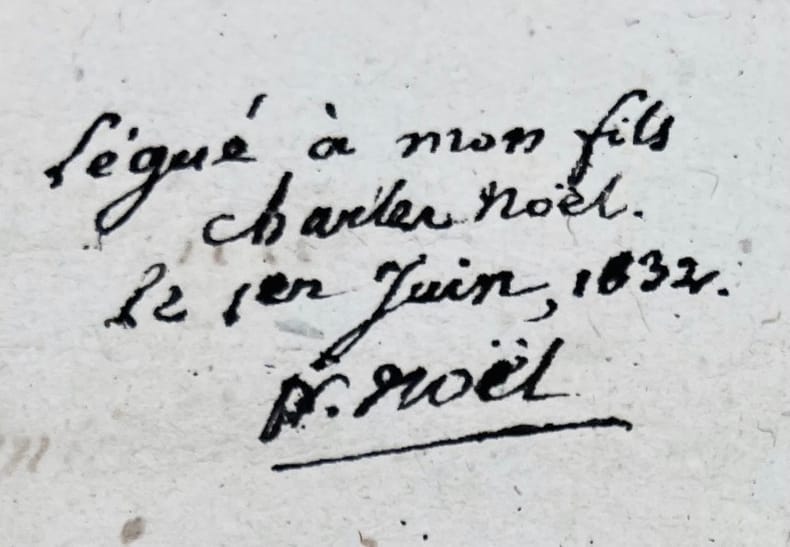
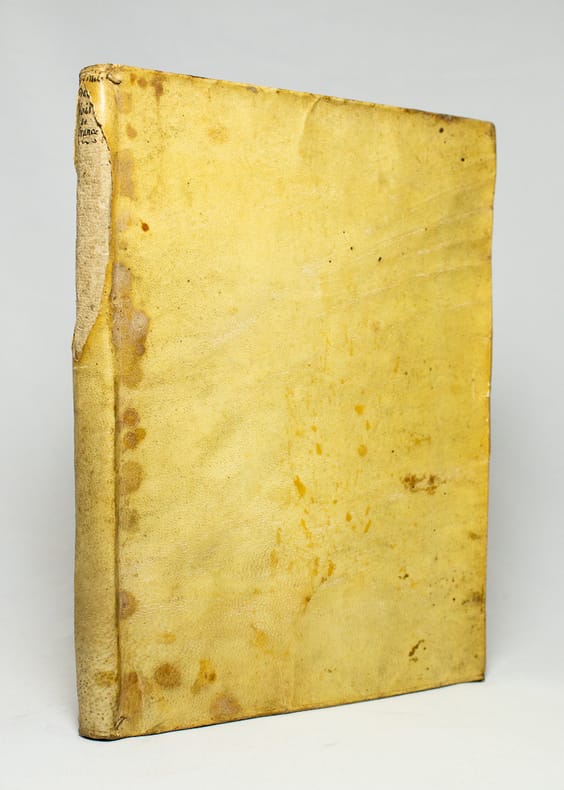
[BOISSEVIN Louis]:
Portraits des rois de France. Depuis Pharamond jusques Louis XVIII.
Paris, Louis Boissevin, [1660]. In-4 de 66 feuillets, plein vélin ivoire.
Bookseller reference : 17510
|
|
|
[BONNECORSE (Balthazar de)]
Lutrigot, poème héroï-comique
1785. Manuscrit de 68 pp., titre manuscrit encadré (quelques rousseurs).
Bookseller reference : 8788
|
|
|
[Book of Hours].
[Liber horarum - Use of Rouen]. Rouen, Maître de l'échevinage (workshop), ca. 1480 (last quarter of the 15th c.).
8vo (190 x 133 mm). Latin manuscript (lettre batarde) on vellum. 2 columns, 25 lines. 70 (instead of 74) ff., with 2 ff. of flyleaves at beginning and end each. Floral borders in colours and gilt; ornamental initials; 10 (instead of 14?) illuminated pages. 16th century calf with gilt double cover rules and central oval stamps (upper cover: crucifixion; lower cover: annunciation). Splendidly illuminated Northern French Book of Hours on vellum. The nearly full-page miniatures (ca. 110 x 80 mm) show extended landscapes as well as interiors, comprising: fol. 14r, Annunciation (at the beginning of the matin of the Office of Mary); fol. 20r, Visitation (Lauds); fol. 26r, Crucifixion (Hours of the Cross); fol. 27r, Pentecost (Hours of the Holy Spirit); fol. 31r, Adoration (Sext), fol. 33r, Presentation at the Temple (None); fol. 35r, Flight into Egypt (Vespers); fol. 38, Coronation of Mary (Compline); fol. 41v, King David in prayer (Penitential Psalms); fol. 50v, Job (Office of the Dead). Wants 4 leaves: before fol. 7 (Gospel lections), before fols. 28 & 30 (Prime and Terce in the Office of Mary), and before fol. 65 (beginning of a prayer to the Blessed Virgin). The finely gilt accents on the figures' clothing are typical of the French book illumination of the period. The borders (on all sides of the first calendar page and surrounding the miniatures, otherwise only to the outside of the text) show characteristically elongated, light brown and blue tendril leaves as well as blossoms and fruits (mainly strawberries and oblong red blossoms) within light brown compartments. The various prayers and lections have small coloured initials; final paragraph lines are completed with red and blue bars bearing gilt decoration. - The localisation of this Book of Hours is conclusively demonstrated by the original note on fol. 13r: "Hore beate Marie virginis secundum usum Rothomagansem" (i.e., Rouen in Normandy). Liturgically of high importance is the calendar (fols. 1r-6v), written in French: the entries are alternately in red and blue, feasts are emphasized in gilt. Names include St Martialis, bishop of Limoges, celebrated in Rouen on 3 July and also prominently mentioned in the litany; St Romanus, bishop of Rouen (23 October); and other bishops of Rouen, such as Ansbertus (9 February), Hugo (9 April), Mellonus (22 October), and numerous saints typical for the region, some of which reappear in the litany (fols. 47v-50r). - The localisation is supported by the art-historical evidence: the tendril forms were developed in Rouen around 1460 by the "maître de l’échevinage", and his highly productive workshop continued the tradition until the 16th century. The compositions and their arched top borders further support this attribution. The date is suggested by the lack of bars in the borders, such as are typical of workshop's ornamentation as late as in the third quarter of the 15th century, and on the other hand by the unadulterated Gothic character of the illumination, which in Rouen tends to give way to Renaissance motifs even in the late 15th century. - Provenance: 16th century old French entries on fol. 70v, concerning the birth of several children of the book's owner. The first entry mentions a fourth son, Pierre, born on 13 May 1563; by 1570 he is followed by four more children who were apparently entered immediately after their birth. While the family's name is not stated, it might be identified from the names of the godparents. An added prayer entered on fol. 13v appears nearly contemporary with these notes. - Occasional very insignificant paint smudges and offsetting to opposite pages with a few very minor stains. Altogether in fine state of preservation.
|
|
|
[BORDEAUX] GUÉPIN Ange-Victor (1831-1880) MÉDECIN, 13, COURS TOURNY, BORDEAUX (FILS DU DOCTEUR ANGE GUÉPIN DE NANTES)
LETTRE AUTOGRAPHE MANUSCRITE SIGNÉE D'ANGE-VICTOR GUÉPIN A SON COUSIN ET AMI CHARLES-ANGE LAISANT DÉPUTÉ DE NANTES (BORDEAUX, LE 29 AVRIL 1879)
nantes 1879 une lettre autographe manuscrite à l'encre brune de 4 pages sur papier à en-tête imprimé en noir :" DOCTEUR GUEPIN , 13, Cours Tourny, BORDEAUX - CONSULTATIONS DE 1 HEURE A 3", format : 21,5 x 13,7 cm, signature manuscrite : Guépin ce 29 Avril 79,
Bookseller reference : 28628
|
|
|
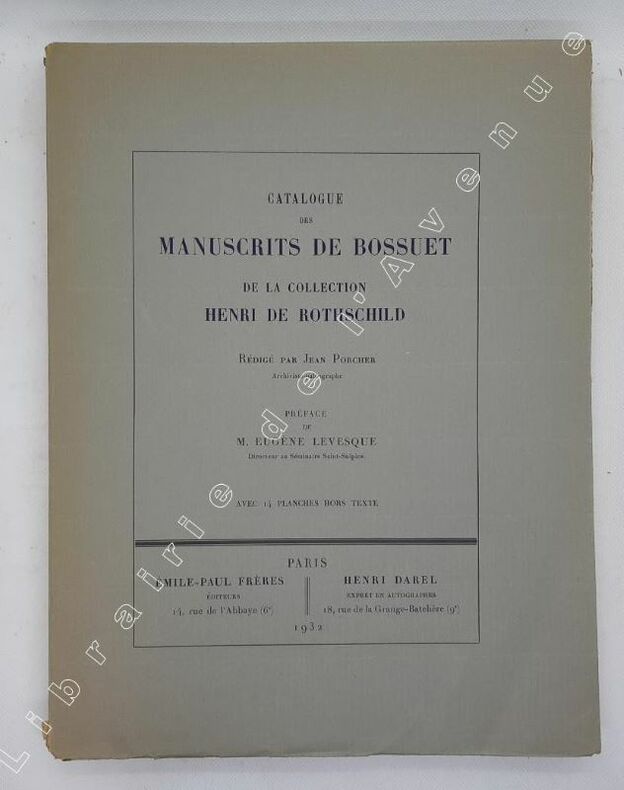
[Bossuet - Manuscrits] PORCHER, Jean
Catalogue des manuscrits de Bossuet de la collection Henri de Rothschild / rédigé par Jean Porcher... ; Préface de M. Eugène Levesque...
Paris, émile-Paul frères, Henri Darel 1932 In-4 33 x 25,5 cm. Broché, couverture grise rempliée, dos muet, titre en noir sur le premier plat, XXIV-109 pp., notes en bas de page, en frontispice, portait de Bossuet, par Robert Nanteuil, 13 fac-similés contrecollés sous serpentes, index, table des planches, table des matières. Exemplaire en bon état.
Bookseller reference : 108728
|
|
|
[BOUILLY (Jean-Nicolas)].
Comédie historique de l'Abbé de l'Épée écrit d'après l'original par Jean H. Wouters.
, , 1815. Manuscrit in-12 de (1)-140 pp., titre orné, vélin souple bruni, dos lisse muet (reliure de l'époque).
Bookseller reference : 43352

|
|
|
[BOULANGER EN PAIN D’ÉPICES] - MANUSCRIT
Inventaires après décès de Madeleine Granier, femme de Louis Chasteau, boulanger en pain d’épices, demeurant à Fontainebleau, Grand’Rue.
17 Février 1670. 6 feuillets in folio (angle extérieur du bas atteint par l’humidité).
Bookseller reference : 10049
|
|
|
[BOURBON-CONDE Louise-Anne de] & SADE Donatien Alphonse François, Marquis de & SADE Jean-Baptiste-François-Joseph, comte de
Testament
- Paris dimanche 2 avril 1758, 13,4x19,2cm et 11,7x17,8cm, 2 feuillets. - Testament de Louise-Anne de Bourbon-Condé dite Mademoiselle de Charolais, recopié de la main de Jean-Baptiste-François-Joseph, comte de Sade (et père du Marquis), dans lequel cette dernière fait de son neveu, Louis-François Joseph de Bourbon, prince de Conti, son légataire universel. Une seconde partie concerne les legs aux gens de livrée, aux femmes et valets de chambre, à la femme de garde-robe, etc. Note de bas de page de la main du Marquis de Sade : « dite Mademoiselle de Charolais ». On y joint un billet de notes, rédigé de la main de Sade, en vue de la publication de la correspondance de son père. Ce testament a été rédigé cinq jours avant la mort de Mademoiselle de Charolais, dont le décès survint le vendredi 7 avril 1758 à la suite de trois mois de maladie. La seconde partie du testament est datée du dimanche 2 avril 1758, sur la première est mentionnée la date du dimanche 12 avril 1758 : il s'agit bien sûr d'une date fautive. La totalité de cette copie a été rédigée de la main du Comte de Sade qui vécut avec Mademoiselle de Charolais à son château d'Athis-Mons à partir de 1750 jusqu'à la mort de cette dernière. Le jeune Comte de Sade, envoyé par son père à Paris aux alentours de 1720, eut pour protecteur Louis-Henri de Bourbon, Prince de Condé, dit Monsieur le Duc. Dès son arrivée, le jeune homme apprécie la vie de cour et « Chose rare, il plaît aux femmes sans se faire haïr des hommes : d'où le nombre de ses amis, au moins aussi élevé que celui de ses maîtresses. [...] M. de Sade ne se contente pas de conquêtes faciles ; les bourgeoises l'indiffèrent. Celles qu'il recherche - et conquiert le plus souvent - sont des femmes de cour, non seulement pourvues d'esprit et de beauté, mais parées encore d'un nom illustre, de crédit, d'influence ou de fortune, capables en un mot de servir ses intérêts et de le mettre bien en cour. » (Lever, Sade). Parmi son tableau de chasse figure Mademoiselle de Charolais, de sept ans son aînée, soeur de son protecteur et alors maîtresse royale. Peu désireuse de se marier, elle préférera toute sa vie conserver le célibat et multipliera les aventures et les amants prestigieux. Elle fut notamment la favorite du Duc de Richelieu, mais aussi de Louis XV pour lequel elle recrutait de nombreuses maîtresses, écopant ainsi du sobriquet de « maquerelle royale ». La rencontre charnelle entre Mademoiselle de Charolais et le Comte de Sade eut lieu le 24 novembre 1725 alors que ce dernier était contraint de garder le lit à cause d'une entorse. Une lettre de Louise-Anne atteste de cette aventure naissante : « Le 24 novembre est le plus beau jour de ma vie si je suis rentrée en possession de mon royaume et de ma souveraineté, par les droits du lit où je vous ai prêté serment de fidélité. Je compte y avoir reçu le vôtre et je vis maintenant pour le plus joli roi du monde. » (Papiers de famille, p.20). La passion n'est pourtant pas réciproque et le volage Comte de Sade fait bientôt la rencontre de la Duchesse de la Trémoïlle. S'éloignant ainsi de Mademoiselle de Charolais, il lui écrit en guise de rupture : « J'ai regardé, Madame, les avances que vous m'avez faites, comme des agacements de votre esprit et point de votre coeur. Je n'avais point l'honneur de vous connaître, je ne vous devais rien, une entorse m'obligeait de garder ma chambre, j'y étais désoeuvré, vos lettres étaient jolies, elles m'amusaient, je me suis flatté s'il était vrai que j'eus fait votre conquête, que vous me guérissiez d'une passion malheureuse qui m'occupe uniquement. » (op. cit. p.23). En 1752, le Comte de Sade est ruiné par son train de vie, il a envoyé le jeune Donatien au collège Louis-le-Grand et loge chez sa bonne amie Mademoiselle de Charolais au château d'Athis-Mons : « Je me suis retiré chez Mademoiselle, quoiqu'il soit cruel à mon âge de dépendre de quelqu'un, pour diminuer ma dépense. » (Lettre du Comte de Sade à son oncle le prévôt

|
|
|
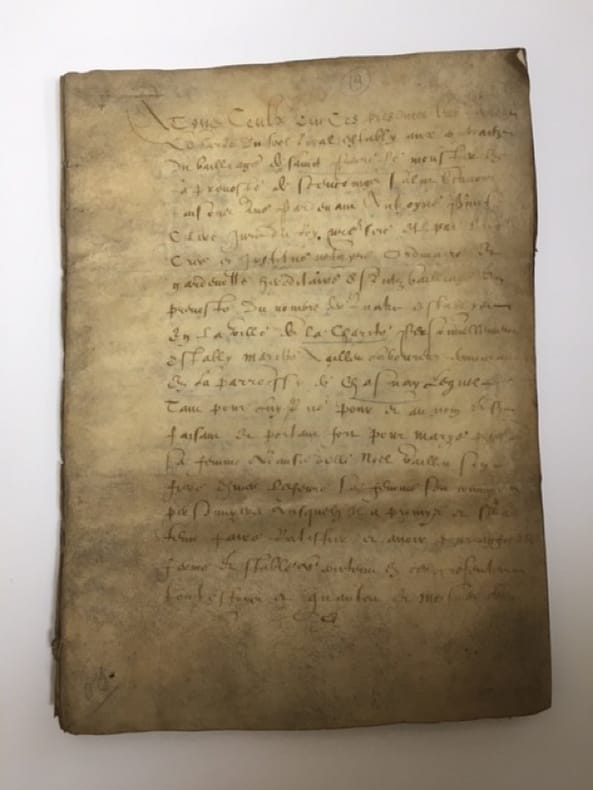
[BOURGOGNE]
[BEAUMONT-LA-FERRIERE] [NIEVRE]. Vente de nombreux arpents de terre.
Cahier sur parchemin du XVIe siècle (1595), gr. in-4 de 20 pp. manuscrites.
Bookseller reference : 576696
|
|
|
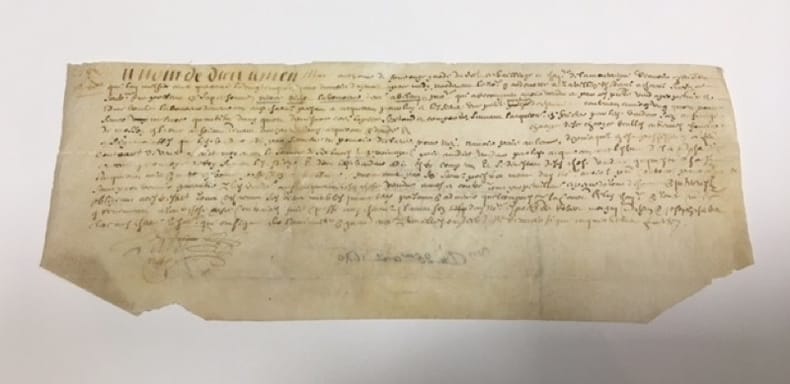
[BOURGOGNE] [BAILLAGE DE LA MONTAGNE]
Pièce manuscrite du XVIIe, in-8 oblong (29x12 cm). Acte de vente entre Pierre Richot laboureur demeurant à Belan et Edme Boulet demeurant à Chaource.
Bookseller reference : 573584
|
|
|
[BRETAGNE - HENRIOT] FAÏENCERIE D'ART BRETON - JULES HENRIOT - LOC-MARIA QUIMPER
LETTRE AUTOGRAPHE DE JULES HENRIOT ADRESSÉE A UN CLIENT INCONNU, 20 AVRIL 1926,
quimper FAÏENCERIE D'ART BRETON - JULES HENRIOT - LOC-MARIA QUIMPER 1926 une lettre autographe manuscrite écrite à l'encre bleue sur papier crème a en-tête illustré de 4 bois en bordeaux, avec noté en haut : FAÏENCERIE D'ART BRETON - JULES HENRIOT - LOC-MARIA QUIMPER, et en bas : GRAND PRIX - JURY INTERNATIONAL - EXPOSITION DES ARTS DÉCORATIFS - PARIS 1925, format : 21 x 27 cm, signée Henriot, et datée du 20 avril 1926,
Bookseller reference : 25617
|
|
|
[BRETAGNE] BARDE BRETON YVES BERTHOU - KALEDVOULC'H - AUTOGRAPHE MANUSCRIT
CARTE POSTALE ANCIENNE EN NOIR : N°155 - Kaledvoulc'h - Drouiz-Veur Breiz-Izel (Grand Druide de Bretagne) collection Y. B. - Collection Yves Petit [PHOTO DU BARDE BRETON YVES BERTHOU - KALEDVOULC'H (1861-1933)] AVEC ENVOI AUTOGRAPHE MANUSCRIT DU BARDE A L'ENCRE BRUNE : "A MONSIEUR CHARON "KEMWERZER" BARDE D'HONNEUR DU GORSEDD ... (signé) KALEDVOULC'H ..." (1910)
Nantes 1910 CARTE POSTALE ANCIENNE EN NOIR : PHOTO DU BARDE BRETON YVES BERTHOU - KALEDVOULC'H (1861-1933) AVEC ENVOI AUTOGRAPHE MANUSCRIT DU BARDE A L'ENCRE BRUNE : "A MONSIEUR CHARON "KEMWERZER" BARDE D'HONNEUR DU GORSEDD ... (signé) KALEDVOULC'H ...",
Bookseller reference : 28658
|
|
|
[BRETAGNE] Kératry, Émile de
LA GUERRE DES BLASONS, Comédie en trois actes, par le Comte de Kératry
Lille Alcan Lévy 1860 in-8 broché un volume, broché bleu in-octavo Editeur (paperback in-8 Editor) (20,2 x 13 cm), dos et couverture imprimés en noir (manque de papier au dos), toutes tranches non-rognées, envoi autographe manuscrit de l'auteur à l'encre brune en haut de la page de faux-titre : "...A ma Mère.....(signé) Comte de Kératry 1860....", sans illustrations, 91 pages, 1860 Lille : Alcan Lévy Editeur,
Bookseller reference : 23552
|
|
|
[British Army].
Establishments of His Majesty's Land Forces 1765. No place, [ca. 1765].
8vo. English manuscript on paper. (2), 34 (switching between foliation and pagination on the last 10 leaves), (1) ff. With a slip of paper attached to folio 11. Contemporary full red morocco with giltstamped border and spine. All edges gilt. Precisely drawn tables filled out in meticulous handwriting, listing forces in Britain and overseas including infantry, cavalry, general staff, garrisons in Gibraltar, Minorca, North America, and the West Indies, noting daily and annual salaries and other expenses. - After folio 22 the scribe occasionally switched to pagination, resulting in page numbers 23-24, 26-27, 29-30, and 32-33. - Spine slightly rubbed; interior crisp and clean. Contemporary ownership to flyleaf: "H. Leece | War Office | 1 Dec[embe]r 1777". Later in the collection of Thomas Fremantle, 3rd Baron Cottesloe (1862-1956), commander of the Territorial Army and president of the Society for Army History Research.
|
|
|
[British Army].
Returns of His Majesty's Forces at 1 August 1807. No place, [ca. 1807].
4to. English manuscript on paper. (2), 43, (1) ff. Contemporary full red morocco with giltstamped border and spine. Endpapers marbled. All edges gilt. Pre-printed table filled in by hand, detailing British military forces stationed in Britain and around the world, including the Caribbean, India, Africa, and Australia. Includes the names of regiments as well as the numbers of commissioned and non-commissioned officers, and the enlisted rank troops ("Rank & File"), distinguishing those fit for duty from those on the sick list, with a total of 238,978 regular forces and 91,586 militia. - Binding insignificantly rubbed at the hinges; interior crisp and clean. Heraldic bookplate incorporating a ducal coronet and Bentinck family crest to pastedown, a pencil note on the flyleaf ascribing it to the Duke of Portland's library. Later in the collection of Thomas Fremantle, 3rd Baron Cottesloe (1862-1956), commander of the Territorial Army and president of the Society for Army History Research.
|
|
|
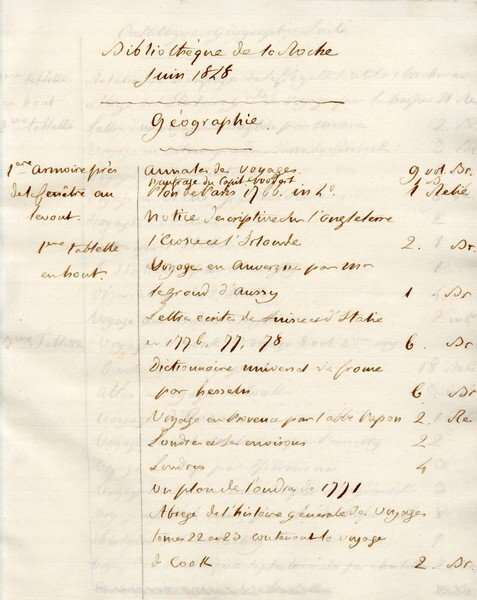
[BROCHET DE VÉRIGNY (Marie Clémence ?)]
[Catalogues des bibliothèques de La Rochemacé]
[Couffé] : [1826-1868]. CATALOGUE MANUSCRIT DES BIBLIOTHÈQUES D'UNE ILLUSTRE FAMILLE NANTAISE
Bookseller reference : 961
|
|
|
[Brooklyn].
Deed from William Morris and wife to the Corporation of New York. Signed by William and Rebecca Morris. Breuckelen (Brooklyn), Long Island, 12. X. 1694.
English manuscript on vellum. Approx. 620 x 555 mm (with folded plica). With two red seals. Stored in a custom-made half morocco case with gilt-stamped spine. Original deed of the first substantial purchase of land on the Brooklyn side of the East River ever made by the New York municipality, a purchase that was called by Henry E. Pierrepont (1808-88), director and historian of the Union Ferry Co., "the foundation of the claim of the City of New York to their land in Brooklyn" (23). After the capture of New Amsterdam from the Dutch in 1664, a municipal government had been formed, the Corporation of New York, while across the water, "Breuckelen" (as it was then called) long remained an independent, rival city on its own. - "As early as the 12th of October, 1694, the Corporation of New York purchased from William Morris, for no specific consideration, his hourse, barn and premises, situated at the 'Ferry', on Long Island. The house stood on the north side of the road, opposite the present Elizabeth Street, about one hundred feet from the then shore of the river" (Pierrepont, 16ff.). The site was then known as "Brookland Ferry", the place where George Washington escaped with his troops after the Battle of Long Island. It adopted its modern name, Fulton Ferry, when in 1814 Robert Fulton established the first steam ferry route connecting Manhattan and Brooklyn, which played such a major role in their shared history and evolution. - Incipit: "This Indenture, made the twelfth day of October, in the sixth year of the reigne of our Sovereigne Lord and Lady, William and Mary, by the grace of God, of England, Scotland, France, and Ireland, King and Queen, defenders of the faith etc., and in the yeare of our Lord one thousand six hundred ninty and four, between William Morris, now of the Ferry, in the bounds of the towne of Breuckle, in Kings county, on Long Island, gent., and Rebecca his wife, of the one part, and the Mayor, Aldermen and Commonalty, of the City of New York of the other part [...]". - Two copies of the deed would have been made, and this appears to be the deed retained by the Morris family and heirs, with an early note indicating that it was also "recorded in the Office of the Town of Clerk of City of New York in the Book of Grants". Pierrepont, writing in 1879, was still able to locate the City's copy at the Office of the Comptroller, where it may have remained until 1910, when such documents were transferred to the New York State Library; it probably perished in the notorious archive fire of 1911. - Drafted and signed by Ebenezer Wilson, later Mayor of New York City (1707-10). Verso signed additionally by William Pinhorne (d. 1720), the American colonial politician and jurist. Folded, few small tears to folds with negligible loss. Gabriel Furman, Notes, Geographical and Historical, Relating to the Town of Brooklyn, in Kings County on Long Island (Brooklyn, 1824), Appendix A, pp. 102f. (published in part). Henry Evelyn Pierrepont, Historical Sketch of the Fulton Ferry, And Its Associated Ferries (1879), pp. 16-23.
|
|
|
[Buddhist manuscript].
Sutra. Burma, [ca. 1896 ].
600 x 65 mm. 21 palm leaves between two painted wooden boards with cord. Burmese manuscript in Pali, most likely a register of Buddhist monastic rules. - Signs of age.
|
|
|
[Buddhist manuscript].
Sutra. Tibet, 18th/19th century.
340 x 100 mm. Manuscript on ca. 240 palm leaves between two wooden boards. In the original wrapping cloth. Signs of age.
|
|
|
[Buddhist manuscript].
Sutra. Tibet, 19th century.
355 x 90 mm. 38 ff. Printed from woodblocks, all edges red.
|
|
|
[BUSSY-RABUTIN.
Manuscrit]. Histoire des àmours du Roy et de Madame Ensemble de ses amours avec Mademoiselle de La Vallière Aussy de ses amours avec Mademoiselle Manchiny histoire des àmours de Madame et du comte Deguiche. Les amours du marquis Dehardes et de la comtesse de Soissons et de leurs portraictz.
, , vers 1666. Manuscrit in-12 de 144 ff., veau brun, dos à nerfs muet orné à froid (reliure de l’époque).
Bookseller reference : 44779

|
|
|
[BYZANTINE MANUSCRIPTS]
Typikon tes en Atho Hieras Mones tou Hagiou Dionysiou
<p><em><strong>Typikon of the Holy Monastery of Saint Dionysius at Mount Athos</strong></em></p><p>In mediaeval Greek. A facsimile reprint of the famous manuscript. Hard cover 28.5 cm 662 pp. ill.</p><p>.</p><p>.</p><p>===================================================</p><p><strong>IMPORTANT: The shipping cost in not included in the price. You will have to approve it at confirmation of the order.</strong></p> Ekd. Perivoli hardcover
Bookseller reference : S4021

|
|
|
[Béret (Michel)]
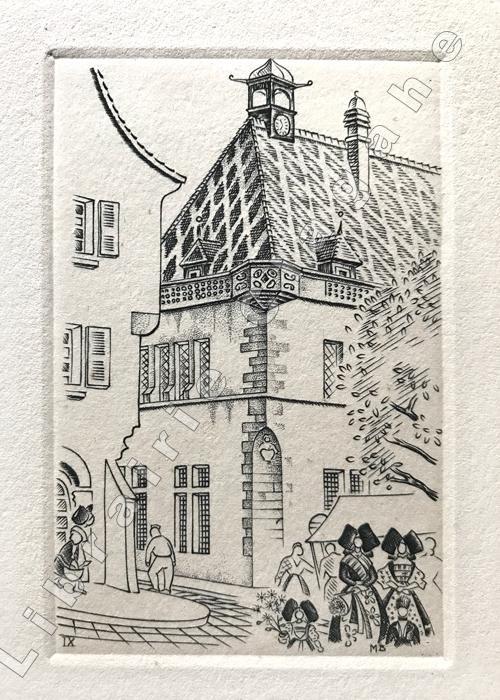
Images d'Alsace. 12 burins de Michel Béret, présentés par André Warnod.
Paris, au dépens d'un groupe d'Amateurs, chez l'Artiste, 18, rue Barbet de Jouy à Paris, (1949) ; petit in-4° (284 mm) en feuilles sous couverture crème illustrée rempliée, chemise : feuillet double décoré de branches verticales de feuillage bleu ou rouge alterné, [12] pp. de faux titre, titre, table des gravures et justificatif, 12 burins sur vélin d'Arches pur fil, numérotés en chiffres romains et placés dans un passe-partout avec fenêtre (burins 25 x 16 cm ; cuvette 10 x 6,5 cm).
Bookseller reference : 21563
|
|
|
[CALLIGRAPHIE - MANUSCRIT] GIRAUD (F. B.)
Cahier d’écriture pour le concours de l’année 1840 par F. B. Giraud élève des frères des Écoles Chrétiennes d’Avignon.
, in-plano (40 x 53 cm.), demi-chagrin rouge de l’époque. 13 ff., texte sur le rectoSuperbe exercice de calligraphie où l’élève montre la variété de caractères, de formats et d’ornements qu’il sait réaliser. Les textes sont des textes religieux ou des extraits d’ouvrages de morale : paraphrase du Salve Regina, anecdotes contre les philosophes concernant d’Alembert, Malesherbes, etc. Les textes de divers formats sont dans de beaux encadrements au trait de plume, certaines pages montrent la variété des styles calligraphiques : ronde, anglaise, gothique.Reliure fortement endommagée, l’encre de certaines pages a déteint sur le verso blanc en regard ou en formant des auréoles sur la page de texte, accident réparé dans la marge inf. du titre.
Bookseller reference : 46405296

|
|
|
[CARNET DE VOYAGE MANUSCRIT / MANUSCRIPT TRAVEL LOG].
SOUVENIRS DE VOYAGES; VOYAGES HISTORIQUES DE 1833 A 1846. [France-Suisse-Allemagne].
France, 1833 à 1846. 1833 1 vol in-12° ( 170 x 105 mm) de: [1] f. (titre), 128 pp. numérotées au crayon, manuscrit à l'encre brune avec une vingtaine de croquis dans le texte et 1 table in-fine, [11] ff bl., 1 f manuscrit non relié titré "Alesia", 1 carte manuscrite de la région de Montbeliard. Cartonnage bradel d'origine recouvert de papier à la colle bleu, dos muet, étiquette de titrage manuscrite "Souvenirs de voyages. 1833-1834-1846." contrecollée sur le premier plat.
Bookseller reference : 6319
|
|
|
[Catalogue of Hinchingbrooke manuscripts of John Montagu, 4th Earl of Sandwich (1718-1792)]:
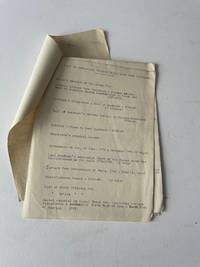
Mimeographed catalogue of manuscripts of John Montagu 4th Earl of Sandwich. List of Manuscripts in two Glazed Cupboards of Billiard Room. Hinchingbrooke. March 1930.
March 1930. 7pp. 4to. Attached with a brass stud. The six pages of the catalogue are in fair condition on aged paper the title leaf is dusty and spotted. The manuscripts listed in this catalogue are primarily of a political and diplomatic nature. They do not appear to correspond with those in the 'Hinchingbrooke Collecton' listed by Cambridgeshire County Record Office on the National Archives website an entry which gives a useful account of their origins mainly the stables at Hinchingbrooke. The first entry in the present list is 'Rules & minutes of the Divan Club' founded by the Earl of Sandwich and Francis Dashwood in 1744. The next entry is 'Private letters from Ministers & friends to the Earl of Sandwich during negotiations at Breda etc. 1747-1748.' Interesting items include: 'Secret memorial by Samuel Engel Esq. concerning certain discoveries & settlements North East of Asia & North West of America. 1773.' 'Collection of letters &c. that passed between Duke of Cumberland Duke of Newcastle & Earl of Sandwich and H.S.H. The Prince of Orange Count Bentinck &c. 1748.' 'Letters & other papers from Arthur Villettes Esq. to the King of Sardinia Lt. Gen. Wentworth & Lt. Gen. St. Clair to the Earl of Sandwich. 1748.' and 'Collection of Private Letters from the Earl of Sandwich to the Duke of Cumberland Duke of Chesterfield Duke of Bedford Henry Pelham Esq the Lord Chancellor & Lord Anson. 1747-48.' See Image. March 1930. unknown
Bookseller reference : 11836
|
|
|
[CATALOGUE DE VENTE JOSEPH BAER & CO FRANKFURT: Ventes de manuscrits enluminés, de miniatures de livres, de reliures incunables, de livres illustrés IIeme Partie] Baer, Joseph (commissaire-priseur)
Sammlung Rudolf Busch. zweiter Teil. ( Illuminierte Manuscripte, Buchminiaturen, Incunabeln Einbände, Illustrierte Bücher) Auktion am 3.-4.Mai 1921 bei J. Baer & Co. Frankfurt a.M. - Collection Rudolf Busch. deuxième partie. (Manuscrits enluminés, miniatures de livres, reliures incunables, livres illustrés) Vente aux enchères du 3 au 4 mai 1921 chez J. Baer & Co. Frankfurt a.M.
Frankfort a. M. Joseph Baer / C.Lang 1921 -in-4- broché un volume, broché marron-clair in-quarto Editeur (paperback in-8) (28,8 x 22,4 cm), dos muet, 1ère de couverture imprimée en noir (petit manque de papier en tête et en pied (moins de 2 cm2) Couverture légèrement défraichie avec quelques rousseurs, manque de papier en coin de la 4ème de couverture, toutes tranches lisses, texte du Catalogue en Allemand, orné de 58 hors-texte à la sépia, VIII + 112 pages, 1921 Frankfort a. M., Joseph Baer / C.Lang Editeur,
Bookseller reference : 23462
|
|
|
[CATALOGUE MANUSCRITS] - SOURGET (Patrick et Elisabeth) -
Librairie SOURGET MANUSCRITS ET LIVRES PRÉCIEUX CATALOGUE XXIV.
CHARTRES, Librairie Sourget, 2002 ; in-4, 623 pp., cartonnage de l'éditeur.
Bookseller reference : 202004729
|
|
|
[Certificat militaire] Chevalier de LARROUX - Maitre de Camp de Cavalerie - Aide major des Gardes du Corps
Certificat fiscal : "Certifions que M. D. LAGARDE DUCHASSAT, garde du corps..., y a payé la capita(n)tion depuis le moment de son entrée au corps qui est en 1764..."
Manuscrit sur papier (19,5 X 15,5 cm) avec cachet de cire rouge signé, situé et daté : "à Beauvais le 15 mai 1784" -
Bookseller reference : GF15380
|
|
|

 Receive by email
 Download as PDF document
 RSS feed
 Permanent link


