|
|
|
[LE QUIEN DE LA NEUFVILLE (Jacques)]
[Histoire générale de Portugal de 1521 à 1683]
S.l. (Lisbonne) : s. d. (entre 1713 et 1728). SUITE ET FIN INÉDITE DE LA PREMIÈRE HISTOIRE FRANÇAISE DU PORTUGAL
Bookseller reference : 458

|
|
|
[LETTRES MANUSCRITS] - PIEGON (Christel), LHERITIER (Gerard) -
Ces papier tachés d'encre-Fleurons des lettres et manuscrits.
Paris, Gallimrd - Musée des lettres et manuscrits, 2014 ; in-8 oblong, broché, couverture illustr.
Bookseller reference : 202000701
|
|
|
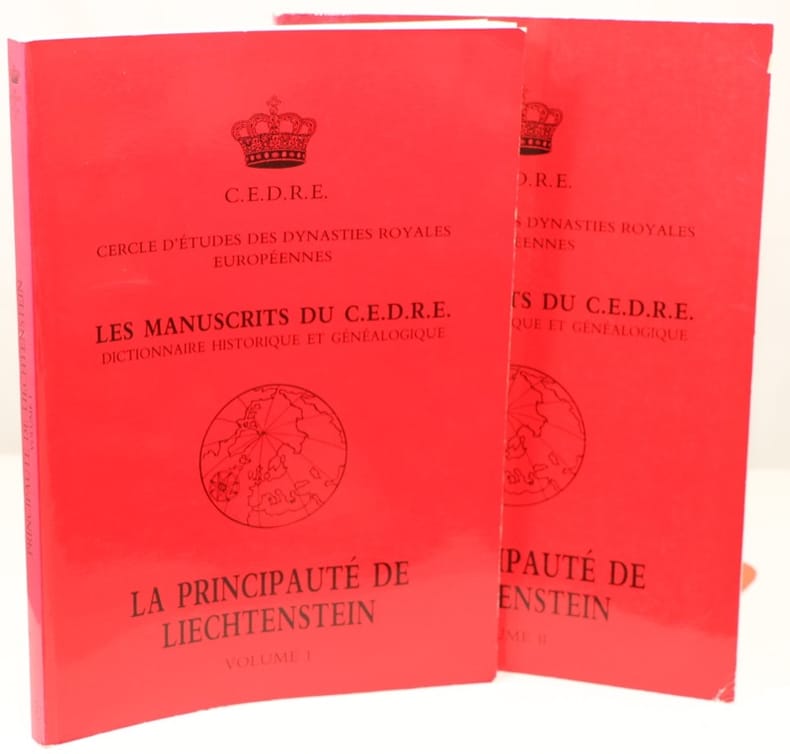
[Les Manuscrits du CEDRE]
La Principauté de Liechtenstein. Vol. I et II. Dictionnaire historique et généalogique.
C.E.D.R.E., 1988. 2 vol. in-4 br., couverture impr., 200 et 216 pp., qq. illustr. dans le texte.
Bookseller reference : 595489
|
|
|
[Les Manuscrit du CEDRE]
Le Royaume-Uni de Grande Bretagne et Irlande du Nord.
C.E.D.R.E., 1989-1990. 3 vol. in-4 br., 190-198-234 pp.
Bookseller reference : 578891
|
|
|
[Les Manuscrits du CEDRE]
LE ROYAUME D'ESPAGNE, Vol. I, II, III ET IV. Dictionnaire historique et généalogique.
C.E.D.R.E., 1995-1997. 4 vol. in-4 br., couverture impr., qq. illustr. dans le texte.
Bookseller reference : 602134
|
|
|
[LEONARD Nicolas Germain] HENRIOT Emile
Manuscrit autographe signé - "Leonard - Idylles et poèmes champétres - choisis et précédés d'une introduction par Emile Henriot" - 106 pages in8 -
Manuscrit autographe de son ouvrage paru chez Sansot en 1909 comprenant la page de titre - 22 pages de notice - 2 pages de bibliographie - 77 pages de poèmes choisis et 2 pages de tables des matières - On y joint des fragments d'épreuves corrigées, de nombreuses notes diverses et 2 lettres autographes signées de l'éditeur E. Sansot -
Bookseller reference : GF23633
|
|
|
[LE MANS] LOUIS RICHEFEUX FILS MARCHAND DE BOIS AU MANS - ANTOINE CRUCY [CRUCY FRÈRES - COMMERCE DU BOIS - CONSTRUCTION NAVALE NANTES]
RELEVÉ DE 5 FACTURES DE SOLLIVEAUX ET PLANCONNAUX LIVRÉS SUR LE PORT D'AVOISE (SARTHE), SABLÉ (SARTHE), LA POINTE (POINTE SUR LE LOIR A CHAHAIGNES - SARTHE) ET BASSE-INDRE PAR MONSIEUR RICHEFEUX FILS MARCHAND DE BOIS DU MANS A MONSIEUR ANTOINE CRUCY (NANTES) ET CHARGÉE PAR MONSIEUR CHARLES - FLOTTEUR, FACTURE ACQUITÉE LE 9 DÉCEMBRE 1810
Le Mans 1810 1 document ORIGINAL de 4 pages manuscrites à l'encre brune, format : 24 x 19,5 cm (une grande feuille pliée en deux), sur papier velin crème, ligné et filigrané : JOHANNOT et "un Aigle couronné"dans un grand cercle et "Napoleon empereur, Roi des Français et Roi d'Italie" dans un autre grand cercle , RELEVÉ DE 5 FACTURES DE SOLLIVEAUX ET PLANCONNAUX LIVRÉS SUR LE PORT D'AVOISE (SARTHE), SABLÉ (SARTHE), LA POINTE (BOUCHEMAINE) ET BASSE-INDRE PAR MONSIEUR RICHEFEUX FILS MARCHAND DE BOIS DU MANS A MONSIEUR ANTOINE CRUCY (NANTES) ET CHARGÉE PAR MONSIEUR CHARLES - FLOTTEUR, FACTURE ACQUITÉE LE 9 DÉCEMBRE 1810, acquit avec signature manuscrite par LOUIS RICHEFEUX,
Bookseller reference : 26290
|
|
|
[Le Rire], MALTESTE (Louis)
Caricature de L. Malteste reproduite dans le magasine Le Rire [Journal humoristique paraissant le samedi] avec la légende suivante : « – Réfléchissez, messieurs les jurés ! Quel besoin avions-nous de tuer cette femme ? Sa mort n’était-elle pas imminente ? Monsieur l’avocat général l’a reconnu lui-même : elle prenait tous les jours le tramways électrique !… », n° 317 (7e année), 1er décembre 1900
première page du Journal imprimée au dos, impression en couleur, (papier jauni, signature en marge de la légende coupée lors du massicotage du journal), bon état
|
|
|
[LEE (Dr. John)]
Oriental Manuscripts Purchased in Turkey.
First edition, 4to, [2],22pp., loosely inserted on a scrap of paper is Dr. Lee's presentation inscription, Sir Thomas has added in ink at the head of the title page "Sir Thomas Phillipps 1831, presented to him by Dr. John Lee, Professor of Arabic at Cambridge", caption title, imprint and date taken from colophon, orig. paper wrappers, upper wrapper having the title added in manuscript by Sir Thomas. A catalogue of 116 Oriental manuscripts from the collection of John Lee of Hartwell House, 1783-1866. "The principal part of the books described in this catalogue was purchased at Aleppo and Damascus, in the years 1811 and 1812, many of them by the assistance and recommendation of the late Mr. J. L. Burckhardt. The rest was procured at Cairo or Constantinople."?Introduction.
|
|
|
[LEE (Dr. John)]
Oriental Manuscripts Purchased in Turkey.
Second edition, 4to, 71[1, errata]pp., presentation inscription "Presented to Sir Thomas Phillipps, Bart. with Dr. Lee's respects, June 11, 1850", caption title, imprint and taken from colophon, Sir Thomas has added in pencil on inner front board "MSS Orientales of Dr Lee, 1850", orig. pink boards, faded, spine chipped. The catalogue has extended to 205 manuscripts for this second edition. "The collection has... enlarged by purchases in London, as will be seen from the references added at the foot of each title."?Introduction. Loosely inserted is a single sheet printed on one side only (265 x 215mm), n.p., c. 1850, lightly foxed, entitled "A Classified Table of the Contents of Dr. Lee's Catalogue of Oriental Manuscripts?", showing in graph form are the subjects of the manuscripts, each language, pages, etc.
|
|
|
[Letter-writing manual - Gellert, Christian Fürchtegott].
Briefe, und Abhandlung vom guten Geschmacke in Briefen. Probably Germany, ca. 1810.
8vo (125 x 187 mm). German manuscript in brown ink on paper. (1 blank leaf), title-leaf (lower two-thirds repaired), 210 (but: 208) numbered pp. (omitting pp. 124-125), 3 final blank pp. Very attractive contemporary half calf with red and green spine label. Coloured paper pastedowns. Silk ribbon. Very pretty and meticulously penned, privately compiled guide to the art of letter writing, partly based on C. F. Gellert's classic "Briefe, nebst einer praktischen Abhandlung von dem guten Geschmacke in Briefen" (first published in 1751), excerpted and paraphrased by the scribe and supplied with his extensive additional examples and discussions. - The manuscript begins with a restatement of Gellert's famous definition of a letter: "The first thing we think of regarding a letter is this, that it takes the place of a conversation. Yet it is not a conversation proper". The text tends to follow the printed book, paraphrasing, abridging, expanding, or quoting verbatim; but on p. 86 begins a chapter "On the external arrangement of letters" not found in Gellert, treating the formal constitution of a letter: the various types of paper, the positioning of salutation and closing on the page, improper salutations, use of envelopes, seals and sealing wax, etc. The examples provided here are not found in Gellert, either, and would appear to be the compiler's own invention: "To a Lady Friend" (signed "Forget-Me-Not"), "A Son's Letter to his Father", "A Brother's Answer to his Sister who has Written that They Have Won the Lottery Together" ("Me and you, winners in the lottery? And ten ducats at that? Well shiver my timbers! What lovely medicine for a foot-sore student"), "A Lady's Congratulations on the Birth of a Child", "Letter of Rejection" ("I still love freedom too dearly, am yet too young"), "To the priest L. (from Carlsbad)": "I have enjoyed the honour of speaking with our German Voltaire, the privy counsellor Goethe. He much favours the French nation, and especially Napoleon. How else could it be, as Napoleon himself invited him to sup with him in Weimar [...] To my pleasure, a travelling musician played several songs by Schiller on his guitar" (p. 136f.), "Thanks for Kind Sentiments", "Thanks for the Offer of Friendship", "To a Noble Friend for his Confidence", "A Young Lady Thanking her Aunt for a Gift", etc. - Later, the writer again draws from Gellert's printed work, inserting the final letter from the book: "To Baron Gr., From the Country", before adding a letter of congratulation, an account of travel adventures, a reminder "To a Late Payer", a letter demanding reimbursement for a loan to a nobleman, as well as an "Appendix" discussing the importance of legible handwriting and providing recipes for "good and well-flowing ink", how to cut quills, and how to make a leather writing case. - Prettily bound, with insignificant staining to covers. The green spine label bears the initials "A.B.", possibly denoting the unidentified compiler. Later autograph ownership of the Czech painter Josef Ferdinand Hettes (1864-1927) to flyleaf. Lower two-thirds of the title-page removed and rebacked, otherwise a clean, well-preserved and often amusing document of German epistolary culture in the late 18th and early 19th century.
|
|
|
[Librairie l'Oeil de Mercure]
DES LIVRES A PEINTURES... AUX LIVRES DE PEINTRES
Un catalogue de 130 pages, format 305 x 215 mm, illustré, relié toile, sans date
Bookseller reference : LFA00b3f
|
|
|
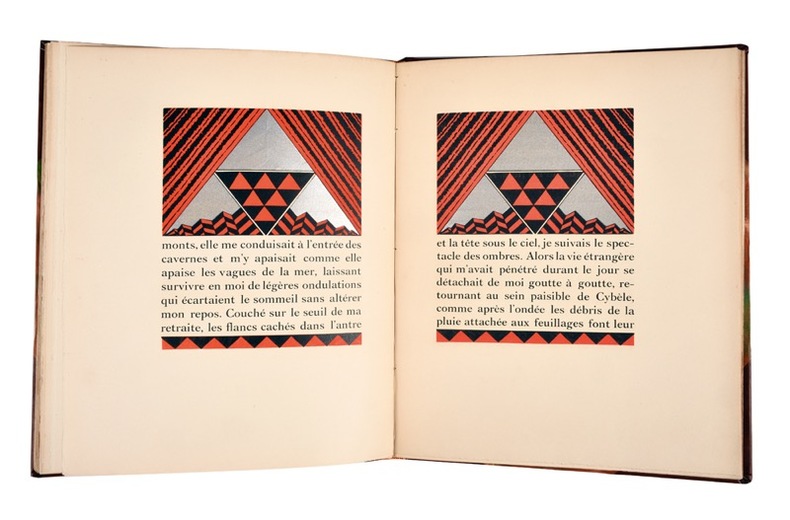
[Linossier (Claudius ; Lyon 1893-1953)] Guérin (Maurice de ; 1810-1839) :
Le Centaure.
Lyon, (Aux dépens du Cercle Gryphe, Marius Audin imprimeur), 1929. In-quarto, demi-basane à coins fauve, dos décoré de 20 nerfs épais, titre doré à la japonaise, couverture illustrée du logo du Cercle Gryphe gravé sur bois par Philippe Burnot et tiré en rouge (Missol relieur-Lyon) ; [38] ff., le premier blanc; illustré de 73 compositions géométriques de Claudius Linossier gravées sur bois par Philippe Burnot et tirées en rouge, noir, gris, beige et argent (palladium).
Bookseller reference : 21587
|
|
|
[LIVRE, MANUSCRIT, ENLUMINURES] - DESROUILLES (Francois dupuigrenet) -
Trésors de la bibliotheque nationale.
Paris, Pml ediitons, 1986 ; in-4, 221 pp., cartonnage de l'éditeur. Avec jaquette.
Bookseller reference : 201613585
|
|
|
[LIVRE, MANUSCRIT, ENLUMINURES] - DESROUILLES (Francois dupuigrenet) -
Trésors de la bibliotheque nationale.
Paris, Pml ediitons, 1986 ; in-4, 221 pp., cartonnage de l'éditeur. Avec jaquette.
Bookseller reference : 201310731
|
|
|
[LIBRARIAN OF YILDIZ PALACE LIBRARY].
[HAFIZ-I KÜTÜB: OTTOMAN LIBRARIANSHIP - PALACE LIBRARY] Ottoman manuscript document including notes on types of rare books, photograph albums and their languages, "Library of HM, Yildiz Palace" letterhead.
Very Good Turkish, Ottoman (1500-1928) Original manuscript document including notes the types and numbers of the rare books, photo albums and their languages, probably taken by the royal librarian of the Ottoman Yildiz Palace in the period. 21,5x13,5 cm. In Ottoman script (Old Turkish with Arabic letters). 1 p. No signature. Letterhead of "Yildiz Sarayi Alîsi Kütübhâne-i Hümâyûn-i Cenâb-i Mülûkâne" [i.e. Library of HM, Yildiz Palace].
|
|
|
[Liturgy - Divine Offices].
Ordine da osservarsi nell'oratorio di Santa Maria di Passione, circa gli Essercicii Spirituali delle feste cavato dalla Regola maggiore. [Compagnia di Santa Maria della Passione, Milan, 18th century].
Folio (27,5 x 18,5 cm). (1 blank), (1), 66 pp. With 5 full-page and 2 half-page hand-painted religious illustrations and 9 hand-painted initials on a blue background, heightened with gold and silver. 18th c. gold- and blind-tooled vellum, each board with a blind ornamental centrepiece in a blind-tooled frame, within a larger frame of gold fillets, with a gilt floral design in each of the 6 spine compartments. A manuscript service book for the divine offices of the confraternity of Santa Maria di Passione (Santa Maria della Passione), remarkably illustrated and penned on vellum in a very fine and legible hand, largely imitating roman printing types. It contains seven illustrations, the five full-page examples showing the Virgin Mary: the Pietà, the Annunciation, Mary as the Woman of the Apocalypse, a Madonna and child, and the Assumption of Mary. The two approximately half-page tailpieces serve a more decorative function, representing of six putti on a garland with grape vines and a tree or shrub (laurel?) growing out of a gold vase (the fragments of red and black text on the vase are in mirror image and must have stuck to the paint). All illustrations are hand-painted with gouaches in striking colours. - A divine office, or liturgy of the hours, contains the official set of prayers for the eight canonical hours of the day: matins, lauds, prime, terce, sext, nones, vespers and compline. The day began with the matins at approximately 2 a.m. and ended at 7 p.m. with compline. Each of the offices in this manuscript begins with a hand-painted initial in gold on blue ground with silver foliage; the text of the matins contains an extra initial, bringing the total to nine. Apart from a detailed description and instruction for the offices, the manuscript also contains other instructions and rules to be observed by members of the confraternity, such as the rites for welcoming novices and pilgrims. - The first known mention of the confraternity of Santa Maria di Passione was in 1455; a set of rules ("Ordini riformati della compagniadi santa maria della passione al campanile dei reverendi canonici") has survived from 1565. The confraternity was located in Milan, in a building right next to - or even attached to - the basilica of Sant'Ambrogio called the Oratorio di Santa Maria di Passione. The basilica was built by St Ambrose in the 4th century, and during its long history it has hosted multiple religious communities, some simultaneously. Even after the damage done during the bombing of Milan by Allied forces in 1943, the building still shows this history in the many different chapels and the existence of two towers, one built for the canons located on the north side and one built for the monks on the south side of the basilica. The confraternity was disbanded near the end of the 18th century and the oratory, until then an autonomous building, was bought by the management of the basilica. The oratory was decorated with several frescos, which were auctioned off at the end of the 19th century, including three bought by the South Kensington Museum (now the Victoria and Albert Museum) in London. - Binding slightly soiled. With an owner's label "Sub tutela matris" (under protection of the [holy] mother) and an inscription in Dutch on the front pastedown: "Handschrift met geschilderde prenten. Italiaansch werk op perkament" ("manuscript with painted illustrations. Italian work on vellum"). The vellum leaves vary in colour from white to slightly toned. Illustrations, initials and text leaves generally in good condition except for the initials on pp. 7 and 31; illustration on p. 33 shows some minor soiling. A tear in p. 9 repaired with tape (but text remains legible), lower corners of the leaves show minor signs of wear, otherwise in good condition. Illustrated manuscript written in a very fine, legible hand. An attractive Italian manuscript that provides an insight into the day-to-day religious life of the members of the confraternity of Santa Maria di Passione in Milan and is supplemented with eye-catching, hand-painted illustrations and initials. Cf. A. Rovetta, "Oratorio di Santa Maria della Passione - Cenni storici", in: Oratorio della Passione in Sant'Ambrogio a Milano: Risanamento degli intonaci e restauro degli affreschi (Milan, 2004), pp. 10-17.
|
|
|
[LOIRET] [SAINT-JEAN DE BRAYE]
André Lebrung et Toussaint Thiercelin, vignerons à Saint-Jean de Braye vendent des biens contre rentes. Orléans, 1626.
1626 Pièce ms sur parch., in-4, 16 pp.
Bookseller reference : 577356
|
|
|
[LOUIS XVII] OSMOND. [pseudonyme de l'Abbé Auguste Berton].
FLEUR DE LYS.
Nantes A. Dugas 1905 -in-8 broché un volume, broché (paperback) marron-clair in-octavo Editeur, dos muet, 1ère de couverture imprimée en noir illustrée d'une fleur de lys dorée, toutes tranches non-rognées(edges no smooth), lettre originale manuscrite de Mr le comte de CORNULIER LUCINIERE à l'Ecrivain Joseph SÉNOT de LA LONDE à propos de ce livre + 4 coupures de journaux parlant de Louis XVII collés en début sur les gardes, orné de 9 planches photographiques hors-texte en noir sur papier glacé + un tableau hors-texte en noir, léger trou de ver en marge basse n'atteignant à aucun moment le texte, 202 + XLVI pages, 1905 Nantes : impr. A. Dugas et Bordeaux : aux bureaux de la "Légitimité" Editeur,
Bookseller reference : 23351
|
|
|
[LORRAINE]
Pièce manuscrite in-4 (18x24 cm) sur parch., 4 pp.
Nicolas MILICE, négociant sur le Banc de Rousseux et Claude ROYER, marchand de Neufchateau, sont autorisés d’anticiper l’appel interjetté par la dame Pelegrin, d’une sentence. Nancy, 7 avril 1785. Beau document.
Bookseller reference : 576284

|
|
|
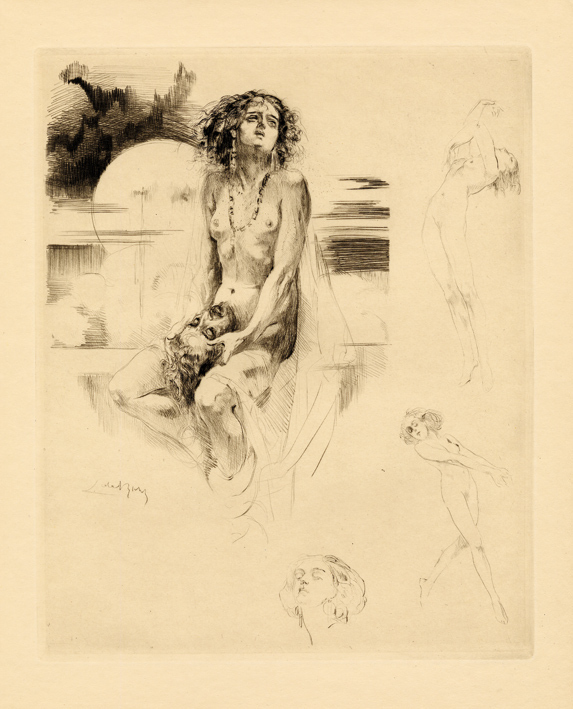
[Lobel-Riche] Wilde (Oscar) :
Salomé. Vingt eaux-fortes originales gravées par Lobel-Riche.
Paris, Devambez, 1930 ; in-4, en ff., couverture crème rempliée, chemise demi-percaline bleue, titre doré au dos, étui avec couvercle plein chagrin brique, dos rond à nerfs, titre doré (reliure de l'éditeur) ; (4), 77, [78], (4) pp., (2) ff. bl., 20 eaux-fortes dont 17 hors-texte.
Bookseller reference : 15457
|
|
|
[Louise-Anne de BOURBON-CONDE] - Donatien Alphonse François de SADE - Jean-Baptiste-François-Joseph, comte de SADE
Testament
Paris dimanche 2 avril 1758 | 13.40 x 19.20 cm | 2 feuillets
Bookseller reference : 59468
|
|
|
[Lustspiel des Biedermeiers].
"Die Heiratlustigen. Lustspiel in 4 Aufzügen". Manuskript (Fragment). O. O., 1839.
Zusammen 28 Bll. Folio. Vorliegend die drei ersten Aufzüge. - An den Rändern stärker lappig, mit kleinen Läsuren und angestaubt.
|
|
|
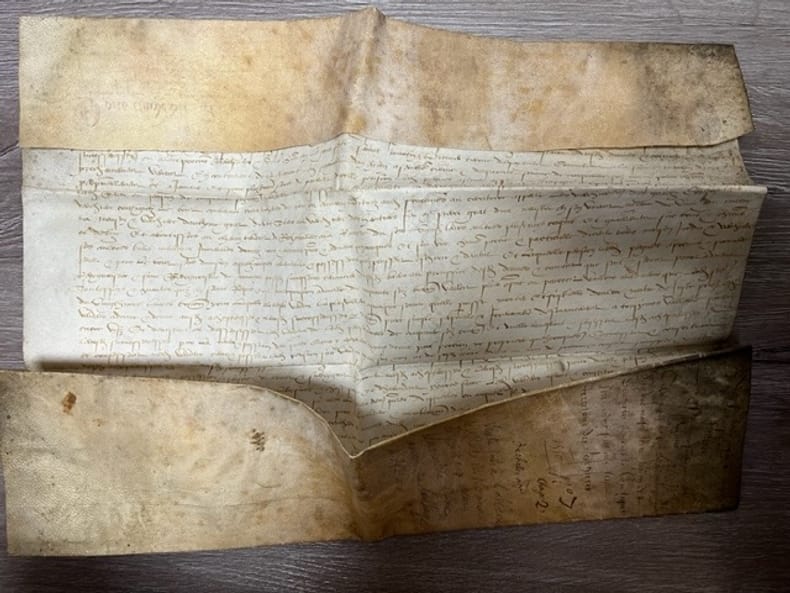
[LYONNAIS] [FONTAINES]
[GRAND PARCHEMIN DU XVIe].
1550 Acte [en français] passé en la chambre abbatiale du monastère de Saint-Pierre-des Nonnains par devant Pierre Dechalles. Lyon, 17 janvier 1550. Grande pièce manuscrite, 51 cm x 66cm, sur parchemin.
Bookseller reference : 576495
|
|
|
[Léon Gruel] - Georges CLAUDE - [1854 - 1921] - Peintre et graveur français
4 Lettres autographes signées à Léon Gruel - Paris - 1901 -
8 pages in8 - une enveloppe - trés bon état -
Bookseller reference : 35554
|
|
|
[MANUSCRIT BIRMAN RELIGIEUX/RELIGIOUS BURMESE MANUSCRIPT]
SLND [Birmanie, 19ème]. 1850 1 vol in-folio oblong (415 X 175 mm) manuscrit de [67] ff. doubles en accordéon, rédigés recto et verso en langue Birmane sur papier de murier, soit 270 pp calligraphiées à l'encre noire et rouge sur 10 lignes tracées au crayon, texte délimité par des marges de 27 mm, titre encadré d'une frise en rouge et noir ornée de deux oiseaux. ( salissures, traces de mouillures, galeries de vers marginales). Reliure asiatique en accordéon, plats de carton décorés décorés de fleurs en mosaïque de verre coloré, et des volutes en cire noire sur un fond doré, tranches dorées, lutrin en bois postérieur. (manques de matériaux dû à leur fragilité).
Bookseller reference : 6252
|
|
|
[MANUSCRIT - ALBUM AMICORUM / MANUSCRIPT - ALBUM AMICORUM].
[Circa 1850]. 1850 1 vol. in-8° manuscrit (230 x 170 mm) de : [62] pp. ; 2 illustrations ; 1 planche intercalée. Étiquette de libraire : Nicholls et Plincke, magasin anglais à St. Petersbourg. Plein chagrin marron d'époque, double filet doré encadrant les plats et motifs floraux. (Dos habilement restauré).
Bookseller reference : 5883
|
|
|
[MANUSCRIT - RECUEIL DE CHANSONS / MANUSCRIPT - SONGBOOK]
[Circa 1870]. 1870 1 vol. in-8 oblong manuscrit (125 x 200 mm) de : [56] ff. de chansons ; 1 f. glissé. Étiquette de libraire : Bazar de lindustrie, boulevard poissonnière 27, dépôt de la papeterie Marion. Plein maroquin vert dépoque, filets dorés et motifs encadrant les plats, large motif estampé à froid sur les plats, dos lisse orné, roulette sur les coupes, tranches dorées, gardes de papier vert. (premiere garde restaurée).
Bookseller reference : 5823
|
|
|
[MANUSCRITS]
"Chansons et pièces de vers de toutes sortes"
Fin XVIIe - XVIIIe s. Liasse d'environ 50 pièces, certaines de plusieurs pp.
Bookseller reference : 15982
|
|
|
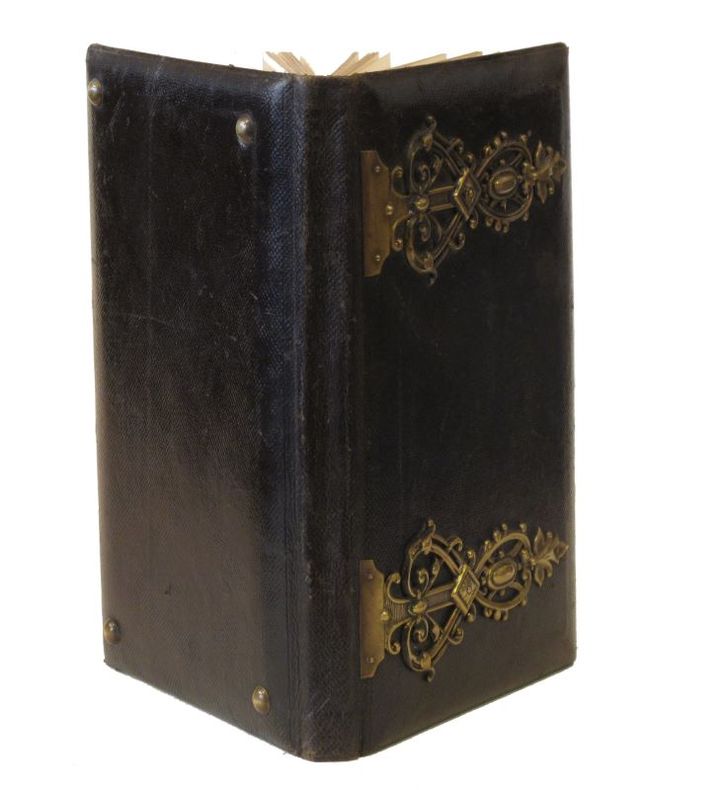
[MANUSCRIT]. [POESIE].
"Pour Alice".
1890 1 Bruxelles, 1884 à 1890. Textes en français et en anglais. In-12, reliure noire, ornée de ferrures plat supérieur, plat arrière clouté, tranches dorées.
Bookseller reference : 12911
|
|
|
[MANUSCRIT]. PILLE (Louis-Antoine).
16me division militaire. - Départements de la Lys, du Nord, du Pas-de-Calais. L. A. Pille, général divisionnaire commandant en chef la 16e division militaire. au ministre de la guerre
Lille, 5 Messidor an IX (24 juin 1801) in-folio, écrit au recto, en feuille.
Bookseller reference : 240205

|
|
|
[MANUSCRIT]
19e Régiment d'Infanterie. - 12me Compagnie. I. Renforts. - II. Cahier des punis
S.l., 1916-1918 2 cahiers in-8, brochés sous couvertures factices modestes.
Bookseller reference : 207973
|
|
|
[MANUSCRIT]
19e Corps d'Armée. - Division d'Oran. - Subdivision d'Aïn Sefra. Considérations sur les Amour et leurs terrains de parcours.
Aïn-Sefra, 17 octobre 1901 in-4, [7] ff. n. ch., couverts d'une écriture moyenne, soignée et très lisible (environ 30 lignes par page), en feuilles.
Bookseller reference : 208335
|
|
|
[MANUSCRIT]. MOCQUARD (Jean-François)
2 L.A.S. à Mademoiselle Colombier.
(Paris), 1864 in-16, sur double feuillet.
Bookseller reference : 157101
|
|
|
[MANUSCRIT]
252e. - Contrôle de la CM4.
S.l., s.d. (1918) cahier in-8, [28] ff. n. ch., broché.
Bookseller reference : 207987
|
|
|
[MANUSCRIT - SALVANDY]
26 et 28 février 1830. Obligation de 24. 000 francs. par M. et Mme de Salvandy au profit de M. et Mme Widmer
S.l. [Versailles], s.d. (1831) in-4, [4] ff. n. ch., couverts d'une écriture moyenne et lisible (environ 25 lignes par page), en feuilles sous chemise de papier crème, rousseurs et piqûres.
Bookseller reference : 207061
|
|
|
[MANUSCRIT]
286e [Régiment d'infanterie]. Ordre du Régiment n° 44.
S.l., 10 mars 1915-16 juin 1920 cahier in-8, 59 pp., [5] pp. n. ch., couvertes à plusieurs mains, écritures moyennes et lisibles, broché sous couverture cartonnée cerise.
Bookseller reference : 207986
|
|
|
[MANUSCRIT].
2me division militaire du pays conquis dans le nord. - Subsistances générales. Vivres-viande. Ordre de service.
Bonn, 29 Brumaire an IV (20 novembre 1795) in-folio, en feuille, avec cachet de cire rouge.
Bookseller reference : 240961

|
|
|
[MANUSCRIT. - MARTINIQUE].
4 L.A.S. adressées à François-Augustin Pécoul.
Lamentin [Martinique], 27 mai 1849 - 27 novembre 1849 4 pièces in-8, en feuilles, sur papier fin.
Bookseller reference : 237118
|
|
|
[Manuscrits]. SEGUR (Vicomte de) Colonel des Chasseurs du Hainaut (et) SEGUR (Comte de) Chef d’escadron du même régiment.
6 pièces signées (demandes de congés) entre le 24 mai 1789 et le 8 juin 1790.
Bookseller reference : 100602
|
|
|
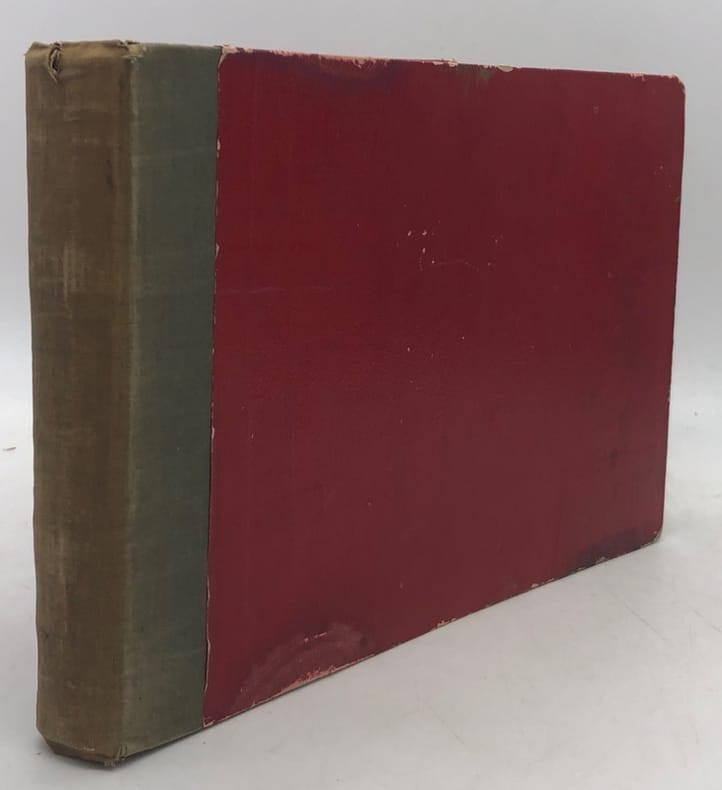
[MANUSCRIT].
[Armorial].
S.l., s.d. (v. 1900) in-8 oblong (17 x 25,5 cm), [6] ff. n. ch. de table, 274 pp., avec 84 vignettes héraldiques contrecollées dans le texte, demi-toile modeste, dos lisse muet (reliure de l'époque). Coins abîmés.
Bookseller reference : 230998
|
|
|
[MANUSCRIT]. [BARTET (Albéric-Joseph-Alfred-Louis)].
[Article sur la participation du Jauréguiberry aux opérations des Dardanelles].
S.l. [Reims], s.d. in-8, [31] pp. mal chiffrées 30 (il y a deux pages chiffrées 12), couvertes d'une écriture moyenne, régulière, très lisible, avec de nombreuses ratures et biffures, en feuilles sur papier de récupération. Feuillets de hauteur différente.
Bookseller reference : 239875
|
|
|
[MANUSCRIT].
[Brevet de commission].
Versailles, 16 mars 1707 in-4 oblong (30 x 46 cm), en feuille sur parchemin souple, muni de sceau.
Bookseller reference : 239877
|
|
|
[MANUSCRIT]. [MAZÉAS (E.)].
[Caricatures].
S.l., s.d. (vers 1900) in-16 oblong (12 x 20 cm), [20] ff. n. ch., 27 ff. vierges, toile grège moderne, dos lisse muet (reliure de l'époque).
Bookseller reference : 228984

|
|
|
[MANUSCRIT] [BERTIN (Ferdinand)]
[Correspondance].
Rome, et, 1865-1870 110 pièces en un vol. in-8, en feuilles, ou demi-basane bouteille, dos lisse orné de filets et guirlandes dorés, chiffre F.B. poussé à la place du titre (reliure de l'époque). Second plat défraîchi.
Bookseller reference : 211500
|
|
|
[MANUSCRIT].
[Correspondance passive d'André Grosdidier].
Versailles et Rebourseaux [Yonne], 2 septembre 1939 - 9 août 1940 78 pièces in-8 ou in-12, en feuilles.
Bookseller reference : 225694
|
|
|
[MANUSCRIT]. GROSDIDIER (André).
[Correspondance active].
12 janvier 1938 - 13 mai 1940 54 pièces in-4 ou in-8, en feuilles.
Bookseller reference : 225695
|
|
|
[MANUSCRIT]. [GROSDIDIER (Gilbert)].
[Correspondance active avec ses parents].
Aulnat [Puy-de-Dôme], 25 janvier 1947 - 26 février 1947 10 pièces in-8, en feuilles, généralement sur papier d'écolier réglé.
Bookseller reference : 225696
|
|
|
[MANUSCRIT].
[Correspondance passive de Bouteville du Metz].
Ll. dd., s.d. (1796) 3 pièces in-4, en feuilles.
Bookseller reference : 225719
|
|
|
[MANUSCRIT].
[Correspondance passive de Léopold de Gantès].
Bône [Annaba], 3 juin 1865 2 pièces, in-4 et in-8, en feuilles.
Bookseller reference : 225721
|
|
|

 Receive by email
 Download as PDF document
 RSS feed
 Permanent link


