|
|
|
MUSTAFA (Authorized person of the Waqf), (Early 19th century).
[MUWAQQIT EFFENDY: TIMEKEEPING OF THE SPECIAL WATCH IN THE TOMB OF SULTAN MEHMET II] Historical manuscript document on the fee of a muwaqqit who was hired to set the special watch that Pertevniyal Kadin Efendi donated to the tomb of Fatih Sultan Mehmed Han.
Very Good Turkish, Ottoman (1500-1928) Original historical autograph manuscript document sealed by the authorized person of the Pertevniyal Hanim Waqf on special paper. 32x18 cm. In Ottoman script. 6 lines with its annotated confirmation with red ink. 1 p. Historical manuscript document on about the muwaqqit who was hired to set the special watch that Pertevniyal Kadin Efendi donated to the tomb of Fatih Sultan Mehmed Han. Pertevniyal Sultan [i.e. "Descended from Radiance"], (1810-1884), was the thirteenth wife of Sultan Mahmud II, and Valide sultan to their son Sultan Abdulaziz of the Ottoman Empire. Pertevniyal exerted some influence over her son. When Abdulaziz took his trip to Europe, Pertevniyal was anxious about him the whole time he was away. On his way home he stopped at Ruse, Bulgaria, where Midhat was governor, with the intention of a month and acquainting himself with the Balkan country. But Pertevniyal, a possessive and short-sighted woman, wrote him to come home immediately. Sultan of Turkey though he was, he obeyed his mother's command. Pertevniyal contributed to the instability of her son's rule by meddling in affairs of state. Especially unwise was her alliance with Mahmud Nedim Pasha, the sycophantic grand vizier whose recklessness and incompetence led to further financial chaos. She founded the Pertevniyal High School as well as Pertevniyal Valide Sultan Mosque in 1872. In the days when the Hejaz was part of the Empire, the Porte tried to improve the health situation there. Pertevniyal, built hospitals in the Harem-i Sherif, and young Turkish doctors went out from Istanbul to man them. Pertevniyal Sultan was a great philanthropist, and thanks to her influence, she had the opportunity to make her son do whatever he wanted. In order to provide income to the foundations that it intends to establish, lands called Fasil fields. She commissioned a fountain in front of the Kâtib Mosque in October 1862, and then it was removed from the square and moved to the entrance door of the mosque on the grounds that it narrowed the road. She also built three fountains, one in Suboyu (Bige) village and two on Karaköy road in Sebinkarahisar. In 1864, she built a shipbuilding pool (stone loom) in Tersane to cover her own income, the first Ottoman battleship came out of this loom. "In the history of Islam, a muwaqqit was an astronomer tasked with the timekeeping and the regulation of prayer times in an Islamic institution like a mosque or a madrasa. Unlike the muezzin (reciter of the call to prayer) who was usually selected for his piety and voice, a muwaqqit was selected for his knowledge and skill in astronomy. The main duty of the muwaqqit was timekeeping and the regulation of daily prayer times in mosques, madrasas, or other institutions using astronomy and other exact sciences. At its zenith in the fourteenth and fifteenth centuries, major mosques often employed prominent astronomers as muwaqqits. In addition to regulating prayer times, they wrote treatises on astronomy, especially on timekeeping and the use of related instruments such as quadrants and sundials. They were also responsible for other religious matters related to their astronomical expertise, such as the keeping of the Islamic calendar and the determination of the qibla (the direction to Mecca used for prayers). (Source: Wikipedia).
|
|
|
MUSTAFA HALIM [ÖZYAZICI], (Ottoman / Turkish calligrapher), (1898-1964).
Autograph paper signed 'Hattat el-Hac Mustafa Halim'.
Fine Turkish, Ottoman (1500-1928) Original manuscript paper with its decorative frame. Paper size: 7,5x13 cm; frame size: 19x24 cm. In Ottoman script. 1 p. Signature of Halim by his very calligraphic style with 'Hattat el-Hac' title and seen one sentence down of paper: 'Gönderilen meblagi mütesekkir aldim hürmetlerim efendim' [i.e. 'I received the amount sent, thanks and gratitude']. Mustafa Halim Özyazici, was an Ottoman calligrapher and one of the last of the classical Ottoman calligraphers, using the Arabic script. He was a versatile calligrapher with a high level of expertise in many styles of script, but was widely regarded as a master jeli-thuluth. He is most noted for his work on various restoration projects, of both manuscripts and public buildings. He was born Mustafa Abdülhalim on 14 January, 1898 in the Hazeki district of Istanbul. He was the son of Nalinci Haci Cemâl Efendi, originally from Crimea and his mother was Sudanese. He was educated at Gülsen Junior High School, where he was given lessons in calligraphy by Hamid Aytaç, who recognised his talent and encouraged him to pursue calligraphy as a career. He later studied drawing and sculpture at the Academy of Fine Arts in Istanbul. His formal calligraphy studies were with Hasan Riza Effendi (1849-1920) and Kamil Akdik (1862-1941) where he mastered the thuluth, nasih and riqâ scripts. In 1916, he was drafted into the Army. After completing basic training he worked in the Military Printing Department and also worked in Evkâf-i Islâmiyye Printing Press. Following his discharge from the Army in 1924, he opened an office in Bâbiâli Street (The Sublime Porte) where he prepared all types of calligraphy; business cards, seals and book covers. He also taught in various schools around the Cagaloglu district of Istanbul. From 1927, he was employed in the Imperial Chancery. When the Latin alphabet replaced Arabic lettering in 1928, he applied to go to Egypt, where classical calligraphy, using Arabic script, was still valued, but his application was rejected in 1929. He subsequently abandoned calligraphy altogether. However, during the 1940s, his skills in classical calligraphy found an outlet when he became part of a major restoration project which worked on repairs to numerous manuscripts in a variety of styles and the restoration of calligraphic reliefs and monumental art in historic, public buildings, including many mosques. In 1948, he was appointed to the position of 'old writing teacher' at the Academy of Fine Arts in Istanbul; a position he retained until his retirement in 1963. One of his responsibilities was to write the diplomas for those who were about to graduate from the Academy. He died on 30 September, 1964, ten days after being involved in a traffic accident. He was buried in the Kozlu Cemetery. Although he developed expertise in many different types of script, he was regarded as a master of jeli-thuluth script. He wrote a number of exercise books for students to practice scripts in nesih, thuluth-nesih, riq'a, diwânî and jeli diwânî, and which were part of a program designed to promote the art of calligraphy. These books are still being printed and distributed to students of calligraphy.
|
|
|
MUSTAFA NECATI [UGURAL], (Turkish statesman in the early years of the Turkish Republic, who served as the Minister of National Education during the reform period), (1894-1929).
Autograph letter signed 'Mustafa Necati' sent to Turkish female poet Halide Nusret Zorlutuna, (1901-1984).
Very Good Turkish, Ottoman (1500-1928) Original manuscript autograph letter signed (ALS) addressed to Turkish female poet Halide Nusret Zorlutuna, (1901-1984). 22,5x17,5 cm. In Ottoman script written on a fine and special Italian hand-made paper with 'Aurelius' watermark. 1 p. on bifolium. Dated March 13, 1926. It starts as "Muhterem hemsire...". 4 lines. Signed as 'Maarif müdürü' [i.e. Director of Ministery of Education] by Mustafa Necati. Mustafa Necati Ugural was a Turkish statesman in the early years of the Turkish Republic, who served as the Minister of National Education during the reform period. He died before the Turkish Surname Law was adopted and the surname Ugural is actually the surname his family members adopted after his death. Mustafa Necati was born in 1894 in Izmir. His father was Halit and his mother was Naciye. After his primary and secondary education in Izmir, he went to Istanbul for higher education and studied law. He returned to Izmir in 1914 to serve as a lawyer and teacher. In 1915 he established a private school with his friend Vasif Çinar. He also served as a legal adviser for the local railway company. After the First World War in which the Ottoman Empire was defeated, the Allies fired the railway workers. He tried to defend the workers' rights by establishing a committee. Later he expanded his activities to defend the rights of the reserve officers who returned from the front. After Izmir was occupied by the Greek army, he fled to Istanbul and then to Balikesir, where he began to participate in the Turkish War of Independence. Among other things, he published a short-lived newspaper to defend Turkish rights against the Greek invasion. After the Ottoman parliament in Istanbul was abolished by the Allies on 16 March 1920, Turkish parliament was established in Ankara on 23 April 1920 and Mustafa Necati was elected as the Saruhan (present Manisa) MP. However, during the 1920-1922 term, he spent most of his time out of Ankara. He was appointed as a member of Independence Tribunals in Sivas and then Kastamonu. Finally, he was appointed as the chairman of Amasya Independence Tribunal. As soon as the Republic was proclaimed on 29 September 1923, Mustafa Necati became a government minister of Ismet Inönü's cabinets. His first seat was Minister of Exchange Construction and Settlement in the 1st government of Turkey. This was a very important seat for its main responsibility was the Population exchange between Greece and Turkey. In the 2nd government of Turkey, he was the Minister of Justice. However, his most important seat was that of the Minister of National Education following a revision in the 4th government of Turkey. He kept this post in the 5th government of Turkey till his death. Up to 1928, the Arabic script was used in Turkey. However, the Turkish language has 8 vowels and the Arabic script remained incapable of reproducing the Turkish words. Nevertheless, being the script of the Quran it was considered to be inalterable. But president Atatürk decided to adopt the Latin alphabet (with small changes). Moreover, he insisted that the reform should be carried out immediately. In addition to adding the Latin alphabet to school curricula, short term courses for the adults called Nation's schools (Turkish: Millet Mektebi) were established. As the minister of National Education, Mustafa Necati was responsible for establishing these courses. The courses were successful and Necati was later considered to be one of the pioneers of the new Turkish alphabet. (Wikipedia).
|
|
|
MUSTAFA NECATI [UGURAL], (Turkish statesman in the early years of the Turkish Republic, who served as the Minister of National Education during the reform period), (1894-1929).
Autograph letter signed 'Mustafa Necati' sent to Turkish female poet Halide Nusret Zorlutuna, (1901-1984).
Very Good Turkish, Ottoman (1500-1928) Original manuscript autograph letter signed (ALS) addressed to Turkish female poet Halide Nusret Zorlutuna, (1901-1984). 20x13,5 cm. In Ottoman script written on a fine paper. 1 p. on bifolium. Dated June 16, 1926. It starts as "Azîz hemsire...". 4 lines. Signed as 'Maarif müdürü' [i.e. Director of Ministery of Education] by Mustafa Necati. Mustafa Necati Ugural was a Turkish statesman in the early years of the Turkish Republic, who served as the Minister of National Education during the reform period. He died before the Turkish Surname Law was adopted and the surname Ugural is actually the surname his family members adopted after his death. Mustafa Necati was born in 1894 in Izmir. His father was Halit and his mother was Naciye. After his primary and secondary education in Izmir, he went to Istanbul for higher education and studied law. He returned to Izmir in 1914 to serve as a lawyer and teacher. In 1915 he established a private school with his friend Vasif Çinar. He also served as a legal adviser for the local railway company. After the First World War in which the Ottoman Empire was defeated, the Allies fired the railway workers. He tried to defend the workers' rights by establishing a committee. Later he expanded his activities to defend the rights of the reserve officers who returned from the front. After Izmir was occupied by the Greek army, he fled to Istanbul and then to Balikesir, where he began to participate in the Turkish War of Independence. Among other things, he published a short-lived newspaper to defend Turkish rights against the Greek invasion. After the Ottoman parliament in Istanbul was abolished by the Allies on 16 March 1920, Turkish parliament was established in Ankara on 23 April 1920 and Mustafa Necati was elected as the Saruhan (present Manisa) MP. However, during the 1920-1922 term, he spent most of his time out of Ankara. He was appointed as a member of Independence Tribunals in Sivas and then Kastamonu. Finally, he was appointed as the chairman of Amasya Independence Tribunal. As soon as the Republic was proclaimed on 29 September 1923, Mustafa Necati became a government minister of Ismet Inönü's cabinets. His first seat was Minister of Exchange Construction and Settlement in the 1st government of Turkey. This was a very important seat for its main responsibility was the Population exchange between Greece and Turkey. In the 2nd government of Turkey, he was the Minister of Justice. However, his most important seat was that of the Minister of National Education following a revision in the 4th government of Turkey. He kept this post in the 5th government of Turkey till his death. Up to 1928, the Arabic script was used in Turkey. However, the Turkish language has 8 vowels and the Arabic script remained incapable of reproducing the Turkish words. Nevertheless, being the script of the Quran it was considered to be inalterable. But president Atatürk decided to adopt the Latin alphabet (with small changes). Moreover, he insisted that the reform should be carried out immediately. In addition to adding the Latin alphabet to school curricula, short term courses for the adults called Nation's schools (Turkish: Millet Mektebi) were established. As the minister of National Education, Mustafa Necati was responsible for establishing these courses. The courses were successful and Necati was later considered to be one of the pioneers of the new Turkish alphabet. (Wikipedia).
|
|
|
MUSTAFA NECATI [UGURAL], (Turkish statesman in the early years of the Turkish Republic, who served as the Minister of National Education during the reform period), (1894-1929).
Autograph letter signed 'Mustafa Necati' sent to Turkish female poet Halide Nusret Zorlutuna, (1901-1984).
Very Good Turkish, Ottoman (1500-1928) Original manuscript autograph letter signed (ALS) addressed to Turkish female poet Halide Nusret Zorlutuna, (1901-1984). 22x13,5 cm. In Ottoman script written on a fine paper. "Maarif Vekâleti" [i.e. Ministry of Education] watermark. 1 p. Dated May 8, 1926. It starts as "Azîz hemsire...". 4 lines. Signed as 'Maarif müdürü' [i.e. Director of Ministery of Education] by Mustafa Necati. Mustafa Necati Ugural was a Turkish statesman in the early years of the Turkish Republic, who served as the Minister of National Education during the reform period. He died before the Turkish Surname Law was adopted and the surname Ugural is actually the surname his family members adopted after his death. Mustafa Necati was born in 1894 in Izmir. His father was Halit and his mother was Naciye. After his primary and secondary education in Izmir, he went to Istanbul for higher education and studied law. He returned to Izmir in 1914 to serve as a lawyer and teacher. In 1915 he established a private school with his friend Vasif Çinar. He also served as a legal adviser for the local railway company. After the First World War in which the Ottoman Empire was defeated, the Allies fired the railway workers. He tried to defend the workers' rights by establishing a committee. Later he expanded his activities to defend the rights of the reserve officers who returned from the front. After Izmir was occupied by the Greek army, he fled to Istanbul and then to Balikesir, where he began to participate in the Turkish War of Independence. Among other things, he published a short-lived newspaper to defend Turkish rights against the Greek invasion. After the Ottoman parliament in Istanbul was abolished by the Allies on 16 March 1920, Turkish parliament was established in Ankara on 23 April 1920 and Mustafa Necati was elected as the Saruhan (present Manisa) MP. However, during the 1920-1922 term, he spent most of his time out of Ankara. He was appointed as a member of Independence Tribunals in Sivas and then Kastamonu. Finally, he was appointed as the chairman of Amasya Independence Tribunal. As soon as the Republic was proclaimed on 29 September 1923, Mustafa Necati became a government minister of Ismet Inönü's cabinets. His first seat was Minister of Exchange Construction and Settlement in the 1st government of Turkey. This was a very important seat for its main responsibility was the Population exchange between Greece and Turkey. In the 2nd government of Turkey, he was the Minister of Justice. However, his most important seat was that of the Minister of National Education following a revision in the 4th government of Turkey. He kept this post in the 5th government of Turkey till his death. Up to 1928, the Arabic script was used in Turkey. However, the Turkish language has 8 vowels and the Arabic script remained incapable of reproducing the Turkish words. Nevertheless, being the script of the Quran it was considered to be inalterable. But president Atatürk decided to adopt the Latin alphabet (with small changes). Moreover, he insisted that the reform should be carried out immediately. In addition to adding the Latin alphabet to school curricula, short term courses for the adults called Nation's schools (Turkish: Millet Mektebi) were established. As the minister of National Education, Mustafa Necati was responsible for establishing these courses. The courses were successful and Necati was later considered to be one of the pioneers of the new Turkish alphabet. (Wikipedia).
|
|
|
MUSTAFA ZEKI PASHA, (The Grandmaster and Commander of Artillery - Tophane-i Amire Müsiri), (1849-1914).
Autograph letter sealed 'Mustafa Zeki', sent to Mazhar Pasha who was the commander of naval forces located in Chios Island (Sakiz Adasi) in the Archipelago, for the fortification to Chios fortress and around, and preparation of an exploration report and a map.
Very Good Turkish, Ottoman (1500-1928) Original manuscript autograph letter/document signed/sealed by Mustafa Zeki Pasha who was Tophâne-i Âmire müsiri [i.e. Grandmaster and Commander of Artillery / Brigadier and Ministry of Military Schools], sent to Mazhar Pasha who was the commander of naval forces located in Chios Island (Sakiz Adasi) in the Archipelago, for the fortification to Chios fortress and around, and preparation an exploration report and a map. 34x21 cm. In Ottoman script. Folded. 1 p. It's written in a beautiful and legible riq'a script. Including 23 lines. Full. Zeki Pasha was one of the most trusted Ottoman generals and statesmen of Sultan Abdulhamid II. He served as Tophane Counselor for 18 years during the reign of Sultan Abdülhamid II. In 1899, Italian architect Alexandre Vallaury built the 'Tophane Müsiri Zeki Pasa Mansion (Yali)', one of the most valuable estates of Istanbul, on his behalf. In 1908, he fell out of favor with the declaration of the Second Constitutional Monarchy by Union and Progress Society (Ittihad ve Terakki Cemiyeti) and was deported first to Büyükada and then to Rhodes. (Source: Wikipedia). Minor stains on paper. A very good manuscript on a fine watermarked paper with a letterhead "Tophâne-i Âmîre Müsireti".
|
|
|
MUTHERICH FLORENTINE - E.GAEHDE JOACHIM
PEINTURE CAROLINGIENNE
EDITIONS DU CHENE, 1977. 126 pages augmentées de nombreuses illustrations en couleur dans et hors texte. In-4 Broché. Bon état. Couv. convenable. Quelques petites rousseurs sur la couverture (au titre). Dos en bon état. Intérieur frais
Referenz des Buchhändlers : art3252m

|
|
|
Mutherich, Florentine & Gaehde, Joachim.E.
Carolingian Painting
Appears unread. No marks or inscriptions. No creasing to covers or to spine. A lovely clean very tight copy with bright unmarked boards and no bumping to corners. 127pp. The story of illuminated books from the Court of Charlemagne in the late 8th and early 9th centuries and his successors during which period scholarship and the arts were revived Descriptive introduction over about twenty pages. With forty-eight full colour full page images of illuminated manuscripts.

|
|
|
Muti, Riccardo, Dirigent (geb. 1941)
Porträtpostkarte mit eigenh. Datierung und U.
o.J. Berlin, 13. II. 1977, 8° (15 x 10,5 cm). 1 Seite. - Beim Dirigieren..
Referenz des Buchhändlers : 58005
|
|
|
MUYLDERMANS J.
A propos d'un feuillet de manuscrit armenien (Brit.Mus., Cod.arm.118)
Louvain, Durbecq 1952 pp.11-16, 26cm., extrait du "Muséon" tome 65, br., non coupé, bon état, R76715
Referenz des Buchhändlers : R76715
|
|
|
MUYLDERMANS J.
A travers la tradition manuscrite d'Evagre le Pontique. Essai sur les manuscrits grecs conservés à la Bibliothèque Nationale de Paris
Louvain, Muséon 1932 96pp., 27cm., brochure originale (avec quelques rousseurs), pages toujours non coupées, dans la série "Bibliothèque du Muséon" volume 3, bon état, R120123
Referenz des Buchhändlers : R120123
|
|
|
MUYLDERMANS J.
Les manuscrits arméniens 120 et 121 de la Bibliothèque Nationale de Paris
Louvain, Le Muséon 1961 pp.75-90, 26cm., extrait du "Muséon. Revue d'études orientales" tome 74 1-2, br., bon état, R76713
Referenz des Buchhändlers : R76713
|
|
|
MUYDEN, Evert van (1853-1922) peintre, illustrateur et aquafortiste:
Lettre manuscrite de Evert van Muyden adressée à son quasi contemporain Eugène Burnand, peintre, à propos de sa participation à l'Exposition Universelle de Paris.
Genève, 18.7.1889, 22,5 cm x 17,5 cm, 12 lignes, écriture lisible, bon état.
Referenz des Buchhändlers : 79331aaf
|
|
|
MUYLDERMANS J.
Miscellanea armeniaca
s.l., s.d. [1934] pp.293-296, 26cm., extrait du "Muséon" tome 47 (1934), br., bel état, R76716
Referenz des Buchhändlers : R76719
|
|
|
Muyden, Jacques Alfred van, Maler (1818-1898)
Eigenh. Brief mit U.
o.J. Ohne Ort [Rom], ca. 1860, 8°. 1 1/2 Seiten. Doppelblatt mit Adresse.
Referenz des Buchhändlers : 44634
|
|
|
MUYLDERMANS J.
A propos d'un feuillet de manuscrit armenien (Brit.Mus., Cod.arm.118)
pp.11-16, 26cm., extrait du "Muséon" tome 65, br., non coupé, bon état, R76715
|
|
|
MUYLDERMANS J.
Les manuscrits arméniens 120 et 121 de la Bibliothèque Nationale de Paris
pp.75-90, 26cm., extrait du "Muséon. Revue d'études orientales" tome 74 1-2, br., bon état, R76713
|
|
|
MUYLDERMANS J.
Miscellanea armeniaca
pp.293-296, 26cm., extrait du "Muséon" tome 47 (1934), br., bel état, R76716
|
|
|
MUZAFFER KÂMIL GÖRDUYSUS, (Turkish Consul of Komotini, 1943-1947).; ISMAIL HAKKI OKDAY, (Son of last Ottoman vizier Ahmet Tevfik Pasha, groom of last Ottoman sultan Vahideddin, soldier, diplomat and philatelist), (1881-1977).
[Autograph dedicated business card of Muzaffer K. Görduysus to Ismail H. Okday].
Very Good Turkish Original business card with autograph dedication. In Turkish. Muzaffer Görduysus was Turkish consul of Komotini (Gümülcine) between the years of 1943-1947. Dedicated to Ismail Hakki Okday, (1881-1977) who was son of last Ottoman vizier Ahmet Tevfik Pasha, groom of the last Ottoman sultan Vahdeddin, soldier, diplomat and philatelist.
|
|
|
MUZAFFER NEBIOGLU, (Turkish vamp actress in 1950s), (1937-).
Original photograph signed and inscribed 'M. Nebioglu'.
Very Good Turkish Original b/w portrait photograph signed and inscribed by Muzaffer Nebioglu as 'Sevgilerimle'. 14x9 cm. Muzaffer Nebioglu was born in 1937 in Istanbul, Turkey. She is an actress, known for Yaman gazeteci (1961), Bir soförün hayati (1954) and Binnaz (1959).
|
|
|
Muzio, Emanuele, Komponist (1821-1890)
Eigenh. Brief mit U.
o.J. Modena, 4. I. 1888, 8° (20 x 13 cm). 4 Seiten. Doppelblatt..
Referenz des Buchhändlers : 55698
|
|
|
Myriam HARRY
"Depuis quelque temps déjà je le désirais et n'osait vous le demander " Lettre autographe adressée à Pierre Belperron lui ayant envoyé et dédicacé son dernier ouvrage en lice pour l'obtention du Prix Vacaresco
Neuilly-sur-Seine s. d. [ca 1947] | 20.50 x 13.50 cm | Une page
Referenz des Buchhändlers : 86689
|
|
|
Myrdal, Gunnar, Wirtschaftswissenschaftler und Nobelpreisträger (1898-1987)
Brief mit eigenh. U.
o.J. Stockholm, ohne Jahr, Fol. 1 Seite. Gedruckter Briefkopf des "Institute for International Economic Studies". In adressiertem Umschlag.
Referenz des Buchhändlers : 50697
|
|
|
Mystery Writers of America
Polar : Mode d'emploi. Manuel d'écriture criminelle - Tome I et II
1989/1990 Editions Encrage - N°1 et 6 de la collection "Travaux" dirigée par Alfu - 1989/1990- 2 volumes in-8 cartonné, illustration en contrecollé sur le premier plat - 156 + 155 pages
Referenz des Buchhändlers : 48273

|
|
|
Mystery Writers of America - ASIMOV, Isaac (Introduction) - WILSON, Gahan (Illustrations)
Polar de la table - Recettes du crime et du mystère
1993 Editions Encrage - N°18 de la collection "Travaux" dirigée par Alfu - 1993- In-8 cartonné, illustration en contrecollé sur le premier plat - 222 pages - Illustrations en N&B dans le texte
Referenz des Buchhändlers : 125331

|
|
|
MÁLAGA.
"Copia de Escriptura de Venta Judicial y Titulos de un Oficio de Regidor Perpetuo desta Ciudad que compró Judicialmente Don Bartolomé Ruiz y Roldán, por vienes vinculados que poseia Don Joseph Ponce de Leon y por Zenso anterior a dicha vinculacion".
Un cuaderno en folio, manuscrito con clara caligrafía de la época, en papel sellado de 1771, Consta de 77 folios útiles. Contiene numerosas firmas de notarios, abogados, intervinientes y testigos, junto a las del entónces Alcalde Mayor de Málaga, Francisco Toral. Encuadernado en becerro, de la época. Extenso manuscrito que contiene la detallada historia de una importante ejecución judicial, en la que se describen minuciosamente buen número de casas malagueñas, con mención de propietarios de fincas, calles, lindes, y otros muchos datos de gran interés para su historia urbana, a los que se unen otros de igual calado sobre el Real Convento de Santa Clara, las propietarias del abultado Censo. Aparecen tambien datos sobre el acaudalado comprador, Bartolomé Ruiz y Roldán.

|
|
|
MÁLAGA.
"Nota o Razon de los Titulos y Alhajas en virtud de ellos concedidas por la Corona a la Ciudad de Malaga que solicita su Confirmacion en el Consejo de Hacienda".
Copia manuscrita de documento fechado a 18 de Abril de 1777, en el que se hace puntual historia de los numerosos avatares sufridos hasta esa fecha por los Privilegios otorgados a la Ciudad por los Reyes Católicos en 1488. Folio; 3 hojas manuscritas en clara caligrafía de la época. Carpeta de cartulina.

|
|
|
MÂLE, Emile (1862-1954)
Une page in-8°, à en-tête "Ecole française de Rome", datée "Rome, 1937". 5 lignes : lois de l'art et de la morale.
1
Referenz des Buchhändlers : 8107
|
|
|
Märker, Friedrich, Schriftsteller (1893-1985)
Eigenh. Albumblatt mit U. sowie Porträtfotografie mit eigenh. Beschriftung und U.
o.J. Feldafing, ohne Jahr, Fol. und 8°. Zus. 2 Seiten.
Referenz des Buchhändlers : 59603
|
|
|
MÈGE (Alexandre, Louis, Charles, André de)
Topographie archéologique du Tarn.
Sans lieu ni date (début du XIXème). 34 pp. in folio (accroc, petits défauts).
Referenz des Buchhändlers : 9704
|
|
|
Méhul, Étienne-Nicolas, Komponist (1763-1817)
Geschnittene Porträtsilhouette aus schwarzem Glanzpapier, auf Papier aufgelegt, Profil nach rechts, in Bleistift bez. "E Méhul. 1780".
o.J. Ohne Ort, ca. 1780, Blattgr.: 138 x 90 mm. Aufgelegt auf Karton. Unter Glas mit Goldlitze gerahmt (Gesamtgr.: 19,5 x 14,5 cm).
Referenz des Buchhändlers : 57944
|
|
|
Mélanie Waldor
Mélanie Waldor - Lettre autographe signée à Monsieur Plouvier - 1870
Mélanie Waldor - Lettre autographe signée à Monsieur Plouvier - 1870 Écrivain Lettre autographe signée de Mélanie Waldor, adressée à Monsieur Plouvier, datée du 14 janvier 1870, écrite à l'encre noire sur un double feuillet de papier vergé avec liseré de deuil de 3 mm, avec ses initiales en en-tête. Dimensions : 13,1 x 20,5 cm État : Voir photos et description pour plus de détails. Nombre de pages : 1 Mélanie Waldor Mélanie Villenave, dite Mélanie Waldor, née le 29 juin 1796 à Nantes (Loire-Inférieure) et morte le 11 octobre 1871 à Paris 1 er , est une femme de lettres françaises, à la fois romancière, poétesse et dramaturge.
Referenz des Buchhändlers : boz_002060

|
|
|
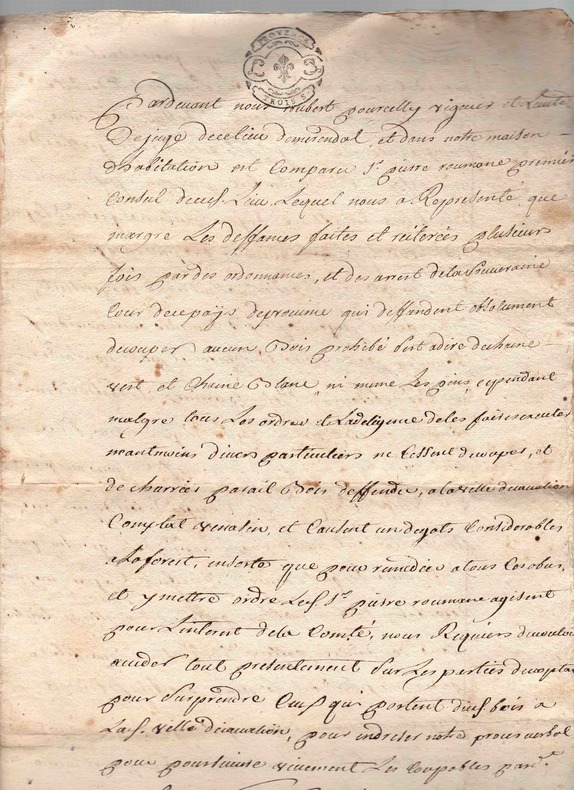
MÉRINDOL
Coupe de bois
... déffence absolue de couper les bois de chêne vert, chêne blanc et les pins...Procès-verbal d’une curieuse affaire de coupe de bois. En feuille Très bon Mérindol 1733 4 pages in-folio
Referenz des Buchhändlers : 6739
|
|
|
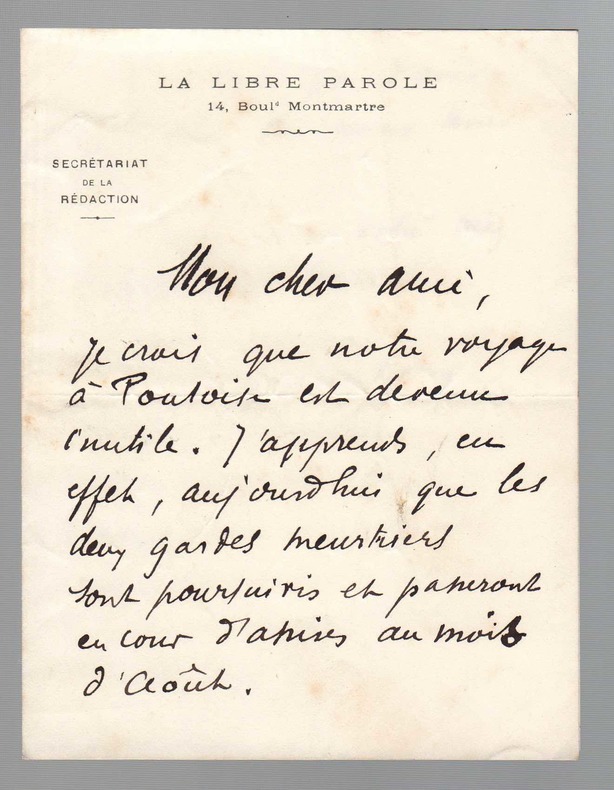
MÉRY Gaston
Lettre autographe signée.
L.A.S. à son “cher ami” sur papier à en-tête de La Libre Parole, le journal dont il était le rédacteur en chef. Disciple de Drumont, c'est lui qui inventa le terme “racisme”. Très bon 1 lettre A.S.
Referenz des Buchhändlers : 6735
|
|
|
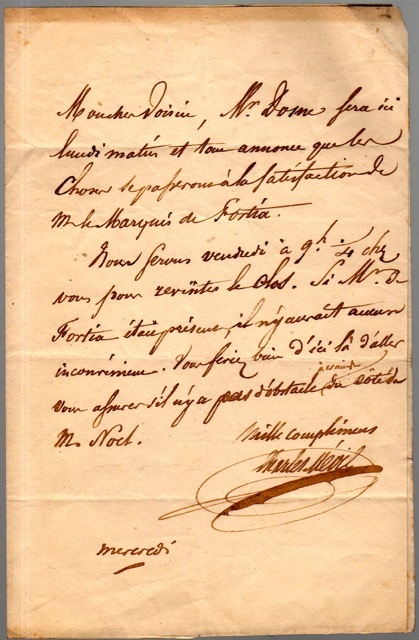
MÉVIL Charles
MÉVIL Charles
L.S. sans date, adressée à Monsieur Ad. Aubenas, Hôtel Fortia 12, rue de La Rochefoucauld. Mévil informe que "Mr Dosne" (l'agent de change qui réalisait d'énormes affaires immobilières dans ce quartier) revisitera le clos de Monsieur le marquis de Fortia. En feuille Très bon Avant 1843
Referenz des Buchhändlers : 10184
|
|
|
Mézière (Victor)
Vie de Pierre Gabriel Mézière.
Angers [Circa 1868] Un volume manuscrit in-8 plein chagrin noir, reliure signée de Lesort, dos à nerfs, titre doré, plats estampés à froid, filet doré sur les coupes, tranches dorées, dentelle intérieure, portrait photographique en frontispice, 301 pages, papier réglé. Hommage de Victor Mézière à son frère, proviseur du Lycée d'Angers, chevalier de la Légion d'Honneur en 1866.
Referenz des Buchhändlers : 3009
|
|
|
Mönnich, Horst, Schriftsteller (geb. 1918)
Eigenh. Manuskript sowie eigenh. Begleitbrief mit U.
o.J. Breitbrunn am Chiemsee, 14. XII. 1988, Verschied. Formate. Zus. 2 Seiten.
Referenz des Buchhändlers : 41793
|
|
|
Mörike, Eduard, Dichter (1804-1875)
Briefe 1857-1863. Hrsg. von Regina Cerfontaine und Hans-Ulrich Simon.
o.J. Stuttgart, Klett-Cotta, 2002, 4°. 1086 S., 2 Bl. Originalleinen mit Schutzumschlag.
Referenz des Buchhändlers : 61385
|
|
|
Mörner, Birger, Schriftsteller und Diplomat (1867-1930)
Porträtfotografie mit rückseit. Beschriftung seiner Frau Gertrud.
o.J. , Ohne Ort und Jahr, 20 x 16 cm.
Referenz des Buchhändlers : 49530
|
|
|
Möser, Carl, Violinist und Kappelmeister (1774-1851)
Eigenh. Brief mit U.
o.J. Berlin, 19. VI. 1844, 8° (18 x 11 cm). 1 Seite. Doppelblatt mit Adresse und Siegelausriss..
Referenz des Buchhändlers : 55696
|
|
|
Mößbauer, Rudolf Ludwig, Physiker (1929-2011)
Sonderdruck mit eigenh. Widmung und U. auf dem Umschlag.
o.J. Garching, 1979 (Poststempel), 26 x 19 cm.
Referenz des Buchhändlers : 59154
|
|
|
Müchler, Karl (Hrsg.), Schriftsteller (1763-1857)
Das Stammbuch. Eine Auswahl von Gnomen und Denksprüchen aus den Werken der vorzüglichsten deutschen und französischen Schriftsteller.
o.J. Stuttgart, Macklot, 1815, 8°. Mit gestoch. Frontispiz. 251 S. Pp. d. Zt. (bestoßen, mit schwarzer Klebefolie überzogen).
Referenz des Buchhändlers : 55511
|
|
|
Müchler, Karl Friedrich, Schriftsteller (1764-1857)
Eigenh. Brief mit U.
o.J. Berlin, 17. X. 1848, Gr.-8°. 1/2 Seite. Doppelblatt mit Adresse.
Referenz des Buchhändlers : 39894
|
|
|
Mücke, Heinrich Karl Anton, Maler (1806-1891)
Eigenh. Brief mit U.
o.J. Düsseldorf, 2. IV. 1840, (28 x 23 cm). 3 Seiten. Doppelblatt mit Adresse und Siegel.
Referenz des Buchhändlers : 61036
|
|
|
Mühlbach, Luise (d. i. Clara Mundt), Schriftstellerin (1814-1873)
Eigenh. Albumblatt mit U. "L. Mühlbach".
o.J. , Ohne Ort und Jahr, Qu.-Kl.-8°. 1 Seite.
Referenz des Buchhändlers : 49576
|
|
|
Mühlbach, Luise (d. i. Clara Mundt), Schriftstellerin (1814-1873)
Eigenh. Brief mit U. "Clara Mundt".
o.J. Berlin, 21. V. 1861, Gr.-8°. 4 Seiten. Doppelblatt. Gelbliches Papier.
Referenz des Buchhändlers : 41212
|
|
|
Mühlberger, Josef, Schriftsteller (1903-1985)
Eigenh. Gedichtmanuskript (12 Zeilen) mit U. sowie eigenh. Begleitbrief mit U.
o.J. Ohne Ort [Eislingen], 8. XI. 1960, 8° (21 x 15 cm). Zus. 2 Seiten.
Referenz des Buchhändlers : 60464
|
|
|
Mühling, August, Organist (1786-1847)
Eigenh. Brief mit U.
o.J. , o.O.u.D., 20 x 17 cm. Doppelblatt, in der Knickfalte repariert. 1 Seite.
Referenz des Buchhändlers : 60165
|
|
|
Mühsam, Kurt, Schriftsteller (1882-1931)
Eigenh. Albumblatt mit U.
o.J. Berlin, 28. IV. 1916, 8°. 1 Seite. Briefkopf.
Referenz des Buchhändlers : 54756
|
|
|
MÜLLER, Joh. Let. (aus Remscheid):
Fussreise durch die Schweiz, vom 10. - 24. Juli 1855. Handschriftliche Reisebeschreibung eines deutschen Schülers aus Remscheid, welcher mit Mitschülern eines internationalen Internats in Genf auf grosse Sommerreise nach Chamonix, Wallis und das Berner Oberland geht.
1855, gr. in-4to, 87 num. S. + 2 S. Anhang, dazwischen 20 eingefügte Bl. mit montierten, teils gefalteten Farblithographien, v.a. von Ad. Cuvillier, aber auch Muller (Panorama von Genf u. vom Faulhorn im Berner Oberland), Himely, Deroy, die meisten Abb. bei Briquet & Fils in Genf verlegt, auf den ersten Seiten und gegen Schluss ein leichter Wasserfleck an den unteren Seitenrändern sichtbar, Exlibris Peter E. Obergfell, Halbleder d. Z. mit Ecken, goldgepr. Name des Autors auf Vorderd., blau gesprenkelter Schnitt, dunkle Flecken an Fussrücken und unterer Ecke, ansonsten gutes Exemplar.
Referenz des Buchhändlers : 138626aaf
|
|
|

 Per e-mail erhalten
 Als pdf-Dokument herunterladen
 RSS feed
 Permanenter link


