|
Theodore Roosevelt
Theodore Roosevelt & the Dawn of the American Century: ""I will tolerate no assault upon the navy or upon the honor of the country""
3/9/07. <blockquote><p>“.nor will I permit anything so fraught with menace as the usurpation by any clique of Wall Street senators of my function as Commander-in-Chief."".</p><p>With an original cartoon that Roosevelt himself cut out and sent with the letter</p></blockquote><p><img class=""alignnone wp-image-32065 size-post-window"" src=""https://cdn.raabcollection.com/wp-content/uploads/20240907141318/T-Roosevelt-Sept-3-1907-1-1-1-1600x579.jpg"" alt="""" width=""1600"" height=""579"" /></p><p>In 1898 at the end of the Spanish-American War the United States was thrust into the mainstream of international affairs and gained status as a world power acquiring as possessions the Philippines and Guam in the Pacific then Puerto Rico in the Caribbean. In 1901 Theodore Roosevelt brought to the White House a deep conviction that only through a strong navy could a nation project its power and prestige abroad. At his behest from 1904 to 1907 American shipyards turned out 11 new battleships to give the Navy awesome battle capabilities. This was timely because in 1907 hostilities with Japan seemed possible and the Japanese navy dominated the Pacific. America's problems with Japan arose shortly after TR mediated the treaty ending the Russo-Japanese War. In that conflict the Russian fleet had been annihilated by the Japanese but despite their triumphs over the Russians on the high seas the Japanese failed to get all they felt they deserved at the peace table and blamed Roosevelt for it. In the same year anti-Japanese feelings were sweeping California and the San Francisco Board of Education ordered the segregation of all immigrant and descendent Japanese school children. When the news of this reached Japan violent anti-American protests broke out. Roosevelt managed to persuade the Board of Education to discontinue its segregation policy in exchange for an agreement with Japan to slow down its stream of immigrants into the United States.</p><p>Roosevelt developed a plan to send the navy around the world expecting both to impress foreign nations serve as a warning to potential adversaries and provide the American people with an example of US naval prepardness strength and range. Such an impression he hoped would help him get the desired appropriations for even more battleships. Not everyone approved of the idea of sending the fleet on this cruise. Some critics were against this show of force while others were worried that the Atlantic naval defenses would be weakened by taking away so many ships. In Congress opponents like anti-Roosevelt Republican Senator Eugene Hale chairman of the Naval Appropriations Committee threatened to withhold money for the cruise. But this didn't bother Roosevelt who replied that it would proceed anyway.</p><p>Roosevelt came to office in a progressive era when corporate monopolies and conspiracies price fixing discriminatory commercial preferences and outright dishonest business practices were being recognized as problems that needed to be addressed. The new President believed strongly that the government could give Americans a more just and equitable society and to do this he needed to bring order and fair dealings to industry and commerce. He broke presidential ground by establishing a detailed program to “effectively control and regulate all big combinations†calling it the Square Deal. He created the Bureau of Corporations with the power to investigate businesses engaged in interstate commerce pursued this policy of “trust-busting†by initiating suits against 44 major corporations managed passage of the Elkins Act that regularized railroad rates and prohibited discriminatory practices and fought for and obtained regulation of food and drugs. Against the opposition of businesses seeking to exploit natural resources he advocated conservation and set aside vast government lands to strictly public use. Just as importantly he attacked the corruption in government that allowed the abuses he now sought to end.</p><p>But Roosevelt went a step farther than indicting business he was an outspoken opponent of those he called malefactors of great weath who used their power for evil purposes. As early as 1895 he wrote “Too much cannot be said against the men of wealth who sacrifice everything to getting wealth. There is not in the world a more ignoble character than the mere money-getting American insensible to every duty regardless of every principle bent only on amassing a fortune.†In 1906 TR complained “I do not like the social conditions at present. The dull purblind folly of the very rich men their greed and arrogance.and the corruption in business and politics have tended to produce a very unhealthy condition.†For these sentiments and personal assaults on them and their entire way of life the very rich hated Theodore Roosevelt as they would his cousin Franklin thirty years later.</p><p><img class=""alignnone wp-image-32066 size-post-window"" src=""https://cdn.raabcollection.com/wp-content/uploads/20240907141350/T-Roosevelt-Sept-3-1907-1-2-1600x903.jpg"" alt="""" width=""1600"" height=""903"" /></p><p>Wall Street was controlled by fewer men then and they were mainly well acquainted. Many belonged to the same clubs where they would meet to express their antipathy to Roosevelt and his policies. When from January 1906-November 1907 there was a decline in the stock market that saw the Dow Jones Industrial Average lose 48% of its value TR in a speech on August 20 1907 blamed the financial elites for fomenting that loss. â€It may well be that the determination of the government in which gentlemen it will not waver to punish certain malefactors of great wealth has been responsible for something of the trouble; at least to the extent of having caused these men to combine to bring about as much financial stress as possible in order to discredit the policy of the government and thereby secure a reversal of that policy so that they may enjoy unmolested the fruits of their own evil-doing.I regard this contest as one to determine who shall rule this free country—the people through their governmental agents or a few ruthless and domineering men whose wealth makes them peculiarly formidable because they hide behind the breastworks of corporate organization.â€</p><p>A few days later in its issue of August 28 1907 the satirical magazine Puck ran a cartoon entitled “Lunch Hour in Wall Street†with the left panel picturing five businessmen smugly enjoying their champagne and cigars over the caption “Before Roosevelt’s name is mentioned†and the right panel showing them in a turmoil cursing and kicking over their champagne above the simple word “After.†It well illustrated the attitutde of business to TR at the time and he saw the cartoon and was much taken with it. He was unafraid of these powerful men and dared them to impeach him; they hated him for that as well.</p><p>Mentioned also in the letter: 1 for almost half a century the reformer and journalist Dr. Albert Shaw was the owner and editor of “The American Review of Reviews.†His magazine remains one of the best primary sources on American reform between 1890 and 1920 providing not only a panoramic view of the range of reformers' interests but also the ties between British and American progressives. 2 During his campaign in 1904 Roosevelt had declared that he would not run again yet with 1908 approaching many urged him to do so. 3 Mark Twain was one of TR’s favorite authors and a noted progressive. 4 Charles H. Moyer was president of the miners’ union and Big Bill Haywood was the union’s secretary. They were activists and in the forefront of advocating confrontation with the mine owners who badly wanted to be rid of them. In 1906 the two union leaders were arrested for murder on trumped up charges. Union sympathizers from all over the country vociferusly called upon the President to act to free them. Roosevelt was not an enemy of the union cause generally but disliked Haywood and Moyer for “preaching an industrial and social policy that is damaging to the best interests of the wage-workers of the country.†Clarence Darrow headed the Moyer/Haywood defense team and the men were ultimately acquitted.</p><p><img class=""alignnone wp-image-32069 size-post-window"" src=""https://cdn.raabcollection.com/wp-content/uploads/20240907142625/T-Roosevelt-Sept-3-1907-2-1-1-1600x1017.jpg"" alt="""" width=""1600"" height=""1017"" /></p><p><strong>Typed Letter Signed</strong> on White House letterhead but datelined Oyster Bay N.Y. two pages September 3 1907 to Shaw packed with important commentary demonstrating his courage attacking the wealthy malefactors and Wall Street defending sending the White Fleet discussing Japan and ending with a mention of Mark Twain. <em>“Would you be willing to reproduce this cartoon from PuckPuck is entirely disinterested and as far as I know is rather unfavorable to me and the cartoon is simply a good illustration of the current mania in Wall Street. As regards myself the mania makes not one particle of difference. Unless I am impeached I shall be President for eighteen months and I shall most certainly not be President any longer and in all probability will hold no public office so that the hysterical violence of the attacks of the Wall Street crowd are of no possible consequence to me. But they have shown signs recently of getting into a condition not much better than that of the Moyer and Haywood people. The New York Sun for instance which is their most servile and most violent and most unscrupulous representative is as part of its campaign on behalf of the wealthy malefactor class trying to prevent the fleet from going to the Pacific. It cannot prevent it. I will tolerate no assault upon the navy or upon the honor of the country nor will I permit anything so fraught with menace as the usurpation by any clique of Wall Street senators of my function as Commander-in-Chief. You know far too much of foreign events and of the needs of the navy for it to be necessary for me to explain to you how important it is that we should now see by actual experiment just how our battle fleet can go to the Pacific and you perhaps know how useful the mere statement that it was going there has already been in quieting the clamor for hostilities against us by the Japanese yellow press. Can not you come here to lunch Friday the 13thMark Twain and Doubleday will be there.†</em>The original cartoon from Puck is included.</p><p><img class=""alignnone wp-image-25018 size-post-window"" src=""https://cdn.raabcollection.com/wp-content/uploads/20231204144051/Folder-site-11-1600x1327.jpg"" alt="""" width=""1600"" height=""1327"" /></p> unknown
Riferimento per il libraio : 5793
|
|
|
Theodore Roosevelt
Theodore Roosevelt; An Autobiography:in large print
Hardcover. New. New Book; Fast Shipping from UK; Not signed; Not First Edition; Reproduction of the original. hardcover
Riferimento per il libraio : ria9783368325756_inp ISBN : 3368325752 9783368325756
|
|
|
Theodore Roosevelt
Theodore Roosevelt; An Autobiography:in large print
Paperback. New. New Book; Fast Shipping from UK; Not signed; Not First Edition; Reproduction of the original. paperback
Riferimento per il libraio : ria9783368325749_inp ISBN : 3368325744 9783368325749
|
|
|
Theodore Roosevelt
Theodore Roosevelt; An Autobiography:in large print
Paperback. New. New Book; Fast Shipping from UK; Not signed; Not First Edition; Reproduction of the original. The publishing house Megali specialises in reproducing historical works in large print to make reading easier for people with impaired vision. paperback
Riferimento per il libraio : ria9783387025743_inp ISBN : 3387025742 9783387025743
|
|
|
Theodore Roosevelt
Theodore Roosevelt; An Autobiography:in large print
Hardcover. New. New Book; Fast Shipping from UK; Not signed; Not First Edition; Reproduction of the original. The publishing house Megali specialises in reproducing historical works in large print to make reading easier for people with impaired vision. hardcover
Riferimento per il libraio : ria9783387025750_inp ISBN : 3387025750 9783387025750
|
|
|
Theodore Roosevelt
Theodore Roosevelt: An Autobiography Royal Collector's Edition Case Laminate Hardcover with Jacket
Hardcover. New. New Book; Fast Shipping from UK; Not signed; Not First Edition; N/A hardcover
Riferimento per il libraio : ria9781778784842_inp ISBN : 1778784844 9781778784842
|
|
|
Theodore Roosevelt
Theodore Roosevelt: Through the Brazilian Wilderness
Paperback. New. New Book; Fast Shipping from UK; Not signed; Not First Edition; 'This is an account of a zoographic reconnaissance through the Brazilian hinterland.' Theodore Roosevelt In this book Theodore Roosevelt describes the scientific discovery scenic tropical vistas and exotic flora and fauna experience paperback
Riferimento per il libraio : ria9783863474263_inp ISBN : 3863474260 9783863474263
|
|
|
Theodore Roosevelt
Theodore Roosevelt : An Autobiography
The Easton Press 1996-01-01. leather_bound. Like New. 0x0x0. Easton Press Full leather with gilt lettering/decoration and ribbon page marker. Book is in excellent condition text is unmarked and pages are tight. The Easton Press hardcover
Riferimento per il libraio : 66136
|
|
|
Theodore Roosevelt
Theodore Roosevelt: An Autobiography Royal Collector's Edition Case Laminate Hardcover with Jacket
Hardback. New. hardcover
Riferimento per il libraio : B9781778784842 ISBN : 1778784844 9781778784842
|
|
|
Theodore Roosevelt
Theodore Roosevelt An Autobiography with Illustrations - Collector's Edition
Norwalk CT: The Easton Press 1996 Book. Near Fine. Leather. Collector's Edition. Collector's edition of this volume from The Easton Press' "The Library of the Presidents" series. Gilt decorated binding all edges gilt satin ribbon page marker. Illustrated. Light exterior rub marks. The Easton Press hardcover
Riferimento per il libraio : 109210
|
|
|
Theodore Roosevelt
Theodore Roosevelt: We are the Real Heirs to the Legacy of Abraham Lincoln and the Representatives of the People
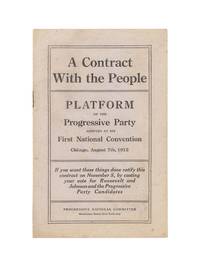
24/01/1913. <blockquote><p>This is a new party one with no allegiance to a boss but just to the people: ""It is as idle to talk of our amalgamating with either of the old party machines as it would have been to talk of the Lincoln Republicans amalgamating either with the Bourbon Democrats or the Cotton Whigs of their day.""</p><p> </p><p>“There is no place in our ranks for the boss for the man who represents the alliance between privilege in business and privilege in politics… The only way they can efficiently fight for social and industrial justice for political and economic freedom for equality of opportunity is by joining the Progressive Party. They shall have exact equality of treatment with us without regard to whether they are ex-Democrats of ex-Republicans. We welcome all honest citizens to our ranks.â€</p></blockquote><p>Theodore Roosevelt first came to the presidency in 1901 following the assassination of William McKinley but won election in his own right in 1904 and proved an extremely popular chief executive. Shortly after the election of 1904 he announced that he would not be a candidate four years later—though he was so much the idol of the masses that he could easily have gained the Republican nomination in 1908. Adhering to his pledge however he arranged the nomination of his secretary of war William Howard Taft who was easily elected president in 1908. Taft faced a restless public and a split Republican Party. National progressivism was nearly at high tide and a large group of Republican progressives sat in both houses of Congress. These Republicans like a majority of Americans demanded reforms - such as tariff reductions an income tax the direct election of senators social justice and stricter railroad and corporation regulations. Taft was much more conservative philosophically than Roosevelt and failed to advance progressive ideals.</p><p>Republican insurgents were determined to prevent Taft’s renomination in 1912. They found their leader in Roosevelt who had become increasingly alienated from Taft and who made a whirlwind campaign for the presidential nomination in the winter and spring of 1912. TR swept the presidential primaries but Taft and conservative Republicans controlled the powerful state organizations and the Republican National Committee and when the Republicans gathered at their national convention in June 1912 it proved a bitter divisive affair. And so complete was Taft’s supporters’ control over the party machinery that delegate challenges made by Roosevelt were all beaten back—leading Roosevelt to refuse to have his name entered into nomination. Taft was nominated on the first ballot. Convinced that the bosses had stolen the nomination from him Roosevelt led his followers out of the Republican convention. In August they organized the Progressive “Bull Moose†Party and named Roosevelt to lead their third-party cause.</p><p>The Democrats emerged from their convention having nominated Woodrow Wilson. Roosevelt and the Bull Moose movement stressed its progressive reform credentials even controversially backing women’s suffrage. For Taft his single objective in the 1912 campaign was to defeat Roosevelt. The real contest however was between Roosevelt and Wilson for control of the progressive majority. Campaigning strenuously on a platform that he called the New Nationalism Roosevelt demanded effective control of big business through a strong federal commission radical tax reform and a whole series of measures to put the federal government squarely into the business of social and economic reform.</p><p>On election day November 5 Roosevelt outpolled Taft but failed to win many Democratic progressives away from Wilson. Though Wilson captured only about 42 percent of the popular vote he won 435 electoral votes. Between them Roosevelt and Taft secured 7.6 million votes—1.3 million more than Wilson—but Roosevelt won only 88 electoral votes and Taft won only 8. Taft’s 8 electoral votes represented the worst performance by an incumbent seeking reelection. But the defeat was stinging for TR and the Progressives as well.</p><p>In the wake of the 1912 defeat TR worked hard to rally the troops continue to advocate progressive ideals and move the party forward. <strong>Typed letter signed</strong> two pages on his The Outlook letterhead New York January 24 1913 to W.C. McDonald of the Progressive Club of Worcester Mass. comparing the Progressives to the Lincoln Republicans whom he calls progressive highlighting their fight for social and industrial justice and for the public good over privilege. <em>“I earnestly wish I could be with you on January 28th to greet the Progressives of Worcester County. As this is impossible I send you a letter of good will.</em></p><p><em>“The Progressive Party stands today precisely where the Republican Party stood in the days of Lincoln when it was the progressive party of the nation. It is as idle to talk of our amalgamating with either of the old party machines as it would have been to talk of the Lincoln Republicans amalgamating either with the Bourbon Democrats or the Cotton Whigs of their day. We stand absolutely for our platform; we believe in applying the principles of that platform to party management as well as to the government. There is no place in our ranks for the boss for the man who represents the alliance between privilege in business and privilege in politics.</em></p><p><em>“I firmly believe that there are literally millions of progressives among the rank and file both of the Republican and Democratic parties and that these men will sooner or later realize that they can do nothing where they are and that the only way they can efficiently fight for social and industrial justice for political and economic freedom for equality of opportunity is by joining the Progressive Party. They shall have exact equality of treatment with us without regard to whether they are ex-Democrats of ex-Republicans. We welcome all honest citizens to our ranks.â€</em></p><p>TR adds a PS.<em> “P.S. I cannot join that club excepting as an honorary member because otherwise I should be required to join clubs all over the country. I have however signed the form you enclosed.â€</em></p><p>An extraordinary and moving letter comparing the Progressives to the party of Lincoln and laying out clearly what the Progressive Party stands for and who is welcome to join its ranks.</p><p>After the party's defeat in 1912 it went into rapid decline in elections disappearing by 1920. But its spirit and programs were not forgotten and would be resurrected with great success by TR’s cousin and nephew-in-law Franklin D. Roosevelt.</p><p><img class=""alignnone wp-image-25018 size-post-window"" src=""https://cdn.raabcollection.com/wp-content/uploads/20231204144051/Folder-site-11-1600x1327.jpg"" alt="""" width=""1600"" height=""1327"" /></p> unknown
Riferimento per il libraio : 33875
|
|
|
THEODORE ROOSEVELT
Theodore Roosevelt As President Signs A Dramatic Photograph Of Him Atop A Jumping Horse
THEODORE ROOSEVELT 1858-1919. Roosevelt was the Twenty-Sixth President. PS. 9 x 7 . May 2 1902. No place. A wonderful black and white photograph signed with regards of Theodore Roosevelt May 2nd 1902 as President. It is inscribed in the upper right corner. The theatrical image shows the behatted President atop a jumping horse that is leaping a fence. The 9 x 7 photograph is matted to an overall size of 13 x 12. The signature is light in part because the surface of the photograph is not conducive to absorbing ink. Some handwritten letters and numbers are darker than others. It is difficult to imagine a better TR image. unknown
Riferimento per il libraio : 6680
|
|
|
Theodore Roosevelt
Theodore Roosevelt an Autobiography
Charles Scribner's Sons. Good. 1922. Hardcover. Book plate inside front unmarked . Charles Scribner's Sons hardcover
Riferimento per il libraio : 1000144240
|
|
|
Theodore Roosevelt
Theodore Roosevelt: An Autobiography
Norwalk CT: Easton Press 1996. Hardcover. Very Good. 8vo - over 7¾ - 9¾" tall. Dark green full leather with bright gilt lettering and decoration; trace wear and slightly bumped corners. All edges gilt with light scuffing. Binding sound interior clean. Satin ribbon bookmarker bound in. Includes Collector's Notes sheet folded. No prev owner names bookplates or stamps. 647 pp. <br/> <br/> Easton Press hardcover
Riferimento per il libraio : 004567
|
|
|
Theodore Roosevelt
Theodore Roosevelt: An Autobiography
New York: Charles Scribner's Sons 1929. Leather. Very Good. 8.5" by 6". P. Laszlo. Handsome prize-bound full-calf edition of the autobiography of eminent U.S. president Theodore Roosevelt. Handsomely bound in brown full calf with marbled endpapers.Prize binding of Cheltenham College with school emblem to front board and "Roosevelt Prize" bookplate to front paste down dated 1937.Frontispiece portrait of the author.The fascinating autobiography of Theodore Roosevelt twenty-sixth U.S. president. Roosevelt served from 1901 to 1909 and is often considered one of America's greatest leaders. Originally published in 1913 this work details Roosevelt's childhood and early career as well as his time in office. Handsomely bound in brown full calf with marbled endpapers. Prize binding of Cheltenham College with school emblem to front board and "Roosevelt Prize" bookplate to front paste down dated 1937. Externally very smart with slight bumping and rubbing leading to minor loss of leather and front joint beginning to crack and a few marks to boards. Internally firmly bound. Light spotting generally contained to first and last few pages leaving remainder of text very bright and clean. Very Good Charles Scribner's Sons hardcover
Riferimento per il libraio : 1004B46
|
|
|
Theodore Roosevelt
Theodore Roosevelt: ""Friends I shall ask you to be as quiet as possible; for I have just been shot and the bullet is in me""
Oct-12. <blockquote><p>One of the momentous quotations in American political history in the hand of its speaker</p><p> </p><p>In a private collection since shortly after the assassination attempt itself and never before on the market</p><p> </p><p>Newly discovered not known to have survived the only other known copy being the corrected version with no marks from TR belonging to the heirs of Martin</p><p> </p><p>This version of the text which appears only here and in Martin's copy was the first printed version of the speech and the version that is closest to Roosevelt's own words and intent</p><p> </p><p>It contains information not known to scholars and is a remarkable find</p><p> </p><p>Listen to the Inspired by History podcast</p><p> </p><p><iframe style=""width: 100%; max-width: 660px; overflow: hidden; border-radius: 10px;"" src=""https://embed.podcasts.apple.com/us/podcast/this-piece-of-paper-saved-theodore-roosevelts-life/id1796821278i=1000765916615"" height=""175"" frameborder=""0"" sandbox=""allow-forms allow-popups allow-same-origin allow-scripts allow-storage-access-by-user-activation allow-top-navigation-by-user-activation""></iframe></p></blockquote><p>embedhttps://vimeo.com/1188655742share=copy&fl=sv&fe=ci/embed</p><p> </p><p>On September 5 1901 President William McKinley delivered a speech at the Pan-American Exposition in Buffalo New York. Also in attendance that day was Leon Czolgosz. The following day the President was shot by Czolgosz and he died a week later. McKinley’s assassination made Theodore Roosevelt president. Eleven years later Roosevelt now running as the Progressive Party candidate for the presidency was the victim of the same act of violence.</p><p>John Schrank was born in Bavaria and emigrated to America at the age of 13. His parents died soon after and Schrank came to work for his uncle a New York tavern owner and landlord. Later he drifted around the East Coast becoming profoundly religious and a Bible preacher whose debating skills were well-known around his neighborhood’s watering holes and public parks. He spent a great deal of time walking around city streets at night.</p><p>On October 14 1912 Roosevelt arrived in Milwaukee at the end of a campaign visit to the area. Schrank stood toward the head of a crowd waving to him as he attempted to enter his car shooting him at close range. Schrank claiming to have been motivated to kill by the ghost of assassinated President McKinley said he wanted to dissuade future third term hopefuls. He wounded Roosevelt who was saved only by a folded 60-plus page speech that was tucked inside his vest pocket as well as a metal spectacle case both of which slowed and deflected the bullet away from sensitive chest areas and the heart.</p><p><img class=""alignnone wp-image-36320 size-post-window"" src=""https://cdn.raabcollection.com/wp-content/uploads/20260430115411/IMG_1723-1-1600x1200.jpg"" alt="""" width=""1600"" height=""1200"" /></p><p>Roosevelt went on to make a moving and significant campaign speech though not the one he had prepared and was carrying. Speaking extemporaneously he quieted the crowd by reminding them that it was hard to speak given that he had just been shot. He started by addressing his being shot: “First of all I want to say this about myself: I have altogether too important things to think of to feel any concern over my own death…I am telling you the literal truth when I say that my concern is for many other things…I am not thinking of my life or of anything connected with me personally. I am thinking of the movement.†He continued about his cause: “ I am in this cause with my whole heart and soul. I believe that the Progressive movement is making life a little easier for all our people; a movement to try to take the burdens off the men and especially the women and children of this country. I am absorbed in the success of that movement.†He made light of the wound using a term associated with the Progressive Party: “It takes more than that to kill a Bull Moose.†He pleaded for honesty in government: “I cannot tell you of what infinitesimal importance I regard this incident as compared with the great issues at stake in this campaign and I ask it not for my sake not the least in the world but for the sake of common country.†He ended with a call for “social and industrial justice.†And all this time he held the speech that had helped save his life. However as brave as he was his campaign was finished and he was hospitalized in Chicago for 8 days.</p><p>In August Roosevelt had hired a stenographer to come with him on the road and make official versions of his speeches. That man was former footballer Elbert Martin an athlete who was responsible for taking down what Roosevelt said and who played a small but notable supporting role as one of Roosevelt’s aides. Martin was there on October 14 and was one of the men who immediately reacted to the gunshot. Along with others in the crowd he helped subdue John Schrank reportedly grabbing and helping restrain him before Schrank could cause further harm. While accounts vary slightly on who made first contact Martin is commonly credited as being among those who physically tackled or pinned Schrank. Afterward he returned to assist Roosevelt who insisted on continuing with his speech despite being wounded making Martin part of both the dramatic capture of the attacker and the controlled response that followed.</p><p><img class=""alignnone wp-image-36321 size-post-window"" src=""https://cdn.raabcollection.com/wp-content/uploads/20260430120329/IMG_1728-1-1600x845.jpg"" alt="""" width=""1600"" height=""845"" /></p><p>Martin’s job as Theodore Roosevelt’s stenographer meant he took down Roosevelt’s speeches in shorthand and then transcribed typed them afterward. Like most stenographers of the time he would quickly record speeches interviews or dictation using shorthand during or immediately after delivery and later prepare a clean typed version for records newspapers or campaign use.</p><p>Because the role of this was to create a version for immediate publication the typed version would have been done in the immediate hours after the speech likely that day.</p><p><strong>Roosevelt's copy of the delivered speech</strong> October 14 1912 typed by Martin in the hours after the speech from shorthand in-person notes being the first appearance of this speech and given to Roosevelt for his edits partial typed partial printed partial Autograph and extensively annotated unsigned containing information and text not previously known. This version differs from the known published version and appears only in Martin's own separate clean copy showing these edits. The articles quoted during the speeches are clipped and pasted for TR in their original form by Martin.</p><p>It contains in Roosevelt's hand the line that he has been shot written likely just hours after the shooting.</p><p>A very few of the edits made in Roosevelt's hand aside the many other edits that appear throughout the manuscript:</p><p><em>- ""Friends I shall ask you to be as quiet as possible for I have just been shot and the bullet is in me.""</em><br /><em>- ""I am thinking of the movement and of what it means to my country and to my people to the people to whom I belong.""</em><br />- He crossed out: ""<em>Colonel Roosevelt then unbuttoned coat and vest and showed his white shirt badly stained with blood. Now friends I am going to be as quiet as possible even if I am not able to give the challenge of the bull moose quite as loudly as usual.""</em><br />- He has crossed out <em>""Voice from audience. 'Please sit down Colonel Roosevelt. You should rest.'""</em><br />- <em>""Now friends nine-tenths of wisdom is to be wise in time.""</em><br />- Wrong is wrong by whomever committed; and to do injustice to others is a mean and sorry thing in a man who is asking for justice to himself.<br />- <em>""The Democratic Party in its platform and through the utterances of Mr . Wilson has definitely committed itself to outworn muzzle-loading flintlock theories of government such as the doctrine of States' Rights treated from the fetish standpoint.""</em><br />- The speech ends: <em>""Friends I thank you for having been so quiet I am ready for the Doctors now.""</em> He has changed <em>""quiet""</em> to ""patient"" and deleted the final sentence.</p><p>The speech itself was a marvelous one.</p><p>It emphasized courage duty and his commitment to reform. Despite being wounded Roosevelt insisted on speaking using the moment to demonstrate strength and dedication to the public. In the speech he reaffirmed his support for policies aimed at controlling corporate power protecting workers and promoting justice while also stressing the importance of democracy and the will of the people. Overall the speech became a powerful symbol of personal resilience and reinforced his message that bold leadership was necessary to address the challenges of modern American society. He railed against President Wilson and Senator LaFollette among others.</p><p><em>""I am saying this by way of introduction because I want to say something very serious to our people and especially to the newspapers. I don't know who the man was who shot me tonight. He was se1zed by one of my stenographers Mr . Martin and I suppose 1s in the hands of the police now. He shot to kill me. I do not know who he was or what party he represented . He was a coward . He stood in the darkness in the crowd around the automobile and when they cheered me and I got up to bow he stepped forward and shot me in the breast. But it is a very natural thing that weak and vicious minds should be inflamed to acts of violence by the kind of foul mendacity and abuse that have been heaped on me for the last three months by the papers in the interests not only of Mr. Debs but of Mr . Wilson and Mr . Taft. Friends I would indignantly disown and repudiate any man of my party who attacked with such vile and foul slander and abuse any of my opponents of any other party. I am not speaking for myself at all I give you my word. I do</em><br /><em>not care a rap about being shot-- not a rap. I have had a good many experiences in my time and this is only one of them. What I care for is this country of ours.""</em></p><p><img class=""alignnone wp-image-36322 size-post-window"" src=""https://cdn.raabcollection.com/wp-content/uploads/20260430120438/IMG_1729-1-1600x794.jpg"" alt="""" width=""1600"" height=""794"" /></p><p><em>""Once after a fight in Cuba I promoted five men for gallantry in battle. After-wards it happened that I made some inquiries about them and found that two were Protestants two Catholics and one a Jew one Protestant having been born in Germany and one of the Catholics in Ireland. Now friends I did not promote them because of the way they happened to be divided up. If all five had been Jews I would have promoted them; if all five had been Catholics or Protestants if all five had been born here or born abroad I would have promoted them. In that regiment I had a man born in Italy who distinguished himself by gallantry; another was the son of Polish parents; another a young fellow who had come here from Bohemia when a child. Friends was incapable of considering and they were incapable of considering any questions whatever but the worth of each individual as a fighting man. If he was a good fighting man then I saw</em><br /><em>that Uncle Sam got the benefit of him that was all. In the same way I want our people to</em><br /><em>stand by one another without regard to difference of class. I have always stood by the laboring man. My appeal to him is to remember that as he wants justice so he must do justice. Wrong is wrong by whomever committed; and to do injustice to others is a mean and sorry thing in a man who is asking for justice to himself. I want every laboring man every labor leader every organized union man to take the lead in denouncing crimes of murderous violence and in denouncing all appeals to violence .</em></p><p><em>""The Democratic Party in its platform and through the utterances of Mr . Wilson has definitely committed itself to outworn muzzle-loading flintlock theories of government such as the doctrine of States' Rights treated from the fetish standpoint . We have said definitely that we are for the people's rights. We are for the rights of the people; if they can best be obtained through State action then we are for States' rights. If they can best be obtained through the National Government then we are for National rights . In either case we are for the people's rights.""</em></p><p>This document was not known to have survived and has never been offered for sale remaining in the same collection for nearly a century.</p><p><img class=""alignnone wp-image-25018 size-post-window"" src=""https://cdn.raabcollection.com/wp-content/uploads/20231204144051/Folder-site-11-1600x1327.jpg"" alt=""historical memorabilia dealer"" width=""1600"" height=""1327"" /></p> unknown
Riferimento per il libraio : 36298
|
|
|
Theodore Roosevelt
Theodore Roosevelt's Original Manuscript of his Great 1911 ""Peace of Righteousness"" Work: ""The true lovers of peace. have been those who followed even though afar off in the footsteps of Washington and Lincoln.""
9/9/11. <blockquote><p>He wrote “We the people of the United States cannot and will not surrender to outsiders the power to determine whether or not we are fit to decide for ourselves what are our vital needs and what are the policies proper for meeting these needs. Only by acting on these principles only by following in the footsteps of these great Americans of the past can we of the present generation effectively work for and secure the peace of righteousness.""</p><p> </p><p>His original article from 1911 opposing President Taft in which he argued that while peace is desirable it must be a peace based on moral righteousness and justice not merely the absence of conflict</p><p> </p><p>21 pages of which 14 entirely handwritten; Entire manuscripts of Roosevelt are very rare this one having been in a private collection for generations</p></blockquote><p>As negotiated by U.S. Secretary of State Philander C. Knox the Taft Arbitration Treaties were signed on August 3 1911. They contained three significant features. First they did not exempt matters affecting vital interests or national honor. They applied to “all differences hereafter arising"" between the parties not settled by diplomatic means ""relating to international matters in which the contracting parties are concerned by virtue of a claim of right made by one against the other under treaty or otherwise…and which are justiciable in their nature."" Second the treaties explicitly invoked equity. An international dispute was deemed ""justiciable"" if it was ""susceptible of decision by the application of the principles of law or equity."" A third notable feature of the Taft Arbitration Treaties was their institutional mechanism for settling disagreements over whether a difference was subject to arbitration. If the parties disagreed about the justiciability of a dispute a Joint High Commission of Inquiry would consider the matter.</p><p>In other words it gave power to international arbiters over some aspects of US actions.</p><p>Theodore Roosevelt opposed the Taft treaties and instead advocated that a peace must be that of righteousness. Roosevelt and a few other high-profile opponents including Admiral Alfred Thayer Mahan voiced themes like the importance of upholding national prestige and power and of furthering national goals. This disagreement between Taft and Roosevelt over the arbitration treaties was part of the wedge that drove them apart and led to TR’s running for president in 1912.</p><p>In The Outlook magazine on September 9 1911 in an article covered at the time by the New York Times TR assailed the Taft treaties of arbitration as making for peace without righteousness and as being hypocritical in that this country would not observe them in certain contingencies even though it agreed to them. He repeatedly emphasized his point that righteousness is more important than peace. He wrote ""It is one of our prime duties as a nation to seek peace. It is even a higher duty to seek righteousnessâ€. So while international peace is important pursuing moral righteousness and integrity is a superior national duty.</p><p>This is Roosevelt’s editorial article published in The Outlook. <strong>Typed article</strong> with substantial revisions in his hand 21 pages being the original draft of the article <strong>signed</strong> twice. The text reads in part:</p><p><em>""It is one of our prime duties as a Nation to seek peace. It is an even higher duty to seek righteousness. It is also our duty not to indulge in shams not to make believe we are getting peace by some patent contrivance which sensible men ought to know cannot work in practice and which if we sought to make it work might cause irretrievable harm. I sincerely believe in the principle of arbitration; I believe in applying that principle so far as practicable; but I believe that the effort to apply it where it is not practicable cannot do good and may do serious harm. Confused thinking and a willingness to substitute words for thought even though inspired by an entirely amiable sentimentality do not tend toward sound action.</em></p><p><em>""I think that the great majority of those persons who advocate any and every treaty which is called a treaty for peace or for arbitration would be less often drawn into a position that tends to humiliate their country if they would take the trouble to formulate clearly and definitely just what it is that they desire. Of course there are persons wholly indifferent to the National honor and interest who in consequence cannot be reached by an appeal to National honor and interest; and there are other persons whose ingrained personal timidity is such that they are more afraid of war than of any dishonor personal or National.â€</em></p><p>TR goes on to stress peace only with righteousness. <em>“We the American people believe and ought to believe in righteousness first and in peace as the handmaid of righteousness. We abhor brutality and wrongdoing whether exhibited by nations or by individuals. We hold that the same law of righteousness should obtain between nation and nation as between man and man. I for one would rather cut off my hand than see the United States adopt the attitude either of cringing before great and powerful nations who wish to wrong us or by bullying small and weak nations who have done us no wrong.â€</em></p><p><em>""The American people desire to do justice and to act with frank generosity toward all the other nations of mankind; but I err greatly in my judgment of my countrymen if they are willing to submit to wrong and injustice. Again and again in the past they have shown and rightly shown that when the choice lay between righteousness and peace they chose righteousness just exactly as they also chose righteousness when the choice lay between righteousness and war.""</em></p><p>Roosevelt cites the Revolutionary War the Civil War and the Spanish-American war as instances in which we put righteousness above peace. He also cites the existing arbitration treaties between the United States Great Britain and France as better than the proposed treaties because they make no false pretenses and exclude questions affecting our vital interests independence or honor. He continues:</p><p><em>""Does the proposal in the treaties if entered into with various nations bind us to arbitrate the Monroe Doctrine the Platt amendment with Cuba the payment of State bonds to European bondholders the question whether various European countries are entitled to the same concessions that Canada is to receive under the reciprocity agreement the right of other foreign nations to interfere in Panama our own right to exclude any immigrants whom we choose to exclude If these questions arose I am sure our representatives would privately or publicly inform foreign powers and indeed would have to inform foreign powers that the American people would never abide by an agreement to arbitrate them; in which case the only proper course to follow is that followed by the Senate Committee and to say in honest fashion that there are certain questions which this Nation will not arbitrate at the dictation of an outside body.</em></p><p><em>""Most men of knowledge who are willing to think know perfectly well that this country would not as a matter of fact keep an agreement to arbitrate all questions of vital honor and interest even though it were so unwise as to make it; and it is a wicked thing to put us in the position of promising what will not and cannot be performed. In such a matter the indulgence of false pretense in the present would with absolute certainty be followed by the breaking of faith in the future.</em></p><p><em>""The fatally objectionable feature of the proposed treaty is the clause providing that the Joint High Commission which may be composed exclusively of 'nationals of the two countries but which also may be composed exclusively of foreigners may by unanimous vote or by a vote of all but one of its members determine that any given question whatever must be arbitrated. It is difficult to characterize this provision truthfully without seeming to be offensive. Merely to speak of it as silly comes far short of saying what should be said.</em></p><p><em>""We the people of the United States cannot and will not surrender to outsiders the power to determine whether or not we are fit to decide for ourselves what are our vital needs and what are the policies proper for meeting these needs. In other words Uncle Sam does not intend to wrong any one but neither does he intend to bind himself if his pocket is picked his house burglarized or his face slapped to arbitrate with the wrongdoer and as long as he does not intend so to bind himself it would be offensive hypocrisy for him to say that he will so bind himself.</em></p><p><em>""The true lovers of peace the men who have really helped onward the movement for peace have been those who followed even though afar off in the footsteps of Washington and Lincoln and stood for righteousness as the supreme end of National life. Only by acting on these principles only by following in the footsteps of these great Americans of the past can we of the present generation effectively work for and secure the peace of righteousness.""</em></p><p>A very important statement in which Roosevelt articulates his philosophy and a foreign policy that demanded high moral standards and strength rather than pacifism. This perspective often referred to as the ""peace of righteousness"" was crucial to his view of America's role on the world stage ensuring that national honor and international justice were prioritized.</p><p>Sheets affixed to leaves of the book into which they are bound.</p><p><img class=""alignnone wp-image-25018 size-post-window"" src=""https://cdn.raabcollection.com/wp-content/uploads/20231204144051/Folder-site-11-1600x1327.jpg"" alt=""historical memorabilia dealer"" width=""1600"" height=""1327"" /></p> unknown
Riferimento per il libraio : 36423
|
|
|
Theodore Roosevelt
Theodore Roosevelt an autobiography
Grand Central Publishing 1985. Hardcover. New/New. <p><strong>Author:</strong> Theodore Roosevelt</p><p><strong>Publisher:</strong> Grand Central Publishing</p><p><strong>Binding:</strong> Hardcover</p><p><strong>ISBN:</strong> 9780306802324</p><p><strong>Release Date:</strong> 1985</p><p><strong>Number Of Pages:</strong> 636</p><p><strong>Details:</strong> Theodore Roosevelt's writing has the same verve panache and energy as the life he lived. Perhaps no president in U.S. history--not even Jefferson--had so many opinions and intellectual interests believed in so many causes or worked so hard to translate his beliefs into action. A hard-headed idealist an unabashed interventionist a crusader on behalf of environmental preservation and against big business "trusts" he was also a writer of uncommon grace and passion with a gift for the memorable phrase. His autobiography one of the two or three finest ever written by a U.S. president abounds in exciting episodes of personal transformation and insights into the bitter politics of the day. Roosevelt was a sickly youth who steeled himself for a life of vigor growing up surrounded by wealth in nineteenth-century Manhattan but vacationing in the West where he rode with cowboys and learned to revere and study the natural world. His book describes his early failures in his political career and his ascent from the New York City police board to assistant secretary of the Navy where he advocated war with Spain to his brief stint and public renown as a Rough Rider; and on to the governorship of New York vice presidency under McKinley and finally the presidency itself. Elting Morison's new introduction analyzes what Roosevelt has included-and not included-about his many political conflicts his role in the acquisition of the Panama Canal and the deaths of his wife and his mother. As everywhere in his writing the personality of T.R.-alert voluble forceful compassionate-shines forth from this book which remains a singular study of a dynamic and in many respects exemplary man who was also a key figure in the Age of Reform.</p> Grand Central Publishing hardcover
Riferimento per il libraio : 9780306802324-2025 ISBN : 0306802325 9780306802324
|
|
|
Theodore Roosevelt
Theodore Roosevelt an autobiography
Grand Central Publishing 1985. Hardcover. New/New. <p><strong>Author:</strong> Theodore Roosevelt</p><p><strong>Publisher:</strong> Grand Central Publishing</p><p><strong>Binding:</strong> Hardcover</p><p><strong>ISBN:</strong> 9780306802324</p><p><strong>Release Date:</strong> 1985</p><p><strong>Number Of Pages:</strong> 636</p><p><strong>Details:</strong> Theodore Roosevelt's writing has the same verve panache and energy as the life he lived. Perhaps no president in U.S. history--not even Jefferson--had so many opinions and intellectual interests believed in so many causes or worked so hard to translate his beliefs into action. A hard-headed idealist an unabashed interventionist a crusader on behalf of environmental preservation and against big business "trusts" he was also a writer of uncommon grace and passion with a gift for the memorable phrase. His autobiography one of the two or three finest ever written by a U.S. president abounds in exciting episodes of personal transformation and insights into the bitter politics of the day. Roosevelt was a sickly youth who steeled himself for a life of vigor growing up surrounded by wealth in nineteenth-century Manhattan but vacationing in the West where he rode with cowboys and learned to revere and study the natural world. His book describes his early failures in his political career and his ascent from the New York City police board to assistant secretary of the Navy where he advocated war with Spain to his brief stint and public renown as a Rough Rider; and on to the governorship of New York vice presidency under McKinley and finally the presidency itself. Elting Morison's new introduction analyzes what Roosevelt has included-and not included-about his many political conflicts his role in the acquisition of the Panama Canal and the deaths of his wife and his mother. As everywhere in his writing the personality of T.R.-alert voluble forceful compassionate-shines forth from this book which remains a singular study of a dynamic and in many respects exemplary man who was also a key figure in the Age of Reform.</p> Grand Central Publishing hardcover
Riferimento per il libraio : 9780306802324-2025 ISBN : 0306802325 9780306802324
|
|
|
Theodore Roosevelt
Theodore Roosevelt An Autobiography
New York: Published by Charles Scribner's Sons 1926. Hardcover. Used - Very Good/None. Leatherbound with six section spine. Gilt edged sections of the spine with gilt title and 1926 date at the foot - spine is very clean and there are a few small scratches on the front cover as well gilt initials ""S.M.B."". Very robust copy with clean contents including many pictures and illustrations. The book was previously owned by the Right Honourable Stanley Melbourne Bruce the 8th Prime Minister of Australia from 1923 to 1929 and later High Commissioner to the UK and a member of the Privy Council which allowed the Right Honourable title. There is a very kind gift inscription from an Edward Harding of Roosevelt House New York. Published by Charles Scribner's Sons, 1926 hardcover
Riferimento per il libraio : 7322
|
|
|
Theodore Roosevelt
Theodore Roosevelt's Original Handheld Manuscript Victory Message on Election Night 1898 The Key Moment in His Rise As His Election As Governor Was Assured
08/11/1898. <blockquote><p>""I shall do all in my power to redeem every promise I have made expressed or implied…I believe I can best serve the Republican Party by doing everything I can to help it serve the state. I shall strive to administer the office of governor in the interests of the whole people. It is by so doing that I can best show my appreciation of the support given me by the independents and Democrats…""</p></blockquote><p>embed size=""full""https://player.vimeo.com/511644882/embed</p><p> </p><p>Wrote Edward F. O'Keefe CEO of the Theodore Roosevelt Presidential Library Foundation of this document: ""<span style=""font-weight: 400;"">Though his exploits in Cuba made him a global celebrity Theodore Roosevelt’s election as New York’s governor in 1898 was hardly assured. The Rough Rider reformer Republican won by less than 18000 votes. The campaign was hard-fought. Democrats questioned his citizenship and legal right to run for governor since he paid taxes in Washington D.C. not New York prior to his military service. I write in </span><i><span style=""font-weight: 400;"">The Loves of Theodore Roosevelt</span></i><span style=""font-weight: 400;""> about how TR’s younger sister countered the offensive by secretly giving her brother’s wartime letters to the press to 'further fan the flames of her brother’s celebrity.' This remarkable document reminds us there is a thin line between victory and defeat. Had Theodore lost that very close election in 1898 his political career would have been over before it reignited. TR knew he owed his victory to more than just Republicans: 'I shall strive to administer the office of the governor in the interests of the whole people. It is by so doing that I can best show my appreciation of the support given to me by the independents and Democrats….'""</span></p><hr /><p>At the start of Roosevelt's political career he served three years as a member of the New York State Assembly. His next post was as a member of the U.S. Civil Service Commission of which he later became head. In 1895 he undertook the direction of the New York City Police Department. Then in 1897 he joined President McKinley's administration as assistant secretary of the Navy. None of these offices were stepping stones to a major political career nor were they ones that placed the holder in the spotlight.</p><p>While in the Navy Department he had the foresight to see the Spanish-American War coming and when it broke out in 1898 he found active service in Cuba as lieutenant colonel of a regiment of volunteer cavalry that he himself had raised from an unlikely combination of sons of prominent families in the East and hunters and cowboys in the West. He won great fame as leader of these - the Rough-Riders - the most renowned unit in the Spanish-American War. News of their exploits dominated the newspaper headlines during the conflict and the men and foremost their leader Roosevelt were widely acclaimed upon their return home from Cuba. The Rough Riders were mustered out of the U.S. service in New York on September 15 1898.</p><p><img class=""alignnone wp-image-21211 size-post-window"" src=""https://cdn.raabcollection.com/wp-content/uploads/20231204174047/1898-1-1600x1912.jpg"" alt="""" width=""1600"" height=""1912"" /></p><p> </p><p>At that time New York was the most populous state in the nation and it had the most electoral votes. Business and industry were headquartered there and the most influential press were concentrated there. Its governor was in a position to exercise power to regularly obtain visibility on a national scale and for an ambitious man to be considered as a serious presidential candidate. TR appreciated all this and back in New York he immediately announced his candidacy for governor. With the gubernatorial election just two months away he planned his campaign with astuteness and cleverness. Tom Platt and the other Republican Party bosses the men who would select the Republican nominee were well aware of TR's popularity and saw his electability. But they also knew that TR was not a machine Republican was known to have in mind the uprooting of Republican ""spoilsmen"" and would be hard to control. Roosevelt went around them and approached the independent Citizens Union and suggested the nomination of a state ticket that would challenge bosses of both manor parties and the independents liked the idea and planned to proceed. In doing this Roosevelt outmaneuvered Platt and the bosses because the bosses realized that if Roosevelt ran as a third party candidate and divided the Republican vote they would surely lose which would cost them all their patronage and be even worse than having to deal with TR. So Platt met with TR and after TR agreed to consult him on appointments to office and important policy matters he offered Roosevelt the Republican nomination.</p><p>The election was held on November 8 1898 and it was very close. Roosevelt who had campaigned on a promise to run a ""clean"" administration won by just 19000 votes out of some 1.3 million cast. But he won and his career was launched. The night of November 8 with the returns in TR received word of his victory and sat down to prepare a statement to reporters one that would reach and speak to readers not only in New York but all around the country. As a newspaper reported at the time with full transcript of TR's remarks they were ""…said after all doubt as to his election had been removed.""</p><p><img class=""alignnone wp-image-21213 size-full"" src=""https://cdn.raabcollection.com/wp-content/uploads/20231204174038/TRforgif-1.gif"" alt="""" width=""1280"" height=""720"" /></p><p>This is that very statement held by him and made to the press as the most important election of Roosevelt's life was successfully concluded. <strong>Autograph Manuscript</strong> New York November 8 1898 containing his entire election night victory remarks to the press and nation. <em>""I appreciate the honor very deeply and I appreciate even more deeply the responsibility involved in the honor. I shall do all in my power to redeem every promise I have made expressed or implied. I am a good Republican and I believe I can best serve the Republican Party by doing everything I can to help it serve the state. I shall strive to administer the office of governor in the interests of the whole people. It is by so doing that I can best show my appreciation of the support given me by the independents and Democrats who have themselves put the welfare of the state first declining to follow those of their leaders who in this crisis either ranged themselves outright on the side of the forces of dishonesty or else supported them in effect by standing aside from the real contest.""</em> This manuscript has been for very many years in a private collection. We understand that it first reached the market via legendary late 19th / early 20th century autograph dealer Walter Benjamin.</p><p>Of course TR's service as governor of New York led directly to his nomination for vice president of the United States in 1900 just a year and a half later and his assumption of the presidency upon the assassination of President McKinley in September 1901. His election in 1898 was the key moment in his career.</p> unknown
Riferimento per il libraio : 7405
|
|
|
Theodore Roosevelt
Theodore Roosevelt Selects His Campaign Manager For His 1904 Presidential Campaign
6/5/04. <blockquote><p>Bliss accepted and led the highly successful campaign TR’s only presidential run as a Republican</p><p> </p><p>This campaign led to the first calls for campaign finance reform and this letter was cited in the investigation</p><p> </p><p><span style=""font-weight: 400;"">""This rare document takes history inside one of TR’s most consequential political decisions in 1904: the selection of his campaign manager. It was a good one. TR won in a landslide: 336 to 140 in the electoral college and well over 2.5 million in the popular vote."" -Edward F. O'Keefe</span></p></blockquote><p>Cornelius N. Bliss was a partner in one of the largest wholesale dry-goods firms in the country. Involved in politics he knew fellow New Yorker Chester A. Arthur and served as chairman of the Republican committee in New York in 1887 and 1888 contributing much to the success of the Benjamin Harrison ticket in his state in the 1888 election. Presidents Arthur and Harrison both wanted to offer him cabinet posts but he declined on the grounds that his wife was a semi-invalid and could not move from their New York home to Washington. He served as Treasurer of the Republican National Committee from 1892 to 1904 and became friendly with William McKinley in his early years in that office. In January 1896 McKinley asked Bliss to become Secretary of the Treasury in his incoming administration but Bliss declined on the same grounds. He did work closely with the McKinley campaign and with McKinley’s campaign manager Mark Hanna. From Hanna Bliss learned much about running a national campaign and how to get corporations to make major contributions.</p><p>In the end McKinley just could not accept no for an answer and as a result of his persistence Bliss accepted the post of Secretary of the Interior in McKinley’s Cabinet. Bliss’s daughter came to Washington to serve as his hostess in lieu of his wife. Then in 1900 a result of the death of his vice president Garrett Hobart McKinley needed a new vice presidential candidate for his reelection run. He offered the post to Bliss who declined. So the party chose Theodore Roosevelt. TR never liked Hanna the feeling was mutual and in any event Hanna died before the 1904 campaign got into swing. So when it came time for Roosevelt to launch his 1904 presidential campaign he immediately turned to Bliss.</p><p>This is the original letter in which TR requested - actually cajoled - Bliss to accept the campaign manager post. We obtained it directly from the Bliss descendants and it has never before been offered for sale.</p><p><strong>Typed letter signed</strong> on White House letterhead two pages May 6 1904 marked <em>“Personalâ€</em> to Bliss urging him to take the office and offering him pretty much carte blanche in the campaign if he would do so. <em>“My Dear Mr. Bliss: I have just received your letter and read It to Cortelyou and Payne both of whom will see you tomorrow or the next day. I also showed it to ex-Postmaster General Smith. Now my dear Mr. Bliss I most earnestly hope for the sake of the party and the country—not to speak of my own sake—that you will make up your mind to the sacrifice and will accept. If you do not I am not sure that there is anyone who can with advantage take the place and I am sure there is no one who can begin to fill It as you will. You were in McKinley's Cabinet: you were Hanna's right-hand man: you are known all over the country as a public servant of marked ability and the highest probity; you are known to the business world as a representative business man: you have the confidence of the people as no one else whom we could choose for the place could have it. You will not only render a great service by your work in the campaign but from your position you would become of right one of the trusted and intimate advisers in all matters before the administration for the next four years if we were successful. This would mean that your influence would be exerted as it could be in no other way. If you do not take the position you will nevertheless work almost as hard during the campaign but your work will then redound very much less to your credit and very very much less to my advantage. You will have an executive committee and an advisory committee practically of your own choice a vice chairman of the East a treasurer of your own choice and a vice chairman of the West who will deal with the West. Your chief care will be New York State and in New York State Odell as chairman of the State committee will take an immense amount of the burden off your hands. Speaking quite truly I believe the work will not be anything like the work of the ordinary chairman has of necessity been and that it will not he a very serious drain upon you. I know that there will be a certain amount at wear and worry and I appreciate fully how much I am asking of you: but I sincerely believe that the burden will not be overpowering and I know that the service you can render will be literally inestimable. I appeal to you as strongly us I can to say ‘yes’. Very faithfully yours. Theodore Roosevelt.â€</em></p><p>Roosevelt mentions three people in his letter. George Cortelyou was a trusted TR advisor. He served as the first Secretary of Commerce and Labor from February 18 1903 to June 30 1904. From 1904 through 1907 Cortelyou also served as Chairman of the Republican National Committee working for TR’s successful re-election. He would serve as Postmaster General from March 6 1905 to January 14 1907 and was then TR’s Secretary of the Treasury. Henry C. Payne was a member of the Republican National Committee between 1880 until his death in late 1904 becoming vice chairman and ultimately chairman of the Republican Party. In that post Payne was instrumental in convincing Theodore Roosevelt to run alongside William McKinley in the presidential election of 1900. Later President Roosevelt would name Payne his benefactor and friend postmaster general in 1901. Charles E. Smith the former Postmaster General was a national figure who had drafted the Republican Party platform in 1896.</p><p>Of this letter <span style=""font-weight: 400;"">Edward F. O’Keefe </span><span style=""font-weight: 400;"">CEO of the </span><span style=""font-weight: 400;"">Theodore Roosevelt Presidential Library Foundation</span> wrote: ""'<span style=""font-weight: 400;"">The one great ambition of Theodore Roosevelt’s was to be chosen President on his own merits by the people of the United States' wrote Theodore’s younger sister Conie. In her always wise words Theodore loathed the idea of coming to power 'through a dead man’s shoes' upon the assassination of William McKinley. 1904 was Theodore’s chance to win the election outright. In </span><i><span style=""font-weight: 400;"">The Loves of Theodore Roosevelt</span></i><span style=""font-weight: 400;""> I reveal how uncertain he was of his chances. 'Whether I shall be re-elected I haven’t the slightest idea' he wrote Conie. To his older sister and essential confidante Bamie TR also wrote: 'On election night Edith intends to have members of the Cabinet around. And we intend to have a little feast which can be turned into a festival of rejoicing or into a wake as circumstances warrant!' This rare document takes history inside one of TR’s most consequential political decisions in 1904: the selection of his campaign manager. It was a good one. TR won in a landslide: 336 to 140 in the electoral college and well over 2.5 million in the popular vote.""</span></p><p>It is interesting to note that the issue of campaign financing first seriously arose in the campaign of 1904. The methods employed by Bliss and the Republican managers were less systematic and less productive than those developed by Hanna. Corporations still contributed but there was no methodical or massive assessment of business as Hanna had made. But late in the campaign Democratic nominee Alton Parker charged that Roosevelt though responsible for enforcing the antitrust laws had improperly accepted large campaign gifts from big corporations. In a speech at Madison Square Garden Parker attacked the political corruption arising from the acceptance of such gifts and called for clean elections. Four days before the election Roosevelt angrily denied the charge denouncing Parker's statements as ""unqualifiedly and atrociously false.â€</p><p>In 1906 the New York Legislature Insurance Investigation Committee known as the “Armstrong Committee†took testimony on claimed abuses and issued a report critical of the industry and highlighting a number of questionable practices. The presidents of the three largest insurance companies resigned and some of their corporate officers were indicted for grand larceny. Since the companies had made political contributions the report also recommended a prohibition on such corporate contributions. It was an admitted fact that corporations gave money to candidates and that President Roosevelt had been the beneficiary of a good deal of it. Relying on the Armstrong Committee report the Democratic press revived Parker’s charges of the campaign of 1904 - that TR accepting such funds was corrupt or at least could lead to corruption. In October 1912 a few weeks before the presidential election in which TR ran as a Progressive a special Senate investigating committee headed by Moses E. Clapp a Republican from Minnesota held hearings on the matter. Nothing substantial was found but press attention to the issue was not helpful to Roosevelt’s campaign.</p><p>The Clapp Committee made specific note of this very letter and took testimony relating to it. Charles H. Duell assistant treasurer of the Republican National Committee testified before the committee that Bliss told him that in the sound money campaign in 1896 every bank and trust company in New York City but one and most of the insurance companies made contributions to the Republican National Committee; that in 1900 few of them did and that in 1904 still less. Nevertheless some 73 per cent of the total Republican campaign fund in 1904 came from corporations according to the testimony before the same committee by George R. Sheldon treasurer of the Republican National Committee in 1908.</p><p>It is entirely legitimate President Roosevelt wrote to George B. Cortelyou to accept contributions no matter how large they are from individuals and corporations with the explicit understanding that they are given and received with no thought of any more obligation on the part of the National Committee or of the National Administration than is implied in the statement that every man shall receive a square deal. “We cannot under any circumstances afford to take a contribution which can be even improperly construed as putting us under an improper obligationâ€. Roosevelt therefore instructed Cortelyou to return a check for $100000 to the Tobacco Trust which was about to undergo prosecution as an illegal combination and a check for the same amount to the Standard Oil.</p><p>Whatever the truth of the stories circulated in 1904 and whatever the inspiration for the Parker charges the outcry of the Democratic candidate in that year initiated the movement which later culminated in the adoption of the first federal corrupt practices act - prohibiting contributions by corporations and banks to national party campaign funds.</p><p><img class=""alignnone wp-image-25018 size-post-window"" src=""https://cdn.raabcollection.com/wp-content/uploads/20231204144051/Folder-site-11-1600x1327.jpg"" alt="""" width=""1600"" height=""1327"" /></p> unknown
Riferimento per il libraio : 17007
|
|
|
Theodore Roosevelt
Theodore Roosevelt Is Shocked That Antiwar Congressman Ernest Lundeen Opposed the Declaration of War With Austria-Hungary
31/01/1918. <p>When World War I broke out in Europe in 1914 many Americans strongly supported the Allies and the foremost and outspoken among them was ex-President Theodore Roosevelt. TR blamed Germany for the war and its atrocities and openly advocated taking a harsh line against that nation. there was no universal American championship of the Allies cause and in fact many people leaned towards the German side. In fact in 1916 President Wilson ran for reelection on the slogan “He kept us out of war†and won. Then on April 6 1917 Wilson changed his stance and asked Congress for a declaration of war against Germany. The vote in Congress was 455 in favor to 56 against. One of the Republican to vote no and a leader of the dissenters was the populist and future U.S. Senator Ernest Lundeen of Minnesota who followed this vote with a no vote on the conscription bill. In the months after the U.S. declaration of war Lundeen engaged in a heated exchange almost a debate via correspondence with Roosevelt one that dealt with the pros and cons of American policy and Roosevelt’s fierce advocacy of the war and Lundeen’s continued reluctance to support it and as importantly delved into the meanings characteristics and limits of patriotism free speech and dissent in a democracy.</p><p>Wilson may have asked Congress to declare war on Germany in April but he held off asking for such a declaration against Germany’s allies. In December Comgress declared war against Austria-Hungary; this time one socialist voted no and Lundeen paired himself no thus becoming one of just two war opponents in Congress. This infuriated Roosevelt.</p><p><strong>Typed Letter Signed</strong> on his Metropolitan letterhead New York January 31 1918 to Lundeen. <em>“The enclosed letter from Mr. Byron K. Cowles explains itself. Is it possble that you voted against or paired yourself against the declaration of war against Austria You clearly assented to my description of our duty for the future; your assert was valueless if you did not mean war with Austria Turkey and Bulgaria. This was an Administration measure for the efficient prosecution of the war. The Administration was to be blamed for not asking a declaration of war against Austria long previous to the date in question and it is now to be blamed for not asking a declaration of war against Turkey and Bulgaria. But its action in declaring war even tardily on Austria was eminently proper and I fail to see how any good American could oppose it. If you care to say anything to me I shall send your letter to Mr. Cowles if not I shall send him a copy of this one.â€Â </em></p> unknown
Riferimento per il libraio : 13562
|
|
|
Theodore Roosevelt
Theodore Roosevelt's Ranch Life and the Hunting-Trail
Bonanza Books 1978 1978-01-01. Hardcover. New. New. In shrink wrap. Looks like an interesting title! Bonanza Books, 1978 hardcover
Riferimento per il libraio : Q-0517243423 ISBN : 0517243423 9780517243428
|
|
|
Theodore Roosevelt; Elting E Morison [Introduction]
Theodore Roosevelt: An Autobiography
Da Capo Press 1985-03-22. Paperback. New. New. In shrink wrap. Looks like an interesting title! Da Capo Press paperback
Riferimento per il libraio : Q-0306802325 ISBN : 0306802325 9780306802324
|
|
|
Theodore Roosevelt
Theodore Roosevelt's Ranch Life and the Hunting-Trail
hardcover. Good. Access codes and supplements are not guaranteed with used items. May be an ex-library book. hardcover
Riferimento per il libraio : 0517243423.G ISBN : 0517243423 9780517243428
|
|
|
Theodore Roosevelt, IV
Theodore Roosevelt's Diaries of Boyhood and Youth
Hardback. New. hardcover
Riferimento per il libraio : B9781258962661 ISBN : 1258962667 9781258962661
|
|
|
Theodore Roosevelt
Theodore Roosevelt: An Autobiography--Original Illustrated Edition
Hardback. New. hardcover
Riferimento per il libraio : B9781646791873 ISBN : 1646791878 9781646791873
|
|
|
Theodore Roosevelt
Theodore Roosevelt's letters to his children Signet classic: CP241
New American Library 1964-01-01. Paperback. Good. in x in x in. NOT ex-library. Clean copy in good condition. New American Library paperback
Riferimento per il libraio : mon0000142559
|
|
|
Theodore Roosevelt Conference
Theodore Roosevelt: Many-Sided American/Papers Presented at Conference Hempstead Long Island New York April 19-21 1990
hardcover. Good. Access codes and supplements are not guaranteed with used items. May be an ex-library book. hardcover
Riferimento per il libraio : 1557870853.G ISBN : 1557870853 9781557870858
|
|
|
Theodore Roosevelt, IV
Theodore Roosevelt: Through the Brazilian Wilderness
Paperback / softback. New. paperback
Riferimento per il libraio : B9783863474263 ISBN : 3863474260 9783863474263
|
|
|
Theodore Roosevelt, IV
Theodore Roosevelt an Autobiography
Paperback / softback. New. paperback
Riferimento per il libraio : A9781162713502 ISBN : 116271350x 9781162713502
|
|
|
Theodore Roosevelt, IV
Theodore Roosevelt an Autobiography
Paperback / softback. New. paperback
Riferimento per il libraio : B9781162713502 ISBN : 116271350x 9781162713502
|
|
|
Theodore Roosevelt, IV
Theodore Roosevelt an Autobiography
New. unknown
Riferimento per il libraio : B9781169345898 ISBN : 1169345891 9781169345898
|
|
|
Theodore Roosevelt
Theodore Roosevelt: An Autobiography
Hardback. New. hardcover
Riferimento per il libraio : B9781015396524 ISBN : 1015396526 9781015396524
|
|
|
Theodore Roosevelt
Theodore Roosevelt; An Autobiography: in large print
New. unknown
Riferimento per il libraio : B9783368325749 ISBN : 3368325744 9783368325749
|
|
|
Theodore Roosevelt
Theodore Roosevelt: An Autobiography
paperback. Good. Access codes and supplements are not guaranteed with used items. May be an ex-library book. paperback
Riferimento per il libraio : 935656874X.G ISBN : 935656874X 9789356568747
|
|
|
Theodore Roosevelt
Theodore Roosevelt; An Autobiography: in large print
Hardback. New. hardcover
Riferimento per il libraio : A9783368325756 ISBN : 3368325752 9783368325756
|
|
|
Theodore Roosevelt / Santa Fe Railroad
Theodore Roosevelt. Document Signed With A Secretarial Signature. U. S. Government / Santa Fe Railroad Land Exchange;
Washington DC: United Sates Land Office 1904. Document. Very good. Folio Document measuring 10.5†x 16â€; Partly printed document with red embossed seal of the General Land Office at bottom left signed by President Theodore Roosevelt lower right Secretarial Signature Washington D. C. June 3 1904. A Land Grant Of Federal Lands To The Santa Fe Pacific Railroad Company. This land a forty acre parcel east of Gila & Salt River Meridian Arizona Territory as part of the Grand Canyon Forest Preserve owned by the SFRR is being exchanged with the United States for a forty acre parcel east of the Mount Diablo Meridian in California. This “swap†was for land east of San Francisco Bay for a parcel near Phoenix Az. Also signed by a F. McKean Secretary & C. H. Brush Recorder of the Land Office. An unusual land grant. There was a controversy in 1902 regarding these exchanges. The Railroad wanted to consolidate its lands and wished to trade uneven numbered parcels for even numbered ones. Their argument was that this would benefit all. Some members of TR’s cabinet were opposed but the argument that grazing lands Arizona could not be parceled out if they were not contiguous won the day and the exchanges were executed. This is a simplification of the event and there were other arguments. This document is a vestige of this series of exchanges. United Sates Land Office unknown
Riferimento per il libraio : 16809
|
|
|
Theodore Roosevelt
Theodore Roosevelt's Ranch Life and the Hunting Trail by Theodore Roosevelt
The Century Co. Good. Hardcover green boards with gold gilt lettering No DJ. Over 94 Illustrations by Frederic Remington. Roosevelt's classic account of ranching ranch life Indians outlaws and with four fine chapters on hunting antelope wapiti bighorn sheep and mountain goat. Ex-Library Copy. Gently used with modest show of wear. Uncut pages. Gold edges on top of pages. 186 pages. Condition Considered in Pricing For Additional Information or pictures Please Inquire. The Century Co hardcover
Riferimento per il libraio : SKU1000223
|
|
|
Theodore Roosevelt
Theodore Roosevelt: Letters and Speeches: 2 Library of America
The Library of America pp. xxxi 915 . Hardback. New. The Library of America hardcover
Riferimento per il libraio : 6430868 ISBN : 1931082669 9781931082662
|
|
|
Theodore Roosevelt
Theodore Roosevelt 3 Volumes: The Strenuous Life: Essays and addresses Theodore Roosevelt: An Autobiography and The Rough Riders by Theodore Roosevelt
The Easton Press. Like New. 2 Volumes show very little use. 1 volume has a bumped corner. Elsewhere in great condition. A nice set. Extra postage required. PROMPT PROFESSIONAL SERVICE! The Easton Press unknown
Riferimento per il libraio : A25536
|
|
|
Theodore Roosevelt
THOMAS H. BENTON American Statesmen Volume XXIII
Boston: Houghton Mifflin Company 1899. Standard Library Edition; First Printing. Hardcover. Very Good in boards. Top text block edge gilded. Houghton Mifflin Company hardcover
Riferimento per il libraio : 180517
|
|
|
Theodore Roosevelt
Thomas Hart Benton Classic Reprint
hardcover. Good. Access codes and supplements are not guaranteed with used items. May be an ex-library book. hardcover
Riferimento per il libraio : 0331671182.G ISBN : 0331671182 9780331671186
|
|
|
Theodore Roosevelt
Thomas Hart Benton
Paperback / softback. New. paperback
Riferimento per il libraio : A9781498055420 ISBN : 1498055427 9781498055420
|
|
|
Theodore Roosevelt
Thomas Hart Benton
Hardcover. New. New Book; Fast Shipping from UK; Not signed; Not First Edition; Reproduction of the original: Thomas Hart Benton by Theodore Roosevelt hardcover
Riferimento per il libraio : ria9783732676309_inp ISBN : 3732676307 9783732676309
|
|
|
Theodore Roosevelt
THOMAS HART BENTON GOUVERNEUR MORRIS; The Works of Theodore Roosevelt Volume VII
New York: Charles Scribner's Sons 1926. National Edition. Hardcover. Very Good in boards. Gilded top text block edge. Light toning on spine. Charles Scribner's Sons hardcover
Riferimento per il libraio : 325490
|
|
|
Theodore Roosevelt
Thomas Hart Benton
Haskell House. Hardcover. Good. Former library book; Missing dust jacket; Pages can have notes/highlighting. Spine may show signs of wear. ~ ThriftBooks: Read More Spend Less.Dust jacket quality is not guaranteed. Haskell House hardcover
Riferimento per il libraio : GB0006BVN5YI3N11
|
|
|
Theodore Roosevelt
Thomas Hart Benton
Paperback / softback. New. paperback
Riferimento per il libraio : B9781498055420 ISBN : 1498055427 9781498055420
|
|
|
Theodore Roosevelt
Thomas Hart Benton
Paperback / softback. New. paperback
Riferimento per il libraio : B9783744666053 ISBN : 3744666050 9783744666053
|
|