Professional bookseller's independent website

‎Tea‎

Main

Parent topics

‎Gastronomy‎
Number of results : 506,695 (10134 Page(s))

First page Previous page 1 ... 13 14 15 [16] 17 18 19 ... 1463 2907 4351 5795 7239 8683 10127 ... 10134 Next page Last page

‎"EINSTEIN, A., L. INFELD & B. HOFFMANN. - EINSTEIN'S LAST CONTRIBUTION TO GENERAL RELATIVITY - THE ROUND OFF OF GENERAL RELATIVITY.‎

‎The gravitational Equations and the problem of Motion. (I-) II. (Part II only with Infeld).‎

‎Baltimore, Princeton University Press, 1938 a.1940. Royal8vo. Bound in 2 full cloth, gilt lettering to spines. In: Annals of Mathematics"", Series 2, Vol. 39 and vol. 40. (Entire volumes offered). The papers: pp. 65-100 a. pp. 455-464. Clean and fine.også on a generalization...... pais p. 496‎

‎First appearance of these two importent papers on the General theory of Relativity, in which is shown that the equation of motion follows directly from the field equation that defined the geometry.""Einstein's last importent contribution to general relativity deals again with the problem of motion. It is the work done with Leopold Indfeld and Banesh Hoffmann on the N-body problem of motion. In these papers, the gravitational field is no longer treated as external. Instead, it and the motion of its (singular) sources are treated simultaneously. A new approximation scheme is introduced in which the fields are no longer necessarily weak but in which the source velocities are small compared with the light velocity... (These equations) are widely used in analyses of planetary orbits in the solar system.""(Pais ""Subtle is the Lord"", pp. 290-91).Weil: 202 a. 205, both with an asterix, denoting a major paper. - Boni: 236 a. 236.1.‎

Bookseller reference : 46954

Livre Rare Book

Herman H. J. Lynge & Son
Copenhagen Denmark Dinamarca Dinamarca Danemark
[Books from Herman H. J. Lynge & Son]

€1,007.25 Buy

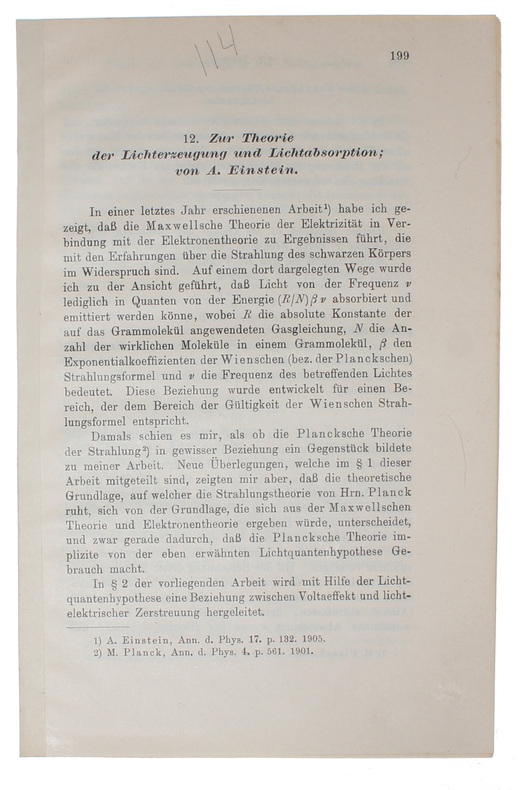
‎EINSTEIN, ALBERT. - THE NOBEL-PRIZE PAPER.‎

‎Zur Theorie der Lichterzeugung und Lichtsabsorption" (Eingegangen 13. März 1906). (On the Theory of Light Production and Light Absorption).‎

‎(Leipzig, Johann Ambrosius Barth, 1906). No wrappers. Extracted from ""Annalen der Physik"" Vierte Folge. Bd. 20. Pp. 199-206. Clean and fine.‎

‎First printing of one of the papers for which Einstein was awarded the Nobel Prize in 1921. It was for the papers ""Ueber einen die Erzeugung und Verwandlung des Lichtes betreffenden heuristischen Gesichtspunkt"" of 1905 and ""Zur Theorie der Lichterzeugung...( Theory of light emission and absorption), the offered item, that Einstein received the prize: ""for his services to theoretical physics and especially for his discoveryof the law of the photoelectrical effect"" - his reward was not based on relativity.""The quantum theory has affected virtually every branch of physics. Its earliest and one of its most significant developments was Einstein's application of the theory to what is known as the 'photo-electrical effect'....Einstein explained this effext by suggesting that the classical view that light is emitted in the form of continous waves must be abandoned. The photo-electrical effect could be explained only as an example of quantum action where the waves of light or X-rays are emitted in minute particles or bullets. It is he size of the bullet (the wave-lenght of the radiation) which determines the number of electrons ejected. It was for this, and not for the theory of relativity, that Einstein was awarded the Nobel Prize in 1921. Einstein's two fundamental papers on this subject are ""Ueber einem Erzeugung...."" 1905 and Zur Theorie der Lichterzeugung (the paper offered here)"" (PMM the note to 391).Weil: 12 (with an asterix, denoting a major paper) - Boni:12.‎

Bookseller reference : 46956

Livre Rare Book

Herman H. J. Lynge & Son
Copenhagen Denmark Dinamarca Dinamarca Danemark
[Books from Herman H. J. Lynge & Son]

€470.05 Buy

‎EINSTEIN, ALBERT. - THE PHOTOELECTRIC EQUATION.‎

‎Zur Theorie der Lichterzeugung und Lichtsabsorption (withbound:) Das princip von der Erhaltung der Schwerpunktsbewegung und die Trägheit der Energie" (2 papers).‎

‎Leipzig, Johann Ambrosius Barth, 1906. Bound together in one contemp. halfcalf. Spine gilt. Minor scratches to spine. A stamp to titlepage and htitle. ""Annalen der Physik. Vierte Folge. Band 20. Herausgegeben von Paul Drude."" , Portrait (Paul Drude), VIII,1048 pp. and 6 plates. Einstein papers: pp. 199-206 and 627-33. The entire volume offered.‎

‎Both papers first edition. It was for the papers ""Ueber einen die Erzeugung und Verwandlung des Lichtes betreffenden heuristischen Gesichtspunkt"" of 1905 and ""Zur Theorie der Lichterzeugung...( Theory of light emission and absorption), the offered item), that Einstein was awarded the Nobel Prize in 1921.""The quantum theory has affected virtually every branch of physics. Its earliest and one of its most significant developments was Einstein's application of the theory to what is known as the 'photo-electrical effect'....Einstein explained this effext by suggesting that the classical view that light is emitted in the form of continous waves must be abandoned. The photo-electrical effect could be explained only as an example of quantum action where the waves of light or X-rays are emitted in minute particles or bullets. It is he size of the bullet (the wave-lenght of the radiation) which determines the number of electrons ejected. It was for this, and not for the theory of relativity, that Einstein was awarded the Nobel Prize in 1921. Einstein's two fundamental papers on this subject are ""Ueber einem Erzeugung...."" 1905 and Zur Theorie der Lichterzeugung (the paper offered here)"" (PMM the note to 391). In the second paper (Principle of the conservation of the centre of mass motion and the inertia of energy) he shows that the conservation of mass is a special application of his energy principle (E= Mc2) - Weil: 12 & 13.Among the many papers in this volume we have Max von Laue: Zur Thermodynamik der Inteferenzerscheinungen. pp. 365-378.‎

Bookseller reference : 46962

Livre Rare Book

Herman H. J. Lynge & Son
Copenhagen Denmark Dinamarca Dinamarca Danemark
[Books from Herman H. J. Lynge & Son]

€872.95 Buy

‎"BERZELIUS, JÖNS JACOB. - THE INTERNATIONAL LANGUAGE OF CHEMISTRY INTRODUCED.‎

‎Experiments on the Nature of Azote, of Hydrogen, and of Ammonia, and upon the Degrees of Oxidation of which Azote is susceptible. (+) Essay on the Cause of Chemical Proportions, and on some Circumstances relating to them: together with a short and eas...‎

‎London, Robert Baldwin, 1813 a. 1814. 8vo. 2 contemp. hcalf. Marbled boards. Spines lacks and boards detached. In: ""Annals of Philosophy"" or Magazine of Chemistry, Mineralogy, Mechanics... By Thomas Thomson"". Vol. II and Vol. III. Entire volumes offered. Berzelius' papers: pp. 276-284, 357-368 (the first paper in vol. II), pp. 443-454 (vol. II) a. pp. 51-62, 93-106, 244-257 a. 353-364. (vol. III). Internally fine and clean.‎

‎First printing of these milestone papers in the history of chemistry, where Berzelius introduced his famous chemical symbolism whereby an element is generally represented by the first letter of its Latin name, or, in the event of elements having the same first letter, by the first two letters. Even though his atomic symbols were introduced in 1813 (see the note on p. 359 in the first paper), it was quite a few years before Berzelius's symbols were adopted by the chemistry community. But once accepted, they became the new international language of chemistry.Berzelius ""contributed more to the development of the atomic theory and to the setting up of accurate values of the atomic weights than did any other worker of the time. Of his contributions, moreover, to the development of the atomic theory and the advancement of chemical science, not the least valuable was the introduction of a chemical symbolism which, with slight modification, is in use at the present day. By giving his symbols a quantitative meaning - the symbol of an element representing one atomic proportion by weight - it was possible ""to show briefly and clearly the number of elementary atoms in each compound and, after the determination of their relative weights, present the results of each analysis in a simple and easely retained manner"". This symbolism was speedily adopted on the Continent but, in England, only after some considerable time.""(Findlay ""A Hundred Years of Chemistry"", p. 14.).Parkinson ""Breakthroughs"", 1813 C. - Leicester & Klickstein ""A Source Book in Chemistry"", p. 258 ff. - Holmberg 1813:28 a. The volume contains other notable papers THOMAS THOMSON ""On the Discovery of the Atomic Theory"", pp. 329-338. and JOHN DALTON ""Remarks on the Essay of Dr. Berzelius on the Cause of Chemical Proportions"", pp. 174-180 (Vol. III).‎

Bookseller reference : 46988

Livre Rare Book

Herman H. J. Lynge & Son
Copenhagen Denmark Dinamarca Dinamarca Danemark
[Books from Herman H. J. Lynge & Son]

€1,611.60 Buy

‎"DIRAC, P.A.M. - THE ALGEBRA OF QUANTUM MECHANICS.‎

‎The Elimination of the Nodes in Quantum Mechanics. (+) Relativity Quantum Mechanics with an Application to Compton Scattering. (2 papers).‎

‎London, Roayl Society, 1926. Royal 8vo. Full cloth. Gilt lettering to spine. In: ""Proceedings of the Royal Society"". Series A, Vol. 111. V,753,LIII pp., textillustr. and plates. (Entire volume offered).‎

‎First appearance of these papers constituting Dirac's own theory of quantum mechanics.""Dirac wanted to establish an algebra for quantum variables, or, as he now termed them, q-numbers... He wanted his q-number algebra to be a general and purely mathematical theory that could then be applied to problem of physics. Although it soon turned out that q-number algebra was equivalent to matrix mechanics, in 1926 Dirac's theory was developed as an original alternative to both wave mechanics and matric mechanics. It was very much Dirac's own theory, and he stuck to it without paying much attention to what went on inmatrix mechanics... In the summer of 1926, Dirac published a new and very general version of q-number algebra, this timepresented as a purely mathematical theory. In this paper (offered here) he did not refer to physics at all... The work had little impact on the physics community but seems to have been appreciated by those who cultivated the mathematical aspects of quantum physics. Most of the results obtained by Dirac in his paper ""The Elimination of the Nodes in Quantum Mechanics"" had been found earlier by the German theorists using a method of matric mechanics, but Dirac was able to improve on some of the results and deduce them from his own system of quantum mechanics.""(Helge Kragh).‎

Bookseller reference : 46991

Livre Rare Book

Herman H. J. Lynge & Son
Copenhagen Denmark Dinamarca Dinamarca Danemark
[Books from Herman H. J. Lynge & Son]

€470.05 Buy

‎"CHADWICK, J. (JAMES) & E.S. BIELER. - THE DISCOVERY OF THE STRONG NUCLEAR FORCES.‎

‎The Collisions of alpha particles with Hydrogen Nuclei.‎

‎(London, Taylor and Francis), 1921. Blank wrapper. In: ""The London, Edinburgh, and Dublin Philosophical Magazine and Journal of Science"" Sixth Series, Vol.42, No. 252, December 1921. Pp. 873-1024, textillustr. a. 1 plate. (Entire issue offered). Chadwick & Bieler's paper: pp. 923-940, textillustr.‎

‎First printingof this milestone paper in which the strong nuclear forces are mentioned for the first time.""It was only in 1921 that Chadwick had first shown that, at very small distances, the interactions of alpha particles with the atomic nucleus did not follow exactly the inverse square law predicted from the repulsion of their positive electrical scharges. Chadwick concluded that his experiments showed that these nuclear forces are of ""very great intensity"". According to Pais, this is THE FIRST PUBLISHED STATEMENT ABOUT THE EXISTENCE OF A STRONG NUCLEAR FORCE. This 'new force' interpretation was disputed untill well into 1920s.""(Hey & Walters).""In any event, Chadwick and Bieler's final conclusion avoid all reference to a possible electromagnetic cause for the deviations from the simple theory: ""The present experiments do not seem to throw any light on the nature of the law of variation of the forces at the seat of an electric charge, but merely show that the forces are of very great intensity... It is our task to find some field of force which will reproduce these effects."" I consider this statement, made in 1921, as marking the birth of the strong interaction.""(Pais in ""Inward Bound"", p. 240).‎

Bookseller reference : 46992

Livre Rare Book

Herman H. J. Lynge & Son
Copenhagen Denmark Dinamarca Dinamarca Danemark
[Books from Herman H. J. Lynge & Son]

€604.35 Buy

‎"CAILLETET, L. - RAOUL PICTET - THE LIQUEFACTION OF OXYGEN A BREAKTHROUGH IN LOW-TEMPERATURE CHEMISTRY.‎

‎De la Condensation de l'oxygè et de l'oxyde de carbone. (Cailletet) + Expériences sur la liquéfaction de l'oxygéne. (2 papers).‎

‎Paris, Gauthier-Villars, 1877. 4to. No wrappers. In: ""Comptes Rendus Hebdomadaires des Séances de L'Academie des Sciences"", Tome 85, No 26 (entire issue offered). With htitle and titlepage to vol. 85. Titlepage with a stamp on verso, seen on front. Pp. 1185-1248. Cailletet's paper: pp. 1213-1214. Pictet's paper: pp. 1214-1217. With an illustration of the apparatus in the text.‎

‎First printing of these two milestone papers in Low-temperature Chemistry. This process of liquefaction of oxygene was achieved independently, in the same year, by Cailletet and Pictet, using different methods. Cailletet used the Joule-Thomson effect"" oxygen was cooled while highly compressed, then allowed to rapidly expand, cooling it further, resulting in the production of small droplets of liquid oxygen. Pictet's method was more elaborate, using compounds pumps. (This compound is shown on the illustration in the text).Parkinson ""Breakthroughs"", 1877 C. - Magee ""Source Books in Physics"" p. 192-93 (Cailletet) and pp. 194-96 (Pictet).‎

Bookseller reference : 47000

Livre Rare Book

Herman H. J. Lynge & Son
Copenhagen Denmark Dinamarca Dinamarca Danemark
[Books from Herman H. J. Lynge & Son]

€604.35 Buy

‎FÆRØERNE - HOLM, P.A.‎

‎Skildringer og Sagn fra Færøerne. Med et Kaart og to Afbildninger. Andet, forøgede Oplag.‎

‎Kjøbenhavn, Schønbergs Forlag, 1860. Samtidigt hshirtbd. med rygforgyldning. (6),132 pp., litograferet kort samt 2 træsnitillustrationer, det ene helsides, det andet halvsides. Spredte brunpletter, mest bagerst.‎

Bookseller reference : 47002

Livre Rare Book

Herman H. J. Lynge & Son
Copenhagen Denmark Dinamarca Dinamarca Danemark
[Books from Herman H. J. Lynge & Son]

€201.45 Buy

‎"CURIE, JACQUES et PIERRE. - THE DISCOVERY OF PIEZOELECTRICITY.‎

‎Développement, par pression, de l'èlectricité polaire dans les cristaux hémièdres à faces inclinées. Note de MM. Jacques et Pierre Curie, présentée par M. Friedel.‎

‎Paris, Gauthier-Villars, 1880. 4to. No wrappers. In: ""Comptes Rendus Hebdomadaires des Séances de L'Academie des Sciences"", Tome 91, No 5 (entire issue offered). Pp. 251-310. The Curie's paper: pp. 294-295.‎

‎First apperance of the paper in which the two brothers announced their discovery of the Piezoelectric Effect, as they observed how an electric potential appeared across crystals of quartza and of Rochelle salt when pressure was applied to them. The potential varied directly with the pressure, and they named the phenomenon Piezoelectricity, meaning ""to press"" (Greek). Crystals with piezoelectric properties form an essential portion of sound-electronics devices such as microphones and record-players.""The applications of piezoelectric crystals are innumerable"" one of the most important is their use in frequency stabilization of oscillating electromagnetic cirasciots for radio broadcasting stations. They are used in most piezometers for measuring with great precision either very strong pressure variations, such as those of a cannon at the moment of firing, or very weak ones, such as artery pulsations. These applications have led to the creation of a new industry, the manufacture of large ""mono"" such as quartz obtained hydrothermally around 500°C. under high water pressures, or crystals such as Rochelle salt, obtained from aqueous solutions. These two substances were mentioned in the Curie brothers’ report announcing the discovery of piezoelectricity."" (DSB).""The first experimental demonstration of a connection between macroscopic piezoelectric phenomena and crystallographic structure was published in 1880 by Pierre and Jacques Curie. Their experiment consisted of a conclusive measurement of surface charges appearing on specially prepared crystals (tourmaline, quartz, topaz, cane sugar and Rochelle salt among them) which were subjected to mechanical stress. These results were a credit to the Curies' imagination and perseverance, considering that they were obtained with nothing more than tinfoil, glue, wire, magnets and a jeweler's saw."" (Piezo Systems, Inc.).Magee ""A Source Book in Physics"", p. 547 ff.‎

Bookseller reference : 47008

Livre Rare Book

Herman H. J. Lynge & Son
Copenhagen Denmark Dinamarca Dinamarca Danemark
[Books from Herman H. J. Lynge & Son]

€604.35 Buy

‎"FRESNEL, A. (AUGUSTIN). - THE ""SECOND MEMOIR"" OF 1827, FIRST ENGLISH EDITION.‎

‎Memoir on Double Refraction. (From the Mémoires de l'Academie Royale des Sciences d l'Institut de France, tome vii. 1827).‎

‎London, Taylor and Francis, 1852. 8vo. Without wrappers. In: ""Scientific Memoirs, selected from Transactions of Foreign Academies of Science... Edited by Richard Taylor."", Vol. V, Part XVIII. With titlepage to Vol. V. Pp. (151-) 352 (entire part offered). Fresnel's paper: pp. 238-333. Clean and fine. Titlepage with a small faint stamp.‎

‎First appearance in English of Fresnel's famous memoir - the memoir of 1827, his so-called second memoir - in which some of his groundbreaking discoveries concerning light is stated. He applies the concept of transverse waves to double refraction and representing the final construction, in the form of an equation of the fourth degree.In the paper Fresnel also explained the fact,that in some cases of quartz the rotation of polarization is from left to right and in other cases from right to left.. He proposed the term 'helical' to denote the property of rotating the plane of polarization, exhibited by such bodies as quartz. The term 'natural rotatory polarisation' is however, generally used.This memoir contains the first printing of three unpublished memoirs from 1821 and 1822 (Mémoire sur la double refraction.Extrait Read 26. Nov., 1821 - Supplement, presented 22 January 1822 - Second Supplement, presented April 1, 1822. - Explication de la réfraction dans le système des Ondes from ""Bulletin Soc. Philom."", 1821. See Jed. Z. Buchwald ""The Rise of the Wave Theory of Light"", pp. 461-63.‎

Bookseller reference : 47019

Livre Rare Book

Herman H. J. Lynge & Son
Copenhagen Denmark Dinamarca Dinamarca Danemark
[Books from Herman H. J. Lynge & Son]

€470.05 Buy

‎"DIRAC, P.A.M. (PAUL ADRIEN MAURICE). - THE RADIATION THEORY, THE BIRTH OF QUANTUM ELECTRODYNAMICS‎

‎The Quantum Theory of Emission and Absorption of Radiation. (+) The Quantum Theory of Dispersion. (2 Papers).‎

‎London, Harrison And Sons, Ltd., 1927. Royal8vo. Contemp. full cloth. A small stamp on verso of titlepage. In: ""Proceedings of the Royal Society of London"", Series A, Vol. 114. VI,IX,748 pp. (entire volume offered). Dirac's papers: pp. 243-265 a. pp. 710-728. Clean and fine.‎

‎First appearance of these milestone papers in Quantum Physics, constituting the first step in Quantum Field Theory and the invention of the Second Quantifization Method. By these papers Dirac ""gave the foundation for that theory, quantum electrodynamics""(Pais).""A New Radiation Theory. Dirac liked his transformation theory because it was the outcome of a planned line of research and not a fortuitous discovery. He forced his future investigations to fit it. The first results of this strategy were almost miraculous. First came his new radiation theory, in February 1927, which quantized for the first time James Clerk Maxwell’s radiation in interaction with atoms. Previous quantum-mechanical studies of radiation problems, except for Jordan’s unpopular attempt, retained purely classical fields. In late 1925 Jordan had applied Heisenberg’s rules of quantization to continuous free fields and obtained a light-quantum structure with the expected statistics (Bose Einstein) and dual fluctuation properties. Dirac further demonstrated that spontaneous emission and its characteristics—previously taken into account only by special postulates—followed from the interaction between atoms and the quantum field. Essential to this success was the fact that Dirac’s transformation theory eliminated from the interpretation of the quantum formalism every reference to classical emitted radiation, contrary to Heisenberg’s original point of view and also to Schrödinger’s concept of ? as a classical source of field.This work was done during Dirac’s visit to Copenhagen in the winter of 1927. Presumably to please Bohr, who insisted on wave-particle duality and equality, Dirac opposed the ""corpuscular point of view"" to the quantized electromagnetic ""wave point of view."" He started with a set of massless Bose particles described by symmetric ? waves in configuration space. As he discovered by’ playing with the equations, ’ this description was equivalent to a quantized Schrödinger equation in the space of one particle"" this’ second quantization’ was already known to Jordan, who during 1927 extended it into the basic modern quantum field representation of matter. Dirac limited his use of second quantization electromagnetic to radiation: to establish that the corpuscular point of view, once brought into this form, was equivalent to the wave point of view.""(DSB).‎

Bookseller reference : 47023

Livre Rare Book

Herman H. J. Lynge & Son
Copenhagen Denmark Dinamarca Dinamarca Danemark
[Books from Herman H. J. Lynge & Son]

€1,141.55 Buy

‎"KORTEWEG, D.J. & G. DE VRIES - THE KORTEWEG-DE VRIES EQUATION FOR THE SOLITARY WAVE‎

‎On the Change of Form of Long Waves advancing in a Rectangular Canal, and on a New Type of Long Stationary Waves.‎

‎London,Taylor and Francis, 1895. 8vo. Contemp. hcalf. Gilt lettering to spine. A stamp at foot of titlepage. In: No wrappers. In: ""The London, Edinburgh and Dublin Philosophical Magazine and Journal of Science"", Vol. XXXIX, Fifth Series. VI,(1),552 pp. a. 7 plates. The paper: pp. 422-443. Internally clean and fine.‎

‎First appearance of the paper in which the authors set forth the equation which bears their name.The equation is named for Diederik Korteweg and Gustav de Vries who studied it, though the equation first appears in Boussinesqs work, 1877.""In mathematics and physics, a soliton is a self-reinforcing solitary wave (a wave packet or pulse) that maintains its shape while it travels at constant speed. Solitons are caused by a cancellation of nonlinear and dispersive effects in the medium.... Solitons arise as the solutions of a widespread class of weakly nonlinear dispersive partial differential equations describing physical systems. The soliton phenomenon was first described by John Scott Russell (1808-1882) who observed a solitary wave in the Union Canal in Scotland. He reproduced the phenomenon in a wave tank and named it the ""Wave of Translation"".Scott Russell's experimental work seemed at odds with Isaac Newton's and Daniel Bernoulli's theories of hydrodynamics. George Biddell Airy and George Gabriel Stokes had difficulty accepting Scott Russell's experimental observations because they could not be explained by the existing water wave theories. Their contemporaries spent some time attempting to extend the theory but it would take until the 1870s before Joseph Boussinesq and Lord Rayleigh published a theoretical treatment and solutions. In 1895 Diederik Korteweg and Gustav de Vries provided what is now known as the Korteweg-de Vries equation, including solitary wave and periodic cnoidal wave solutions."" (Wikipedia).‎

Bookseller reference : 47026

Livre Rare Book

Herman H. J. Lynge & Son
Copenhagen Denmark Dinamarca Dinamarca Danemark
[Books from Herman H. J. Lynge & Son]

€268.60 Buy

‎"WURTZ, ADOLPHE. - ANNOUNCING THE DISCOVERY OF THE AMINES IN CHEMISTRY.‎

‎Sur une série d'alcalis organiques homologues avec l'ammoniaque.‎

‎(Paris, Bachelier), 1849. 4to. No wrappers. In: ""Comptes Rendus Hebdomadaires des Séances de L'Academie des Sciences"", Tome 28, No 7. Pp. 189-240 (entire issue offered). Wurtz's paper: pp. 223-226.‎

‎First appearance of the announcement of Wurtz's outstanding discovery of Liebig’s prediction, that there might be organic compounds analogous to ammonia and derivable from it by the replacement of hydrogen - the amines. The entire memoir was not published in full until 1855 in 'Annales de Chimie et de Physique'.Wurtz is most noted for his investigation of glycols and for his discovery of the amines. The latter discovery in 1849 (the paper offered) was very significant at the time, for ot suggested the possibility of a new type, the ammonia type, which helped to explain the behaviour of nitrogenous compounds. (Leicester & Klickstein ""A Source Book.."", pp. 362-63). - Parkinson ""Breakthroughs"" 1849 C.‎

Bookseller reference : 47031

Livre Rare Book

Herman H. J. Lynge & Son
Copenhagen Denmark Dinamarca Dinamarca Danemark
[Books from Herman H. J. Lynge & Son]

€335.75 Buy

‎"COMPTON, ARTHUR HOLLY. - THE DISCOVERY OF THE COMPTON-EFFECT, NOBEL PRIZE PAPER.‎

‎A Quantum Theory of the scattering of X-Rays by Light Elements.‎

‎Lancaster, The Physical Review, 1923. Royal8vo. Contemp. full buckram. In:""The Physical Review"", Series II, vol. 21. (4),736 pp., Plates and textillustr. (Entire volume offered). A perforated stamp in upper margin on a few leaves. Compton's paper: pp. (483-) 501.‎

‎First printing of this milestone paper in quantum physics in which Compton verifies Planck's quantum postulate and found that some of the X-rays had, in scattering, lenghtened their wavelenght. This phenomena was called the ""Compton Effect"" in his honour. For this discovery Compton received the Nobel prize in physics in 1927.""Compton was able to account for this (lenghtening of wavelenght) by presuming that a photon of light struch an electron, which recoiled, subtracting some energy from the photon and therefore increasing its wavelenght. This made it seem that a photon acted as a particle: thus after more than a century, the particulate natuer of light, as evolved by Newton, was revived... What itamounted to was that Compton brought to fruition the view that electromagnetic radiation had both a wave aspect and a particle aspect, and that the aspect which was most evident depended on how the radiation was tested. De Broglie was, at the same time, showing that this held true also for ordinary particles, such as electrons."" (Asimov)Parkinson ""Breakthroughs"", 1923 P. - Sigmund Brandt ""The Harvest of as Century"", Episode 31.‎

Bookseller reference : 47061

Livre Rare Book

Herman H. J. Lynge & Son
Copenhagen Denmark Dinamarca Dinamarca Danemark
[Books from Herman H. J. Lynge & Son]

€2,686.00 Buy

‎"WILSON, C.T.R. - THE ""WILSON-CLOUD-CHAMBER"" BROUGHT TO PERFECTION.‎

‎Investigations on X-Rays and Beta-Rays by the Cloud Method.. Part I. - X-Rays. Part II. - Beta-Rays. (2 Papers).‎

‎London, Harrison and Sons, 1923. Royal8vo. Contemp. full cloth, gilt lettering to spine. A small stamp to verso of titlepage and on foot of a few leaves.. In: ""Proceedings of the Royal Society"", Series A, Vol. 104. VI,(6),676,XXXII pp., textillustr. and plates. (Entire volume offered). Wilson's papers: pp. (1-) 24 and 12 plates + pp. 192-212 and 9 plates.‎

‎First printing of the paper in which Wilson had brought his Cloud Chamber to perfection and showed the photographic tracks of the particles. The Cloud Chamber was the first detector of radioacticity and nuclear transmutations and it played an importent role in experimental particle physics e.g. the discovery of the positron. Wilson received the Nobel prize - together with Arthur Compton - in physics in 1927 for his work on the Cloud Chamber.""The 21 cloud chamber pictures of X-rays and beta-rays on coated stock printed recto only were the culmination of many years research by Wilson and at last showed the full potential of this method as a tool for particle physicists. Early in 1911 (Wilson) was the first person to see and photograph the tracks of individual alpha-particles and electrons. The event aroused great interest as the paths of the alpha-particle were just as W.H. Bragg had drawn them in publication some years earlier. But it was not until 1923 (the paperoffered) that the clous chamber was brought to perfection and led to his two, beautifully illustrated classic papers on the track of electron."" (The Nobel Foundation).‎

Bookseller reference : 47063

Livre Rare Book

Herman H. J. Lynge & Son
Copenhagen Denmark Dinamarca Dinamarca Danemark
[Books from Herman H. J. Lynge & Son]

€671.50 Buy

‎"POINCARÉ, HENRI. - THE POINCARÉ RELATIVITY PRINCIPLE.‎

‎Sur la dynamique de l'electron. (Séance du Lundi 5 Juin 1905).‎

‎Paris, Gauthier-Villars, 1905. 4to. No wrappers. In: ""Comptes Rendus Hebdomadaires des Séances de L'Academie des Sciences"", Tome 140, No 23. Titlepage to vol. 140. Pp. (1497-) 1572. (Entire issue offered). Poincaré's paper: pp. 1504-1508. Titlepage with a stamp on verso. A bit of upper right corner gone. Leaves a bit fragile, caused by the poor paperquality. Clean.‎

‎First printing of this famous paper delivered to the Academy of Paris on its session of June 1905, as the first Poincaré relativistic text ""On the dynamic of electron"", where Poincaré set forth the essential element of relativity and the ""Lorentz Transformation"". Poincaré concludes ""It seems that this impossibility of demonstrating absolute motion is a general law of nature"" !! and that Newton's law need modification and that there should exist gravitational waves which propagate with the velocity of light !! - This famous paper gave rice to the controversy about priority around the discovery of special relativity as Poincaré's paper is from June 5 and Einstein's first paper on relativity was received by the ""Annalen"" on June 30, both 1905.""The official history tells us that Einstein, without having read the works of Lorentz and Poincaré past 1895 and without any prior publication on the subject, had written alone in Bern the ""founder paper"" of the Relativity in the last days of June 1905. For that reason, and a few other of less importance, the biographers of Einstein have called that year 1905 ""Annus mirabilis"" and its centenial is celebrated in 2005. However on June 5, 1905, after many other papers on this subject, Poincaré had presenteda note at the French Academy of Science, a text that contains the essential elements of Einstein paper: the relativity principle and the ""Lorentz transformation"". This coincidence involves the suspicion of a possible plagiarism of Poincaré by Einstein."" (C. Marchal ""Poincaré, Einstein and the Relativity: the Surprising Secret.""‎

Bookseller reference : 47065

Livre Rare Book

Herman H. J. Lynge & Son
Copenhagen Denmark Dinamarca Dinamarca Danemark
[Books from Herman H. J. Lynge & Son]

€1,343.00 Buy

‎"VON NEUMANN, JOHANN (JOHN). - THE MATHEMATICAL FOUNDATION OF QUANTUM MECHANICS.‎

‎Mathematische Grundlagen der Quantenmechanik. (+) Wahrscheinlichkeitstheoretischer Aufbau der Quantenmechanik. (+) Thermodynamik quantenmechanischer Gesamtheiten. (3 Papers).‎

‎Berlin, Weidmannsche Buchhandlung, 1928. 8vo. Full cloth, but spine gone. In: ""Nachrichten von der Gesellschaft der Wissenschaften zu Göttingen aus dem Jahre 1927"". (4),469 pp. Von Neumann's papers: pp. 1-57, pp. 245-272 a. pp. 273-291. Internally clean and fine.‎

‎First printing of von Neumann's importent papers in which he gave a mathematically precise formulation of the foundation of Quantum MeChanics, basing the theory on the use of Hilbert spaces.""He (von Neumann) developed between 1927 and 1929 a new mathematical framework of the theory subsequently proved to be the most suitable formalism of nonrelativistic quantum mechanics as we use it today, as well as of its extensions, the relativistic quantum mechanics of partcles and the quantum theory of fields.""(Max Jammer ""The Conceptual Development og Quantum Mechanics"", pp.314-15""Von Neumann’s most famous work in theoretical physics is his axiomatization of quantum mechanics. When he began work in that field in 1927, the methods used by its founders were hard to formulate in precise mathematical terms"" ""operator"" on ""functions"" were handled without much consideration of their domain or definition to their topological properties: and it was blithely assumed that such ""operators,"" when self-adjoint, could always be ""diagonalized"" (as in th finite dimensional case), at the expense of introducing ""Dirac functions"" as ""eigenvectors."" Von Neumann showed that mathematical rigor could be restored by taking as basic axioms the assumptions that the states of a physical system were poinds of a Hilbert space and that the measurable quantities were Hermitian (generally unbounded) operators densely efined in that space. This formalism. the practical use of which became available after von Neumann had developed the spectral theory of unbounded Hermitian operators (1929), has survived subsequent developments of quantum mechanics and is still the basisi of non relativistic quantum theory"" with the introduction of the theory of distributions, it has even become possible to interpret its results in a way similar to Dirac’s original intuition.""(DSB).‎

Bookseller reference : 47068

Livre Rare Book

Herman H. J. Lynge & Son
Copenhagen Denmark Dinamarca Dinamarca Danemark
[Books from Herman H. J. Lynge & Son]

€738.65 Buy

‎"FERMI, E., E. AMALDI, O. D'AGOSTINO, F. RASETTI, E. SEGRÉ. - THE FIRST ARTIFICIAL RADIOACTIVITY BY NEUTRON BOMBARDMENT.‎

‎Artificial Radioactivity produced by Neutron Bombardment. (Communicated by Lord Rutherford) + Artificial Radioactivity produced by Neutron Bombardment - II. (Communicated by Lord Rutherford). 2 Papers.‎

‎London, Harrison and Sons, 1934 a. 1935. Royal8vo. Bound in 2 contemp. full cloth. Gilt lettering to spine. A stamp on verso of titlepages. In: ""Proceedings of the Royal Society"", Series A, Vol. 146 and vol. 149. VI,942 pp. + VIII,600 pp. (Entire volumes offered). The joint papers: pp. 483-500 (1934) and pp. 522-558 (1935).‎

‎These seminal papers constitutes the description of the first realization of artificial radioactivity produced by neutron bombardment, and it is the first demonstration of neutron-induced radioactivity. These highlights and his many other results have left their imprint on the most diverse parts of physics. Fermi was awarded the Nobel prize in 1938 for these discoveries.""Acting on this idea, (Fermi reasoned that neutrons should be more effective than alpha particles in producing radioactive elements because they are not repelled by the nuclear charge and thus have a much greater probability of entering the target nuclei) Fermi bombarded several elements of increasing atomic numbers with neutrons. He hoped to find an artificial radioactivity produced by the neutrons. His first success was with fluorine. The neutron source was a small ampul containing beryllium metal and radon gas. The detecting apparatus consisted of rather primitive Geiger-Müller counters. Immediately thereafter Fermi, with the help of Amaldi, D’Agostino, Rasetti, and Segrè, carried out a systematic investigation of the behavior of elements throughout the periodic table. In most cases they performed chemical analysis to identify the chemical element that was the carrier of the activity. In the first survey, out of sixty-three elements investigated, thirty-seven showed an easily detectable activity. The nuclear reactions of (n, a), (n, p), and (n, ?) were then identified, and all available elements, including uranium and thorium, were irradiated. In uranium and thorium the investigators found several forms of activity after bombardment but did not recognize fission. Fermi and his collaborators, having proved that no radioactive isotopes were formed between lead and uranium, put forward the natural hypothesis that the activity was due to transuranic elements. These studies, which were continued by Otto Hahn, Lise Meitner, Irène Joliot Curie, Frédéric Joliot, and Savitch, culminated in 1938 in the discovery of fission by Hahn and Fritz Strassmann.""(DSB).""The present papers are a summary of these letters (the letters from the team communicated almost weakly to ""Ricerca Scientifica"") for the English speaking readers. ""When we (Fermi and Segre) went to Cambridge, we discussed with him (rutherford), in great detail, our work. The work which had been accomplished up to that date by our group is summarized in a paper which was presented by Lord Rutherford to the Royal Society (Paper No. 98). The manuscript of this paper had been prepared in Rome and delivered to him in Cambridge. he read it immediately with great attention, made several corrections to improve our English, and turned it over to the Royal Society. I asked him whether it would be possible to obtain a speedy publication and he immediately answered ""What did you think I was President of the Royal Society for ?"" (Collected Papers of Enrico Fermi, Vol. I, p. 641).Volume 149 contains the importent joint paper on SUPERCONDUCTIVITY by the brothers FRITZ And H. LONDON ""The Electromagnetic Equations of the Superconductor"", pp. 71-88.""In 1933 shortly before Heinz London joined his brother at Oxford, W. Meissner and R. Ochsenfeld made a startling discovery. It was well known that currents in superconductors flow in such a way as to shield points inside the material from changes in the external magnetic field. This indeed is an obvious property of any resistance less medium, fully discussed by Maxwell in 1873 long before the discovery of superconductivity. But a superconductor does more. Whereas a zero resistance medium only counteracts changes in the field, it actually tends to expel the field present in its interior before cooling.... The London quickly saw its implications and in 1935 published a joint paper on the electrodynamics of superconductors, in which they replaced (paper by Deaver and Fairbanks) by a new phenomenological equation connecting the current with the magnetic rather than the electric field... ""(DSB).‎

Bookseller reference : 47070

Livre Rare Book

Herman H. J. Lynge & Son
Copenhagen Denmark Dinamarca Dinamarca Danemark
[Books from Herman H. J. Lynge & Son]

€1,678.75 Buy

‎"CURIE, IRÈNE et M.F. JOLIOT. - ANNOUNCING THE DISCOVERY OF ARTIFICIAL RADIOACTIVITY - NOBEL PRIZE PAPER OF 1935.‎

‎Un nouveau type de radioactivité. (Séance du 15 Janvier 1934).‎

‎Paris, Gauthier-Villars, 1934. 4to. No wrappers. In: ""Comptes Rendus Hebdomadaires des Séances de L'Academie des Sciences"", Tome 198 No 3. Titlepage to vol. 198. Pp. (213-) 292. (Entire issue offered). The joint paper: pp. 254-256 a. 1 photographic illustration in the text. Titlepage with a stamp on verso, 2 small tears and a tiny bit of upper right corner gone. Titlepage a bit browned.‎

‎First appearance of this seminal paper in which artificial radioactivity was announced for the first time. Curie and Joliot were awarded the Nobel Prize in Chemistry 1935 ""in recognition of their synthesis of new radioactive elements"".""Until this date (1934), atomic nuclei emitting radiation were found in nature: it was called the natural radioactivity. It had been known since Rutherford that this natural radioactivity changed a nucleus into an other one: for instance radium becomes finally lead after many radioactive decays. We could say that lead does not become gold but gold becomes lead! But... this change of matter was not under control. It was not possible to construct the desired chemical element as the alchemist dreamed... But Irene and Frederic Joliot-Curie, made the dream become almost reality.""""Another very important development in the early 1934 by the Joliot-Curies in connection with irradiation of aluminum by alpha particles. The two French scientists detected the production of the recently discovered positrons. [...] However, they soon realized that the positron activity continued after the alpha source was removed and that they had, in fact, discovered positive beta radioactivity. The importance of the discovery of artificial radioactivity was immediately recognized and resulted in a Nobel Prize in chemistry to the Joliot-Curies in 1935. The new phenomenon immediately became widely employed in nuclear physics, chemistry, biology, and medicine."" (Kragh, Quantum Generations, p. 187)""These elegant experiments, which provided the first chemical proof of induced transmutations and showed the possibility of artificially creating radioisotopes of known stable elements, were repeated and extended in the major nuclear physics laboratories of various countries "" (DSB).Born on 12 September 1897 in Paris, Irène Curie was the daughter of Pierre and Marie Curie. ""During World War I, she worked as a nurse, helping her mother operate radiography equipment, and then studied physics and mathematics at the Sorbonne, gaining a doctorate for studying the range of alpha particles. She then went to work for her mother at the Radium Institute. There she met Frédéric Joliot whom she married in 1926. Frédéric Joliot was born on 19 March 1900 in Paris - He joined the Radium Institute in 1925 and obtained his PhD in 1930. Together the Joliot-Curies worked on radioactivity and the transmutation of the elements. Twice they just missed major discoveries: in 1932 when Chadwick beat them to the neutron, and in 1933 when Anderson discovered the positron. However, in 1934, whilst bombarding light elements with alpha particles, the Joliot-Curies noticed that, although proton production stopped when the alpha particle bombardment stopped, another form of radiation continued. The alpha particles had produced an isotope of phosphorus not found in nature. This isotope was radioactive and was decaying through beta-decay"" (DSB).‎

Bookseller reference : 47071

Livre Rare Book

Herman H. J. Lynge & Son
Copenhagen Denmark Dinamarca Dinamarca Danemark
[Books from Herman H. J. Lynge & Son]

€1,007.25 Buy

‎"EINSTEIN, A. & N. ROSEN. - THE SILBERSTEIN-EINSTEIN CONTROVERSY.‎

‎Two-Body Problem in General Relativity Theory.‎

‎Lancaster, American Physical Society, 1936. 4to. In: ""The Physical Review"", Vol. 49, Second Series. X,971 pp. (Entire volume offered). Einstein & Rosen's paper: pp. 404-405.‎

‎First printing of Einstein and Rosen's answer to Silberstein's critique of Einstein's Theory of Relativity ..""Ludwik Silberstein, who initially was a supporter of the special theory, objected at different occasions against general relativity. In 1920 he argued that the deflection of light by the sun, as observed by Arthur Eddington et al. (1919), is not necessarily a confirmation of general relativity, but may also be explained by the Stokes-Planck theory of complete aether drag. However, such models are in contradiction with the aberration of light and other experiments (see ""Alternative theories""). And in 1935, Silberstein claimed to have found a contradiction in the Two-body problem in general relativity. However, also this claim was refuted by Einstein and Rosen (1935) (in the paper offered).""(Wikipedia).‎

Bookseller reference : 47073

Livre Rare Book

Herman H. J. Lynge & Son
Copenhagen Denmark Dinamarca Dinamarca Danemark
[Books from Herman H. J. Lynge & Son]

€241.74 Buy

‎"NAVIER, (CLAUDE L.M.H.). - THE NAVIER-STOKES EQUATIONS FOR FLUID FLOW.‎

‎Sur les Lois des mouvemens des fluides, en ayant égard à l'adhésion des molécules.‎

‎Paris, Crochard, 1821. Contemp. hcalf. Spine gilt with tome-and titlelabels with gilt lettering. Wear to top of spine. A crack along first hinge, but cover not loose. In 'Annales de Chimie et de Physique', Volume 19. (Entire volume offered). 448 pp. a. 2 plates. Navier's paper: pp. 244-260. A faint dampstain to margins of the first 20 leaves and a bit seen on the following pages, decreasing.‎

‎First appearance of Navier's famous paper in which he describes the relations between fluid flow and friction, giving the FUNDAMENTAL EQUATIONS OF THE MATHEMATICAL THEORY OF ELASTICITY. The full paper was not published until 1828. Stokes's analysis of the internal friction of fluids was published in 1845, and as he was not familiar with the French litterature of mathematical physics, he derived independently his own equations, which accounts for the double-name of the equations. ""The Navier-Stokes equation is now regarded as the universal basis of fluid mechanics, no matter how complex and unpredictable the behavior of its solutions may be. It is also known to be the only hydrodynamic equation that is compatible with the isotropy and linearity of the stress-strain relation."" (Olivier Darrigol).""Navier studied the motion of solid and liquid bodies, deriving the partial differential equations to which he applied Fourier's methods to find particular solutions. This theoretical research led him to formulate the well-known equation identified with his name and that of Stokes. Navier viewed bodies as made up of particles which are close to each other and which act on each other by means of two opposing forces - one of attraction and one of repulsion - which, when in a state of equilibrium, cancel each otherout. The repelling force resulted from the caloric that a body possessed. When equilibrium is disturbed in a solid, a restoring force acts which is proportional to the change in distance between the particles.""(DSB, X, p. 4).""The equations are useful because they describe the physics of many things of academic and economic interest. They may be used to model the weather, ocean currents, water flow in a pipe and air flow around a wing. The Navier-Stokes equations in their full and simplified forms help with the design of aircraft and cars, the study of blood flow, the design of power stations, the analysis of pollution, and many other things. Coupled with Maxwell's equations they can be used to model and study magnetohydrodynamics. ""(Wikipedia).‎

Bookseller reference : 47074

Livre Rare Book

Herman H. J. Lynge & Son
Copenhagen Denmark Dinamarca Dinamarca Danemark
[Books from Herman H. J. Lynge & Son]

€671.50 Buy

‎[THE ECONOMIST].‎

‎The Economist, Weekly Commercial Times, Bankers' Gazette, and Railway Monitor: A Political Literary, and General Newspaper.‎

‎London, The Economist Office, 1876. Small folio. Bound in comtemporary half cloth with paper label pasted on to spine. Entire volume 34, July-December, 1876 of The Economist. Front hinge weak, internally very fine and clean. 761-1532 pp.‎

‎Original printing of The Economist - the most important and influential economic journal worldwide - from the year 1876.‎

Bookseller reference : 47088

Livre Rare Book

Herman H. J. Lynge & Son
Copenhagen Denmark Dinamarca Dinamarca Danemark
[Books from Herman H. J. Lynge & Son]

€134.30 Buy

‎[THE ECONOMIST].‎

‎The Economist, Weekly Commercial Times, Bankers' Gazette, and Railway Monitor: A Political Literary, and General Newspaper.‎

‎London, The Economist Office, 1879. Small folio. Bound in comtemporary half cloth with paper label pasted on to spine. Entire volume 34, July-December, 1876 of The Economist. Front hinge weak, internally very fine and clean. 761-1532 pp.‎

‎Original printing of The Economist - the most important and influential economic journal worldwide - from the year 1879.‎

Bookseller reference : 47089

Livre Rare Book

Herman H. J. Lynge & Son
Copenhagen Denmark Dinamarca Dinamarca Danemark
[Books from Herman H. J. Lynge & Son]

€134.30 Buy

‎"JOULE, J.P. (JAMES PRESCOTT) - ONE OF THE MOST IMPORTENT IMPROVEMENTS OF THE STEAM-ENGINE.‎

‎On the Surface-condensation of Steam. Received October 10, - Read December 13, 1860.‎

‎(London, Taylor and Francis, 1862). 4to. No wrappers as extracted from ""Philosophical Transactions"" 1862 - Vol. 151. Pp. 133-160, 1 large textillustration.‎

‎First appearance of Joule's paper in which he describes his importent improvement of the Steam-Engine, using the principles of the first law of thermodynamics which he himself helped to establish.""In addition, numerous other researches stand to Joules credit -- the work done in compressing gases and the thermal changes they undergo when forced under pressure through small apertures (with Lord Kelvin), the change of volume on solution, the change of temperature produced by the longitudinal extension and compression of solids, etc. It was during the experiments involved by the first of these inquiries that Joule was incidentally led to appreciate the value of surface condensation in increasing the efficiency of the steam engine. A new form of condenser was tested on the small engine employed, and the results it yielded formed the starting-point of a series of investigations which were aided by a special grant from the Royal Society, and were described in an elaborate memoir presented to it on the 13th of December 1860 (the paper offered). His results, according to Kelvin, led directly and speedily to the present practical method of surface-condensation, one of the most important improvements of the steam engine, especially for marine use, since the days of James Watt. Joule died at Sale on the 11th of October 1889.""(NNDB)‎

Bookseller reference : 47108

Livre Rare Book

Herman H. J. Lynge & Son
Copenhagen Denmark Dinamarca Dinamarca Danemark
[Books from Herman H. J. Lynge & Son]

€335.75 Buy

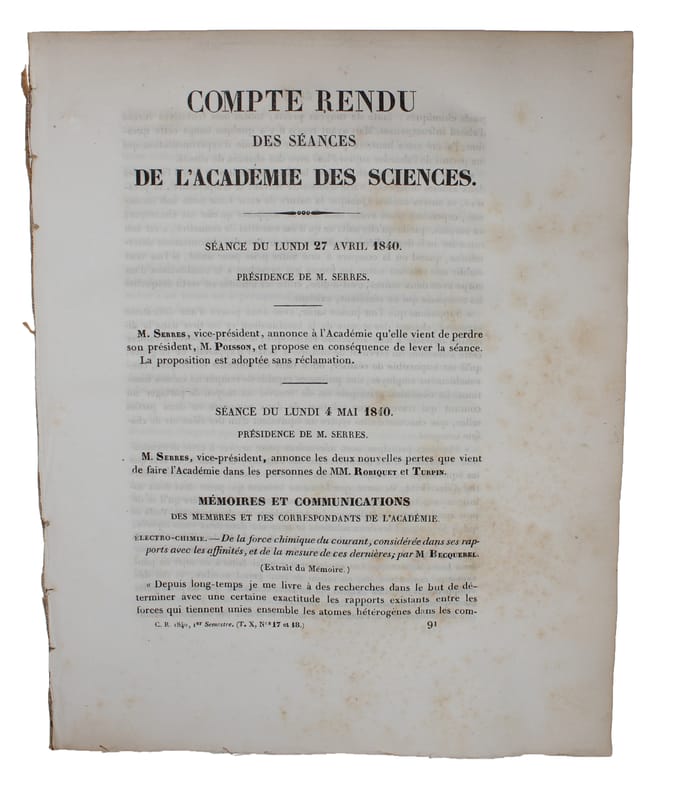
‎DUMAS, (JEAN BAPTISTE-ANDRE). - THE MAIN PAPER ON SUBSTITUTION AND THE THEORY OF TYPES.‎

‎Mémoire sur la loi des substitutions et la Theorie des types" Séance du Lundi 5 Février 1840.‎

‎Paris, Bachelier, 1840 4to. No wrappers. In: ""Comptes Rendus Hebdomadaires des Séances de L'Academie des Sciences"", Tome X , No 5 (entire issue offered). Pp. (143-) 207. Dumas' paper: pp. 149-178.‎

‎First appearance of this paper, which was published the same year in 'Annales de Chimie et de Physique', is the most importent on the theory of structural types and the nomenclature of organic compounds, refuting the electrochemical theory of Berzelius. ""The development of this idea (type organique) into what is sometimes called the ""Older Type Theory"", as distinguished from Gerhardt's Type heory, is contained in Dumas' importent memoir on the substitution and the theory of types, presented on 3 febriary 1840.""(Partington IV, p. 365). ""Jean Baptiste Dumas advances a theory that the chemical properties of an organic compound are determined by its structure and not, as seems to be the case with inorganic compounds, by its electrical properties. he illustrates the concept with the example that the basic qualitative properties of acetic acid are retained even after replacing three fourths of the hydrogen by chlorine. As a consequence, he calls for a revision of chemical nomenclature for organic compounds, basing terms on common features, not on elemental composition.""(Parkinson ""Breakthroughs"" 1840 C).‎

Bookseller reference : 47109

Livre Rare Book

Herman H. J. Lynge & Son
Copenhagen Denmark Dinamarca Dinamarca Danemark
[Books from Herman H. J. Lynge & Son]

€470.05 Buy

‎"BERNARD, CLAUDE. - THE DISCOVERY AND ISOLATION OF GLYCOGENE.‎

‎Sur le mécanisme de la formation du sucre dans le foie. (+) Suite Sur le mécanisme... (+) Remarques sur la formation de la matière glycogène du foie. (3 Papers).‎

‎Paris, Mallet-Bachelier, 1855 a. 1857. 4to. No wrappers. In: ""Comptes Rendus Hebdomadaires des Séances de L'Academie des Sciences"", Tome 41, No 13 and Tome 44, No 12 a. No. 26. Pp. 461-500, pp. 578-640 a. pp. 1293-1363 (3 entire issues offered). Bernard's papers: pp. 461-469, pp. 578-586 a. pp. 1325-1331. Some scattered brownspots to the first paper.‎

‎First printing of these two milestone-papers in physiology in which Bernard discovers and isolates glycogen from the liver, shows that it is converted into blood glucose, and discovers the process of gluconeogenesis. He further creates the concepts ""experimental determination"" and ""local interieur""Bernard undertook the task of tracing out the various transformations of food stuffs within the animal organism, beginning with the carbohydrates"" and he not only found, contrary to the accepted view, that sugar was formed in the liver, but he was also able to isolate a substance from the hepatic tissue which, though not sugar, was converted by fermentation into dextrose. He made a special study of its properties and called it ""glycogen"".""The culmination of Bernard's work on the glycogenic function of the liver. He invented the term ""internal secretion"", and can be said to have started the scientific investigation of the internal secretions, although for 30 years the significance of his work was not generally realized. By his research on glycogene Bernard showed that the body not only can break down, but can also build up, complex chemical substances.""(Garrison & Morton) .Claude Bernard (1813-78) was a key figure in French nineteenth-century science, and one of the world's great physiologists. With good reason he has been called the ‘father of experimental medicine’.Garrison & Morton No. 1000 a. 999.1‎

Bookseller reference : 47110

Livre Rare Book

Herman H. J. Lynge & Son
Copenhagen Denmark Dinamarca Dinamarca Danemark
[Books from Herman H. J. Lynge & Son]

€604.35 Buy

‎"BERNARD, CLAUDE. - DISCOVERY OF THE VASODILATING NERVES.‎

‎De l'influence de deux ordres de berfs qui déterminant les variations de couleur du sang veineux dans les organes glandulaires. (+) Sur la quantité d'oxygène que contient le sang veineux des organes glandulaires, à l'état de fonction et à l'éta...‎

‎Paris, Mallet-Bachelier, 1858. 4to. No wrappers. In: ""Comptes Rendus Hebdomadaires des Séances de L'Academie des Sciences"", Tome 47, No 6 a. No 10. Pp. (245-) 279 a. pp. (393-) 431 (entire issues offered). Bernard's papers: pp. (245-) 253 a. pp. (393) -400.‎

‎First appearance of these landmark papers in which Barnard explains his discovery of how the nerves controls the blood vessels. This is the ""discovery of the vascoconstrictor and vasodilator nerves and description of their function of regulating the blood supply to the different parts of the body.""(Garrison & Morton, No. 774).""In 1858 (the papers offered) Bernard demonstrated the existence of vasodilator nerves by finding an increased blood flow through the submaxillary gland, when the corda tympani is stimulated. He also observed that the venous blood became bright red. Since that time an enormous amount of research has been carried out on the vasomotor system.""(R.J.S. Mcdowall).Garrison & Morton, No. 774.‎

Bookseller reference : 47111

Livre Rare Book

Herman H. J. Lynge & Son
Copenhagen Denmark Dinamarca Dinamarca Danemark
[Books from Herman H. J. Lynge & Son]

€382.75 Buy

‎"BERNARD, CLAUDE. - PROOVING THE DOCTRINE OF IRRETABILITY.‎

‎Analyse physiologique des propriètés des systèmes musculaire et nerveux au moyen du curare.‎

‎Paris, Mallet-Bachelier, 1856. 4to. No wrappers. In: ""Comptes Rendus Hebdomadaires des Séances de L'Academie des Sciences"", Tome 43, No 18. Pp. (825-) 892. (Entire issue offered). Bernard's paper: pp. 825-829.‎

‎First printin of an importent paper in toxicology in which Bernard describes how he ""paralyzed motor nerve-endings with curare and demonstrated the independent excitability of muscle"" his paper is the classical proof of Haller's doctrine of irretability"" (Garrison & Morton).""Bernard was a true innovator in the study of the effects of toxic and medicinal substances. No one before him had understood so well the role of drug metabolization. He regarded poisoning as a local phenomenon, and advocated the use of certain poisons in physiological research. Curare and carbon monoxide had served him, he said, as ""chemical bistoury,"" making it possible to destroy specific structures selectively. ""(DSB).Garrison & Morton, No 616 and 2079.‎

Bookseller reference : 47113

Livre Rare Book

Herman H. J. Lynge & Son
Copenhagen Denmark Dinamarca Dinamarca Danemark
[Books from Herman H. J. Lynge & Son]

€201.45 Buy

‎"BESSEL, (FRIEDRICH WILHELM) - THE FIRST MEASURE OF THE DISTANCE TO A STAR AND OF ITS PARALLAX.‎

‎Observations pour déterminer la parallaxe annuelle de la 61e étoile du Cygne. - Extrait d'une Lettre de M. Bessel à M. de Humboldt. Note de M.Arago sur le même sujet. (Séance du Lundi 5 Novembre 1838). (+) Nouvelles observations sur la parallaxe annu...‎

‎Paris, Bachelier, 1838 a. 1840. 4to. No wrappers. In: ""Comptes Rendus Hebdomadaires des Séances de L'Academie des Sciences"", Tome 7, No 19 and Tome 10, No 17/18. Pp. (769-) 803 a. pp. (671-) 717. (Entire issues offered). Bessel's papers: pp. 785-793 a. pp. 703-710. Some scattered brownspots.‎

‎First appearance of a milestone paper in astronomy, giving the solution of the great problem of distances in the universe which had baffled astronomers ever since the time of Copernicus, announcing the FIRST SUCCESSFUL DISPLACEMENT OR PARALLAX OF A FIXED STAR and hence deducing the FIRST RELIABLE DISTANCE OF THE EARTH TO A FIXED STAR. The parallax observed corresponded to ab. 600.000 times that of the earth from the sun. On these grounds Bessel calculated the distance to about 11 light years, and this was confirmed by fresh investigations by Bessel in 1839-40 (the second paper offered). In 1842-43 it was also confirmed by C.A.F. Peters at Pulkowa. It is the first published instance of the fathom-line thrown into celestial space.Bessel communicated his observations in Comptes Rendus, in a letter to Humboldt (the offered paper dated Nov. 5, 1838), in ""Monthly Notices"" in letter to J. Herschel, and in ""Astronomische Nachrichten"" Vol. 16, No 365-66 (pp. 65-96), 1838), where a more detail account was published.Ther paper ""Bestimmung der Entfernung des 61sten Stern des Schwans"" in ""Astronomische Nachrichten"" is dated at the end: Altona 1838, Dec. 13.Bessel's investigation was hailed by John Herschel when Bessel was awarded the R.A.S. gold medal ""The greatest and most glorious triumph which practical astronomy has ever witnessed"". ""For determining the parallax of 61 Cygni, Bessel selected two comparison stars of magnitude 9-10 at distances of roughly eight and twelve minutes of arc. 61 Cygni is a physical double star whose components differ in brightness by less than one magnitude. The distance of sixteen seconds of arc between the components favored the accuracy of the determination of the parallax because pointing could be carried out with two star images. After observing for eighteen months, by the fall of 1838 Bessel had enough measurements for the determination of a reliable parallax. He found that p = 0.314? with a mean error of ±:0.020?. This work was published in the Astronomische Nachrichten (1838), the first time the distance of a star became known. Bessel’s value for the parallax shows excellent agreement with the results obtained by extensive modern photographical parallax determinations,..."" (DSB).Parkinson ""Breakthroughs"" 1838 A. - Shapley & Howarth ""A Source Book in Astronomy"", pp. 216 ff.‎

Bookseller reference : 47114

Livre Rare Book

Herman H. J. Lynge & Son
Copenhagen Denmark Dinamarca Dinamarca Danemark
[Books from Herman H. J. Lynge & Son]

€1,544.45 Buy

‎"BRILLOUIN, LÉON.- THE INDTRODUCTION OF THE ""WKB METHOD"" IN QUANTUM MECHANICS.‎

‎La mécanique ondulatoire de Schrödinger"" une méthode générale de résolution par approximations successives.‎

‎Paris, Gauthier-Villars et Cie, 1926. 4to. Without wrappers. In: ""Comptes Rendus Hebdomadaires des Séances de L'Academie des Sciences"", Tome 183, No 1. Pp. (5-) 100. (Entire issue offered). Brillouin's paper: pp. 24-26.‎

‎First appearance of Brillouin's importent paper in which he introduced the WKB-method in quantum Mechanics.""In 1925 Brillouin was the only French theoretician to react competently to Werner Heisenberg’s new matrix mechanics. In two papers published in 1926, he contributed to the exploration of the mathematical content of Heisenberg’s theory. Brillouin’s first contribution in this field was important (the paper offered). Through a new method of semiclassical approximation, he discovered the relation between Schrodinger’s mechanics and the quantum theory of Niels Bohr and Sommerfeld. Presumably inspired by de Broglie’s early analogies between mechanics and optics, he found this approximation as the quantum mechanical counte)t of the approximation. In this procedure, stationary solutions of the Schrödinger equation are sought in the form eiS/h (as in the eikonal approximation of optics). In the first approximation (h small), S must be a solution of the Hamilton-Jacobi equation of classical mechanics, and the Bohr-Sommerfeld conditions (S = 2pnh on a closed trajectory) must be satisfied for the W function to be defined and singlevalued in all space. Subsequent corrections are proportional to successive powers of h. They intermix the various Bohr trajectories. thereby reintroducing the complex interplay of quantum states found in matrix mechanics, This method, published by Brillouin in July 1926 - anticipated by Harold Jeffreys in 1923 in a purely mathematical context, reinvented by Gregor Wentzel in September 1926. and perfected by Hendrik Kramers in November 1926 - is now called the (J) BWK method and is widely used in many quantum mechanical problems.""(DSB).See also Max Jammer ""The Conceptual development of Quantum Mechanics"", pp. 277 ff.‎

Bookseller reference : 47142

Livre Rare Book

Herman H. J. Lynge & Son
Copenhagen Denmark Dinamarca Dinamarca Danemark
[Books from Herman H. J. Lynge & Son]

€201.45 Buy

‎"MATTEUCCI, CARLO. - THE DISCOVERY OF THE ""CURRENT OF INJURY"" AND THE ""CURRENT OF REST"".‎

‎Note sur les phénomenes électriques des animaux""‎

‎(Paris, Bachelier), 1841. 4to. No wrappers. In: ""Comptes Rendus Hebdomadaires des Séances de L'Academie des Sciences"", Tome XIII, No. 10. Pp. (487-) 558. (Entire issue offered). Matteucci's paper: pp. 540-41.‎

‎First appearance of a main paper in the history of electro-physiology.""The discovery by Volta of means for producing galvanic currents led to the construction of a galvanometer for measuring currents and later to its refinement.... In 1841 Matteucci presented... a paper which showed that a galvanometer indicates a curring flowing whenh it is connected from the surface of a muscle to a wound in the muscle, a current that was later called the ""current of injury"" and also the ""current of rest"", since it flowed without observable muscular contraction. Johannes Müller showed tis paper to his brilliant pupil, du Bois-reymond... Du Bois interest was caught at once. He published his first paper on ""thierische Electricität"" in 1843, and his two-volumes on the subject - soon to become the classic - in 1848-49.""(Boring ""History of Experimental Psychology"", p. 40).‎

Bookseller reference : 47143

Livre Rare Book

Herman H. J. Lynge & Son
Copenhagen Denmark Dinamarca Dinamarca Danemark
[Books from Herman H. J. Lynge & Son]

€201.45 Buy

‎"PEARSON, KARL. - INTRODUCING THE ""CHI-SQUARED GOODNESS-OF-FIT TEST""‎

‎On the Criterion that a given System of Deviations from the Probable in the Case of a Correlated System of Variables is such that it can be reasonably supposed to have arisen from Random Sampling.‎

‎London, Taylor and Francis, 1900. Contemp. hcalf, spine gone and covers loose. In: ""The London, Edinburgh, and Dublin Philosophical Magazine and Journal of Science"", Vol. 50, Fifth Series. VI,(2),624 pp. a. 5 plates. (Entire volume offered). Pearson's paper: pp. 157-175. A stippled stamp on titlepage. Internally clean and fine.‎

‎In this fundamental paper in statistics, Pearson introduced his chi-squared test, the statistical procedure whose results are evaluated by reference to the chi-squared distribution, or the formula yielding a measure of how well a set of observations fits a theoretical hypothesis, the test of goodness of fit. A founding seminal paper in statistical testing theory.""Pearson’s many contributions to statistical theory and practice, many contributions to statistical theory and practice, this X2 text for goodness of fit is certainly one of his greatest"" and in its original and extended forms it has remained one of the most useful of all statistical tests."" (DSB).Parkinson ""Breakthroughs"" 1900 M.‎

Bookseller reference : 47148

Livre Rare Book

Herman H. J. Lynge & Son
Copenhagen Denmark Dinamarca Dinamarca Danemark
[Books from Herman H. J. Lynge & Son]

€671.50 Buy

‎"PASTEUR, LOUIS. - ANNOUNCING THE DISCOVERY OF ""MOLECULAR ASSYMETRY""‎

‎Mémoire sur la relation qui peut exister entre la forme cristalline et la composition chimique, et sur la cause de la polarisation rotatoire"" (Extrait). (Séance du Lundi 22 Mai 1848).‎

‎(Paris, Bachelier), 1848. 4to. No wrappers. In: ""Comptes Rendus Hebdomadaires des Séances de L'Academie des Sciences"", Tome 26, No 21. Pp. (529-) 548. (Entire issue offered). Pasteur's paper: pp. 535-538.‎

‎First appearance of the announcement of Pasteur's momentous and revolutionary discovery of ""molecular assymetry"" and founding the science of Polarimetry.The discovery was first announced by Pasteur in may 1848 by the printing of the preliminary report of only 4 short pages, in order to establish priority (the paper offered). A more full exposition was published the same year in ""Annales de Chimie et de Physique"", 3me Series - Tome XXIV.""In 1848....Pasteur studied the crystals of tartrates (one of the substances that exhibited the now-clockwise, now-counterclockwise effect) under the microscope and found that the xcrystasls were mirror images of the others. The two crystals resemmbled each other as a right-hand glove resembles a left-hand glove....This was a revolutionary discovery and it took some courage to announce it. A few years before, the well-known chemist Mitscherlich had studies the same tartrate crystals and declared them all to be identical. Pasteur was only a twenty-sic-year-old unknown. neverthelless he announced his findings and went before Biot to repeat the separation ofthe crystals before the eyes of the aged authority in the field. Biot was convinced and Pasteur received the Rumford medal of the Royal Society for his work....Pasteur had thus founded the science of polarimetry in which the measurements of the manner in which the plane of polarized light was twisted could be used to help to determine the structure of organic substance, to follow various chemical reactions, and so on.""(Asimov). Leicester & Klickstein ""A Source Book of Chemistry"", p. 374-379).‎

Bookseller reference : 47149

Livre Rare Book

Herman H. J. Lynge & Son
Copenhagen Denmark Dinamarca Dinamarca Danemark
[Books from Herman H. J. Lynge & Son]

€604.35 Buy

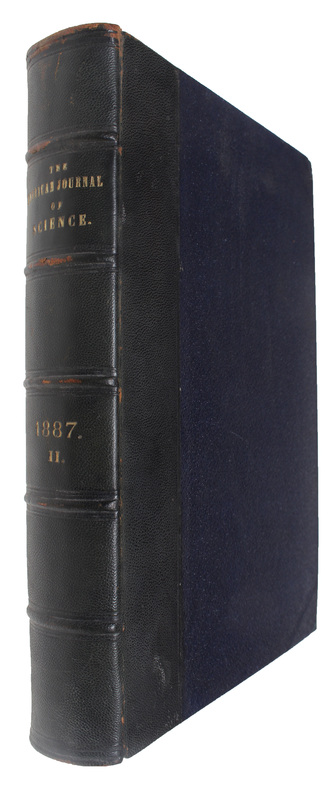
‎"MICHELSON, ALBERT A. & EDWARD W. MORLEY - THE MICHELSON-MORLEY EXPERIMENT, THE ETHER DRAG.‎

‎On the Relative Motion of the Earth and the Luminiferous Ether.‎

‎New Haven, Conn., J.D. & E.S. Dana, 1887. 8vo. Contemporary half calf. Gilt lettering to spine. A small stamp to top of title-page. In: ""The American Journal of Science. Editors James D. and Edward S. Dana"", Third series Vol. XXXIV (July to December, 1887). VIII,500 pp., textillustr. and 10 plates. (Entire volume offered). The joint paper: pp. 333-345 and textillustr. (Apparatus). A few faint brownspots to titlepage, otherwise clean and fine.‎

‎First appearance of this classic paper which announced one of the most celebrated experiments in the history of physics and eventually led Einstein to his Relativity Theory.The experiment was expected to show the rate of the earth's movement through the ether"" they looked in vain for a difference between the speed of light in the direction of the earth's motion around the sun and the direction perpendicular to it. The failure of this experiment was a serious blow to classical scientific theories because it cast doubts on the existance of the universal ether which had been a basic principleof, for example, the Newtonian theories of the universe. (Vide PMM: 378, 401, 408).The paper appeared first in the ""American Journal of Science"" in November (as offered here), and was published a month later in ""Philosophical Magazine"" in a slightly modified form.""Michelson, trained at the U.S. Naval Academy, and Morley, minister turned chemist, began a series of experiments to determine the relation of ether drift and the velocity of light, effects of extremely minute values. They used a slightly silvered glass set angular to a ray of sunlight so that a part ofthe ray was transmitted, a part reflected out and again returned, thereby providing two paths, one perpendicular to the other. If drift existed, the superimposed rays would produce interference. None was observed, showing that the earth's motion did not affect the light's speed. The negative result held revolutionary implications which led directly thru Lorentz and Einstein to the acceptance of new standards of reference of time and space from geometry and cosmometry.""(Dibner)In 1919 Einstein met Michelson in California. At a dinner given in honor of them both, Einstein said in a speech ""You (Michelson) uncovered an insidious defect in the ether theory of light, as it existed, and stimulated the ideas of H.A. Lorentz and Fitzgerald, out of which the Special Theory of Relativity developed. Without your work this theory would today be scarcely more than an interesting speculation..."" In an interview in 1842 Einstein said: ""It is no doubt that Michelson's experiment was of considerably influence upon my work insofar as it strengthened my conviction concerning the validity of the Principle of relativity...On the other side I was pretty much convinced of the validity of the principle before I did know this experiment and its result. In any case, Michelson's experiment removed practically any doubt about the validity of the principle in optics and showed that a profound change of the basic concepts of physics was inevitable.""Michelson was awarded the 1907 Nobel Prize ""for his optical precision instrument (the inteferometer) and the spectroscopic and metrological investigations he has carried on.""Dibner: Heralds of Science: 161 (lising the later version from ""Philosophical Magazine"") - Norman 1505.- Magee ""A Source Book in Physics"", pp. 369 ff. (the later paper).The volume contains another paper by Michelson and Morley ""On a method of Making the Wave-lenght of Sodium Light the actual and practical Standard of Lenght"", pp. 427-430.‎

Bookseller reference : 47165

Livre Rare Book

Herman H. J. Lynge & Son
Copenhagen Denmark Dinamarca Dinamarca Danemark
[Books from Herman H. J. Lynge & Son]

€5,103.40 Buy

‎"VAN VLECK, J.H. - TOWARDS QUANTUM MECHANICS, THE CORRESPONDENCE PRINCIPLE.‎

‎The Absorption of Radiation by multiply periodic Orbits, and its relation to the Correspondence Principle and the Rayleigh-Jeans Law. Part I- (II). (I. Some Extensions of the Correspondence Principle. - II. Calculation of Absorption by multiply period...‎

‎Corning, N.Y., and Menasha, Wisc., The Physical Review, 1924. Royal8vo. Full buckram. Gilt lettering to spine. A stamp to top of titlepage and to front free endpaper. In: ""The Physical Review. A Journal of Experimental and theoretical Physics"", Vol. 24, Second Series. V,704 pp., textillustr. Van Vleck's papers: pp. 330-346 a. pp. 347-365. Internally clean and fine.‎

‎First appearance of Van Vleck's two importent papers in which he clarifies and extends the Principle of Correspondence.""Van Vleck made his greatest contribution to the old quantum theory in 1924, when he conceived his correspondence principle for absorption. He demonstrated that in the limit of high quantum numbers there would be a correspondence between absorption by classical, multiply periodic systems, and by their quantum analogues. His proof depended on interpreting net absorption in the quantum theory as the difference between gross absorption and stimulated emission of radiation (an interpretation prompted by a remark of Breit’s). Van Vleck was particularly pleased that his classical theory reproduced the quantum result without the need for stimulated emission, which he referred to as ""negative absorption."" (DSB).""Van Vleck’s theory of absorption by multiply periodic systems was consistent with the newly derived Kramers theory of dispersion, and it convinced Bohr that his correspondence principle applied not only to emission but also to absorption. Further, Van Vleck’s 1924 calculation made use of several of the ideas that Werner Heisenberg used in his matrix mechanics a year later. Van Vleck’s work, however, did not lead in the direction of matrix mechanics. His intent was to explain quantum phenomena (especially ""negative absorption"") in classical terms rather than to devise an internally consistent quantum theory."" (DSB).In 1977 he shared the Nobel Prize with Philip Anderson and N. F. Mott.Van der Waerden ""Sources of Quantum Mechanics"", pp. 203 ff.‎

Bookseller reference : 47166

Livre Rare Book

Herman H. J. Lynge & Son
Copenhagen Denmark Dinamarca Dinamarca Danemark
[Books from Herman H. J. Lynge & Son]

€402.90 Buy

‎"BERRY, M.V. (MICHAEL VICTOR) - THE DISCOVERY OF THE ""BERRY-PHASE""‎

‎Quantal phase factors accompanying adiabatic changes.‎

‎London, Royal Society, 1984. Royal8vo. Full buckram, gilt lettering to spine.In: ""Proceedings of the Royal Society of London"", Series A, vol. 392. IV,478 pp. (Entire volume offered). Berry's paper: pp. 45-57. Clean and fine.‎

‎First printing of the paper in which Berry describes his discovery of the ""Berry phase"", a unifying concept in quantum mechanics.""In 1983, Berry made the surprising discovery that a quantum system adiabatically transported round a closed circuit in the space of external parameters acquires, besides the familiar dynamical phase, a non-integrable phase depending only on the geometry of the circuit. This Berry phase, which had been overlooked for more than half a century, provides us a very deep insight on the geometric structure of quantum mechanics and gives rise to various observable effects. The concept of the Berry phase has now become a central unifying concept in quantum mechanics, with applications in fields ranging from chemistry to condensed matter physics. In particular, the Berry phase plays an important role in modern magnetism, an allows to reach a deeper understanding of a broad range of phenomena such as the spin-orbit coupling, the Aharonov-Bohm effect, the quantum Hall effect, the anomalous Hall effect, the magnon dynamics, the tunneling of magnetization in molecular magnets, etc. Further, in the light of the Berry phase, a number of new phenomena can be predicted in ferromagnets with a textured magnetization or in semiconductors with spin-orbit coupling."" (Patrick Bruno).‎

Bookseller reference : 47169

Livre Rare Book

Herman H. J. Lynge & Son
Copenhagen Denmark Dinamarca Dinamarca Danemark
[Books from Herman H. J. Lynge & Son]

€429.76 Buy

‎"BOHR, N. (NIELS). - THE ATOMIC MODEL AND THE ""STATIONARY STATE""‎

‎On the Quantum Theory of Radiation and the Structure of the Atom. (+) On the Decrease of velocity of Swiftly Moving Electrified Particles passing through Matter. (2 papers).‎

‎London, Taylor & Francis, 1915. Contemp. hcalf. Spine gilt, title- and tomelabels with gilt lettering. Spine a bit rubbed, some cracking to hinges, but covers not detached. In: ""The London, Edinburgh, and Dublin Philosophical Magazine and Journal of Science"", Vol. XXX, Sixth Series. VIII,824 pp., textillustr. and 18 plates. (Entire volume offered). Bohr's papers: pp. 394-413 and pp. 581-612. A stamp to verso of titlepage. Internally clean and fine.‎

‎First appearance of a landmark paper in which Bohr found experimental support for his energy equation for electron orbits and of stationary states in the work of Franck and Hertz from 1914. Furthermore, Franck and Hertz unwittingly provided an independent confirmation of the concept of stationary state. In 1914 they observed an energy threshold in the electron-stopping power of mercury vapor. This threshold, Bohr explained the following year, corresponded to a transition between the normal state and another (first excited) stationary state of the mercury atom (and not, as Franck and Hertz had originally thought, to the ionization of the atom). The supramechanical stability implied by the assumption of stationary states was now empirically proved to comprehend stability with regard to electron impacts.""Bohr had to frequently revise and refine his atomic model in light of new discoveries. One significant paper ""On the Quantum Theory of Radiation and the Structure of the Atom,"" (the paper offered) added more specific details about atomic states. For example Bohr had earlier made the argument that electrons could jump from one orbit to another as energy was emitted or absorbed. In this paper, he theorezed that an atom possesses stationary states in which energy was neither emitted nor absorbed. Any emission or absorption that did occur, such as might induce an electron ump, would correspond to the transition between two stationary states.""(sparknotes.com).An: the second paper offered. When Bohr had finished his importent paper on the hydrogen atom ""On the Theory of Decrease of Velocity of Moving Electrified Particles on passing through Matter"" 1913, he completed another paper on that subject (the paper offered), which includes the influence of effects due to relativity and to straggling (that is, the fluctuations in energy and in range of individual particles).(Pais p. 128).Rosenfeld no 13 a. 14.The volume contains further importent papers by J.J. THOMSON, W.H. BRAGG, RUTHERFORD & BARNES, SODDY & HITCHINS etc.‎

Bookseller reference : 47170

Livre Rare Book

Herman H. J. Lynge & Son
Copenhagen Denmark Dinamarca Dinamarca Danemark
[Books from Herman H. J. Lynge & Son]

€872.95 Buy

‎"LE VERRIER (LEVERRIER), URBAIN JEAN JOSEPH. - THE EXISTANCE OF NEPTUNE PREDICTED.‎

‎Recherches sur les mouvements d'Uranus. (Séance du Lundi 1er Juin 1846).‎

‎Paris, Bachelier, 1846. 4to. No wrappers. In: ""Comptes Rendu hebdomadaires des Séances de l’Académie des Sciences"", Vol. 22, No 22. Pp. (893-) 928. (Entire issue offered). Le Verrier's paper: pp. 907-018.‎

‎First appearance of Le Verrier's paper in which he postulated the existance of a new planet on mathematical premises from the gravitational disturbencies of Uranus.""In 1846 John Cauch Adams... and Urban J. Leverrier... simultaneously and independently determined the location of a possible new planet... In 1845 he wrote of his findings of the mathematical location of a new planet to Sir George Bidell Airy,,, Because Adams was unknown, his letter was put aside. Meanwhile the same perturbations of Uranus had become of interest to Leverrier. On July 1(should be June !), 1846 he presented a paper ""Recherches sur les mouvements d'Uranus"" (the paper offered) to the Academie des Sciences inParis. When Airy realized that Leverrier and Adams had reached the same conclusions, he hastened to suggest that a search be made for the newplanert. Shortly hereafter it was seen bur not recognized. About a week before it was found in England, it was discovered by Galle in Berlin on information supplied by Leverrier. Thus, the honour of the discovery, or even co-discovery of the new planet, Neptune, was lost to Adams and credited to Leverrier.... Adams paper was reade before the Royal Astronomical Society, November 13, 1846, and was published in 1847. (Milestones p. 40).Milestones of Science No 132. - Dibner No. 16.‎

Bookseller reference : 47206

Livre Rare Book

Herman H. J. Lynge & Son
Copenhagen Denmark Dinamarca Dinamarca Danemark
[Books from Herman H. J. Lynge & Son]

€1,141.55 Buy

‎"POISSON, (SIMÉON-DENIS). - THE PREAMBLE.‎

‎Théorie mathématique de la Chaleur. (Cet article est le préambule d'un ouvrage actuellement sous presse, et qui paraitra incessamment).‎

‎(Berlin, G. Reimer, 1834). 4to. No wrappers. Extracted from ""Journal für die reine und angewandte Mathematik. Hrsg. von A.L. Crelle"", Bd. XII. Pp. 258-262.‎

‎First apperance of Poisson's preamble to his famous work ""Théorie mathématique de la Chaleur"", published 1835. “Poisson scored a point in this work by demonstrating how the conductibility of heat in the interior of bodies, far from being contained in the notion of flux as Fourier had held, must be derived from an absorption coefficient that restores a neglected functional dimension. It was in this area that … Poisson’s mechanical model for conduction of heat was the most fruitful. That conception enabled Poisson to understand on the molecular scale the complete and correct equation for radiation of heat” (DSB)‎

Bookseller reference : 47207

Livre Rare Book

Herman H. J. Lynge & Son
Copenhagen Denmark Dinamarca Dinamarca Danemark
[Books from Herman H. J. Lynge & Son]

€134.30 Buy

‎"BECQUEREL, EDMOND (ALEXANDRE-EDMUND). - BECQUEREL'S ""CONTINUING RAYS"" OR THE ""BECQUEREL PHENOMENA""‎

‎Mémoire sur le rayonnement chimique qui accompagne la lumiere solaire et la lumiere électrique. (3e Mémoire.- Extrait par l'auteur).‎

‎(Paris, Bachelier), 1840. 4to. No wrappers. In: ""Comptes Rendus Hebdomadaires des Séances de L'Academie des Sciences"", Tome XI (No.18). Pp. (667-) 716. (Entire issue offered). Becquerel's paper:pp. 702-703. Some marginal brownspots, margins slightly soiled, light browning an creasing.‎

‎First printing of an importent paper in the history of photochemistry as he here discovered some effects of coloured rays of the solar spectrum.""Edmund Becquerel seems to be the first person to observe, in 1840 (in the paper offered), that the latent daguerreotype image which had been underexposed could be intensified if re-exposed to the yellow and red rays of the spectrum and then developed with mercury... Explaining this phenomenon, Becquerel called the yellow-red continuing rays (""rayon continuateurs"") in contrast to the primary rays, which exicited or produced the light image and which he called exiciting rays (""rayons excitateurs"").... They are dependent on the wave lenght of the light.""(Eder ""History of Photography"", pp. 265 ff.)""Becquerel was an early experimenter in photography. In 1840 he discovered that the silver halides, natively insensitive to red and yellow light, became sensitive to that part of the spectrum in proportion to their exposure to blue, violet and ultraviolet light, allowing Daguerreotypes and other photographic materials to be developed by bathing in strong red or yellow light rather than by chemical treatment. In practice this technique was rarely used."" (Wikipedia).‎

Bookseller reference : 47213

Livre Rare Book

Herman H. J. Lynge & Son
Copenhagen Denmark Dinamarca Dinamarca Danemark
[Books from Herman H. J. Lynge & Son]

€201.45 Buy

‎"ARLOING, SATURNIN. - THE SERUM DIAGNOSIS OF TUBERCULOSIS.‎

‎Sur l'obtention de cultures et d'émulsions homogénes du bacille de la tuberculose humaine en milieu liquide et ""sur une variété mobile de ce bacille"".‎

‎(Paris, Gauthier-Villars), 1898. 4to. No wrappers. In: ""Comptes Rendus Hebdomadaires des Séances de L'Academie des Sciences"", Tome 126, No 19. Pp. (1299-) 1382. (Entire issue offered). Arloing's paper: pp. 1319-1321.‎

‎First appearance of this importent paper in which Arloing describes his ""Sero-agglutination for the diagnosis of presence of tubercle bacillus."" (Garrison & Morton No. 2334).It is well known that the ordinary cultures of the bacillus of Koch can not be used for agglutination. Arloing, however, in 1898, obtained a fluid homogeneous culture of the tubercle bacillus and demonstrated its specific agglutinability by the serum of tuberculous human beings or animals, thus rendering possible the serum diagnosis of tuberculosis. (Courmont in ""Arch Intern Med."" 1909).‎

Bookseller reference : 47217

Livre Rare Book

Herman H. J. Lynge & Son
Copenhagen Denmark Dinamarca Dinamarca Danemark
[Books from Herman H. J. Lynge & Son]

€134.30 Buy

‎"CALMETTE, (LÉON CHARLES ALBERT). - THE REACTION TEST FOR TUBERCULOSIS.‎

‎Sur un nouveau procédé de diagnostic de la tuberculose chez l'homme par l'ophtalmo-réaction à la tuberculine.‎

‎(Paris, Gauthier-Villars et Cie), 1907. 4to. Without wrappers. In: ""Comptes Rendus Hebdomadaires des Séances de L'Academie des Sciences"", Tome 144, No 24. Pp.(1309-) 1396. (Entire issue offered). Calmette's paper: pp. 1324-1326.‎

‎First printing of calmette's paper in which he introduced his conjunctival reaction test for tuberculosis.Garrison & Morton: 2337.‎

Bookseller reference : 47219

Livre Rare Book

Herman H. J. Lynge & Son
Copenhagen Denmark Dinamarca Dinamarca Danemark
[Books from Herman H. J. Lynge & Son]

€134.30 Buy

‎"NIEPCE DE SAINT-VICTOR, (CLAUDE FELIX ABEL). - THE INVENTION OF NIEPCEOTYPES OR ""GLASS PICTURES"".‎

‎Sur des propriétés particulières de l'iode, du phosphore, de l'acide azotique, etc. (Dépose en deux parties a l'Institut, le 22 juin 1846 et le 11 janvier 1847.) (Extrait). (+) Annexe au Mémoire précédent, présenté à l'Academie le 25 octobre 1847....‎

‎(Paris, Bachelier), 1847. 4to. No wrappers. In ""Comptes rendus hebdomadaires des séances de l’Académie des sciences"", Vol. 25, No 17. Pp. (561-) 608. (Entire issue offered). Niepce de Saint-Victor's paper: pp. 579-589.‎

‎First appearance of this milestone paper in the histroy of photography in which Niepce de Saint-Victor describes his invention of photography on glass or ""glass negatives"".""Early in 1847 Niepce de Saint-Victor experienced with the use of starch paste on his glass plates as a binding substratum for the iodide coating, but he soon found that albumen was preferable"" he also tried gelatine, but laid it aside because it came off in the aceto-silver nitrate bath. By a mixture of honey, syrup, or whey with the albumen, he oncreased, later the sensivity. He published his process on October 25, 1847, in the Comp. rend. (the paper offered), and soon had many followers. He also made many modifications (Annexe to the memoir)."" (Eder ""History of Photography"", Dover Publ., pp. 338 ff.).‎

Bookseller reference : 47222

Livre Rare Book

Herman H. J. Lynge & Son
Copenhagen Denmark Dinamarca Dinamarca Danemark
[Books from Herman H. J. Lynge & Son]

€470.05 Buy

‎"PAULI, WOLFGANG. - ANNOUNCING THE ""EXCLUSION PRINCIPLE""‎

‎Über den Zusammenhang des Abschlusses der Elektronengruppen im Atom mit der Komplexstruktur der Spektrum. (On the Connexion between the Completion of Electron Groups in an Atom with the Complex Structure of Spectra).‎

‎Berlin, Julius Springer, 1925. 8vo. Contemp. full cloth. Spine lacks and covers detached (in need of a new spine). A stamp to front free endpaper (chinese). In: 'Zeitschrift für Physik', Volume 31. VIII,952 pp., textillustr. (Entire volume offered). Pauli's paper: pp.765-783.‎

‎First edition of the first announcement of Pauli's Exclusion Principle which gives a criterion for the electronic structure of atoms, and explains the periodic table and the combining properties of the elements.Pauli first formulated his exclusion principle in this article in an attempt to explain the structure of the periodic table. By introducing an additional quantum number, namely the spin of an electron, to the already known three quantum numbers in Bohr's atom model, and by postulating that no two electrons can have the same four quantum numbers, Pauli could explain the number of electrons allowed in the outermost shell, e.g., explaining the varying lengths of successive periods in the table. The exclusion principle turned out to be applicable to all fermions, and thus plays a role in a variety of physical phenomena. For example it explains the formation of degenerate matter in white dwarfs and neutron stars. In 1945 Pauli received the Nobel Prize in physics ""for the discovery of the Exclusion Principle, also called the Pauli Principle"".This volume also contains a paper by Heisenberg: 'Über eine Anwendung des Korrespondenzprinzips auf die Frage der Polarisation des Floureszenzlichtes' , A. Einstein: ""Bemerkung zu P. Jordans Abhandlung ""Zur Theorie der Quantenstrahlung""and another paper by Pauli: 'Über den Einfluss der Geschwindigkeitsabhängigkeit der Elektronenmasse auf den Zeemaneffekt' (Zeeman-Effect and the Dependence of Electron-Mass on the Velocity).‎

Bookseller reference : 47224

Livre Rare Book

Herman H. J. Lynge & Son
Copenhagen Denmark Dinamarca Dinamarca Danemark
[Books from Herman H. J. Lynge & Son]

€2,686.00 Buy

‎"SÉDILLOT, C. (CHARLES EMMANUEL). - THE FIRST GASTROTOMY PERFORMED.‎

‎De la gastrotomie fistuleuse.‎

‎(Paris, Bachelier), 1846. 4to. No wrappers. In ""Comptes rendus hebdomadaires des séances de l’Académie des sciences"", Vol. 23, No 4. Pp. (171-) 232. (Entire issue offered). Sédillot's paper: pp. 222-227.‎

‎First appearance of the paper which records the first gastrotomy performed on a human. The operation was unsuccessfull and the patient died later.Garrison & Morton No 2451.‎

Bookseller reference : 47227

Livre Rare Book

Herman H. J. Lynge & Son
Copenhagen Denmark Dinamarca Dinamarca Danemark
[Books from Herman H. J. Lynge & Son]

€134.30 Buy

‎"PAULI, WOLFGANG. - ANNOUNCING THE ""EXCLUSION PRINCIPLE""‎

‎Über den Zusammenhang des Abschlusses der Elektronengruppen im Atom mit der Komplexstruktur der Spektrum. (On the Connexion between the Completion of Electron Groups in an Atom with the Complex Structure of Spectra).‎

‎Berlin, Julius Springer, 1925. 8vo. Contemp. hcloth. In: 'Zeitschrift für Physik', Volume 31. VIII,952 pp., textillustr. A circular stamp to titlepage.(Entire volume offered). Pauli's paper: pp.765-783. A fine and clean copy, internally as well as externally.‎

‎First edition of the first announcement of Pauli's Exclusion Principle which gives a criterion for the electronic structure of atoms, and explains the periodic table and the combining properties of the elements.Pauli first formulated his exclusion principle in this article in an attempt to explain the structure of the periodic table. By introducing an additional quantum number, namely the spin of an electron, to the already known three quantum numbers in Bohr's atom model, and by postulating that no two electrons can have the same four quantum numbers, Pauli could explain the number of electrons allowed in the outermost shell, e.g., explaining the varying lengths of successive periods in the table. The exclusion principle turned out to be applicable to all fermions, and thus plays a role in a variety of physical phenomena. For example it explains the formation of degenerate matter in white dwarfs and neutron stars. In 1945 Pauli received the Nobel Prize in physics ""for the discovery of the Exclusion Principle, also called the Pauli Principle"".This volume also contains a paper by Heisenberg: 'Über eine Anwendung des Korrespondenzprinzips auf die Frage der Polarisation des Floureszenzlichtes' , A. Einstein: ""Bemerkung zu P. Jordans Abhandlung ""Zur Theorie der Quantenstrahlung""and another paper by Pauli: 'Über den Einfluss der Geschwindigkeitsabhängigkeit der Elektronenmasse auf den Zeemaneffekt' (Zeeman-Effect and the Dependence of Electron-Mass on the Velocity).‎

Bookseller reference : 47228

Livre Rare Book

Herman H. J. Lynge & Son
Copenhagen Denmark Dinamarca Dinamarca Danemark
[Books from Herman H. J. Lynge & Son]

€2,887.45 Buy

‎"PIRIA, RAFFAELE. - THE DISCOVERY OF SALICIN - ASPIRIN.‎

‎Recherches sur la Salicine et les produits qui en dérivent.‎

‎Paris, Bachelier, 1839. 4to. No wrappers. In: ""Comptes Rendus Hebdomadaires des Séances de L'Academie des Sciences"", Tome VIII, No 13. Pp. (459-) 504. (Entire issue offered). Piria's paper: pp. 479-485.‎

‎First apperance of a main paper in pharmacology, describing the discovery of Salicylic acid compound, giving it the empirical formula C7H6O3. It is the most successful drug in history. A trillion tablets are consumed every year. Used to treat everything from headaches to heart disease, from rheumatism to cancer - scientists are still struggling to understand all its qualities. But aspirin can truly claim the title of wonder drug.Raffaele Piria (20 August 1814 - 18 July 1865), an Italian chemist from Scilla who converted the substance Salicin into a sugar and a second component, which on oxidation becomes salicylic acid, a major component of an analgesic drug, Aspirin (acetylsalicylic acid).Garrison & Morton No 1857.‎

Bookseller reference : 47232

Livre Rare Book

Herman H. J. Lynge & Son
Copenhagen Denmark Dinamarca Dinamarca Danemark
[Books from Herman H. J. Lynge & Son]

€335.75 Buy

‎"POISSON, (SIMÉON-DENIS). - INTRODUCING ""THE LAW OF LARGE NUMBERS""‎

‎Recherches sur la probabilité des jugements, principalement en matière criminelle. (+) Note sur la loi des grands nombres. (2 Papers).‎

‎(Paris, Bachelier), 1835-36. 4to. No wrappers. In: ""Comptes Rendus Hebdomadaires des Séances de L'Academie des Sciences"", Tome 1, Séance du Lundi 14 Décembre 1835 and tome 2, Séance Lundi 11 Avril 1836. Pp. (467-) 498 and (355-) 386. (2 entire issues offered. Poisson's papers: pp. 473-495 (1835) a. pp. 377-380 (1836).‎

‎First appearance of 2 importent paper in probability theory, serving as a preamble to Poissons's famous work published two years later, and with nearly the same title ""Recherches sur la probabilité des jugements en matiere criminelle et en matiere civile"" (1837). The paper offered introduces THE LAW OF LARGE NUMBERS (Loi universelle des Grandes nombres, pp. 478-79), a key concept in probability theory. Poisson states that all events of a moral as well as of a physical nature are subject to this universal law. His definition (in English translation) on p. 478 reads ""Things of every kind obey a universal lw that we may call the law of large numbers. Its essence is that if we observe a very large number of events of the same nature, which depend on constant causes and on causes that vary irregularly, sometimes in another, 1.e., not progressively in any determined sense, then almost constant proportions will be found among numbers"" (p. 478 in the first memoir).""Prior to the publication of the ""Rechearces"", Poisson presented his principal results and philosophical views to the Academie des Sciences in papers read at the sessions of 14 december 1835 and 11 April 1836. The first memoir became the ""Préambule"" of the ""Rechearches"" and outlined Poisson's criticism of Laplace's approach to the probability judgements, the universal applicability of the law of large numbers, and some of the results based on the Ministry of Justice's statistics.... Poisson's second memoir discussed his ""Law of Large Numbers"", with special attentuion to how it differed from bernoulli's theorem and how it was particularly well suited for applications to the moral sciences..."" (Lorraine Daston ""Classical Possibility in the Emlightment"", pp. 364-65).""In Recherches sur la probabilité des jugements en matière criminelle et en matière civile (1837"" (Research on the Probability of Criminal and Civil Verdicts), an important investigation of probability, the Poisson distribution appears for the first and only time in his work. Poisson’s contributions to the law of large numbers (for independent random variables with a common distribution, the average value for a sample tends to the mean as sample size increases) also appeared therein."" Encl. Britannica). - In fact the law appears here, two years before, in the offered paper."" (Encl. Britannica).‎

Bookseller reference : 47235

Livre Rare Book

Herman H. J. Lynge & Son
Copenhagen Denmark Dinamarca Dinamarca Danemark
[Books from Herman H. J. Lynge & Son]

€671.50 Buy

‎"DUMAS, JEAN BAPTISTE & ANDRE & J.S. STAS. - THE ATOMIC WEIGHT OF CARBON ESTABLISHED.‎

‎Recherches sur la véritable poids atomiques du carbone.(Extrait).‎

‎(Paris, Bachelier), 1840. 4to. No wrappers. In: ""Comptes Rendus Hebdomadaires des Séances de L'Academie des Sciences"", Tome XI , No 25. Pp. (991-) 1020. (Entire issue offered). The paper: pp. (991-) 1008. A bit of marginal soiling and some creasing to leaves.‎

‎First appearance of the paper which states the correct weight of the carbon atom. This research had profound influence on the development of organic chemistry. The paper in full was published the year after (1841) in ""Annales de Chimie et de Physique"".""From 1840 onward he carried out an important revision of the atomic weights of thirty elements. His most valuable contribution in this field was his very precise determination of the atomic weight of carbon (jointly with his pupil Stas) in 1840. A previously accepted weight, determined by Berzelius as C = 12.20 (O = 16), was shown to be incorrect. Dumas proved that C = 12±.002 (O = 16) or C = 75 (O = 100). The analysis was made by burning diamond and artificial and natural graphite in oxygen"" the carbon dioxide formed was weighed in potash solution. The results were in close agreement. The ""new"" weight of carbon had a great effect on the progress of organic chemistry.""(DSB).‎

Bookseller reference : 47238

Livre Rare Book

Herman H. J. Lynge & Son
Copenhagen Denmark Dinamarca Dinamarca Danemark
[Books from Herman H. J. Lynge & Son]

€268.60 Buy

‎"BÉGUYER DE CHANCOURTOIS, (ALEXANDRE-ÈMILE). - THE TELLURIC HELIX - A PERIODIC TABLE FORERUNNER.‎

‎Mémoire sur un classement naturel des corps simples ou radicaux appelé vis tellurique. (7 Avril 1862). (+) Mémoire sur un classement naturel.... addition au Mémoire... du 7 Avril... (+) Sur un classement naturel des corps simples.... addition au Mémoi...‎

‎Paris, Mallet-Bachelier, 1862. 4to. No wrappers. In: ""Comptes rendus hebdomadaires des séances de l’Académie des sciences"", Vol. 54, No 13, No 15 a. No 17. Pp. (749- 772, pp. (806-) 868 a. pp. (941-) 992. And vol. 55, No 15. Pp. (583-) 631. (4 entire issues offered). With htitle and titlepage to vol. 54. Titlepage with a stamp in upper corner of titlepage on verso, shown on recto. Béguyer de Chancourtois's papers: pp. 757-761, 840-843, pp. 967-971 and pp. 600-601.‎

‎First appearance of Chancourtois's historical paper in which he conceived a way to arrange the chemical elements in a periodic manner, years before Mendelejeff and Lothar Meyer. He arranged the elements on a cylinder in the order of atomic weight. This importent paper was never published in full, but only as abstracts as offered here. His principle of the periodicity of the elements remained unnoticed until the first communication (of April 7) was translated by P.J. Hartog in Nature in 1889 under the title ""A Foreshadowing of the periodic law"".""Generalizing further from Élie’s ideas, Béguyer formulated a method for classifying chemical elements based ""in the last analysis upon the distribution of these elements in the crust of the globe."" His scheme, a precursor of the periodic table, was put forth in ""Vis tellurique, classement des corps simples ou radicaux au moyen d’une système de classification helicoïdal et numérique"" (1862). The model for his theory was the ""telluric screw,"" a helical graph wound about a cylinder. The base of the cylinder was divided by sixteen equally spaced points, and the screw thread was similarly divided on each of its turns"" the seventeenth point was on the second turn directly above the first, the eighteenth above the second, and so forth. Each point was supposed to represent the ""characteristic number"" of some element that could be deduced from its physical properties or chemical characteristics. Actually, Béguyer used unit equivalent weights as characteristic numbers, following Prout, who made hydrogen the unit. These weights were derived by measuring the specific heat of each element in a manner suggested by Regnault."" (DSB).Parkinson ""Breakthroughs"" 1862 C.‎

Bookseller reference : 47239

Livre Rare Book

Herman H. J. Lynge & Son
Copenhagen Denmark Dinamarca Dinamarca Danemark
[Books from Herman H. J. Lynge & Son]

€872.95 Buy

Number of results : 506,695 (10134 Page(s))

First page Previous page 1 ... 13 14 15 [16] 17 18 19 ... 1463 2907 4351 5795 7239 8683 10127 ... 10134 Next page Last page