|
United States, Department of the Navy, Maury Center for Ocean Science
Acoustic Environmental Scenarios and Predictions for ASW; Volume 15 Area 5 Summer Predictions for Passive Sonar MC Report 011
Washington DC: United States Department of the Navy Maury Center for Ocean Science 1972. Presumed First Edition First printing. Spiral bound. Good. 4 150 pages. Consists of data graphically displayed. Arrival Angle. DB Loss Noise DB and Depth in meters. This is part of the Long Range Acoustic Propagation Project. There is a distribution limitation statement at the bottom of the front cover "This document may be further distributed by the holder only with the specific prior approval of the Director Long Range Acoustic Propagation Project ONR Code 102-OS" However it is understood that this limitation no longer applies due to the passage of time and advances in technology. Passive Sonar is a device that detects the source of acoustic vibrations or noise and determines the direction or bearing to the source. It is used as a hydroacoustic direction finder. Passive sonars operate in the range of sonic ultrasonic and infrasonic frequencies. They are used on submarines on surface vessels in containers lowered from helicopters and on buoys Passive sonars consist of sonic detector compensator filter amplifier and display device. Anti-submarine warfare ASW or in older form A/S is a branch of underwater warfare that uses surface warships aircraft or other submarines to find track and deter damage or destroy enemy submarines. Successful anti-submarine warfare depends on a mix of sensor and weapon technology training and experience. Sophisticated sonar equipment for first detecting then classifying locating and tracking the target submarine is a key element of ASW. To destroy submarines both torpedoes and naval mines are used launched from air surface and underwater platforms. ASW also involves protecting friendly ships. United States, Department of the Navy, Maury Center for Ocean Science unknown
Bookseller reference : 77595
|
|
|
United States Department of the Navy Maury Center for Ocean Science
Acoustic Environmental Scenarios and Predictions for ASW; Volume 810 Area 4A Winter Predictions for Passive Sonar MC Report 011
Washington DC: United States Department of the Navy Maury Center for Ocean Science 1972. Presumed First Edition First printing. Spiral bound. Good. 4 240 pages. Consists of data graphically displayed. Arrival Angle. DB Loss Noise DB and Depth in meters. This is part of the Long Range Acoustic Propagation Project. There is a distribution limitation statement at the bottom of the front cover "This document may be further distributed by the holder only with the specific prior approval of the Director Long Range Acoustic Propagation Project ONR Code 102-OS" However it is understood that this limitation no longer applies due to the passage of time and advances in technology. Passive Sonar is a device that detects the source of acoustic vibrations or noise and determines the direction or bearing to the source. It is used as a hydroacoustic direction finder. Passive sonars operate in the range of sonic ultrasonic and infrasonic frequencies. They are used on submarines on surface vessels in containers lowered from helicopters and on buoys Passive sonars consist of sonic detector compensator filter amplifier and display device. Anti-submarine warfare ASW or in older form A/S is a branch of underwater warfare that uses surface warships aircraft or other submarines to find track and deter damage or destroy enemy submarines. Successful anti-submarine warfare depends on a mix of sensor and weapon technology training and experience. Sophisticated sonar equipment for first detecting then classifying locating and tracking the target submarine is a key element of ASW. To destroy submarines both torpedoes and naval mines are used launched from air surface and underwater platforms. ASW also involves protecting friendly ships. United States, Department of the Navy, Maury Center for Ocean Science unknown
Bookseller reference : 77590
|
|
|
United States, Department of the Navy, Maury Center for Ocean Science
Acoustic Environmental Scenarios and Predictions for ASW; Volume 9 Area 3B Summer Predictions for Passive Sonar MC Report 011
Washington DC: United States Department of the Navy Maury Center for Ocean Science 1972. Presumed First Edition First printing. Spiral bound. Good. 4 189 1 pages. Consists of data graphically displayed. Arrival Angle. DB Loss Noise DB and Depth in meters This is part of the Long Range Acoustic Propagation Project. There is a distribution limitation statement at the bottom of the front cover "This document may be further distributed by the holder only with the specific prior approval of the Director Long Range Acoustic Propagation Project ONR Code 102-OS" However it is understood that this limitation no longer applies due to the passage of time and advances in technology. Passive Sonar is a device that detects the source of acoustic vibrations or noise and determines the direction or bearing to the source. It is used as a hydroacoustic direction finder. Passive sonars operate in the range of sonic ultrasonic and infrasonic frequencies. They are used on submarines on surface vessels in containers lowered from helicopters and on buoys Passive sonars consist of sonic detector compensator filter amplifier and display device. Anti-submarine warfare ASW or in older form A/S is a branch of underwater warfare that uses surface warships aircraft or other submarines to find track and deter damage or destroy enemy submarines. Successful anti-submarine warfare depends on a mix of sensor and weapon technology training and experience. Sophisticated sonar equipment for first detecting then classifying locating and tracking the target submarine is a key element of ASW. To destroy submarines both torpedoes and naval mines are used launched from air surface and underwater platforms. ASW also involves protecting friendly ships. United States, Department of the Navy, Maury Center for Ocean Science unknown
Bookseller reference : 77589
|
|
|
United States, Department of the Navy, Maury Center for Ocean Science
Acoustic Environmental Scenarios and Predictions for ASW; Volume 14 Area 5 Winter Predictions for Passive Sonar MC Report 011
Washington DC: United States Department of the Navy Maury Center for Ocean Science 1972. Presumed First Edition First printing. Spiral bound. Good. 4 180 pages. Consists of data graphically displayed. Arrival Angle. DB Loss Noise DB and Depth in meters. This is part of the Long Range Acoustic Propagation Project. There is a distribution limitation statement at the bottom of the front cover "This document may be further distributed by the holder only with the specific prior approval of the Director Long Range Acoustic Propagation Project ONR Code 102-OS" However it is understood that this limitation no longer applies due to the passage of time and advances in technology. Passive Sonar is a device that detects the source of acoustic vibrations or noise and determines the direction or bearing to the source. It is used as a hydroacoustic direction finder. Passive sonars operate in the range of sonic ultrasonic and infrasonic frequencies. They are used on submarines on surface vessels in containers lowered from helicopters and on buoys Passive sonars consist of sonic detector compensator filter amplifier and display device. Anti-submarine warfare ASW or in older form A/S is a branch of underwater warfare that uses surface warships aircraft or other submarines to find track and deter damage or destroy enemy submarines. Successful anti-submarine warfare depends on a mix of sensor and weapon technology training and experience. Sophisticated sonar equipment for first detecting then classifying locating and tracking the target submarine is a key element of ASW. To destroy submarines both torpedoes and naval mines are used launched from air surface and underwater platforms. ASW also involves protecting friendly ships. United States, Department of the Navy, Maury Center for Ocean Science unknown
Bookseller reference : 77594
|
|
|
United States, Department of the Navy, Maury Center for Ocean Science
Acoustic Environmental Scenarios and Predictions for ASW; Volume 13 Area 4B Summer Predictions for Passive Sonar MC Report 011
Washington DC: United States Department of the Navy Maury Center for Ocean Science 1972. Presumed First Edition First printing. Spiral bound. Good. 4 240 pages. Consists of data graphically displayed. Arrival Angle. DB Loss Noise DB and Depth in meters. This is part of the Long Range Acoustic Propagation Project. There is a distribution limitation statement at the bottom of the front cover "This document may be further distributed by the holder only with the specific prior approval of the Director Long Range Acoustic Propagation Project ONR Code 102-OS" However it is understood that this limitation no longer applies due to the passage of time and advances in technology. Passive Sonar is a device that detects the source of acoustic vibrations or noise and determines the direction or bearing to the source. It is used as a hydroacoustic direction finder. Passive sonars operate in the range of sonic ultrasonic and infrasonic frequencies. They are used on submarines on surface vessels in containers lowered from helicopters and on buoys Passive sonars consist of sonic detector compensator filter amplifier and display device. Anti-submarine warfare ASW or in older form A/S is a branch of underwater warfare that uses surface warships aircraft or other submarines to find track and deter damage or destroy enemy submarines. Successful anti-submarine warfare depends on a mix of sensor and weapon technology training and experience. Sophisticated sonar equipment for first detecting then classifying locating and tracking the target submarine is a key element of ASW. To destroy submarines both torpedoes and naval mines are used launched from air surface and underwater platforms. ASW also involves protecting friendly ships. United States, Department of the Navy, Maury Center for Ocean Science unknown
Bookseller reference : 77593
|
|
|
Marine Corps Research, Development and Acquisition Command, Mobility and Logistics Division
Prime Item Development Specification for the CATFAE Round; NWC xxx
Quantico VA: Marine Corps Research Development and Acquisition Command Mobility and Logistics Division 1987. Presumed First Edition First printing thus. Wraps. Good. Cover plus 19 numbered pages. Figures. Tables. Ink notation at bottom of front cover. Distribution notice on front cover is understood to no longer apply do to the passage of time and advancement of technology. CATFAE stands for Catapult Launched Fuel-Air Explosive which is a land mine countermeasure. Prime Item Development Specifications is also known by the acronym PIDS. This document addresses military specification Military standards other relevant publications. It proves a general description of this all-up fuel-air explosive munition. It addresses ballistic dispersion and launch velocity. It presents its physical characteristics and components and assemblies. It discusses the Preproduction sample and Preproduction verification as well as quality assurance and preproduction inspections. Various aspects of testing and inspection are also discussed. Environmental factors such as shipboard vibration and mechanical shock are also discussed. A thermobaric weapon is a type of explosive that uses oxygen from the surrounding air to generate a high-temperature explosion and in practice the blast wave typically produced by such a weapon is of a significantly longer duration than that produced by a conventional condensed explosive. The fuel-air bomb is one of the best-known types of thermobaric weapons. Most conventional explosives consist of a fuel-oxidizer premix whereas thermobaric weapons are almost 100% fuel so thermobaric weapons are significantly more energetic than conventional condensed explosives of equal weight. Their reliance on atmospheric oxygen makes them unsuitable for use underwater at high altitude and in adverse weather. They are considerably more destructive when used against field fortifications such as foxholes tunnels bunkers and caves-partly due to the sustained blast wave and partly by consuming the oxygen inside. Many types of thermobaric weapons can be fitted to hand-held launchers. Marine Corps Research, Development and Acquisition Command, Mobility and Logistics Division paperback
Bookseller reference : 77613
|
|
|
Marine Corps Research, Development and Acquisition Command, Mobility and Logistics Division
Critical Item Development Specification for the Retarder Subsystem; NWC xxx/1
Quantico VA: Marine Corps Research Development and Acquisition Command Mobility and Logistics Division 1987. Presumed First Edition First printing thus. Wraps. Good. Cover plus 13 numbered pages. Figures. Tables. Ink notation at bottom of front cover. Distribution notice on front cover is understood to no longer apply do to the passage of time and advancement of technology. This is a subsystem of the CATFAE. CATFAE stands for Catapult Launched Fuel-Air Explosive which is a land mine countermeasure. Prime Item Development Specifications is also known by the acronym PIDS. This document addresses military specification Military standards other relevant publications. It proves a general description of this all-up fuel-air explosive munition. It addresses ballistic dispersion and launch velocity. It presents its physical characteristics and components and assemblies. It discusses the Preproduction sample and Preproduction verification as well as quality assurance and preproduction inspections. Various aspects of testing and inspection are also discussed. Environmental factors such as shipboard vibration and mechanical shock are also discussed. A thermobaric weapon is a type of explosive that uses oxygen from the surrounding air to generate a high-temperature explosion and in practice the blast wave typically produced by such a weapon is of a significantly longer duration than that produced by a conventional condensed explosive. The fuel-air bomb is one of the best-known types of thermobaric weapons. Most conventional explosives consist of a fuel-oxidizer premix whereas thermobaric weapons are almost 100% fuel so thermobaric weapons are significantly more energetic than conventional condensed explosives of equal weight. Their reliance on atmospheric oxygen makes them unsuitable for use underwater at high altitude and in adverse weather. They are considerably more destructive when used against field fortifications such as foxholes tunnels bunkers and caves-partly due to the sustained blast wave and partly by consuming the oxygen inside. Many types of thermobaric weapons can be fitted to hand-held launchers. Marine Corps Research, Development and Acquisition Command, Mobility and Logistics Division paperback
Bookseller reference : 77614
|
|
|
Marine Corps Research, Development and Acquisition Command, Mobility and Logistics Division
Critical Item Development Specification for The Lane Marker; NWC xxx/3
Quantico VA: Marine Corps Research Development and Acquisition Command Mobility and Logistics Division 1987. Presumed First Edition First printing thus. Wraps. Good. Cover plus 15 numbered pages. Figures. Tables. Ink notation at bottom of front cover. Distribution notice on front cover is understood to no longer apply do to the passage of time and advancement of technology. This is a subsystem of the CATFAE. CATFAE stands for Catapult Launched Fuel-Air Explosive which is a land mine countermeasure. Prime Item Development Specifications is also known by the acronym PIDS. This document addresses military specification Military standards other relevant publications. It proves a general description of this all-up fuel-air explosive munition. It addresses ballistic dispersion and launch velocity. It presents its physical characteristics and components and assemblies. The Marker is a device which is expelled from the round upon impact and activated upon cloud detonation. The marker provides a visual indication of the impact point of a detonated round. The marker shall not cause the cloud nor any adjacent cloud to burn or prematurely detonate. A thermobaric weapon is a type of explosive that uses oxygen from the surrounding air to generate a high-temperature explosion and in practice the blast wave typically produced by such a weapon is of a significantly longer duration than that produced by a conventional condensed explosive. The fuel-air bomb is one of the best-known types of thermobaric weapons. Most conventional explosives consist of a fuel-oxidizer premix whereas thermobaric weapons are almost 100% fuel so thermobaric weapons are significantly more energetic than conventional condensed explosives of equal weight. Their reliance on atmospheric oxygen makes them unsuitable for use underwater at high altitude and in adverse weather. They are considerably more destructive when used against field fortifications such as foxholes tunnels bunkers and caves-partly due to the sustained blast wave and partly by consuming the oxygen inside. Many types of thermobaric weapons can be fitted to hand-held launchers. Marine Corps Research, Development and Acquisition Command, Mobility and Logistics Division paperback
Bookseller reference : 77616
|
|
|
Marine Corps Research, Development and Acquisition Command, Mobility and Logistics Division
Critical Item Development Specification for Solid Propellant Motor of the CATFAE Catapult Launched Fuel Air Explosive Round; NWC xxx/4
Quantico VA: Marine Corps Research Development and Acquisition Command Mobility and Logistics Division 1987. Presumed First Edition First printing thus. Wraps. Good. Cover plus 22 and A 1-9 numbered pages. Figures. Tables. Append 1 is the "Design Objectives for the Motor Save and Arm Device". Ink notation at bottom of front cover. Distribution notice on front cover is understood to no longer apply do to the passage of time and advancement of technology. This is a subsystem of the CATFAE. CATFAE stands for Catapult Launched Fuel-Air Explosive which is a land mine countermeasure. Prime Item Development Specifications is also known by the acronym PIDS. This document addresses military specification Military standards other relevant publications. It proves a general description of this all-up fuel-air explosive munition. It addresses ballistic dispersion and launch velocity. It presents its physical characteristics and components and assemblies. The solid propellent expulsion motor provides propulsion for the CATFAE round. The expulsion motor consists of an assembly of propellant grains case pressure vessel igniter and arm/fire device. A thermobaric weapon is a type of explosive that uses oxygen from the surrounding air to generate a high-temperature explosion and in practice the blast wave typically produced by such a weapon is of a significantly longer duration than that produced by a conventional condensed explosive. The fuel-air bomb is one of the best-known types of thermobaric weapons. Most conventional explosives consist of a fuel-oxidizer premix whereas thermobaric weapons are almost 100% fuel so thermobaric weapons are significantly more energetic than conventional condensed explosives of equal weight. Their reliance on atmospheric oxygen makes them unsuitable for use underwater at high altitude and in adverse weather. They are considerably more destructive when used against field fortifications such as foxholes tunnels bunkers and caves-partly due to the sustained blast wave and partly by consuming the oxygen inside. Many types of thermobaric weapons can be fitted to hand-held launchers. Marine Corps Research, Development and Acquisition Command, Mobility and Logistics Division paperback
Bookseller reference : 77617
|
|
|
Marine Corps Research Development and Acquisition Command Mobility and Logistics Division
Critical Item Development Specification for Delay Detonator Percussion Initiated; NWC xxx/2
Quantico VA: Marine Corps Research Development and Acquisition Command Mobility and Logistics Division 1987. Presumed First Edition First printing thus. Wraps. Good. Cover plus 14 numbered pages. Figures. Tables. Ink notation at bottom of front cover. Distribution notice on front cover is understood to no longer apply do to the passage of time and advancement of technology. This is a subsystem of the CATFAE. CATFAE stands for Catapult Launched Fuel-Air Explosive which is a land mine countermeasure. Prime Item Development Specifications is also known by the acronym PIDS. This document addresses military specification Military standards other relevant publications. It proves a general description of this all-up fuel-air explosive munition. It addresses ballistic dispersion and launch velocity. It presents its physical characteristics and components and assemblies. The delay detonator is a pyrotechnic delay device that is initiated by a percussion type firing pin and has an explosive output suitable for initiating explosive trains. The detonator was to withstand a five foot drop while remaining safe an with no explosive element burned or detonated. A thermobaric weapon is a type of explosive that uses oxygen from the surrounding air to generate a high-temperature explosion and in practice the blast wave typically produced by such a weapon is of a significantly longer duration than that produced by a conventional condensed explosive. The fuel-air bomb is one of the best-known types of thermobaric weapons. Most conventional explosives consist of a fuel-oxidizer premix whereas thermobaric weapons are almost 100% fuel so thermobaric weapons are significantly more energetic than conventional condensed explosives of equal weight. Their reliance on atmospheric oxygen makes them unsuitable for use underwater at high altitude and in adverse weather. They are considerably more destructive when used against field fortifications such as foxholes tunnels bunkers and caves-partly due to the sustained blast wave and partly by consuming the oxygen inside. Many types of thermobaric weapons can be fitted to hand-held launchers. Marine Corps Research, Development and Acquisition Command, Mobility and Logistics Division paperback
Bookseller reference : 77615
|
|
|
United States Marine Corps, Combat Development Command
Candidate Regulations; Officer Candidate School
Quantico VA: United States Marine Corps Combat Development Command 1993. Presumed First Edition First printing thus. Wraps. Fair. Format is approximately 3 inches by 5 inches. Various paginations estimated to be about 220 pages. Illustrations. Appendix A-Q. Covers worn torn soiled with some notations. Rep has list of names and positions in ink. Other ink markings noted. The content addresses: Evaluation Training Clothing Equipment Safety Medical Treatment Dental Treatment Orders and General Information. The Appendix addresses in part: Leadership Traits and Principles Marine Air-Grounds Task Force Evaluation Report Inspection Report Candidate Interview Field Equipment Service Rifle Marking of Clothing Marine Corps Terminology Marine Corps Grade Structure Navy Grade Structure Sample Log Entries General Orders Drill Cares Marking of Gear Marines Hymn. This set of regulations reflects the standards in place between the first and second Persian Gulf Wars. The United States Marine Corps Officer Candidates School OCS is a training regiment designed to screen and evaluate potential Marine Corps Officers. Those who successfully complete the period of instruction are commissioned as Second Lieutenants in the United States Marines. Unlike the other United States military services the majority of Marine Corps officers complete OCS to earn a commission; the exceptions are midshipmen from the United States Naval Academy limited duty officers and inter-service transfers. It is located at Marine Corps Base Quantico. Officer Candidates go through either a 10-week PLC Combined/OCC or two 6-week courses PLC over separate summers designed primarily to screen and evaluate candidates' fitness to lead Marines by placing them in leadership positions in a stressful environment. Students are evaluated during 2-3 day garrison command billets at the company and platoon level and squad and fire-team level tactical billets during field exercises. United States Marine Corps, Combat Development Command paperback
Bookseller reference : 77194
|
|
|
U. S. Department of the Navy, Office of the Chief of Naval Operations, Navy History Division
Dictionary of American Naval Fighting Ships Volume IV: L-M--Appendices One-Six; U. S. Department of the Navy Office of the Chief of Naval Operations Navy History Division
Washington DC: U. S. Department of the Navy Office of the Chief of Naval Operations Navy History Division 1969. Presumed First Edition First printing. Hardcover. Good. Quarto. xxvi 744 2 pages. Volume IV: G-K-Appendices One-Six ONLY Illustrated endpapers. Abbreviations and Symbols. List of Illustrations. Maps. Illustrations. Bibliography. Historical Sketches: Letters G H I J and K. Appendices I-VI: Amphibious Warfare Ships Aviation Auxiliaries Destroyer Tenders Ships of the Line Classification of Naval Ships and Service Craft. Errata Volume III. Contents of earlier volumes. Cover has some wear and soiling. The Dictionary of American Naval Fighting Ships DANFS is the official reference work for the basic facts about ships used by the United States Navy. When the writing project was developed the parameters for this series were designed to cover only commissioned US Navy ships with assigned names. If the ship was not assigned a name it was not included in the histories written for the series. In addition to the ship entries DANFS was published in print by the Naval Historical Center NHC as bound hardcover volumes ordered by ship name from Volume I A-B in 1959 to Volume VIII W-Z in 1981. Several volumes subsequently went out of print. In 1991 a revised Volume I Part A covering only ship names beginning with A was released. Work continues on revisions of the remaining volumes. As the DANFS is a work of the U.S. government its content is in the public domain and the text is often quoted verbatim in other works including in some cases Wikipedia articles. Many websites organized by former and active crew members of U.S. Navy vessels include a copy of their ships' DANFS entries. The Dictionary limits itself largely to basic descriptions and brief operational notes and includes almost no analysis or historical context. Unless otherwise specified all the ships illustrated in this volume are commission ships of the United States Navy with their names preceded by the Identification USS. U. S. Department of the Navy, Office of the Chief of Naval Operations, Navy History Division hardcover
Bookseller reference : 77254
|
|
|
U. S. Department of the Navy, Office of the Chief of Naval Operations, Navy History Division
Dictionary of American Naval Fighting Ships Volume II: C-F--Carriers Confederate Forces; U. S. Department of the Navy Office of the Chief of Naval Operations Navy History Division
Washington DC: U. S. Department of the Navy Office of the Chief of Naval Operations Navy History Division 1969. Reprint with corrections. Hardcover. Good. Quarto. xxiii 1 591 1 pages. Volume II: C-F--Carriers Confederate Forces ONLY Illustrated endpapers. Abbreviations and Symbols. List of Illustrations. Bibliography. Historical Sketches: Letters C D E and F. Aircraft Carriers. Confederate Forces Afloat. Cover has some wear and soiling. This revised edition depicts each ship in its historical setting; the original edition was published in 1959. The Dictionary of American Naval Fighting Ships DANFS is the official reference work for the basic facts about ships used by the United States Navy. When the writing project was developed the parameters for this series were designed to cover only commissioned US Navy ships with assigned names. If the ship was not assigned a name it was not included in the histories written for the series. In addition to the ship entries DANFS and the online links have been expanded to include appendices on small craft histories of Confederate Navy ships and various essays related to naval ships. DANFS was published in print by the Naval Historical Center NHC as bound hardcover volumes ordered by ship name from Volume I A-B in 1959 to Volume VIII W-Z in 1981. Several volumes subsequently went out of print. In 1991 a revised Volume I Part A covering only ship names beginning with A was released. Work continues on revisions of the remaining volumes. As the DANFS is a work of the U.S. government its content is in the public domain and the text is often quoted verbatim in other works including in some cases Wikipedia articles. Many websites organized by former and active crew members of U.S. Navy vessels include a copy of their ships' DANFS entries. The Dictionary limits itself largely to basic descriptions and brief operational notes and includes almost no analysis or historical context. Unless otherwise specified all the ships illustrated in this volume are commission ships of the United States Navy with their names preceded by the Identification USS. U. S. Department of the Navy, Office of the Chief of Naval Operations, Navy History Division hardcover
Bookseller reference : 77252
|
|
|
U. S. Department of the Navy, Office of the Chief of Naval Operations, Navy History Division
Dictionary of American Naval Fighting Ships Volume III: G-K--Appendices One-Six; U. S. Department of the Navy Office of the Chief of Naval Operations Navy History Division
Washington DC: U. S. Department of the Navy Office of the Chief of Naval Operations Navy History Division 1968. presumed First Edition First printing. Hardcover. Good. Quarto. xxvi 876 2 pages. Volume III: G-K-Appendices One-Six ONLY Illustrated endpapers. Abbreviations and Symbols. List of Illustrations. Maps. Illustrations. Bibliography. Historical Sketches: Letters G H I J and K. Appendices I-VI: Historic Ship Exhibits Monitors. Civil War Naval Ordnance. Addenda to Appendix III IV and V of Volume I. Addenda to Appendix I of Volume II. Additional Ships named AFI. Errata Volumes I and II. Contents of earlier volumes. Cover has some wear and soiling. The Dictionary of American Naval Fighting Ships DANFS is the official reference work for the basic facts about ships used by the United States Navy. When the writing project was developed the parameters for this series were designed to cover only commissioned US Navy ships with assigned names. If the ship was not assigned a name it was not included in the histories written for the series. In addition to the ship entries DANFS was published in print by the Naval Historical Center NHC as bound hardcover volumes ordered by ship name from Volume I A-B in 1959 to Volume VIII W-Z in 1981. Several volumes subsequently went out of print. In 1991 a revised Volume I Part A covering only ship names beginning with A was released. Work continues on revisions of the remaining volumes. As the DANFS is a work of the U.S. government its content is in the public domain and the text is often quoted verbatim in other works including in some cases Wikipedia articles. Many websites organized by former and active crew members of U.S. Navy vessels include a copy of their ships' DANFS entries. The Dictionary limits itself largely to basic descriptions and brief operational notes and includes almost no analysis or historical context. Unless otherwise specified all the ships illustrated in this volume are commission ships of the United States Navy with their names preceded by the Identification USS. U. S. Department of the Navy, Office of the Chief of Naval Operations, Navy History Division hardcover
Bookseller reference : 77253
|
|
|
Slayton, Marina I. (Editor)
Four Centuries of Friendship; America-Bermuda Relations 1609-2009
Old Royal Naval Dockyard Bermuda: Bermuda Maritime Museum Press 2009. Presumed First Edition First printing. Hardcover. Very good/Very good. 152 pages. Illustrated endpapers. Illustrations some in color. Appendices. Photo sources. DJ has slight wear soiling and sticker residue. The book has become a Bermuda best-seller. The Library of Congress believes that it is the first complete historical summary of US-Bermuda relations written from an American perspective ever published. The book also provided the images and materials for the "400 Years of Friendship Walls" that had erected at the American Consulate and the U.S. Preclearance facility at the airport. The "Friendship Walls" convey America and Bermuda's long-lasting and mutually beneficial friendship for the hundreds of thousands of visitors that pass through the airport and the Consulate each year. Containing chapters on famous Americans who loved Bermuda from Mark Twain Babe Ruth Winslow Homer and Georgia O'Keefe to present day superstars such as Michael Douglas and Catherine Zeta-Jones the book is an intimate portrait of a partnership that has meant so much to both lands. Covering everything from the early days through the Revolutionary War to Bermuda's key role in the allied victories in WWII and the Cold War the book will be a touchstone for everyone interested in US-Bermuda relations. And with chapters covering recent history - and a look at the potential future of the US/Bermuda alliance by US Consul General to Bermuda Gregory W. Slayton - Four Centuries of Friendship is a must-have for anyone interested in any aspect of US/Bermuda relations. Bermuda Maritime Museum Press hardcover
Bookseller reference : 76931 ISBN : 0921560168 9780921560166
|
|
|
US. War and Navy Departments, Armed Forces Special Weapons Project, Joint Crossroads Committee U. S.
Radiological Defense; A Manual Prepared by the Joint Crossroads Committee Volume I Radiological Safety
Washington DC: GPO 1948. Presumed First Edition First printing thus. Hardcover. good. Quarto Approximately 8 inches by 10.5 inches Volume I ONLY. xi 3 163 3 pages. Frontis. Illustrations. Figures. Tables. Bibliography. Appendix on Fission Products. Subject Index. This publication was Official Use Only and remarked Unclassified in pencil. Ex-library with usual library markings. Cover has some wear and soiling. Name in ink inside front cover. Small tear in frontis illustration. Foreword by Major General L. R. Groves Armed Forces Special Weapons Project. This text is a reprint of a document formerly issued under the title of Radiological Safety. The previous document had been classified as Restricted. Upon review this document was found to have contained no restricted data under Public Law 585 79th Congress the Atomic Energy Act of 1946. Additional volumes were anticipated. The Armed Forces Special Weapons Project AFSWP was a U. S. military agency responsible for those aspects of nuclear weapons remaining under military control after the Manhattan Project was succeeded by the Atomic Energy Commission. These responsibilities included the maintenance storage surveillance security and handling of nuclear weapons as well as supporting nuclear testing. The AFSWP was a joint organization staffed by the U. S. Army U. S. Navy and U. S. Air Force. Major General Leslie R. Groves was its first chief. The early nuclear weapons were stored as components rather than complete devices and required expert knowledge to assemble. The short life of their lead-acid batteries and modulated neutron initiators and the heat generated by the fissile cores precluded storing them assembled. The large quantity of explosives in each weapon demanded special care be taken in handling. A team of regular Army officers were trained in the assembly and handling of the weapons. GPO hardcover
Bookseller reference : 56732
|
|
|
US. War and Navy Departments, Armed Forces Special Weapons Project, Joint Crossroads Committee U. S.
Radiological Defense; A Manual Prepared by the Joint Crossroads Committee Volume II The Principles of Military Defense against Atomic Weapons
Washington DC: GPO 1951. Presumed First Edition First printing thus. Hardcover. good. Quarto Approximately 8 inches by 10.5 inches Volume II ONLY. xiv 242 pages. Illustrations some with color. Figures. Tables. Bibliography. Appendix I II and III. Index. This publication was Restricted and remarked by stamp as Unclassified. Ex-library with usual library markings. Cover has some wear and soiling. Small tear in frontis illustration. Foreword by Brigadier General Herbert B. Loper Armed Forces Special Weapons Project. The purpose of this volume was to provide in its true perspective the essential background information which would make possible intelligent planning in advance and appropriate action in an emergency. The first half of the book deals with the characteristics of atomic weapons and their effects on structures equipment and personnel. The second half considered the steps that could be taken to minimize those effects and to control their consequences. The Armed Forces Special Weapons Project AFSWP was a U. S. military agency responsible for those aspects of nuclear weapons remaining under military control after the Manhattan Project was succeeded by the Atomic Energy Commission. These responsibilities included the maintenance storage surveillance security and handling of nuclear weapons as well as supporting nuclear testing. The AFSWP was a joint organization staffed by the U. S. Army U. S. Navy and U. S. Air Force. Major General Leslie R. Groves was its first chief. The early nuclear weapons were stored as components rather than complete devices and required expert knowledge to assemble. The short life of their lead-acid batteries and modulated neutron initiators and the heat generated by the fissile cores precluded storing them assembled. The large quantity of explosives in each weapon demanded special care be taken in handling. A team of regular Army officers were trained in the assembly and handling of the weapons. GPO hardcover
Bookseller reference : 76953
|
|
|
US. War and Navy Departments, Armed Forces Special Weapons Project (Compiler) U. S.
Radiological Defense; Volume III A Series of Indoctrination Lectures on Atomic Explosion with Medical Aspects
Washington DC: GPO 1950. Presumed First Edition First printing thus. Hardcover. good. Quarto Approximately 8 inches by 10.5 inches Volume III ONLY. v 1137 1 pages. Illustrations . Figures. Tables. Bibliography. No restrictive markings but a statement that the contents were not to be reproduced without permission. Ex-library with usual library markings. Cover has some wear and soiling. Small tear in frontis illustration. Foreword by Major General K. D. Nichols Armed Forces Special Weapons Project. This volume is a compilation of lectures presented in Washington D. C. during 1947 1948 and 1949 in a joint course on "Medical Aspects of Nuclear Energy" presented by the Armed Forces Special Weapons Project. This joint course was conducted for indoctrination of Medical Officers of the Armed Services with participation open to representatives of all interested government agencies. This volume should assist defense personnel preparing for complex casualty problems and others in the civil defense structure. The Armed Forces Special Weapons Project AFSWP was a U. S. military agency responsible for those aspects of nuclear weapons remaining under military control after the Manhattan Project was succeeded by the Atomic Energy Commission. These responsibilities included the maintenance storage surveillance security and handling of nuclear weapons as well as supporting nuclear testing. The AFSWP was a joint organization staffed by the U. S. Army U. S. Navy and U. S. Air Force. Major General Leslie R. Groves was its first chief. The early nuclear weapons were stored as components rather than complete devices and required expert knowledge to assemble. The short life of their lead-acid batteries and modulated neutron initiators and the heat generated by the fissile cores precluded storing them assembled. The large quantity of explosives in each weapon demanded special care be taken in handling. A team of regular Army officers were trained in the assembly and handling of the weapons. GPO hardcover
Bookseller reference : 76954
|
|
|
US. Department of the Navy Bureau of Navigation Hydrographic Office U. S.
Tracks for Full Powered Steam Vessels; With Distances in Nautical Miles
Washington DC: U.S. Department of the Navy Bureau of Navigation Hydrographic Office 1896. Presumed First Edition First printing thus. Map. Good. This was published at the Hydrographic Office in Washington D.C. in February 1896. No. 1530. Charles D. Sigabee Commander U.S. N. Hydrographer. Format is approximately 26 inches by 17 inches folded. This map is disbound from Volume I of the Commercial Directory of the American Republics compiled by the Bureau of American Republics International Union of American Republics Joseph P. Smith Director 1897 Title page from Directory is present. Taped to top right of map in margin is the statement "This chart is intended solely to show tracks of steam vessels on the ocean and no authority is assumed for the boundary lines as drawn between the countries." Map has some color differentiation and several inserts presenting distance information between major ports of call. Map has been folded with approximately the top third folded down. It is also folded into four sections of different lengths to fit as the frontis to the Directory. Map has some wear and soiling/staining. This is similar to the large-scale and detailed World chart on Mercator's projection produced by the British Admiralty under the "Superintendence of Captain Wharton R.N. F.R.S Hydrographer" engraved by Edward Weller and sold by J. D. Potter chart agent. The map has no internal landmass detail unless relevant to steam ship routes thus the Suez and Panama canals are marked as is the Canadian Pacific Railway. Panels along the lower edge list major ports and give distances dependent on routes taken and average knots-per-hour speeds with daily distances covered in miles. The world's major ports are linked by ship-routes each track with its relevant distance and so on. An interesting chart at the time steam took over from sail. Charles Dwight Sigsbee 1845 - 1923 was a Rear Admiral in the United States Navy. In his earlier career he was a pioneering oceanographer and hydrographer. He is best remembered as the captain of the USS Maine which exploded in Havana harbor Cuba in 1898. U.S. Department of the Navy, Bureau of Navigation, Hydrographic Office unknown
Bookseller reference : 77014
|
|
|
Germany, High Command of the Navy
The U-Boat Commander's Handbook
Gettysburg PA: Thomas Publications 1989. Presumed First Edition First printing. Trade paperback. Very good. 115 3 pages. Illustrations. This is a translation of The Submarine Commander's Handbook "U.Kdt.Hdb." Incorporated in the Secret Archives under Heading IV No. 4 Command 32 Submarine Flotilla New Edition 1943 comprising Amendments Nos. 1-11. The Submarine Commander's Handbook "U.Kdt.Hdb." 1943 describes the submarine U-boat tactics of Nazi Germany. Note that this edition is from 1943 during which the Allies had effectively countered these tactics and the battle of the Atlantic turned in the Allies favor. This is the complete wartime translation by the U.S. Navy of the 1943 edition of the official handbook given to all U-boat commanders. The original handbook was compiled from combat reports and was regularly updated throughout the war. The handbook was an invaluable reference for every operational U-boat commander. Simply written and highly accessible for a wider audience the U-boat handbook attempted to anticipate every possible situation and to advise on suitable tactics. This superb war-time primary source is enhanced by a rare series of photographs taken on an actual combat patrol and published during the time of the Third Reich in the book "U-Boot Auf Feindfahrt". Together the handbook and these rare photographs provide a fascinating glimpse into the world of the U-boats from a first hand perspective and is essential reading for anyone interested in World War II from primary sources. Thomas Publications paperback
Bookseller reference : 76857 ISBN : 0939631210 9780939631216

|
|
|
US. Marine Corps, History and Museums Division U. S.
The Marines in Vietnam 1954-1973; An Anthology and Annotated Bibliography
Washington DC: U. S. Government Printing Office 1985. Second Edition stated. Presumed first printing. Hardcover. Good. Quarto approximately 8.75 inches by 11.5 inches. xii 373 3 pages. Illustrations. Occasional Footnotes. Maps. Bibliography. Front flyleaf removed. Includes articles in addition to the Annotated Bibliography. This edition has added 10 articles to the 13 that appeared in the first edition. One article on fire bases in the original has not been included. The format remained basically the same. The first 16 articles give a chronological presentation of the Marine participation in the Vietnam War from one lone Marine advisor in 1954 through the buildup and withdrawal of major forces the "Easter Offensive" of 1972 the evacuation of U.S. citizens from both Phnom Penh and Saigon and the Mayaguez incident in May 1975. The second group has six articles are arranged topically. They concern aviation logistics civil affairs Navy medical support amphibious doctrine and maritime support. Part II is an annotated bibliography of articles from 1954-1984 drawn from Nav. Inst. Proc. Naval Review and Marine Corps Gazette. U. S. Government Printing Office hardcover
Bookseller reference : 76721
|
|
|
United States Marine Corps Tactical Systems Support Activity (TSTB)
TACC Pocket Checklist; Supplement to The System Operator Manual U-TACC-PCL-0104A
Camp Pendleton CA: United States Marine Corps Tactical Systems Support Activity TSTB 1989. Reprinted with Changes 1 and 2 Incorporated. Four-hole punched with four rings. Good. 4 202 6 pages. Illustrations. Some pages at the back are laminated. This represents the state of the art the state of knowledge and the state of practice at the time of the First Persian Gulf War. Stiff card covers. Tabbed sections. Sections include: Emergency TACC Brief Senior Air Coordinator Data Links Air Defense Air Support Communication Electronic Warfare TACC Hook Orders and Glossary. When issued distribution was only authorized to the Department of Defense and its contractors in accordance with the provisions of DoD Instruction 7930.2; 1 May 1986. Other requests were to be referred to the Commanding Officer Marine Corps Tactical Systems Support Activity at Camp Pendleton California. Previous issues were to be discarded. However copies have become available in the secondhand and collectibles market and given the passage of time and changes in technology it is believed that there are no current limitations on surviving copies. the Tactical Systems Support Activity is a subordinate command of Marine Corps Systems Command MCTSSA provides test and evaluation engineering and deployed technical support for USMC and joint service command control computer communications and intelligence systems throughout all acquisition life-cycle phases. Marine Corps leaders saw the need within the Marine Corps for a single focal point for computer driven tactical systems. MCTSSA was founded to support the technology requirements of the C4ISR community. MCTSSA monitored tactical systems development and prepared for transition and fielding to the Operating Forces. Requirements changed as computers grew in memory power and downsized. MCTSSA met the evolving C4ISR needs by changing their core competencies skill sets size and composition infrastructure facility and organizational structure. In 1970 the Marine Corps took ownership of its first computer based Command and Control C2 System. United States Marine Corps Tactical Systems Support Activity (TSTB) unknown
Bookseller reference : 76736
|
|
|
Drasnin Gilboa, Marina
Little Feet
Chronicle Books LLC 2000. Hardcover. Very Good. Disclaimer:A copy that has been read but remains in excellent condition. Pages are intact and are not marred by notes or highlighting but may contain a neat previous owner name. The spine remains undamaged. Chronicle Books LLC hardcover
Bookseller reference : G0811824527I4N00 ISBN : 0811824527 9780811824521

|
|
|
US. Army and US. Marine Corps U. S. U. S.
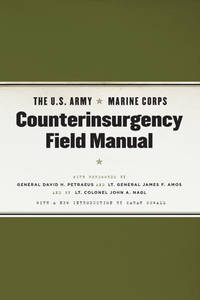
The U.S. Army Marine Corps Counterinsurgency Field Manual; U.S. Army Field Manual No. 3-24 Marine Corps Warfighting Publication No. 3-33.5
Chicago IL: The University of Chicago Press 2009. University of Chicago Press Edition stated. Fourth printing stated. Trade paperback. Very good. liv 419 7 pages. Footnotes. Appendices. Source Notes. Glossary. Annotated Bibliography. Military References. Index. Foreword by General David H. Petraeus and Lt. General James F. Amos. Foreword to the University of Chicago Press Edition by Lt. Colonel John A. Nagl. New Introduction by Sarah Sewall. This field manual/Marine Corps war-fighting publication establishes doctrine fundamental principles for military operations in a counterinsurgency COIN environment. It is based on lessons learned from previous counterinsurgencies and contemporary operations. It is also based on existing interim doctrine and doctrine recently developed. Counterinsurgency operations generally have been neglected in broader American military doctrine and national security policies since the end of the Vietnam War over 30 years ago. This manual is designed to reverse that trend. It is also designed to merge traditional approaches to COIN with the realities of a new international arena shaped by technological advances globalization and the spread of extremist ideologies-some of them claiming the authority of a religious faith. Doctrine by definition is broad in scope and involves principles tactics techniques and procedures applicable worldwide. Thus this publication is not intended to be a standalone reference. The University of Chicago Press paperback
Bookseller reference : 76251 ISBN : 0226841510 9780226841519
|
|
|
Navy Clothing and Textile Research Facility
Navy Clothing and Textile Research Facility
Natick MA: Navy Clothing and Textile Research Facility. Presumed First Edition First printing. Brochure. Good. Single sheet approximately 8 inches by 8.5 inches folded in half resulting in four panels. Illustrations. Map. Item has some wear and soiling. NCTRF's focus is to test fabrics for fire and heat resistance water immersion and buoyancy heat and cold stress ballistic protection and uniform design and development. With an experienced staff as well as unique testing equipment and facilities NCTRF can quickly move a concept from the drawing board to the production line. A team of textile technologists clothing designers physiologists and other scientific experts are all involved in conducting research design development improvement and user assessment studies of protective garments and equipment. Depending upon needs commercial off-the-shelf products are evaluated or unique military products are developed for use in the Navy shipboard environment. . NCTRF's technical teams conduct wear/fit tests determine appropriate sizing systems for uniforms and support a continuous quality assurance program. Historically uniforms have been the product of a Sailor's environment: physically geographically and technically. Uniforms provided protection against the elements and created distinction among specialists in a growing Navy. Foremost however was an element of simplicity in providing a uniform that would not interfere with the Sailor's job. The Navy uniform is designed and manufactured with safety in mind. The long sleeves and high securable collars protect against heat and flash; the shoes and boots are non-slip non-FOD and have steel toes; the designs of the clothing utilize simple tailored patterns for working in close proximity to machinery and to allow for mobility; and the seams are stitched for strength and durability. Adequate testing of both material and finished uniform is essential to assure functionality comfort and compatibility of shipboard uniforms. Physical testing of the material assures the key survivability characteristics are present and wear testing assures that the uniforms perform properly. Navy Clothing and Textile Research Facility unknown
Bookseller reference : 76017
|
|
|
United States Navy, Naval Coastal Systems Center
Catapult Launched Fuel-Air Explosive CATFAE Land Mine Countermeasures System; Concepts of Employment COE
Panama City FL: United States Navy Naval Coastal Systems Center 1987. Draft. Staplebound. Good. 1 21 pages plus stiff front cover. Illustrations. Format is approximately 8.5 inches by 11 inches. It is stapled in the upper left corner. It is printed single sided. Distribution was initially limited to DOD components only with expected dissemination in March 1988. This is marked as Atch 19 and while a stand alone document appears to have been part of a larger assemblage. A thermobaric weapon is a type of explosive that uses oxygen from the surrounding air to generate a high-temperature explosion and in practice the blast wave typically produced by such a weapon is of a significantly longer duration than that produced by a conventional explosive. Thermobaric weapons are almost 100% fuel so thermobaric weapons are significantly more energetic than conventional condensed explosives of equal weight. They are quite destructive when used against field fortifications such as foxholes tunnels bunkers and caves-partly due to the sustained blast wave and partly by consuming the oxygen inside. Development of the Catapult-Launched FAE CATFAE system followed the termination of the Surface Launched Unit SLU SLU-FAE program. The purpose of this document was to present the concept of employment COE for the Marine Corps Catapult Launched Fuel-Air Explosive CATFAE Land Mine Countermeasures System. CATFAE was an amphibious continuous breach land mine countermeasures system. the CATFAE was envisioned as a mobile mine countermeasure system capable of breaching enemy mine fields in very shallow water and from the high water mark inland in conjunction with lead echelons of the amphibious assault. The system was to be employed by assault amphibian vehicle AAV unites to provide a highly mobile quick response capability for the assault breaching of single impulse pressure and tilt-rod anti-tank and anti personnel minefields. An additional goal was to neutralize magnetically fuzed blast hardened and multiple impulse mines. FOC was planned for FY 95. United States Navy, Naval Coastal Systems Center unknown
Bookseller reference : 76003
|
|
|
United States Navy Office of Naval Intelligence
Iranian Naval Forces; A Tale of Two Navies
Washington DC: United States Navy Office of Naval Intelligence 2017. Presumed First Edition First printing thus update of 2009 publication. Wraps. Very good. 42 2 pages including covers. Poster inside back cover. Cover has slight wear and soiling. Iran's defense strategists recognize the growing importance of the maritime environment and are shaping its naval forces to secure Tehran's interests accordingly. The Islamic Revolutionary Guard Corps Navy IRGCN emphasizes an asymmetric doctrine to ensure national security in the Persian Gulf against regional neighbors and foreign presence. The Islamic Republic of Iran Navy IRIN dubbed by the Supreme Leader as a strategic force employs a more conventional doctrine and focuses on forward presence and naval diplomacy. Its mission areas include the Caspian Sea the Gulf of Oman and out-of-area operations. Both navies have considerable equities and are well positioned to influence and leverage the Strait of Hormuz; a vital chokepoint for the flow of resources and international commerce. During Iran's navies have been supplemented by its other military branches through acquisition of air-launched cruise missiles and antiship ballistic missiles. These developments are a clear indication that Iran understands the growing importance of controlling the maritime environment in its security calculus. Over the past several years Iran staged a major naval exercise that blatantly featured attacks directed against a mock-up of a U.S. Nimitz-class aircraft carrier. Iran also employed its navies in an attempt to reinforce Huthi rebels in Yemen and to interdict the merchant vessel Maersk Tigris in the Strait of Hormuz. Each of these events serves as a reminder that Iran's navies are capable of churning the waters of the Persian Gulf and beyond. As Iran continues to hone its naval strategy and modernize its respective fleets this capability will only improve creating greater challenges to security in an already security-challenged region. United States Navy, Office of Naval Intelligence paperback
Bookseller reference : 76007
|
|
|
United States Marine Corps
Catapult Launched Fuel-Air Explosive Land Mine Countermeasures System CATFAE; Design History
Quantico VA: United States Marine Corps Research Development and Acquisition Command Mobility and Logistics Division 1984. Draft. Staplebound. Good. Various paginations approximately 65 pages plus stiff front cover. Illustrations. Format is approximately 8.5 inches by 11 inches. It is stapled twice on the left side. It is printed single sided. Distribution was initially limited to DOD components only with expected dissemination in March 1988. This is marked as Atch 21 and while a stand alone document appears to have been part of a larger assemblage. A thermobaric weapon is a type of explosive that uses oxygen from the surrounding air to generate a high-temperature explosion and in practice the blast wave typically produced by such a weapon is of a significantly longer duration than that produced by a conventional explosive. Thermobaric weapons are significantly more energetic than conventional condensed explosives of equal weight. They are quite destructive when used against field fortifications such as foxholes tunnels bunkers and caves-partly due to the sustained blast wave and partly by consuming the oxygen inside. Development of the Catapult-Launched FAE CATFAE system followed the termination of the Surface Launched Unit SLU SLU-FAE program. The purpose of this document was to present the concept of employment COE for the Marine Corps Catapult Launched Fuel-Air Explosive CATFAE Land Mine Countermeasures System. CATFAE was an amphibious continuous breach land mine countermeasures system. the CATFAE was envisioned as a mobile mine countermeasure system capable of breaching enemy mine fields in very shallow water and from the high water mark inland in conjunction with lead echelons of the amphibious assault. The system was to be employed by assault amphibian vehicle AAV unites to provide a highly mobile quick response capability for the assault breaching of single impulse pressure and tilt-rod anti-tank and anti personnel minefields. An additional goal was to neutralize magnetically fuzed blast hardened and multiple impulse mines. FOC was planned for FY 95. United States Marine Corps Research, Development and Acquisition Command, Mobility and Logistics Division unknown
Bookseller reference : 76004
|
|
|
Susan Codi, Miles Furnas, Brian King, et al. and various others. Australian Institute of Marine Studies: Dr. Kathryn A. Burns
Environmental Implications of Offshore Oil and Gas Development in Australia: Further Research - A Compilation of Three Marine Studies
Australian Petroleum Production and Exploration Association 2003. CR1 - A hardcover book in very good condition that has bumped corners some light discoloration and shelf wear with no dust jacket. Dispersion and fates of produced formation water constituents in a North West Shelf shallow water ecosystem and Bass Strait / Fate and effects of oil and dispersed oil on mangrove ecosystems in Australia / Marine seismic surveys: Analysis and propagation of air-gun signals; and effects of air-gun exposure on humpback whales sea turtles fish and squid. 10.75"x8.75" 521 pages. Satisfaction Guaranteed. Hardcover. Very Good/No Jacket. 4to - over 9¾" - 12" tall. Australian Petroleum Production and Exploration Association Hardcover
Bookseller reference : ec47060 ISBN : 0957700113 9780957700116

|
|
|
Commandant of the Marine Corps
Invitation to the Passage of Command Ceremony from General Charles C. Krulak to LtGen James L. Jones held at the Marine Barracks Washington D.C. on the Thirtieth of June 1999
2 Navy Annex Washington DC: Commandant of the Marine Corps Headquarters U.S. Marine Corps CMC 1999. Presumed First Edition First printing thus. Other. Very good. This is a complete invitation to the Passage of Command of the United States Marine Corps from General Charles C. Krulak to Lieutenant General James L Jones. This includes An approximately 6 inch by 5 inch invitation card with the flag of the Marine Corps at the top center for the change of command ceremony that was held on the thirtieth of June 1999 with the accompanying envelop slit open at the top addressed to a married couple in Bethesda Maryland. Also included is yellow card/VIP parking pass for parking at the Marine Barracks where the ceremony was held. Also present is a colored card to be given to a Marine at the entrance to Gate 4 of the Barracks on 8th street. Also enclosed is a card stating that LtGen Jones has been nominated for promotion to general and that his nomination was pending in the United States Senate. Lastly is a slip of approximately 4 inches by 5.5 inches with instructions for the event. Charles Chandler Krulak born March 4 1942 served as the 31st Commandant of the Marine Corps from July 1 1995 to June 30 1999. He is the son of Lieutenant General Victor H. "Brute" Krulak who served in World War II Korea and Vietnam. He was the 13th President of Birmingham-Southern College. James Logan "Jim" Jones Jr. born December 19 1943 is a retired United States Marine Corps general. During his military career he served as Commander United States European Command COMUSEUCOM and Supreme Allied Commander Europe SACEUR from 2003 to 2006 and as the 32nd Commandant of the Marine Corps from July 1999 to January 2003. Jones retired from the Marine Corps in 2007 after 40 years of service. In 2007 Jones served as chairman of the Congressional Independent Commission on the Security Forces of Iraq which investigated the capabilities of the Iraqi police and armed forces. In 2007 he was appointed by the U.S. Secretary of State as special envoy for Middle East security. He served as chairman of the Atlantic Council from June 2007 to January 2009 when he assumed the post of National Security Advisor which he held until November 2010. Commandant of the Marine Corps, Headquarters U.S. Marine Corps (CMC) unknown
Bookseller reference : 74739
|
|
|
United States Navy
Blue Angels; 35th Anniversary Year 1981
United States Navy Blue Angels 1981. Presumed First Edition First printing thus. Wraps. Very good. 55 1 pages. Illustrations some in color. The Blue Angels is the United States Navy's flight demonstration squadron with aviators from the Navy and Marines. The Blue Angels team was formed in 1946 making it the second oldest formal flying aerobatic team under the same name in the world after the French Patrouille de France formed in 1931. The Blue Angels' six demonstration pilots currently fly the McDonnell Douglas F/A-18 Hornet typically in more than 70 shows at 34 locations throughout the United States each year where they still employ many of the same practices and techniques used in their aerial displays in their inaugural 1946 season. An estimated 11 million spectators view the squadron during air shows each full year. The Blue Angels also visit more than 50000 people in a standard show season March through November in schools and hospitals. Since 1946 the Blue Angels have flown for more than 260 million spectators. As of November 2011 the Blue Angels received $37 million annually out of the annual DoD budget. During their aerobatic demonstration the Blues fly six F/A-18 Hornet aircraft split into the Diamond Formation Blue Angels 1 through 4 and the Lead and Opposing Solos Blue Angels 5 and 6. Most of the show alternates between maneuvers performed by the Diamond Formation and those performed by the Solos. The Diamond in tight formation and usually at lower speeds 400 mph performs maneuvers such as formation loops rolls and transitions from one formation to another. The Solos showcase the high performance capabilities of their individual aircraft through the execution of high-speed passes slow passes fast rolls slow rolls and very tight turns. The highest speed flown during an air show is 700 mph just under Mach 1 and the lowest speed is 120 mph. Some of the maneuvers include both solo aircraft performing at once such as opposing passes toward each other in what appears to be a collision course and mirror formations back-to-back. belly-to-belly or wingtip-to-wingtip with one jet flying inverted. The Solos join the Diamond Formation near the end of the show for a number of maneuvers in the Delta Formation. United States Navy, Blue Angels paperback
Bookseller reference : 74621
|
|
|
US. Navy U. S.
Small Arms Firing Regulations U. S. Navy
Washington DC: Government Printing Office 1917. Later printing. Wraps. fair to good. Pocket-sized. 62 pages. Wraps. Illustrations. Figures. Tables. Some wear to cover edges slight darkening to text. Pencil erasure residue on fep. All forms of practices fired with rifles pistols and machine guns. These regulations were adopted for the U. S. Navy and Marine Corps and the Naval Militia to take effect July 1 1916 and then supersede the Firing Regulations for Small Arms U. S. Navy 1916. These regulations were designed to furnish systematic and progressive instruction with due regard to the conditions prevailing in the naval service to adaptability to existing range facilities to convenience and expediency to economy in time ammunition and effort commensurate with the results expected to be obtained and by relative standing and competition rather than by stringent requirements to promote among all grades of naval personnel interest and effort in overcoming difficulties which interfere with opportunities for practice. Government Printing Office paperback
Bookseller reference : 74347
|
|
|
Departments of the Army, Navy and Air Force. Commandants, Marine Corps and Coast Guard
Operator's Manual Pistol Semiautomatic 9mm M9 1005-01-118-2640; Army TM 9-1005-317-10 Navy SW 370-AA-OPI-010/9mm Air Force TO 11W3-3-5-1 Marine Corps TM 1005A-10/1 Coast Guard COMDTINST M8370.6
Washington DC: U. S. Government Printing Office 1985. Presumed First Edition First printing thus. Wraps. Very good. Various Paginations approximately 80 pages. Illustrations. References. Index. Two hole punched. Staple-bound. Cover has some wear and soiling. The Beretta M9 officially the Pistol Semiautomatic 9mm M9 is a 9×19mm Parabellum pistol adopted by the United States Armed Forces in 1985. It is essentially a military specification Beretta 92FS. The M9 won a competition in the 1980s to replace the M1911A1 as the primary sidearm of the U.S. military beating many other contenders and only narrowly defeating the SIG P226 for cost reasons. It officially entered service in 1990. Some other models have been adopted to a lesser extent namely the M11 pistol and other models remain in use in certain niches. The M9 was scheduled to be replaced under a United States Army program the Future Handgun System FHS which was merged with the SOF Combat Pistol program to create the Joint Combat Pistol JCP. The JCP was renamed Combat Pistol CP and the number of pistols to be bought was drastically cut back. The U.S. Army and Air Force are seeking to replace their M9s through the Modular Handgun System program. In the 1970s every branch of the U.S. Armed Forces except the U.S. Air Force carried the .45 ACP M1911 pistol. USAF opted to use .38 special revolvers which were also carried by some criminal investigation/military police organizations USAF strategic missile ICBM officer crews and by military flight crewmembers across all the services when serving in combat zones or when engaged in nuclear weapons duties. The Department of Defense then decided to synchronize the weapons of all five branches of U.S. forces. The ground combat branches of the services found this decision highly contentious but was meant to eliminate the need to buy replacements for worn out M1911 frames and to establish a common NATO pistol round to simplify logistics in case of war with the Soviet Union in Europe. In 1979 the Joint Service Small Arms Program began searching for a replacement for the venerable M1911 and the 9×19mm Parabellum round was selected for compliance with the NATO Standardization Agreement STANAG. In 1980 the Beretta 92S-1 design was chosen over entries from Colt Smith & Wesson Walther the Star M28 and various Fabrique Nationale and Heckler & Koch models. The result however was challenged by the US Army and new tests were done by the Army. In 1984 the trials started again with updated entries from Smith & Wesson Beretta SIG Sauer Heckler & Koch Walther Steyr and Fabrique Nationale. Beretta won this competition but there was a new trial the XM10 competition in 1988. This resulted in two different trials that were more limited but resulted in the Beretta being chosen albeit with an updated design. Concurrent to the pistol selection process beginning in 1979 the Bianchi International holster company began its development of a multi-function military holster to be ready for the issuance of a new pistol. This holster - designed by John Bianchi and Richard Nichols - has served the U.S. Armed Forces well for decades designated the M12 was adopted simultaneously with the adoption of the Beretta 92F in 1985. The Beretta 92F survived exposure to temperatures from 40 to 140 °F 40 to 60 °C being soaked in salt water being dropped repeatedly on concrete and being buried in sand mud and snow. Additionally the 92F proved a MRBF mean rounds before failure of 35000 rounds. That number is often touted as the equivalent to five or six times the pistol's service life. While this is normally true in European militaries armed forces of the United States normally subject sidearms to much more extensive use. The Iraq War which featured frequent urban and room-to-room combat has required American soldiers to rely more heavily on their pistols. The M9 is a short recoil semi-automatic single-action / double-action pistol that uses a 15-round staggered box magazine with a reversible magazine release button that can be positioned for either right- or left-handed shooters. The M9 is used with the Bianchi M12 Holster though other holsters are often used. The specific modifications made from the Beretta 92 includes: · Design of all the parts to make them 100% interchangeable to simplify maintenance for large government organizations. · Modified the front of the trigger guard so that one could use finger support for easier aiming. · Recurved the forward base of the grip to aid aiming. · Hard chromed the barrel bore to protect it from corrosion and to reduce wear. · New surface coating on the slide called Bruniton which allegedly provides better corrosion resistance than the previous plain blued finish. It also has an enlarged hammer pin that fits into a groove on the underside of the slide. The main purpose is to stop the slide from flying off the frame to the rear if it cracks. This was in response to reported defective slides during U.S. Military testing. The M9 features multiple internal safeties including a firing pin block that prevents the firing pin from moving without the trigger being pulled and a firing pin striker that rotates when the safety lever is engaged preventing the firing pin from being hit even if the hammer falls. The M9 also has an ambidextrous external safety lever allowing both left and right handed people to engage or disengage the safety mechanism. U. S. Government Printing Office paperback
Bookseller reference : 73401
|
|
|
United States Marine Corps
Military Operations on Urban Terrain; MCI 0366B
Marine Barracks Washington DC: Marine Corps Institute 2004. Later printing. Wraps. Good. Various paginations approximately 180 pages. Illustrations. Unit exercises. Review Lesson answered by former owner. Bibliography. This is intended for use by private through gunnery sergeant in MOS 0300. The Marine Corps Institute commonly referred to as MCI developed and maintained a curriculum of Marine Corps education. Subjects included infantry strategy/tactics leadership skills MOS qualifications personal finance and mathematics. Completion of MCI courses was generally required for promotion to the next Marine enlisted rank. Founded in part by then-Col. John A. Lejeune since February 1920 the Marine Corps Institute facilitated the training and education of individual Marines. MCI ensured access to products and provided opportunities to improve performance to enhance Professional Military Education and to provide promotion opportunity together with sponsors of Marine Corps education and training programs. As a tenant company of the Marine Barracks Washington MCI also coordinated and executed the Hosting and Parade Escort plan for the Evening and Sunset Parades. It provided ceremonial Officers and NCOs for the Parade Staffs and other assigned ceremonies in order to promote the Marine Corps heritage and to enhance the Marine Corps image to the general public. MCI company also maintained individual MOS and Battle Skills proficiency both in garrison and field environments to prepare the individual Marine for combat. The Marine Corps Institute was located at the historic Washington Navy Yard in Washington D.C. S.E. Military Operations on Urban Terrain MOUT are not new to the US military. Throughout its history soldiers have fought an enemy on urban terrain. What is new is that urban areas and urban populations have grown significantly during the late twentieth century and have begun to exert a much greater influence on military operations. The worldwide shift from a rural to an urban society and the requirement to transition from combat to stability and support operations and vice-versa have affected the US military's doctrine. It is estimated that by the year 2010 seventy-five percent of the world's population will live in urban areas. The increased population and accelerated growth of cities have made the problems of combat in built-up areas an urgent requirement for the US military. Urban areas are expected to be the future battlefield and combat in urban areas cannot be avoided. The acronym MOUT Military Operations on Urbanized Terrain is defined as all military actions that are planned and conducted on a terrain complex where man-made construction affects the tactical options available to the commander. Urban combat operations may be conducted in order to capitalize on the strategic or tactical advantages which possession or control of a particular urban area gives or to deny these advantages to the enemy. Major urban areas represent the power and wealth of a particular country in the form of industrial bases transportation complexes economic institutions and political and cultural centers. The denial or capture of these centers may yield decisive psychological advantages that frequently determine the success or failure of the larger conflict. Villages and small towns will often be caught up in the battle because of their proximity to major avenues of approach or because they are astride lines of communications that are vital to sustaining ground combat operations. These operations are conducted to defeat an enemy that may be mixed in with civilians. Therefore the rules of engagement ROE and use of combat power are more restrictive than in other conditions of combat. Marine Corps Institute paperback
Bookseller reference : 73455
|
|
|
US. Navy U. S.
The Ship and Gun Drills: U.S. Navy 1914
New York: Military Publishing Co 1914. Hardcover. fair. 289 1 pages. Illustrations. Index. Musical notes. Cover has some wear and soiling. Name of former owner in ink on fep. Pencil erasure residue on fep. Slightly shaken. This is a reprint of the Government Printing Office edition. This supersedes all previous editions. This edition contains the addition of new calls in Part IX Battle Calls which was rendered necessary by modern conditions and to the shortening of some of the most commonly used boat calls. This text reflects the state of knowledge and the state of practice as the United States prepared to enter the First World War. Military Publishing Co hardcover
Bookseller reference : 73194
|
|
|
United States Navy
Navy Day Program; Washington Navy Yard October 21 1941
Ephemera. Good. 16 pages including covers. Color Illustrated front cover. Format is approximately 4.5 inches by 6.5 inches staplebound. Cover has some wear and soiling. In the United States the Navy League of the United States organized the first Navy Day in 1922 holding it on October 27 because it was the birthday of President Theodore Roosevelt who was a naval enthusiast. Although meeting with mixed reviews the first year in 1923 over 50 major cities participated and the United States Navy sent a number of its ships to various port cities for the occasion. The 1945 Navy Day was an especially large celebration with President Harry S. Truman reviewing the fleet in New York Harbor. In 1949 Louis A. Johnson secretary of the newly created Department of Defense directed that the U.S. Navy's participation occur on Armed Forces Day in May although as a civilian organization the Navy League was not affected by this directive and continued to organize Navy Day celebrations as before. In the 1970s the "birthday" of the Continental Navy was found to be October 13 1775 and so CNO Admiral Elmo R. Zumwalt worked with the Navy League to define October 13 as the new date of Navy Day. However Navy Day in the United States is still largely recognized as October 27. This was the last Navy Day celebrated in Washington D. C. before the Japanese attacked the United States at Pearl Harbor and the country entered the Second World War. This event was held at Fairlawn Park Anacostia D. C. and commenced at 8:30 a.m. and the last listed event Colors on the field commenced at 5:14 p.m. The Program includes a section on Laws relating to the United States Flag and the Flag code. Among the events of the day were: Navy Band Weapon Demonstration Catapulting Battleship Observation Plane Guard Mounting Drum and Bugle Corps Deep Sea Diving Crilley Tactical Flying Demonstration Machine Gun Platoon Exercise Drill Chemical Warfare Defense Bugle Calls Coast Guard Life-Saving Demonstration of Infantry Weapons Parachute Platoon Jump Dive Bombing Strafing Landing Operation and Bombing Attack. unknown
Bookseller reference : 73226
|
|
|
US. Navy Department, Bureau of Ships U. S.
Radar Electronic Fundamentals NavShips 900016. T.O. 16-1-195
Washington DC: U.S. Government Printing Office 1947. Later printing per date on page 474. Wraps. Good. v 1 474 pages. Wraps. Illustrations. Figures. Glossary. Index. Original price stamped at bottom of front cover. Topics covered include introduction to radar review of electrical fundamentals nonsinusoidal waves and transients vacuum tubes and applications power-supply circuits amplifiers and oscillator circuits special circuits cathode-ray tubes cathode-ray oscilloscope circuits transmission lines waveguides and cavity resonators ultra-high-frequency generators and antennas. Radar electromagnetic sensor used for detecting locating tracking and recognizing objects of various kinds at considerable distances. It operates by transmitting electromagnetic energy toward objects commonly referred to as targets and observing the echoes returned from them. The targets may be aircraft ships automotive vehicles and astronomical bodies or even birds insects and rain. Besides determining the presence location and velocity of such objects radar can sometimes obtain their size and shape as well. What distinguishes radar from optical and infrared sensing devices is its ability to detect faraway objects under adverse weather conditions and to determine their range or distance with precision. Radar underwent rapid development during the 1930s and '40s to meet the needs of the military. It is still widely employed by the armed forces where many technological advances have originated. At the same time radar has found an increasing number of important civilian applications notably air traffic control weather observation remote sensing of the environment aircraft and ship navigation speed measurement for industrial applications and for law enforcement space surveillance and planetary observation. Radar typically involves the radiating of a narrow beam of electromagnetic energy into space from an antenna see the figure. The narrow antenna beam scans a region where targets are expected. When a target is illuminated by the beam it intercepts some of the radiated energy and reflects a portion back toward the radar system. Since most radar systems do not transmit and receive at the same time a single antenna is often used on a time-shared basis for both transmitting and receiving. A receiver attached to the output element of the antenna extracts the desired reflected signals and ideally rejects those that are of no interest. For example a signal of interest might be the echo from an aircraft. Signals that are not of interest might be echoes from the ground or rain which can mask and interfere with the detection of the desired echo from the aircraft. The radar measures the location of the target in range and angular direction. Range or distance is determined by measuring the total time it takes for the radar signal to make the round trip to the target and back see below. The angular direction of a target is found from the direction in which the antenna points at the time the echo signal is received. Through measurement of the location of a target at successive instants of time the target's recent track can be determined. Once this information has been established the target's future path can be predicted. In many surveillance radar applications the target is not considered to be "detected" until its track has been established. U.S. Government Printing Office paperback
Bookseller reference : 73289
|
|
|
United States. Department of Defense. Department of the Navy. Office of Naval Intelligence
The Russian Navy; A Historic Transition
Washington DC: Office of Naval Intelligence 2016. Revised Edition. Trade paperback. Good. xx 44 plus fold-outs. Maps. Illustrations color. Rear cover has a small edge tear. The Office of Naval Intelligence ONI is the military intelligence agency of the United States Navy. Established in 1882 primarily to advance the Navy's modernization efforts ONI is the oldest member of the United States Intelligence Community and serves as the nation's premier source of maritime intelligence. Since the First World War its mission has broadened to include real-time reporting on the developments and activities of foreign navies; protecting maritime resources and interests; monitoring and countering transnational maritime threats; providing technical operational and tactical support to the U.S. Navy and its partners; and surveying the global maritime environment. ONI is headquartered at the National Maritime Intelligence Center in Suitland Maryland. In an era of rapid industrialization globalized commerce and colonial expansion the prevailing military theory of the time held that navies were critical to the commercial and strategic interests of a nation as well as a source of national prestige and power projection. American naval officers and military strategists advocated for a larger and more technologically advanced navy that could protect the U.S.' vast maritime borders safeguard its commercial interests and project power abroad. The leading reformers called for the creation of a naval intelligence office dedicated to gathering information on foreign navies and the latest in naval science to help rebuild the U.S. Navy. Cleared for public release by Defense Office of Prepublication and Security Review DOPSR Case 16-S-0274. The Russian Navy lit. Military-Maritime Fleet of the Russian Federation is the naval arm of the Russian Armed Forces. The present Russian Navy was formed in January 1992 succeeding the Navy of the Commonwealth of Independent States which had itself succeeded the Soviet Navy following the dissolution of the Soviet Union in December 1991. The regular Russian Navy was established by Peter the Great Peter I in October 1696. Ascribed to Peter I is the oft quoted statement: "A ruler that has but an army has one hand but he who has a navy has both." The symbols of the Russian Navy the St. Andrew's ensign seen to the right and most of its traditions were established personally by Peter I. Neither Jane's Fighting Ships nor the International Institute for Strategic Studies list any standard ship prefixes for the vessels of the Russian Navy. For official U.S. Navy photographs they are sometimes referred to as "RFS"—"Russian Federation Ship". However the Russian Navy itself does not use this convention. The Russian Navy possesses the vast majority of the former Soviet naval forces and currently comprises the Northern Fleet the Russian Pacific Fleet the Russian Black Sea Fleet the Russian Baltic Fleet the Russian Caspian Flotilla Naval Aviation and the Coastal Troops consisting of the naval infantry and the Coastal Missile and Artillery Troops. A rearmament program approved in 2007 placed the development of the navy on an equal footing with the strategic nuclear forces for the first time in Soviet and Russian history. This program covering the period until 2015 expected to see the replacement of 45 percent of the inventory of the Russian Navy. Out of 4.9 trillion rubles $192.16 billion allocated for military rearmament 25 percent will go into building new ships. "We are already building practically as many ships as we did in Soviet times" First Deputy Prime Minister Sergei Ivanov said during a visit to Severodvinsk in July 2007 "The problem now is not lack of money but how to optimize production so that the navy can get new ships three not five years after laying them down." The Russian Navy suffered severely since the dissolution of the Soviet Union due to insufficient maintenance lack of funding and subsequent effects on the training of personnel and timely replacement of equipment. Another setback is attributed to Russia's domestic shipbuilding industry which is reported to have been in decline as to their capabilities of constructing contemporary hardware efficiently. Some analysts even say that because of this Russia's naval capabilities have been facing a slow but certain "irreversible collapse". Some analysts say that the recent rise in gas and oil prices has enabled a sort of renaissance of the Russian Navy due to increased available funds which may allow Russia to begin "developing the capacity to modernize". In August 2014 Defence Minister Sergei Shoigu said that Russian naval capabilities would be bolstered with new weapons and equipment within the next six years in response to NATO deployments in eastern Europe and recent developments in Ukraine. Office of Naval Intelligence paperback
Bookseller reference : 72999
|
|
|
Stokes, T. M. [Captain, US. Navy, Head of Department of Marine Engineering] U. S.
Naval Machinery 1946; Part III Naval Auxiliary Machinery Part IV Naval Reciprocating Steam Engines
Annapolis: United States Naval Academy 1947. Reprinted. Hardcover. Good. xv 3 various paginations. Fold-out. Index. Pressure flow feed system diagram laid in. Some pencil underlining noted. Cover has some wear and soiling. Stamp of former owner inside front cover. along with pencil notes on members of a marine engineering class. Illustrations and diagrams some with color. The primary function of any marine engineering plant is to convert the chemical energy of a fuel into useful work and to employ that work in the propulsion of a ship. Other functions include the production of power for steering lighting ventilating heating cooking refrigeration operation of various types of electrical equipment including radio and other electronic devices and in naval vessels the power for loading aiming and firing the ship's guns. This work is a descriptive treatment of the stem engines and machinery to be found aboard ships of the Navy. The subject matter has been treated to emphasize the construction details and the operating principles. United States Naval Academy hardcover
Bookseller reference : 72335
|
|
|
The Society of Naval Architects and Marine Engineers
Transactions: Volume 92 1984
New York: The Society of Naval Architects and Marine Engineers 1985. Presumed first edition/first printing thus. Hardcover. Good. No dust jacket. Signed by previous owner. Cover has wear especially noticable at spine and soiling. 6 392 p. Includes illustrations. The 92nd Annual Meeting of the Society of Naval Architects and Marine Engineers was held at The New York Hilton Hotel New York New York in early November 1984. Includes remarks by Vice Admiral James B. Stockdale ret. Vietnam War Prisoner of War and Vice Presidential candidate on the Reform Party with Ross Perot. Stockdale was a Senior Research Fellow at the Hoover Institution at Stanford University when he spoke to the SNAME annual meeting. Stockdale spoke on "Men Machines and Modern Times" borrowing the title from Elting Morison's monograph. At the time this speech was delivered Stockdale's memoir written with his wife Sybil In Love and War was just being published. The morning of this speech he was interviewed on NBC's Today show by Jane Pauley. Other than his memoir Stockdale publications are increasingly scarce. The Society of Naval Architects and Marine Engineers hardcover
Bookseller reference : 63115
|
|
|
United States. Department of Defense. Department of the Navy. Naval Sea Systems Command. Surveillance Systems Subgroup
Handbook for Shipboard Surveillance Radars SE 200-AA-HBK-010
United States. Department of the Navy. Naval Sea Systems Command 1982. Revised. Spiralbound. Good. xi 1 124 p. Includes: illustrations diagrams index. Tables. Figures. Index of Terms. Index of Symbols. List of References. Name of previous owner in ink. This Handbook for Shipboard Surveillance Radars has been revised and published by Naval Sea Systems Command in support of the requirement to provide useful documentation of existing Shipboard Surveillance Radars. This replaces the January 1976 edition identified as NAVSEA A 09670LP-587-0010. The information contained is principally intended as technical support and backup data for shipboard radar systems engineers. However the Handbook further provides fundamental and descriptive information to facilitate dialogue between the engineers and the principal Navy radar users and managers. United States. Department of the Navy. Naval Sea Systems Command unknown
Bookseller reference : 66293
|
|
|
United States Marine Corps
Marine Air Reserve Training Detachment Washington D.C.
Washington DC: United States Marine Corps 1986. Hardcover. Very good. No dust jacket as issued. Cover has slight wear and soiling. Willett Jim Cartoonist. Marine Air Reserve Training Detachment apparently had components designedated as Hell's Angels VMFA-321 Crusader; MAG-41 H&MS-41 Det A and MASD. This work focuses on Marine Aircraft Group Detachment A history. Reference is made to 210 years of proud service indicating probably that this was published around the 210 anniversary of the establishment of the United States Marine Corps circa 1985. Significant production services were provided by Andrews Air Force Base. This work cites unit accomplishments related to intermediate maintenance and logistical airlift support; air-to-air missile firing exercise at Roosevelt Roads Puerto Rico two green flag deployments at Nellis Air Force Base a deployment to Canadian Forces Bases Cold Lake Canada participation in the JCS directed Joint Readiness Exercies Bold Eagle 86 and a grade of outstanding in the Marine Corps Combat Readiness Evaluation as MCAS Yuma. United States Marine Corps hardcover
Bookseller reference : 65477
|
|
|
US. Department of The Navy, Naval War College U. S.
Naval War College Review Volume XXXI Number 1/Sequence Number 268 Summer 1978
Newport RI: U.S. Naval War College 1978. Wraps. Fair. No dust jacket as issued. Cover has some wear and soiling and is missing bottom front corner. Mailing label on back cover. 150 wraps illus. Notes. Professional Reading. Index. Includes the Raymond A. Sprucance lecture by Henry Kissinger. The Naval War College Review was formerly known as Information Service for Officers and was established in 1948 by the Chief of Naval Personnel in order that the officers of the service might receive some of the same benefits as the resident students of the Naval War College. The material contained herein was furnished to the individual addressee for his private information and education only. The frank remarks and personal opinions of many Naval War College guest lecturers are presented with the understanding that they will not be quoted; recipients were enjoined to respect their privacy. Under no circumstances were this material to be republished or quoted publicly as a whole or in part without specific clearance in each instance from the author and the Naval War College. U.S. Naval War College paperback
Bookseller reference : 59347
|
|
|
United States. Department of Defense. Department of the Navy. Naval Research Laboratory
1976 Review Naval Research Laboratory Washington D.C.
Washington DC: Naval Research Laboratory 1977. Presumed 1st edition/1st printing thus. Wraps. Very good. No dust jacket. Cover has slight wear and soiling. viii 194 2 p. Includes: illustrations diagrams maps. The United States Naval Research Laboratory NRL is the corporate research laboratory for the United States Navy and the United States Marine Corps and conducts a wide range of basic scientific research applied research technological development and prototyping. A few of the laboratory's current specialties include plasma physics space physics materials science and tactical electronic warfare. NRL is one of the first US Government scientific R&D laboratories having opened in 1923 at the instigation of Thomas Edison and is currently under the Office of Naval Research. NRL's research expenditures are approximately $1.1 billion per year. The Naval Research Laboratory conducts a wide variety of basic and scientific research and technological development of importance to the Navy. It has a long history of scientific breakthroughs and technological achievements dating back to its foundation in 1923. In many instances the laboratory's contributions to military technology are declassified decades after those technologies have become widely adopted. In 2011 NRL researchers published 1 398 unclassified scientific & technical articles book chapters and conference proceedings. In 2008 the NRL was ranked #3 among all U.S. institutions holding nanotechnology-related patents behind IBM and the University of California. Naval Research Laboratory paperback
Bookseller reference : 71398
|
|
|
The Society of Naval Architects and Marine Engineers
Transactions: Volume 91 1983
New York: The Society of Naval Architects and Marine Engineers 1984. Presumed first edition/first printing thus. Hardcover. Good. No dust jacket. Signed by previous owner. Cover has some wear and soiling. 4 412 p. Includes illustrations. The 91st Annual Meeting of the Society of Naval Architects and Marine Engineers was held at The New York Hilton Hotel New York New York on November 10-11 1983. The Society of Naval Architects and Marine Engineers hardcover
Bookseller reference : 63116
|
|
|
Kaufman, J. B. (Revisor and Corrector), and United States. Department of the Navy
Handy Book for the Hospital Corps: United States Navy: 1917
Washington DC: Government Printing Office 1917. Revised and Cdrrected. Hardcover. Good. No dust jacket as issued. Cover has some wear and soiling. 386 p. Includes: illustrations index. This was published for the instruction and guidance of the Hospital Corps and for use as a textbook of instruction at the Hospital Corps Training Schools. This reflects the state of knowledge the state of practice and the medical state of the art at the time of the United States entrance into the First World War. Government Printing Office hardcover
Bookseller reference : 63699
|
|
|
National Academy of Sciences. Committee on Oceanography. Panel on Marine Chemistry
Marine Chemistry: A Report of the Marine Chemistry Panel of the Committee on Oceanography
Washington DC: National Academy of Sciences 1971. Presumed first edition/first printing. Wraps. Good. No dust jacket as issued. Previous own's name N. Jay Bassin stamped on front cover. Cover has some wear and soiling. ix 61 p. Figure. Table. References. A Bibliography of Recent Literature. This seminal work is increasingly scarce. The Panel included; Norris Rakestraw; Richard Bader John Bunt; James Carpenter; Dayton Carritt; Gordon Erdman Robert Garrels Edward Goldberg John Hunt Ravid Menzel Timothy Parsons and Richard M. Pytkowicz. In this report the Panel descrive the field of marine chemistry the activities of marine chemists and the nature of the principal probems. The Panel also seeks to indicate the directions in which they expected progress to be made and various ways in which that prograss might be hastened. National Academy of Sciences paperback
Bookseller reference : 61248 ISBN : 0309019281 9780309019286
|
|
|
The Society of Naval Architects and Marine Engineers
Transactions: Volume 84 1976
New York: The Society of Naval Architects and Marine Engineers 1977. Presumed first edition/first printing thus. Hardcover. Very good. No dust jacket. Signed by previous owner. Cover has slight wear and soiling. Address sticker inside front cover. 6 439 5 p. Includes illustrations. The 84rd Annual Meeting of the Society of Naval Architects and Marine Engineers was held at The New York Hilton Hotel New York New York on November 11-13 1976. The Society of Naval Architects and Marine Engineers hardcover
Bookseller reference : 63112
|
|
|
United States. Department of Defense. Department of the Navy. Naval Research Laboratory
Naval Research Laboratory Washington D.C.
Washington DC: Naval Research Laboratory 1968. Presumed first edition/first printing thus. Wraps. Good. No dust jacket. Cover has some wear and soiling. Includes: illustrations diagrams. Various paginations approximately 100 pages. This appears to be the earliest version of what became the Naval Research Laboratory Fact Book. The United States Naval Research Laboratory NRL is the corporate research laboratory for the United States Navy and the United States Marine Corps and conducts a wide range of basic scientific research applied research technological development and prototyping. A few of the laboratory's current specialties include plasma physics space physics materials science and tactical electronic warfare. NRL is one of the first US Government scientific R&D laboratories having opened in 1923 at the instigation of Thomas Edison and is currently under the Office of Naval Research. NRL's research expenditures are approximately $1.1 billion per year. The Naval Research Laboratory conducts a wide variety of basic and scientific research and technological development of importance to the Navy. It has a long history of scientific breakthroughs and technological achievements dating back to its foundation in 1923. In many instances the laboratory's contributions to military technology are declassified decades after those technologies have become widely adopted. In 2011 NRL researchers published 1 398 unclassified scientific & technical articles book chapters and conference proceedings. 2 In 2008 the NRL was ranked #3 among all U.S. institutions holding nanotechnology-related patents behind IBM and the University of California. Naval Research Laboratory paperback
Bookseller reference : 71394
|
|
|
United States. Department of the Navy
Centennial of the United States Naval Academy 1845-1945: A Sketch containing the History the Growth the Daily Routine and the Activities of the United States Naval Academy
Washington DC: U. S. Government Printing Office 1945. Wraps. Good. No dust jacket as issued. Cover has some wear and soiling. Front cover has a about a 3/4 inch tear at top edge. 6 27 3 p. This booklet includes The Naval Academy Centennial Program that occured Oct. 7-Oct 13th. 79th Congress 1st Sessin Senate Document No. 91. This Sketch was prepared by The Navy Department at the Request of Senator David I. Walsh Chairman of the Committee on Naval Affairs of the Senate. Introductory Note by James V. Forrestal The Secretary of the Navy. U. S. Government Printing Office paperback
Bookseller reference : 65589
|
|

 Receive by email
 Download as PDF document
 RSS feed
 Permanent link


