Il sito di sole librerie professionali

‎Medecine‎

Main

Topic's parents ***

‎Santé‎
‎Sciences‎

Vedere i soggetti connessi

Sotto temi

Numero di risultati : 97.157 (1944 pagina/e)

Prima pagina Pagina precedente 1 ... 94 95 96 [97] 98 99 100 ... 363 626 889 1152 1415 1678 1941 ... 1944 Pagina successiva Ultima pagina

‎"LITTRE, (ALEXIS). - ""LITTRE'S GLAND"" DISCOVERED.‎

‎Description de l'uréthre de l'homme, démontrée à l'Academie le troisiéme Juillet 1700.‎

‎(Paris, Jean Boudot, 1703). 4to. No wrappers. Extracted from ""Histoire de L'Academie Royale des Sciences"", Année 1700. Pp. 305-310.‎

‎"LITTRE, (ALEXIS). - ""LITTRE'S GLAND"" DISCOVERED.‎

‎Description de l'uréthre de l'homme, démontrée à l'Academie le troisiéme Juillet 1700.‎

‎(Paris, Jean Boudot, 1703). 4to. No wrappers. Extracted from ""Histoire de L'Academie Royale des Sciences"", Année 1700. Pp. 305-310.‎

‎First appearance of the paper in which Littre described for the first time the urethral gland which was later named ""Littre's gland"". Garrison & Morton No 1215.‎

Riferimento per il libraio : 49035

Livre Rare Book

Herman H. J. Lynge & Son
Copenhagen Denmark Dinamarca Dinamarca Danemark
[Books from Herman H. J. Lynge & Son]

€ 134,30 Informazioni/Compera

‎"MAGENDIE, FRANCOIS.‎

‎Magendie's Vorlesungen über das Blut. Aus dem Französischen vion Gustav Krupp.‎

‎Leipzig, C.E. Kollmann, 1839. Contemp. hcalf. Gilt. Spine slightly rubbed. (6),250 pp. A faint dampstain in inner upper margin of the first 7 leaves.‎

‎"MAGENDIE, FRANCOIS.‎

‎Magendie's Vorlesungen über das Blut. Aus dem Französischen vion Gustav Krupp.‎

‎Leipzig, C.E. Kollmann, 1839. Contemp. hcalf. Gilt. Spine slightly rubbed. (6),250 pp. A faint dampstain in inner upper margin of the first 7 leaves.‎

‎First German edition. Magendie, the pioneer of experimental physiology in France, demonstrated the absorption of fluids and semisolids to be the function of the blood-vessels, as well as of the lynphatics. He was the founder in 1821, of the Journal de physiologie experimentale. - In this part of his ""Vorlesungen"" on the blood, Magendie showed that secondary or subsequent injections of egg/albumin caused death in rabbits who had tolerated an initial injection. This was the first experiment in anaphylaxis, though Jenner in 1798 had observed the phenomenon in variolous inoculations. (Garrison & Morton).‎

Riferimento per il libraio : 39101

Livre Rare Book

Herman H. J. Lynge & Son
Copenhagen Denmark Dinamarca Dinamarca Danemark
[Books from Herman H. J. Lynge & Son]

€ 335,75 Informazioni/Compera

‎"MANTOUX, CH. (CHARLES) - THE INVENTION OF THE ""MANTOUX TEST"" FOR TUBERCULOSIS.‎

‎Intradermo-reaction de la tuberculine.‎

‎(Paris, Gauthier-Villars), 1908. 4to. No wrappers. In: ""Comptes Rendus Hebdomadaires des Séances de L'Academie des Sciences"", Tome 147, No 6. Pp. (323-) 366 (entire issue offered). Mantoux's paper: pp. 355-357.‎

‎"MAREY, (ETIENNE JULES). - MAREY'S ""LAW OF THE HEART""‎

‎Loi qui préside à la fréquence des battements du coeur.‎

‎(Paris, Gauthier-Villars), 1861. 4to. No wrappers. In: ""Comptes Rendus Hebdomadaires des Séances de L'Academie des Sciences"", Tome 53, No 3. Pp. (77-) 128. (Entire issue offered). Marey's paper: pp. 95-98. Faint marginal brownspots.‎

‎"MAREY, (ETIENNE JULES). - MAREY'S ""LAW OF THE HEART""‎

‎Loi qui préside à la fréquence des battements du coeur.‎

‎(Paris, Gauthier-Villars), 1861. 4to. No wrappers. In: ""Comptes Rendus Hebdomadaires des Séances de L'Academie des Sciences"", Tome 53, No 3. Pp. (77-) 128. (Entire issue offered). Marey's paper: pp. 95-98. Faint marginal brownspots.‎

‎First printing of the paper in which Marey formulates the law, named after him and stating that heart rate is related inversely to arterial blood pressure.Marey contributed greatly to the development of experimental physiology. In 1860 he invented the modern sphygmograph, an instrument for recording the features of the pulse and variation in blood pressure on a graph. In 1861 he formulated Marey's law. He was the first to realize the relationship between blood pressure and heart rate.Garrison & Morton: 813.‎

Riferimento per il libraio : 49480

Livre Rare Book

Herman H. J. Lynge & Son
Copenhagen Denmark Dinamarca Dinamarca Danemark
[Books from Herman H. J. Lynge & Son]

€ 201,45 Informazioni/Compera

‎"MAREY, (ETIENNE JULES). - THE FIRST ELECTROCARDIOGRAM.‎

‎Des variations électriques des muscles et du coeur en particulier, étudiées au moyen de l'électromètre de M. Lippmann.‎

‎(Paris, Gauthier-Villars), 1876. 4to. No wrappers. In: ""Comptes Rendus Hebdomadaires des Séances de L'Academie des Sciences"", Tome 82, No 17. Pp. (927-) 1006. (Entire issue offered). Marey's paper: pp. 975-77‎

‎"MAREY, (ETIENNE JULES). - THE FIRST ELECTROCARDIOGRAM.‎

‎Des variations électriques des muscles et du coeur en particulier, étudiées au moyen de l'électromètre de M. Lippmann.‎

‎(Paris, Gauthier-Villars), 1876. 4to. No wrappers. In: ""Comptes Rendus Hebdomadaires des Séances de L'Academie des Sciences"", Tome 82, No 17. Pp. (927-) 1006. (Entire issue offered). Marey's paper: pp. 975-77‎

‎First printing of a founding paper in electrocardiography where Marey recorded the first electrocardiogram, using the mercury capillary electrometer, the electrical activity of an exposed frog's heart.‎

Riferimento per il libraio : 51113

Livre Rare Book

Herman H. J. Lynge & Son
Copenhagen Denmark Dinamarca Dinamarca Danemark
[Books from Herman H. J. Lynge & Son]

€ 201,45 Informazioni/Compera

‎"MATTHIOLI, (MATTHIOLUS, MATTIOLI), PIETRO ANDREA.‎

‎Kreutterbuch Desz Hochgelehrten unnd weitberühmten Herrn D. Petri Andreae Matthioli, Jetzt widerumb mit viel schönen neuwen Figuren, auch nützlichen Artzeneyen und andern guten stücken, zum andern mal auss sondern fleiss gemehret, und verfertigt Durch...‎

‎Franckfort am Mayn, (Colophon: Johan Feyrabendt), 1590. Folio. (40,5x26 cm.). Contemporary full pigskin over wood, 5 raised bands, panels stamped in blind on covers. 2 clasps. Binding professionally restored at edges and corners, but still with traces of use, some scratches and overall wear. End-papers renewed with old paper. Title-page printed in red and black inside a broad woodcut compartment depicting Dioscorides and the author and with printed mottos around ovals. Both the title-page and the large printer's device at the end are by Jost Amman. (10),460,(2),(35) pp. With more than 800 woodcuts of plants in the text and several illustrations of destilling apparatus in the section ""Von Distillier un Brennoefen"" (fol.456 ff.). A few leaves neatly repaired at corners and at outer margins. At foot of title an ink-erasement repaired. A few leaves with faint dampstainings to upper and right margins. A few scattered brownspots. Some margins slightly brownspotted. Leaves of index at end with some small wormholes. In general a well preserved copy, professionally restored where needed.‎

‎"MECKEL, (JOHANN FRIEDRICH)‎

‎Dissertation Anatomico-Physiologique sur la préparation des liquides sécrétoires du corps humain par la résorption, & sur les diverses & considérables utilités qui en résultent.‎

‎(Berlin, C.F. Voss, 1772). 4to. Without wrappers as issued in ""Nouveaux Memoires de L'Academie Royales des Sciences et Belles- Lettres"", Année 1770, pp. 19-50.‎

‎"MECKEL, JOHANN FRIEDRICH.‎

‎Le Squirre et les Abscés du cerveau, avec L'Explication physiologique et pathologique.‎

‎(Berlin, Haude et Spener, 1768). 4to. No wrappers, as issued in ""Memoires de L'Academie Royale des Science et Belles Lettres"", tome XVII, pp. 59-80 and 2 large folded engraved plates showing the malformations of the head caused by these abcesses.‎

‎First edition. Meckel (The Elder) was one of Haller's most brilliant disciples, an anatomist endowed with great powers of obaservation and notable skills in the preparation of anatomical specimens. (DSB).‎

Riferimento per il libraio : 41245

Livre Rare Book

Herman H. J. Lynge & Son
Copenhagen Denmark Dinamarca Dinamarca Danemark
[Books from Herman H. J. Lynge & Son]

€ 67,15 Informazioni/Compera

‎"MECKEL, JOHANN FRIEDRICH.‎

‎Le Squirre et les Abscés du cerveau, avec L'Explication physiologique et pathologique.‎

‎(Berlin, Haude et Spener, 1768). 4to. No wrappers, as issued in ""Memoires de L'Academie Royale des Science et Belles Lettres"", tome XVII, pp. 59-80 and 2 large folded engraved plates showing the malformations of the head caused by these abcesses.‎

‎"MEDICINSKE DISPUTATSER FRA LUND -‎

‎Samling af medicinske disputatser: 1. LOVÉN, N.H. De Frederico Hoffmanno, ejusque medicina rationali systematica. 1846. - 2. LINDSTRÖM, ALBERT. Menigitis cerebro-spinalis epidemica och dess uppträdande inom Sverige åren 1854-57.. 1857. - 3. LUNDGREN, ...‎

‎Lund, 1846-59. Et senere marmoreret papbd. Forgyldt skindtitel på ryg: ""Universitetet. Disputationer"". Ialt 368 pp., 1 foldekort.‎

‎"MEDICINSKE DISPUTATSER FRA LUND -‎

‎Samling af medicinske disputatser: 1. LOVÉN, N.H. De Frederico Hoffmanno, ejusque medicina rationali systematica. 1846. - 2. LINDSTRÖM, ALBERT. Menigitis cerebro-spinalis epidemica och dess uppträdande inom Sverige åren 1854-57.. 1857. - 3. LUNDGREN, ...‎

‎Lund, 1846-59. Et senere marmoreret papbd. Forgyldt skindtitel på ryg: ""Universitetet. Disputationer"". Ialt 368 pp., 1 foldekort.‎

Riferimento per il libraio : 53186

Livre Rare Book

Herman H. J. Lynge & Son
Copenhagen Denmark Dinamarca Dinamarca Danemark
[Books from Herman H. J. Lynge & Son]

€ 201,45 Informazioni/Compera

‎"METCHNIKOFF, ÉLIE.‎

‎Études sur la Nature Humaine. Essai de philosophie optimiste. - [FOUNDING GERONTOLOGY]‎

‎Paris, 1903. 8vo. Nice contemporary half calf with raised bands and gilt lettering to spine. Inner hinge a bit weak, but still tight. 3 leaves with a tear, no loss. Otherwise a nice and clean copy. Inscribed by the author author to half-title, to the preeminent Russian Byzantinist F.I. Uspenky. (6), II, 399 pp.‎

‎"METCHNIKOFF, ÉLIE.‎

‎Études sur la Nature Humaine. Essai de philosophie optimiste. - [FOUNDING AND COINING GERONTOLOGY]‎

‎Paris, 1903. 8vo. Nice contemporary half calf with raised bands and gilt lettering to spine. Inner hinge a bit weak, but still tight. 3 leaves with a tear, no loss. Otherwise a nice and clean copy. Inscribed by the author to half-title, to the preeminent Russian Byzantinist F.I. Uspenky. (6), II, 399 pp.‎

‎First edition, first issue, presentation-copy, of the groundbreaking work, in which Metchikoff coins ""gerontology"" and establishes the field, which today is considered more important than ever, namely the study of the social, psychological and biological aspects of aging.Earlier on, Metchnikoff had made pioneering studies in immunology, and these led him on to the problems of biological ageing. His first work on the subject is the present, in which he coins the term ""gerontology"" and advances the idea that senile changes result from the toxins produced by bacteria in the intestine. In order to prevent these ""unhealthy fermentations"", Metchnikoff advocates the inclusion of sour milk on one's diet. As his ideas of ""right living"" were so closely connected with the consummation of large amounts of fermented milk or yoghurt made with a Bulgarian bacillus, his name actually came to be associated with a popular commercial preparation of yogurt (although he received no royalties). His studies into the potential life-lengthening properties of lactic acid bacteria, inspired Japanese scientist Minoru Shirota to begin investigating the causal relationship between bacteria and good intestinal health, which eventually led to the worldwide marketing of Kefir and other fermented milk drinks or probiotics, still extremely popular today.Apart from the consummation of yoghurt, Metchnikoff warned of eating uncooked foods, claiming that the bacteria present on them could cause cancer. Metchnikoff claimed he even plunged bananas into boiling water after unpeeling them and passed his silverware through flames before using it.""In his ""Nature of Man"" Metchnikoff argued that when diseases have been suppressed and life has been hygienically regulated, death would come only with extreme old age. Death would then be natural, accepted gratefully, and robbed of its terrors."" (D.S.B. IX: 334-35).He continued writing on ageing and death until 1910. In 1908 he shared the Nobel Prize for medicine with Ehrlich for his work on immunity.The interesting presentation-inscription reads: ""Dorogim Naste I Fedoru/ Ivanovich Uspenskim/ na dobruyu panijat ot Il. Metchnikova."" [In Russian, i.e.: For dear Nastya and Fyodor/ Ivanovich Uspenski/ in good memory from Il. Metchnikov."" Fyodor Ivanovich Uspensky or Uspenskij (1845-1928) was the preeminent Russian Byzantinist in the first third of the 20th century. His works are considered to be among the finest illustrations of the flowering of Byzantine studies in Tsarist Russia.Uspensky was educated at the University of St. Petersburg, with his first thesis (1872) dedicated to Nicetas Choniates. For two decades (1874-94) he read lectures at the Novorossiysky University in Odessa. This position allowed him to spend considerable time abroad.Uspensky's doctoral thesis (1879) dealt with the foundation of the Second Bulgarian Empire. Although he specialized in the Byzantine-Bulgarian relations and investigated the Slavic influence on the Byzantine economy, Uspensky also researched and wrote extensively on the Crusades.In 1894 Uspensky, who shared Slavophile ideals, decided to move to Constantinople in order to study and protect the surviving monuments of Byzantine antiquity, which had been neglected by the Ottoman authorities for centuries. He founded the Russian Archaeological Institute (headquartered at Studion) and presided over its pioneering archaeological research in Constantinople, Asia Minor, Macedonia and Bulgaria. In 1900, he was elected into the Russian Academy of Sciences. With the outbreak of World War I, Uspensky was forced to abandon his work and flee Turkey.Back in Petrograd, the 70-year-old professor was invited to edit the organ of Byzantine studies, ""Vizantiysky Vremennik"". After the October Revolution, he delivered lectures at the Leningrad University (1922-27) and, enduring criticism of the Bolshevik authorities, prepared for publication the results of a lifelong study - a monumental three-volume account of the history of the Byzantine Empire.Uspensky died in Leningrad in 1928. The posthumous publication of his magnum opus, based on numerous unpublished sources and unprecedented in scope, demonstrated the wide range of his scholarship. His book about the Trapezuntine Empire also appeared posthumously.‎

Riferimento per il libraio : 48299

Livre Rare Book

Herman H. J. Lynge & Son
Copenhagen Denmark Dinamarca Dinamarca Danemark
[Books from Herman H. J. Lynge & Son]

€ 5.640,60 Informazioni/Compera

‎"MIDWIFERY - BURTON J. (JOHN).‎

‎Systeme nouveau et complet de L'Art des Accouchements, tant theorique que pratique, Avec la Description des Maladies particulières aux Femmes enceintes, aux Femmes en couche, & aux Enfans nouveau-nés. Traduit de l'Anglois...Par M. Le Moine. Ouvrage ...‎

‎Paris, J.Th. Hérissant, 1771. 8vo. Contemp. full calf. Raised bands, richly gilt spine, titlelabel with gilt lettering. Spine ends a bit worn. A small nick to top of spine. Slightly rubbed. XII,(4),XXII,615,(1) pp. a. 18 folded engraved plates.The 8 first leaves (Dedication and Preface) with a dampstain in lower right corner. Otherwise fine and clean, printed on good paper.‎

‎"MIDWIFERY - BURTON J. (JOHN).‎

‎Systeme nouveau et complet de L'Art des Accouchements, tant theorique que pratique, Avec la Description des Maladies particulières aux Femmes enceintes, aux Femmes en couche, & aux Enfans nouveau-nés. Traduit de l'Anglois...Par M. Le Moine. Ouvrage ...‎

‎Paris, J.Th. Hérissant, 1771. 8vo. Contemp. full calf. Raised bands, richly gilt spine, titlelabel with gilt lettering. Spine ends a bit worn. A small nick to top of spine. Slightly rubbed. XII,(4),XXII,615,(1) pp. a. 18 folded engraved plates.The 8 first leaves (Dedication and Preface) with a dampstain in lower right corner. Otherwise fine and clean, printed on good paper.‎

‎First French edition. ""Burton was the first to suggest that puerperal fever is contagious"" (Garrison & Morton No. 6268 (Engl. ed.). - Waller No. 1667 (only the Engl. ed.). - Wellcome II, p. 277. There seems to be published an additional part (or is it so that a 12mo-edition from the same year is published in 2 vols.), although the present volume is a finished work.‎

Riferimento per il libraio : 43043

Livre Rare Book

Herman H. J. Lynge & Son
Copenhagen Denmark Dinamarca Dinamarca Danemark
[Books from Herman H. J. Lynge & Son]

€ 382,75 Informazioni/Compera

‎"MINOT, GEORGE R. (+) WILLIAM P. MURPHY.‎

‎A Diet Rich in Liver in the Treatment of Pernicious Anemia. Study of one Hundred and Five Cases.‎

‎Chicago, American Medical Association, 1927. 8vo. Offprint in the original printed wrappers. A fine and clean copy. 25 pp.‎

‎"MINOT, GEORGE R. (+) WILLIAM P. MURPHY.‎

‎A Diet Rich in Liver in the Treatment of Pernicious Anemia. Study of one Hundred and Five Cases.‎

‎Chicago, American Medical Association, 1927. 8vo. Offprint in the original printed wrappers. A fine and clean copy. 25 pp.‎

‎First printing, in the scarce offprint, of Minot and Murphy's paper, published the year after their landmark Nobel Prize winning 1926-paper, in which they elaborate on their 1926-study and record further observations. Minot and Murphy shared the Nobel Prize in Physiology or Medicine in 1934 with George Whipple ""for their discoveries concerning liver therapy in cases of anaemia"". ""The brilliant discovery by Minot and Murphy in 1926, demonstrating the dramatic effectiveness of liver preparations in pernicious anemia, forms one of the landmarks in the history of therapeutics."" (Satoskar, Pharmacology and Pharmacotherapeutics).""Prompted by pathologist George Whipple's research on the feeding of liver to anemic dogs, Minot and Murphy fed liver to their patients. In a now famous 1926 paper [the present], they announced its miraculous benefits for forty-five otherwise doomed souls"" (Wailoo, Drawing Blood: technology and Disease Identity in Twentieth-Century America). Up until the 1920'ies, pernicious anemia (also known as ""blood thinning"" disease) was a fatal disease, for which there was no cure. People who developed pernicious anemia - characterized by dangerously low counts of red blood cells - were left exhausted, hospitalized, and without the hope of being cured. ""Minot's work and that of numerous pupils during the decade after 1926 initiated a new era in clinical hematology by replacing the largely morphologic studies of the blood and of the blood-forming and blood-destroying organs with dynamic measurements of their functions."" (DSB).In the early 1920s, most doctors believed that pernicious anemia was caused by a toxic substance in the body, and they prescribed doses of arsenic, transfusions, or removal of the spleen as treatments. But after these remedies were administered, patients had relapses, and death was inevitable. Across the world, 6,000 lives a year were lost to the scourge of pernicious anemia.""In 1923, Minot met William P. Murphy, who had graduated from Harvard Medical School in 1922 and who was to become an assistant instructor at Harvard Medical School in 1924. In their investigations to find a cure for pernicious anemia, Minot believed that research by George Whipple, a researcher whom he had known while both were at Johns Hopkins Hospital, was particularly significant. Whipple had completed experiments in which he bled dogs to make them anemic. Then he determined which foods restored their red blood cells. His results showed that red meat and certain vegetables were effective treatments, but liver was the best treatment. Minot wondered if Whipple's findings with dogs could be duplicated in humans. He and Murphy were determined to try it, and proceeded to do so with their private patients. Observing an increase in the patients' red blood cell counts, they thought they were on the right track, and decided to try the experiment with hospitalized patients which eventually led to their landmark discovery."" (The Harward University Gazette, 1998).After Minot and Murphy's verification of Whipple's results in 1926, pernicious anemia victims ate or drank at least one-half pound of raw liver, or drank raw liver juice, every day. This continued for several years, until a concentrate of liver juice became available.The active ingredient in liver remained unknown until 1948, when it was isolated by chemists Karl A. Folkers.Garrison & Morton: 3140‎

Riferimento per il libraio : 51660

Livre Rare Book

Herman H. J. Lynge & Son
Copenhagen Denmark Dinamarca Dinamarca Danemark
[Books from Herman H. J. Lynge & Son]

€ 671,50 Informazioni/Compera

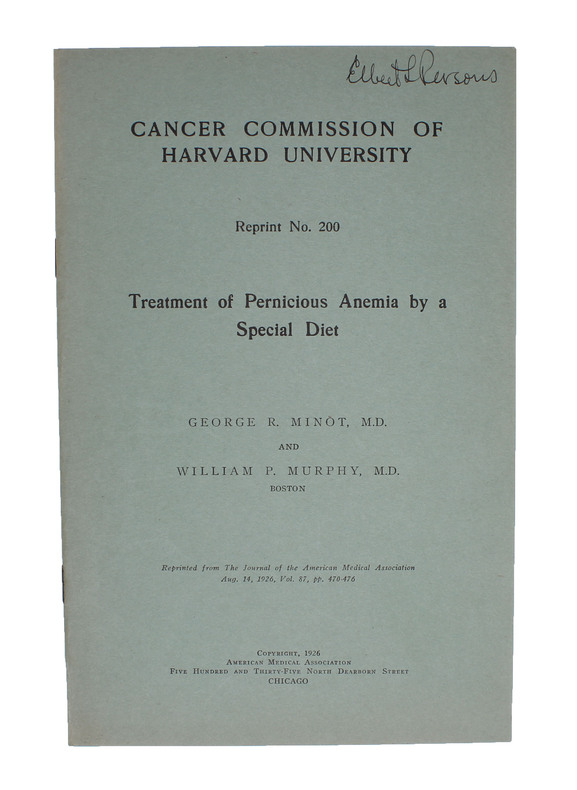
‎"MINOT, GEORGE R. (+) WILLIAM P. MURPHY.‎

‎Treatment of Pernicious Anemia by a Special Diet. (Offprint from ""The Journal of the American Medical Association"", Aug. 14, 1926, Vol. 87, pp. 470-476). - [NOBEL PRIZE IN MEDICINE 1934 - ""ONE OF THE LANDMARKS IN THE HISTORY OF THERAPEUTICS""]‎

‎Chicago, American Medical Association, 1926. 8vo. Offprint in the original printed wrappers. Previous owner's name to top right corner of front wrapper. A very fine and clean copy. 19 pp.‎

‎"MINOT, GEORGE R. (+) WILLIAM P. MURPHY.‎

‎Treatment of Pernicious Anemia by a Special Diet. (Offprint from ""The Journal of the American Medical Association"", Aug. 14, 1926, Vol. 87, pp. 470-476). - [NOBEL PRIZE IN MEDICINE 1934 - ""ONE OF THE LANDMARKS IN THE HISTORY OF THERAPEUTICS""]‎

‎Chicago, American Medical Association, 1926. 8vo. Offprint in the original printed wrappers. Previous owner's name to top right corner of front wrapper. A very fine and clean copy. 19 pp.‎

‎First printing, in the scarce offprint, of Minot and Murphy's seminal Nobel Prize winning paper which ""ranks as one of the greatest modern advances in [anemia] therapy."" (GM). Minot and Murphy shared the Nobel Prize in Physiology or Medicine in 1934 with George Whipple ""for their discoveries concerning liver therapy in cases of anaemia"". ""The brilliant discovery by Minot and Murphy in 1926, demonstrating the dramatic effectiveness of liver preparations in pernicious anemia, forms one of the landmarks in the history of therapeutics."" (Satoskar, Pharmacology and Pharmacotherapeutics).""Prompted by pathologist George Whipple's research on the feeding of liver to anemic dogs, Minot and Murphy fed liver to their patients. In a now famous 1926 paper [the present], they announced its miraculous benefits for forty-five otherwise doomed souls."" (Wailoo, Drawing Blood: technology and Disease Identity in Twentieth-Century America). Up until the 1920'ies, pernicious anemia (also known as ""blood thinning"" disease) was a fatal disease, for which there was no cure. People who developed pernicious anemia - characterized by dangerously low counts of red blood cells - were left exhausted, hospitalized, and without the hope of being cured. ""Minot’s work and that of numerous pupils during the decade after 1926 initiated a new era in clinical hematology by replacing the largely morphologic studies of the blood and of the blood-forming and blood-destroying organs with dynamic measurements of their functions."" (DSB).In the early 1920s, most doctors believed that pernicious anemia was caused by a toxic substance in the body, and they prescribed doses of arsenic, transfusions, or removal of the spleen as treatments. But after these remedies were administered, patients had relapses, and death was inevitable. Across the world, 6,000 lives a year were lost to the scourge of pernicious anemia.""In 1923, Minot met William P. Murphy, who had graduated from Harvard Medical School in 1922 and who was to become an assistant instructor at Harvard Medical School in 1924. In their investigations to find a cure for pernicious anemia, Minot believed that research by George Whipple, a researcher whom he had known while both were at Johns Hopkins Hospital, was particularly significant. Whipple had completed experiments in which he bled dogs to make them anemic. Then he determined which foods restored their red blood cells. His results showed that red meat and certain vegetables were effective treatments, but liver was the best treatment. Minot wondered if Whipple's findings with dogs could be duplicated in humans. He and Murphy were determined to try it, and proceeded to do so with their private patients. Observing an increase in the patients' red blood cell counts, they thought they were on the right track, and decided to try the experiment with hospitalized patients which eventually led to their landmark discovery."" (The Harward University Gazette, 1998).After Minot and Murphy's verification of Whipple's results in 1926, pernicious anemia victims ate or drank at least one-half pound of raw liver, or drank raw liver juice, every day. This continued for several years, until a concentrate of liver juice became available.The active ingredient in liver remained unknown until 1948, when it was isolated by chemists Karl A. Folkers.Garrison & Morton: 3140‎

Riferimento per il libraio : 51659

Livre Rare Book

Herman H. J. Lynge & Son
Copenhagen Denmark Dinamarca Dinamarca Danemark
[Books from Herman H. J. Lynge & Son]

€ 3.357,50 Informazioni/Compera

‎"MUSITANI, CAROLI. (CARLO MUSITANO)‎

‎WeiberKranckheiten Worinnen die Erzeugung der Menschen auf das genaueste untersuchet.‎

‎Leipzig, Braun, 1724. 8vo. In contemporary half vellum with gilt lettering to spine. Light wear to extremities, small paper-label pasted on to spine. A few doodles to pasted down front end-papers. Internally very nice and clean. (6), 746, (14) pp. + frontispiece.‎

‎Later German edition of Musitano's ""De morbis mulierum tractatus"" on Women’s diseases with a focus on gynaecology and venereal illnesses - Musitano's most famous and influential work. Musitano (1635 – 1714), is regarded as being one of the most important Italian physicians of the seventeenth century and his works were reissued several times and translated into both French and German. Musitano was both a priest and a physician which made him many enemies who, under the pretext of ""indecency"", tried to prevent him from practicing medicine. However, Pope Clement IX, acknowledging Musitano's merit, granted him permission to continue his medical practice.‎

Riferimento per il libraio : 61095

Livre Rare Book

Herman H. J. Lynge & Son
Copenhagen Denmark Dinamarca Dinamarca Danemark
[Books from Herman H. J. Lynge & Son]

€ 604,35 Informazioni/Compera

‎"NICOLLE, CHARLES J.H. et LOUIS H. MANCEAUX. - TOXOPLASMA FOUND.‎

‎Sur une infection à corps de Leishman (ou organismes voisins) du gondi.‎

‎(Paris, Gauthier-Villars), 1908. 4to. No wrappers. In: ""Comptes Rendus Hebdomadaires des Séances de L'Academie des Sciences"", Tome 147, No 17. Pp. (727-) 770. (Entire issue offered). The paper: pp. 763-66.‎

‎"NICOLLE, CHARLES J.H. et LOUIS H. MANCEAUX. - TOXOPLASMA FOUND.‎

‎Sur une infection à corps de Leishman (ou organismes voisins) du gondi.‎

‎(Paris, Gauthier-Villars), 1908. 4to. No wrappers. In: ""Comptes Rendus Hebdomadaires des Séances de L'Academie des Sciences"", Tome 147, No 17. Pp. (727-) 770. (Entire issue offered). The paper: pp. 763-66.‎

‎The paper describes toxoplasma for the first time.""In collaboration with L. Manceaux, he isolated a previousluy unknown parasite of Tunisian rodents. Toxoplasma gondii (1908). Other researchers later established that toxoplasmosis is also a human disease.""(DSB).Garrison & Morton, 5534.‎

Riferimento per il libraio : 59102

Livre Rare Book

Herman H. J. Lynge & Son
Copenhagen Denmark Dinamarca Dinamarca Danemark
[Books from Herman H. J. Lynge & Son]

€ 201,45 Informazioni/Compera

‎"NITZE, MAX. - FOUNDING UROLOGY - THE FIRST TEXTBOOK IN UROLOGY‎

‎Lehrbuch der Kystoskopie. Ihre Technik und klinische Bedeutung. Mit 6 Tafeln und 26 Abbildungen im Texte.‎

‎Wiesbaden, J.F. Bergmann, 1889. Contemp. hcalf. Raised bands, gilt, titlelabel in leather with gilt lettering. Compartments richly blindtooled. A small crack to backhinge, board still holding. VIII,(1),319,(1) pp. 5 lithographed plates (numb. I-V, No. I in chromolitography) and 1 folded woodengraved plate (Tafel A). Internally fine and clean, but with some pencil undrlinings (easy toremove) and some underlinings in ink on the last leaves (from p. 304 ff).‎

‎"OBSTETRICS - LENOIR, A.(DOLPHE).‎

‎Atlas de L'Art des Accouchements. Continué par Marc Sée (et) S. Tavernier. Ouvrage contenant 105 Planches avec Texte Explicatif en Regard.‎

‎Paris, G. Masson, (No year but presumably 1871). 4to. Cont. hcalf. Top edge gilt. Raised bands, gilt back. Head a. foot of spine frayed. Hinges repaired for splitting. Titlepage and 105 pp. with explanation to each plate. Titlepage somewhat brownspotted. With 105 fine chromolithographed plates, among these are 11 showing surgical instruments. Plates ""Dessiné et Lithogr. dap. nat. par Emile Beau"". Plates ocassional a little brownspotted.‎

‎"ORÉ, (PIERRE CYPRIEN). - PIONEERING INTRAVENOUS ANASTHESIA.‎

‎De l'anesthésie produite chez l'homme par les injections de chloral dans les veines. (+) (Suite). Tétanos traumatique traité par les injections. Guérison.‎

‎(Paris, Gauthier-Villars), 1874. 4to. No wrappers. In: ""Comptes Rendus Hebdomadaires des Séances de L'Academie des Sciences"", Tome 78, No 7 a. 9. Pp. (453-) 520 a. (577-) 664 (2 entire issues offered). Oré's papers: pp. 515-517 a. 651-654.‎

‎"ORÉ, (PIERRE CYPRIEN). - PIONEERING INTRAVENOUS ANASTHESIA.‎

‎De l'anesthésie produite chez l'homme par les injections de chloral dans les veines. (+) (Suite). Tétanos traumatique traité par les injections. Guérison.‎

‎(Paris, Gauthier-Villars), 1874. 4to. No wrappers. In: ""Comptes Rendus Hebdomadaires des Séances de L'Academie des Sciences"", Tome 78, No 7 a. 9. Pp. (453-) 520 a. (577-) 664 (2 entire issues offered). Oré's papers: pp. 515-517 a. 651-654.‎

‎First printing of 2 importent papers in surgical anaesthesia as they records ""The first successfull human anaesthesia. Oré, professor of physiology at Bordeaux, reported the successfull use of this method in animals... 1872."" (Garrison & Morton No. 5672).‎

Riferimento per il libraio : 49096

Livre Rare Book

Herman H. J. Lynge & Son
Copenhagen Denmark Dinamarca Dinamarca Danemark
[Books from Herman H. J. Lynge & Son]

€ 201,45 Informazioni/Compera

‎"OTTESEN, J.‎

‎On the Age of Human White Cells in Peripheral Blood.‎

‎(Stockholm, 1954). 8vo. Stapled without wrappers (as issued). Offprint from ""Acta Physiologica Scandinavica"" 1954, Vol. 32, Fasc. 1.‎

‎"Par l'auteur des ""Paillettes d'Or"""‎

‎Le livre des gardes-malades à l'usage des familles et principalement des communautés religieuses et des soeurs hospitalières - Nouvelle édition‎

‎Aubanel Frères. 1922. In-18. Relié toilé. Etat d'usage, Couv. convenable, Dos satisfaisant, Papier jauni. VII + 328 pages. Titre doré sur le dos. Coins très légèrement frottés. Mors légèrement fendus en coiffe de pied.. . . . Classification Dewey : 614-Santé publique, médecine préventive‎

‎Classification Dewey : 614-Santé publique, médecine préventive‎

Riferimento per il libraio : R300296477

‎"PASSOT, RAYMOND.‎

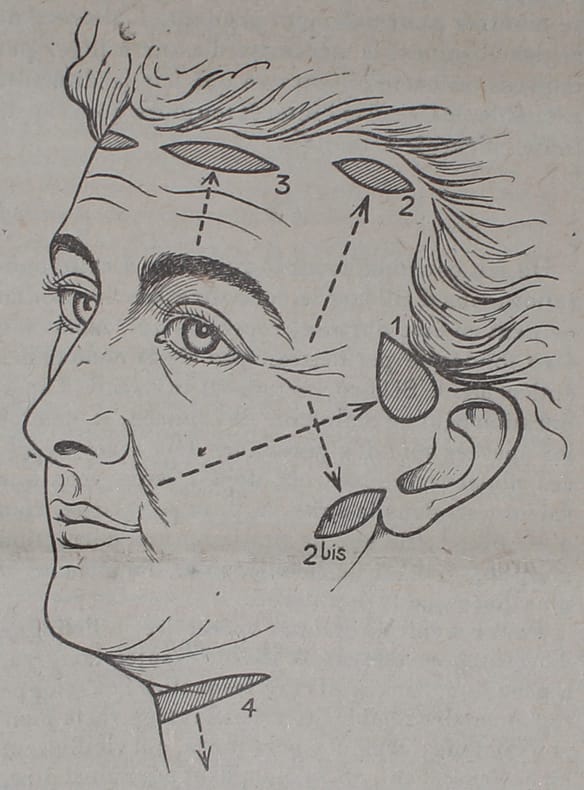
‎La Chirurgie Esthétique des Rides du Visage. [In: La Presse Médicale. No 27. Lundi, 12 Mai 1919]. - [FIRST PUBLISHED FACELIFT]‎

‎(Paris), 1919. Folio. With a nice, later paper backstrip. Entire issue 27, 1919 of La Presse Médicale present (pp. 353- 360). Passot's article: 7 columns on pp. 258-261. With one illustration, depicting the ways to reduce wrinkles on a face. Well preserved.‎

‎"PASSOT, RAYMOND.‎

‎La Chirurgie Esthétique des Rides du Visage. [In: La Presse Médicale. No 27. Lundi, 12 Mai 1919]. - [FIRST PUBLISHED FACELIFT]‎

‎(Paris), 1919. Folio. With a nice, later paper backstrip. Entire issue 27, 1919 of La Presse Médicale present (pp. 353- 360). Passot's article: 7 columns on pp. 258-261. With one illustration, depicting the ways to reduce wrinkles on a face. Well preserved.‎

‎The very rare first printing of this pioneering work of plastic surgery - one of the very first - most likely THE first - publication on face lifting, consisting mainly in the elevating and redraping of the facial skin. The first facelift was reportedly done in either 1901 or 1907, but ""[n]ot all writers of rhytidectomy spread their innovations through publication"" some were teachers instead of writers. Sooner or later, however, those they taught began to write. Giving credit to his masters, Pozzi and Morestin, as well as Mlle. Pertat, Raymond Passot in 1919 described the following technique for eliminating cheek wrinkles and the buccolabial sulcus: First, he began the operation by ""withdrawing miniscule amounts of tegument in the preauricular region, using as a limit the lower part of the male's sideburns and the region onto which the mass of the female feair falls...."" (Gonzales-Ulloa, The Creation of Aesthetic Surgery, p. 43). The paper is extremely famous, not only due to its great influence, but also because it has come to be regarded as a milestone publication in the history of face lifting, being perhaps the very first publication to describe this now so popular method of rejuvenation. ""There is still doubt as to who performed the first facelift, but most sources date it to the first decade of the 20th century.... Hollander... in 1932 stated that his original procedure had been preformed in 1901 for a Polish aristocrat. Lexer, however, reported in 1931 that he had preformed a facelift for and acr´tress in 1906 and that he was unaware of any such operation before that date. Joseph reported in 1921 that he had preformed an operation in 1912 for cerrection of aging cheek tissues in a 48-year-old woman. By the time Hollander, lexer, and Joseph reported their first procedures, a number of other prominent surgeons in Europe, such as Noel, Passot, Morseting... were busy performing cosmetic surgical procedures.... Passot in 1919 published an illustrated article showing sites of elliptic skin excision of the hairline, the forehead, and the temporal and preauricular areas to tighten the skin and an elliptic excision of skin and fat to reduce submental fat deposits."" (Neligan, Plastic Surgery, vol. 6, p. 184). ""In France, Passot was the first surgeon to describe the submental excision to correct a double chin and multiple facial direct excisions in 1919 in his article ""La chirurgie esthétiques des rides du visage"". (Panfilov, Aesthetic Surgery of the Facial Mosic, p. 5).‎

Riferimento per il libraio : 60126

Livre Rare Book

Herman H. J. Lynge & Son
Copenhagen Denmark Dinamarca Dinamarca Danemark
[Books from Herman H. J. Lynge & Son]

€ 5.103,40 Informazioni/Compera

‎"PASTEUR, LOUIS. - DISCOVERING THAT ""CHILD-BED"" FEVER IS CAUSED BY STREPTOCOCCUS.‎

‎De l'extension de la théorie des germes à l'étiologie de quelques maladies communes.‎

‎(Paris, Gauthier-Villars), 1880. 4to. No wrappers. In: ""Comptes Rendus Hebdomadaires des Séances de L'Academie des Sciences"", Tome 90, No 18. Pp. (1021-) 1092. (Entire issue offered). Pasteur's paper: pp. 1033-1044. Very small tears to the first few leaves, not affecting Pasteur's paper.‎

‎"PASTEUR, LOUIS. - DISCOVERING THAT ""CHILD-BED"" FEVER IS CAUSED BY STREPTOCOCCUS.‎

‎De l'extension de la théorie des germes à l'étiologie de quelques maladies communes.‎

‎(Paris, Gauthier-Villars), 1880. 4to. No wrappers. In: ""Comptes Rendus Hebdomadaires des Séances de L'Academie des Sciences"", Tome 90, No 18. Pp. (1021-) 1092. (Entire issue offered). Pasteur's paper: pp. 1033-1044. Very small tears to the first few leaves, not affecting Pasteur's paper.‎

‎First apperance of an importent paper in microbiology in which Pasteur attributes Puerpal Fever to the development of micro-organisms infecting the pus of the inflammatory condition. He claims that the childhood fever was caused by the bacterium later named Streptococus pyogenes.‎

Riferimento per il libraio : 53363

Livre Rare Book

Herman H. J. Lynge & Son
Copenhagen Denmark Dinamarca Dinamarca Danemark
[Books from Herman H. J. Lynge & Son]

€ 268,60 Informazioni/Compera

‎"PASTEUR, LOUIS. - THE FIRST CASE OF IMMUNITY VIA ARTIFICIALLY ATTENUATED VIRUS - RABIES.‎

‎Méthode pour prévenir la rage après morsure. (Method for preventing Rabies after Bites). (+) Résultats de l'application de la méthode pour prévenir la rage aprés morsure. (+) Note complémentaire sur les résultats de l'application de la méthode de pr...‎

‎(Paris, Gauthier-Villars), 1885 a. 1886. 4to. No wrappers. In: ""Comptes Rendus Hebdomadaires des Séances de L'Academie des Sciences"", Tome 101 (No. 17), 102 (No. 9 + 15) a. 103. (No. 18). Titlepages to vol. 101, 102 a. 103. Pp. (765-) 848, (459-529), (835-) 886, (777-) 840. (Four entire issues offered). Pasteur's papers: pp. 765-772, 459-469, 835-838 a. 777-785.. A stamp to verso of titlepages.‎

‎"PAULLI, SIMON.‎

‎Quadripartitum, de simplicium medicamentorum facultatibus (+) Oratio ad dn Professores ac Studiosos amnium ordinum. - [PAULLI'S FIRST BOTANICAL WORK]‎

‎Rostock, Johann Hallervord, 1639. 4to. In contemporary full vellum. Title in contentemporary hand to spine. Gilt ornamentation to spine and gilt frames to boards. All edges gilt. Extremities with light soiling and a few dots and marks. Two previous owner's names in near contemporary hand to title-page. Three small worm-tracts affecting first few leaves, otherwise internally very nice and clean. (16), 80, 184, 19, (17), (32), (16) pp.‎

‎Exceedingly rare first edition of Paulli’s first substantial botanical work - and the first botanical university textbook in Denmark - which laid the foundation for his magnum opus, the greatest illustrated work in Danish book-production, and the largest Flora ever produced, namely that of Flora Danica. The present work deals with the medicinal properties of various substances and is considered one of Paulli's most important contributions to the field of medicine. In the preface to Flora Danica, Simon Paulli writes that the plant descriptions are drawn from Dodoens but organized into four groups based on the flowering time. One might think that this was meant as a simple and understandable system for laypeople, but the system was not specifically created for this work. In Flora Danica, Paulli employed a classification that he had already developed and presented in the present work, the same year he arrived in Copenhagen. Since Simon Paulli originally wrote Flora Danica in Latin and had it translated with the help of a Danish student, it is reasonable to assume that he drew much of the material directly from this book. (See Bjerke, “De Lærdeste Lægers Urtegaarde”). Simon Paulli (1603–1680) was a Danish physician and naturalist and made significant contributions to the fields of medicine and botany during the 17th century. Paulli was born in Rostock, Germany, and later moved to Denmark. He served as a professor of medicine at the University of Copenhagen and became the personal physician to King Christian IV of Denmark. In the botanical realm, Paulli is particularly known for his work ""Flora Danica,"". Published in the mid-17th century, ""Flora Danica"" was one of the earliest works of its kind and contributed to the scientific understanding of plant life in Denmark. Apart from his botanical contributions, Simon Paulli made important strides in the field of medicine, and he is recognized for his studies on human anatomy. Simon Paulli's impact on botany and medicine, particularly in Scandinavia, has left a lasting legacy in the history of science.‎

Riferimento per il libraio : 60630

Livre Rare Book

Herman H. J. Lynge & Son
Copenhagen Denmark Dinamarca Dinamarca Danemark
[Books from Herman H. J. Lynge & Son]

€ 6.715,00 Informazioni/Compera

‎"PAVLOV, I.P.‎

‎Lektsii o rabote bolshikh polusarov golovnogo mozga. [Russian. i.e.: Lectures on Big Cerebral Hemispheres]. - [THE NERVOUS SYSTEM AND PSYCHIC ILLNESS - PRESENTATION-COPY]‎

‎Moskva, 1927. 8vo. Contemporary black half calf with gilt lines and gilt Russian lettering to spine. Inscribed by Pavlov to front end-paper. Annotated in pencil and crayon throughout (by Podkopaev?). A fine and clean copy. 371 pp.‎

‎"PAVLOV, I.P.‎

‎Lektsii o rabotie glavnikh pishtshevaritelnikh zhelyoz [Russian - i.e. Lectures on the Work of the Principal Digestive Glands]. - [FOUNDING CLASSICAL CONDITIONING - PMM 385]‎

‎S.-Peterburg, 1897. 8vo. Bound with the original printed front wrapper in a nice 20th century half calf wih four raised bands and gilt lettering to spine. Very nice and clean. Front wrapper re-hinged and with an old ownership signature and date (1915). Private library-stamp to verso of title-page. A very nice, clean, and fresh copy. (6), II, 223 pp.‎

‎"PAWLOW, J. P. [PAVLOV].‎

‎Die Arbeit der Verdauungsdrüsen.‎

‎Weisbaden, J. F. Bergman, 1898. Large8vo. Bound uncut with the original wrappers in contemporary half cloth with marbled boards and gilt lettering to spine. Front wrapper partly detached and previous owner's inscription to top of front wrapper. Otherwise a fine and clean copy. XII, 199, (5) pp.‎

‎"PAWLOW, J. P. [PAVLOV].‎

‎Die Arbeit der Verdauungsdrüsen.‎

‎Weisbaden, J. F. Bergman, 1898. Large8vo. Bound uncut with the original wrappers in contemporary half cloth with marbled boards and gilt lettering to spine. Front wrapper partly detached and previous owner's inscription to top of front wrapper. Otherwise a fine and clean copy. XII, 199, (5) pp.‎

‎First German (and first in general) translation of Pavlov's seminal work on the digestion glands in which he demonstrated that the effects of feeding were transmitted to the gastric glands even when food was prevented from entering the stomach. (One Hundred Books Famous in Medicine 86). ""Pavlov summarized his experiments in a series of lectures given in 1896 and published in Russian the following year. A German translation appeared in 1898 and an English one in 1902. For his work on physiology of digestion Pavlov was awarded the Nobel Prize in 1904."" (One Hundred Books Famous in Medicine 86). ""Scientific Research In the years 1891-1903, Pavlov concentrated on the studies of the digestive system that were systematized in his Lectures on the Work of the Main Gastric Glands (1897) and won him a Nobel Prize in Physiology or Medicine (1904). In this research, Pavlov’s ""physiological thinking"" was embodied in the ""chronic experiment,"" and his analysis of data was structured by his metaphor of the digestive system as a precise and purposive chemical factory. For the chronic experiment, experimental dogs were prepared surgically with an operation designed to give the experimenter access to a digestive gland. Experiments began only after the dog had recovered and regained a ""normal"" state. These operations included the esophagotomy, which separated the cavities of the mouth and stomach, allowing Pavlov to use sham-feeding experiments to demonstrate the centrality of a psychic actor, appetite, in the first phase of digestive secretion. To study the second, nervous-chemical phase of digestion, he developed an innervated version of Heidenhain’s isolated stomach. In Pavlov’s isolated sac, the main stomach remained continuous with the digestive tract, but a smaller pouch, isolated from food by a mucous membrane, maintained its nervous connections to the larger stomach. For Pavlov, as a nervist, the innervation of the isolated sac assured that its glandular reactions would mirror those in the main stomach. Inserting a fistula in this small stomach, Pavlov and his co-workers measured the quantity and quality of its glandular secretions, which Pavlov analyzed in his ""characteristic secretory curves."" For Pavlov, these curves reflected the precise and purposive action of the glands as they processed different foods."" (DSB)Bibliotheca Walleriana 7257.‎

Riferimento per il libraio : 46198

Livre Rare Book

Herman H. J. Lynge & Son
Copenhagen Denmark Dinamarca Dinamarca Danemark
[Books from Herman H. J. Lynge & Son]

€ 470,05 Informazioni/Compera

‎"PAWLOW, J. P. [PAVLOV].‎

‎Die Arbeit der Verdauungsdrüsen. Vorlesungen. Autorisierte Übersetzung aus dem Russischen von Dr. A. Walther. Mit einem Vorwort und Zusätzen des Verfassers.‎

‎Wiesbaden, J. F. Bergmann, 1898. 8vo. In later half cloth with gilt lettering to spine. Ex-libris pasted on to pasted down front end-paper. Previous owner's name to title-page. A very fine and clean copy. XII, 199, (5) pp.‎

‎"PAWLOW, J. P. [PAVLOV].‎

‎Die Arbeit der Verdauungsdrüsen. Vorlesungen. Autorisierte Übersetzung aus dem Russischen von Dr. A. Walther. Mit einem Vorwort und Zusätzen des Verfassers.‎

‎Wiesbaden, J. F. Bergmann, 1898. 8vo. In later half cloth with gilt lettering to spine. Ex-libris pasted on to pasted down front end-paper. Previous owner's name to title-page. A very fine and clean copy. XII, 199, (5) pp.‎

‎First German (and first in general) translation of Pavlov's seminal work on the digestion glands in which he demonstrated that the effects of feeding were transmitted to the gastric glands even when food was prevented from entering the stomach. (One Hundred Books Famous in Medicine 86). ""Pavlov summarized his experiments in a series of lectures given in 1896 and published in Russian the following year. A German translation appeared in 1898 and an English one in 1902. For his work on physiology of digestion Pavlov was awarded the Nobel Prize in 1904."" (One Hundred Books Famous in Medicine 86). ""Scientific Research In the years 1891-1903, Pavlov concentrated on the studies of the digestive system that were systematized in his Lectures on the Work of the Main Gastric Glands (1897) and won him a Nobel Prize in Physiology or Medicine (1904). In this research, Pavlov’s ""physiological thinking"" was embodied in the ""chronic experiment,"" and his analysis of data was structured by his metaphor of the digestive system as a precise and purposive chemical factory. For the chronic experiment, experimental dogs were prepared surgically with an operation designed to give the experimenter access to a digestive gland. Experiments began only after the dog had recovered and regained a ""normal"" state. These operations included the esophagotomy, which separated the cavities of the mouth and stomach, allowing Pavlov to use sham-feeding experiments to demonstrate the centrality of a psychic actor, appetite, in the first phase of digestive secretion. To study the second, nervous-chemical phase of digestion, he developed an innervated version of Heidenhain’s isolated stomach. In Pavlov’s isolated sac, the main stomach remained continuous with the digestive tract, but a smaller pouch, isolated from food by a mucous membrane, maintained its nervous connections to the larger stomach. For Pavlov, as a nervist, the innervation of the isolated sac assured that its glandular reactions would mirror those in the main stomach. Inserting a fistula in this small stomach, Pavlov and his co-workers measured the quantity and quality of its glandular secretions, which Pavlov analyzed in his ""characteristic secretory curves."" For Pavlov, these curves reflected the precise and purposive action of the glands as they processed different foods."" (DSB)Bibliotheca Walleriana 7257.‎

Riferimento per il libraio : 60159

Livre Rare Book

Herman H. J. Lynge & Son
Copenhagen Denmark Dinamarca Dinamarca Danemark
[Books from Herman H. J. Lynge & Son]

€ 268,60 Informazioni/Compera

‎"PEARSON, GEORG.‎

‎Untersuchung uber die Geschichte der Kuhpocken : in besonderer Hinsicht auf die Ausrottung der Kinderpocken. - [EARLY WORK ON SMALLPOX]‎

‎Nürnberg, 1800. 8vo. In contemporary half calf with gilt lettering to spine. Small paper-label pasted on to top of spine. A fine copy. XII, 132 pp.‎

‎Rare first German translation of Pearson's work on smallpox translated by J. Fr. Küttlinger (originally published in 1798 under the following title: ""An Inquiry Concerning the History of the Cowpox, Principally with a View to Supersede and Extinguish the Smallpox""). Vaccination reached the European continent in 1800 and the present publication is one of the very earliest to describe this. Pearson was an early supporter of smallpox vaccination and endorsed Edward Jenner, promptly publishing his initial observations shortly after Jenner's Inquiry was released. In 1799, he played a key role in establishing the Original Vaccine Pock Institute in London, distributing vaccine samples. Unfortunately, some of these samples were contaminated with the smallpox virus, leading to a disagreement with Jenner, who felt overshadowed. As Jenner gained prominence, Pearson became envious. In 1802, when Jenner sought financial recognition from Parliament, Pearson presented a detailed account of his own contributions, challenging Jenner's sole credit for the discovery of vaccination. Pearson highlighted farmer Benjamin Jesty and others with prior claims. Despite Pearson bringing Jesty to London in 1805 to support his case during Jenner's second Parliamentary grant request, it proved unsuccessful. Not in Garrison & Morton‎

Riferimento per il libraio : 60689

Livre Rare Book

Herman H. J. Lynge & Son
Copenhagen Denmark Dinamarca Dinamarca Danemark
[Books from Herman H. J. Lynge & Son]

€ 1.074,40 Informazioni/Compera

‎"PETIT, JEAN LOUIS - ""TOURNIQUET OF PETIT""‎

‎Dissertation sur la Maniere d'arrester le Sang dans les hemorragies. Avec la Description d'une Machine ou Bandage propre à procurer la consolidation des Vaisseaux, après l'Amputation des membres, par la seule Compression.‎

‎(Paris, L'Imprimerie Royale, 1733). 4to. Without wrappers. Extracted from ""Mémoires de l'Academie des Sciences. Année 1731"". Pp. 85-102 and 1 engraved plate.‎

‎"PETIT, JEAN LOUIS - ""TOURNIQUET OF PETIT""‎

‎Dissertation sur la Maniere d'arrester le Sang dans les hemorragies. Avec la Description d'une Machine ou Bandage propre à procurer la consolidation des Vaisseaux, après l'Amputation des membres, par la seule Compression.‎

‎(Paris, L'Imprimerie Royale, 1733). 4to. Without wrappers. Extracted from ""Mémoires de l'Academie des Sciences. Année 1731"". Pp. 85-102 and 1 engraved plate.‎

‎First printing of this importent paper, as the invention described represents one of the main advancements in the art and science of amputation in the eighteenth century. ""Petit's tourniquet is considered by many sources to be one of the ""most important surgical advancements before the advent of anesthesia.""""‎

Riferimento per il libraio : 53204

Livre Rare Book

Herman H. J. Lynge & Son
Copenhagen Denmark Dinamarca Dinamarca Danemark
[Books from Herman H. J. Lynge & Son]

€ 335,75 Informazioni/Compera

‎"PETIT, JEAN LOUIS. - FIRST OPERATION ON FISTULA LACRYMALIS.‎

‎De la Fistule Lacrymale.‎

‎(Paris, L'Imprimerie Royale, 1736). 4to. Without wrappers. Extracted from ""Mémoires de l'Academie des Sciences. Année 1734"". Pp. 135-148 and 1 engraved plate.‎

‎"PETIT, JEAN LOUIS. - FIRST OPERATION ON FISTULA LACRYMALIS.‎

‎De la Fistule Lacrymale.‎

‎(Paris, L'Imprimerie Royale, 1736). 4to. Without wrappers. Extracted from ""Mémoires de l'Academie des Sciences. Année 1734"". Pp. 135-148 and 1 engraved plate.‎

‎First appearance of an importent paper describing the first operation for fistula lacrymalis by an incision of the lacrymal sac.‎

Riferimento per il libraio : 53205

Livre Rare Book

Herman H. J. Lynge & Son
Copenhagen Denmark Dinamarca Dinamarca Danemark
[Books from Herman H. J. Lynge & Son]

€ 241,74 Informazioni/Compera

‎"PETTENKOFER, MAX (JOSEPH VON).‎

‎Ueber die Verbreitungsart der Cholera.‎

‎(München), 1865. No wrappers. ""Aus der Zeitschrift für Biologie, Jahrgang 1865"". Pp. 322-374.‎

Numero di risultati : 97.157 (1944 pagina/e)

Prima pagina Pagina precedente 1 ... 94 95 96 [97] 98 99 100 ... 363 626 889 1152 1415 1678 1941 ... 1944 Pagina successiva Ultima pagina