Die unabhängige Plattform professioneller Buchhändler und Antiquare

‎Medecine‎

Main

Eltern des Themas

‎Santé‎
‎Sciences‎

Siehe Unterthemen

Unterthemen

Anzahl der Treffer : 97,167 (1944 seiten)

Erste Seite Vorherige Seite 1 ... 96 97 98 [99] 100 101 102 ... 365 628 891 1154 1417 1680 1943 ... 1944 Nächste Seite Letzte Seite

‎"STENO, NICOLAI (NIELS STENSEN).‎

‎Observationes Anatomicae. - [THE FOUNDATION OF THE STUDY OF GLANDS AS A SCIENCE]‎

‎Lugduni [Leiden], Jacobum Chouët, 1662. 12mo. Partly uncut in a nice later full calf binding (19th century?) with five raised bands and gilt lettering to spine. Hinges with a bit of wear and small piece of leather lacking on top of spine. Vague previous owner's name in contemporary hand to lower part of title-page. Ex-libris pasted on to pasted down front end-paper. Vague traces after stamp on p. 108. A fine copy. (12), 108 pp. + 3 folded plates.‎

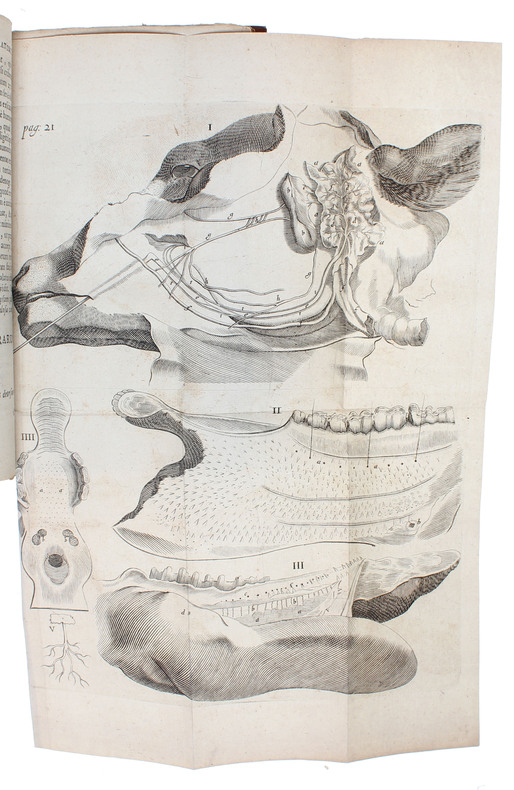
‎The rare first edition of Steno's early and first major discovery, being the findings of the 3 main Ducts and glands of the eye, the mouth and the nose, among these the first account of the excretory duct of the parotid gland now named ""Stensen's Duct"". He correctly stated that the true purpose of the glands was to secrete fluid and ""with [the present work] Nicolaus Steno had established the study of glands as a science"". (Snorrason). His careful dissections of animal, and later human, brains were revolutionary. He demonstrated that tears are secrated by specific glands, thus striking a deadly blow to the ancient notion of cerebral excretion, even disproving the speculations of scholars such as Descartes, who believed that the corpus pineale (a brain gland) was the connecting point between soul and body.Steno arrived in Holland in March 1660 and was given lodging by the city's physician Gerad Blaes (Latin: Blasius) who himself had studied in Copenhagen and was a friend of Thomas Bartholin. A year later Steno wrote in a letter to Bartholin: ""After I had been given leave by Blasius to dissect on my own in the museum, I bought a sheep's-head in order to examine the brain. I happened to decide to investigate first the course of the veins and arteries at the mouth by introducing a probe into the vessels. I suddenly discovered that the point of the probe was moving freely in a spacious cavity and struck with a ringing sound against the teeth. Surprised at this, I called my host to hear his opinion. Blasius first said that it was due to force, then that it was one of nature's frequent freaks, and finally he looked up Wharton's book, but found no explanation there"". Shortly thereafter, Steno repeated the investigation on a dog and confirmed, ""there was a duct leading from the gland by the ear to the oral cavity, of a similar kind to the duct from the submaxillary gland found by the English man Thomas Wharton (1610-1673) a few years previously and described in his book Adenographia 1656. Steno was now certain that the gland was a salivary gland and not, as Wharton said in his book and as had been believed for some 1500 year, a kind of sponge intended to absorb surplus materials from the hard rami of the fifth pair of nerves, carry these back to the veins, warm up the outer and inner ear, and fill up the hollow around them."" (Snorrason). ""This discovery led Stensen to consider every fluid in the body as a glandular secretion. He then found a series of glands furnishing fluid to each of the body cavities. He likewise sought the afferent and efferent ducts of secretion. Stensen still used the name ""lymph"" for all watery glandular secretions, because he was not yet able to differentiate between them and to specify them chemically and physiologically. In the course of this basic research Stensen presented in his Leiden dissertation new discoveries of glands in the cheeks" beneath the tongue" and in the palate, whose structure of veins, arteries, nerves, and lymph vessels he also described. In his Observationes anatomicae (1662), dealing with his new discoveries concerning the glands, he described the lachrymal apparatus in great detail."" DSB 13, 33. ""Niels Stensen remains one of the most notable scientists in the history of anatomy. His method based on dissection and experiment enabled him to make significant contribution to the understanding of structure and function of human body. Like many successful scientists he was able to make the most of the rather serendipitous discovery of the parotid duct early in his career, soon expanding his research focus into new areas."" (Strkalj, Niels Stensen and the Discovery of the Parotid Duct).""In the physiology his researches into the anatomy of the glands led to his discovery of the [duct of] parotid gland, one of the three salivary glands near the ear, into the mouth, is still named ""Steno's duct."""" (PMM 151)Osler 4018Garrison & Morton 973Waller 9226Heirs of Hippocrates 393Norman 2010Snorrason 1662(PMM 151)‎

Referenz des Buchhändlers : 53846

Livre Rare Book

Herman H. J. Lynge & Son
Copenhagen Denmark Dinamarca Dinamarca Danemark
[Bücher von Herman H. J. Lynge & Son]

€ 10,744.00 Kaufen

‎"SZENT-GYÖRGI, ALBERT.‎

‎Observation on the function of peroxidase systems and the chemistry of the adrenal cortex. Description of a new corbohydrate derivative. - [DISCOVERY OF VITAMIN C - NOBEL PRIZE 1937]‎

‎London, Cambridge University Press, 1928. Royal8vo. In the original printed wrappers. In ""The Biochemical Journal"", Vol. 22, 1928. Entire issue offered. Wrappers with nicks and ligt overall soiling. A tear to last 7 leaves. Internally fine and clean. Pp. 1387-1409. [Entire issue: Pp. (8), 1341-1575, (2), XIV, (1).].‎

‎"SZENT-GYÖRGI, ALBERT.‎

‎Observation on the function of peroxidase systems and the chemistry of the adrenal cortex. Description of a new corbohydrate derivative. - [DISCOVERY OF VITAMIN C - NOBEL PRIZE 1937]‎

‎London, Cambridge University Press, 1928. Royal8vo. In the original printed wrappers. In ""The Biochemical Journal"", Vol. 22, 1928. Entire issue offered. Wrappers with nicks and ligt overall soiling. A tear to last 7 leaves. Internally fine and clean. Pp. 1387-1409. [Entire issue: Pp. (8), 1341-1575, (2), XIV, (1).].‎

‎First printing of Szent-Györgyi's landmark paper in which he for the first time discovered and isolated ""hexuronic acid"" or ""ascorbic acid"", today commonly known as vitamin C. In 1937 he was awarded the Nobel in Medicine ""for his discoveries in connection with the biological combustion processes, with special reference to vitamin C and the catalysis of fumaric acid"".""Szent-Györgyi is most notably associated with the discovery of vitamin C. The discovery of vitamins themselves was recognized in 1929 in a Nobel Prize to Christiaan Eijkman and Gowland Hopkins. The search for vitamin C was then well underway in several labs. Ironically, the compound had already been isolated by Szent-Györgyi. Though no one-not even Szent-Györgyi-yet knew its identity."" (DSB). ""In 1928 Szent-Györgyi had proposed that hexuronic acid, a highly reducing substance that he had isolated from oranges, cabbages and adrenal glands, was responsible for the anti-scurvy properties of fruit and vegetables, that is, that hexuronic acid was vitamin C. Zilva disagreed, citing work that he had done showing that vitamin activity and reducing power were independent of one another. There the matter lay for four years until, in 1932, Szent-Györgyi, carried out experiments to see whether hexuronic acid would protect guinea pigs from scurvy [which it indeed did]"". (Smith, Nutrition in Britain, P. 45). At the same time, for five years King's laboratory at the University of Pittsburgh had been trying to isolate the antiscorbutic factor in lemon juice using the original 1907 model of scorbutic guinea pigs which developed scurvy when not fed fresh foods but were cured by lemon juice. They had also considered hexuronic acid, but had been put off the trail when a coworker made the explicit (and mistaken) experimental claim that this substance was not the antiscorbutic substance. Finally, in late 1931, Szent-Györgyi gave Svirbely, formerly of King's lab, the last of his hexuronic acid with the suggestion that it might be the anti-scorbutic factor. By the spring of 1932, King's laboratory had proven this but published the result without giving Szent-Györgyi credit for it, leading to a bitter dispute over priority claims.Garrison & Morton 1059‎

Referenz des Buchhändlers : 49355

Livre Rare Book

Herman H. J. Lynge & Son
Copenhagen Denmark Dinamarca Dinamarca Danemark
[Bücher von Herman H. J. Lynge & Son]

€ 1,343.00 Kaufen

‎"SÉDILLOT, C. (CHARLES EMMANUEL). - THE FIRST GASTROTOMY PERFORMED.‎

‎De la gastrotomie fistuleuse.‎

‎(Paris, Bachelier), 1846. 4to. No wrappers. In ""Comptes rendus hebdomadaires des séances de l’Académie des sciences"", Vol. 23, No 4. Pp. (171-) 232. (Entire issue offered). Sédillot's paper: pp. 222-227.‎

‎"SÉDILLOT, C. (CHARLES EMMANUEL). - THE FIRST GASTROTOMY PERFORMED.‎

‎De la gastrotomie fistuleuse.‎

‎(Paris, Bachelier), 1846. 4to. No wrappers. In ""Comptes rendus hebdomadaires des séances de l’Académie des sciences"", Vol. 23, No 4. Pp. (171-) 232. (Entire issue offered). Sédillot's paper: pp. 222-227.‎

‎First appearance of the paper which records the first gastrotomy performed on a human. The operation was unsuccessfull and the patient died later.Garrison & Morton No 2451.‎

Referenz des Buchhändlers : 47227

Livre Rare Book

Herman H. J. Lynge & Son
Copenhagen Denmark Dinamarca Dinamarca Danemark
[Bücher von Herman H. J. Lynge & Son]

€ 134.30 Kaufen

‎"TJIO, JOE HIN & ALBERT LEVAN.‎

‎The Chromosome Number in Man. Separat (=Offprint) ur Hereditas 42 (1956). - [ESTABLISHING THE NORMAL NUMBER OF CHROMOSOMES IN MAN - FOUNDING CYTOGENETICS]‎

‎Lund, 1956. 4to. Minor signs of wear. A fine copy, With signature of ""Joh. Holtfreter"" to top of p. (1). 6 pp. + 1 plate.‎

‎"TJIO, JOE HIN & ALBERT LEVAN.‎

‎The Chromosome Number in Man. Separat (=Offprint) ur Hereditas 42 (1956). - [ESTABLISHING THE NORMAL NUMBER OF CHROMOSOMES IN MAN - FOUNDING CYTOGENETICS]‎

‎Lund, 1956. 4to. Minor signs of wear. A fine copy, With signature of ""Joh. Holtfreter"" to top of p. (1). 6 pp. + 1 plate.‎

‎First printing, in the very rare off-print - Johannes Holtfreter's copy -, of the revolutionary paper that established for the first time the correct number of chromosomes in man, thus founding modern human cytogenetics. The present paper constitutes the most important breakthrough in genetics since Mendel. ""The finding that the normal human diploid chromosome number was 46, rather than 48 as had been assumed for many years previously, represents the starting point of modern human cytogenetics, with great importance for future clinical applications in the detection of both constitutional chromosome abnormalities and somatic abnormalities such as those seen in cancers. This discovery, made 50 years ago at the Institute of Genetics of the University of Lund, Sweden, in December 1955 and published early in 1956 in the journal ""Hereditas"" (Tjio and Levan 1956), is now of historical as well as scientific importance."" (Harper). ""After 50 years, the paper of Tjio and Levan can be clearly seen as one of the major landmarks of human genetics, opening up the field of human chromosomes and of medical genetics generlly to detailed analysis, as well as fulfilling its original aim of providing a normal reference point for studies of chromosomes in cancer."" (Harper).The rediscovery of Mendel's law at the end of the 19th century triggered intense interest in the principles of heredity"" ever since that time, chromosome behavior had been studied scientifically, but although a great deal of scientific interest was directed towards learning more about chromosomes themselves, it wasn't until Joe Hin Tjio and Albert Levan's epochal discovery that the correct human chromosome count was established. For half a century it had been accepted that humans normally have 48 chromosomes - only due to Tjio and Levan were we to know that the chromosome number of man is actually 46. ""Difficulties in determining the human diploid number arose for a variety of reasons. For one, early experiments that provided evidence for the chromosome theory often used invertebrate species that reproduced in large numbers and had a relatively low number of well-defined chromosomes. Neither of these characteristics, of course, is a common finding in humans. In addition, the human samples initially used for chromosome analysis were derived from fresh testicular tissue in which haploid meiotic cells were often present. Furthermore, what morphology could be deduced suggested that human chromosomes were more complex than those of the model organisms studied earlier. In light of these and other factors, an erroneous estimate by prominent cytologist Theophilus Painter dominated the field for decades, until researchers Joe Hin Tjio and Albert Levan eventually applied new technology to identify the true diploid number of human chromosomes."" (O'Connor). As Painter's estimate of 48 chromosomes had been generally accepted from studies over the previous 30 years, study of normal human chromosomes was not an active research field in the mid-1950's. Albert Levan - one of the key figures in cancer cytogenetics -, however, extensively studied the chromosomes of human cancers and realized that it was necessary to be certain of the normal human karyotype. Likewise, Joe Hin Tjio - who then was primarily involved in plant cytogenetics - realized the importance and necessity in establishing the correct number. ""In the decades following Painter's work, scientists continued to refine their methods for preparing chromosomes for microscopy. Sectioning of paraffin-embedded preserved tissue was gradually replaced by squash techniques, in which small tissue specimens are placed on a microscope slide and then literally squashed under a cover slip to produce a single layer of cells. This approach gained broad acceptance as it eliminated any need to slice through tissues and reconstruct the organization of chromosomes in a single nucleus from several different sections. Chromosome preparations were also dramatically improved by combining treatment with a hypotonic salt solution (described by T. C. Hsu in 1952) and cell fixation. This combination of treatments enhanced chromosome spreading without deterioration or fragmentation, thereby facilitating better chromosome counts. In fact, in 1956, these techniques enabled researchers Joe Hin Tjio and Albert Levan to make a more accurate estimate of the human chromosome number.When their classic paper was published in 1956, Tjio and Levan had already been collaborating for several years. Albert Levan was a well-established cytologist who had pioneered the use of colchicine for analyzing chromosomes. Colchicine is a plant-derived toxin that arrests cells in metaphase, the point in the cell cycle at which chromosomes are most condensed. Colchicine is toxic to animals, but Levan and others found that colchicine allowed investigators to work with cells grown in tissue culture. Capturing cells at a specific state of mitosis when the chromosomes are condensed and easily tracked improved the reliability of their observations... Tjio and Levan used spreads such as these in their research, eventually reporting summary data from 261 unique chromosome spreads obtained from 22 different cell cultures of fetal lung tissue. All of the cultures were used within a few days after the tissue was obtained, thus minimizing the possibility of long-term culture-induced artifacts of chromosome number. The results were both clear and replicable. In the words of Tjio and Levan, ""We were surprised to find that the chromosome number 46 predominated in the tissue cultures from all four embryos, [with] only single cases deviating from this number."" Appreciating the fact that these in vitro data may not have been representative of cells in the body (i.e., in vivo data), Tjio and Levan also highlighted the importance of finding the same chromosome number in spermatogenic cells from testicular samples. Within a year, Ford and Hamerton (1956) did just that, providing confirmatory data by reporting the diploid chromosome number in human testicular cells to be 46."" (O'Connor). The revolutionary finding of Tjio and Levan was submitted to the Swedish journal ""Hereditas"" (which was published for the Mendelian Society of Lund) on January 26, 1956, only a month and four days after the discovery, and appeared in the April issue. ""The clarity and unambiguous nature of the published results in the ""Hereditas"" paper meant that the predominant reaction internationally was surprise rather than dispute"" confirmation rapidly came from other workers, while workers who had previously supported the number of 48 soon admitted that they had been wrong. Additional publicity was given in the form of a display by Tjio at the 1956 International Genetics Congress in Copenhagen. Debate rapidly turned to the question of how it was that repeated studies done over the previous 30 years had found 48, not 46 chromosomes. This is an important general issue for science..."" (Harper). ""Joe Hin Tjio (born Nov. 2, 1919, Java, Indon.-died Nov. 27, 2001, Gaithersburg, Md.), Indonesian-born American geneticist who dispelled a 50-year-held belief that the number of chromosomes in the human cell was 48 when he established that the majority of human cells contain 46 chromosomes, arranged in 23 pairs. While working in 1955 at the Institute of Genetics in Lund, Swed., Tjio used a newly discovered technique to separate chromosomes from the nucleus of a cell"" he helped establish modern cytogenetics-the study of the relationship between the structure and activities of chromosomes and the mechanisms of heredity-as a major branch of genetics. His work led to the discovery in 1959 that those people afflicted with Down syndrome have an additional chromosome in their cells."" (Encycl. Britt.). JOHANNES HOLTFRETER was the world's foremost experimental embryologist in the decades between 1930 and 1960. He initiated and contributed substantially to many lines of experimentation (that are still ongoing) in the analysis of the embryonic ""organizer"" (a part of the embryo essential for the development of the proper body plan) and embryonic induction. Through his research on amphibian embryos, Holtfreter made many significant discoveries in the field of developmental biology and is considered one of the most significant embryologists of the 20th century. See:Peter S. Harper: The Discovery of the Human Chromosome Number in Lund"" in: Hum. Genet. 119, 2006: pp.226-232.Clare O'Connor: Human Chromosome Number. In: Nature Education. 1(1):43. 2008. Garrison&Morton: 256.2 (""Proof that the normal chromosome number in man is 46"").‎

Referenz des Buchhändlers : 50079

Livre Rare Book

Herman H. J. Lynge & Son
Copenhagen Denmark Dinamarca Dinamarca Danemark
[Bücher von Herman H. J. Lynge & Son]

€ 7,252.20 Kaufen

‎"TOURETTE, GILLES DE LA.‎

‎Hypnotismen og de med den beslægtede Tilstande i retslægevidenskabelig Belysning. Med et Forord af P. Brouardel.‎

‎Kjøbenhavn, Bergmann, 1888. Samtidigt hldrbd. med rygforgyldning. Ryg med lettere brugsspor. IX,493 pp. Indvendigt rent frisk eksemplar.‎

‎"TOURETTE, GILLES DE LA.‎

‎Hypnotismen og de med den beslægtede Tilstande i retslægevidenskabelig Belysning. Med et Forord af P. Brouardel.‎

‎Kjøbenhavn, Bergmann, 1888. Samtidigt hldrbd. med rygforgyldning. Ryg med lettere brugsspor. IX,493 pp. Indvendigt rent frisk eksemplar.‎

‎Første danske udgave af ""L'Hypnotisme et les etats analogues de vue medico-legal"". Paris 1887.‎

Referenz des Buchhändlers : 36088

Livre Rare Book

Herman H. J. Lynge & Son
Copenhagen Denmark Dinamarca Dinamarca Danemark
[Bücher von Herman H. J. Lynge & Son]

€ 60.43 Kaufen

‎"TRONCHIN, (THEODORE) - ""THE POITOU-COLIC""‎

‎De Colica Pictonum.‎

‎Genevæ, Fratres Cramer, 1757. Cont. boards. Light staining to upper corner on frontcover. XII,82 pp. A few scattered brownspots. On good paper.‎

‎First edition. ""Tronchin, sometimes physician to Voltaire, showed that the so-called ""Poitou-colic"" was caused by drinking water which had passed through lead gutters. Tronchin introduced inoculation into Holland, France, and Switzerland"" he was Boerhaave's favourite pupil and became a very wealthy practioner."" (Garrison & Morton No. 2095). - Waller 9686.‎

Referenz des Buchhändlers : 28781

Livre Rare Book

Herman H. J. Lynge & Son
Copenhagen Denmark Dinamarca Dinamarca Danemark
[Bücher von Herman H. J. Lynge & Son]

€ 537.20 Kaufen

‎"TRONCHIN, (THEODORE) - ""THE POITOU-COLIC""‎

‎De Colica Pictonum.‎

‎Genevæ, Fratres Cramer, 1757. Cont. boards. Light staining to upper corner on frontcover. XII,82 pp. A few scattered brownspots. On good paper.‎

‎"TULPII, NICOLAI.‎

‎Amstelredamensis Observationes Medicae‎

‎Amsterdam, Danielem Elsevirium, 1672. 8vo. In a full calf binding with five raised bands and gilt lettering and ornamentation to spine. With repairs to hindges and and capitals. Previous owner's name to title-page and notes in to front free end-paper. Occassional light brownspotting throughout, otherwise a fine copy. (16), 392 pp. + frontiespiece depicting the Author and 20 engravings in the text 19 of them being full page. Withbound in the back are 100 blank leaves, presumably ment for personal notes.‎

‎"UNZER, JOHANN AUGUST.‎

‎Der Arzt. Eine medicinische Wochenschrift. Neue von dem Verfasser verbesserte und viel vermehrte Ausgabe. 6 Bde. (12 Theile, alles).‎

‎Hamburg, Lüneburg und Leipzig, G.C. Berth, 1769. Bound in 6 cont. hcalf. Richly gilt backs. Gilt volume-and titlelabels on backs. Small tears in top a. bottom of spines on 2 vols. Engr. portr. and 6 engr. titlevignettes. Around 3.000 pages and with General-Index to all volumes. Old names on titles.‎

‎"UNZER, JOHANN AUGUST.‎

‎Der Arzt. Eine medicinische Wochenschrift. Neue von dem Verfasser verbesserte und viel vermehrte Ausgabe. 6 Bde. (12 Theile, alles).‎

‎Hamburg, Lüneburg und Leipzig, G.C. Berth, 1769. Bound in 6 cont. hcalf. Richly gilt backs. Gilt volume-and titlelabels on backs. Small tears in top a. bottom of spines on 2 vols. Engr. portr. and 6 engr. titlevignettes. Around 3.000 pages and with General-Index to all volumes. Old names on titles.‎

‎Unzer was probably the first to employ the word ""reflex"" in connection with sensory-motor reactions.‎

Referenz des Buchhändlers : 13067

Livre Rare Book

Herman H. J. Lynge & Son
Copenhagen Denmark Dinamarca Dinamarca Danemark
[Bücher von Herman H. J. Lynge & Son]

€ 872.95 Kaufen

‎"VENETTE, NICOLAI.‎

‎Abhandlung von Erzeugung der Menschen.‎

‎Leipzig, Thomas Fritsch, 1711. 8vo. In contemporary full vellum. Author in contemporary hand to spine. Binding miscoloured. Inner hindges split, but book block firmly attached. A good copy. (62), 608 pp + 10 engraved plates.‎

‎"VENETTE, NICOLAI.‎

‎Abhandlung von Erzeugung der Menschen.‎

‎Leipzig, Thomas Fritsch, 1711. 8vo. In contemporary full vellum. Author in contemporary hand to spine. Binding miscoloured. Inner hindges split, but book block firmly attached. A good copy. (62), 608 pp + 10 engraved plates.‎

‎Originally published in Amsterdam in 1686 under title ""Tableau de l'amour humain considéré dans l'état du mariage"" (Table of human love considered in the state of marriage) and under the pseudonym Salocini Venetian (anagram of Nicolas Venette) is considered to be the first treatise on sexology in West. It proved to be a bestseller and was translated into English, Spanish, German and Dutch. There were 33 editions published sporadically until 1903.‎

Referenz des Buchhändlers : 60176

Livre Rare Book

Herman H. J. Lynge & Son
Copenhagen Denmark Dinamarca Dinamarca Danemark
[Bücher von Herman H. J. Lynge & Son]

€ 268.60 Kaufen

‎"VERNEY, (JOSEPH DU). - DESCRIPTION OF A ""MONSTRE DOUBLE"".‎

‎Observations sur deux Enfans joints ensemble.‎

‎(Paris, Jean Boudot, 1707). 4to. Without wrappers. Extracted from ""Mémoires de l'Academie des Sciences. Année 1706"". Pp. 418-432 and pp. 516-521. With 7 large folded engraved plates (antomy and physiology).‎

‎"VERNEY, (JOSEPH DU). - DESCRIPTION OF A ""MONSTRE DOUBLE"".‎

‎Observations sur deux Enfans joints ensemble.‎

‎(Paris, Jean Boudot, 1707). 4to. Without wrappers. Extracted from ""Mémoires de l'Academie des Sciences. Année 1706"". Pp. 418-432 and pp. 516-521. With 7 large folded engraved plates (antomy and physiology).‎

‎First appearance of du Verneys rather famous description and dissection of two children linked together by the lower abdomen and lacking an anus.Jacques du Verney was ""medicin ordinaire du roi"". During a conference open to the public he exhibited a ""monstre double"" to a crowd of Parisians and provincials in order to refute the fortuitous and haphazard accidentalist theories...According to Verney, the very form of this monster leaves little doubt as to God'øs agency in nature...the monstrous fetus are read as a sign of celestial ""Telos"". (Based on ""The Faces of Eighteent-Century Monstroisity).Together with LEMERY: Que les Plantes contiennent réellement du fer, & que ce metal entre necessairement dans leur composition naturelle. Pp. 411-418 and 2 large folded engraved plates.‎

Referenz des Buchhändlers : 44724

Livre Rare Book

Herman H. J. Lynge & Son
Copenhagen Denmark Dinamarca Dinamarca Danemark
[Bücher von Herman H. J. Lynge & Son]

€ 241.74 Kaufen

‎"VULPIAN, (EDME FÉLIX ALFRED). - DISCOVERY OF ADRENALINE.‎

‎Note sur quelques réactions propres à la substance des capsules surrénales.‎

‎(Paris, Mallet-Bachelier, 1856). 4to. No wrappers. In: ""Comptes Rendus Hebdomadaires des Séances de L'Academie des Sciences"", Tome 43, No 13. Pp. (637-) 672. (Entire issue offered). Vulpian's paper: pp. 663-665.‎

‎"VULPIAN, (EDME FÉLIX ALFRED). - DISCOVERY OF ADRENALINE.‎

‎Note sur quelques réactions propres à la substance des capsules surrénales.‎

‎(Paris, Mallet-Bachelier, 1856). 4to. No wrappers. In: ""Comptes Rendus Hebdomadaires des Séances de L'Academie des Sciences"", Tome 43, No 13. Pp. (637-) 672. (Entire issue offered). Vulpian's paper: pp. 663-665.‎

‎First appearance of the paper in which Vulpian described his discovery of adrenaline in the adrenal medulla. Vulpian established that the medulla synthesised a substance that was liberated into the blood circulation. This substance was later identified as adrenaline.Garrison & Morton No. 1141.‎

Referenz des Buchhändlers : 49036

Livre Rare Book

Herman H. J. Lynge & Son
Copenhagen Denmark Dinamarca Dinamarca Danemark
[Bücher von Herman H. J. Lynge & Son]

€ 201.45 Kaufen

‎"WALLER, AUGUSTUS.‎

‎Experiments on the Section of the Glossopharyngeal and Hypoglossal Nerves of the Frog, and observations of the alterations produced thereby in the Structure of their Primitive Fibres. Communicated by Professor Owen, F.R.S. Received November 22, 1849, ... - [THE ""LAW OF WALLERIAN DEGENERATION""]‎

‎(1850). 4to. Disbound. Fine copy. pp. 423-436 + 2 plates.‎

‎"WALLER, AUGUSTUS.‎

‎Experiments on the Section of the Glossopharyngeal and Hypoglossal Nerves of the Frog, and observations of the alterations produced thereby in the Structure of their Primitive Fibres. Communicated by Professor Owen, F.R.S. Received November 22, 1849, ... - [THE ""LAW OF WALLERIAN DEGENERATION""]‎

‎(1850). 4to. Disbound. Fine copy. pp. 423-436 + 2 plates.‎

‎First printing of the groundbreaking paper that constitutes the starting-point of neuron theory, Waller's pioneering work on the nerves of the frog's tongue, which led him to the discovery of ""Wallerian Degeneration"". ""In a short life span of 54 years, of which a little more than 10 years were spent on research, Augustus Volney Waller offered epoch-making contributions to the understanding of the structure of the nervous system. Waller's pioneering work marked the starting point for the neuron theory and provided an ingenious technique for studying neuroanatomical pathways and connections."" (Venita Jay, Augustus Volney Waller).""Waller showed that if glosso-pharyngeal and hypoglossal nerves are severed, the outer segment, containing the axis-cylinders cut off from the cells, undergoes generation, the central stump remaining intact for a long period. From this he inferred that nerve-cells nourish nerve-fibres."" (G&M: 1266).""To every student of pathology, Waller's name is synonymous with ''Wallerian degeneration.'' Using a simple technique of cutting the nerves of a frog's tongue, Waller found that the distal stump would soon degenerate, while the proximal stump remained relatively intact. From his observations, the astute Waller inferred that nerve cells nourished the nerve fibers. This important work, entitled ''Experiments on the Section of the Glossopharyngeal and Hypoglossal Nerves of the Frog and Observations of the Alterations Produced Thereby in the Structure of Their Primitive Fibers,'' was published in the ""Philosophical Transactions of the Royal Society"" in 1850. Waller's finding that the proximal stump and the cell body did not degenerate was subsequently modified with application of better staining techniques."" (Venita Jay).Garrison & Morton: 1266 (""The ""law of Wallerian degeneration"". The experiments recorded in the above paper were the starting-point of the neuron theory."" ...).‎

Referenz des Buchhändlers : 48583

Livre Rare Book

Herman H. J. Lynge & Son
Copenhagen Denmark Dinamarca Dinamarca Danemark
[Bücher von Herman H. J. Lynge & Son]

€ 1,880.20 Kaufen

‎"WAWRA, CECIL Z. (+) J. LEYDEN WEBB.‎

‎The Isolation of a New Oxidation-reduction enzyme from Lemon peel (Vitamin P). - [ISOLATION OF VITAMIN P]‎

‎Lancaster PA, The Science Press, 1942. Royal8vo. Bound with the original wrappers in full cloth. In ""Science"", New Series, Volume XCVI [96], July - December, 1942. Entire volume offered. Library stamp to title page otherwise a fine and clean copy. [Wawra and Webb's paper:] Pp. 302-3.‎

‎"WAWRA, CECIL Z. (+) J. LEYDEN WEBB.‎

‎The Isolation of a New Oxidation-reduction enzyme from Lemon peel (Vitamin P). - [ISOLATION OF VITAMIN P]‎

‎Lancaster PA, The Science Press, 1942. Royal8vo. Bound with the original wrappers in full cloth. In ""Science"", New Series, Volume XCVI [96], July - December, 1942. Entire volume offered. Library stamp to title page otherwise a fine and clean copy. [Wawra and Webb's paper:] Pp. 302-3.‎

‎First appearance of Wawra's important paper in which he announced that he for the first time had isolated Vitamin P.Garrison & Morton 1097‎

Referenz des Buchhändlers : 49465

Livre Rare Book

Herman H. J. Lynge & Son
Copenhagen Denmark Dinamarca Dinamarca Danemark
[Bücher von Herman H. J. Lynge & Son]

€ 335.75 Kaufen

‎"WEITBRECHT, IOSIA.‎

‎De Utero Muliebri Observationes Anatomicae.‎

‎(Petropoli (St. Petersbourg), 1750). 4to. Uncut, without wrappers. Extracted from ""Novi Commentarii Academiae Scientiarum Imperialis Petropolitanae"", Tom. I. ad Annum 1747 et 1748. Pp. 337-352 a. 1 large engraved plate (40x31 cm.). Tear to folding on plate, no loss. Clean and fine.‎

‎"WEITBRECHT, IOSIA.‎

‎De Utero Muliebri Observationes Anatomicae.‎

‎(Petropoli (St. Petersbourg), 1750). 4to. Uncut, without wrappers. Extracted from ""Novi Commentarii Academiae Scientiarum Imperialis Petropolitanae"", Tom. I. ad Annum 1747 et 1748. Pp. 337-352 a. 1 large engraved plate (40x31 cm.). Tear to folding on plate, no loss. Clean and fine.‎

Referenz des Buchhändlers : 42913

Livre Rare Book

Herman H. J. Lynge & Son
Copenhagen Denmark Dinamarca Dinamarca Danemark
[Bücher von Herman H. J. Lynge & Son]

€ 87.29 Kaufen

‎"WEST, CHARLES.‎

‎Pathologie und Therapie der Kinderkrankheiten. deutsch bearbeitet. rsg. und ergänzt von E. Henoch. Vierte Aufl.‎

‎Berlin, A. Hirschwald, 1865. Cont. hcalf. Gilt back. Small tear in hinge at lower compartment, otherwise fine. viii,528 pp.‎

‎"WEST, CHARLES.‎

‎Pathologie und Therapie der Kinderkrankheiten. deutsch bearbeitet. rsg. und ergänzt von E. Henoch. Vierte Aufl.‎

‎Berlin, A. Hirschwald, 1865. Cont. hcalf. Gilt back. Small tear in hinge at lower compartment, otherwise fine. viii,528 pp.‎

‎Garrison & Morton: 6334. ""In its days it was the best English work on the subject""‎

Referenz des Buchhändlers : 27303

Livre Rare Book

Herman H. J. Lynge & Son
Copenhagen Denmark Dinamarca Dinamarca Danemark
[Bücher von Herman H. J. Lynge & Son]

€ 67.15 Kaufen

‎"WHEATSTONE, CHARLES. - STEREOSCOPIC VISION DISCOVERED.‎

‎Beiträge zur Physiologie des Gesichtssinnes. (Aus dem Englishen von dr. August Franz). Erster Theil (alles übersetzt): Ueber einige merkwürdige und bis jetzt unbeobachtete Erscheinuungen beim Sehen mit beiden Augen.‎

‎(Leipzig, Johann Ambrosius Barth, 1842). No wrappers. In: In ""Annalen der Physik und Chemie. Hrsg. von J.C. Poggendorff"", Ergänzungsband (Nach Bd. LI einzuschalten), Stück 1. With titlepage to the volume (Erg.-Bd.). Pp. 1-192 a. 3 plates. (Entire issue offered). Wheatstones paper: pp. 1-48. Brownspots to inner margin on the first page, otherwise clean. Stamp to titlepage and verso of plates.‎

‎First appearance in German of this classic paper in physiological optics in which Wheatstone discovered the stereoscopic vison of the human eye.Stereopsis was first described by Wheatstone in 1838 (published first in the Transactions). In 1840 he was awarded the Royal Medal of the Royal Society for his explanation of binocular vision, a research which led him to make stereoscopic drawings and construct the stereoscope. He showed that our impression of solidity is gained by the combination in the mind of two separate pictures of an object taken by both of our eyes from different points of view. Thus, in the stereoscope, an arrangement of lenses or mirrors, two photographs of the same object taken from different points are so combined as to make the object stand out with a solid aspect. Sir David Brewster improved the stereoscope by dispensing with the mirrors, and bringing it into its existing form with lenses.""As the inventor of the stereoscope, later developed by Brewster, Wheatstone found himself - to his own surprise - the first since Leonardo da Vinvi to discuss depth perception in terms of the different image received by the eye...""(DSB XIV, p. 290).Garrison & Morton No. 1498. Also with K.E. von baer ""ueber das Klima von Sitcha und den russischen besitzungen an der Nordwestküste von Amerika"", pp. 129-154.‎

Referenz des Buchhändlers : 49144

Livre Rare Book

Herman H. J. Lynge & Son
Copenhagen Denmark Dinamarca Dinamarca Danemark
[Bücher von Herman H. J. Lynge & Son]

€ 335.75 Kaufen

‎"WHEATSTONE, CHARLES. - STEREOSCOPIC VISION DISCOVERED.‎

‎Contributions to the Physiology of Vision.- Part the First. On some remarkable, and hitherto unobserved, Phenomena of Binocular Vision. Received and Read June 21, 1838. (+) The Bakerian Lecture. - Contributions to the Physiology of Vision. Part the Se...‎

‎(London, Richard and John E. Taylor, 1838 a. 1852). 4to. No wrappers as extracted from ""Philosophical Transactions"" 1838 - Part II. Pp. 371-394 and 2 engraved plates. Light browning to plates. + 1852- Part I. pp. 1-17 and 1 engraved plate. A dampstain to plate.‎

‎First appearance of these classic paper in physiological optics in which Wheatstone discovered the stereoscopic vison of the human eye.Stereopsis was first described by Wheatstone in 1838 (in the paper offered). In 1840 he was awarded the Royal Medal of the Royal Society for his explanation of binocular vision, a research which led him to make stereoscopic drawings and construct the stereoscope. He showed that our impression of solidity is gained by the combination in the mind of two separate pictures of an object taken by both of our eyes from different points of view. Thus, in the stereoscope, an arrangement of lenses or mirrors, two photographs of the same object taken from different points are so combined as to make the object stand out with a solid aspect. Sir David Brewster improved the stereoscope by dispensing with the mirrors, and bringing it into its existing form with lenses.""As the inventor of the stereoscope, later developed by Brewster, Wheatstone found himself - to his own surprise - the first since Leonardo da Vinvi to discuss depth perception in terms of the different image received by the eye...""(DSB XIV, p. 290).Garrison & Morton No. 1498.‎

Referenz des Buchhändlers : 42847

Livre Rare Book

Herman H. J. Lynge & Son
Copenhagen Denmark Dinamarca Dinamarca Danemark
[Bücher von Herman H. J. Lynge & Son]

€ 738.65 Kaufen

‎"WHEATSTONE, CHARLES. - STEREOSCOPIC VISION DISCOVERED.‎

‎Beiträge zur Physiologie des Gesichtssinnes. (Aus dem Englishen von dr. August Franz). Erster Theil (alles übersetzt): Ueber einige merkwürdige und bis jetzt unbeobachtete Erscheinuungen beim Sehen mit beiden Augen.‎

‎(Leipzig, Johann Ambrosius Barth, 1842). No wrappers. In: In ""Annalen der Physik und Chemie. Hrsg. von J.C. Poggendorff"", Ergänzungsband (Nach Bd. LI einzuschalten), Stück 1. With titlepage to the volume (Erg.-Bd.). Pp. 1-192 a. 3 plates. (Entire issue offered). Wheatstones paper: pp. 1-48. Brownspots to inner margin on the first page, otherwise clean. Stamp to titlepage and verso of plates.‎

‎"WHEATSTONE, CHARLES. - STEREOSCOPIC VISION DISCOVERED.‎

‎Contributions to the Physiology of Vision.- Part the First. On some remarkable, and hitherto unobserved, Phenomena of Binocular Vision. Received and Read June 21, 1838. (+) The Bakerian Lecture. - Contributions to the Physiology of Vision. Part the Se...‎

‎(London, Richard and John E. Taylor, 1838 a. 1852). 4to. No wrappers as extracted from ""Philosophical Transactions"" 1838 - Part II. Pp. 371-394 and 2 engraved plates. Light browning to plates. + 1852- Part I. pp. 1-17 and 1 engraved plate. A dampstain to plate.‎

‎"WILMUT, I, A E SCHNIEKE, J MCWHIR, A J KIND & K H S CAMPBELL.‎

‎Viable offspring derived from fetal and adult mammalian cells. [In: Nature. Vol 385, no. 6619, 27 February, 1997]. - [DOLLY, THE WORLD'S MOST FAMOUS CLONE]‎

‎1997. Small folio. Entire volume of no. 6619 of Nature, in the original illustrated wrappers, with the cloned sheep Dolly on the front wrapper. Very minor signs of wear to corners and capitals. Original label with address of original buyer to front wrapper. An excellent, clean and fresh copy. Pp. 810-13. [Entire volume: 753-844, 44 pp. (Classified) + 3 subscription-leaves]. Richly illustrated.‎

‎"WILMUT, I, A E SCHNIEKE, J MCWHIR, A J KIND & K H S CAMPBELL.‎

‎Viable offspring derived from fetal and adult mammalian cells. [In: Nature. Vol 385, no. 6619, 27 February, 1997]. - [DOLLY, THE WORLD'S MOST FAMOUS CLONE]‎

‎1997. Small folio. Entire volume of no. 6619 of Nature, in the original illustrated wrappers, with the cloned sheep Dolly on the front wrapper. Very minor signs of wear to corners and capitals. Original label with address of original buyer to front wrapper. An excellent, clean and fresh copy. Pp. 810-13. [Entire volume: 753-844, 44 pp. (Classified) + 3 subscription-leaves]. Richly illustrated.‎

‎The scarce volume of Nature, in which the completey groundbreaking article on Dolly the sheep, the first mammal in history successfully cloned fron an adult body cell, appears for the first time. This seminal paper constitutes a milestone in the history of genetics, a spectacular scientific breakthrough, which not only provided the modern world with a wealth of new medical advances and sparked a revolution in our understanding of mammal reproduction, ageing, genetics in general, etc., but also raised a storm of ethical questions, pushing our boundaries of man's abilities to play God. ""Dolly was an important milestone, inspiring scientists to continue improving cloning technology as well as to pursue new concepts in stem cell research. The endgame was never meant to be armies of genetically identical livestock: Rather, researchers continue to refine the techniques and combine them with other methods to turbocharge traditional animal breeding methods as well as gain insights into aging and disease."" (George Seidel, in The Conversation).""[I]n February 1997, Ian (now Sir Ian) Wilmut and his research team at the Roslin Institute announced Dolly’s birth in the prestigious science journal ""Nature"". This provoked political and ethical debates that have never truly stopped... issues relating to cloning technology remain crucial to debates over biomedical research and its regulation.The announcement - with a description of the method used to bring Dolly into existence - triggered a feverish worldwide response because of the possible implications for human cloning. It was immediately obvious that SCNT could, in principle, be used to create human babies. Across the world, many countries banned human cloning - often with significant punishments, such as lengthy jail terms, even for attempting such a thing."" (Russell Blackford in The Coversation)Dolly is now the symbol of modern medical technology, of our exitement with mankind's ability to create specific kinds of life as well as the symol of the fear of a ""brave new world"". ""It’s been 20 years since scientists in Scotland told the world about Dolly the sheep, the first mammal successfully cloned from an adult body cell. What was special about Dolly is that her ""parents"" were actually a single cell originating from mammary tissue of an adult ewe. Dolly was an exact genetic copy of that sheep - a clone."" (George Seidel, in The Conversation).""Before the decades of experiments that led to Dolly, it was thought that normal animals could be produced only by fertilization of an egg by a sperm. That's how things naturally work. These germ cells are the only ones in the body that have their genetic material all jumbled up and in half the quantity of every other kind of cell. That way when these so-called haploid cells come together at fertilization, they produce one cell with the full complement of DNA. Joined together, the cell is termed diploid, for twice, or double. Two halves make a whole....In contrast, Dolly was produced by what's called somatic cell nuclear transfer. In this process, researchers remove the genetic material from an egg and replace it with the nucleus of some other body cell. The resulting egg becomes a factory to produce an embryo that develops into an offspring. No sperm is in the picture"" instead of half the genetic material coming from a sperm and half from an egg, it all comes from a single cell. It's diploid from the start....To date, the most valuable contribution of these somatic cell nuclear transplantation experiments has been the scientific information and insights gained. They’ve enhanced our understanding of normal and abnormal embryonic development, including aspects of aging, and more. This information is already helping reduce birth defects, improve methods of circumventing infertility, develop tools to fight certain cancers and even decrease some of the negative consequences of aging - in livestock and even in people. Two decades since Dolly, important applications are still evolving."" (George Seidel, in The Conversation).‎

Referenz des Buchhändlers : 58902

Livre Rare Book

Herman H. J. Lynge & Son
Copenhagen Denmark Dinamarca Dinamarca Danemark
[Bücher von Herman H. J. Lynge & Son]

€ 3,760.40 Kaufen

‎"WINSLOW, (WINSLØW), JACOB BENIGNUS.‎

‎Exposition Anatomique de la Structure du Corps Humain. - [THE ANATOMY OF THE HUMAN BODY]‎

‎Paris, Guillaume Desprez et Jean Desessartz, 1732. 4to. Contemp. hcalf with raised bands and gilt title-label on backs. A bit rubbed and light wear to covers. Small stamp in upper corner of title-page. XXXII,740,(8) pp. and 4 large folded engraved plates with many figs. Printed on good paper, internally clean.‎

‎"WINSLOW, (WINSLØW), JACOB BENIGNUS.‎

‎Exposition Anatomique de la Structure du Corps Humain. - [THE ANATOMY OF THE HUMAN BODY]‎

‎Paris, Guillaume Desprez et Jean Desessartz, 1732. 4to. Contemp. hcalf with raised bands and gilt title-label on backs. A bit rubbed and light wear to covers. Small stamp in upper corner of title-page. XXXII,740,(8) pp. and 4 large folded engraved plates with many figs. Printed on good paper, internally clean.‎

‎First edition. ""The foramen between the greater and lesser sacs of the peritoneum (described on pages 352-65), is named after Winslow. His Exposition is distinguished as being the first book on descriptive anatomy to discard physiological details and hypothetical explanations foreign to the subject. He did much to condense and systematize the anatomical knowledge of his time."" - ""Section VI deals with the nerves. Winslow designated the ganglion chain ""the grand sympathetic nerve"", and the smaller branches ""the lesser sympathetic"", terms which remain today."" (Garrison & Morton: 394 a. 1314).‎

Referenz des Buchhändlers : 38388

Livre Rare Book

Herman H. J. Lynge & Son
Copenhagen Denmark Dinamarca Dinamarca Danemark
[Bücher von Herman H. J. Lynge & Son]

€ 1,141.55 Kaufen

‎"YOUNG, THOMAS. - THE HYDRODYNAMICS OF THE BLOOD CIRCULATION.‎

‎The Croonian Lecture. On the Functions of the Heart and Arteries. Read November 10, 1808.‎

‎(London, W. Bulmer and Co., 1809). 4to. No wrappers as extracted from ""Philosophical Transactions"" 1809 - Part I. Pp. 1-31.First lower right corner a bit creased. Clean and fine, wide-margined..‎

‎"YOUNG, THOMAS. - THE HYDRODYNAMICS OF THE BLOOD CIRCULATION.‎

‎The Croonian Lecture. On the Functions of the Heart and Arteries. Read November 10, 1808.‎

‎(London, W. Bulmer and Co., 1809). 4to. No wrappers as extracted from ""Philosophical Transactions"" 1809 - Part I. Pp. 1-31.First lower right corner a bit creased. Clean and fine, wide-margined..‎

‎First appearance of an importent paper by ""The father of physiological optics"". In this memoir Young studied, as perhaps the first, the blood circulation and the function of the heart from a hydrodynamic standpoint, and he predicted that there exist a relationship between arterieal stiffness and pulse wave velocity, a relation which was only confirmed much later.""In this lecture from 1808 (the item offered) he discusseas the properties of the circulatory system from a remarkkably modern standpoint. His work exerts significant influence on the subsequent studies of the Weber brothers."" (Gedeon. Science and Texhnology in Medicine No. 44.8).‎

Referenz des Buchhändlers : 42121

Livre Rare Book

Herman H. J. Lynge & Son
Copenhagen Denmark Dinamarca Dinamarca Danemark
[Bücher von Herman H. J. Lynge & Son]

€ 604.35 Kaufen

‎# AUTEUR: Ballay M. - Fracastor Jérôme.‎

‎# TITRE: Traité sommaire des maladies vénériennes et Syphilis ou le mal vénérien.‎

‎# AUTEUR: Ballay M. - Fracastor Jérôme. # ILLUSTRATEUR: gravé par Bacquay d'après Desève # ÉDITEUR: Debure et Quillau # ANNÉE ÉDITION: 1762 et 1753 # COUVERTURE: plein veau - dos à nerf orné - motifs dorés # DÉTAILS: In12 °, Deux livres reliés en un seul volume. 1er livre : 2pp+VIII + 224 pp +3pp ,200pp+2pp. Annoté et signé par l'auteur. M Ballay, chirurgien en chef de L'hôtel Dieu et professeur d'anatomie au collège royal d'Orléans (1758) puis au collège royal de chirurgie de Paris (1761). 2ème livre : 200 pp 2 ff. 1 ère traduction française. Fracastor 1483-1553 : Il inventa le terme syphilis en 1530 en publiant son poème en vers latins ”syphilis sive morbus gallicus” racontant l'histoire du Berger Syphilus qui pour avoir offensé Apollon fut frappé par cette terrible maladie. (Brunet II 1363) # PHOTOS visibles sur www.latourinfernal.com‎

‎# ÉTAT: Très bon état‎

Referenz des Buchhändlers : 0114

Livre Rare Book

Latour infernal
Chambéry France Francia França France
[Bücher von Latour infernal]

€ 400.00 Kaufen

‎# AUTEUR: Beugnot‎

‎# TITRE: dictionnaire usuel de chirurgie et de médecine vétérinaires. Manuel pratique ou l'on trouve exposés avec clarté…‎

‎# AUTEUR: Beugnot # ÉDITEUR: Labé - éditeur - librairie de la faculté de médecine - Paris # ANNÉE ÉDITION: 1859 # COUVERTURE: 1/2 chagrin violet - dos à nerfs - encadrements - liserés et titre dorés # DÉTAILS: 2 volumes grands In 8° T1.: 2ff + 676pp. T2: 2ff + 727pp. 21 planches gravées in fine...1° Tout ce qui regarde l'histoire naturelle, la propagation, l'entretien, et la conservation des animaux domestiques. 2° La description de toutes les maladies auxquelles ces animaux sont sujets. 3° Les moyens de les traiter de la manière la plus efficace et la plus économique. 4° La législation vétérinaire. D'après les travaux de Bourgelat, Vitet, HUzard, Chabert, chaumontel, Gohier, Flandrin, Fromage, Bernard Dupuis, Girard, V. Ivart, Moiroud, Grognier, Vatel, Hurtrel- d'Arboval… Nouvelle édition revue et corrigée. Ouvrage nécessaire aux propriétaires, fermiers, cultivateurs, officiers de cavalerie, maréchaux, vétérinaires...Ex-libris Henri Tardivi, gravé.(bibliophile stéphanois) # PHOTOS visibles sur www.latourinfernal.com‎

‎# ÉTAT: Bon état,‎

Referenz des Buchhändlers : 2478

Livre Rare Book

Latour infernal
Chambéry France Francia França France
[Bücher von Latour infernal]

€ 250.00 Kaufen

‎# AUTEUR: Bracy Clarck F.L.S.‎

‎# TITRE: Recherches sur la construction du sabot du cheval, et suite d'expériences sur les effets de la ferrure...‎

‎# AUTEUR: Bracy Clarck F.L.S. # ÉDITEUR: Huzard (née Vallat de la Chapelle) - Paris # ANNÉE ÉDITION: 1817 # ENVOI, BEAUX PAPIERS: Vergé # COUVERTURE: 1/2 chagrin bleu nuit - dos à nerfs - fleurons et titre dorés # DÉTAILS: In 8° relié fx titre + XXIV + 188pp. ...avec une dissertation sur quelques moyens que les anciens employoient pour protéger les pieds de leurs chevaux, et sur l'origine de la ferrure actuelle. 8 planches dépliantes in fine, dont le frontispice. Ouvrage traduit de l'anglais par l'auteur, vétérinaire, correspondant de l'académie royale des sciences de France.(signatures à l'encre sur la page de titre). # PHOTOS visibles sur www.latourinfernal.com‎

‎# ÉTAT: Légère mouillure sur l'angle supérieur du frontispice s'atténuant sur la page de titre et en marge de 2 planches‎

Referenz des Buchhändlers : 2475

Livre Rare Book

Latour infernal
Chambéry France Francia França France
[Bücher von Latour infernal]

€ 350.00 Kaufen

‎# AUTEUR: Carton Paul‎

‎# TITRE: Traité de médecine d'alimentation et d'hygiène naturistes‎

‎# AUTEUR: Carton Paul # ÉDITEUR: Maloine A., Paris et l'auteur à Brévannes # ANNÉE ÉDITION: 1920 # DÉTAILS: Fort in 8° relié 923pp. Edition originale. Reliure 1/2 basane brune, dos à faux nerfs dorés, titre doré, coins inférieurs émoussés. Bon état général. # PHOTOS visibles sur www.latourinfernal.com‎

‎Les bases de la médecine naturiste, l'alimentation et l'hygiène naturiste par le docteur Paul Carton, ancien interne des hôpitaux de Paris. L'étude de l'homme ne peut être disjointe de l'étude de la nature.‎

Referenz des Buchhändlers : 2961

Livre Rare Book

Latour infernal
Chambéry France Francia França France
[Bücher von Latour infernal]

€ 130.00 Kaufen

‎# AUTEUR: Chaumartin Henry‎

‎# TITRE: Le mal des Ardents et le feu de Saint-Antoine‎

‎# AUTEUR: Chaumartin Henry # ÉDITEUR: imprimerie Ternet-Martin # ANNÉE ÉDITION: 1946 # COUVERTURE: souple titre rouge # DÉTAILS: Grand in 8° broché 2ff. (titre et frontispice)+ 203pp.+ planche XXVI + XIX + 5ff. XLIII planches hors-texte. N° 476 des 700 exemplaires sur Albélio des papeteries Alibaux qui constitue l'édition originale. Envoi autographe de l'auteur sur la page de garde. Très bon état # PHOTOS visibles sur www.latourinfernal.com‎

‎Avec une préface du professeur Laignel-Lavastine. Etude historique, médicale, hagiographique et légendaire. ”...la gloire thérapeutique du saint fondateur de la vie érémétique, dans le désert de la Thébaïde égyptienne, éclate au XIème siècle dans un bourg ignoré du Dauphiné.”‎

Referenz des Buchhändlers : 3001

Livre Rare Book

Latour infernal
Chambéry France Francia França France
[Bücher von Latour infernal]

€ 160.00 Kaufen

‎# AUTEUR: Curasson G.‎

‎# TITRE: Traité de pathologie exotique vétérinaire et comparée ( 3 tomes complet)‎

‎# AUTEUR: Curasson G. # ÉDITEUR: Vigot frères - Paris # ANNÉE ÉDITION: 1942 # COUVERTURE: 1/2 basane rouge - titre doré au dos (passé) # DÉTAILS: Trois volumes In 4° reliés ensembles T1 Maladies à ultra-virus 2ff.+ 365pp. T2 Maladies microbiennes 2ff.+ 360pp. T3 Maladies sporadiques intoxications carences 2ff.+ 323pp. Deuxième édition. L'auteur qui fut inspecteur général des services vétérinaires des colonies est né à Poligny (Jura) en 1889 - 1970 et maire de cette ville de 1947 à 1965. Aide vétérinaire au Maroc dès 1913, puis à Héricourt (Haute-Saône) # PHOTOS visibles sur www.latourinfernal.com‎

‎# ÉTAT: Bon état, couvertures conservées‎

Referenz des Buchhändlers : 2845

Livre Rare Book

Latour infernal
Chambéry France Francia França France
[Bücher von Latour infernal]

€ 110.00 Kaufen

‎# AUTEUR: Dagand Paul‎

‎# TITRE: Action physiologique et usages thérapeutiques des lavements froids‎

‎# AUTEUR: Dagand Paul # ÉDITEUR: Pichon Paris # ANNÉE ÉDITION: 1879 # COUVERTURE: Impr. illust. titre noir # DÉTAILS: In 8° broché 49pp. L'auteur, médecin à Bourg-Argental en Isère est le fils du médecin maire d'Alby en haute Savoie. Rare plaquette avec envoi. # PHOTOS visibles sur www.latourinfernal.com‎

‎# ÉTAT: Couverture salie, trace de scotch‎

Referenz des Buchhändlers : 0940

Livre Rare Book

Latour infernal
Chambéry France Francia França France
[Bücher von Latour infernal]

€ 60.00 Kaufen

‎# AUTEUR: Dardel Jean‎

‎# TITRE: Aix en Savoie - Les indications des eaux - Le plateau du Revard‎

‎# AUTEUR: Dardel Jean # ÉDITEUR: Steinheil G. Paris # ANNÉE ÉDITION: 1892 # COUVERTURE: Souple titre noir # DÉTAILS: Grand in 8° broché 82pp.+ 2ff. (table et errata). A propos du Revard : ”La création de cette station climatérique n'est pas sans avoir soulevé déjà de nombreuses objections : ”Le projet aboutira à ruiner la station d'Aix, en attirant chez nous des malades tuberculeux qui feront fuir les malades ordinaires et les bien portants” et plus loin: ”la future station du Revard ne prendra pas son essor si on en fait d'emblée une station de malades graves”. (L'avenir d'Aix-les-Bains, fév. 1892) Très bon état. # PHOTOS visibles sur www.latourinfernal.com‎

‎” Nous avons repris les principales maladies soignées à Aix, et nous munissant autant que possible des publications les plus récentes, nous avons cherché à présenter l'état actuel des diverses indications des eaux d'Aix.” Docteur Jean Dardel. (1892)‎

Referenz des Buchhändlers : 3050

Livre Rare Book

Latour infernal
Chambéry France Francia França France
[Bücher von Latour infernal]

€ 50.00 Kaufen

‎# AUTEUR: Delafond O.‎

‎# TITRE: Traité sur la maladie de sang des bêtes à laine suivi de l'étude comparée de cette affection avec la fièvre charbonneuse,...‎

‎# AUTEUR: Delafond O. # ÉDITEUR: Labé - ancienne maison Bechet jeune - librairie de la faculté de médecine - Paris # ANNÉE ÉDITION: 1843 # ENVOI, BEAUX PAPIERS: Vergé # COUVERTURE: 1/2 chagrin marron - dos à faux nerfs - liserés fleurons et titre dorés # DÉTAILS: In 8° relié VIII + 224pp. ...l'empoisonnement par les végétaux vénéneux, et la maladie rouge. Envoi autographe de l'auteur sur la page de faux titre. # PHOTOS visibles sur www.latourinfernal.com‎

‎# ÉTAT: Bon état‎

Referenz des Buchhändlers : 2476

Livre Rare Book

Latour infernal
Chambéry France Francia França France
[Bücher von Latour infernal]

€ 200.00 Kaufen

‎# AUTEUR: Domenget‎

‎# TITRE: Aperçu sur la nature et les propriétés médicinales des eaux minérales de Challes en Savoie‎

‎# AUTEUR: Domenget # ÉDITEUR: Puthod - Chambéry # ANNÉE ÉDITION: 1841 # COUVERTURE: Souple bleue illustré - titre noir - # DÉTAILS: In 8° broché 39pp. Rare publication originale du docteur Louis Demenget, médecin du roi de Sardaigne qui découvre en 1841 la source qui va changer la destinée de la commune jusqu'à lui donner un nouveau nom en 1872 Challes-les-Eaux. Il vend le château et les eaux à une société qui le transforme en hôtel et exploite les thermes. # PHOTOS visibles sur www.latourinfernal.com‎

‎# ÉTAT: D'usage,‎

Referenz des Buchhändlers : 2819

Livre Rare Book

Latour infernal
Chambéry France Francia França France
[Bücher von Latour infernal]

€ 70.00 Kaufen

‎# AUTEUR: Evrat‎

‎# TITRE: Etudes sur la reconstruction projetée de l'asile public des aliénés de l'Isère situé à Saint-Robert, près de Grenoble‎

‎# AUTEUR: Evrat # ÉDITEUR: Bonaventure et Ducessois, Paris # ANNÉE ÉDITION: 1854 # DÉTAILS: In 8° broché 74pp. 6 planches hors texte. Couverture verte, titre noir, avec dédicace de l'auteur Dr Evrat dans la marge de l'encadrement. Titre en long au dos. # PHOTOS visibles sur www.latourinfernal.com‎

‎Par le docteur Evrat médecin-directeur de l'asile des aliénés de Saint-Robert. Extrait des annales médico-psychologiques, numéros de janvier 1852 et avril 1853.‎

Referenz des Buchhändlers : 2995

Livre Rare Book

Latour infernal
Chambéry France Francia França France
[Bücher von Latour infernal]

€ 30.00 Kaufen

‎# AUTEUR: Fodéré François Emmanuel‎

‎# TITRE: Traité de médecine légale et d'hygiène publique, ou de police de santé, adapté aux codes de l'empire français, et…‎

‎# AUTEUR: Fodéré François Emmanuel # ÉDITEUR: Imprimerie de Mame - Paris # ANNÉE ÉDITION: 1813 # COUVERTURE: 1/2 basane verte - dos lisse orné de doubles filets dorés (reliure d'époque) # DÉTAILS: 6 volumes in 8° reliés. A l'usage des gens de l'art, de ceux du barreau, des jurés et des administrateurs de la santé publique, civils, militaires et de marine. T1 1ff+ LXXXIV + 502pp + 1ff, 2 tables dépliantes. T2 4ff + 492pp. T3 4ff + 483pp. T4 4ff + 526pp. T5 4ff + 502pp. T6 4ff + 606pp. Portrait en frontispice. Edition définitive, ouvrage dans lequel la première édition a été entièrement refondue et augmentée de deux tiers. # PHOTOS visibles sur www.latourinfernal.com‎

‎# ÉTAT: Bon état. rousseurs aux 15 dernières pages du T1, léger accident à la coiffe sup. du T5‎

Referenz des Buchhändlers : 1695

Livre Rare Book

Latour infernal
Chambéry France Francia França France
[Bücher von Latour infernal]

€ 500.00 Kaufen

Anzahl der Treffer : 97,167 (1944 seiten)

Erste Seite Vorherige Seite 1 ... 96 97 98 [99] 100 101 102 ... 365 628 891 1154 1417 1680 1943 ... 1944 Nächste Seite Letzte Seite