|
MARLO, Karl
Aus Karl Georg Winkelblechs (Karl Marlos) literarischem Nachlaß. Eingeleitet und herausgegeben von W. Ed. Biermann.
Leipzig, Deichert, 1911. 163 S. Hlwd (Stempel auf Titelrückseite, Bibliotheksschild).
Bookseller reference : 3081142
|
|
|
KLEINWÄCHTER, Friedrich
Das Wesen der städtischen Grundrente.
Leipzig, Hirschfeld, 1912. XII, 234 S. Hlwd (Stempel auf Titel, Vorsatz repariert, Bibliotheksschild).
Bookseller reference : 3280471
|
|
|
KLEINWÄCHTER, Friedrich von
Lehrbuch der Volkswirtschaftspolitik. 2., teilweise umgearbeitete Auflage.
Leipzig, Hirschfeld, 1923. VIII, 348 S. OHlwd.
Bookseller reference : 3066247
|
|
|
KIESSELBACH, Wilhelm
Der Gang des Welthandels und die Entwicklung des europäischen Völkerlebens im Mittelalter.
Stuttgart, Cotta, 1860. XII, 322 S. Kart. (Stempel auf Titel).
Bookseller reference : 3216949
|
|
|
KIEHL, E. J
Anfangsgründe der Volkswirthschaft.
Berlin, Puttkammer & Mühlbrecht, 1870. V, 169 S. Hlwd.
Bookseller reference : 3064990
|
|
|
KERSCHAGL, Richard
Volkswirtschaftslehre. Ein Abriß der wichtigsten Lehrmeinungen. 2. Auflage.
Wien, Manz, 1946. XI, 202 S. OBroschur (Exlibris, Rücken leicht lädiert).
Bookseller reference : 3426337
|
|
|
INAMA-STERNEGG, Karl Theodor von
Neue Probleme des modernen Kulturlebens.
Leipzig, Duncker & Humblot, 1908. VI, 314 S. OLwd (Stempel auf Vorsatz und Titel, Bibliotheksschild, Rücken leicht lädiert).
Bookseller reference : 3059003
|
|
|
HERZFELDER, Edmund
Die Goldwährung als eine Fiktion der Nationalökonomie.
Berlin, Paetel, 1928. 145 S. OPpbd.
Bookseller reference : 3053677
|
|
|
GOTTL-OTTLILIENFELD, Friedrich v
Die wirtschaftliche Dimension. Eine Abrechnung mit der sterbenden Wertlehre.
Jena, Fischer, 1923. XI, 288 S. OKart. (Stempel auf Titel).
Bookseller reference : 3323026
|
|
|
GOETSCHEL, Edmund
Gut, Geld und Kapital. Ein Beitrag zur Böhm-Bawerk'schen Theorie.
Bern, Haupt, 1921. 156 S. OKart.
Bookseller reference : 3466708
|
|
|
FRIDRICHOWICZ, Eugen
Grundriß einer Geschichte der Volkswirtschaftslehre.
München/Leipzig, Duncker & Humblot, 1912. VII, 267 S. OLwd.
Bookseller reference : 3038558
|
|
|
ERDBERG-KRCZENCIEWSKI, Robert von
Johann Joachim Becher. Ein Beitrag zur Geschichte der Nationalökonomik.
Jena, Fischer, 1896. VI, 141 S. Kart.
Bookseller reference : 3033277
|
|
|
DIEZEL, Gustav
Die Bildung einer nationalen Partei in Deutschland, eine Nothwendigkeit in der jetzigen Krisis Europa's.
Gotha, Scheube, 1855. VIII, 138 S. OBroschur.
Bookseller reference : 3143349
|
|
|
CONTZEN, Heinrich
Die Nationalökonomie - ein politisches Bedürfniß unserer Zeit. Vorträge und gesammelte Abhandlungen aus dem Gebiete der Volkswirthschaft. 2. Auflage.
Berlin, Heymanns, 1872. VII, 233 S. Hlwd.
Bookseller reference : 3343106
|
|
|
CAREY, Henry Charles
Socialökonomie. Nach dem amerikanischen Originale übersetzt. Mit biographisch-literarischer Skizze und Portrait des Verfassers (von Eugen Dühring).
Berlin, Eichhoff, 1866. XLI, 490 S. Hlwd (Stempel auf Titelrückseite).
Bookseller reference : 3018979
|
|
|
BUDGE, Siegfried
Der Kapitalprofit. Eine kritische Untersuchung unter besonderer Berücksichtigung der Theorie Franz Oppenheimers.
Jena, Fischer, 1920. XI, 155 S. OKart.
Bookseller reference : 3145566
|
|
|
BUCHENBERGER, Adolf
Agrarwesen und Agrarpolitik. 2 Bde.
Leipzig, Winter, 1892/93. XV, 615; XII, 641 S. Original Halbleder
Bookseller reference : 3016749
|
|
|
BOSSHARD, Helen
Pestalozzis Staats- und Rechtsverständnis und seine Stellung in der Aufklärung.
Frankfurt, Lang, 1983. 181 S. OKart.
Bookseller reference : 3614729
|
|
|
BICHMANN, Heinrich
Der Zinsfuss seit 1895.
Berlin, Puttkammer & Mühlbrecht, 1912. VI, 154 S. Mit Tabellen. OBroschur (Stempel auf Titel).
Bookseller reference : 3249545
|
|
|
BENDIXEN, Friedrich
Währungspolitik und Geldtheorie im Lichte des Weltkrieges. Neue Folge von "Geld und Kapital".
München, Duncker & Humblot, 1916. V, 114 S. OKart. (Stempel auf Einband und Titel).
Bookseller reference : 3242698
|
|
|
BAXA, Jakob
Geschichte der Produktivitätstheorie.
Jena, Fischer, 1926. 159 S. OKart.
Bookseller reference : 3006745
|
|
|
BACK, Josef
Der Streit um die nationalökonomische Wertlehre mit besonderer Berücksichtigung Gottls.
Jena, Fischer, 1926. VI, 233 S. OKart.
Bookseller reference : 3144178
|
|
|
Yale Law School
Yale Law Journal. Vol. 129 Parts 1-3 2019-2020
2020. Yale Law Journal. New Haven Conn.: Yale Law School. Vol. 129 Parts 1-3 2019-2020. Hardcover. Newly bound. $160. unknown books
Bookseller reference : 71799
|
|
|
Harvard Law School
Law School of the University at Cambridge caption title
1849. Cambridge Mass. January 15 1849. Cambridge Mass. January 15 1849. Course Offerings at Harvard Law School Spring Term 1849 Harvard Law School. Law School of the University at Cambridge. Caption Title. Cambridge MA January 15 1849. 2 pp. Single 9-3/4" x 8" blue-paper sheet blank conjugate leaf lacking single column text. Horizontal and verical fold lines left margin a bit ragged franked on verso in contemporary hand: "Law School/ Cambridge." $450. Intended to be mailed to prospective students this brochure lists the lectures that will be offered in the term commencing Feb. 28 1849 by Professors Joel Parker and Theophilus Parsons and Lecturers Franklin Dexter and Luther Stearns Cushing. Students are promised nine or more lectures per week. The broadside also mentions that students will be able to participate in moot courts and receive training in legal drafting and parliamentary practice. It also states that students are provided with text books and have access to the 13000 volume law library and other Harvard facilities. The final paragraphs describe the course of study leading to a degree and fees. OCLC locates two copies at Yale University and the Massachusetts Historical Society both with the blank conjugate leaf. unknown books
Bookseller reference : 71632

|
|
|
Farmer Fannie ; Boston Cooking School
The Original Fannie Farmer 1896 Cook Book the Boston Cooking School
Ottenheimer Publishing 1996. Very Good. Farmer Fannie . The Original Fannie Farmer 1896 Cook Book the Boston Cooking School. Boston Cooking-School. Owings Mills MD: Ottenheimer Publishing 1996. reprint of 1896 edition. xxx 567pp. Indexed. Illustrated. 12mo. Paperback. Book condition: Very good. Edges lightly rubbed. Ottenheimer Publishing paperback books
Bookseller reference : UFARORI00fp
|
|
|
MAGIC SCHOOL BU
Giant Germ : The Magic School Bus Chapter Book #6
Scholastic Inc. 2000. New. New book. Scholastic Inc. unknown books
Bookseller reference : WELLER9780439204200 ISBN : 0439204208 9780439204200

|
|
|
Gustavus W. Smith John Stephen Sewell Engineer School United States Army Smith S. Leach Francis J. Behr
COMPANY "A" CORPS OF ENGINEERS U. S. A. 1846-'48 IN THE MEXICAN WAR. LECTURES ON BUILDING CONSTRUCTION. REPORT ON THE TEST-FIRING AT ELECTRICAL SEARCHLIGHTS IN CAMP AT HARSKAMP IN SEPTEMBER 1904. TRANSLATION FROM THE DUTCH IN THE MILITARY INFORMATION DIVISION GENERAL STAFF. REPORTS OF MEMBERS OF THE BOARD OF ENGINEERS AND THE ENGINEER OFFICER DEPARTMENT OF THE EAST UPON THE JOINT ARMY AND NAVY MANEUVRES HELD AT PORTLAND MAINE AUGUST 1903. REPORT ON ENGINEER EQUIPMENT REQUIRED FOR EXPEDITIONS OF 25000 50000 150000 AND 250000 MEN. PREPARED IN ACCORDANCE WITH INSTRUCTIONS FROM THE CHIEF OF ENGINEERS U. S. A. DRILL REGULATIONS FOR THE INFANTRY GERMAN ARMY 1906. ONE VOLUME
Washington Barracks D. C.: The Battalion Press Press of the Engineer School Government Printing Office 1908. Hard Cover. Very Good binding. Six pamphlets from the late 19th early 20th century primarily on military engineering bound together in one volume. Brown buckram with a black leather label. Spots of discoloration to the spine. Very Good binding. The Battalion Press | Press of the Engineer School | Government Printing Office unknown books
Bookseller reference : 288258

|
|
|
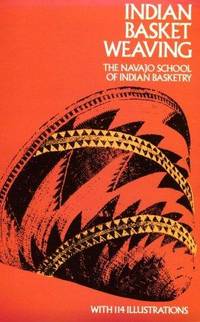
Navajo School of Indian Basketry
Indian Basket Weaving
Dover 1971. Very Good. Navajo School of Indian Basketry. Indian Basket Weaving. New York: Dover 1971. 103pp. Illustrated. 12mo. Paperback. Book condition: Very good. Dover paperback books
Bookseller reference : UNAVIND00MEL ISBN : 0486226166 9780486226163
|
|
|
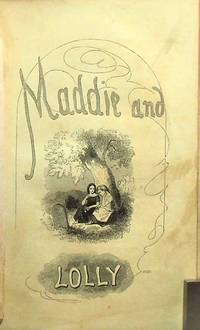
American Sunday School Union.
Maddie and Lolly
Philadelphia: American Sunday-School Union 1859. First edition. Very Good. 16 cm; 36 pages. Wood-engraved frontispiece and extra title page. Bound in original patterned cloth stamped in blind; titled in gilt on spine. Very little wear or deterioration. Pages somewhat toned. American Sunday-School Union hardcover books
Bookseller reference : 5863
|
|
|
MORONOBU or SUKENOBU SCHOOL.
AMANJAKU DEN: A PERVERSE EROTIC JAPANESE LEGEND. A Bizarre and Unque Erotic Jap
Edo c.1700-50 n.p. Brown & silver covered boards very clean 7 double-page b.w. erotic woodblock illustrations mounted on mica flecked paper 18 x 25 cm. accordion folded illustration size: 31 x 12 cm. FIRST & ONLY UNRECORDED COPY! . . . . A VERY RARE UNRECORDED EARLY BOOK . . . A BIZARRE & UNIQUE EROTIC BOOK . . . UNSIGNED BUT CLEARLY THE WORK OF A MASTER ARTIST . BY SUKENOBU OR HIS :SCHOOL: . A unique and hitherto unfound odd and most unusual erotic book of the early-mid-18th century. One of the most bizarre erotic books ever done in Japan. . The graphically explicit work portrays men and women with genitals on their foreheads engaged in heterosexual and homosexual intercourse. There is no other book with such unusual and strange illustrations. . . THE TITLE: THE LEGEND OF AMANJAKU or AMAN NO JAKU: Chinese Title: TIAN XIE GUI YUN . THE MEANING OF AMANJAKU: Japanese Buddhist literature is abundant with variations on the theme of "Aman-No-Jaku" aka. "Amanjaku" "Manojaku" commonly understood to be a "Heavenly Evil Spirit." . This spirit or demon-like creature in Japanese folklore is usually depicted as being a male during the day and female at night. The demon is usually depicted as a kind of small Oni devil and is thought to be able to provoke a person's darkest desires and instigate him into perpetrating wicked deeds. . Amanjaku is also depicted in Chinese and Japanese mythology the AMANOJAKU is a changeling a water spirit that infiltrates the human world to play cruel tricks on people by reading their minds and twisting their requests or desires to be used against them. . The "AMANOJAKU" is also known the "Lord of the River" and in Japan serves Bishamonten one of the four Deva kings of Buddhism as a minor demon. See Wikipedia below. . In Japanese the term "Amanojaku" also refers to a person who is deliberately contradictory someone who argues for the sake of arguing or can be used in common Japanese conversation to refer to someone who is a "Perverted Demon." . THE ILLUSTRATIONS: THE BUDDHIST THEME:. This work is unusual in that the genitals of common people are located on their foreheads. A symbolist meaning can be in Buddhist concept that sex and sexual hedonism is openly on the minds of 'lay' people. The Buddha and his disciples on the other hand do not have sex organs on their foreheads meaning their organs are covered and in a different usual location. This can symbolize 'self control' over such biological energies. Devout Buddhist disregard sex as a pleasurable pastime and devote themselves to monastic focus. By contrast "lay" people are distracted with hedonistic pleasure a path away from rather than towards the Dharma or teachings of Buddhism. . In a sense this work illustrates the overwhelming force of evil or the "Amanojaku" and how it distracts people from the "Righteous Path" towards the Dharma and the ultimate goal of attaining Nirvana. It can be posited that this work is designed to give understanding to "lay" people by way of visual example of what forces direct their energies away from the Buddhist teachings in an effort to redirect them towards the "Righteous Path" and life style. . EXCEPTIONALLY RARE UNIQUE WORK: . The work is exceptionally RARE unusual and erotic there are no other example showing genitals on the foreheads of any other Japanese book cited anywhere in the bibliographic literature or record. . This work is certainly RARE in subject content and quantity. Though it was woodblock printed and unsigned which was usual for Japanese erotic works which were banned by the Shogun we have not found anything similar or recorded anywhere in the bibliography. Being woodblock printed one assumes there are other copies in existence. The average printing from woodblocks were somewhere between 100-200 copies. However in this instance no others exist. We have the strong feeling the book could have been the production of a famous Japanese illustrator and perhaps financed by a Buddhist temple again there are no known facts about this rarity. . THE EROTIC ILLUSTRATIONS: . Number 1: This work begins showing the Buddha flanked by two of his disciple monks. The title is written in four Japanese Kanji in Kambun & Chinese characters. The Buddha and his two disciples listen to two elderly Buddhist believers: one is a male he has and erect penis on his forehead. The other is a woman she has a vagina on her forehead. Neither the Buddha nor his two disciples monks show genitals on their foreheads. The couple have come to consult with the Buddha about their grievances. . Number 2: Shows a man and a woman in a Tatami matted room both wear lovely 18th century decorated Kimono. They embrace each other and are engaged in making love from their foreheads which show an erect penis and testicles inserted into the woman's forehead where her vagina is located. Adjacent to the young couple is an older woman who has become aroused by the adjacent couple's making love. The old woman uses a dildo tied to a post which she hugs while inserting the dildo into the vagina on her forehead. . Number 3: Shows a couple laying on a blanket their Kimono pulled down and opened and used as a top cover. They engage in love-making and kiss. The man has an erect penis on his forehead the woman a vagina on hers. There is some used Chirishi toilet paper just above her head on the floor used to wipe the love fluids. There is a folded package of yet unused Chirishi in readiness. Chishiri shown in Japanese Shunga erotic prints prints & paintings is an 'erotic symbol' indicative of sexual excitement with lots of love fluids flowing. Ergo the need for paper to clean up the results of erotic love-making. . Number 4 shows an adult man with an erect penis on his forehead penetrating the anus of a younger man who's smaller but erect penis is seen on his forehead as he faces his lover. The younger man has no pubic hair yet indicating his youth. . Adjacent to these two men is a woman in the next room. The door is open she is a secret voyeur of the two men. Her vagina is also on her forehead. A Shogi board and two bowls for stones is located in the front left of the illustration. Gay activities in Japanese society were accepted as a norm and were not especially unusual. However to find graphic examples in Japanese erotic books are exceptionally rare and seldom found. . Number 5: Depicts a fully clothed man on his knees he bends over a sleeping woman. He has a very large erect penis and begins to penetrate a woman with her vagina on her forehead. She is fully clothed and sleeping on a wooden "pillow" which supports her elaborate hair coiffeur. . Number 6: Depicts a lively scene of two men and a woman. One man with a very large and erect penis pulls the woman's arm toward him while she fends him off with a straight arm to his head. A second excited man also with a large and erect penis on his forehead masturbates and ejaculates in ecstasy. The woman has a vagina on her forehead. The scene is likely an intended rape of a young girl. She looks away in an effort not to allow him to pull her close enough to insert his penis into her exposed vagina. . Number 7: Illustrating a lonely old man in bed. He has an erect penis on his forehead and holds a kind of pot with a large opening. He faces down and inserts his penis into the pot for gratification. . THE TEXT: The text in Shunga erotic Japanese books & prints is often an erotic dialogue describing the erotic action. Often these words are onomatopoetic mimicking the sounds of people in orgasm or making comments about making love or the pleasure and good feelings. The size and hardness of the penis or the flavor and the juices of the vagina and its supple feelings of euphoria when engaged in love-making. All wear 18thcentury period Kimono. . MODE AND FASHION OF THE MID-18TH CENTURY: The room furnishing and Kimono of the participants in this work all wear 18th century period Kimono with period decorations. The style of Kimono and room screens reflect this period. . BINDING AND MOUNTING: Binding: The book has probably been rebound sometime after the 1750's with a more recent thin brown decorated paper with a silver chrysanthemum and a Mon family crest with gold and black on both front and rear covers. Each cover has a distinctly different kind of illustration but of the same theme. The corners and edges are a bit worn some loss to the paper as usual for a work from this period. . Mounting: At an earlier time each page was expertly mounted on a stiff Washi hand-made Japanese paper into an accordion folded book. Each illustration is bordered with a rare and stunning crushed oyster-shell powder mixed with rice-glue and overlaid on the border paper. The stunning effect is a rare shimmering pearl-like color and hue with a remarkable effect. This rare and largely unknown effect has been used for print backgrounds by some of the later masters. . This was no ordinary mounting and appropriate for an exceptionally and most unusual RARE book ! . Contents: By and large the contents are clean solid with a two old worm holes for the first 6 of 7 pages. These are small and towards the edge and does not detract from the overall quality of the illustration. On page 7 there are a few center margin old minor worm holes. All of these have been restored when the prints were laid down on the thick Washi paper creating book format. The work is otherwise solid and firm. There are a few 'rubs' on the old Washi paper which was made from very soft Kozo fibers common to any item of this period on this on handmade papers of the period. . CONDITION OF THE WOODBLOCK PRINTS: . These are very early black and white woodcut prints. Each print has an excellent and vivid impression key blocks are black and superbly printed with strong images. The paper is old and has the patina of paper from that age the usual minor mild surface rubbing or thumbing in the lower corners which is common. . We tend to be overly critical of any flaws found on our books and believe it is better to overly describe rather than avoid such discussion any imperfections. Suffice to say by and large this is an excellent item in very nice condition something that any collector or museum would be proud to own. Please review photos posted to our website. . R A R I T Y OF SUBJECT: The placement of the genitals on the forehead gives one a lot of room to theorize on the meaning of such artistic expression. In our 50 years of experience in dealing Japanese woodblock printed books and painted original art this is the first and only example with such imaginative and symbolist expression. With the beginning of the work showing the Buddha and his two disciples lacking any genitals on their foreheads one can simply assume that in a Buddhist way they have given up carnal desire as represented by common people who's foreheads display genitals perhaps meaning that sex is on their minds or they simply view others as sexual objects eager to make love and engage in carnal thoughts and activities. Obviously seeing an erect penis on some man whiles others see what he thinks and feels is an insight to his innermost thoughts and desires. In all cases in this book the men all show an erect penis. The women are a bit more difficult to fathom. Their vaginas are simply visible on their foreheads and no fluids are visible or other evidence of their carnal desire or sexually excited stated. All of the men have public hair adjacent to their sex organs while all women are lacking any pubic hair completely. This is an erotic symbolism giving full view to women's genitals. . "BANNED" or "PROHIBITED" BOOKS: Shun Pon Haru Bon: In the case of this item it is very likely that it was printed in a much smaller discreet quantity than the 200 copies possible off the blocks. Due to the "banned" nature of such books there is no date publisher nor place cited. One is simply left to determine the date and artist by stylistic analysis. It is well-known that during the Tokugawa period 1603-1868 erotic prints and books were "BANNED" or "PROHIBITED" by decree of the Shogun. One of the influencing factors was that during this period some Shoguns were changing their views and being influenced by Christians who entered Japan during this period. The Shogun did not want foreigners and Jesuit missionaries to think that Japan was a crass and base nation. Naturally foreigners soon learned that prostitution was rampant and so this strange logic from the Shogun never had much affect on the Christians and surely not on the Japanese. . The Shogun enforced severe punishments for persons involved in drawing printing carving blocks and publishing erotic books and prints. With out the "Kiwame" or censor's approval seal all such items were "Banned" outright by the Shogun decree. . While these "Prohibited" books and prints were widely circulated in an "underground" society there are ample examples of famous artists taking on commissions to produce erotic books and prints fun or profit. The record and bibliography is loaded with these examples. "Banning" such erotic works simply meant that the number printed were limited to smaller numbers and distribution was done under the table discretely circulating such books privately among collectors. During these times it was not necessary for artists to sign their such artistic creations by-and-large the population had a very good idea who the artist was by being familiar with their style and other works it was simply a "public secret" who the artist was. Often the artist poked fun at the Shogun with political jokes and assumed names to confound any chance of being discovered by the authorities. . Over the centuries this knowledge decreased and is now the domain of the art historian or scholar to identify and determine the actual artist. Stylistic analysis remains the standard method for unsigned works. . THE ARTIST/SCHOOLS: While there are no signatures or seals indicating the artist's name or even his alternate Go studio name we believe this work is part of the "Primitives and First Century of Ukiyo-e School 1660-1765" period. See Lane below. The women's coiffeur is very similar to those found in this period as well as the drawing style technique and genre. It is this cataloger's opinion that this work was likely the creation of one of the Moronobu School masters. Perhaps done by Sukenobu Yoshikiyo Morishige Sugimura Moronobu Kiyonobu Masanobu or others from this period. We believe this work was likely done from around 1710-1750. It was also likely that it was done by one of the artists listed below. . LIKELY ARTIST ATTRIBUTION: . MORONOBU SUKENOBU SCHOOL: Nishikawa Sukenobu 1671 -August 20 1750 often called simply "Sukenobu" was a Japanese printmaker from Kyoto. He was unusual for a Ukiyo-e in being based in the imperial capital of Kyoto. He did prints of actors but gained note for his works concerning women. His Hyakunin Joro Shinasadame: Appreciating 100 Women in two volumes published in 1723 depicted women of all classes from the empress to prostitutes and received favorable results His Hyakunin Joro Shinasadame: Appreciating 100 women in two volumes published in 1723 depicted women of all classes from the empress to prostitutes and received favorable results Leading members of this school were: Nishikawa Sukenobu the founder; Nishikawa Suketada; Kawashima Nobukiyo; Nishikawa Terunobu; and Takagi Sadatake. . NISHIKAWA MORONOBU SCHOOL: Nishikawa Moronobu 1618-July 25 1694 was a Japanese painter and printmaker known for his advancement of the Ukiyo-e woodcut style starting in the 1670s. Leading members of the MORONOBU school were: Nishikawa Moronobu the founder; Hishikawa Morofusa; Hishikawa Moroyoshi; Hishikawa Moronaga; Hishikawa Moroshige; Hishikawa Morohira; and Tamazaki Ryujo. . BIBLIOGRAPHY: . This title is NOT listed in any of the below resources: SHIBUI Kiyoshi. UKIYO-E NAISHI. BIBLIOGRAPHY OF JAPANESE EROTIC ILLUSTRATED WOODBLOCK PRINTED BOOKS. H. KERLEN. CATALOGUE OF PRE-MEIJI JAPANESE BOOKS & MAPS IN PUBLIC COLLECTIONS IN THE NETHERLANDS. Richard Lane: IMAGES FROM THE FLOATING WORLD THE JAPANESE PRINT; pages 28 40-60 show examples of the Ukiyo-e primitives 1660-1765 especially the Moronobu school pp.60-88 et al. . NOT LISTED IN: . KSM SHIBUI Kiyoshi: UKIYO-E NAISI. BIBLIOGRAPHY OF JAPANESE EROTIC ILLUSTRATED WOODBLOCK PRINTED BOOKS. Modern Reading: UKIYO-E NAISHI KERLEN H.: CATALOGUE OF PRE-MEIJI JAPANESE BOOKS & MAPS IN PUBLIC COLLECTIONS IN THE NETHERLANDS. Not in any other usual bibliographies on Japanese E-hon woodblock printed books. . See: WIKIPEDIA: http://en.wikipedia.org/wiki/Amanjaku . hardcover books
Bookseller reference : 86003001
|
|
|
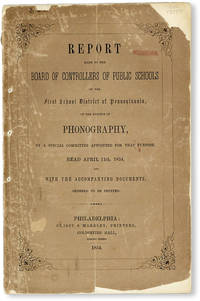
FIRST SCHOOL DISTRICT OF PENNSYLVANIA BOARD OF CONTROLLERS OF PUBLIC SCHOOLS
Report Made to the Board of Controllers of Public Schools of the First School District of Pennsylvania on the Subject of Phonography by a Special Committee Appointed for That Purpose. Read April 11th 1854 and with the accompanying documents ordered to be printed
Philadelphia: Crissy & Markley 1854. First Edition. Octavo 22.5cm.; publisher's tan wrappers printed within decorative border; 50pp. Ex-Massachusetts State Library with their small pressure stamp to title page and faint Withdrawn rubberstamp to upper cover wrapers rather chipped along extremities; a Good copy internally clean and sound. Report especially recommends that news reporters and printers learn phonography Pitman shorthand. Crissy & Markley unknown books
Bookseller reference : 50120
|
|
|
Cedargrove School Yearbook Staff
Guidon 1967 Cedargrove
Covina CA: Taylor Publishing Company 1967. Edition not stated. Quarto 28.5cm; white leatherette boards with green lettering and graphic; 56pp. Spine cocked; boards mildly soiled scratched; spine heel and rear upper leading corner bumped; extremities slightly chapped; interiors clean with light thumb wear. Very Good.<br/><br/>The 1967 Cedargrove School class yearbook; Cedargrove School was a middle school grades 6-8 in Covina CA; it is now Cedargrove Elementary School grades K-6. This yearbook contains b/w photo-illustrations of staff and students sports activities and "candids" with most subjects identified. No signatures. Taylor Publishing Company unknown books
Bookseller reference : 46665

|
|
|
SCHOOL OF LIVING WERKHEISER Don
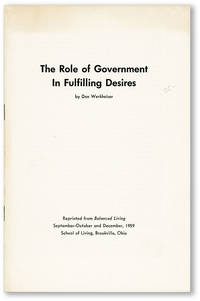
The Role of Government in Fulfilling Desires. Reprinted from Balanced Living September-October and December 1959
Brookville OH: School of Living 1959. First separate edition. Staple-bound self-wrappers; 13pp. Fine. Individualist anarchist critique of government published under the auspices of Ralph Borsodi's decentralist cooperative The School of Living. School of Living unknown books
Bookseller reference : 45809
|
|
|
YEARBOOK Mission High School Yearbook Staff
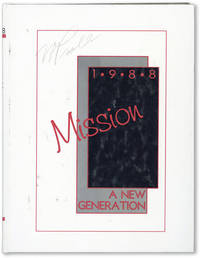
1988 Mission High School: A New Generation
Los Angeles: Mission High School 1988. First Edition. 1988 edition of the Mission High School Los Angeles yearbook. Quarto 28.5cm.; glossy white paper boards with red and black print no dust jacket; 160pp. Contains student-written memoirs plus all b/w photo-illustrations of Mission High School student body faculty and activities. Text block is clean and sound with no signatures; Near Fine. Boards have some surface wear and smudging; ink signature on front panel else Very Good. Mission High School unknown books
Bookseller reference : 46087
|
|
|
SUNDAY SCHOOL REWARD WATTS Isaac
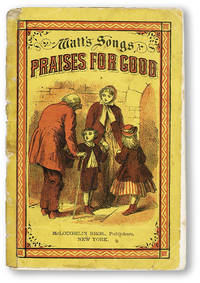
Watt's Songs - Praises for Good
New York: McLoughlin Bros. Publishers N.d. Edition not stated. 12mo; chromolithographed wrappers; 12pp; illus. Ownership inscription Jacob H. Kerr dated 1890. Spine held together with clear tape; generally soiled and worn; text complete with the four color-printed vignettes clean and in excellent condition; still just Good. A McLoughlin Brothers juvenile chapbook issued in the publisher's series of "Illuminated Texts for Sunday School Rewards. McLoughlin Bros., Publishers unknown books
Bookseller reference : 45220
|
|
|
SCHOOL SEGREGATION SCHMIDT George
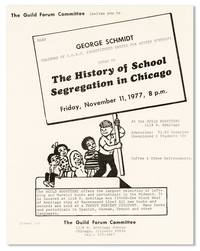
The Guild Forum Committee invites you to hear George Schmidt . The History of School Segregation in Chicago. Friday November 11 1977
Chicago: Guild Forum Committee 1977. Broadside bulletin board flyer 11" x 8-1/2". Mimeographed printed recto-only on standard white bond. Mild corner creases Near Fine. Announces a lecture under the auspices of the Guild Bookstore a cooperatively-run business which was Chicago's largest radical bookshop through the Seventies and Eighties. George Schmidt was the chairman of a group called S.U.B.S. Substitutes United for Better Schools. Guild Forum Committee unknown books
Bookseller reference : 38465
|
|
|
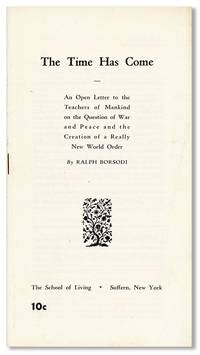
UTOPIAN COMMUNITIES SCHOOL OF LIVING BORSODI Ralph
The Time Has Come: an open letter to the Teachers of Mankind on the Question of War and Peace and the Creation of a Really New World Order
Suffern NY: School of Living 1942. First Edition. Staple-bound pamphlet 22cm x 12cm. Printed paper wrappers; 16pp. Very mild toning at extremities else fresh and unmarked; Near Fine. Ralph Borsodi 1886-1977 along with Helen and Scott Nearing and J.I. Rodale is considered one of the apostles of the American "back to the land" movement of postwar era. His School of Living founded in Suffern New York in 1936 provided hands-on instruction to families interested in agrarian self-sufficiency. It also functioned as a loosely communistic co-operative society with sixteen families occupying and farming two-acre plots; land ownership remained with the community. School of Living communities survived in various locations until 1986.<br/><br/>The current pamphlet offers a decentralist plan for permanent peace addressed to "the teachers of mankind." Acknowledges that if we must choose between the American way of life and the one which Hitler would impose upon us American democracy is preferable; but insists that the world's current leaders are incompetent to draft or even conceive a lasting peace settlement following the defeat of Nazism. ".they may be great men in spite of . grave flaws but they are not great enough to be trusted after the war is won when they no longer need to court public opinion in the matter to frame the peace." Uncommon as are most School of Living publications. OCLC notes 7 locations all in North America. School of Living unknown books
Bookseller reference : 38107
|
|
|
ROOSEVELT HIGH SCHOOL BRONX
Rough Rider 1981 Inscribed & Signed by Principal Phil Smith
New York: Roosevelt High School 1981. First Edition. Quarto 27cm.; publisher's blue pictorial imitation leather stamped in gilt; 168pp.; chiefly photographic illus. Some internal foxing else Very Good and sound. Inscribed and signed by the school principal Phil Smith dated 1990. Yearbook for the recently closed high school in the Bronx Roosevelt High School whose predominantly black student body suffered greatly from heroin use and gang violence during the 1970s and 1980s. Roosevelt High School unknown books
Bookseller reference : 37384

|
|
|
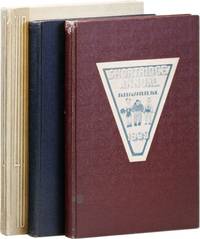
VONNEGUT Kurt SHORTRIDGE HIGH SCHOOL
Shortridge Annual - Collection of Three Volumes 1938 1939 & 1940 Signed Bookplates Laid in
Indianapolis: Shortridge High School Press 1938-1940. First Edition. Three volumes; quarto 25.5 - 27.25cm.; original cloth the two earliest Annuals with color pictorial plates mounted to upper covers last issue pictorially blind-embossed; illus. mostly photographic throughout. Light edge wear tiny loss to cover plate of earliest volume not approaching image or text the usual student signatures throughout else a Very Good or better set. High school yearbooks dating from Vonnegut's sophomore junior and senior years. We find images of Vonnegut on the student council in 1938 and 1940 though never the Fiction Club; ths Social Committee in 1939 and 1940; and the editorial staff in 1940. He was also listed one of the ten most popluar boys "Uglymen" in school his senior year. Years later Vonnegut would famously write: "Shortridge High School is my dream of an America with great public schools. [Shortridge High School Press] unknown books
Bookseller reference : 33807
|
|
|
AMERICAN SUNDAY SCHOOL UNION
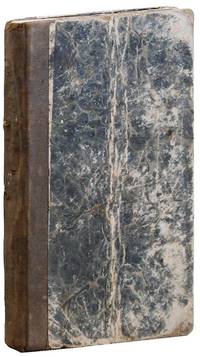
The Infidel Class; or the Second Party of the Story of Archibald Thompson
Philadelphia: American Sunday-School Union No. 146 Chestnut Street 1835. First Edition. 24mo 14.25cm.; contemporary cloth-backed marbled boards; 107pp.; frontispiece text illus. throughout. Boards rather rubbed with some loss of paper to rear cover a few tiny puncture holes to spine hinges broken old dampstain along gutter edge of rear hinge textblock loose in binding. About Good overall. From the library of Ben and Bernarda Shahn with their estate label to front pastedown. American Imprints 32301. American Sunday-School Union, No. 146 Chestnut Street unknown books
Bookseller reference : 32025
|
|
|
THEATRE SCHOOL OF DRAMATIC ARTS BRACE Norman
Co-Ed Summer Session at Briarcliff Lodge Briarcliff Manor New York . Intensive Course in Dramatic Arts for Teachers Directors and Students. From July Seventh to August Nineteenth
New York: Theatre School of Dramatic Arts 1938. First Edition. Octavo 22.5cm.; original pink staplebound double self-wrappers printed in brown; unpaged; textblock printed on pink stock interleaved with photographic plates. Fine. Order blank laid in. New York Historical Society only in OCLC as of June 2015. Theatre School of Dramatic Arts unknown books
Bookseller reference : 26792

|
|
|
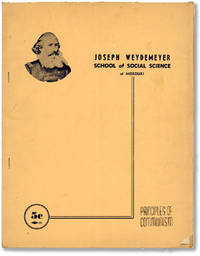
JOSEPH WEYDEMEYER SCHOOL OF SOCIAL SCIENCE OF MISSOURI
Principles of Communism cover title
St. Louis: Joseph Weydemeyer School of Social Science of Missouri ca. 1930. First Edition. Quarto 28.5cm.; original tan pictorial staplebound wrappers a touch soiled; 111 mimeographed leaves. Vertical fold small loss to bottom fore-edge corner of upper cover and first two preliminary leaves not affecting text else Very Good and sound. Unrecorded syllabus for a course offered at the School later described by the House Committee of Un-American Activities as a Communist front established as early as 1920. On top of a reading list comprised of works by Marx Lenin and Stalin the students were also encouraged to read The Daily Worker Political Affairs and New Times. Unlocated in OCLC as of March 2015. Joseph Weydemeyer School of Social Science of Missouri unknown books
Bookseller reference : 25754
|
|
|
Chapbook. American Sunday School Union
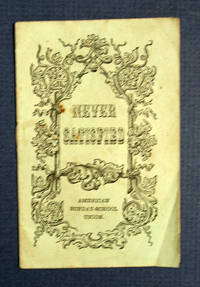
NEVER SATISFIED
Philadelphia: American Sunday-School Union 146 Chestnut Street n. d. Ca. 1827 - 1853 dates taken from OCLC. Light green printed paper wrappers tied. Modest wear to wrappers rubbing and light soiling. An about VG example. 8 pp. Woodcut illustrations within. 4-1/4" x 2-7/8" <br/><br/>OCLC records just 1 institutional holding of this edition Yale. Rare in the trade. American Sunday-School Union, 146 Chestnut Street unknown books
Bookseller reference : 40620
|
|
|
19 cent Women Education Catholic Girls' School
Regulations for the Catholic Girls' School 1841
Catholic Girls' School Ugbrook England. Regulations for the Catholic Girls' School at Ugbrook. Chudleigh: J. E. Searle 1841. This book contains the regulations approved by the Right Reverend the Vicar Apostolic of the Western District of England for the Catholic Girls School at Ugbrook. Uncommon to find formal women's education regulations from this early in the 19th century. Very good. unknown books
Bookseller reference : 16451
|
|
|
GARDENING PHOTOS PUBLIC SCHOOL
NY Public School Urban Gardening A Collection of Original Vintage Photographs 1916-1920
Important collection of 43 original vintage photos of the Public School Gardening Movement in Queens New York City 1916-1920. The school gardening movement was a nationwide initiative to create gardens for children peaking1900-1920. The movement integrated many aspects of Progressive Era urban reform including education reform tenement house work and the transformation of the urban environment with Small Parks and City Beautiful. Unfolding in cities across the country including Berkeley Boston Dayton New York Philadelphia and Chicago; it was directly influenced by the educational "nature-study" movement which advocated the study of the natural world the growth of children's gardening programs in Europe and the development of the modern playground. These 43 photos show children planting harvesting watering and carrying their produced under the guidance of teachers. Most are approximately 2"x4" with some bearing dates 1916-1920 and a few with notes or names of those pictured. This collection is particularly relevant today as there is a resurgence of interest in the urban gardening model and the benefit to children of time spent in direct contact with the natural world.<br/> <br/>The leader of the school gardening movement was Frances Griscom Parsons 1850-1923 who created the first example in New York City and helped invent a profession of school garden advocacy. In 1902 she created the "Children's School Farm" on a plot of land in Hell's Kitchen where immigrant children living in congested tenements surrounded by warehouses factories slaughterhouses and the docks could have their own plot of land to grow vegetables. Parsons created the garden to counteract the slum conditions by providing an open space and experience of nature that was so glaringly absent from the neighborhood. However she emphasized that she did not start the farm "simply to grow a few vegetables and flowers." Parsons believed that gardening would teach children values and skills applicable to their lives in the city specifically "brotherhood cooperation self-respect and the dignity of labor." By "playing the part of little farmers" the children would become urban citizens. This was particularly essential as many of them were children of immigrants or immigrants themselves. The farm-which had a deep resonance in the American imagination-was the site of Parson's vision of an idealized city as manifested in her design of the farm into four "boroughs" with the main path named "Broadway" and an government elected among the children. unknown books
Bookseller reference : 15640
|
|
|
School Records Kemble Parochial
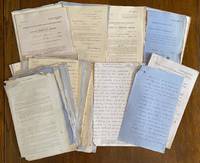
The Birth of the English Public School System: 30 Years of Records of Kemble Parochial School Tracing the Dramatic Shift from Small Independent Schoolhouse to Systemized Mandatory Public Education
Kemble Parochial School Record Book 1871-1904. Kemble Cirencester Gloucestershire. Collection of approximately over 100 documents on approximately 180 leaves many written on both sides comprising the complete records of the Kemble Parochial School. Unbound contained in original protective black cloth boards. Large legal "foolscap" size pages. Comprising both printed Circulars directed to the schools from the Education Department and handwritten copies of records the school was ordered to send as reports to the Education Department. This school is built from grant money received in the wake of the first of the Forster Acts known as the Elementary Education Act of 1870 which made education compulsory in England and Wales for all children aged 5 to 13. <br/><br/> The Forster Acts named for the sponsor of the original bill William Forster brought a sweeping change to elementary education in England by declaring public education for children to be mandatory. It also mandated that the schools should be publicly funded and overseen by regular inspections. The Kemble Parochial school founded at the very inception of this legislation provides a window into the dramatic shift to public education. The first document in this record is a Circular of Instructions and Rules for the construction of a school building. Through the handwritten retained copies of annual reports by Principal A.G.W. Wilts to the Inspector of Schools we are able to grasp the immensity of the change. Wilt first report comes in 1872 when the schools 18 students were taught in an old traditional schoolhouse by headmistress Ms. Hopkinson who did not have an official certification in teaching "This is an average country School carried on at present in rather inadequate premises but a new and handsome school-room and teacher's residence have just been erected.The mistress is a successful disciplinarian and has much natural aptitude for teaching." By 1875 the school has grown to 49 students though still under the tutelage of the unfortunate Ms. Hopkinson who continues struggling to obtain a teaching credential. By 1878 undergoing regular inspections it is reported that the school needs improvement in multiplication and to better follow the state mandated provisions as to Needlework. Their ranks swelled to around 80 students just before the end of the century before petering out and ending in 1904 with only 3 students registered. By then Ms. Hopkinson had been replaced by two subsequent teachers Ms. Lane and Ms. Reed who also struggle to obtain a Certificate while managing a large class.<br/><br/> Circulars from the Education Department show that the idea of public education while welcomed in many quarters arrived also with surprise and some distrust. In 1878 the Circulars report the most recent developments of the Forster Acts "As it has now become evident that by the operation of recent legislation the great majority of the labouring classes will be virtually compelled to send their children to Public Elementary Schools." A major controversy of the Forster Acts surrounded the requirement that the schools operate non-denominationally. While individual churches pushed for the right to educate children under their own religious tenets the Church of England feared that doing so would weaken state control of education. The archive contains notes of this church-state tension in a handwritten letter of 1880 in which the Rev. R.H. Taylor inquires of the Education Department "whether the School is now conducted as a public elementary school.Section VII of the Elementary Education Act 1870 having been conspicuously put up in the School. If not my Lords cannot direct H.M. Inspector to inspect the School annually as a public elementary school." <br/><br/>On the lighter side repeated entreaties from the Education Department in Whitehall during the 1870s call for "teachers of Schools will be willing to give their assistance in endeavoring by due warning to the scholars to put a stop to.the mischief caused by throwing stones at the insulators of telegraph wires." Threatened punishments to the "schoolboys" responsible for this "great evil" include "imprisonment and flogging." Documents are in very good condition on large size sheets of blue or white paper clear and legible. Some dog-ears and a couple pages of the archive have been chewed on the corners but most are complete. Names of all enrolled students appear yearly on the Examination Schedule. A very complete set of records and historical resource on the most dramatic transition ever to come to education; that of going from independent schoolhouses to systemized public education. unknown books
Bookseller reference : 16092
|
|
|
School Logs Wrotham National
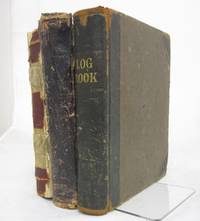
3 Manuscript Log Books 1500 pages on Wrotham National School in Kent 1863-1939
Education Daily or weekly handwritten reports in many hands on a school in Kent from the years 1863-1939. The logs chronicle the school's development from single gender instruction to a "mixed school" with classes of boys and girls learning together. The final pages of the log detail WWII-era preparations to train students in gas mask procedures and to prepare the school and community to begin receiving the children evacuated from London and other major cities. 9.5 x 8 in. Quarter morocco. 3 volumes each 500 pages. Original cloth boards. Marbled end papers. 2 entries from 1939: "Aug. 30. Time was spent today with fitting gas masks and gas-mask drill. The time table was to a certain extent disorganized particularly in Gps. I & III." "Sept. 1. The evacuation of London children commenced today. The school was hurriedly closed in view of the arrival of parties of children with their Teachers." In the first four days of September 1939 nearly 3000000 people were transported from places identified as vulnerable to quieter more rural sites. <br/><br/>There were opportunities for women to each and girls to learn as the school became "mixed" at the behest of teachers who believed it would be better for their students' academics. 1885: New teacher "Examined Boys in Arithmetic - about 3 passed in standards I to VII. Reading fair but "sing song" manner. Spelling bad except few boys in 1st class. My conviction is that a "mixed school" would bring better results as practically one teacher has 7 standards to teach--which cannot be well done. Average for the week 52 Boys. Discipline is bad." Includes many entries from women teachers such as this entry from July 15 1872. "Entered upon my new duties as School Mistress of the Wrotham National Infant School having been provisionally certificated on the recommendation of my late Inspector.Found the children to be very backward indeed their being several . years of age and knowing only the alphabet; and not one able to read words of one syllable without spelling. The average attendance of the Infants for the week 28.6. The elder girls from the boy's school attending the Infants school . of an afternoon to receive instruction in needlework and cutting out."<br/><br/>Depending on the principal teacher there are daily or weekly handwritten entries on school business including attendance students' progress with academic material such as spelling and Arithmetic and other notes such as interesting lessons. "School Diary or Log-Book. In every school receiving annual grants the managers must provide out of the school funds besides registers of attendance Article 17h-- a A Diary or Log-Book.The Diary or Log-book bust be stoutle bound and contain not less than 500 ruled pages.The principal teacher must maake at least once a week in the Log-book an entry which will specify ordinary progres and the facts concerning the school or its teachers such as the dates of withdrawals commencements of duty cautions illness.No reflections or opinions of a general character are to be entered in the Log-book." Includes several reports from visiting district supervisors on the progress of students. "The Mixed School.Writing-the best taught subject-is good all through the school and the papers are neat and clean generally."<br/><br/>Many issues related to attendance for holidays and seasonal harvests and notes of outbreaks of diseases and illness such as measles whooping cough and scarlet fever. 1863: "P.J. punctual. First Class commenced writing from dictation on paper. School tin as usual at this season of Hay-making. School year commended. Girls visited by Mrs. Gowland." 1877: "Many students have been migratory this quarter roaming from school to school. Leaflets of New Education Act Laws been supplied to the parents of every child attending school." Many new teachers complained on the educational level of students who attended the school. 1887: "Admitted Thos. Skinner 7 yrs old does not know his letter nor can make one average attendance.Admitted John Broad aged 6 ½ not know his letters.Many infants absent through sickness and also being a very cold stormy week of frost and snow." Covers worn on all volumes at extremities. Spine missing and worn extremities on 1901-1939 volume. Missing front end page boards detached on 1863-1901 volume. Generally clean interior. Good condition. unknown books
Bookseller reference : 16093
|
|
|
University of Cincinnati College of School
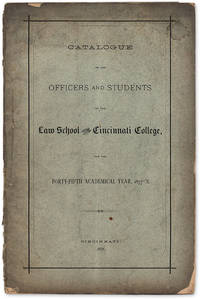
Catalogue of the Officers Students of Law School of Cincinnati College
1851. Cincinnati: A.H. Pugh 1878. Cincinnati: A.H. Pugh 1878. The First Law School West of the Alleghenies University of Cincinnati College of Law. Catalogue of the Officers and Students of the Law School of the Cincinnati College. Cincinnati: A.H. Pugh 1878. 55 1 pp. Octavo 9" x 6". Stab-stitched pamphlet in printed wrappers. Faint vertical crease through center moderate soiling and a few small stains a few chips to edges and corners spine abraded wrappers partially detached part-erased inscription in pencil to verso of title page. Light browning to text occasional faint dampstaining to head of text block. $150. Founded in 1833 by graduates of Harvard Law School and Litchfield Law School the University of Cincinnati College of Law was the first law school established west of the Allegheny Mountains. This 1878 catalogue was published for prospective and incoming students. It contains general information about the school regulations course outlines and lists of required texts. Lists of students and alumni are included as well. unknown books
Bookseller reference : 70969
|
|
|
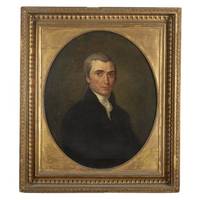
American School 19th Century; Read John Meredith
Portrait of John Meredith Read Oil on Canvas framed
1815. 25 inches x 20 inches. 25 inches x 20 inches. A Great Nineteenth-Century Pennsylvania Jurist American School 19th Century. Read John Meredith 1797-1874. Portrait of John Meredith Read. Philadelphia c.1815. 25" x 20" image size. Oil on canvas in ornate nineteenth-century gilded wood frame. Some minor nicks and chips to frame gilding slightly dulled otherwise fine. $3000. Read was elected to the Pennsylvania House of Representatives in 1822 and 1823 and served as City Solicitor of Philadelphia from 1830 to 1833. He was appointed District Attorney of the Eastern District of Pennsylvania in 1837 and held the office until 1845. Read became Justice of the Supreme Court of Pennsylvania in 1858 and Chief Justice of the Supreme Court of Pennsylvania in 1872. Read gained an international reputation for the depth of his knowledge eloquence and masterly arguments in the courtroom. Active in politics Read was an early supporter and organizer of the Republican Party. This portrait belonged to the Philadelphia Bar Association. Founded in 1802 it is the oldest association of lawyers in the United States. Its library where this portrait was last displayed was renamed the Theodore F. Jenkins Memorial Law Library in 1967. unknown books
Bookseller reference : 69061
|
|
|
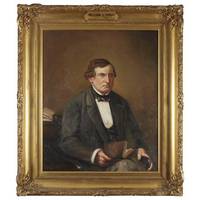
American School 19th Century; Hirst William L.
Portrait of William L. Hirst Oil on Canvas framed
1876. 39-1/2" x 31-1/4. 39-1/2" x 31-1/4" A Notable Nineteenth-Century Philadelphia Lawyer and Democratic Politician American School 19th Century. Hirst William L. 1804-1876. Portrait of William L. Hirst. 31-1/4" x 39-1/2" image size. Oil on canvas in ornate nineteenth-century gilded wood frame. Some minor nicks and chips to frame gilding slightly dulled otherwise fine. $3750. Hirst had a thriving private law practice and was active in Democratic politics. In 1853 Hirst was elected President of the Democratic State Convention. He was an early proponent of the City of Philadelphia consolidation. This portrait belonged to the Philadelphia Bar Association. Founded in 1802 it is the oldest association of lawyers in the United States. Its library where this portrait was last displayed was renamed the Theodore F. Jenkins Memorial Law Library in 1967. unknown books
Bookseller reference : 69069
|
|

 Receive by email
 Download as PDF document
 RSS feed
 Permanent link


