ARABIAN GULFBiblio.com
4 361 résultats
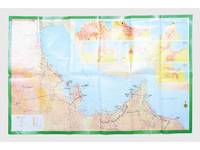
réf. 181557Saudi Arabia: Kruger for I.P.A. International Bookshops Dharan Airport 1977. Road construction faster than map production A folding road map of the Gulf and an interesting snapshot of its natural and human geography in the 1970s with 25 attractive photographs of Dubai. The map extends from Kuwait to Oman's Jabal al-Akhdar showing primary metalled roads roads under construction secondary roads towns wadis oil wells and pipelines oilfields and the morphology of the terrain. It also features 7 inset maps of the city centres of Manama Doha Abu Dhabi Kuwait Dubai Mutrah and Muscat. The small print in the reference section explains that "all roads under construction are being completed as the progress was faster than our production". The photos of Dubai include views of Dubai Creek dhows dromedaries and camels local inhabitants and the main heritage sites. Colour printed map folded 295 x 157 mm; unfolded 585 x 910 mm. Text in Arabic and English. Seven inset maps of Gulf capital cities verso with 25 colour photograph views of Dubai by Said Salah. Original colour self-wrappers printed in yellow black and white on a red and green ground. A few tiny chips or light wear to some folds couple of minor creases to outer corners: a very good exemplar. unknown
1942réf. 191335Washington DC: Army Map Service April 1942. The Gulf when America joined the war An expansive wartime flight chart "the advance edition" classified as "Restricted" for use by the U.S. Army Air Forces. It covers the whole of the Arabian Gulf and a substantial part of the Arabian Peninsula including Saudi Arabia Trucial Oman and Kuwait. After the United States joined the Allies in December 1941 they began operations in the Middle East most notably by providing support in North Africa as part of the Second Battle of El Alamein and Operation Torch. Over the following years the American government began to recognise the importance of Middle Eastern resources extending the Lend-Lease programme to Saudi Arabia Iran and Israel as well as indirectly supporting British colonies in the region. To protect these resources they set up Persian Gulf Command and manned the "Persian Corridor" from Iran through to Azerbaijan. They also participated in the Tehran Conference in late 1943. Further west the Ninth Air Force ran regular sorties out of Egypt and Libya to assist in the European theatre securing air dominance and denying the enemy the opportunity to replenish their supplies. The reverse of the chart features three inset maps of Bahrain Cyprus and Rhodes. They are accompanied by sectional views of their coastlines. The first two countries were host to RAF and Royal Navy bases while Rhodes was occupied by Italy and later Germany after the Battle of Rhodes in 1943. We have traced no copies of this map in institutions and one copy of a 1944 coloured edition in commerce. Single sheet 965 x 1305 mm maps and sectional views printed both sides highlights and compass roses printed in blue key on recto. Rolled tidemarks and creasing in upper margin not past neatlines: a very good copy. unknown
8vo. (4), 86 pp. With 3 folding maps. Original printed wrappers. Informational publication issued by the New York Arab Information Center - The Research Section to argue the Arab cause among U.N. delegates, with contributions by Fathalla El Khatib, Khalid I. Babaa, Ism Kabbani and Omar Halig. Articles include "British Penetration and Imperialism in Yemen", "British Aggression Against the Imamate of Oman", and the "Buraimi Dispute". - Old ownership "M. Cain" to front cover; Arvada I.R.C. stamps. Information Papers Number 6.
4to. (48) pp. All edges sprinkled in red. Disbound. Exceedingly rare separate "offprint" issue, with Heyinger's imprint and date on title page, of this account usually only encountered bound after a half-title as part of Francisco Caccia's "Monumentum Gloriae Seraphicae" (bibliographically unrecorded thus). Contains the German translation of the Sultan's mandate by which suzerainity over several holy sites in Jerusalem (particularly, two vaults in the Church of the Holy Sepulchre, part of Golgotha, the Seven Arches of the Virgin, and the Stone of the Anointing) was restored to the Franciscans. Includes relevant correspondence and indulgences (all in German). - Some browning and staining. Removed from a collection; old number "23" on t. p. An early work from the press of Andreas Heyinger, active in Vienna from 1692 to 1732. Cf. VD 17, 12:113676Z.
Vintage lithographed poster. 1000 x 620 mm. A vividly coloured travel poster with the image of a hookah and a vignette of a Middle Eastern city shown inside the base, designed by Raoul Éric Castel (1915-97). - Right and left edge with minor defects. Affiches Air-France (2006), p. 149.
Large 4to. 3 vols. (4), VIII, 602, (2) pp. (4), 598, (2) pp. (4), 634, (2) pp. Contemporary half leather with marbled covers and giltstamped spines. Illustrated throughout with nearly 2000 wood-engravings. A finely illustrated Dutch edition by the bookseller, publisher and writer Hendrik Frijlink (1800-86), first issued in 1829. - Slight browning and foxing, but well preserved. Chauvin IV, p. 65, no. 168 ("1847-1849"). Burton VIII, 238. OCLC 63831066.
12mo. 8 vols. XXIV, 334; (4), 356; (4), 356; (4), 353, final blank; (4), 348, (2); (4), 353, (3); (4), 425, (3); (4), 410, (2) pp. With 36 engraved plates, including 8 frontispieces. Contemporary half calf over marbled boards with giltstamped spine and spine-title. All edges marbled. Illustrated edition of Galland's highly influential French translation of the Arabian Nights, complete in eight volumes. Published simultaneously with the slightly more common 1832 edition by Hiard. Not a single copy of the Ledentu edition traceable at auction within the last decades. - Adapted to Parisian tastes, Galland's translation of the "Nights" had been first published in 12 volumes between 1704 and 1717, and "was quickly translated into English and German. It enjoyed a most remarkable success throughout Europe, perceptible even in children's literature, and contributed significantly to the new image which enlightened Europeans entertained of the Islamic East: after Galland, this was no longer the home of the Antichrist and of accursed heresy, but rather the ever-constant Orient beneath an eternally fair sky, boasting splendid colours and unheard-of wealth, Caliphs, Viziers, and Kadis, harems, fairy-tale princes, fairies and genies, sorcerers and sages, a world of fantastic adventure and outrageous incidents" (cf. Fück). - Extremities slightly rubbed; occasional light spotting and a few minimal edge flaws; pp. 47-50 of volume VII loose. A charming set. Chauvin IV, 24. Cf. Fück 101. OCLC 82688412.
8vo. 2 parts in 1 volume. (8), 119, (1) pp. (4), 158, (2) pp. Publisher's original printed auburn cloth with gilt spine. Second edition of the original Arabic text, revised and corrected; first published in 1874. "Chaque page entourée d'un double filet vermillon" (Chauvin). The text and vocabulary, lithographed throughout, are hand-drawn by E. Ducret, "Diplomé de première classe". A clean copy. Chauvin VII, p. 3. NYPL Arabia Coll. 187. OCLC 4433368.
8vo. VI, (7)-69, (1) pp. Publisher's original green printed wrappers. First edition of the story of Nur al-Din and Shams al-Din, edited by the French oriental scholar (Jacques-)Auguste Cherbonneau (1813-82), professor at the Collège Arabe Française in Algier. Arabic text with French notes. - Well preserved. Chauvin VI, 102, no. 270, 2. OCLC 4432899.
8vo. (4), XII, 265 (but: 255), (1) pp. With an engraved frontispiece. Contemporary half calf with gilt-stamped label to florally gilt spine. Only edition thus of this collection of Arabic tales in the manner of the 1001 Nights. Anonymously edited by Jean-Baptiste Decourdemanche; attributed by Chauvin to the abbé Marie Nicholas Silvestre Guillon. - Slight traces of worming to upper cover; a very light waterstain near the end, otherwise fine. From the collection of the Swedish goldsmith Christian Hammer (1818-1905) with his wood-engraved bookplate on the front pastedown over an earlier engraved armorial bookplate, monogrammed "H.U.D.G." in ink. Chauvin IV, 96. OCLC 47704430.
Large 4to. 2 pp. Together with a contemporary transcription into French. To the Crown prosecutor of Algeria, describing a case of child murder under Sharia law.
8vo. 15, (1) pp. With printer's device to title page. Modern half calf. Brief introduction to the Arabic language for Catholic missionaries, "an exact reproduction of the 1715 edition" (Smitskamp). Includes a table of the alphabet and the Lord's Prayer and Ave Maria in Arabic. "The best known products of the Propaganda Press, apart from its missals, grammars, and dictionaries, are the Alphabeta" (Smitskamp 193). This is, perhaps, little surprise, for the missionaries sent forth to all parts of the globe by the Roman see through the Sacra Congregatio de Propaganda Fide, founded by Pope Gregory XV in 1622 for the purpose of spreading the Catholic interpretation of the Gospel, depended on language study textbooks such as these. The production of such alphabets was taken up as early as 1630 and was not discontinued until the early years of the 19th century; in 1812 the Congregation's in-house printing office was dissolved. - A good copy with deckle edges intact. Smitskamp 216. Cf. Streit XVII, p. 351, no. 6551.
Original poster. 51.5 x 34.7 cm, one illustration in a box with titles in grey, signed 'DP' or 'PD' in a monogram in the stone, titles in black on grey, offset lithography. Old horizontal and vertical folds, a small tear on top edge (not affecting image), some trivial browning, worn through on one of the folds. A good, clean copy. A captivating poster from a campaign that redefined the strategy of relief efforts in the 20th century. - When news of the atrocities committed by the Ottoman government against Armenians reached America in 1915, a group of salubrious New Yorkers banded together to form the American Committee for Armenian and Syrian Relief (named American Committee for Relief in the Near East from 1918-1919). After raising $60,000 for direct relief at their first meeting, the committee set about taking their cause to the public. The effort to do so centred around a media campaign of unprecedented ambition and modernity: one that utilised famous speakers, first-hand accounts from the Near East, and an array of visual media. - This poster was part of the imagery that inspired the American people to give over $116 million for direct relief between 1915 and 1930. The work of the committee also saved the lives of over a million refugees. It still exists today as the Near East Foundation and continues to provide support to over 40 countries in the Near East, sub-Saharan Africa, and the Middle East.
Map (67 x 98 cm). Lights and beacons highlighted in purple. Wartime reprint, “reproduced by the U.S. Hydrographic Office from British Admiralty Chart”. First issued in 1921, with changes in 1923, 1928, 1931, 1936, 1940, and 1943. Not in Al Ankary; Al-Qasimi.
Coloured map (72 x 57 cm). Scale 1:4,055,040. Map of the Arabian Gulf. “It must have been drawn to show the zones of influence of Russia and Great Britain in Persia, as defined by the Anglo-Russian convention on 31st of august 1907” (Alai). Alai, General maps E.354. OCLC 221059917. Not in Al Ankary; Al-Qasimi.
4to. 63 pp., final blank page. With map frontispiece and several illustrations and tables in the text. Contemporary printed wrappers. Stapled. First edition. Rare climatological study originating from a series of meteorological handbooks of the Indian Ocean issued by the British government between 1940 and 1944. The three-volume series, comprising a total of 12 parts, was prepared by the Meteorologial Office, Air Ministry, in cooperation with the Naval Meteorological Branch, Admiralty, London; it was reprinted for the U.S. Navy as late as 1980. The ESSA Technical Memorandum of 1969 mentions another reprint in 1945. - The present volume is the last of nine parts of volume II, covering the climate of the East African coast from the equator to Cape Delgado, discussing tropical cyclones and depressions, winds, visibility, clouds, rain and hail, temperature, humidity and other meteorological events. The frontispiece shows a map of the relevant area; additional diagrams illustrate surface winds and higher winds, as well as the amount of clouds and rainfall. The tables show the general climate in Mombasa, Tanga, Zanzibar, Dar es Salaam, Kilwa, and Lindi, as well as the monthly frequency of wind direction and force at sea and in the upper air, and the visibility at coastal stations. - Library shelfmark in pencil, as well as a mounted blank loaning sheet to final blank page. 7 combinations of letters and digits in black felt pen to lower cover. Traces of a shelfmark label and a cancelled inscription to front cover. Not a single copy in auction records. U.S. Department of Commerce, ESSA Technical Memorandum EDSTM10, A Note on Climatology of Thailand and Southeast Asia, 164, 19. OCLC 1181290135.
4to. 32 pp. Illustrated wrappers. The Arabic Superman issue of the Aramco World Magazine, with a charming illustration of Superman on the front and Batman and Robin on the back. An included article explains the history of these Arabic counterparts of these American superheroes. In 1964 the Arabic Superman was introduced into the Middle East operating under the guise of Nabil Fawzi instead of Clark Kent, followed a year later by Sobhi (Batman) and Zakkour (Robin). The comics of course read from right to left, as does the "S" on the costume of Superman. The article seems to be an important source on these Arabic comics. Other articles cover David Roberts, Cotton Castle, the history of Aramco and the journey of father Abd al-Masih. - A fine copy.
4to. 32 pp. Illustrated wrappers. The Arabic Superman issue of the Aramco World Magazine, with a charming illustration of Superman on the front and Batman and Robin on the back. An included article explains the history of these Arabic counterparts of these American superheroes. In 1964 the Arabic Superman was introduced into the Middle East operating under the guise of Nabil Fawzi instead of Clark Kent, followed a year later by Sobhi (Batman) and Zakkour (Robin). The comics of course read from right to left, as does the "S" on the costume of Superman. The article seems to be an important source on these Arabic comics. Other articles cover David Roberts, Cotton Castle, the history of Aramco and the journey of father Abd al-Masih. - In good condition.
Large folding map (60 x 90.5 cm), printed in colour, depicting the Kingdom of Saudi Arabia and its main roads. With on the right the title in both Arabic and English and a table with the distances from one city to another. Printed on two sides, one side with the map in English and the other in Arabic. Bilingual road map of the Arabian Peninsula for Aramco employees. Focused on Saudi Arabia, the map shows the main roads, as well as surfaced roads, trails, roads under constructions and even proposed roads. A list titled "hints for survival" mentions extremely logical traffic rules such as "come to a complete stop at stop signs and observe stop-and-go signals" and "observe speed laws in the community where you live as well as on the highway". Placing common traffic rules under the header "hints for survival" makes one fear the worst for Saudi Arabian traffic in this period. The Arabic side of the map contains the same "hints" as well as a list of road signs in Arabic and English. A table lists the distance in kilometres from several towns and cities to some of the major cities: Buraidah, Dhahran, Dammam, Hofuf, Jeddah, Mecca, Medina, Riyadh and Ta'if. - In very good condition.
Educational material on Saudi Arabia, comprising 1 book, 1 Arabian flag, 2 Arabian coins, 2 Arabian stamps, 1 string of worry beads, 24 study posters (17" x 22") and 1 study guide in a cardboard container (33 x 27 x 4.5 cms). Book: Theodore O. Phillips. Getting to Know Saudi Arabia. Illustrated by Haris Petie. NY, Coward, McCann & Geoghegan, Inc., 1963, 8th impression, revised 1972. 8vo. 64 pp. Original illustrated wrappers. - Further includes: Documentary still film, 41 frames, colour, 35 mm, stored in waterproof plastic can labelled "You Discover Saudi Arabia Filmstrip". 1971. Remarkable educational kit issued by Aramco to teachers throughout the U.S. from late 1969 into the early 1970s. In the words of a contemporary Aramco advertisement, "The multi-media 'You Discover Saudi Arabia Kit' is designed to allow teachers to introduce into the classroom by sight and touch, as well as the printed word, many facets of Aramco's operations in Saudi Arabia and some of the economic-sociologial aspects of life in that country". The kit includes a miniature flag of Saudi Arabia, sample coins, stamps, and worry beads, as well as an introductory booklet on Saudi Arabia and extensive information on the country, its geography, history, and culture, spread out on 24 folding instructional posters. While the book is directed at juvenile audiences, the posters and the study guide that accompanies them appear designed to be used in junior and senior college classes. Containing a wealth of information for expats, the set was also made available to university graduates considering a career in the oil industry. - A slightly later example with the book revised in 1972, this set is remarkable for including the separately issued 1971 documentary film to go with the kit. Comprising two titles and 39 captioned stills, it provides a brief overview of the people, history, topography, culture, economic development, and future of Saudi Arabia. - In the original cardboard box with shipping label addressed to the Meade Public Library, Kansas. Box a little grease-stained, otherwise in excellent state throughout. OCLC 2959261, 2723896.
8vo. (2), XVI, 512 pp. With engraved title vignette, folding engr. map, and 4 engr. plates. Contemporary half calf with remains of spine labels. First edition, conceived as a continuation of Bergk's volume on Egypt. This copy includes the frequently lacking half-title "Aegypten. Erste Fortsezzung, enthaltend Arabien und Syrien [...]". - The map shows Syria; the plates depict Arabic costumes, household tools, and views of Haleb and Palmyra. The title vignette shows Mt. Sinai. Also discusses the history , topography, climate, illnesses etc. of the Arabian Peninsula (with chapters on the Nejd, Arabia Felix and Yemen, etc.) - Extremeties rubbed and bumped; some spine defects. Interior somewhat browned as usual. Contemp. ms. ownership "Ernst Hanns Dönig" on front flyleaf. Kayser I, 32. Holzmann/B. I, 2892. Hamberger/Meusel XXII/1, 216. OCLC 257668994. Not in Macro, Atabey or Blackmer.
8vo. (6), 230 pp. (without terminal blank). Title within double rules, added ruling in red. 18th-century (probably English) gilt-tooled red half morocco, contrasting morocco lettering-piece, blue paper boards. A rare London-printed Arabic translation of the Psalms of David by 'Abdallah ibn al-Fadl al-Antaki, taken from the revised and corrected edition published at Aleppo by Athanasius, Patriarch of Antioch, in 1706. For this SPCK edition marginal notes, the Decalogue and Lords Prayer have been added. - This work, which represents the first separate British edition of the Psalms in Arabic, was printed by Samuel Palmer (1692-1732), prepared for the press by Sulaiman Ibn-Ya'qub as-Saliliyani, with a new Arabic font produced by a young William Caslon. The project was beset with difficulties: conceived in 1720, it took five years to come to fruition. The intention, as is printed in the preface of "An extract of several letters relating to the great charity and usefulness of printing the New Testament and Psalter in the Arabick language" (London, 1725), was to "preserve and propagate the Christian Faith among our Brethren in Syria, Palestine, Arabia, and other Eastern Countries from whence we first received it". - As William Brown notes "the whole impression, consisting of upwards of six thousand copies, was sent abroad, so that a copy of it is now rarely to be seen" (The History of Missions or, Of the Propagation of Christianity Among the Heathen, Since the Reformation. Philadelphia, 1816). Darlow/Moule enumerates the impression more exactly to 6,250 copies. Perhaps unsurprisingly, given the work's intended use, ESTC locates copies at just four British libraries (BL, Cambridge, Edinburgh and Oxford), two in Europe (Berlin State Library and the Dutch State Library), and a single location in North America (General Theological Seminary). - A trifle rubbed and marked, else a handsome copy with occasional marginal notes in pencil, marking to margins. Darlow/Moule 1654. ESTC T154998 (with erroneous pagination).
Large 4to. (4), III, (3), 29, (1) pp; (2), 32, 42, 6 pp. Modern wrappers. Rare edition of the seventh chapter of the "Anvari Suhaili", a Persian fable, in Farsi, English and Arabic, with Arabic tables, analysis of the Arabic words, and the "Kalila Dumna", the Arabic version of the same chapter by 'Abd Allah ibn al-Mukaffa. Designed by Charles Stewart (1764-1837), professor of oriental languages at the East India College at Hailey, Hertfordshire, to help civil servants and military men in the service of the East India Company learn Persian. - A few page corners creased, occasional light soiling. With extensive pencil annotations from contemporary use; contemporary ink ownership of H. L. Dick to the title-page. As vol. 7 of Alexander's East India Magazine and Colonial and Commercial Journal reports under the Company's civil appointments, in January 1834 "Mr. H. L. Dick, writer [= administrator], has exceeded the period allowed for the Study of the Native Languages, and has been directed to return to England" (p. 103). Chauvin II, p. 27, no. 47. OCLC 891514783.
Folio. Italian manuscript on paper. 51, (1) pp. Sewn. Authentic 19th century copy of the manuscript in the Biblioteca Marciana. A public servant of the Republic of Venice, Bolic was assigned to provide information on the Ottoman Sanjak of Scutari (Shkodra), established after the Sultan acquired Shkodra in 1478/79. Bolic's work, delivered in 1614, contains the earliest description of the people and geography of modern Montenegro. - Wrappers slightly dustsoiled; a few small edge tears (no loss of text).
8vo. (2), 210, (2), 211-422, (2), 423-664 pp. With a wood-engraved title vignette. Contemporary half calf over marbled boards. Brown marbled endpapers. A volume from James Buckingham's important journal which he founded in January 1824 under the significant title, "The Oriental Herald and Colonial Review", though the subtitle was renamed "Journal of General Literature" the following year. Several pieces are of direct relevance to the Arab world and the Gulf region: the transcript of a Debate at the East India House on the Bombay Marine (pp. 146ff.) variously discusses the "pirates in the Persian Gulph", the climate and various mishaps befalling ships there, while a review of the 1826 book "Sketches of Persia" (pp. 77ff.) gives an account of the "burning sandy plain which skirts the gulf". Johann Gottfried Eichhorn's "Historical Sketch of the Trade with India Before the Age of Mohamed" (pp. 437ff.) includes a discussion of Arabian and Gulf-region trade in the third century, and literature is represented in reviews of the Arabian tales "Abassah" (pp. 239ff.) and "Karmath" (pp. 557ff.). - "Except for 'The Asiatic Journal', the official publication of the East India Company, England had no paper devoted to colonial affairs. 'The duty of nations to enlighten and improve the condition of the people they subjugate,' he said in an introductory essay, 'can scarcely be required to be enforced by argument.' From this point of view he proposed to treat colonial problems in terms of colonial interests and at the same time to show the English people that conditions in the colonies were related to their own welfare" (R. E. Turner, James Silk Buckingham, 1786-1855: A Social Biography [1934], p. 226). - Binding rubbed; extremeties bumped; occasional wrinkles to pages. Armorial bookplate of Richard Archdall on pastedown. Stamps of the Caesarean Dramatic Literary Society of the Royal Hall, Jersey.


