Tamisier, Maurice.MareMagnum

4361 risultati
8vo. 2 pts. in 1 vol. (4), 399, (1) pp. (4), 402 pp. With folding engr. map. Contemporary marbled half calf with giltstamped title to spine. First edition; rare. - The work of a sympathetic observer who made an extraordinary journey. Tamisier accompanied the Egyptian forces to Arabia in 1833/34 as chief of the Medical Corps. Bearded and in Arab dress, he visited areas never seen by a westerner before. The author describes Jeddah and the pilgrimage to Mecca and Medina from different parts of the Muslim world, as well as Ta’if, the Asir region, the Bedouins of Outeiba and Khamis Moushait, etc. Tamisier was offered the post of secretary to the chief medical officer of the punitive expedition against the Wahhabis. He focuses on the country he saw and the people he encountered on his journey from Jeddah into the Nejd and south to the borders of Yemen, taking particular interest in the medical conditions of the populace. - Binding slightly rubbed. The Burrell copy fetched £2,000 at Sotheby's in 1999 (lot 801). Macro, Bibliography of the Arabian Peninsula, 2163. Weber IV, 279. Gay 3608. NYPL Arabia coll. 172. OCLC 2569222. Not in Atabey or Blackmer.
8vo. 8 pp. on 2 bifolia. To W. Cabell, regarding the potential independence of Muhammad Ali of Egypt and the British occupation of Kharg Island. - A fascinating letter, composed at a time of great tumult in the Near and Middle East. It relays news of important events and evidences the willingness of the British to use force to implement their policy in the region. Lieut. Col. Robert Taylor went to India as a cadet in 1803 and did not return to England for over forty years, serving as Political Resident at Basra (1819-21) and Baghdad (1821-43). His library was purchased by the British Library in 1860 and forms the bedrock of its Arabic-language collection. - Writing from Baghdad, Taylor addresses W. Cabell of the India Board Office in London. He first informs Cabell of two loads of missing post; one outgoing tranche "lost by dromedaries running away with the bags and throwing their riders", and the mail from India "robbed by a party of Wahabis". He then notes Ottoman alarm at "the threatened independence of Mohamed Ali", and comments at length on relations with Persia, which were extremely tense due to the ongoing siege of Herat by Qajar and Russian forces: "Our envoy [John McNeill] ... was not listened to; while the Russian [Count Simonich] & his staff conducted their approaches to the fortress which was expected to fall." In response, the British occupied Kharg Island with a "small force ... not exceeding 500 men", thereby threatening military intervention. Reporting that it had "instilled a wholesome fear into the Persians", Taylor advocates the use of gunboat diplomacy elsewhere "to produce similar effects". - Official correspondence relating to Persia and the Gulf region is rarely found outside of institutional archives such as the India Office Records. This example is interesting on a number of levels, not least for showing how Britain's aggression in the first decades of "The Great Game" manifested in the Gulf. - A few later pencil annotations in a different hand; pages a little dusty.
8vo. 51 ff. (without final blank). Printer's woodcut device on title page. Attractive modern boards. Second edition thus (previously published in 1544) of this collection of smaller treatises on Europe and the Orient. Göllner calls this "a chronicle of contemporary history, spanning the years 1480 through 1532, fuelled by a calculated optimism". Contains the "Prognosticon" by the Ferrarese physician A. Arcoato (ff. 2-10), about the Turkish threat to Europe; A. & C. Cella's "Europae descriptio" (ff. 11-22r); F. Titelmans' "De fide ... Aethiopum" (ff. 22v-28r); D. a Gois, "Legatio Magni Indorum Imperatoris presbyteri Ioannis ... 1513" (ff. 28v-45r), and two treatises on the Ottoman Empire. - Some loss to final leaf (though not to text) professionally remargined. BM-STC Dutch 199. Adams 811. Göllner III, 341.
8vo. (2), 160 pp. With a portrait of Eduard Glaser, 8 numbered plates and 2 large folding maps. Later half cloth, with the original front wrapper mounted on the front board. First separate publication (offprint) of "an extremely important article" (Smith) on the geography of north-west Yemen, based on the results of the unpublished journals of Eduard Glaser, who explored a region that still had to be visited by any other European. It includes a history of exploration of the region, a biography of Glaser, a description of the expedition of his expeditions and two large maps of region (the second a version of the same map in Arabic). The article was originally published in the Bulletin de la Société Royale de Géographie d'Egypte XX. - A very good copy. Smith, The Yemens 40. Cf. Macro 2288.
8vo. 181, (3) pp., final blank f. With 20 engraved plates in original hand colour. Contemporary boards. First edition, issued in ten separate instalments. An entire chapter is dedicated to the Wahhabi Bedouin Arabs, their customs and costumes. The charming engravings in vibrant original hand colour are based on Castellan's 1812 "Moeurs", each plate containing several meticulous costume illustrations. - Spine sunned. Contemporary ownership "S. M. Mayer zu Klagenfurt" on title page; additional (partly deleted) ownership on flyleaf. Very clean altogether. Rare. Formerly in the Ottoman collection of the Swiss industrialist Herry W. Schaefer. Atabey 1333. OCLC 255511974. Not in Lipperheide, Colas, or Hiler.
8vo. VIII, 136; 22 pp. (appendix in a nashk Arabic type). Publisher's original printed wrappers (spine repaired). First and only early edition, in German, of an extraordinarily thorough documentation of scholarly academies in the early Islamic world, containing a biographical dictionary of early Arabic scholars and lists of their writings. This is one of the earliest and most important publications of the Göttingen orientalist Ferdinand Wüstenfeld, who based much of it on the ancient biographical dictionaries compiled by Abu-Bakr Ibn Qadi Shuhba and Ibn Khallikan. It covers the 5th to the 9th centuries AH (11th to 15th centuries CE), with accounts of 37 academies in Bagdad, Nishabur, Damascus, Jerusalem, and Cairo, and brief biographies of 254 scholars, 187 listed under the academies where they taught and 67 in a separate section at the end. For most he includes a list of their writings. The German text ends with a 2-page extract, in German translation, from the works of Ibn Khallikan. A 22-page appendix gives the original Arabic text of an extract from Ibn Shuhba, "Tabaqat al-shafi 'iyya", published here for the first time, with an Arabic title-page. - Ibn Qadi Shuhba (1377-1448 CE) was a leading jurist and chief Qadi in his native Damascus, best known for his biographical dictionary, completed ca. 1407. Ibn Khallikan (1211-82 CE), born in what is now Iraq, studied in Aleppo, Damascus, and Mosul before settling in Cairo, where he became a leading jurist in the Shafi'i school of Sunni Islamic law. He is best known for his biographical dictionary, completed ca. 1274. - The German orientalist and historian of Arabic literature H. F. Wüstenfeld (1808-99) studied theology and oriental languages at Göttingen and Berlin. He settled in Göttingen, taking a post at the University Library the year after the present publication, and taught at the University there from 1842, becoming professor of oriental languages in 1856. From 1835 to his death almost 65 years later, he published many important contributions to the study of early Arabic texts, covering the fields of medicine, language, topography and geography, often including the original Arabic texts of important works not previously published. - The Arabic type used for the excerpt from Ibn Qadi Shuhba is smaller than that of the Nies foundry, often used in Germany around this time, and quite different stylistically. It may have been produced for Wüstenfeld's works. - Minor browning, but altogether in very good condition, only slightly tattered at the edges. Original publisher's wrappers a little damaged along spine (professionally repaired; modern spine). Untrimmed copy, removed from the "Institut für Geschichte und Kultur des Nahen Orients an der Universität München" with their stamp on the title-page. Neue Jahrbücher für Philologie und Paedagogik VIII (1838), pp. 355f. Not in Blackmer or Gay.
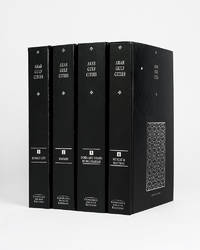
rif. 121943Cambridge Cambridge Archive Editions 2020. . 4 vols 8vo 25.5. x 16.5 cm; publisher's original black cloth lettered in silver a fine set. A valuable collection of records detailing the development and growth of the cities of Kuwait Manama Doha Abu Dhabi Dubai Sharjah Muscat and Mattrah from as early as 1818 right the way through until the mid-1960s before the Gulf War. Chapters are divided into: topography municipality water electricity health education communication lines urban development port development and social history with many royal decrees reproduced. Cambridge, Cambridge Archive Editions, 2020. hardcover
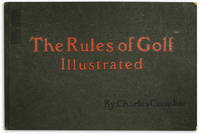
rif. 117551London Perrier / Golf Illustrated 1905. . First edition; landscape folio 29.5 x 45.5 cm; 1 half-size sheet detailing sales information 1 copyright page "Copyright of Perrier" 24 colour plates each with Perrier copyright and details to verso 1 advertising leaf at rear a couple small marginal nicks to rules XVI and XXIII plates fresh and bright; publisher's green cloth-backed boards upper board lettered in red and black boards lightly rubbed a very good copy. Crombie's amusing look at golf in a bygone age. London, Perrier / Golf Illustrated, [1905]. hardcover
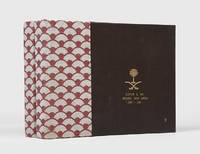
rif. 163098Jeddah: Kingdom of Saudi Arabia Ministry of Defense and Aviation; Lockheed Aircraft International 1983. The Saudi approach is unique Unrecorded institutionally and commercially this attractive set of albums celebrates Lockheed's role in augmenting Saudi Arabia's air traffic control systems both commercial and military over the period 1972-82. They comprise a total of 80 leaves covering summaries of developments "information flow" diagrams for Kaia Riyadh International Dhahran and Jeddah airports colour maps charts and photographs of facilities operatives and aircraft. Writing in Arabian Studies in 1976 aviation expert Elda I. Stifani notes: "By virtue of its geographical position and the strategic economic and political interests of both local and worldwide powers the Middle East plays a major role in civil aviation operations The Saudi approach is unique. No other country in the Arabian Peninsula has an equally determined and precise policy of national aviation development" Arabian Studies III p. 36. Interestingly he also notes that "Bahrain handles air traffic for all the UAA United Arabian Airlines Qatar part of Oman of Kuwait and of Saudi Arabia Dhahran". In March 1974 the Saudi airline Saudia ordered two of Lockheed's new TriStar airliners specially fitted with increased wing fuel tankage. By 1978 Saudia had increased its fleet of TriStars to thirteen. Provenance: presented to Clifford G. Fay of Lockheed Saudi Arabia 1980-82 with his name and dates of service on the front covers. Loosely inserted is a typed letter from Lockheed to Fay presenting the volumes and mentioning that they have been supplied by Joe Akers who was a Lockheed veteran with 28-years' experience at the company retiring as chairman in 1988 26 June 1983 Jeddah letterhead in English and Arabic. 2 vols landscape quarto 235 x 320 mm. With 80 sheets presented recto and verso in clear plastic pockets. Original ring binders fan-patterned cloth spines brown morocco-grain faux leather sides upper covers and front flaps with gilt arms of Saudi Arabia. Cloth sides just a little rubbed tear to first pocket in vol. II not affecting image minor creasing to presentation letter. An excellent set. Elda I Stifani "Civil Aviation in the Gulf: The Role of Commercial Interests in the Issue of Traffic Rights" Arabian Studies III 1976. hardcover
8vo. (2), 6, 637, (3) pp. Contemporary full red morocco on 4 raised bands with giltstamped spine, covers with ornamental blindstamps and gilt rules; leading edgesgilt, inner dentelle gilt. All edges gilt. Luxuriously bound Turkish New Testament, newly translated from the Greek by the German-born William Gottlieb Schauffler (1798-1883). This is the first Constantinople-printed complete New Testament in Osmanli Turkish ever printed in Arabic characters: previous editions had been printed in Greek or Armenian characters only. - "Ordained a missionary [..., Schauffler] reached Constantinople in 1833. His linguistic gifts and missionary experience fitted him for translation-work [...] In 1858 the British and Foreign Bible Society commissioned him to transcribe into Arabic character W. Goodell's Armeno-Turkish version of the Bible, slightly adapting it to meet the needs of the Moslems. When this proved impracticable, he was authorised to make an independent version in simple, idiomatic Osmanli" (Darlow/M., p. 1641). - This copy was bought in Constantinople on 9 August 1879 by J. Gies for 25 silver piastres, as noted by the collector in ink on the title-page. Later in the library of by Karl Schäffeler (his ownership, dated 20 Sept. 1927, on the flyleaf and his bibliographical note on the pastedown). - Occasional light browning, but a well-preserved, pretty copy. Darlow/Moule 9488. Özege 10984. OCLC 42824525
Oblong small folio (238 x 320 mm). Photo album with 197 albumen prints, mounted between 3 and 6 per page on 49 cardboard leaves. Various sizes, typically 70 x 100 mm. Some larger small-format panoramas. Captioned in ink. Contemporary full cloth with handwritten title-label. An interesting album recording the construction of new British military barracks at Abbassia, Cairo, shortly before World War I. Compiled by James Frazer Annan (1887-1957), a British engineer working for the contractor Henry Lovatt Ltd. in Abbassia between 1910 and 1913. Some 40 photographs depict construction at its various stages, showing workers and equipment, including a concrete mixer, details of walling blocks, column caps and shells, scaffolding, and a consignment of cement, as well as a panoramic view of the construction site from July 1910. - Other images show memorable events including the coronation ceremonies for King George V in 1911, Lord Kitchener presenting prizes at a Rifle Meeting, and the Mahmal passing through Cairo during the annual pilgrimage to Mecca. City views of Cairo and Heliopolis, street scenes "in the Mousky district" and "among the Bazaars", the Eshekieh Gardens, the Pyramids, the Nile barrage and dam, tombs of the Khalifs and "typical Mosque tombs": A few more personal scenes such as Christmas dinner 1910 and a picture of baby "James junior" complete this appealing collection. - Occasional light spotting and duststaining. Provenance: Peter Johnstone, whose paternal grandmother, Elsie Amelia Johnstone, was housekeeper to James Frazer Annan. Peter Johnstone numbered the pages and loosely inserted an autograph description of the album, dated 13 May 1996.
Small folio (227 x 294 mm). (6), 113, (1) pp. With Allenby's portrait frontispiece on cloth and 56 coloured maps (facing explanatory texts printed on versos). Original printed wrappers with printed cloth spine. First edition, edited by Harry Pirie-Gordon as a souvenir album: an account of the 1917-19 campaign in the Middle East. Contains two reports written by T. E. Lawrence, "Sherifian Co-Operation in September" and "Story of the Arab Movement", in which he details the Ashraf contribution to the War effort and narrates his own involvement in a third-person report. - Rubbed and stained, with occasional edge flaws. Endpapers have pencil ownership of O. A. Holstius, attached to Headquarters, 19th Brigade, Royal Field Artillery. Loosely inserted is a typed extract from "The Honourable Artillery Company in the Great War, 1914-1919" by George Goold Walker (1930), detailing living conditions in the Jordan Valley during the Great War (torn and frayed at edges). O'Brien A011.
8vo. (26), 237 pp., final blank. Title within double-ruled border. 19th century half calf over marbled boards with giltstamped spine and spine label. Marbled endpapers. Very scarce English translation of this popular chronicle of the 8th-century Moorish invasion of Spain, purportedly translated from an Arabic manuscript that the Moorish apologist and interpreter Miguel de Luna claimed to have found in the Escorial library, but in fact a work of historical fiction of his own composition. Originally issued as "La verdadera hystoria del Rey Don Rodrigo" in two parts (in 1592 and 1600), the present edition, which encompasses only the first part (a second volume announced in the publisher's letter "To the reader" was never published), is the third one in English, following that of Robert Ashley in 1627 and the slightly more common edition published by Leach in 1687. Further translations appeared in French and Italian. It was not until almost a century after its publication that de Luna's book was discovered to be a literary forgery, and even today it remains important as a sympathetic account of the Moorish conquest of Spain. - Binding insignificantly rubbed. Occasional very light foxing; title-page slightly trimmed at foot affecting border. A tiny rust-hole to I5 and a larger tear to K8. Provenance: Handwritten ownership of the Revd. Thomas Watkins (1761-1829), F.R.S., of Pennoyre, Breconshire (dated 1806) to p. 1. Later in the library of the art collectors Howard and Linda Knohl at Fox Pointe Manor, California, with their bookplate to front pastedown. Rare; a single copy in auction records. Palau 144.080. Wing L3484C.
1989Mineral Resources Bulletins Nos. 1, 4, 7-9, 12-29. Includes maps and diagrams. Professional Papers Nos. PP-1-3. Mineral Resources Research 1967-68. All in their original printed green wrappers or full cloth bindings. Extensive collection of rare geologic Bulletins issued by the Saudi Ministry of Petroleum and Mineral Resources (Directorate General of Mineral Resources; after 1980: Deputy Ministry for Mineral Resources), spanning two decades from the mid-1960s to the mid-1980s. Wants merely issue 5/6 and the slim issues 10-11, as well a a final vol. of bibliography (no. 3 was never published). Includes the "Professional Papers" periodical published from 1982 onwards (all three issues published) and the "Mineral Resources Research" volume for 1967/68. - Very clean and well-preserved throughout.
Folio. VI, 103, (1) pp. Sewn. Rare British parliamentary papers and correspondence with local agents and officers on the slave trade, including the account of a dhow seized near Jebel Yarid, on the Persian side of the Arabian Gulf, carrying a single slave, the captain of which hailed from "Debai and Shargeh" (Dubai and Sharjah; p. 76), Zanzibar slave traffic to Mecca and Muscat, etc. The relevant sections are: firstly, under the heading "Correspondence with British Representatives and Agents abroad", "Muscat" (pp. 31f.), & "Zanzibar" (pp. 33-63); and secondly, under the heading "Reports from Naval Officers", "East Coast of Africa Station" (pp. 64-102). - Neat old stamps; a very good copy.
Sm. Folio. xi, 355 pp. Sewn, with traces of spine. Rare British parliamentary papers and correspondence with local agents and officers on the slave trade. Includes communications relevant to the slave trade on the Arabian Peninsula (e.g., "Movements of Her Majesty's ships in the Red Sea"; "Active slave trade in the Hedjaz. To call upon the Porte to put it down"; "Increase of slave trade at Jeddah. To represent it to the Porte"; "Slave trade in the Hedjaz and Yemen. Note to the Porte" and off Oman ("Detention of a dhow, and her subsequent acquittal at Muscat"; "Dhow detained off Muscat. Released in Court"), as well as much material on the murder of Captain Charles J. Brownrigg, who had tried to board a slaving dhow off Zanzibar, in 1881, but had encountered unexpected resistance from the Arab crew and was killed in the ensuing battle. - Disbound from a volume of parliamentary papers, a good copy.
Small 4to (225 x 175 mm). 2 parts in one vol. (11), 150, (25) ff. 39, (1) ff. Title-page printed in red and black; woodcut chapter initial and head-tail pieces, 2 text illustrations and 3 full-page woodcuts. Full vellum, title gilt on spine red label. Somewhat later edition of the first important work on the history of Egyptian medicine. Alpini (1553-1617) was an Italian physician and botanist who spent three years in Egypt studying botany and hygiene as a companion to the Venetian Consul Giorgio Emo. This work is considered "one of the earliest European studies of non-western medicine. Alpini’s work dealt primarily with contemporary (i.e. Arabic) practices observed during his sojourn in Egypt. These included moxibustion - the production of counter-irritation by placing burning or heated material on the skin - which Alpini introduced into European medicine [...] Alpini also mentioned coffee for the first time in this work" (Norman). Jacobus Bontius (Jacques de Bondt, 1592-1631), whose work on Indian medicine is included, was a Dutch physician and botanist. He travelled to Persia and Indonesia to study the botany of the area. He was the first to study cholera on the island of Batavia in 1689, before it was known in Europe, and died on Java. His botanic and medical works were published after his death by Pisonius. He "was probably the first to regard tropical medicine as an independent branch of medical science. He spent the last four years of his life in the Dutch East Indies, and his book incorporates the experience he gained there. It is the first Dutch work on tropical medicine and includes the first modern descriptions of beri-beri and cholera" (Garrison/M. 2263, citing the 1642 first edition). - Binding slightly brownstained in places. Small tear to 3rd leaf, not affecting text; occasional browning. Caillet 230. Krivatsy 236. Wellcome II, 36. Hirsch/Hübotter I, 101 & 627. Hunt 161 (note). Ibrahim-Hilmy I, 32. Osler 1796. Waller 12509. Cf. Garrison/Morton 6468. Norman 39 (1591 first edition); Heirs 384 (1646 edition) and 463 (1642 edition).
4to (24.5 × 18 cm). With title-page printed in red and black and 48 albumen prints (measuring ca. 10 × 13 cm) mounted on leaves with lithographed captions. Original publisher's goldblocked blue cloth, gilt edges. First and only edition of a collection of 48 albumen prints of photographs by the British photographer Francis Bedford (1816-94). "A significant boost to his reputation came with the commission to accompany the Prince of Wales, later King Edward VII, on a trip to Egypt and the Holy Land in the spring and early summer of 1862. The resulting images were exhibited in London in July 1862 [...] Selections from Bedford's Middle Eastern views were included in [...] The Holy Land, Egypt, Constantinople, Athens etc" (Hannavy). The photographs mainly show ancient and Islamic architecture, as well as some landscape views, in and around Cairo, Gizeh, Thebes, Jerusalem, Bethlehem, Damascus, Baalbek, Istanbul (Constantinople), Athens and more. The photographs are accompanied by an introduction and 100 pages of descriptive text by W. M. Thompson. - With bookplate. Slightly browned with some occasional foxing, not affecting the photographs. Binding slightly rubbed along the extremities. Overall in good condition. Blackmer 1483. J. Hannavey, Encyclopedia of 19th-century photography, pp. 134-136.
Coloured two-part bronze, cold painted. Ca. 205 x 117 x 105 mm. A scribe in oriental costume, seated on a carpet with a large removable Qur'an on a bookrest. - Recognised for his great attention to detail and use of wonderfully vibrant colours, works from Bergman’s foundry are highly prized today by collectors worldwide. F. X. Bergman was the son of a Bohemian metalwork chaser and finisher who had moved to Vienna in 1860, there founding a small bronze factory. At the turn of the century, his son Franz Xaver inherited the company and opened a new foundry, basing many of his early bronzes on designs from his father’s workshop and producing an eclectic mix of oriental, erotic and animal figure bronzes. Bergman used a cold painted technique, whereby cast bronzes were decorated in several layers of polychrome ‘dust paint.’ These layers were not fired to fix them to the bronzes, hence they are ‘cold painted’. - Very slightly rubbed. An appealing work, likely from the artist's late phase.
4to. 3 parts in one vol. (8), 227, (1) pp. (12), 268 pp. (8), 112 pp. With 3 woodcut printer's devices to title pages and 9 engraved maps in the text of part one. 17th-century vellum mit ms. spine title. First Brescia edition. - Second, third and fourth volume of this famous geographical treatise by Giovanni Botero (1544-1617), with the map of Arabia on p. 173 and a map of Persia (including the north-eastern coast of the Arabian Peninsula) on p. 133. Originally conceived as a statistical examination of the ecumenical propagation of Christianity, in subsequent editions the work gradually expanded until it formed a comprehensive repertory of anthropology and geography, with systematic accounts of the physical properties, demographics, economic resources, military power, and political constitution of all states of the world. - Wants the first part, which would have formed a separate volume (536 pp.). Vellum damaged at lower edge. Interior shows some browning with occasional worming to margins; a few contemporary marginalia. BM-STC Italian 122. Adams B 2559. Edit 16, CNCE 7301.
Engraved map (35 x 49 cm), hand-coloured in outline. Rare map of Arabia, from the “Nuovo Atlante Geografico Universale”, with a decorative title cartouche showing a nomadic camp. Al Ankary 227.
Large 8vo (170 x 255 mm). (2), VI, (2), VII-XXXVI, 639, 639a-h, 640-1110, (2) pp. With 15 (mostly folding) maps (many in colour) and numerous text ilustrations. Contemporary giltstamped cloth. Second, enlarged edition of this standard work, first published in 1866. An encyclopedic volume of over 1000 pages with a detailed index. The chapters include descriptions of the coasts and islands of the Cape Colony; coast of Kaffraria and Natal; Eastern Africa; Madagascar and the Mozambique Channel; the coast of Africa, between Cape Delgado and the Red Sea; the Red Sea, etc. - In particular, Findlay devotes much attention to the coasts of Arabia and onwards to the Arabian Gulf, providing rich detail about the port of Aden, navigating and anchoring around Ras Arah and Ghubbet Seylan, the population of Masirah Island, the climate of the Gulf and its threats to Western health, topography of the coastal settlements, information on the reefs and pearl banks, etc. The discussion of the Gulf ("Our acquaintance with the hydrography of the Persian Gulf is nearly perfect") includes intelligence on Sharjah ("Shargeh"), "the most important town on the coast", numbering 8,000 to 10,000 inhabitants, and on Dubai ("Debay"), "a large town of 5,000 or 6,000 inhabitants" standing "a little back from the shore" and "recognizable as being the last town on the coast, there being not a single date-tree or house from this all the way to Abu Thabi". The coast is described as "quite barren and uninhabited, throughout very low, with tufts of mangrove bush", and "so uniform in appearance that the smallest peculiarities are noted by the Arabs, and names given to them". Abu Dhabi ("Abothubbee") is noted as "the most populous town on the coast", containing "about 20,0000 inhabitants" and sending "600 boats to the pearl fishery. The chief is very friendly to the English. Cattle might be obtained here". - Binding rubbed; hinges split. Some foxing throughout as common; repeatedly annotated quite ungraciously by a 20th century hand in coloured ballpoint and broad felt-tip pen. A later edition (from Humphrey Winterton's library) commanded £720 at Sotheby's in 2003. Mill (Cat. of the RGS Library) 160. OCLC 217065553.
Small folio (215 x 336 mm). (8), 156 pp. With a folding map in lower-cover pouch. Contemporary printed boards; spine reinforced with later black leather. Official report by Colonel A. H. Gleadowe-Newcomen (1853-1928), President of the Commercial Mission to Persia, of the mission's results regarding the state of British Indian trade in South-Eastern Persia and the consideration of measures which might bring about an expansion of Indo-Persian trade. Assistance to the mission was rendered by Major Percy Molesworth Sykes, then Consul at Kerman, as well as by Percy Cox, the British resident in the Gulf. - Paper brittle; some worming; a few edge flaws near the beginning. Upper cover trimmed at the head and somewhat crudely repaired. Rare. OCLC 69210748.
18868vo. 1 bl. f., (6), 232 pp. Original front printed wrapper cover bound within contemporary red half morocco with marbled boards and giltstamped spine. Marbled endpapers. Mémoires d'Histoire et de Géographie Orientales, No. 1, second edition (first published in 1862). Standard work on a mediaeval Shi'a Ismaili group, the Qarmatians of Bahrain, which at this period included much of eastern Arabia as well as the islands that comprise the present state. For much of the 10th century the Qarmatians were the most powerful force in the Persian Gulf and Middle East, controlling the coast of Oman and collecting tribute from the caliph in Baghdad. They instigated what has been termed a "century of terrorism" in Kufa: they considered the pilgrimage to Mecca a superstition and, once in control of the Bahraini state, they launched raids along the pilgrim routes crossing Arabia. In 906 they ambushed the pilgrim caravan returning from Mecca and massacred 20,000 pilgrims. The Qarmatians came close to raiding Baghdad in 927 and sacked Mecca and Medina in 930. The assault on Islam's holiest sites saw the Qarmatians desecrate the Well of Zamzam with corpses of Hajj pilgrims and take the Black Stone from Mecca to Al-Hasa. - The Dutch Arabist and Orientalist de Goeje (1836-1909) taught at the University of Leiden. He was editor of the "Encyclopaedia of Islam" and collated the Bodleian manuscripts of al-Idrisi. - A few contemporary pencil notes in the margins. With an appendix containing relevant Arabic texts. Minor rubbing to binding, but altogether a fine copy of this rare work; no copy in auction records. Macro, Bibliography of the Arabian Peninsula, 1052. OCLC 4738568. Cf. Fück 211 (for Goeje).
4to. VI, 32 pp. With 2 lithogr. plates and 28 ff. of Arabic letterpress with lithogr. borders, toned in various colours. Modern boards with the original wrappers bound within. First edition. - Without any doubt Hammer’s finest work in imitation of an oriental manuscript: the Persian text of the famous Sufi manual ‘Golshan-e Râz’ is printed in seven four-leaf quires of varying colours, each framed by a lithographed sequence of interlaced flowers and animals (pheasants, deer, antilopes, panthers, jackals). The German translation, the unsophisticated typography of which provides a striking contrast to the luxurious Persian text, is illustrated by two plates of topographical interest. The binding preserves the original blue paper wrappers with a large emblematic lithograph of a shell hidden among a bouquet of roses, drawn by Pauline von Koudelka-Schmerling. - Occasional slight foxing. Untrimmed. Goedeke VII, 767, 100. Rabenlechner I, 122. Cf. Brunet III, 34 (Vienna, 1838 ed.).