4361 risultati
4to (210 x 268 mm). XIV, 176 pp. With 2 colour-printed plates (one bound as a frontispiece) and 9 plates in monotone. Publisher's original blue cloth with gilt title to spine, upper cover stamped in gilt and blind. Top edge gilt. A history of Persian navigation and trade from the earliest times to the sixteenth century. First edition, on hand made paper, one of 250 signed copies (but number and signature erased). With a preface by Muhammad Iqbal. - The Indian scholar Hadi Hasan (1894-1963), a native of Hyderabad, was educated at Cambridge in geology, botany, and chemistry. "On his return to India he played an active role in the freedom movement against British rule and was praised for his work for independence by Mahatma Gandhi" (Encyclopedia Iranica). He subsequently completed a Ph.D. in Persian at the University of London before being "appointed professor and head of the Department of Persian at Aligarh Muslim University, a position he held until 1958" (ibid.). - Occasional insignificant fingerstains; slight paper flaw to title-page from erasure of the number. Binding rubbed and faded, extremeties a little bumped, but well-preserved on the whole. Wilson 88. Encyclopedia Iranica XI, 436f. OCLC 4517880.
Engraved map, ca. 103 x 192 cm. Constant ratio linear horizontal scale, approx. 1:10,000,000. Relief shown by hachures and spot heights. Depth shown by isolines and soundings. Large blue-backed hydrographic chart of the Indian Ocean, showing an area between the Cape of Good Hope and New Zealand. Extends north to include the Arabian and Indian peninsulas, Philippines, and much of China. Shows the Gulf coast as far north as Al-Latif, identifying "Abu Thabi" as the major settlement on the Trucial Coast. Includes courses of currents and standard tracks for shipping through the ocean, with nine inset maps of islands and coastal features (Cargados Carajos; Coetivy; Rodrigues; Des Roches; Farquhar Passage; Tromelin; Réunion; Saint Paul; Saint Denis). - Stamped "Imray & Son, London, 1886". Noticeable browning and staining; several edge and corner defects as well as paper flaws in the map professionally repaired (some corner loss and slight loss near Capetown). Signs of contemporary use with several pencil markings. Cf. OCLC 884378574 (1879 edition). Tooley II, 407.
Black ink on paper, ca. 34 x 57 cm. With gilt Tughra of the Sultan at the head. Certificate showing that Salahaddin Bey, auditor of the Hazine-i Hassa treasury (which managed the personal income and expenses of the Sultan), was awarded the Navy Aid Medal (in nickel) for his donation of 2024 Kurus to the Ottoman Naval Society. - As the Ottoman Empire dominated important waterways during the First World War, the government sought to strengthen its navy's defensive capabilities while fighting on many fronts on land. For this purpose, The Ottoman Naval Society was established. To finance the building of new ships, a campaign was initiated which was joined by many notables, including Sultan Mehmed Resad himself and state officials. The Navy Aid Medal was awarded to supporters who pledged a certain donation to the project, and the recipients' names were published in the press. - Meticulously calligraphed in black and gold ink. On the reverse are official attestations of authenticity. Folded with tears and a few chips to edges. Full transcription available.
12 sheets joined and mounted on cloth; total dimensions 1190 x 1300 mm. Engraved map in original outline colour. In the original marbled paper box with manuscript title on cartouche and a 19th century bookseller’s label. A large map coving from the Balkans to the Ukraine, the Caspian Sea, Western Persia, Arabia and the Nile. Unusually, the map uses stipple engraving to give texture to the open areas, especially in Arabia. It is also an uncommonly international publication, published in France by the engraver, with the assistance of publishers in other countries: James Wyld and John Cary in London; Artaria & Fontaine in Mannheim; Villardi in Milan; Bouffa & Fils in Amsterdam; and Brunin in Glasgow (a publisher not listed in Tooley’s Dictionary). - Minor defects to the box, slight browning, otherwise in fine condition. OCLC 1061136095.
4to. With 13 numbered lithographed plates (the first used as frontispiece), including 3 fully and 1 partially coloured by a contemporary hand, of which 2 highlighted in gold. Contemporary half calf, restored and rebacked with parts of the original backstrip laid down, with new tooling and title-label on spine, cloth sides, later endpapers. First edition of "the historic cornerstone of the study [of mummification] in English. For the time at which it appeared, the work was a monumental undertaking. Based on scholarly research and practical experience, Pettigrew's work was a summation of almost all that was known concerning Egyptian funerary practices. He compiled all the ancient sources and commented on them, as well as discussing many examples of mummified remains investigated by or known to him. The work is illustrated by [...] Georges Cruikshank (better known for his satirical drawings) that are the product of careful observation" (Peck). - With the bookplate of the British lawyer and politician Bernard John Seymour Coleridge, 2nd Baron Coleridge (1851-1927). Some foxing on the title-page and some spots and marginal waterstains on the plates, touching the last three illustrations, otherwise in good condition. Binding rebacked and restored. Brunet IV, 581. Gay 1565. W. H. Peck, "Mummies of ancient Egypt" in: Mummies, disease and ancient cultures (1998), p. 15.
4to. VI, 50 pp. With a portrait frontispiece of the author, from a photograph, 34 other photographic illustrations on plates, and a double-page sketch map of the Kittar Mountains. Publisher's purple cloth, blocked in black and gilt with ibex and palm tree. All edges gilt. First edition. Extremely rare example of this journal which covers Pretyman's 1891 hunting expedition to the Kittar mountains, the Eastern Desert of Egypt between Qena on the Nile and Quseer on the Red Sea, using the only known map of the area produced by Floyer four years earlier. H. E. Pretyman, a lieutenant in the Grenadier Guards, travelled back from Ismalia to London in 1891 but died the same year, whilst Camp Adjutant at Bisley, and it is believed he had not fully recovered from a severe attack of typhoid and jaundice in 1889. His father, the Rev. Frederic Pretyman, arranged to have the journal published as a memorial volume. - Extremeties insignificantly rubbed, light brownstaining or foxing to a few places in the first and last few leaves. An excellent copy. Meckly, Alpine Journal. Bibliography of Privately Printed Mountaineering Books 204. Lloyd, Cat. of the Graham Brown and Lloyd Collections in the NLS, 813. Not in Czech, Asian Big Game Hunting Books.
1885Folio (310 x 405 mm). 4 pp. index of plates. 110 plates, 100 of which are in colour (incl. 26 double-page plates). Contemp. half leather with gilt title to spine, marbled boards. First edition of this selection from the author's famous, standard work on Arabian art, published between 1869 and 1877. The plates are slightly reduced from the original format and limit themselves to characteristic elements of decoration and ornament from all areas of the visual and applied arts of the Middle East. "'Arab Art', however, is more than a monument to the author's tenacity, skill, and devotion. For the historian of architecture, it is a precise source, a unique documentary record [...] On an entirely different level, Prisse d'Avennes has provided today's architects, designers, artists, and illustrators with some of the finest examples of measured drawings, pattern details, and illustrations of selected aspects of the built environment of a medieval Islamic city" (preface to the London 1963 edition). - Spine shows insignificant traces of restoration; interior clean and spotless. A fine copy. OCLC 643808682. Cf. Ibrahim-Hilmy II, 138-140.
8vo. 307 ff. Naskh calligraphy, 15 lines. Black ink on polished paper; borders in red and gold; sura headings in white ink on gilt; gilt discs for verse divisions. Double-page 'unwan on first two pages shows elaborate gilt ornamentation; colophon shows floral ornamentation in green and gilt. Coloured floral decoration to margins. Later cloth. Colophon in Arabic: "Finished Thursday afternoon 3 o'clock. The scribe is the son of Mehmed Halil Ibrahim, what is done is determined by Allah". - Provenance: acquired in Istanbul, Turkey, in the 1960s.
4to (29 x 19.5 cm). VII, (1 blank), 147, (1 blank) pp. With 24 hand-coloured lithographed plates by William Brodrick. Publisher's blind- and gold-blocked cloth, front board with title and large illustration of a falcon. First edition of a complete and important treatise on the art of falconry by F. H. Salvin (1817-1904), in which he describes the various species of birds used in England, both hawks and falcons. ''The best English book on falconry and a very attractive publication'' (Schwerdt). - The treatise is illustrated with lithographs by William Brodrick (1814-1888); they show 21 falcons and 5 hawks; plates 22-24 depict equipment used for falconry. The stones for the first edition were destroyed after publication so the plates for the second edition (London, 1873) had to be redrawn. - With bookplate of Leon Colin Somervell on front paste-down. Some pages and plates reinforced, two plates loose, some spotting, but still in good condition. Binding discoloured and slightly worn. Nissen, IVB 147. Souhart 419. Schwerdt II, p. 145. Wood p. 541. Not in Thiebaud.
Folio. 1 page. On uncut wove paper, bearing the Schoellers-Parole blind embossed seal, margins uncut. The original autograph contribution of Si Kaddour Benghabrit to the Committee of the World League for Peace (Ligue Mondiale pour la Paix), a remarkable organization formed in 1925 with close ties to the League of Nations. The Committee itself was composed of such notaries as Queen Elizabeth of Belgium, King Carol II of Romania, John D Rockefeller, Marie Curie, and Albert Einstein, who personally gathered the present manuscripts over the course of seven years (1925-32). Among the public figures who contributed to the project were dignitaries from the newly-created League of Nations' member states. "Rebellion sleeps in the heart of man, may he be cursed who awakens it'. Thus spoke our Prophet. This is still the living doctrine of modern Islam. How could it not prefer the pure and simple joys of peace to the torments and dark nights of war! [Signed] Benghabrit". Si Khaddour Benghabrit rose to prominence under the French regime in Morocco . He is also remebered for his courage in saving the lives of the many Jews during the Second World War by disguising them as Muslim members of his Paris mosque - somewhere between 500 and 1600 people were saved from deportation in this way, and the Medal of Justice has been awarded to the descendants of Benghabrit by the Yad Vashem Memorial. Pax Mundi. Livre d'or de la paix. Enquete universelle de la Ligue mondiale pour la paix sous le haut patronage de son comite d'honneur avec l'approbation de la Societe des nations, du Bureau international du travail et de la Cour permanente de justice internationale. Geneve, Societe paxunis, 1932.
8vo. XII, 331, (1), 40 pp. (appendix printed in Arabic, Persian, and Ottoman Turkish). Contemporary papered boards with ms. spine label. First edition. - Dissertation of the German theologian August Tholuck (1799-1877), a study of Sufism and oriental Pantheism composed because an illness prevented him at the time from accepting the chair of oriental languages and Old Testament exegesis at Dorpat. "Still worth reading" (Nicholson). While Schleiermacher criticised the work as untheological, the University of Jena accorded Tholuck an honorary doctorate in 1822 on the strength of his Persian studies. As professor of Old Testament studies in Berlin and Halle, Tholuck would go on to influence many American theologians, including the Methodist John Fletcher Hurst and Philip Schaff. - A contemporary inkstain to the first few pages. Inscribed by the author on the flyleaf: "Seinem innigst verehrten 'Nomodidaskalos en Kyrio' [Greek], der ihn zu Jesu wieß / der Vf." ("To his dearly beloved Instructor of Law in the Lord, who showed him the path to Jesus, from the author"). The recipient of this gift was likely the church historian Johann August Wilhelm Neander (1789-1850), in whose collection the volume was before the entire library was acquired by the American banker Roswell S. Burrows (1798-1884) for the Rochester Theological Seminary in New York (their printed shelfmark label of "Neander Library" on the front pastedown). A good copy. ADB 38, 55. Herzog/H. XIX, 697. Nicholson, the Mystics of Islam, p. 76. OCLC 7436665.
1930rif. 110628Um 1930. 50 x 63,5 cm.
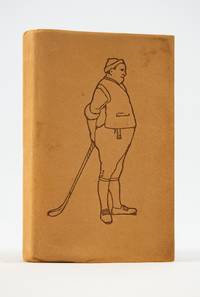
1903rif. ST20237New York: The Gorham Manufacturing Co 1903. FIRST EDITION. ONE OF 500 COPIES. 102 x 64 mm. 4 x 2 1/2". 4 p.l. 9-148 pp. CHARMING PUBLISHER'S LIMP SUEDE illustrated covers with a rotund golfer on front and a long-suffering caddy at rear top edge gilt other edges untrimmed. In a later glassine wrapper. Housed in a very sturdy custom-made buckram folding box with inlaid marbled spine label. Color floral and foliate headpieces tailpieces and title page and 16 DELIGHTFUL MOUNTED COLOR PLATES BY JOHN HASSALL. Front endpaper with the ownership inscription "W. P. Rockwell November 1905." Murdoch 888; Donovan & Murdoch 19030. Trivial smudges to the suede but A NEARLY PRISTINE COPY of this delightful little book an item that is simply never found this well preserved. This is a diminutive golf manual with immense charm and offered in the most immaculate condition possible. In a small-pocket format the book provides the golfer with the game's rules etiquette technical terms names of golf clubs and their various uses a list of American champions since the organization of the United States Golf Association and a roster of the "leading players in the United States." Accompanying the text are a group of quite charming colored plates done by John Hassall 1868-1948 an active and celebrated watercolorist poster designer and illustrator from 1895 onwards. Houfe calls him "an original and versatile designer." As can be seen in the present volume Hassall seems to have been influenced by "the flat colors and two-dimensional decorative quality of Japanese prints which he adapts to his own work with thick outline and careful patterning." Whatever the influence one can't help but smile when looking at his work. Hassall depicts golf costume through the ages here including golfers in kilts trousers cloaks knickers and other attire; he also shows us a pair of disarmingly shabby young caddies two women and a boy incongruously dressed in Napoleonic greatcoat and tricorn hat. The most memorable thing about this item is its condition: as a book intended to be put in one's pocket and as a volume that was never sturdy to begin with there is absolutely no explanation for how our copy has survived to the present day in its remarkable state of preservation. When this copy without its box was sold in 2004 at PBA Galleries the most prominent auction purveyor of golf books and equipment the catalogue called it "the finest copy we have ever offered of this exceedingly scarce and fragile book.". The Gorham Manufacturing Co unknown
1903rif. ST20237New York: The Gorham Manufacturing Co 1903. FIRST EDITION. ONE OF 500 COPIES. 102 x 64 mm. 4 x 2 1/2". 4 p.l. 9-148 pp. CHARMING PUBLISHER'S LIMP SUEDE illustrated covers with a rotund golfer on front and a long-suffering caddy at rear top edge gilt other edges untrimmed. In a later glassine wrapper. Housed in a very sturdy custom-made buckram folding box with inlaid marbled spine label. Color floral and foliate headpieces tailpieces and title page and 16 DELIGHTFUL MOUNTED COLOR PLATES BY JOHN HASSALL. Front endpaper with the ownership inscription "W. P. Rockwell November 1905." Murdoch 888; Donovan & Murdoch 19030. Trivial smudges to the suede but A NEARLY PRISTINE COPY of this delightful little book an item that is simply never found this well preserved. This is a diminutive golf manual with immense charm and offered in the most immaculate condition possible. In a small-pocket format the book provides the golfer with the game's rules etiquette technical terms names of golf clubs and their various uses a list of American champions since the organization of the United States Golf Association and a roster of the "leading players in the United States." Accompanying the text are a group of quite charming colored plates done by John Hassall 1868-1948 an active and celebrated watercolorist poster designer and illustrator from 1895 onwards. Houfe calls him "an original and versatile designer." As can be seen in the present volume Hassall seems to have been influenced by "the flat colors and two-dimensional decorative quality of Japanese prints which he adapts to his own work with thick outline and careful patterning." Whatever the influence one can't help but smile when looking at his work. Hassall depicts golf costume through the ages here including golfers in kilts trousers cloaks knickers and other attire; he also shows us a pair of disarmingly shabby young caddies two women and a boy incongruously dressed in Napoleonic greatcoat and tricorn hat. The most memorable thing about this item is its condition: as a book intended to be put in one's pocket and as a volume that was never sturdy to begin with there is absolutely no explanation for how our copy has survived to the present day in its remarkable state of preservation. When this copy without its box was sold in 2004 at PBA Galleries the most prominent auction purveyor of golf books and equipment the catalogue called it "the finest copy we have ever offered of this exceedingly scarce and fragile book.". The Gorham Manufacturing Co unknown books
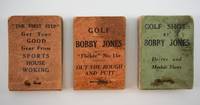
1930rif. ST20235London: Harrods Ltd 1930s. FIRST EDITION. 76 x 51 mm. 3 x 2". 100 pp. Original green or orange paper wrappers side stitched titling on front cover and imprint on spine. In a custom-made folding buckram box with book wells for the three books and gilt-stamped marbled paper label inset on spine of the box. Consisting of three bound sets of 50 sequential photographs that when flipped either from back to front or front to back generate a stop motion animation of Bobby Jones demonstrating the proper form for executing a shot with various golf clubs see below. Advertisements on inside wrappers. Donovan & Murdoch 22610. One volume with portions of spine gone at either end with partial loss of imprint wrappers inevitably somewhat soiled corners a bit rounded as expected but still remarkably well preserved especially considering its inevitable hard use being entirely sound and with the photographs in excellent condition. This is a scarce grouping of some of the most charming sports as well as miniature books we've ever offered for sale. In the 1930s the famous London department store Harrods published a series of so-called sports "flicker" books of which these three are perhaps the most famous other sports books involved cricket tennis lacrosse soccer badminton swimming and greyhound racing. Our three "flicker" books when the pages are riffled with one's thumb or fingers show the famous smooth-swinging American golfer Bobby Jones executing shots with various clubs. The first book #11a in the Harrods series features the driver and the mashie. The modern equivalent for this latter piece of equipment is slightly elusive but the "mashie" is an iron club with considerable loft meant to hit a golf ball a relatively short distance with a high trajectory Jones' "driver" has the same meaning today as it did 90 years ago. The second book features shots with a "brassie" roughly equivalent to today's 3- or 4-wood and an "iron" also called a "driving iron" which is like today's 1- or 2-iron. The third book shows Jones putting and escaping from heavy rough with a high-lofted club like today's sand wedge. It is great fun--not to mention still instructive--to riffle through these photographs watching one of the world's most celebrated golf swings come to life complete with Jones' knickers white shirt and flapping tie. It is also a fact of some interest that this English series would feature an American player at a time when British dominance in golf was beginning to erode. Given the physical use to which these items have been subjected it is difficult to believe that they are still intact let alone that they are solid enough to be handled without worry. Harrods Ltd unknown
1930rif. ST20235London: Harrods Ltd 1930s. FIRST EDITION. 76 x 51 mm. 3 x 2". 100 pp. Original green or orange paper wrappers side stitched titling on front cover and imprint on spine. In a custom-made folding buckram box with book wells for the three books and gilt-stamped marbled paper label inset on spine of the box. Consisting of three bound sets of 50 sequential photographs that when flipped either from back to front or front to back generate a stop motion animation of Bobby Jones demonstrating the proper form for executing a shot with various golf clubs see below. Advertisements on inside wrappers. Donovan & Murdoch 22610. One volume with portions of spine gone at either end with partial loss of imprint wrappers inevitably somewhat soiled corners a bit rounded as expected but still remarkably well preserved especially considering its inevitable hard use being entirely sound and with the photographs in excellent condition. This is a scarce grouping of some of the most charming sports as well as miniature books we've ever offered for sale. In the 1930s the famous London department store Harrods published a series of so-called sports "flicker" books of which these three are perhaps the most famous other sports books involved cricket tennis lacrosse soccer badminton swimming and greyhound racing. Our three "flicker" books when the pages are riffled with one's thumb or fingers show the famous smooth-swinging American golfer Bobby Jones executing shots with various clubs. The first book #11a in the Harrods series features the driver and the mashie. The modern equivalent for this latter piece of equipment is slightly elusive but the "mashie" is an iron club with considerable loft meant to hit a golf ball a relatively short distance with a high trajectory Jones' "driver" has the same meaning today as it did 90 years ago. The second book features shots with a "brassie" roughly equivalent to today's 3- or 4-wood and an "iron" also called a "driving iron" which is like today's 1- or 2-iron. The third book shows Jones putting and escaping from heavy rough with a high-lofted club like today's sand wedge. It is great fun--not to mention still instructive--to riffle through these photographs watching one of the world's most celebrated golf swings come to life complete with Jones' knickers white shirt and flapping tie. It is also a fact of some interest that this English series would feature an American player at a time when British dominance in golf was beginning to erode. Given the physical use to which these items have been subjected it is difficult to believe that they are still intact let alone that they are solid enough to be handled without worry. Harrods Ltd unknown books
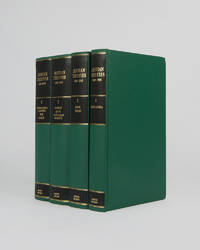
rif. 121944London Archive Editions 1992. . 4 vols 8vo 25 x 16.5 cm; includes maps and tables; publisher's original green cloth gilt lettering pieces to spines top edges gilt a fine set. Extensive collection of international and governmental treaties of the Gulf states of Iraq Kuwait Bahrain Qatar the United Arab Emirates Oman Yemen and Saudi Arabia. Improves on the previous work of Aitchison by including inter-regional and inter-state treaties rather than ones specifically related to Britain. London, Archive Editions, 1992. hardcover
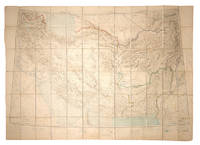
rif. 108381Calcutta Survey of India Office 1912-1923. . Heliozincographed colour map four sheets dissected and mounted on linen as one folding out to 108 x 152 cm in size scale 1:2000000 1.014 inches to 32 miles original paper covers with manuscript title label faint crayon lines confined to the area around Quetta a couple minor marginal tears repaired linen a little fragile in a few places but still a sturdy and attractive copy. Four sheets of the Survey of India Southern Asia Series 1912-1945 covering the Gulf Persia Afghanistan Boluchistan and western India stretching from Riyadh in the south-west to Bukhara in the north-east. The sheet covering the Arabian Gulf titled 'Southern Persia' is dated 1912 and shows the main travel routes along the Gulf and into the interior as far as Riyadh with none of the roads being depicted as suitable for wheeled vehicles and totally absent of railways or telegraph lines. Kuwait Bahrain Qatar Abu Dhabi and Dubai are all identified. Sir Sidney Gerald Burrard 1860-1943 initially served in the Survey offices at Dehra Dun before being made Surveyor General in 1908. In 1912 it was his decision to produce a new set of maps which would correct trigonometric errors in previous surveys and give a totally accurate mapping of Arabia and Central Asia centred on the oil reserves in Persia which Britain had a controlling interest in. Calcutta, Survey of India Office, 1912-1923. unknown
rif. 121953Cambridge Cambridge Archive Editions 2021. . 4 vols 8vo 25.5 x 16.5 cm; 5 large folding maps loose in rear pocket; publisher's original black cloth silver gilt lettering a fine set. A comprehensive collection of documents recording the history of Qatar between the years 1966 and 1971 which saw the withdrawal of Britain from the region and the eventual establishment of Qatar as an independent nation rather than joining the Emirates in a confederation. Cambridge, Cambridge Archive Editions, 2021. hardcover
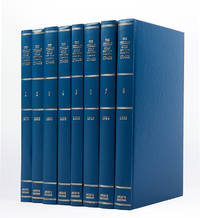
rif. 121085London Archive Editions 1989. . 8 vols 8vo; original blue cloth gilt a fine set. A complete set of this handsome facsimile edition of all eight Persian Gulf pilots published between 1870 to 1932. Invaluable not only for sailing directions but also for descriptions of the coast and its towns and villages and how they have grown over the period. London, Archive Editions, 1989. hardcover
1807rif. ST12145Edinburgh: Printed for Peter Hill et al. 1807. FIRST EDITION. 197 x 114 mm. 7 3/4 x 4 1/2". 2 p.l. v-viii 244 pp. PUBLISHER'S ORIGINAL BLUE BOARDS paper label on spine edges untrimmed. In a felt-lined morocco-backed folding box. Four engraved plates three views and a city plan. Front free endpaper inscribed "Edin. 27th April 1807 / Agnes Cockburn / in memory / of the author." Donovan & Murdoch 270. Boards a little soiled front joint cracked rear joint starting at tail extremities with the expected considerable wear spine label chipped with a fourth of the letters gone but the boards still attached and the extremely insubstantial publisher's binding still appealing because of its original materials. Title page with a bit of offsetting from frontispiece isolated minor foxing in text other trivial imperfections but an excellent copy internally the untrimmed leaves bright fresh and clean with all of their ample margins intact. This is an invaluable early book on the history of St. Andrews in general and more specifically on St. Andrews as the home of the game of golf offered here in the publisher's original boards. It is the first work by the clergyman and polymath James Grierson M. D. 1768-1844 and the first printing of the first work on the ultimate destination of all those who consider golf sacred.The final chapter here entitled "The Company of Golfers" gives a short history of golf provides "an idea of the nature of this elegant amusement" and describes how the earliest golf balls called "featheries" on account of their stuffing were made. The book is dedicated to Lady Elizabeth Moncreiffe the daughter of the renowned military leader and politician George Ramsay 9th Earl of Dalhousie Governor General of British North America and later Commander-in-Chief of India wife to Sir Thomas Moncreiffe and a woman of considerable wealth. Grierson had served as tutor to her son Sir David Moncreiffe 6th Baronet 1788-1830 early in his career and apparently maintained a connection to the family. Our first edition is uncommonly found in publisher's boards. Printed for Peter Hill, et al. unknown
1807rif. ST12145Edinburgh: Printed for Peter Hill et al. 1807. FIRST EDITION. 197 x 114 mm. 7 3/4 x 4 1/2". 2 p.l. v-viii 244 pp. PUBLISHER'S ORIGINAL BLUE BOARDS paper label on spine edges untrimmed. In a felt-lined morocco-backed folding box. Four engraved plates three views and a city plan. Front free endpaper inscribed "Edin. 27th April 1807 / Agnes Cockburn / in memory / of the author." Donovan & Murdoch 270. Boards a little soiled front joint cracked rear joint starting at tail extremities with the expected considerable wear spine label chipped with a fourth of the letters gone but the boards still attached and the extremely insubstantial publisher's binding still appealing because of its original materials. Title page with a bit of offsetting from frontispiece isolated minor foxing in text other trivial imperfections but an excellent copy internally the untrimmed leaves bright fresh and clean with all of their ample margins intact. This is an invaluable early book on the history of St. Andrews in general and more specifically on St. Andrews as the home of the game of golf offered here in the publisher's original boards. It is the first work by the clergyman and polymath James Grierson M. D. 1768-1844 and the first printing of the first work on the ultimate destination of all those who consider golf sacred.The final chapter here entitled "The Company of Golfers" gives a short history of golf provides "an idea of the nature of this elegant amusement" and describes how the earliest golf balls called "featheries" on account of their stuffing were made. The book is dedicated to Lady Elizabeth Moncreiffe the daughter of the renowned military leader and politician George Ramsay 9th Earl of Dalhousie Governor General of British North America and later Commander-in-Chief of India wife to Sir Thomas Moncreiffe and a woman of considerable wealth. Grierson had served as tutor to her son Sir David Moncreiffe 6th Baronet 1788-1830 early in his career and apparently maintained a connection to the family. Our first edition is uncommonly found in publisher's boards. Printed for Peter Hill, et al. unknown books
8vo. LXXII, 452 pp. Near-contemporary half cloth with giltstamped red spine label. Edges sprinkled in red and blue. First edition. - A rare and scholarly investigation of the Arabic origins of star names, incorporating the first edition (with a German translation) of the relevant part of the famous "Aja'ib al-makhluqat" by the astronomer Zakariya al-Qazwini (1203-83), which contains a description of the 48 constellations of Ptolemy and is hailed by Brockelmann as "the most valuable cosmography in Islamic culture" (GAL). Taking Qazwini's text as his guideline, the Prussian astronomer Ideler (1766-1846) provides a detailed commentary elucidating the respective Greek, Latin, oriental, and modern names of the stars. The final chapter is an essay on the Arabic nomenclature of celestial bodies, tracing the names' origins to the ancient nomadic Arabs (Bedu). Although Ideler was not an orientalist and claimed merely a scholarly working knowledge of Arabic, he had the advice of Oluf Gerhard Tychsen and Georg Beigel. The resulting text edition, translation and critical study were highly praised by Fück, who called the annotations "excellent". - Some browning throughout as common; professional repairs to spine. Old stamp and shelfmark of the Boston Arts Academy Library to title; handwritten ownership "J. Johnson / Jan.y 1930" to pastedown. Schnurrer p. 466f., no. 404. Fück 160 ("1810" in error). Kayser III, 248. OCLC 11828254. Cf. GAL S I, 882.
Folio (244 x 341 mm). (12) pp. With 2 engravings (one in the text, one on the title). - (Bound after) II: (Schiepati, Giuseppe / Assemani, Simone). Descrizione di alcune monete cufiche del Museo di Stefano de Mainoni. Milan, Paolo Emilio Giusti, 1820. 136 pp. With 3 engraved plates. - (And) III: Reinaud, [Joseph Toussaint]. Lettre à M. le baron Silvestre de Sacy sur la collection des monuments orientaux de [...] comte de Blacas. Paris, Firmin Didot, 1820. 16 pp. Original pink printed wrappers. 8vo. All three within contemporary green boards with giltstamped red spine label. Collection of three rare studies falling within "the rarely-entered territory of Muslim archaeology" (cf. Fück, p. 153), comprising the two final works of Simone Assemani and the first publication of Joseph Toussaint Reinaud. - In 1818, the orientalist Assemani, well known as an authority on Kufic coins through his "Museo Cufico Naniano" (1787) and, more recently, his treatise "Sopra le Monete Arabe effigiate" (1809), published his "Spiegazione", a discussion of two rare Cufic coins in Stefano de Majnoni's collection. Subsequently, Majnoni called on Assemani to identify several additional coins and in 1820 requested him to check a catalogue of his collection compiled by Giuseppe Schiepati. When Schiepati published the second work here included, "Descrizione di alcune monete cufiche", it was found to contain many unacknowledged contributions by Assemani, as well as extracts from his "Museo Cufico Naniano". Also, Schiepati’s historical comments relied on, and indeed summarized, C. O. Castiglioni’s "Monete Cufiche dell’ I. R. Museo di Milano" (1819). A controversy arose, in the course of which Schiepati was accused of plagiarism - a matter exacerbated by the fact that Assemani had died in early 1821, at the age of 69. - The third work in the volume is a slim octavo brochure, composed by Reinaud as a letter to his teacher Silvestre de Sacy reporting on the Islamic collection of the French antiquarian and diplomat Pierre de Blacas (1771-1839). Eight years later Reinaud would publish his famous, lavishly produced two-volume catalogue "Description des monumens musulmans du cabinet de M. le duc de Blacas", which made his name. - Occasional insignificant browning; Reinaud's work untrimmed, the folio works printed on large paper retaining very wide margins. From the library of Jean-Baptiste Alexandre Billard de Saint-Laumer (1814-92) with his collection drystamp to title page of "Descrizione"; the three plates interleaved with smaller sheets bearing numbered annotations, likely in his hand. I: Leitzmann 5. Achat 11216. OCLC 84477158. - II: Leitzmann 124. Brunet V, 199. Graesse VI, 301; I, 240. OCLC 52651290. - III: Leitzmann 114. OCLC 229903535.
Small folio (218 x 340 mm). 19, (9) pp. With 5 folding plans, one measuring more than two metres in length. Original stiff printed wrappers. Extremely rare report on construction plans for a railway from Keneh (Qena) on the eastern shore or the Nile to Kosseir (al-Qosair) on the coast of the Red Sea. The project was never carried out. "La roue de Kéneh à Kosseir a éte étudiée dans un rapport de Ch. Nicour [...] qui déposa ses conclusions le 21 Février 1891 auprès du Conseil d'Administration des Chemins de fer de l'Etat égyptien. Ce rapport fut utilisé par J. Raimondi [...] dans son livre sur 'Le désert oriental égyptien du du Nil à la Mer Rouge' [...] Dans le chapitre V, intitulé 'Projet de chemin de fer de Kéneh à Kosseir [...]' Raimondi rappelle que, dès 1891, on avait formé le projet d'une ligne de chemin de fer de Kéneh à Kosseir. Le port, en effet [...] est le point de la mer Rouge le plus rapproché du Nil [...] Après avoir évalué les recettes probables de cette ligne [...] et avant d'étudier les problèmes de réalisation pratique [...] Raimondi reprend le rapport de Ch. Nicour pour donner une description de la route et une étude du tracé de ce chemin de fer, qui ne devait pas etre réalisé. La mission de Ch. Nicour étudia le terrain en décembre 1890. Elle décrit d'abord la route depuis Kéneh jusqu'à l'entrée de L'Quadi Hammamat, puis elle étudie les gorges de l'Quadi Hammamat proprement dit [...]" (Bernard). - The five plans include: 1) "Ligne de Kéneh à Kosseir. Route du Nord [...] Plan géneral et profil en long", ca. 62 x 205 cm. 2) "Plan de la grande gorge de El Hammamat", ca. 33 x 125 cm. 3) "Plan de la petit gorge de El-Sed", ca. 33 x 77 cm". 4) "Plan de petit gorge de E-Rieh", ca. 33 x 94 cm. 5) "Plan de ville de Kosseir", ca. 59 x 90 cm. - Binding lightly wrinkled and duststained in places, but altogether very well preserved. Inscribed on the upper cover by Yacoub Artin Pasha (1842-1919), the Armenian-born historian and Egyptian Minister of Education, to Julius Franz (1831-1915, "Frantz Pacha"), the German-born senior architect to the Egyptian Viceroy. André Bernard, De Koptos à Kosseir, p. 26. Not in OCLC.