4409 risultati
8vo. IX, (1) pp., 1 blank leaf, 300 pp. Contemporary red half leather over marbled boards with giltstamped spine title. Marbled endpapers. Rare anthology of Arabic poetry with Arabic text and French translations printed on opposite pages as well as literal Latin translations and notes. Jean Humbert (1792-1851), a Geneva clergyman, learned Arabic in Paris under the auspices of Silvestre de Sacy and later pioneered the Arabic curriculum at the University of Geneva. - Binding rubbed, extremeties bumped and chipped, upper spine-end defective, front hinge starting. From the library of the oriental scholar Edouard Montet (1856-1934), professor at Geneva, with his bookplate on the front pastdown (with a fine quotation from Al-Zamakhshari in Arabic). Additional handwritten ownership "Edward Cooper" to flyleaf. OCLC 29298262. GAL II, 479 (for the writings of Michel Sabbagh, pp. 291ff. in the Anthology). Cf. Fück 156 (for Humbert).
4to (180 x 225 mm). Arabic manuscript on paper. 47 pp. 23-25 lines, per extensum, in black and occasional red and yellow ink. Bound in modern blue cloth with marbled covers. A mystical contemplation of animate and inanimate creatures, in particular of birds and flowers, whose various qualities proclaim the existence and wisdom of their creator. A popular and much-copied work by the Muslim mystic Ibn Ghanim al-Maqdisi (d. 678 H/1279 CE?). A French translation was published in Paris in 1821; an edition of the Arabic text appeared in Cairo in 1280 H. - Written in an elegant northern African, very probably Moroccan calligraphy. A few edge flaws due to brittleness of paper, but on the whole well preserved. Cf. GAL I, 451 & II, 808f.
Folio (237 x 312 mm). 2 parts in one volume. XXV, (1), 128 pp. (French and Latin text); 50 pp. (Arabic text); central blank. Contemp. half brown hard-grained morocco, raised bands on gilt fleuron spine. Marbled endpapers. First edition, with the full text in Arabic: an early effort of the Franco-Irish editor. The pre-Islamic Arab poet Imru al-Qays (497-545) from the Kinda is regarded as the greatest writer in Arabic of his time. His Diwan (complete collection of poems), written in a language of impeccable classicism, was collected from the 8th century; it includes 28 to 68 parts according to recensions. - The Irish scholar William McGuckin de Slane (1801-78), a disciple of Silvestre de Sacy, to whom the present work is dedicated, went on to serve as Principal Interpreter of Arabic of the French Army and Professor of Arabic at the École de langues orientales in Paris. It is remarkable the he chose to present a Latin version of these works: he later became known for his translations into French and English of Arab and Persian historians. - Occasional browning and foxing. GAL I, 24. OCLC 457350459.
4to. (4), 92 pp. Printed on thick paper with 2 text illustrations and 1 plate (counted as III). Contemporary brown half cloth over marbled covers with old paper label pasted on the spine. First edition of this important study of Arabic papyrology, exceedingly rare. With quotations and interspersions in Arabic. The orientalist Joseph Maria von Karabacek (1845-1918) was professor at the University of Vienna and director of the Imperial Court Library. This is the first and only independent, monographic edition in German, an offprint (with separate pagination) from vols. II and III of the "Mittheilungen aus der Sammlung der Papyrus Erzherzog Rainer" (1887). The book was translated into English in 1991 (republished in 2001); it remains a classic textbook referenced by specialized literature such as Adam Gacek's handbook on Arabic manuscripts (Leiden: Brill, 2009). - In very good condition: title-page showing light foxing; contemporary library stamp of the Brünn German Technical University on the cover, their bookplate on the pastedown. Binding slightly rubbed; extremeties bumped. A wide-margined copy. OCLC 17791658. Cf. Gacek, Arabic Manuscripts, pp. 191f., 306 (citing the serialized edition and the English translation).
Large 8vo. VIII, 488 pp. With an engraved frontispiece captioned in Arabic. Contemporary full calf with giltstamped spine. Marbled endpapers. All edges red. First Arabic edition of this classic ascetical work by Saint Alphonse de Liguori (1696-1787), first published in Italian in 1758 and translated by Maksimus ibn Jurjis Mazlum, archbishop of the Melkite Greek Catholic Archeparchy of Aleppo. Printed in Arabic throughout save for the preliminary matter. A second Arabic edition was prepared in 1851 by the Franciscans of Jerusalem. - Old red library stamp of the Roman Jesuit College on the title page; handwritten ownership on flyleaf opposite: "Dono del medesimo autore alla Bibl. degli scol. teol. del Coll. Rom.". Some occasional brownstaining and loosening of quires, still a very good copy. Only three copies known in libraries internationally (Yale; BSB Munich; Naples). OCLC 702211341. ICCU NAPE\032122.
8vo. XI, (1), 257, (1), (2, advertisements) pp. With photographic frontispiece and 12 photographic plates. Publisher's green cloth with gilt vignette of a dervish to front cover, spine lettered in gilt. First edition of this study of Sufi practice in Eastern Anatolia, Northern Iraq and Cyprus. From the library of Vittorio Emanuele III, King of Italy, extensively underlined and marked by the king with the inscription "Villa Savoia - 21.2.15" to last page; shelfmark label of the royal library to spine. The king terminated this book only three months before Italy declared war on Austria-Hungary, de facto entering WWI. Villa Savoia was first purchased by the house of Savoy in 1872. Subsequently sold to count Telfner, the royal family's financial administrator, Villa Savoia, which in the meanwhile had been renamed Villa Ada (as it is still known today) after Telfner's wife, was purchased back in 1904 by Vittorio Emanuele III, who admired its vast park and secluded location, making it perfect as a private retreat within Rome for the royal family, as well as a safe refuge during WWII (an elaborate bunker was built within the estate). In 1946 King Umberto II gifted the villa to Egypt, as a symbol of gratitude for the hospitality received during his and his father's exile; the villa now hosts the embassy of the Arab Republic of Egypt. - Some very light scattered foxing, but a very good copy. Rare. OCLC 82156703.
Ink on paper. With large gilt Tughra. Ca. 55 x 28 cm. In original, addressed envelope. Pretty Ottoman document from the last months before the beginning of the Balkan Wars, concerning an arms factors. Includes the rare envelope. - Berat certificates were official documents presented as appointments for office, exemption certificates from a tax or duty, or accompanying the award of a medal or other honour. This example is meticulously calligraphed in black and gold ink.
4to. (6), XLI, (1), 408, (14) pp., 1 blank leaf. Engraved title-page. With 24 numbered plates (7 of which folding), a folding map of Yemen (coloured in outline), and a folding table. - (Bound with) II: Michaelis, Johann David. Vragen aan een gezelschap van geleerde mannen [...]. Ibid., 1774. XLVI, 270, (2) pp. Contemporary half calf over marbled boards with giltstamped spine and spine labels. First Dutch translation of an important and famous account of the Danish royal expedition to the Middle East, Egypt, Persia and India (1761-67), the first scientific expedition to this area. Niebuhr's account is here bound with the Dutch translation of Michaëlis's work, containing a review of the first. "The expedition had been proposed by the Hebrew scholar Johann David Michäelis of Göttingen for the purpose of illustrating certain passages of the Old Testament, and initially envisaged only a single traveller, possible an Arabic scholar. However, the idea rapidly blossomed into a fully-fledged scientfiic expedi - tion. The team eventually assembled, for which there was no appointed leader, included Niebuhr as surveyor, along with Friedrich Christian von Haven, Peter Forskall, Christian Carl Kramer, Georg Baurenfeind, and a Swedish ex-soldier named Berggren'' (Howgego). Carsten Niebuhr (1733-1815) was the sole survivor, and his work represents an important contribution to the study of the Middle East. His map of Yemen, the first exact map of the area ever, remained the standard for the next 200 years. The plates include views of the mosques of Mecca and Medina, and 6 maps including the map of Yemen and of the Gulf of Suez. Furthermore it contains Arabic specimens from the Qur'an, with vowel points and decorations hand coloured. Niebuhr's "accounts are probably the best and most authentic of their day" (Cox). - Handwritten ownership on title-page cancelled, causing some ink spots to neighbouring pages. Extremities somewhat rubbed. A tear in the large map of Yemen repaired with tape; slight foxing to some plates along the fold lines. A good copy of this standard work. Howgego I, N24. Tiele, Bibl. 795f. Gay 3589. Cf. Atabey 873f. Cox I, 237f. Hamilton, Europe and the Arab world 48.
Partially engraved sea chart, 1 sheet of 6 sheets only. 940 x 675 mm. Updated 1852 edition of Norie's very rare and monumental sea chart of the Indian Ocean, one of the 19th century's greatest works of maritime cartography. The present sheet embraces the southern coasts of the Arabian Peninsula, including the coasts of Oman, Yemen, and much of the Red Sea coast of Saudi Arabia, up as far as Yanbu, including the Jeddah-Mecca area. In Africa the chart includes the coasts of Eritrea, Djibouti, Somalia, Kenya, and Tanzania, while the Seychelles appear within the Indian Ocean itself. The quality of the hydrography and engraving is exquisite. The antecedent chart of the present work was first issued by William Heather in 1799 but was re-engraved and dramatically updated in 1833 by Heather's successor J. W. Norie. The present edition was issued by Norie's successor firm, Norie & Wilson, featuring the latest updates. - Pronounced staining and crackling with minor loss to middle of left blank margin, some light staining in other areas, some short tears emanating from the margins; some offsetting in lower part of chart. Altogether well preserved. Cf. OCLC 498106078 (1833 edition).
Engraved map (49 x 37 cm). Contemporary hand-coloured. Matted. Map of the Arabian Peninsula, Turkey, North Africa, Syria, Israel, the Balkans, etc. From the "Theatrum Orbis Terrarum" by Abraham Ortelius. - Slightly age-toned and brownstained. Green faded to brown; repaired tear with tiny holes in the middle. Generally in a good condition. Van den Broecke, 169. Al Ankary 15. Tibetts 42.
Engraved map (56 x 77 cm), hand-coloured in outline. Scale 1: 4,300,000. A rather large English map of the Arabian peninsula, with detail starting to appear in the interior, especially around Oman. Al-Qasimi 222. Cf. Alai, General maps E.260 (1811 ed.).
4to. 4 pp. on 4 ff. On headed stationery. Draft of a letter to Mohammed Salman, the Oil Minister of Iraq, about the administration of Abadan port, claimed both by Iran and Iraq, reflecting his concern with achieving consent in political matters as well as matters of the oil industry: "The Port of Abadan lies incontestably within the jurisdiction of Iran, and when the Iranian Government takes steps to provide its own harbourmasters in that Port it is doing nothing else than exercising a normal function of administration within its own waters. The past history of this question, and the fact that the Port of Basra has supplied harbourmasters for the Port of Abadan for some time [...] could not possibly deprive Iran of its right as an independent State to exercise sover[e]ignty over its territory. And yet this is what the attitude of your Government towards this question involves [...] If we cannot remove a difference of this simple nature, in which Iran is so evidently in the right; if the Iranian people are to be told that Iraq wishes to prevent Iran from administering the Port of Abadan in the same manner as Iraq administers, for instance, the Port of Basra; if the surprising statement of General Shawi that this matter concerns not the Iranian State but the Oil Consortium (which is foreign to both of us) is to be represented as the serious view of your Government, then how can we hope ever to achieve that harmony and unity of views and effective position on matters of joint importance, for example in relation ot OPEC, which is the first condition of success in the difficult common tasks which lie ahead of us? [...]". - With several corrections; the header "private and confidential" deleted.
Autograph document in Arabic. 8vo. 1 p. Accompanied by the first published account of Slatin's escape: 3 consecutive issues of the Pall Mall Gazette, 23-25 April 1895 (42 x 37 cm each). Wrapped as a parcel within a bifolium of the Times, inscribed "Slatin Bey's Escape" by Sir Reginald Wingate. An archive of first-hand contemporary documents concerning the escape of Slatin Pasha (Major-General Rudolf Anton Carl Freiherr von Slatin, 1857-1932), who was held prisoner for eleven long years by the Mahdi Muhammad Ahmad and his successor. The material was assembled by General Sir Reginald Wingate of the Egyptian Intelligence Department, who facilitated the escape and assisted on the perilous three-week, thousand-kilometre journey across the Nubian desert to Aswan, Egypt. "Probably the most famous European in the history of the Sudan, this Austrian survived as a captive of the Mahdi from 1883 until his escape to Egypt in 1895. His knowledge of the Sudan and its people was unrivalled and after the re-conquest he was appointed Inspector-General, second in authority only to the Governor-General, Reginald Wingate, of whom he was a great personal friend" (H. Keown-Boyd, Soldiers of the Nile [1996], p. 174). - The archive includes an Arabic document presumed to be written by Slatin Pasha (1 p. on thick handmade paper, 16 x 25 cm). Any writing by Slatin Pasha in Arabic is exceedingly scarce. Also, Slatin Pasha's first published account of his captivity and escape in Sudan, in three consecutive "Special Edition" issues of London's Pall Mall Gazette newspapers, preceding his book "Fire and Sword in the Sudan" by an entire year. Dated 23, 24, 25 April 1895 respectively, each contains 1 of 3 parts of Slatin's account entitled "The Story of My Flight". Each issue measures 42 x 37 cm. Wear to extremities and folds, otherwise very good. A scarce contemporary report, complete and in original condition. - Wrapped together within contemporary leaves of the Times, forming a parcel and inscribed by Sir Reginald Wingate "Slatin Bey's Escape", addressed in his secretary's hand to "Miss Campbell, Cawley Priory" - evidently a close friend or relative of Slatin's who Wingate thought would appreciate knowledge of his safety as soon as possible.
8vo. 2 pts. in 1 vol. (4), 399, (1) pp. (4), 402 pp. With folding engr. map. Contemporary marbled half calf with giltstamped title to spine. First edition; rare. - The work of a sympathetic observer who made an extraordinary journey. Tamisier accompanied the Egyptian forces to Arabia in 1833/34 as chief of the Medical Corps. Bearded and in Arab dress, he visited areas never seen by a westerner before. The author describes Jeddah and the pilgrimage to Mecca and Medina from different parts of the Muslim world, as well as Ta’if, the Asir region, the Bedouins of Outeiba and Khamis Moushait, etc. Tamisier was offered the post of secretary to the chief medical officer of the punitive expedition against the Wahhabis. He focuses on the country he saw and the people he encountered on his journey from Jeddah into the Nejd and south to the borders of Yemen, taking particular interest in the medical conditions of the populace. - Binding slightly rubbed. The Burrell copy fetched £2,000 at Sotheby's in 1999 (lot 801). Macro, Bibliography of the Arabian Peninsula, 2163. Weber IV, 279. Gay 3608. NYPL Arabia coll. 172. OCLC 2569222. Not in Atabey or Blackmer.
8vo. 8 pp. on 2 bifolia. To W. Cabell, regarding the potential independence of Muhammad Ali of Egypt and the British occupation of Kharg Island. - A fascinating letter, composed at a time of great tumult in the Near and Middle East. It relays news of important events and evidences the willingness of the British to use force to implement their policy in the region. Lieut. Col. Robert Taylor went to India as a cadet in 1803 and did not return to England for over forty years, serving as Political Resident at Basra (1819-21) and Baghdad (1821-43). His library was purchased by the British Library in 1860 and forms the bedrock of its Arabic-language collection. - Writing from Baghdad, Taylor addresses W. Cabell of the India Board Office in London. He first informs Cabell of two loads of missing post; one outgoing tranche "lost by dromedaries running away with the bags and throwing their riders", and the mail from India "robbed by a party of Wahabis". He then notes Ottoman alarm at "the threatened independence of Mohamed Ali", and comments at length on relations with Persia, which were extremely tense due to the ongoing siege of Herat by Qajar and Russian forces: "Our envoy [John McNeill] ... was not listened to; while the Russian [Count Simonich] & his staff conducted their approaches to the fortress which was expected to fall." In response, the British occupied Kharg Island with a "small force ... not exceeding 500 men", thereby threatening military intervention. Reporting that it had "instilled a wholesome fear into the Persians", Taylor advocates the use of gunboat diplomacy elsewhere "to produce similar effects". - Official correspondence relating to Persia and the Gulf region is rarely found outside of institutional archives such as the India Office Records. This example is interesting on a number of levels, not least for showing how Britain's aggression in the first decades of "The Great Game" manifested in the Gulf. - A few later pencil annotations in a different hand; pages a little dusty.
8vo. 51 ff. (without final blank). Printer's woodcut device on title page. Attractive modern boards. Second edition thus (previously published in 1544) of this collection of smaller treatises on Europe and the Orient. Göllner calls this "a chronicle of contemporary history, spanning the years 1480 through 1532, fuelled by a calculated optimism". Contains the "Prognosticon" by the Ferrarese physician A. Arcoato (ff. 2-10), about the Turkish threat to Europe; A. & C. Cella's "Europae descriptio" (ff. 11-22r); F. Titelmans' "De fide ... Aethiopum" (ff. 22v-28r); D. a Gois, "Legatio Magni Indorum Imperatoris presbyteri Ioannis ... 1513" (ff. 28v-45r), and two treatises on the Ottoman Empire. - Some loss to final leaf (though not to text) professionally remargined. BM-STC Dutch 199. Adams 811. Göllner III, 341.
8vo. (2), 160 pp. With a portrait of Eduard Glaser, 8 numbered plates and 2 large folding maps. Later half cloth, with the original front wrapper mounted on the front board. First separate publication (offprint) of "an extremely important article" (Smith) on the geography of north-west Yemen, based on the results of the unpublished journals of Eduard Glaser, who explored a region that still had to be visited by any other European. It includes a history of exploration of the region, a biography of Glaser, a description of the expedition of his expeditions and two large maps of region (the second a version of the same map in Arabic). The article was originally published in the Bulletin de la Société Royale de Géographie d'Egypte XX. - A very good copy. Smith, The Yemens 40. Cf. Macro 2288.
8vo. 181, (3) pp., final blank f. With 20 engraved plates in original hand colour. Contemporary boards. First edition, issued in ten separate instalments. An entire chapter is dedicated to the Wahhabi Bedouin Arabs, their customs and costumes. The charming engravings in vibrant original hand colour are based on Castellan's 1812 "Moeurs", each plate containing several meticulous costume illustrations. - Spine sunned. Contemporary ownership "S. M. Mayer zu Klagenfurt" on title page; additional (partly deleted) ownership on flyleaf. Very clean altogether. Rare. Formerly in the Ottoman collection of the Swiss industrialist Herry W. Schaefer. Atabey 1333. OCLC 255511974. Not in Lipperheide, Colas, or Hiler.
8vo. VIII, 136; 22 pp. (appendix in a nashk Arabic type). Publisher's original printed wrappers (spine repaired). First and only early edition, in German, of an extraordinarily thorough documentation of scholarly academies in the early Islamic world, containing a biographical dictionary of early Arabic scholars and lists of their writings. This is one of the earliest and most important publications of the Göttingen orientalist Ferdinand Wüstenfeld, who based much of it on the ancient biographical dictionaries compiled by Abu-Bakr Ibn Qadi Shuhba and Ibn Khallikan. It covers the 5th to the 9th centuries AH (11th to 15th centuries CE), with accounts of 37 academies in Bagdad, Nishabur, Damascus, Jerusalem, and Cairo, and brief biographies of 254 scholars, 187 listed under the academies where they taught and 67 in a separate section at the end. For most he includes a list of their writings. The German text ends with a 2-page extract, in German translation, from the works of Ibn Khallikan. A 22-page appendix gives the original Arabic text of an extract from Ibn Shuhba, "Tabaqat al-shafi 'iyya", published here for the first time, with an Arabic title-page. - Ibn Qadi Shuhba (1377-1448 CE) was a leading jurist and chief Qadi in his native Damascus, best known for his biographical dictionary, completed ca. 1407. Ibn Khallikan (1211-82 CE), born in what is now Iraq, studied in Aleppo, Damascus, and Mosul before settling in Cairo, where he became a leading jurist in the Shafi'i school of Sunni Islamic law. He is best known for his biographical dictionary, completed ca. 1274. - The German orientalist and historian of Arabic literature H. F. Wüstenfeld (1808-99) studied theology and oriental languages at Göttingen and Berlin. He settled in Göttingen, taking a post at the University Library the year after the present publication, and taught at the University there from 1842, becoming professor of oriental languages in 1856. From 1835 to his death almost 65 years later, he published many important contributions to the study of early Arabic texts, covering the fields of medicine, language, topography and geography, often including the original Arabic texts of important works not previously published. - The Arabic type used for the excerpt from Ibn Qadi Shuhba is smaller than that of the Nies foundry, often used in Germany around this time, and quite different stylistically. It may have been produced for Wüstenfeld's works. - Minor browning, but altogether in very good condition, only slightly tattered at the edges. Original publisher's wrappers a little damaged along spine (professionally repaired; modern spine). Untrimmed copy, removed from the "Institut für Geschichte und Kultur des Nahen Orients an der Universität München" with their stamp on the title-page. Neue Jahrbücher für Philologie und Paedagogik VIII (1838), pp. 355f. Not in Blackmer or Gay.
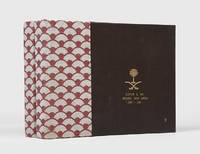
rif. 163098Jeddah: Kingdom of Saudi Arabia Ministry of Defense and Aviation; Lockheed Aircraft International 1983. The Saudi approach is unique Unrecorded institutionally and commercially this attractive set of albums celebrates Lockheed's role in augmenting Saudi Arabia's air traffic control systems both commercial and military over the period 1972-82. They comprise a total of 80 leaves covering summaries of developments "information flow" diagrams for Kaia Riyadh International Dhahran and Jeddah airports colour maps charts and photographs of facilities operatives and aircraft. Writing in Arabian Studies in 1976 aviation expert Elda I. Stifani notes: "By virtue of its geographical position and the strategic economic and political interests of both local and worldwide powers the Middle East plays a major role in civil aviation operations The Saudi approach is unique. No other country in the Arabian Peninsula has an equally determined and precise policy of national aviation development" Arabian Studies III p. 36. Interestingly he also notes that "Bahrain handles air traffic for all the UAA United Arabian Airlines Qatar part of Oman of Kuwait and of Saudi Arabia Dhahran". In March 1974 the Saudi airline Saudia ordered two of Lockheed's new TriStar airliners specially fitted with increased wing fuel tankage. By 1978 Saudia had increased its fleet of TriStars to thirteen. Provenance: presented to Clifford G. Fay of Lockheed Saudi Arabia 1980-82 with his name and dates of service on the front covers. Loosely inserted is a typed letter from Lockheed to Fay presenting the volumes and mentioning that they have been supplied by Joe Akers who was a Lockheed veteran with 28-years' experience at the company retiring as chairman in 1988 26 June 1983 Jeddah letterhead in English and Arabic. 2 vols landscape quarto 235 x 320 mm. With 80 sheets presented recto and verso in clear plastic pockets. Original ring binders fan-patterned cloth spines brown morocco-grain faux leather sides upper covers and front flaps with gilt arms of Saudi Arabia. Cloth sides just a little rubbed tear to first pocket in vol. II not affecting image minor creasing to presentation letter. An excellent set. Elda I Stifani "Civil Aviation in the Gulf: The Role of Commercial Interests in the Issue of Traffic Rights" Arabian Studies III 1976. hardcover
8vo. (2), 6, 637, (3) pp. Contemporary full red morocco on 4 raised bands with giltstamped spine, covers with ornamental blindstamps and gilt rules; leading edgesgilt, inner dentelle gilt. All edges gilt. Luxuriously bound Turkish New Testament, newly translated from the Greek by the German-born William Gottlieb Schauffler (1798-1883). This is the first Constantinople-printed complete New Testament in Osmanli Turkish ever printed in Arabic characters: previous editions had been printed in Greek or Armenian characters only. - "Ordained a missionary [..., Schauffler] reached Constantinople in 1833. His linguistic gifts and missionary experience fitted him for translation-work [...] In 1858 the British and Foreign Bible Society commissioned him to transcribe into Arabic character W. Goodell's Armeno-Turkish version of the Bible, slightly adapting it to meet the needs of the Moslems. When this proved impracticable, he was authorised to make an independent version in simple, idiomatic Osmanli" (Darlow/M., p. 1641). - This copy was bought in Constantinople on 9 August 1879 by J. Gies for 25 silver piastres, as noted by the collector in ink on the title-page. Later in the library of by Karl Schäffeler (his ownership, dated 20 Sept. 1927, on the flyleaf and his bibliographical note on the pastedown). - Occasional light browning, but a well-preserved, pretty copy. Darlow/Moule 9488. Özege 10984. OCLC 42824525
Oblong small folio (238 x 320 mm). Photo album with 197 albumen prints, mounted between 3 and 6 per page on 49 cardboard leaves. Various sizes, typically 70 x 100 mm. Some larger small-format panoramas. Captioned in ink. Contemporary full cloth with handwritten title-label. An interesting album recording the construction of new British military barracks at Abbassia, Cairo, shortly before World War I. Compiled by James Frazer Annan (1887-1957), a British engineer working for the contractor Henry Lovatt Ltd. in Abbassia between 1910 and 1913. Some 40 photographs depict construction at its various stages, showing workers and equipment, including a concrete mixer, details of walling blocks, column caps and shells, scaffolding, and a consignment of cement, as well as a panoramic view of the construction site from July 1910. - Other images show memorable events including the coronation ceremonies for King George V in 1911, Lord Kitchener presenting prizes at a Rifle Meeting, and the Mahmal passing through Cairo during the annual pilgrimage to Mecca. City views of Cairo and Heliopolis, street scenes "in the Mousky district" and "among the Bazaars", the Eshekieh Gardens, the Pyramids, the Nile barrage and dam, tombs of the Khalifs and "typical Mosque tombs": A few more personal scenes such as Christmas dinner 1910 and a picture of baby "James junior" complete this appealing collection. - Occasional light spotting and duststaining. Provenance: Peter Johnstone, whose paternal grandmother, Elsie Amelia Johnstone, was housekeeper to James Frazer Annan. Peter Johnstone numbered the pages and loosely inserted an autograph description of the album, dated 13 May 1996.
Small folio (227 x 294 mm). (6), 113, (1) pp. With Allenby's portrait frontispiece on cloth and 56 coloured maps (facing explanatory texts printed on versos). Original printed wrappers with printed cloth spine. First edition, edited by Harry Pirie-Gordon as a souvenir album: an account of the 1917-19 campaign in the Middle East. Contains two reports written by T. E. Lawrence, "Sherifian Co-Operation in September" and "Story of the Arab Movement", in which he details the Ashraf contribution to the War effort and narrates his own involvement in a third-person report. - Rubbed and stained, with occasional edge flaws. Endpapers have pencil ownership of O. A. Holstius, attached to Headquarters, 19th Brigade, Royal Field Artillery. Loosely inserted is a typed extract from "The Honourable Artillery Company in the Great War, 1914-1919" by George Goold Walker (1930), detailing living conditions in the Jordan Valley during the Great War (torn and frayed at edges). O'Brien A011.
8vo. (26), 237 pp., final blank. Title within double-ruled border. 19th century half calf over marbled boards with giltstamped spine and spine label. Marbled endpapers. Very scarce English translation of this popular chronicle of the 8th-century Moorish invasion of Spain, purportedly translated from an Arabic manuscript that the Moorish apologist and interpreter Miguel de Luna claimed to have found in the Escorial library, but in fact a work of historical fiction of his own composition. Originally issued as "La verdadera hystoria del Rey Don Rodrigo" in two parts (in 1592 and 1600), the present edition, which encompasses only the first part (a second volume announced in the publisher's letter "To the reader" was never published), is the third one in English, following that of Robert Ashley in 1627 and the slightly more common edition published by Leach in 1687. Further translations appeared in French and Italian. It was not until almost a century after its publication that de Luna's book was discovered to be a literary forgery, and even today it remains important as a sympathetic account of the Moorish conquest of Spain. - Binding insignificantly rubbed. Occasional very light foxing; title-page slightly trimmed at foot affecting border. A tiny rust-hole to I5 and a larger tear to K8. Provenance: Handwritten ownership of the Revd. Thomas Watkins (1761-1829), F.R.S., of Pennoyre, Breconshire (dated 1806) to p. 1. Later in the library of the art collectors Howard and Linda Knohl at Fox Pointe Manor, California, with their bookplate to front pastedown. Rare; a single copy in auction records. Palau 144.080. Wing L3484C.
1989Mineral Resources Bulletins Nos. 1, 4, 7-9, 12-29. Includes maps and diagrams. Professional Papers Nos. PP-1-3. Mineral Resources Research 1967-68. All in their original printed green wrappers or full cloth bindings. Extensive collection of rare geologic Bulletins issued by the Saudi Ministry of Petroleum and Mineral Resources (Directorate General of Mineral Resources; after 1980: Deputy Ministry for Mineral Resources), spanning two decades from the mid-1960s to the mid-1980s. Wants merely issue 5/6 and the slim issues 10-11, as well a a final vol. of bibliography (no. 3 was never published). Includes the "Professional Papers" periodical published from 1982 onwards (all three issues published) and the "Mineral Resources Research" volume for 1967/68. - Very clean and well-preserved throughout.