4.497 Ergebnisse
4to. XV, 332 pp. Published as a typescript printed on one side. Original cloth. An invaluable collection of primary source documents, mostly in English (a few in French), related to international relations and the Middle East. The volume is composed as an aid to students at Columbia University, using documents available from that library only, covering nearly every nation in the Middle East and their relations with European nations. Topics include the texts of commercial and territorial treaties (including regarding the Dardanelles and Bosporus straits), Napoleon's proclamation to the Egyptians, territorial negotiations, proclamations of goodwill and protection of foreign merchants, the Suez Canal concession, regulations for colonies in the region, the Baghdad railroad, the mandate for Palestine, World War I and World War II regional restructuring discussions, etc. Most documents are from the 19th and 20th centuries, with the earliest being "Capitulation with France of February 1535", and the most recent, "Nationalization of the Oil Industry in Iran, 2-30 May 1951." A brief commentary is provided before each document describing context and significance. These papers represent an enormously important work for scholars, students, historians and diplomats, bringing together, as they do, such core reference material. In 1956, Hurewitz would expand this collection to the two-volume publication "Diplomacy in the Near and Middle East: a documentary record". - J. C. Hurewitz (1914-2008) did his graduate work at Columbia, making what was then an unusual decision to concentrate on the Middle East. He worked for the Near East section of the OSS during World War II, then worked successively at the State Department, as a political adviser on Palestine to the President’s cabinet and for the UN secretariat. As a Professor, Hurewitz began studying Middle Eastern politics in 1950, before the field had emerged as an academic discipline. From 1970 until his retirement in 1984, he was director of Columbia's Middle East Institute. - Handwritten ownership (dated Washington, October 1952) on half-title; later in the collection of the professor of oriental studies and Brandeis librarian Miroslav Krek (1924-2014), with his ownership stamp on the reverse. OCLC 5749457.
4to. (8), 190, (4) pp. With the academy's woodcut device on the title-page (incorporating the Portuguese coat-of-arms, Athena's owl and Hermes's staff). Set in roman, italic and Arabic types. Modern green morocco, gold-tooled spine with a red morocco spine label with title in gold and the imprint in gold at the foot of the spine, marbled endpapers. First and only edition of a collection of letters written in Arabic during the reigns of Kings Manuel I and João III of Portugal (numbered 1-58 in chronological order, the dated letters from 1503 to 1528), from the official Portuguese state correspondence, with the original Arabic and a parallel Portuguese translation. The letters came from North Africa, the Gulf, East Africa, India and the East Indies. The writers include kings, princes, governors, wazirs, sheikhs and noblemen, including Kings "Mahomed Xáh" and "Mir Abanasar" of Ormus, King "Azarkam" of Barus in Sumatra, and kings of Fez, Malindi and Calicut/Kozhikode. They are especially important for the light they shed on Portugal's East Indian trade, but also provide a rare primary source of information about Islamic leaders for whom little documentation has survived. The original Arabic appears in the inside columns with the Portuguese translation in the outside columns, and the apparatus and notes are in Portuguese. João de Sousa (1734-1812), born in Damascus, came to Portugal in 1750 and was appointed the first professor of Arabic at the University of Lisbon. - The Royal Printing Office in Lisbon had used the present Arabic type in 1774 for Antonio Baptista, Instituições da lingua Arabica. The form of the Arabic type may have been influenced by Robert Granjon's of this size, cut in 1586, his smallest Arabic, which was at this time in possession of the Propaganda Fide in Rome, but the direct model and the circumstances of the cutting remain unknown. The type here measures 96 mm/20 lines (14 point). It is not the Arabic type acquired by the Biblioteca Real in Madrid in 1751 for the 1760 Bibliotheca Arabico-Hispana, which came from the Voskens and Clerk foundry in Amsterdam. - The first page of the first letter is very slightly soiled, otherwise internally fine and clean. Overall in very good condition. A remarkable primary source for numerous Arabic-speaking leaders and their relations with Portugal in the early 1500s. Macro 2098. Palau 320779. Schnurrer 186. Innocêncio IV, 41-42. Palha 2777. Krek, Typographia Arabica, p. 36, no. 3. Streit XVII, 6441. Not in Blackmer or Atabey.
Folio (ca 350 x 225 mm). Portuguese manuscript on paper. 1 p. Very rare document of colonial history and the history of Portuguese and British abolitionism: a certificate of appointment of Carlos Eugenio Correa da Silva as Commissioner for the Prevention of the Slave Trade on the African West Coast. - In accordance with the Anglo-Portuguese Treaty on the Abolition of Slave Trade of 3 March 1842, Correa da Silva, commander of the brig "Pedro Nunes", was appointed by order of the Portuguese King as commissioner for the suppression of the slave trade on the African west coast ("encarregado de evitar o tráfico da escravatura na costa occidental de África") and was authorized to stop and search suspicious Portuguese and English ships ("para visitar e dar busca às embarcações mercantes portuguezas e inglezas que sejam suspeitas com fundamentos razoaveis de se empregarem em transportar negros para o fim de os reduzir a escravidão, ou de terem sido equipadas com esse intento, ou de terem assim sido empregadas durante a viagem [...] tudo na conformidade do tratado de 3 de Julho de 1842 concluido entre as coroas de Portugal e da Grã Bretanha, para a kompleta abolição do tráfico da escravatura, o qual tratado o mesmo Primeiro Tenente, Commandante do dito Brigue, deverá exactamente observar [...]"). - Includes: Instructions of the Naval Headquarters (ca. 385 x 240 mm, 3 pp.; spotty, small holes in margins) for Correa da Silva, issued by the General Commander of the Portuguese Navy, Francisco Visconde Soares Franco (1810-85), with instructions for the passage to Luanda, where Correa da Silva had to take over the "Estação Naval d'Angola" from the former Commander Caetano Alexandre de Almeida e Albuquerque (1824-1916, Governor of Cape Verde, Governor General of Angola and Portuguese India) in accordance with the guidelines for the prevention of the slave trade ("instruções ... relativos à supressão do tráfico da escravatura"). - Carlos Eugénio Correia da Silva, Count of Paço d'Arcos (1834-1905), a friend of King Luis I of Portugal, whom he succeeded as commander of the brig "Pedro Nunes", later became commander of the Portuguese Navy, governor general of Portuguese India, Macao and Mozambique, as well as civil governor of Lisbon and was the first Portuguese ambassador to Brazil. He had already recommended himself for this position in 1864 by the capture of the Spanish slave trader "Virgen del Refugio". The Anglo-Portuguese treaty to abolish the slave trade was signed on 3 July 1842 by the Portuguese foreign minister, the Duke of Palmela, and the British ambassador Baron Howard de Walden, and Portugal subsequently made great efforts to implement this treaty.
4to. 1 p. on bifolium. A unique account documenting the restoration of Turko-French relations after Napoleon's campaign in Egypt and Syria between 1798 and 1801, describing how several unspecified objects confiscated during the campaign were returned by the Ottoman press to the French. Fleurat, who served as chancelier provisoire to the French legation, here reports that he was accompanied by the orientalist and linguist Jean-Daniel Kieffer (1767-1833), who counter-signs the document, to the Aynalikavak palace in Istanbul. Here they were handed over the items by Müderris Abdurrahman Efendi, the first manager of the Mühendishane printing house (opened in Istanbul in 1797, the house that would publish the famous Cedid Atlas in 1803). The objects, Fleurat reports, were then transported to the French embassy for safekeeping. His account also mentions that the diplomat Jacques Argyropoulo, appointed by Ibrahim (Müteferrika) Effendi, the pioneer of printing in the Muslim world, was present at the handover, and refers to a list of the received objects which has probably not survived. - From the collection of the Turkish author, journalist, and publisher Sevket Rado (1913-88), founder of "Tifdruk" printing house. - Small tears to the left and right margins along the centrefold, not touching the text; a few minor edge flaws.
Italian manuscript on vellum (445 x 160 mm). Written space ca. 270 x 140 mm. In a fine cursive handwriting by two hands. Written by a notary public of the Much Serene Republic of Venice: a statement of debt for 3,300 ducats owed to the main commissioner of Venice by the gentleman Francesco Marcello, for the collection of custom taxes in Damascus. The creditor renounces all other claims, and the debt is to be paid in annual instalments of 300 ducats, beginning the year following the drafting of this document, but after a deposit has been paid the following month: "Parendo debitor ser Thadio Polo del Cothimo de Damasco et general de la soria de certa suma de denari, de i qual ser Francesco Marcello se ne chiama piezo: et per i magnifici siori de le raxon vechie el fo sententiando volontarie in ducati tremillia et trexento per parte. Et perchè per le grande sue adversità come publicamente ognuno intende, non è possibele che senza qualche axeveleza el possi pagar et essendo visto et cognossudo questo per li comessi del dicto Cothimo, misier Francesco Falier, misser Zuan Bembo et misser Benedeto Sanudo, azoché scorando el tempo senza qualche conclusion de haverse con qualche habilità a pagar per nome del dicto Cothimo sono venuti a questa ultima conclusion et acordo chel dicto ser Francesco se chiama come piezo debitor per resto de tute raxon de Cothimo, et de le uxure seguide computando la sententia tolta ut supra de ducati tremillia et trexento da esser pagadi per el dicto ser Francesco ducati trexento alanno et sia obligato dar bona et sufficiente piezarìa over caution de paga in paga. Et comenza el tempo anno uno da poi concluso tal acordo: et die mexe uno da poi tal acordo dar dicta piezarìa over caution, et cussi de paga in paga fin integra satisfatction havendoli isoproducti per nome del Cothimo a pregar Carta de Segurtà de non li haver ni poder altro domandar [...]". Immediately underneath this statement is a confirmation by the Damascus consul, ser Giovanni Mocenigo, of the obligation to pay the sum of 3,300 ducats in 11 annual instalments, by the Venetian gentleman Francesco Marcello and his son. - A remarkable early Renaissance document concerning a legal agreement set up by the three commissioners of the council of the Venetian court known as "Quarantia Civil Vecchia", commissioned to oversee the correct collection of the customs tax which was to be paid by merchants on goods imported from or exported to Egypt and Syria. - Perfectly preserved.
Best.-Nr. 375468Pine Valley Clementon County of Camden NJ: Pine Valley Golf Club. Club Seal stamped in blind and signed in print by B.B. Reath Secretary and J. Mathews Brown President. Printed by Security Banknote Company. Oblong folio. Old fold. about fine. Club Seal stamped in blind and signed in print by B.B. Reath Secretary and J. Mathews Brown President. Printed by Security Banknote Company. Oblong folio. Pine Valley Golf Club unknown books
Best.-Nr. 375468Pine Valley Clementon County of Camden NJ: Pine Valley Golf Club. Club Seal stamped in blind and signed in print by B.B. Reath Secretary and J. Mathews Brown President. Printed by Security Banknote Company. Oblong folio. Old fold. about fine. Club Seal stamped in blind and signed in print by B.B. Reath Secretary and J. Mathews Brown President. Printed by Security Banknote Company. Oblong folio. Pine Valley Golf Club unknown
8vo. (8), 164 [recte: 160], (4) ff. Early 20th century half vellum with giltstamped red spine label and marbled blue boards. Edges sprinkled in red. First and only edition (not reprinted until 2004) of this rare and little-received example of the "education of princes" genre, translated into Spanish from an unknown Arabic source. "Francisco de Gurmendi learned Arabic in Madrid at the school of Marcos Dobelo, a Syrian who worked for a time as a translator of the 'plomos'. Gurmendi eventually achieved enough facility with the language to publish 'Doctrina phisica y moral de principes' (Madrid, 1615), a translation of an Arabic text" (A. K. Harris, From Muslim to Christian Granada [Baltimore 2007], p. 170). Recently, the work was the subject of a 2016 doctoral thesis at the University of Alicante: M. I. Llopis Mena, "Teoría política árabe y persa en la corte de Felipe III: la Doctrina Phísica y Moral de Príncipes de Francisco de Gurmendi". - Slight browning; paper flaws to title page (no loss to text). Exceedingly rare; not a single copy in auction records. Palau III, 433. OCLC 804490168.
8vo. (16), (88) pp. With woodcut arms of the Pope on first and engraved arms of Savary de Brèves on final leaf of prelims. Contemporary blindstamped brown full calf with ornamental central and cornerpiece decorations. Marbled endpapers. The first book ever printed with the fine Arabic types of the Roman Typographia Savariana: the first Arabic edition of Robert Bellarmino's catechism, an abridgment of his "Dichiarazione piu copiosa della dottrina christiana" (1598). Translated by the Maronites Vittorio Scialac (d. 1635) and Gabriel Sionita (1577-1648). "Les traducteurs disent qu'ils ont ponctué l'arabe, changé et ajouté quelque chose au texte primitif de Bellarmin, mais avec son consentement. Ce volume rare est le premier publié avec les beaux charactères arabes de Savary" (de Backer/S.). The present copy does not contain the Latin text at all, hence it has only 88 unnumbered pages of text instead of the 171 numbered pages usually cited. This catechism and the Arabic-Latin Psalter produced the following year would remain the only works to leave the Typographia Savariana; the types have survived and are now in the archives of the Imprimerie Nationale in Paris. - Stains and traces of moisture. Old shelfmark labels to spine, cover and final flyleaf; bookplate of the Dutch Jesuit Seminary on final pastedown. Contemp. ms. notes to endpaper. Rare; only two copies in auction records (the last in 1999). Schnurrer 242. Smitskamp, PO 181. De Backer/Sommervogel I, 1188f. OCLC 491559247.
1909Best.-Nr. RO80093851"****. 1909. In-12. Broché. Etat d'usage, Couv. convenable, Dos satisfaisant, Intérieur frais. Ensemble de différents documents : 4 lettres dactylographiées + 6 documents d' ""Avenants"" (Stéphane Blanchy, Courtier Juré d'Assurances) ""Catherine"", """"Correntin"", ""Beluga"", ""Gorgual"", ""Nordeaper"", ""Baleine"". Avec timbres fiscaux. Provenant des Archives d'un Armateur de Pêche à la Morue de Bègles (Gironde - 33).. . . . Classification : 0-Affiches Cinéma"
Large 4to (ca. 210 x 273 mm). XXXII, 392 pp. Unsophisticated modern full calf. Only edition of this rare work on the history of the Ottoman Empire. Includes biographical entries for sultans and other leading figures, topographical references, as well as architectural and religious entries. - Occasionally, illustrated copies containing a frontispiece, plates, plans and maps have been known to appear, but these do not seem to form part of the regular issue but rather were inserted in specially prepared copies, and "neither the British Library nor the Gennadius copies have them" (Atabey). - An untrimmed, wide-margined copy, occasionally a little stained but altogether well preserved, with a 19th century armorial stamp to the title-page. Atabey 2 (extra-illustrated copy). OCLC 35682561. Not in Blackmer.
4to. (4), 552, (2) pp. Contemporary half calf. The first complete New Testament printed by the BFBS entirely in Syriac, edited by Samuel Lee. "The editor based his text upon Schaaf's edition; but he collated an ancient Syriac MS. belonging to Adam Clarke, a MS. from the Lebanon, dated 1523, now at Cambridge, and a third MS. (without vowel-points) brought by Claudius Buchanan from Travancore, as well as the Commentaries of Ephrem Syrus, and also made some use of the collations of R. Jones. The printing of this edition was completed in 1816" (Darlow/M.). This copy has the "extensive obliterations [...] in the section headings, made by means of a stamp and violet ink", which were "made by order of the BFBS Committee, on the ground that the headings contravened the rules of the Society" (ibid.). - Binding rubbed and bumped; occasional marginal scribblings in red crayon (more extensive on p. 5). Traces of worming in the upper margin of the final two leaves overpasted with brown paper. In all a good copy of a rarely seen edition. Darlow/Moule 8979. NUC LVI, 13. BM XVIII, 1449. OCLC 921205405.
4to. (132), 400, (2) pp. Publisher's original giltstamped blue cloth. First critical edition of the famous "Diwan" by the great mediaeval Persian poet Hafez, whose work influenced Goethe as well as Thoreau and Emerson. This publication marks the beginning of modern Hafez philology. - Ink note in Arabic script to title page. A clean copy. OCLC 254557372.
1993Best.-Nr. 35097NY: Villard Books. Fine in Fine dust jacket. 1993. Hardcover. 0394580052 . First printing. INSCRIBED by the author. Also laid in is a hand written note from the author. Fine in a fine dust jacket. . Villard Books hardcover books
4to. 120 (instead of 124), 164, 92 pp. Ottoman Turkish in Arabic type. Contemporary blindstamped full calf with fore-edge flap. First edition. - A miscellancy of the two principal works of the classical Turkish Mevlevi poet known as Sheikh Galib. As merely 506 copies were published, it can be considered the rarest divan book produced by the Bulaq printing house, the first official and governmental printing press in Egypt, founded in 1820. The "Divan" reflects Galib's preoccupation with mystical religious themes, his poems being characterized by highly symbolic language, complex conceits and wordplay, while his magnum opus, the allegorical mathnawi "Hüsn ü Ask" ("Beauty and Love"), consists of 2101 verses with a strong Sufi theme. It tells the tale of two lovers, Hüsn and Ask, and the tribulations imposed on Ask by the elders of their clan, in order to be granted Hüsn's hand in marriage. All names used in the story, including those of characters and places, are Sufi terms. The story is ripe with symbolism and is meant to be taken not literally but for its symbolic meaning: man's journey towards God. - Wants bifolium 10 (pp. 37-40) of the Divan. Vertical crack to spine, heavily rubbed at lower edge, binding loosened in places. Internally well preserved. - A pioneering work of symbolism in Turkish literature. Özege 4233. Bulaq, The Checklist 47. BM 14472, e.29. Cairo FKT 143. DornCO 196. Bulaq MK 9,9. Bianchi CG 49. Ridwan 467.
8vo. XXIV, 213, (1) pp. With 2 folding engraved plates. Contemporary full mottled calf with giltstamped red morocco label to prettily gilt spine. Marbled endpapers. All edges red. First edition thus. Very rare French translation of two essays by the Scottish-born East India Company officer and orientalist Alexander Dow (1735-79), first published within his "History of Hindostan, translated from the Persian of Ferishta" (1768). The present edition omits the text of the world history of Firishta that Dow had presented in his book, giving only his "dissertation concerning the religion and philosophy of the Brahmins" as well as an outline of the then-current state of India, partly taken from Dow's preface. Contains two folding plates, engraved by P. L. Charpentier, showing the Sanskrit alphabet and the metre employed in the Vedas. Re-issued in 1780. - Early 19th century bookseller label of A. Claudin, Paris, pasted head-over-heels to lower pastedown. Binding very attractively preserved. Excepting the Sir Thomas Phillipps copy, sold at Sotheby's in 1977, this is the second copy known in trade records. Lanson III, 8161. OCLC 34570575.
4to. 56 pp. Slightly later papered spine. Very rare sole edition of this detailed study of the Al-Fatihah, the first Surah of the Holy Qu'ran. By the mid-18th century the text of the Qu'ran had become less of a heretical menace to European scholars and more of a document of serious study: the present work focuses on philological subtleties within the various manuscripts of the Qu'ran known to Europeans including Erpenius, Hinckelmann, Wasmuth, and Schiefferdecker. A printed dissertation defended by one of Nagel's students, Jakob Holste, the text presents a word-for-word comparison of two manuscripts of the Al-Fatihah: one in the possession of Nagel himself, and the other of Christoph Fürer von Haimendorf (1541-1610), who had brought a copy back from his visit to the Middle East in 1565. To these are further compared printed editions of Marracio, Hinckelmann, Erpenius, and others. Because no Arab typeface was available in Nuremburg at the time, the author is forced here to write the text of the Al-Fatihah in Hebrew characters (!). The last section of the work gives no less than 17 translations into Latin of the Al-Fatihah drawn from Arabic, Persian, and Turkish. Nagel and his student Holste finally propose a 'perfect' conglomerate translation of the Surah based on their findings. Much space is devoted to the question of whether Al-Fatihah was revealed in Medina or Mecca, and Nagel's discussion of this point even includes topographical details collected from previous authors (cf. pp. 13-15, 31-36). - OCLC shows just a handful of copies in institutions worldwide, including one in America at the University of Chicago. The present copy is deaccessioned from the library of the Ludwig-Maximilian University in Munich with small release stamps on verso of title-page. Printed glosses trimmed closely, with occasional loss of a few letters; otherwise a good copy. Schnurrer 382. Chauvin I, LXI. Not in Enay. Cf also Encyclopedia of the Qu'ran IV, 250.
4to. 32 pp. Modern green morocco. Second edition of this dissertation about the grave of the Prophet Muhammad, first published in 1677, including a description of the location of Mecca (where the grave was believed to be situated) and an account of the Prophet's body being preserved in a box of iron, levitated in mid-air by magnetic forces. - The Danzig-born theologian Samuel Andreae (1640-99) had taught Greek, Philosophy, Rhetorics, and History before settling at the Hessian university of Marburg, where he served as professor of Theology and head of the university library. Several of his academic works offer a historical slant on Biblical topics. The physician Johann Philipp Jordis (1658-1721/25) studied in Utrecht and practised in Frankfurt from 1685 onwards. - Browned throughout due to paper. No copy in America, according to OCLC. VD 17, 12:142174N. OCLC 67857720.
2014140 pages. Glossary. Reproductions of many black and white photos. Clean, bright and unmarked with very light wear. Bit of peeling atop first page where label removed. A nice copy. Book
Manuscript diplomatic letter in Arabic (total sheet approx. 430 x 575 mm), recto with 8 lines of text framed by ruled compartments incorporating penned decoration of stylised foliage and calligraphic seal in green and blue ink heightened with gold, fraying along two old folds with small losses to border, some negligible foxing and light wear to extremities. Decorated in blue and green ink heightened in gold, this diplomatic letter was sent in December 1720 by the fearsome ruler of Morocco Moulay Ismail Ibn Sharif to Charles Stewart, the English ambassador at the head of a mission sent by King George I to negotiate a peace with Morocco. The small squadron sailed from England on 24 September 1720, commanded by Commodore Stewart, who was authorised with the powers of a minister plenipotentiary to negotiate with Moulay Ismail. A treaty of peace between the two countries was signed on January 1721 at Ceuta, the terms securing the release of 296 British slaves, the free movement of British ships in Moroccan waters, and unhindered access for Moroccan ships wishing to trade with Britain. Before the embassy returned to London a conference was held in May 1721 with Pasha Hamet Ben Ali Ben Abdallah. Stewart was accompanied by John Windus, whose important account of the adventure was published as "A Journey to Mequinez" (London, 1725). - Addressed to "the Christian ambassador of the English" (i. e., Stewart), this letter in Arabic offers greetings from Moulay Ismail, followed by a statement acknowledging the English desire for a truce, close friendship and communication with Morocco, and that the potentate of the English (King George I) has despatched the embassy with this in view. Note is made of previous communications through Pasha Hamet Ben Ali Ben Abdallah and Ibn al Attar and that the content has already been ratified and agreed. He hopes that the agreement will be in accord with the expectations of the ambassador and notes the history of friendly diplomatic relations between the English and the kings of Morocco, citing the relationship between his cousin Ahmad Al Mansour (1549-1603) and Queen Elizabeth I. He continues by advising that if it is the ambassador's wish to renew that covenant and treaty and to encourage the relationship between the two countries then he shall in no way oppose it. The layout of the letter with subdivided frames is characteristic of Moroccan chancellery letters of this period (cf. J. F. P. Hopkins, Letters from Barbary 1576-1774: Arabic documents in the Public Record Office, OUP 1982).
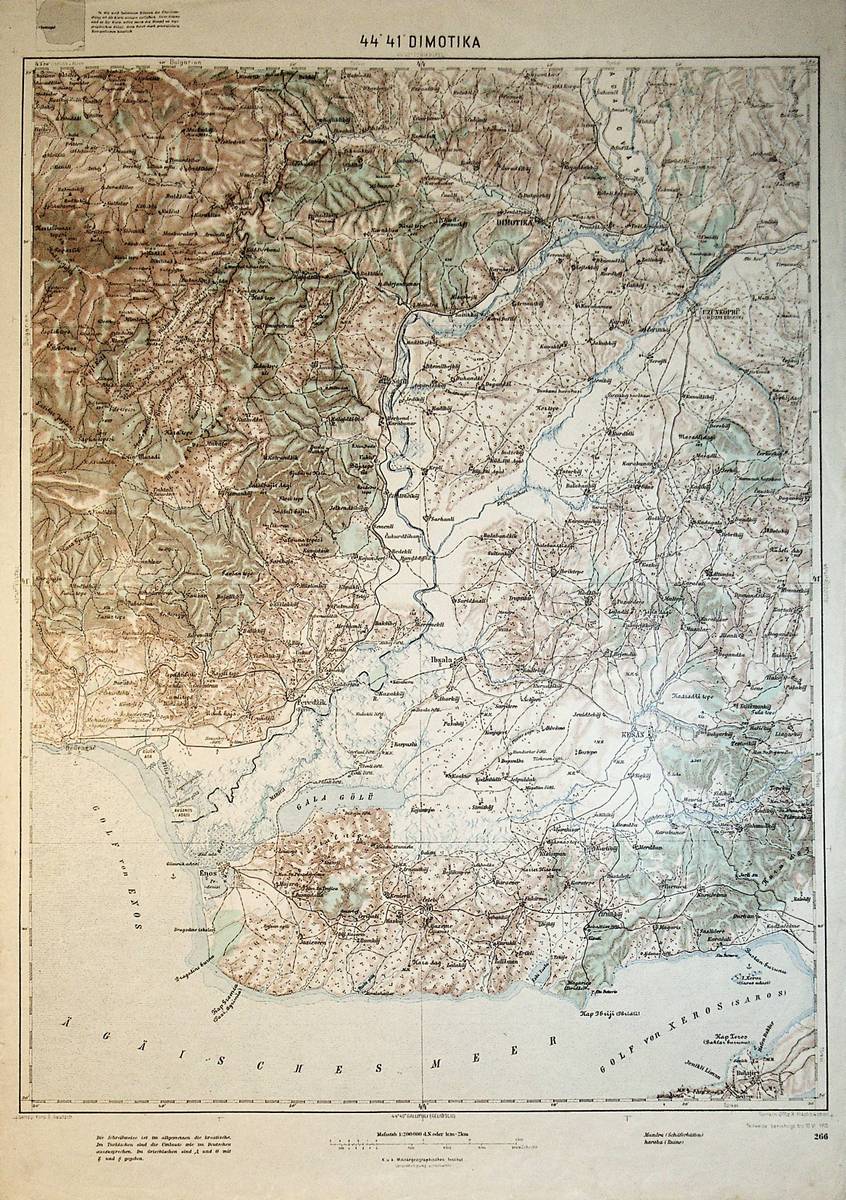
1915Best.-Nr. A111-166Wien, Kaiserlich-K?nigliches Milit?r-Geographisches Institut, 1915. Hochformat, ca. 42 x 55 cm, Ausgabe: mehrf?rbig; Zustand: gut +
1973Best.-Nr. 31304Reinbek (bei Hamburg) : Rowohlt, 1973. 414 S. 94 Ill., graph. Darst. u. Kt. 8°. [Nachaufl.]. OPpbd. ohne SU.
Best.-Nr. 2742calmann levy 1972 in 8 broché 388 pages - illustrations - index
Large 4to (195 x 268 mm). Title and 30 captioned plates, engraved throughout (image size ca 110 x 170 mm). Late 19th century half calf with gilt spine rules and 18th or early 19th c. giltstamped lozenge label on upper cover. Charming, rare suite of engravings showing the costumes of the Turks, including the Sultan and various courtiers of the Porte, Ottoman soldiers and janissaries, an Arabian preacher, a falconer, street salesmen, a porter smoking a long meerschaum pipe, and several Turkish ladies (one in surprisingly revealing attire). - Charles-Francois Silvestre (1667-1738) held the title of "Maître à dessiner du Roi" (Drawing Master to the King) and was in 1695 appointed art instructor to the young Dukes of Burgundy, Anjou and Berry, the grandsons of Louis XIV. The present suite, dedicated to Louis, Duke of Burgundy, reflects the orientalist fashion of its time but is also a highly original work of art demonstrating a vivid, flamboyant style and not apparently based on earlier illustrations. The title and 21 of the plates are signed in full with the Royal privilege: "F. Silvestre inv. et ex. C.P.R.", while eight are simply signed "S." and one ("Janissaire de la garde, Solac ou Pzyc") is not signed, though it is clearly executed in the same style as the others. Uncommon thus with 31 plates including the title: the copies listed by both Hiler and Colas, as well as that in the Gennadius Library at the American School of Classical Studies at Athens, are oblong volumes containing only 30 plates including the title, on a total of 15 leaves (Colas: "titre compris [...] Ces planches sont tirées à deux sur la même feuille"), while the Lipperheide copy comprised a mere 22 plates including the title, making this the most complete set known. - Insignificant browning and fingerstaining, more pronounced in title but on the whole confied to the wide margins. Hiler 799; Colas 2744 (both listing 30 plates including title). Lipperheide Lb 25 (listing title and 21 plates).
8vo. XV, (1), 240 pp. Contemporary half cloth over marbled boards with handwritten title label to spine. First edition. - Lively report of an Austrian horse-buying expedition in Syria, Palestine, and the Palestinian desert, carrious out under the Austrian colonel Rudolf von Brudermann, who was to purchase Arabian horses so as to enhance the stock of the Austrian-Hungarian cavalry. The author Löffler was among the participants of the expedition: his first-hand travelogue describes the itinerary and the local customs as well as the newly acquired horses. - A few contemporary ownership stamps of the Stuttgart Museum's library in blue ink to several pages. King Wilhelm I of Württemberg was a famous enthusiast of Arabian horses: his stud in Marbach, just north of the royal residence of Stuttgart, was the first Arabian stud in Europe. - First and last third slightly waterstained. Boyd/P. 75. Kayser XVI, 45.