Leisure Arts (Editor)Biblio.com

6243 risultati
2013rif. 1-1464715785Leisure Arts 2013. Paperback. New. 48 pages. 11.00x8.50x0.25 inches. Leisure Arts paperback
rif. DADAX3319755285New unknown
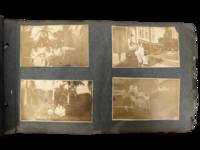
1914rif. 231551914. Caribbean photograph album likely compiled by a person connected to the Panama Canal Zone and the Caribbean documenting how steamship mobility port circulation and U.S. imperial presence linked Jamaica Venezuela Trinidad Barbados Cuba Puerto Rico the Bahamas Florida and Panama in the years after the canal opened. The felt cover lettered "PANAMA" and bearing the Seal of the Canal Zone places the album within the new travel geography created by U.S. control of the Canal Zone and the canal's 1914 opening when Panama became a central hinge between Atlantic and Pacific movement and a major point of contact between North American travelers and Caribbean port cities. Photos show passengers on steamers and docks markets and streets forts and government buildings and repeated encounters between white visitors and Afro Caribbean and mixed-heritage residents across multiple colonial and semi-colonial settings. Panama Canal Zone travel photograph album. Caribbean and circum-Caribbean locations including Kingston Jamaica; La Guaira and Caracas Venezuela; Trinidad; Key West and Palm Beach Florida; Havana Cuba; Barbados; Panama City Balboa and Colón Panama; Nassau Bahamas; and San Juan Puerto Rico. Likely circa mid 1910s to early 1920s. Oblong felt-covered album measuring 6.5" x 11" with "PANAMA" stitched in large letters on the front cover and photographs pasted to grey leaves. Contains more than 160 black-and-white photographs most approximately 2.5 x 4.5 inches many with handwritten captions identifying locations activities and occasional names. The sequence opens in Kingston with captions including "Kingston JA" and "on the steamer" then moves through island and mainland stops; "Port of Spain Trinidad" "Market at Barbados" "Rapid Transit Barbados" "Havana Cuba" "San Juan Porto Rico" "Morro Castle" "Balboa" and "Colon R.P." Repeated figures especially a young college-aged woman and an older woman appear throughout. Notable images include a group of locals in shallow water at Barbados sifting for tossed coins from rowboats; a large crowd scene in San Juan gathered for what appears to be a public speech or civic event; battlements cannon and stone defenses in Havana; vernacular dwellings and children in impoverished conditions in Balboa; posed visitor photographs in what is labeled a "bull ring"; and numerous street dockside market and architectural views that juxtapose local populations with hotels public buildings ruins and newer urban construction. The album's historical force comes from the way it captures the social landscape of Caribbean travel under early twentieth-century U.S. power. After 1914 the Canal Zone intensified Panama's role within a wider American maritime sphere while Caribbean travel increasingly moved through port infrastructures shaped by empire commerce military strategy and tourism; this album records that world at eye level with photographs of docks steamers fortifications government sites public squares and local street life rather than limiting themselves to family snapshots alone. At the same time the images preserve the unequal human encounters built into that system especially where visitors photograph Black children boatmen market crowds and working neighborhoods as part of the travel experience. Felt cover worn and soiled with losses at edges and stitching strain; leaves brittle with chipping and tears; photographs generally present and legible with silvering fading corner wear and occasional losses or lifting. Overall fair to good condition. A substantial early twentieth-century visual record of Canal Zone connected Caribbean travel with dense captioning and wide geographic reach from Jamaica and Barbados to Havana San Juan and Panama. unknown
1914rif. 231551914. Caribbean photograph album likely compiled by a person connected to the Panama Canal Zone and the Caribbean documenting how steamship mobility port circulation and U.S. imperial presence linked Jamaica Venezuela Trinidad Barbados Cuba Puerto Rico the Bahamas Florida and Panama in the years after the canal opened. The felt cover lettered "PANAMA" and bearing the Seal of the Canal Zone places the album within the new travel geography created by U.S. control of the Canal Zone and the canal's 1914 opening when Panama became a central hinge between Atlantic and Pacific movement and a major point of contact between North American travelers and Caribbean port cities. Photos show passengers on steamers and docks markets and streets forts and government buildings and repeated encounters between white visitors and Afro Caribbean and mixed-heritage residents across multiple colonial and semi-colonial settings. Panama Canal Zone travel photograph album. Caribbean and circum-Caribbean locations including Kingston Jamaica; La Guaira and Caracas Venezuela; Trinidad; Key West and Palm Beach Florida; Havana Cuba; Barbados; Panama City Balboa and Colón Panama; Nassau Bahamas; and San Juan Puerto Rico. Likely circa mid 1910s to early 1920s. Oblong felt-covered album measuring 6.5" x 11" with "PANAMA" stitched in large letters on the front cover and photographs pasted to grey leaves. Contains more than 160 black-and-white photographs most approximately 2.5 x 4.5 inches many with handwritten captions identifying locations activities and occasional names. The sequence opens in Kingston with captions including "Kingston JA" and "on the steamer" then moves through island and mainland stops; "Port of Spain Trinidad" "Market at Barbados" "Rapid Transit Barbados" "Havana Cuba" "San Juan Porto Rico" "Morro Castle" "Balboa" and "Colon R.P." Repeated figures especially a young college-aged woman and an older woman appear throughout. Notable images include a group of locals in shallow water at Barbados sifting for tossed coins from rowboats; a large crowd scene in San Juan gathered for what appears to be a public speech or civic event; battlements cannon and stone defenses in Havana; vernacular dwellings and children in impoverished conditions in Balboa; posed visitor photographs in what is labeled a "bull ring"; and numerous street dockside market and architectural views that juxtapose local populations with hotels public buildings ruins and newer urban construction. The album's historical force comes from the way it captures the social landscape of Caribbean travel under early twentieth-century U.S. power. After 1914 the Canal Zone intensified Panama's role within a wider American maritime sphere while Caribbean travel increasingly moved through port infrastructures shaped by empire commerce military strategy and tourism; this album records that world at eye level with photographs of docks steamers fortifications government sites public squares and local street life rather than limiting themselves to family snapshots alone. At the same time the images preserve the unequal human encounters built into that system especially where visitors photograph Black children boatmen market crowds and working neighborhoods as part of the travel experience. Felt cover worn and soiled with losses at edges and stitching strain; leaves brittle with chipping and tears; photographs generally present and legible with silvering fading corner wear and occasional losses or lifting. Overall fair to good condition. A substantial early twentieth-century visual record of Canal Zone connected Caribbean travel with dense captioning and wide geographic reach from Jamaica and Barbados to Havana San Juan and Panama. unknown books
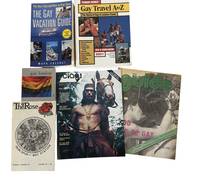
1978rif. 211511978. Gay travel guides published between 1978 and 2002 document the development of LGBTQ social spaces and travel networks during the late twentieth century. Printed guides of this kind served as practical tools for gay and lesbian travelers seeking safe environments and community venues in cities and tourist destinations. At a time when many establishments serving LGBTQ patrons were not openly advertised in mainstream publications specialized travel guides compiled addresses telephone numbers and descriptions of bars restaurants hotels gyms clubs and other gathering places. Today these publications provide valuable documentation of LGBTQ cultural geography preserving records of venues and community spaces that often operated informally and have since disappeared. Archive contains six travel guides and magazines published between 1978 and 2002 documenting LGBTQ travel destinations and social venues in North America and Europe. The publications include directories of establishments travel advice and descriptions of cities known for active LGBTQ communities. Many listings include addresses telephone numbers and brief descriptions of businesses catering to gay and lesbian travelers. 1 Ciao! The World of Gay Travel. New York: QQ Publications 1978. 54 pages. Early international gay travel magazine featuring destinations including Canada Malaysia El Salvador and Morocco with numerous listings for cafes bars restaurants and other venues. 2 The Rose. Vol. 1 No. 15. 1980. 43 pages. Travel and lifestyle guide focused on Southern California with listings for gay and gay friendly bars restaurants clubs gyms and entertainment venues. 3 The Guide to Gay New England. Boston: The Haymarket 1987. 70 pages. Travel guide covering New England destinations including cities such as Providence and Manchester as well as established resort communities including Provincetown. 4 Gay London: A Guide. London: Ellipsis 1999. Guide to LGBTQ nightlife and community spaces in London including bars clubs bookstores and cafes. 5 Ferrari Guides: Gay Travel A to Z. Phoenix: Ferrari International Publications 2001. 160 pages. Directory style guide listing United States destinations with entries for bars tour operators bathhouses and related venues. 6 Chesnut Mark. The Gay Vacation Guide: The Best Trips and How to Plan Them Revised and Updated. New York: Kensington Books 2002. 212 pages. Travel planning guide featuring information on resorts cruises tours and seasonal destinations popular among LGBTQ travelers. Together these publications illustrate the growth of LGBTQ tourism and the increasing visibility of queer social networks during the late twentieth century. Travel directories such as these helped connect travelers with welcoming venues and contributed to the development of identifiable LGBTQ neighborhoods and resort destinations. The guides also preserve historical records of establishments that have since closed making them useful sources for studying the geography of LGBTQ culture and nightlife. Volumes remain clean and well preserved with light handling wear. Very good condition overall and a representative group of late twentieth century LGBTQ travel publications. unknown
1978rif. 211511978. Gay travel guides published between 1978 and 2002 document the development of LGBTQ social spaces and travel networks during the late twentieth century. Printed guides of this kind served as practical tools for gay and lesbian travelers seeking safe environments and community venues in cities and tourist destinations. At a time when many establishments serving LGBTQ patrons were not openly advertised in mainstream publications specialized travel guides compiled addresses telephone numbers and descriptions of bars restaurants hotels gyms clubs and other gathering places. Today these publications provide valuable documentation of LGBTQ cultural geography preserving records of venues and community spaces that often operated informally and have since disappeared. Archive contains six travel guides and magazines published between 1978 and 2002 documenting LGBTQ travel destinations and social venues in North America and Europe. The publications include directories of establishments travel advice and descriptions of cities known for active LGBTQ communities. Many listings include addresses telephone numbers and brief descriptions of businesses catering to gay and lesbian travelers. 1 Ciao! The World of Gay Travel. New York: QQ Publications 1978. 54 pages. Early international gay travel magazine featuring destinations including Canada Malaysia El Salvador and Morocco with numerous listings for cafes bars restaurants and other venues. 2 The Rose. Vol. 1 No. 15. 1980. 43 pages. Travel and lifestyle guide focused on Southern California with listings for gay and gay friendly bars restaurants clubs gyms and entertainment venues. 3 The Guide to Gay New England. Boston: The Haymarket 1987. 70 pages. Travel guide covering New England destinations including cities such as Providence and Manchester as well as established resort communities including Provincetown. 4 Gay London: A Guide. London: Ellipsis 1999. Guide to LGBTQ nightlife and community spaces in London including bars clubs bookstores and cafes. 5 Ferrari Guides: Gay Travel A to Z. Phoenix: Ferrari International Publications 2001. 160 pages. Directory style guide listing United States destinations with entries for bars tour operators bathhouses and related venues. 6 Chesnut Mark. The Gay Vacation Guide: The Best Trips and How to Plan Them Revised and Updated. New York: Kensington Books 2002. 212 pages. Travel planning guide featuring information on resorts cruises tours and seasonal destinations popular among LGBTQ travelers. Together these publications illustrate the growth of LGBTQ tourism and the increasing visibility of queer social networks during the late twentieth century. Travel directories such as these helped connect travelers with welcoming venues and contributed to the development of identifiable LGBTQ neighborhoods and resort destinations. The guides also preserve historical records of establishments that have since closed making them useful sources for studying the geography of LGBTQ culture and nightlife. Volumes remain clean and well preserved with light handling wear. Very good condition overall and a representative group of late twentieth century LGBTQ travel publications. unknown books
rif. 19494Paris, Maradan, 1803-1806. 4 vol. in-12, VIII-VIII-247-[1] pp. 1 pl. + [4]-306 pp. 1 pl. + XIV-349 pp. 1 pl. + XX-336 pp. 1 pl., bradel de de mi-toile brune, dos long orné du titre doré (quelques rousseurs et taches, pâle mouillure à la gravure et au titre du 2e vol.)
rif. 23678Genève, Oscar Buess, [1917]. In-4 oblong, 65 pp. 48 pl., broché, cartonnage à dos de toile de aubergine (cartonnage défraîchi, dos décollé, quelques rousseurs et taches).
rif. 17255Paris, chez tous les libraires, 1860. In-12, 188 pp., 1 pl., maroquin rouge, dos à nerfs, titre doré au dos, tête dorée, couverture conservée (quelques petites déchirures, couverture défraîchie, rousseurs, pâles mouillures, restaurations du papier).
rif. DADAX0415200989New unknown
1888rif. 109730Paris, C. Marpon et E. Flammarion 1888 Ensemble de 2 volumes. In-4 26 x 16,5 cm. Reliures demi-maroquin rouille à coins, dos à 5 nerfs, titres et dates dorés au dos, têtes dorées, couvertures conservées. Vol. I : Les Femmes de sport. Préface par Henri Houssaye et Lettre de Catulle Mendès, [3] ff., IX pp., [1] ff., VI pp., [1] ff., 187 pp., [2] ff., 22 gravures et vignettes in-texte. édition originale. Tirage à 500 exemplaires numérotés, celui-ci, un des 464 sur papier de Hollande justifié “Au Bon de Vaux” - Vol. II : Les Hommes de sport. Préface par Alexandre Dumas. [4] ff., XXI pp., [1] ff., 336 pp., 18 portraits hors-texte gravés sur Chine, vignettes dans le texte. édition originale. Tirage à 500 exemplaires numérotés, celui-ci, un des 463 sur papier de Hollande. Très bel ensemble. Reliures légèrement frottées, intérieur et planches d’une grande fraîcheur.
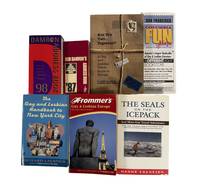
1987rif. 209821987. Damron Bob Lindsy Van Gelder Pamela Robin Brandt Hanns Ebensten and others archive of seven travel publications and related materials dating from 1987 to 2003 documents the development of queer travel infrastructure and the circulation of information necessary for LGBTQ individuals to navigate public space safely in the late twentieth century. Produced during and after the AIDS crisis these guides provided listings of bars hotels medical resources and social organizations at a time when visibility and safety varied widely by region. The publications extend a tradition of minority travel guides comparable in function to The Negro Motorist Green Book offering practical tools for identifying supportive environments and avoiding hostile ones. Early editions of the Damron guides compiled through firsthand travel by Bob Damron established a model for cataloging queer friendly spaces across North America and beyond while later publications expanded coverage to Europe and incorporated broader cultural and political resources. Archive of seven items comprising five travel guides one fold out map and one volume of travel writing published between 1987 and 2003. Items include: 1 Damron Bob. Damron Address Book. San Francisco 1987. Approximately 3 x 6 inches. Contains over 6000 listings across the United States Canada and Mexico with extensive coverage of U.S. locations. 2 Van Gelder Lindsy and Pamela Robin Brandt. Are You Two.Together A Gay and Lesbian Travel Guide to Europe. 1991. Approximately 345 pages. Covers accommodations dining and travel sites across multiple European countries. Signed by both authors. 3 The Gay and Lesbian Handbook to New York City. 1994. Approximately 277 pages. Includes listings for cultural venues social organizations and medical resources including AIDS related services. 4 Columbia Fun Maps: Mapping the Gay and Lesbian World. San Francisco 1995. Fold out map with directory of businesses and resources in San Francisco. 5 Damron Bob. Damron Address Book. 1998. Expanded edition with hundreds of pages of listings across North America the Caribbean and Europe. 6 Ebensten Hanns. The Seals on the Icepack and More Gay Travel Adventures. 1999. Signed and inscribed. Travel narratives documenting experiences in multiple global locations. 7 Frommer's Gay and Lesbian Europe. 2003. Comprehensive guide to travel across the United Kingdom and continental Europe. These materials document how LGBTQ travelers relied on print networks to construct routes of movement community and safety prior to the widespread availability of digital resources. The guides reveal the geographic distribution of queer spaces the integration of medical and social support listings during the AIDS crisis and the expansion of international travel opportunities in the late twentieth century. Ebensten's travel writing provides a narrative counterpart to directory based guides offering firsthand accounts that complement the logistical frameworks of the other publications. Together the archive provides evidence of how queer communities mapped social belonging across cities and nations contributing to the study of LGBTQ history tourism and spatial politics. Light handling wear across volumes with typical age toning; overall clean and stable. Overall very good condition. unknown
1987rif. 209821987. Damron Bob Lindsy Van Gelder Pamela Robin Brandt Hanns Ebensten and others archive of seven travel publications and related materials dating from 1987 to 2003 documents the development of queer travel infrastructure and the circulation of information necessary for LGBTQ individuals to navigate public space safely in the late twentieth century. Produced during and after the AIDS crisis these guides provided listings of bars hotels medical resources and social organizations at a time when visibility and safety varied widely by region. The publications extend a tradition of minority travel guides comparable in function to The Negro Motorist Green Book offering practical tools for identifying supportive environments and avoiding hostile ones. Early editions of the Damron guides compiled through firsthand travel by Bob Damron established a model for cataloging queer friendly spaces across North America and beyond while later publications expanded coverage to Europe and incorporated broader cultural and political resources. Archive of seven items comprising five travel guides one fold out map and one volume of travel writing published between 1987 and 2003. Items include: 1 Damron Bob. Damron Address Book. San Francisco 1987. Approximately 3 x 6 inches. Contains over 6000 listings across the United States Canada and Mexico with extensive coverage of U.S. locations. 2 Van Gelder Lindsy and Pamela Robin Brandt. Are You Two.Together A Gay and Lesbian Travel Guide to Europe. 1991. Approximately 345 pages. Covers accommodations dining and travel sites across multiple European countries. Signed by both authors. 3 The Gay and Lesbian Handbook to New York City. 1994. Approximately 277 pages. Includes listings for cultural venues social organizations and medical resources including AIDS related services. 4 Columbia Fun Maps: Mapping the Gay and Lesbian World. San Francisco 1995. Fold out map with directory of businesses and resources in San Francisco. 5 Damron Bob. Damron Address Book. 1998. Expanded edition with hundreds of pages of listings across North America the Caribbean and Europe. 6 Ebensten Hanns. The Seals on the Icepack and More Gay Travel Adventures. 1999. Signed and inscribed. Travel narratives documenting experiences in multiple global locations. 7 Frommer's Gay and Lesbian Europe. 2003. Comprehensive guide to travel across the United Kingdom and continental Europe. These materials document how LGBTQ travelers relied on print networks to construct routes of movement community and safety prior to the widespread availability of digital resources. The guides reveal the geographic distribution of queer spaces the integration of medical and social support listings during the AIDS crisis and the expansion of international travel opportunities in the late twentieth century. Ebensten's travel writing provides a narrative counterpart to directory based guides offering firsthand accounts that complement the logistical frameworks of the other publications. Together the archive provides evidence of how queer communities mapped social belonging across cities and nations contributing to the study of LGBTQ history tourism and spatial politics. Light handling wear across volumes with typical age toning; overall clean and stable. Overall very good condition. unknown books
1830rif. 2859Paris, Veuve TURGIS, sans date (circa 1830). Dimensions : 64 x 47 cm. Gravure collée sur carton. Rarissime grand jeu de l’oie napoléonien, gravé sur papier vergé et contrecollé sur carton pour former un plateau dépliant, qui retrace les événements de la vie du consul, puis de l'empereur Napoléon Ier, notamment les célèbres batailles. Il est composé de 63 cases qui mènent les joueurs jusqu’à la Colonne Vendôme, érigée entre 1806 et 1810 pour commémorer la bataille d'Austerlitz. Case 1 : « Allocution de Napoléon » - Case 63 : « Ah qu’on est fière (sic) d’être français quand on regarde la Colonne ». Les cases du jeu où se trouvent habituellement les oies sont occupées par des aigles impériaux accompagnés de la devise « La Gloire fut toujours son guide. ». Henri René D'ALLEMAGNE, Le Noble Jeu de l'Oie en France, de 1640 à 1950, p. 215.
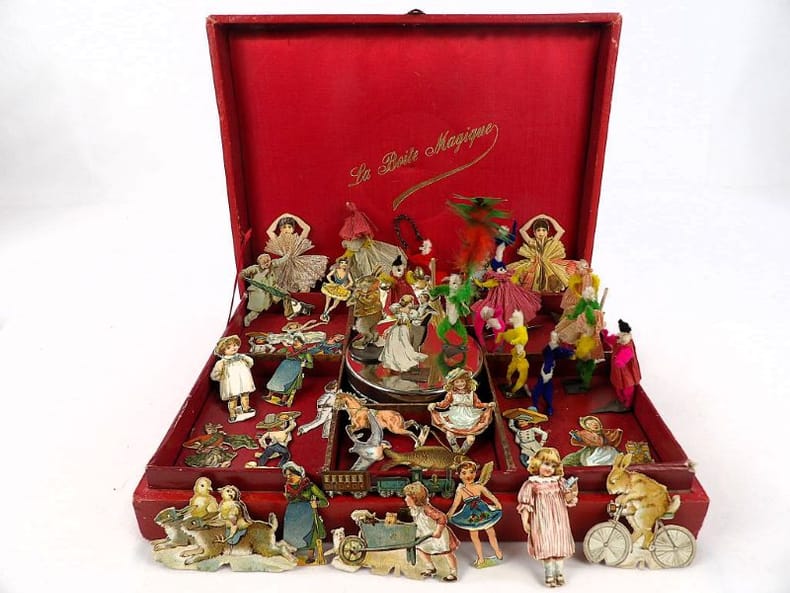
1906rif. 2854Paris, K-B (Kratz-Boussac), circa 1906. 26,5 x 20 x 5 cm. Boîte recouverte de papier rouge. Titre doré sur le couvercle. La Boîte Magique est un jouet magnétique créé à l'origine par Abraham Martin, ingénieur mécanicien, qui déposa son brevet en France le 21 décembre 1894 avant de céder ses droits à Henri Kratz-Boussac en janvier 1906. Ce dernier, fondateur de la célèbre "Société des inventions brevetées" et de la marque Euréka, commercialisa alors le jouet sous sa propre marque. Malgré son nom évocateur, le principe est purement magnétique : à l'intérieur d'un boîtier en métal chromé, un mécanisme entraîne en rotation un ou plusieurs volants à axe aimanté, lequel — actionné par une crémaillère — communique son mouvement à des figurines [en chromos, en papier crépon et cure pipe, en simple fil de fer torsadé, ou encore en tôle lithographiée (train et poisson)] posées sur des patins métalliques glissant sur la surface lisse de la boîte, s'animant ainsi en va-et-vient ou en rotation. Cette version de la boîte magique de Kratz-Boussac, avec ses sept compartiments, correspond vraisemblablement à la version de luxe, bien plus généreuse en figurines et accessoires que les modèles courants à deux compartiments décrits dans les catalogues de l'époque.
rif. 22069Paris, Marcel Plée, 1927-1932. 15 vol. in-4, demi-maroquin à coins bleu, dos à nerfs orné de caissons dorés, tranches mouchetées (rares et minuscules épidermures).
2013rif. SBBIH-WZTENYWWMO5JGALLIM LOISIRS 2013. paperback. Good. Our good condition books are generally good for reading but not for gifting or collecting. They could have imperfections such as creasing fanning inscriptions margin notes yellowing staining on edge or cover or pages bumps scuffs etc etc sometimes multiple of these. It's a wide category that encompasses anything that isn't almost-new down to anything that is slightly better than poor. We would NOT recommend gifting Good books - these should be considered reading copies. Our books are dispatched from a Yorkshire former cotton mill. We list via barcode/ISBN so please note that the images are stock images and may not be the exact copy you receive furthermore the details about edition and year might not be accurate as many publishers reuse the same ISBN for multiple editions and as we simply scan a barcode or enter an ISBN we do not check the validity of the edition data when listing. If you're looking for an exact edition please don't order at least not without checking with us first although we don't always have time to check. We aim to dispatch prompty the service used will depend on order value and book size. We can ship to most countries see our shipping policies. Payment is via Abe only. GALLIM LOISIRS paperback
2014rif. SBBIH-J53TXI32RHJ7Leisure Arts 2014. paperback. Good. Our good condition books are generally good for reading but not for gifting or collecting. They could have imperfections such as creasing fanning inscriptions margin notes yellowing staining on edge or cover or pages bumps scuffs etc etc sometimes multiple of these. It's a wide category that encompasses anything that isn't almost-new down to anything that is slightly better than poor. We would NOT recommend gifting Good books - these should be considered reading copies. Our books are dispatched from a Yorkshire former cotton mill. We list via barcode/ISBN so please note that the images are stock images and may not be the exact copy you receive furthermore the details about edition and year might not be accurate as many publishers reuse the same ISBN for multiple editions and as we simply scan a barcode or enter an ISBN we do not check the validity of the edition data when listing. If you're looking for an exact edition please don't order at least not without checking with us first although we don't always have time to check. We aim to dispatch prompty the service used will depend on order value and book size. We can ship to most countries see our shipping policies. Payment is via Abe only. Leisure Arts paperback
2011rif. SBBIH-5AS6P7V3JZ3VLeisure Arts 2011. paperback. Good. Our good condition books are generally good for reading but not for gifting or collecting. They could have imperfections such as creasing fanning inscriptions margin notes yellowing staining on edge or cover or pages bumps scuffs etc etc sometimes multiple of these. It's a wide category that encompasses anything that isn't almost-new down to anything that is slightly better than poor. We would NOT recommend gifting Good books - these should be considered reading copies. Our books are dispatched from a Yorkshire former cotton mill. We list via barcode/ISBN so please note that the images are stock images and may not be the exact copy you receive furthermore the details about edition and year might not be accurate as many publishers reuse the same ISBN for multiple editions and as we simply scan a barcode or enter an ISBN we do not check the validity of the edition data when listing. If you're looking for an exact edition please don't order at least not without checking with us first although we don't always have time to check. We aim to dispatch prompty the service used will depend on order value and book size. We can ship to most countries see our shipping policies. Payment is via Abe only. Leisure Arts paperback
1772rif. 1840Couverture rigide 1ère Édition J.-L. de Boubers - Emmanuel Flon 1772 Bruxelles 19,5x11,5 cm
1900rif. 223161900. Early twentieth century Mexico documented in photographs and real photo postcards depicting rural life Indigenous labor archaeological sites and urban landscapes during the decades surrounding the Mexican Revolution. The images record scenes of everyday activity alongside monumental remains of ancient Mesoamerican civilizations illustrating the cultural landscape of Mexico during a period when tourism archaeology and national identity formation increasingly emphasized the country's Indigenous heritage. Photographs of markets domestic work agricultural labor and village life provide visual evidence of social conditions and cultural practices within rural communities during the early twentieth century. Archive of thirty nine black and white real photo postcards and photographs dating from approximately the 1900s through the 1920s. Many images contain captions printed in the negative in English or Spanish identifying locations and subjects. Several photographs depict well known archaeological sites including views of the Pyramid of the Sun at Teotihuacan and detailed images of the carved serpent heads of the Temple of Quetzalcoatl. Other photographs document rural environments and community life including images labeled "Xochimilco Mex." showing canal traffic and canoe riders navigating the waterways near Mexico City. One real photo postcard captioned "Haciendo tortillas" depicts Indigenous women preparing tortillas over open fires surrounded by cooking vessels and firewood. Additional photographs show thatched roof dwellings agricultural labor including men harvesting agave plants and scenes of local marketplaces. A group portrait depicting Mexican soldiers alongside women and children suggests the presence of military or political activity during the revolutionary era. The photographs reflect a period when Mexico's archaeological monuments and Indigenous communities were increasingly photographed by travelers ethnographers and publishers producing visual material for both domestic and international audiences. After the Mexican Revolution of 1910-1920 intellectual and political movements promoting indigenismo emphasized Indigenous heritage as a central component of Mexican national culture while archaeological research at sites such as Teotihuacan gained international attention. Real photo postcards circulated widely during this period and served both as souvenirs and as documentary images of landscapes monuments and local communities. Photographs and postcards generally measure approximately 3 x 5 inches and remain preserved as loose prints. Minor edge wear and surface toning visible with occasional curling at the corners; most images retain strong contrast and clarity. Overall very good condition. The archive provides a varied photographic record of Mexican cultural life Indigenous communities and archaeological sites in the early twentieth century. unknown
1900rif. 223161900. Early twentieth century Mexico documented in photographs and real photo postcards depicting rural life Indigenous labor archaeological sites and urban landscapes during the decades surrounding the Mexican Revolution. The images record scenes of everyday activity alongside monumental remains of ancient Mesoamerican civilizations illustrating the cultural landscape of Mexico during a period when tourism archaeology and national identity formation increasingly emphasized the country's Indigenous heritage. Photographs of markets domestic work agricultural labor and village life provide visual evidence of social conditions and cultural practices within rural communities during the early twentieth century. Archive of thirty nine black and white real photo postcards and photographs dating from approximately the 1900s through the 1920s. Many images contain captions printed in the negative in English or Spanish identifying locations and subjects. Several photographs depict well known archaeological sites including views of the Pyramid of the Sun at Teotihuacan and detailed images of the carved serpent heads of the Temple of Quetzalcoatl. Other photographs document rural environments and community life including images labeled "Xochimilco Mex." showing canal traffic and canoe riders navigating the waterways near Mexico City. One real photo postcard captioned "Haciendo tortillas" depicts Indigenous women preparing tortillas over open fires surrounded by cooking vessels and firewood. Additional photographs show thatched roof dwellings agricultural labor including men harvesting agave plants and scenes of local marketplaces. A group portrait depicting Mexican soldiers alongside women and children suggests the presence of military or political activity during the revolutionary era. The photographs reflect a period when Mexico's archaeological monuments and Indigenous communities were increasingly photographed by travelers ethnographers and publishers producing visual material for both domestic and international audiences. After the Mexican Revolution of 1910-1920 intellectual and political movements promoting indigenismo emphasized Indigenous heritage as a central component of Mexican national culture while archaeological research at sites such as Teotihuacan gained international attention. Real photo postcards circulated widely during this period and served both as souvenirs and as documentary images of landscapes monuments and local communities. Photographs and postcards generally measure approximately 3 x 5 inches and remain preserved as loose prints. Minor edge wear and surface toning visible with occasional curling at the corners; most images retain strong contrast and clarity. Overall very good condition. The archive provides a varied photographic record of Mexican cultural life Indigenous communities and archaeological sites in the early twentieth century. unknown books
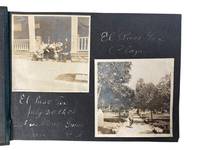
1905rif. 231541905. Texas HistoryBorderlands U.S.-Mexico borderlands photograph album 1905-1906 centered on El Paso and Juárez with additional views in New Mexico Arizona California Oregon and Alaska. The album documents an early twentieth-century traveler's movement through the southern border of the U.S. when El Paso and Ciudad Juárez were being promoted through rail travel tourism and cross-border entertainment and when American visitors regularly treated Mexican religious sites plazas bullrings and street life as part of a border excursion circuit. Its strongest historical value lies in the concentration of images tied to the Texas-Mexico border including Juárez bullfight and cockfight scenes street and church views and domestic group portraits in El Paso alongside a labeled photograph of a Santo Domingo Pueblo corn dance likely Kewa Pueblo north of Albuquerque showing non-Native travelers recording Indigenous life in the Southwest. Photograph album containing 81 original photographs most measuring approximately 2 x 3 to 4 x 5 inches mounted on thick black paper leaves in a cloth-bound album. Contemporary manuscript captions identify numerous locations and subjects including "El Paso Tex" "Juarez Mex" "Bull Fight" "Cock Fight" "Near Albuquerque 1906" "1906 New Mexico" "New Mexico 1905" "Juarez Mex Church over 350 years old" and "Corn Dance. Santo Domingo." Visible subjects include family and social group portraits posed on porches and in front of residences; women in white dresses and men in coats hats and ties; a tree-lined park path in El Paso; religious architecture and church interiors in Juárez; a fountain identified as Robinson Park in Albuquerque; river and landscape views labeled Rio Grande; a saguaro cactus study; a donkey; a seated elderly woman in a doorway; and multiple arena photographs showing matadors horses attendants spectators and ring action in Juárez. Several photographs bear later ink inscriptions including one later image of five men captioned "Alaska" en recto and with names on verso including "Mayor Goldstein" a prominent Jewish businessman and six time Juneau Mayor Isadore Goldstein. The album records border travel encompassing scenes of domestic life in El Paso tourism in Juárez and excursions into New Mexico and the wider West. The Juárez images are especially strong preserving direct vernacular views of public spectacle in the bullring and cockfight pit as well as church architecture and urban settings seen from the perspective of a visiting American observer. Photographs mounted throughout; some images faded or silvered with scattered surface wear corner wear occasional discoloration and a few later annotations or tape remnants visible. Overall very good condition. unknown
1905rif. 231541905. Texas HistoryBorderlands U.S.-Mexico borderlands photograph album 1905-1906 centered on El Paso and Juárez with additional views in New Mexico Arizona California Oregon and Alaska. The album documents an early twentieth-century traveler's movement through the southern border of the U.S. when El Paso and Ciudad Juárez were being promoted through rail travel tourism and cross-border entertainment and when American visitors regularly treated Mexican religious sites plazas bullrings and street life as part of a border excursion circuit. Its strongest historical value lies in the concentration of images tied to the Texas-Mexico border including Juárez bullfight and cockfight scenes street and church views and domestic group portraits in El Paso alongside a labeled photograph of a Santo Domingo Pueblo corn dance likely Kewa Pueblo north of Albuquerque showing non-Native travelers recording Indigenous life in the Southwest. Photograph album containing 81 original photographs most measuring approximately 2 x 3 to 4 x 5 inches mounted on thick black paper leaves in a cloth-bound album. Contemporary manuscript captions identify numerous locations and subjects including "El Paso Tex" "Juarez Mex" "Bull Fight" "Cock Fight" "Near Albuquerque 1906" "1906 New Mexico" "New Mexico 1905" "Juarez Mex Church over 350 years old" and "Corn Dance. Santo Domingo." Visible subjects include family and social group portraits posed on porches and in front of residences; women in white dresses and men in coats hats and ties; a tree-lined park path in El Paso; religious architecture and church interiors in Juárez; a fountain identified as Robinson Park in Albuquerque; river and landscape views labeled Rio Grande; a saguaro cactus study; a donkey; a seated elderly woman in a doorway; and multiple arena photographs showing matadors horses attendants spectators and ring action in Juárez. Several photographs bear later ink inscriptions including one later image of five men captioned "Alaska" en recto and with names on verso including "Mayor Goldstein" a prominent Jewish businessman and six time Juneau Mayor Isadore Goldstein. The album records border travel encompassing scenes of domestic life in El Paso tourism in Juárez and excursions into New Mexico and the wider West. The Juárez images are especially strong preserving direct vernacular views of public spectacle in the bullring and cockfight pit as well as church architecture and urban settings seen from the perspective of a visiting American observer. Photographs mounted throughout; some images faded or silvered with scattered surface wear corner wear occasional discoloration and a few later annotations or tape remnants visible. Overall very good condition. unknown books
rif. 5854"P. Hachette et Cie, sans date. In folio relié, demi maroquin rouge postérieur, dos lisse, 316 pp., très nombreuses illustrations in et hors texte en noir et en couleurs, ancien tampon d'une amicale laïque masqué par de petits morceaux de papier ; très bel exemplaire."