20 116 résultats
1 p. Very good condition
1p Very good condition From one poet to another
1 p. Very good condition The recipient was an American post and playwright who was active in the Communist Party
1 p. With this is a carbon copy of Mrs. Tosi 's letter to Kennedy. 2 p. Very good condition
1941réf. 28255Croton-on-Hudson 1941. Brief 1-pp TLS on Eastman's personal Croton-On-Hudson letterhead addressed to a "Mr. Simon" dated November 14 1941. Single holograph correction in Eastman's hand. Mailing folds; slightly toned at margins; Very Good. Regarding the recipient's letter to the Reader's Digest of September 24 Eastman had been hired as an editor for the conservative publication earlier in the same year. The subject appears to be the institution of the death penalty in the Soviet Union: ".Nobody questions the fact that the death penalty was decreed for theft of 'socialist property' and the extension of all penalties to children twelve years old automatically extends that one. I am sorry to say I can not tell you offhand when the previous decree was issued but I think it was the Spring of 1934. unknown
1968Very Good Turkish Original typescript document signed by Sadan Bezeyis. 30x22 cm. In Turkish. 1 p. Includes 20 lines. Dated Istanbul, November, 25, 1968. Bezeyis was a Turkish painter, sculptor and the president of the Turkish Contemporary Artists Society. His father is calligrapher Abdullah Bey. He graduated from Istanbul State Fine Arts Academy High Painting Department Nurullah Berk Workshop, which he started in 1945, in first place in 1951. He represented Turkey at the International Venice Biennale 1958. Paintings and sculptures of Bezeyis are included in many institutions and private collections in Turkey and worldwide.
1950Very Good Turkish Typescript document signed (TLS) by Mehmet Güleryü and Ercüment Kalmik. 30x21cm. In Turkish. Jury selection questionnaire for the "Artist of the Year and Young Artist" awards to be organized by the Society of Turkish Contemporary Painters. The questionnaire, which includes Metin Sözer as an art historian, Ferit Edgü as a critic, and Nuri Iyem, Yasar Yeniceli, Hamit Görele, Cihat Burak and Ferruh Basagaas painters, is signed by two contemporary Turkish painters (Güleryüz and Kalmik). Ercüment Kalmik was an artist and art historian, known for his work in studying the lyrical-abstract Turkish painters. In 1928, Academy of Fine Arts in the Department of Painting by entering the first Nazmi Ziya's, then Ibrahim Calli was a student. In 1937, after graduation time in various newspapers and magazines and worked. In 1939 Paris 'e went and André Lhote 's studied painting at the workshop. Sorbonne University also took courses in art history. After returning to Turkey in 1940 in Ankara and Istanbul, he was an art teacher at various high schools (1942-47). In 1947 Istanbul Technical University Faculty of Architecture 'in the colors and shapes began to teach composition. In 1967-68 Berlin Technical University's department of architecture as a guest lecturer in the basic design taught. Previously, impressionistic understanding Kalmik employees, located in Europe at the time of cubism was interested. Braque 'la Picasso 's, then Fernand Léger and Henri Matisse's figures were impacted by understanding. After returning to Turkey maintained a distinct outer line of figurative abstraction and had a strong sense of pattern. In the 1960s, fishermen, boats, and sailboats in front of abstract landscape imagery began funding. With a solid color stain, which highlights the contours of lyrical expression in the works of this period are seen. As well as the etching Kalmik also makes the picture in the 1960s in the figurative sense of the prints that are dominant. As well as objects and natural appearance of the figure given the place and occupancy of the space in this building has been used in a balanced manner. Domestically and abroad, participated in many group exhibitions, solo exhibitions opened. Picture, as well as many of the Republican era artists such as Turkish official's theoretical and philosophical concepts of articles on who wrote, conferences and radio talk, conducts the Kalmik, "The Color of Harmony Systems" and "Nature and Art Texture entitled" two books in the 1950s, Istanbul Technical was published by the University.
1961Very Good Turkish, Ottoman (1500-1928) Original typescript letter signed by Cahit Külebi. 15x21 cm. In Turkish. 1 p. Dated Bern, November 3, 1961. Typescript document. Signed by Külebi as 'cultural attache'. Külebi was a leading Turkish poet and author. He has an important place in contemporary Turkish poetry due to his adherence to folk poetry traditions. His poetry is enriched with simple yet ironic language, embellished with original descriptions.
réf. 140300aafFrankfurt/Main im Sommer 1936, in-4to, Frontispiz Fotografie + 87 S. Maschinenschriftdurchschlägen) (inkl. ill. Titelblatt mit Aufkleber: ,10.9.1920 Südtirol wird völkerrechts-widrig dem italienischen Staatsgebiet einverleibt’) + 1 Bl. Inhalts-Verzeichnis. Exlibris Peter E. Obergfell, reliure en demi-toile, couverture devant avec illustr. photogr.
réf. 6695, Leuven, Peeters, 1985., softcover geillustreerd in kleur, 20x26,5cm, 206pp, ge llustreerd z/w. ISBN 9789068310412.
réf. 40179Turnhout, Brepols, 2002 Hardback, 195 p., 22 x 28 cm.*NEW ISBN 9782503514116.
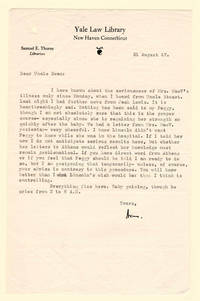
1947réf. 101463New Haven Connecticut: August 21 & 25 1947. 1947. Fine. - Two letters from the American legal historian Sameul E. Thorne about whether to share with his wife Peggy who has just given birth news of his mother-in-law's serious illness. Both letters are typed on 8-1/2 inch high by 5-3/8 inch wide "Yale Law Library" stationery. The first dated "21 August 47" consists of over 170 words addressed to his uncle Ewen. "I have known about the seriousness of Mrs. MacV's illness only since Monday." "It is heartbreakingly sad. Nothing has been said to my Peggy though I am not absolutely sure that this is the proper course--especially since she is regaining her strength so quickly after the baby. We had a letter from Mrs. MacV. yesterday--very cheerful. I know Lincoln didn't want Peggy to know while she was in the hospital." Signed "Sam". The second letter is dated "25 : August : 47" consisting of over 300 words addressed to his uncle Ewen. "The afternoon of the day I'd answered your letter enclosing cablegram copy brought a long letter from Athens and I decided that evening after a talk with Jack Lewis to tell Peggy which has been done. It was made somewhat easier by a letter from Dublin in which her grandmother made it more of less clear that something was badly wrong in Athens." He goes on to say that Peggy took it well and that she agrees that her mother Margaret who is seriously ill "must know nothing" and that Peggy has "sent off a long cheerful gossipy letter though I saw how difficult she found it and couldn't stand seeing it done." He goes on to write about the baby whose sleep schedule is the opposite of his as the baby sleeps all day and is active at night. Signed "Sam". Folded for mailing with a punch hole at the top left corner of both letters. Fine. The American legal historian Samuel Edmund Thorne 1907-1994 was the editor of many English legal manuscripts. He is known for his annotated translation of Bracton's "De legibus et consuetudinibus Angliae" considered to be the definitive translation. Thorne was married to Peggy the daughter of Ambassador Lincoln MacVeagh and his first wife Margaret. Margaret MacVeigh died but a few days later on September 9 1947. New Haven, Connecticut: August 21 & 25, 1947.
8vo (115 x 162 mm). 100 ff. Arabic manuscript on paper. 21 lines, per extensum. Brown ink (as well as light red for rubricated terms) in an essentially drawn, compact, non-serifed Yemeni naskh calligraphy. 19th century Arabic manuscript copy of two much earlier mystical works concerning the virtues and benefits related to the knowledge and recitation of the Holy Qur'an, namely: - 1) Kitab al-Barq al-Lami wa’l-Gayt al-Hami ("The Book of the Shining Flashes and Showering Rain"), epitomizing the work of the early Islamic judge Abu Bakr al-Gassani, probably an abridged version of the "Kitab ad-Durr an-Nazim fi Fada'il al-Qur'an al-Azim" by the Yemeni mystic Muhammad ibn Ahmad ibn al-Hassab (fl. 1250s AD). - 2) Kitab Hawass Ayat min-al-Qur’an wa Fawatih al-Suwar ("The Book of Peculiarities of the Qur'anic verses and the Surahs’ overtures"), a late work by the famous Persian mystic and thinker Abu Hamid al-Gazali (d. 1111 AD), here referred to by his traditional honorific "Huggatu’l-Islam" ("Proof of Islam"). - The book contains an anthological commentary on specific Qur'anic verses (ayat) and their supposed virtues and talismanic properties. The first work’s initial chapter, e.g., deals with the virtues of those verses in the Holy Qur'an that name the Prophet (an-Nabi) Muhammad. Immediately afterwards, the Ayat al-Shifa’ (i.e., “Healing Verses”) are included. Here, they are nine Qur'anic verses deemed effective against illness if recited by a believer with pure heart. The second part of this codex quotes several Qur'anic verses suitable for specific occasions, listed after each Surah. - Dated in the first colophon, where Amr bin Abi Hurayra is mentioned, the son of a famously prolific Yemeni traditionist and hadith collector (Sunni scholars ascribed to Abu Hurayra more than 5000 hadiths). The scribe is named as Ahmad ibn al-Hagi Muhammad. Cf. F. Sobieroj, Variance in Arabic Manuscripts - Arabic Didactic Poems from the 11th to the 17th Centuries (Berlin 2016), pp. 90f. & note 128.
1942Two signed membership documents formally accepting English geographer Monica Mary Cole into two scientific societies for the learned, the Royal Geographical Society and the Geologists' Association, respectively. 8vo. Two separate printed documents, three leafs combined, each document completed, signed and dated by the respective society's secretary. Leafs measure approximately 20,5 x 26 cm. Creasing to one document, otherwise in very good condition. Monica Mary Cole (1922-1994) was an English geographer, lecturer, and author, an intellectual woman and polyglot, whose legacy has been described by her colleagues as "a leader in her chosen field of academic research" who "scaled the heights of a profession that, even today, finds too few women as the incumbents of chairs." She left the Royal Geographical Society £10,000 for it to establish a research travel grant for young female physical geographists. The Archives of the Royal Holloway, University of London holds a collection of papers relating to Cole. They include her personal papers and objects connected to her career as a geographer between 1967 and 1970. During her distinguished career she produced pioneering works in the fields of biogeography and geobotany, remote sensing and terrain analysis, and mineral exploration. Her research spanned Central and Southern Africa, Brazil, Venezuela, Australia, China and Finland. Cole was not the archetypal quiet and contemplative academic. She was a larger-than-life character, and people loved to be around her. She was elected as a Fellow in the Royal geographical Society on 22 June 1942. The following year, on 6 December 1943, she also became an elected member of the Geologists' Association of London. The present documents are her official membership declaration papers from each of these societies. In 1947, Miss Cole was appointed geography lecturer under Bill Talbot at the University of Cape Town. She conducted a detailed land utilisation survey on the soils and crop yield affected by climate anomalies in Elgin, Western Cape, which was called "one of the most thorough and useful land utilization surveys carried out anywhere in South Africa" by Stanley Jackson, in The Geographical Journal.
1799Two manuscript signed letters, Dated 22 February & 10 May 1799, sent by the Assessor and Quaestor of Bückeburg, addressed to both Princess Juliane Wilhelmine Louise of Schaumburg-Lippe and Johann Ludwig Reichsgraf [Count] von Wallmoden-Gimborn, who were jointly governing the Principality of Schaumburg-Lippe, concerning a specific incident in delayed transportation of corn to Prussian troops. Text is in German. Quarto. 3 pages in manuscript, combined. Double leafs measuring approximately 20 x 32 cm, each with two watermarks, and armorial paper seal impressed over red wax. Very slight creasing, otherwise in very good and original condition, a most interesting correspondence from the fiefdom rule of beloved Princess Juliane. Manuscript
réf. a98158Two sheets of paper with almost all ink manuscript text on one side each originals with red wax seal. One 15 x 12 inches; other 16 x 12 inches. Both documents concern land in Cortland New York. The first is dated April 28 1762 and is signed by Benjamin Menton also as Minton. The second is wirtten November 15 1762 and signed by Jacob with an "x" and by Maryann Miller with her own name. Both are in bad condition - splitting at most all fold lines with very ancient old sewn repairwork but intact and legible. Pictures available on request. Pair: . unknown
1861Nikolayevsk-on-Amur, Chita, Sretensk, Blagoveshchensk, TransBaikal villages, 17 May 1861 - 23 September 1880. Two manuscript journals of an English Engineer in Russian Far East, contracted to test and repair some of the pioneering steamships on the Rivers Amur and Shilka, and other important works in the Trans-Baikal region, beginning his work some 24 years before the founding of the Eastern Siberian Inland Navigation Company, and interacting several notables who were involved in the development projects. 8vo. The earliest volume comprises 113 pages of manuscript entries dating from 17 May 1861 to 22 July 1861 and then a few pages from and then from 1 January 1868 to 22 May 1870, with a tipped-in folding map of the Amur River. The subsequent volume contains 135 pages in manuscript and dates from 14 August 1876 to 23 September 1880. Cloth over marbled boards. Volumes measure approximately 19 x 24 cm and 17 x 20 cm, respectively. Map measures approximately 46 x 20 cm. Wear to boards, hinges loose, otherwise internally clean, an exceedingly scarce and early primary source account of early developments of steam navigation in the Far East of Russia. This account is very early for the region, particularly the inner reaches of the Amur river and its tributaries, where there were scarce inhabitants or even visitors, and thus are even fewer surviving manuscript accounts. It pre-dates the founding of the important "Eastern Siberian Inland Navigation Company" which would be founded in 1885, twenty-four years after the writer began his pioneering work. It also pre-dates the Trans-Siberian Railway which would be built between 1891 and 1916 under the supervision of Russian government ministers personally appointed by Tsar Alexander III and his son, the Tsarevich Nicholas (later Tsar Nicholas II). The writer's arrival occurs only three years after the Aigun Treaty in 1858, through which the area north of the Amur belonging to the Manchu Qing dynasty since the 1689 Treaty of Nerchinsk was suddenly ceded to Russia. The Amur River has formed Russia's border with China since the 1858 Aigun Treaty and the 1860 Treaty of Peking. A folding map compiled in 1858 according to contemporary Russian sources, delineates the winding route of the Amur River throughout the Russian-Chinese borderlands, from Lake Baikal, to the mountainous Transbaikal region, to the Sea of Okhotsk snd the Strait of Tartary. Manuscript
1964107pp.+ plates out-of-text, in the series "Studi e Testi" vol.230, 25cm., VG
1944Very Good Turkish Original two manuscript ALSs and one manuscript autobiography including 30 lines. 1 p.; 2 p.; 2 p. In Ottoman script. Only one letter with date and letterhead of 'Vecih Bereketoglu'. In his first letter dated April 26, [19]44, he talks about the painting and oil painting he is working on. He states that he has met Fazil Bey since 1923. Another paper includes a two-pages autobiography. Second ALS includes 19 lines. Hasan Vecih Bereketoglu was a Turkish painter, influenced by impressionistic aesthetics, who took painting lessons from Halil Pasha and at the Julian Academy in Paris. He is one of the painters of the 1914 Generation. He was the son of Kazasker Bereketzade Cemil Bey. Since his father was a civil servant, he completed his primary education in Egypt. He completed high school in Rhodes. He studied at Istanbul Darülfunun Law Faculty. He took his first lessons in painting from Halil Pasha between 1916 and 1920. He became one of the names that supported the establishment of the Fine Arts Union. He was in Paris between 1922-1923 and continued at the Art Academie Julian. Upon his return to Turkey in 1923 he became the Chairman of Kadikoy Halkevi. When he moved to Ankara in 1943, he became the Presidential office manager. During these years, he produced still life works. He produced such works by adopting the impressionist understanding of his art life in general. It was seen that he was influenced by Halil Pasha, Hikmet Onat, and Nazmi Ziya Güran in his works on Istanbul. He was mostly remembered as an 'open-air painter' with his paintings with the views of Fenerbahçe, Kurbagalidere, and Göksu. In these paintings, he did not see the light element as the element that determines the color and presented it with the reflection it's created in nature.
réf. 140313aafca. 1853 - 1858. in-8vo, First journal: 90 leafs illustrated with: 18 dried plants (with name and origin), 14 hand-coloured aquatints or engravings, 11 uncoloured engravings, 1 chromolith. of the Strassbourg clock, 6 tinted lithographs.Second journal: 78 leafs illustrated with: 3 dried plants, 11 hand-coloured aquatints or engravings, 19 uncoloured engravings and two photographs of paintings. Contemporary half calf / Contemporary limp calf,
1964réf. T59030Citta del Vaticano, Biblioteca Apostolica Vaticana 1964 107pp. + 5 plates out-of-text, in the series "Studi e Testi" vol.230, 25cm., Very good, T59030