8091 resultados
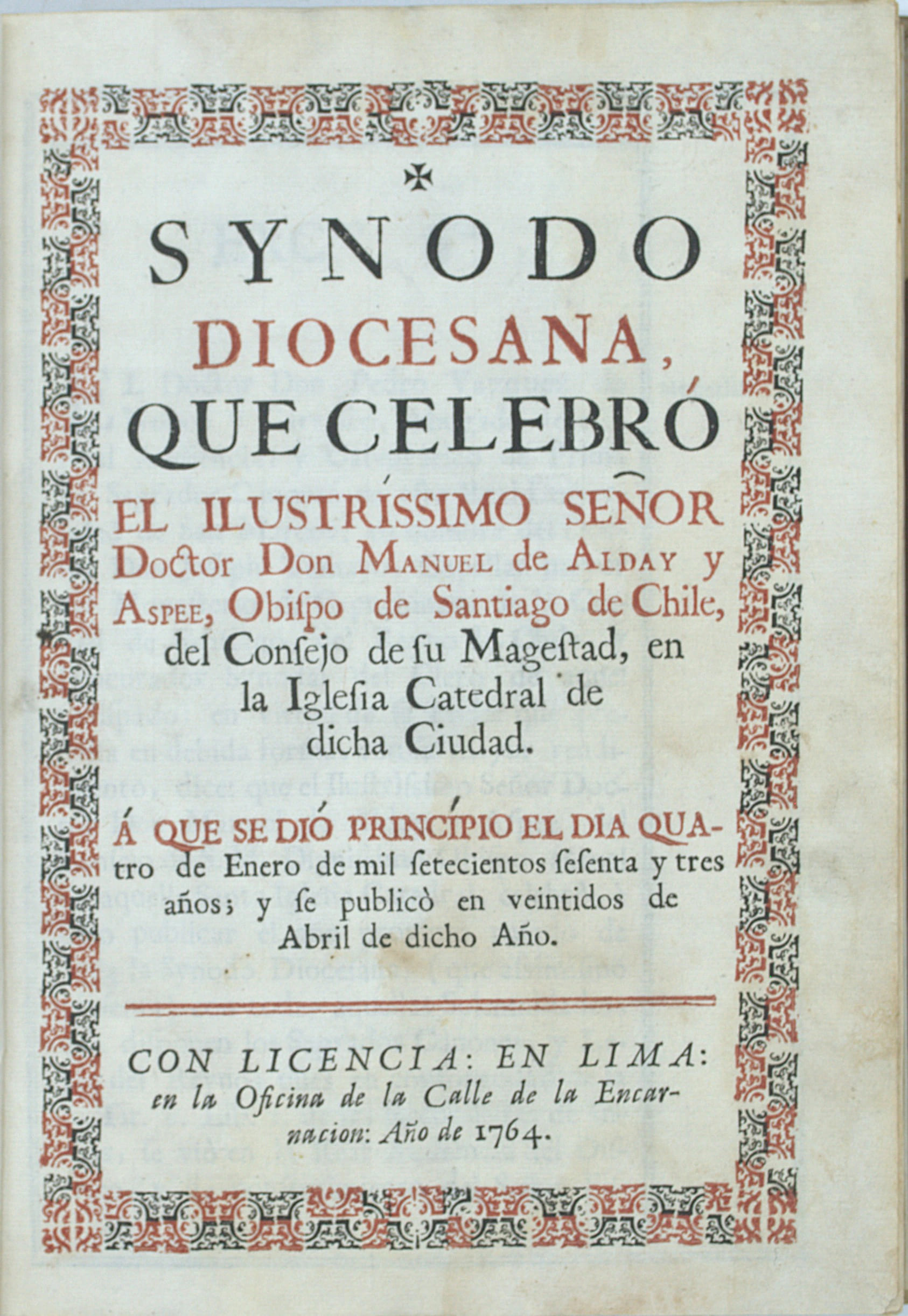
1764ref. PHO-2524Lima, Oficina de la Calle de la Encarnación, Imprenta Real, 1764. Grand in-4° (280 × 206 mm), 4ff.-170pp.-13ff. ; 7ff.-168 pp., relié en demi-vélin à coins, pièce de titre et de tomaison. 1 cahier bruni.
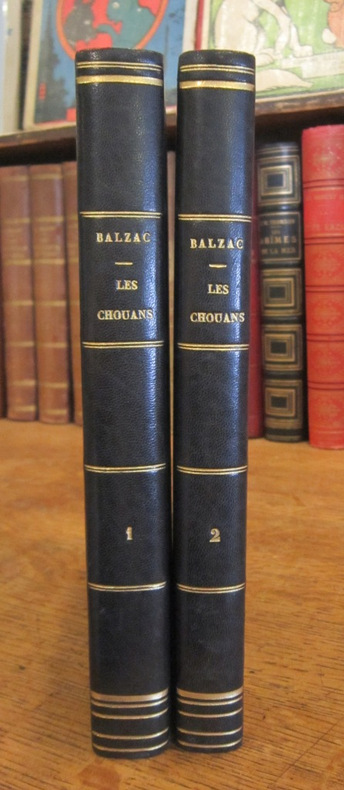
1843ref. 20995Grenoble, Hippolyte Bouteille (imprimerie Allier), 1843; 2 tomes in-4°, (255 mm), demi veau glacé bleu-marine, dos lisse, titre entre deux compositions de rinceaux et rocaille dorés (reliure de l’époque) ; 416 ; 358 pp., 72 belles planches lithographiées par Pegeron et un grand tableau synoptique dépliant en fin d’ouvrage.
1592Large 4to. (8), 750 (but: 760), (84) pp. Contemporary vellum, decoratively gilt. Traces of ties. Exceptionally beautifully bound copy of this standard work on Roman legal practice; definitive edition of the oft-reprinted work. First published in 1583, this is the second edition, revised, expanded and with a dedication to Heinrich von Rantzau. - Brisson (1531-91), president of the parliament of Paris, was the first scholar to systematically collect all expressions of Roman legal and political writing. - Slightly bronwed throughout; title page with erased note of owenership. Elegant binding with insignificant traces of worming to front cover, otherwise perfect. VD 16, B 8330. IA 125.117. Adams B 2848. Cf. Brunet I, 1262. Ebert 2984. Graesse I, 541. Jöcher I, 1385f.
1958ref. 1555Geibi Shuppan, Tokyo 1958. 1 volume in-4 (28.5 x 22.5 cm) sous cartonnage bichrome de l'éditeur, jaquette illustrée en couleurs pelliculée. ÉDITION ORIGINALE. Premier et unique tirage. Le livre contient 178 photographies en noir et blanc reproduites en héliogravure (dont planches dépliantes) et 7 en couleurs. Avec une préface (en anglais et en japonais) par Tsutomu Watanabe. Bien complet du colophon contrecollé imprimé sur papier jonquille portant le cachet/tampon circulaire du photographe encré en rouge. Geibi Shuppan, Tokyo 1958. 4to. (11 1/8 x 8 7/8 in.) pp. 168. With 7 colour & 178 black-and-white photographs including various gatefolds and fold-outs. Publisher's black cloth and yellow printed spine and color printed photographic dust-jacket. First edition, first and only printing of Yasuhiro Ishimoto's critically acclaimed photobook "Someday, Somewhere" "ある日ある所". Yasuhiro Ishimoto's work represented an influential link between japanese and american photography. With this book, published in 1958, he had the distinction of producing the first major postwar Japanese photobook shot in both Tokyo and Chicago. In between he published this, his first book, and the first important work to emerge from the group. Ishimoto occupies an interesting position in the history of Japanese photography and was another important link between the East and West. Born in San Francisco in 1921, he moved with his family to Japan at the age of three. After graduating from high school he went back to San Francisco to study. A year later, as a result of the war, he was sent to an internment camp in Colorado for Japanese citizens and those of Japanese descent. It was here that his interest in photography began. After the war Ishimoto went to Chicago and studied at the Institute of Design under Harry Callahan and Aaron Siskind. He graduated in 1952 and returned to Japan the following year, although he continued to travel between the two countries. Someday, Somewhere contains photographs from both Chicago and Tokyo, and clearly shows the influence of his time studying with Callahan and Siskind. Et pour en savoir plus, suivez ce lien / if you want to know more about Yasuhiro Ishimoto, follow this excellent link: http://www.espritsnomades.com/artsplastiques/Ishimoto/ishimoto.html
1900(8), 428, (32) SS. Mit großer Druckermarke am Titel und vielen Wappenholzschnitten im Text. - (Beigebunden) II: Ders. Chronicon ecclesiasticum. A C. Iulii Caesaris dictatoris imperio, usque ad imp. Caesarem Maximilianum II. Austrium, pium, felicem, perpetuum Augustum. Köln, Maternus Cholinus, 1568. (14), 144 (recte: 146) SS. Mit Holzschnittvignette am Titel. - (Beigebunden) III: Ders. Romanorum principum et eorum quorum maxima in Italia imperia fuerunt libri IV. Eiusdem de comitiis imperatoriis liber. Basel, Henricpetri, 1558. (12), 450 (recte: 480), (2) SS. Mit Holzschnittdruckermarke am Titel (am letzten Bl. verso wdh.). Lederband des 17. Jhs. mit Spuren goldgepr. Rückenschildchen. Dreiseitiger gesprenkelter Rotschnitt. Folio (214:293 mm). Sammelband mit drei historischen Schriften Panvinios (1530-68), jeweils in erster Ausgabe. "Den Ehrennamen 'Pater omnis historiae' (Scaliger) verdiente [Panvinio] nicht bloß durch die Vielseitigkeit seiner Studien, sondern durch ganz moderne kritische Fragestellung und Auffassung; er ist originell und echter Historiker, sieht die Lücken und Probleme und dient unbestechlich der Wahrheit. Sein Stil ist einfach, aber sorgfältig und angenehm" (LThK VII, 923). - I: Erste Personalgeschichte der Kurie; ein reiches Quellenwerk von großer Bedeutung. Die ersten 4 Bll. im Bug verstärkt und in der unteren Ecke angerändert (geringfügiger Textverlust, auch das Impressum betreffend). - II: Kirchengeschichte, in der Propheten, Kaiser, Könige, Konsuln, Päpste etc. von Anbeginn der Zeiten bis 1566 tabellarisch-chronologisch verzeichnet sind. Titel etwas fleckig und mit alt getilgtem Besitzvermerk. - III: Genealogie der römischen, fränkischen und deutschen Kaiser und Könige bis 1556. Mit dem Anhang über die Kurfürsten und deren Wahl; am Schluß die Goldene Bulle. - Durchgehend leicht gebräunt bzw braunfleckig, teils auch etwas wasserrandig. Einband berieben; Kapitale stärker lädiert. Exemplar aus der Bibliothek des Wiener Augustiner-Eremiten Theophilus Paulle (1680-1731), Professor für Kasuistik an der theologischen Fakultät der Universität Wien, mit seinem mehrzeiligen eigenh. Besitzvermerk am Titel von I und III (dat. 1721) sowie seinem typograph. Exlibris am vorderen Innendeckel. Nach seinem Tode in die Bibliothek der Wiener Unbeschuhten Augustiner einsigniert (entspr. hs. Signatur am vorderen Innendeckel und Signaturetikett am Rücken. I: BM-STC Italian 488. Adams P 194. Edit 16, CNCE 34274 (nennt am Ende irrtümlich 20 Bl.). Cerroti 1406 (dat. irrtümlich 1551). - II: BM-STC German 673. VD 16, P 250. Nicht bei Adams. - III: BM-STC German 673. Adams P 204. VD 16, ZV 12146.
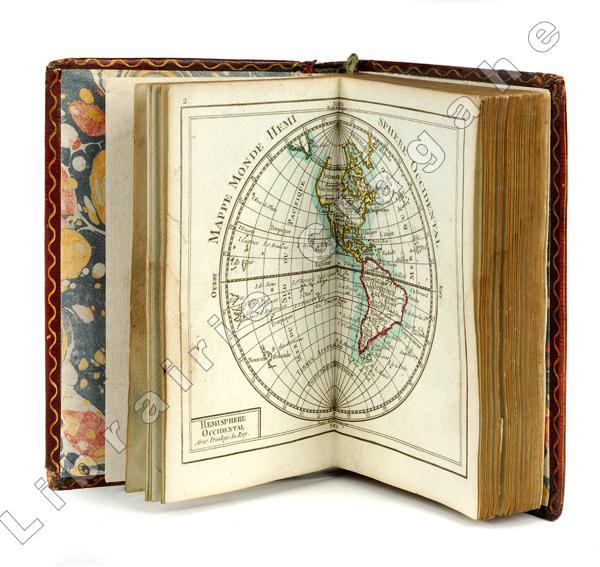
ref. 19883Paris, Charles Dien, s.d. (circa avant la Révolution française) ; in 16 (121 mm), maroquin grenat à grain long, filets et titre dorés au dos, filet doré d’encadrement des plats et filet ondulé d’intérieur, tranches dorées (reliure seconde moitié du XVIIIe), ouvrage entièrement monté sur onglets; titre gravé et 29 planches sur feuille double, la première sur les Sphères, en noir et blanc, toutes les autres sont aquarellées à la main, dont 2 mappemondes, l’Europe, l’Asie, l’Afrique, l’Amérique du Nord et l’Amérique du Sud, puis l’Europe et la France en quatre parties.
1792ref. 5795Parme, Bodoni, 1792. 2 parties en 1 vol. in-8 de (4)-175-(1) pp. et (4)-190-(2) pp. 1 f. blanc, veau marbré, dos orné à nerfs, triple filet doré sur les plats, fleurons aux angles, pièces de titre en maroquin rouge et en maroquin noir, tranches dorées (reliure de l'époque).
ref. ST15039aBMcMinnville Oregon: Phillip J. Pirages 2019. ONE OF 32 COPIES in linen-backed blue paper boards from a total edition of 165 COPIES. Text: 244 x 154 mm. 9 1/8 x 6 1/8"; Case: 502 x 372 mm. 19 3/4 x 14 5/8". ii 75 pp. Bound in linen-backed blue paper boards inspired by Kelmscott Press bindings by Amy Borezo who also constructed the case holding the volume and leaves. The book printed letterpress on Zerkall Book Laid Vellum paper by Arthur Larson at Horton Tank Graphics. Book layout by Jill Mann. EACH COPY WITH FIVE LEAVES: ONE FROM THE KELMSCOTT CHAUCER with text only AND ONE EACH FROM THE PRESSES OF FOUR GERMAN PRINTERS FROM THE 1470s--PETER SCHOEFFER JOHANN MENTELIN GÜNTHER ZAINER AND ANTON KOBERGER. ◆The incunabular leaves consistently excellent with only minor defects and the Kelmscott leaves which were never part of a bound volume in entirely fine condition. This is a unique leaf book in the way that it combines three elements: a significant private press production involving people at the top of their craft a scholarly commentary that contributes to a further understanding of the history of printing and--most important--five leaves: one from the Kelmscott Press "Works" of Geoffrey Chaucer and four from books issued by German printers at work in the 1470s. The book has been printed and bound by hand by gifted professionals; the essay addresses a topic of significance to typophiles in a considerably more thoroughgoing way than has been done before; and the assemblage of leaves represents a powerful visual reinforcement of the text as well as an opportunity to share in the ownership of four important incunabula along with the extraordinary Kelmscott Chaucer. The story of the production is heavy on serendipity: in the winter of 2012 after purchasing a very incomplete copy of the Kelmscott Chaucer at auction we considered the possibility of producing a leaf book but because the Chaucer--universally considered to be one of the most beautiful books ever printed--had been written about by so many different people in so many different ways we didn't know what aspect was left for us to explore. The one topic we fastened on as thus far inadequately examined is the origin of the work's typeface. We soon learned that Morris who is known to have owned more than 500 incunables most admired--and was consequently most likely to have been influenced in his typographic design by--Peter Schoeffer of Mainz Johann Mentelin of Strassburg Günther Zainer of Augsburg and Anton Koberger of Nuremberg. Over the course of the years succeeding the purchase of the defective Chaucer we were fortunate beyond all expectation to acquire incomplete books from each of these four eminent printers. As a result the present leaf book will allow the reader not only to read in the accompanying essay about the influence on Morris of his typographic forebears but also to compare with his or her own eyes the resemblances between the Kelmscott leaf and the leaves from four centuries earlier. We have additional copies of this binding available at different price points. Please contact us directly for more details. Phillip J. Pirages unknown
ref. ST15039aBMcMinnville Oregon: Phillip J. Pirages 2019. ONE OF 32 COPIES in linen-backed blue paper boards from a total edition of 165 COPIES. Text: 244 x 154 mm. 9 1/8 x 6 1/8"; Case: 502 x 372 mm. 19 3/4 x 14 5/8". ii 75 pp. Bound in linen-backed blue paper boards inspired by Kelmscott Press bindings by Amy Borezo who also constructed the case holding the volume and leaves. The book printed letterpress on Zerkall Book Laid Vellum paper by Arthur Larson at Horton Tank Graphics. Book layout by Jill Mann. EACH COPY WITH FIVE LEAVES: ONE FROM THE KELMSCOTT CHAUCER with text only AND ONE EACH FROM THE PRESSES OF FOUR GERMAN PRINTERS FROM THE 1470s--PETER SCHOEFFER JOHANN MENTELIN GÜNTHER ZAINER AND ANTON KOBERGER. ◆The incunabular leaves consistently excellent with only minor defects and the Kelmscott leaves which were never part of a bound volume in entirely fine condition. This is a unique leaf book in the way that it combines three elements: a significant private press production involving people at the top of their craft a scholarly commentary that contributes to a further understanding of the history of printing and--most important--five leaves: one from the Kelmscott Press "Works" of Geoffrey Chaucer and four from books issued by German printers at work in the 1470s. The book has been printed and bound by hand by gifted professionals; the essay addresses a topic of significance to typophiles in a considerably more thoroughgoing way than has been done before; and the assemblage of leaves represents a powerful visual reinforcement of the text as well as an opportunity to share in the ownership of four important incunabula along with the extraordinary Kelmscott Chaucer. The story of the production is heavy on serendipity: in the winter of 2012 after purchasing a very incomplete copy of the Kelmscott Chaucer at auction we considered the possibility of producing a leaf book but because the Chaucer--universally considered to be one of the most beautiful books ever printed--had been written about by so many different people in so many different ways we didn't know what aspect was left for us to explore. The one topic we fastened on as thus far inadequately examined is the origin of the work's typeface. We soon learned that Morris who is known to have owned more than 500 incunables most admired--and was consequently most likely to have been influenced in his typographic design by--Peter Schoeffer of Mainz Johann Mentelin of Strassburg Günther Zainer of Augsburg and Anton Koberger of Nuremberg. Over the course of the years succeeding the purchase of the defective Chaucer we were fortunate beyond all expectation to acquire incomplete books from each of these four eminent printers. As a result the present leaf book will allow the reader not only to read in the accompanying essay about the influence on Morris of his typographic forebears but also to compare with his or her own eyes the resemblances between the Kelmscott leaf and the leaves from four centuries earlier. We have additional copies of this binding available at different price points. Please contact us directly for more details. Phillip J. Pirages unknown books
1889ref. 2111902160201047Usomatsu Inoue Ryuunsha 1889. Soft Cover. Fine. Number of books: 2 books Usomatsu Inoue Ryuunsha paperback
1838Very Good Turkish, Ottoman (1500-1928) Original full leather bdg. with its miklep (traditional flap), embossed shamsa (mystical sun) on boards. Roy. 8vo. (24 x 17 cm). In Ottoman script. [8], 263 p. Sarlavla page decorated with traditional ornaments. First edition of this extremely rare and the first translation of the Anabasis of Alexander in the Ottoman / Turkish literature. One of 1010 copies. The Anabasis of Alexander was composed by Arrian of Nicomedia in the second century AD, most probably during the reign of Hadrian. The Anabasis (which survives complete in seven books) is a history of the campaigns of Alexander the Great, specifically his conquest of the Persian Empire between 336 and 323 BC. Both the unusual title "Anabasis" (literally "a journey up-country from the sea") and the work's seven-book structure reflect Arrian's emulation (in structure, style, and content) of the Greek historian Xenophon, whose own Anabasis in seven books concerned the earlier campaign "up-country" of Cyrus the Younger in 401 BC. The Anabasis is by far the fullest surviving account of Alexander's conquest of the Persian Empire. It primarily revolves around the military history, reflecting the content of Arrian's model, Xenophon's Anabasis; the work begins with Alexander's accession to the Macedonian throne in 336 BC and has nothing to say about Alexander's early life (in contrast, say, to Plutarch's Life of Alexander). Nor does Arrian aim to provide a complete history of the Greek-speaking world during Alexander's reign. Arrian's chief sources for his writing of the Anabasis were the lost contemporary histories of the campaign by Ptolemy and Aristobulus and, for his later books, Nearchus. One of Arrian's main aims in writing this work on history seems to have been to correct the standard "Vulgate" narrative of Alexander's reign that was dominant in his own day, primarily associated with the lost writings of the historian Cleitarchus. The Anabasis gives a broadly chronological account of the reign of Alexander the Great of Macedonia (336-323 BC), with a particular focus on military matters. George Rhasis (Yorgaki Razi) translated Anabasis Alexandrou = "History of Alexander the son of Philip" the work of Xenophon under the title "Târîh-i Iskender bin Filipos". This is the first translation of an ancient Greek historian into Turkish. Georgios Rhasis, who was one of the first writers of the French-Turkish dictionary in the early period, was an Ottoman intellectual who worked as an instructor and translator in Ottoman and French languages. He also taught at the Eastern Languages School in Paris and continued her studies in Corfu and Paris. In 1821 he came to be in Istanbul as a famous orientalist. Rhasis left the city and the homeland he lived in to settle in Tsarist Russia due to concerns during the Greek Revolution in 1821. The Bulaq or El-Amiriya Press is the first official and governmental printing press to be established in Egypt, and functions according to industrial printing basis, causing not just a qualitative but also a quantitative and knowledgeable leap in science throughout the Arab region. It's established in 1820 by Muhammad Ali Pasha of Egypt and Sudan (1769-1849) and it was part of Muhammad Ali's inclusive development plans for the modernization of Egypt. Library of Congress, Karl Süssheim Collection, no. 129. (OCLC: 966315151). Only 6 copies in OCLC: 27236333.; Alex II 25.; BM e15.; Cairo FKT 166.; IstUKT 802.; Bianchi CD 155.; Bulaq IF 8:21.; Bulaq FK 7:8.; Ridwan 162.; Özege 19837 (No author and no translator in Özege record).
1816A SPECTACULAR LARGE-PAPER COPY OF THE PLATE VOLUME DEVOTED TO WORMS AND ZOOPHYTES (from the Dictionnaire des sciences naturelles), PRINTED LARGE QUARTO ON EXTREMELY FINE WOVE PAPER, WITH ALL THE PLATES (116, by various engravers after Jean-Gabriel PrÍtre) IN TWO STATES, BOTH UNCOLORED AND COLORED. Some of the colored plates are printed in color, others are colored by hand, but most are printed in color and finished by hand. 32 pp. and 232 plates, complete. The coloring in this copy is vastly superior to that found in the regular octavo issue--in many of the plates it is positively luminous. Large 4to (30.4 x 23 cm). Beautifully bound in contemporary quarter calf and decorated boards. Little traces of wear to extremities of binding. Plates FINE AND BRIGHT, WITH THE COLORS VERY FRESH, and a little faint spotting caused by impurities in the paper. EXTREMELY RARE in this state: Brunet (II, 696) mentions that large-paper copies exist, and acknowledges that a few copies have the plates both colored and uncolored. SPECTACULAR AND IMPORTANT.
1878AN IMPORTANT EXAMPLE OF AMERICAN COLOR PRINTING. Two volumes, complete. A remarkable catalogue of a remarkable collection. Odell focused on bibliography, books about books, history of printing and the graphic arts, and fine printing, at a time when few American collectors were interested in these areas. Books in these categories account for well over half of the 2,434 lots. There is also a wide selection of extremely rare books in other areas, especially the occult, including incunables and a few highly important medieval manuscripts. The catalogue itself is notable for two reasons. First, there are the precise, knowledgeable, and extensive descriptions, with numerous references to specialized bibliographies: most American book catalogues of this period give the barest information about the items at hand. Second, this is certainly the most lavishly-produced American book auction catalogue of the 19th century. It was beautifully printed on fine laid paper, with numerous engraved initials, headpieces, and tailpieces. THIS SET IS THE DELUXE ISSUE, ONE OF VERY FEW COPIES PRINTED PRIMARILY FOR PRIVATE CIRCULATION, with the initials, headpieces, and tailpieces printed in different colors. (Volume II of this deluxe issue is dated 1879, while volume II of the regular issue is dated 1880.) The sets of this deluxe issue that reached the market were sold for $10 each, a colossal price when we consider that lot 1462, a copy of Bodoni's 1818 Manuale Tipografico, sold for $4.50! Title-pages printed in red and black. Facsimiles. 4to. Original wraps. Uncut. Minimal wear to wraps, INTERNALLY FINE AND BRIGHT. Complete sets are extremely rare (volume II is especially scarce). Not in Bigmore & Wyman or Taylor. AN OUTSTANDING ITEM IN OUTSTANDING CONDITION.
FIRST AND ONLY EDITION of the MOST IMPORTANT MONOGRAPH ON THE CANAL LINKING PARIS WITH THE SEA, one of the great engineering projects of its time. XI, 221 pp. plus 3 lithographed maps. The book is divided into two sections: Besons (near Paris) to Rouen, and Rouen to Le Havre. Each section is divided into numerous (and very detailed) subsections. Numerous tables throughout. At the end are three large folding lithographed maps, with the course of the Seine colored by hand in blue. Beautifully printed by Didot on fine wove paper, with large margins. From the library of noted engineer Rudolph Glossop (1902-1993), with his bookplate on pastedown. 4to. Attractively bound in half crimson morocco. FINE AND BRIGHT, with no defects. An outstanding copy of an important book.
1893ref. 2111902160200405Iwanami Sono Remnants Edition 1893. Soft Cover. Fine. Volume: 1 Iwanami Sono Remnants Edition paperback
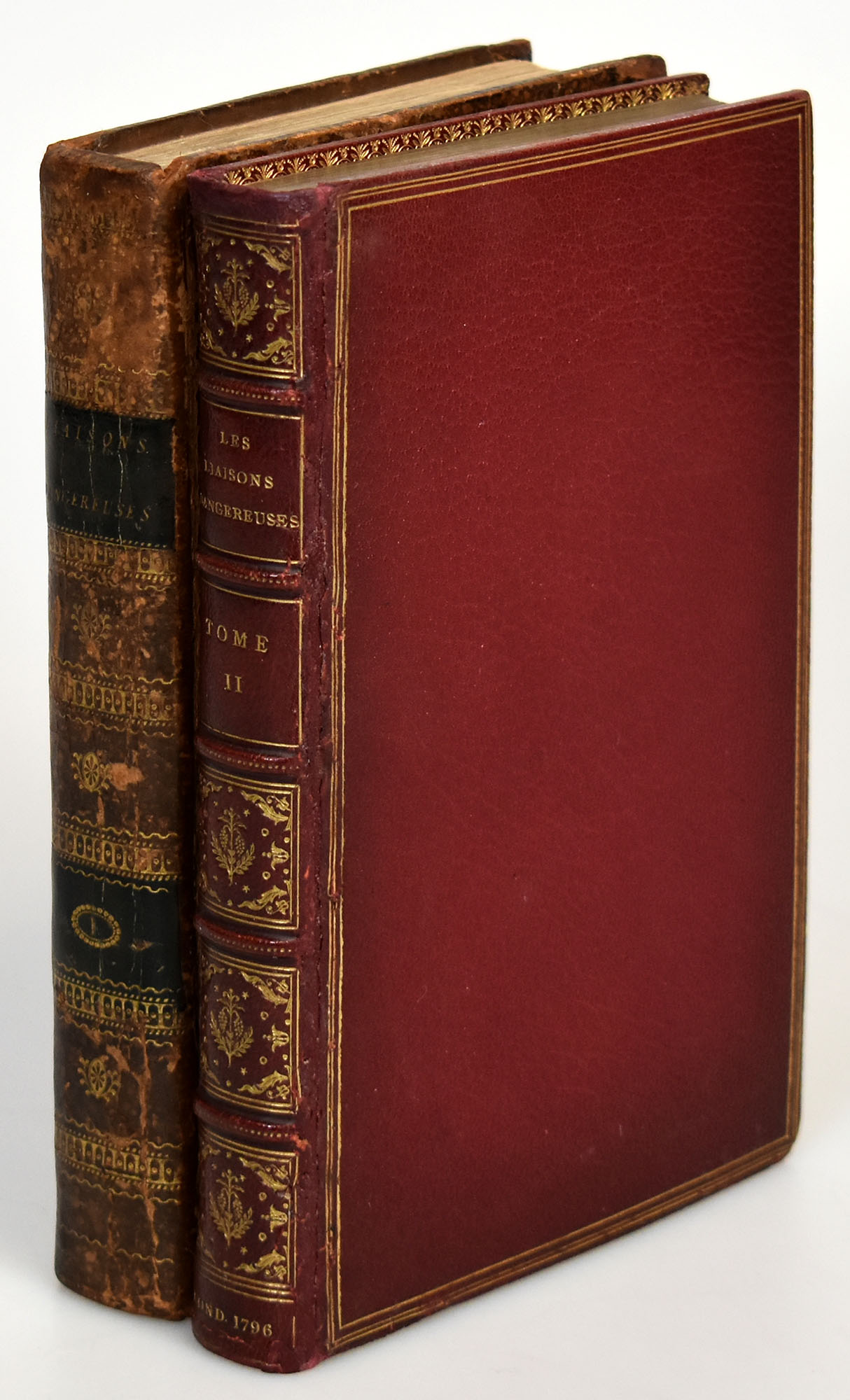
1796ref. 62445CBLondres [London, i.e. Paris], Selbstverlag, 1796. 8°. 20,5 x 13 cm. 415 Seiten, Frontispiz, 5 Tafeln ; 2 Blatt, 398 Seiten, Frontispiz, 6 Tafeln. Erster Band: Brauner Lederband der Zeit mit schwarzen, ledernen Rückenschildern mit goldgeprägtem Rückentitel sowie ornamentaler Rückenvergoldung. Zweiter Band (abweichend): Fachmännisch restaurierter roter Lederband der Zeit auf fünf Bünden mit goldgeprägtem Rückentitel und ornamentaler Rückenvergoldung, Außen- und Innenkantenfileten, Rundum-Goldschnitt und marmorierten Vorsätzen. [6 Warenabbildungen]
ref. ST15039aAMcMinnville Oregon: Phillip J. Pirages 2019. ONE OF 32 COPIES in linen-backed blue paper boards from a total edition of 165 COPIES. Text: 244 x 154 mm. 9 1/8 x 6 1/8"; Case: 502 x 372 mm. 19 3/4 x 14 5/8". ii 75 pp. Bound in linen-backed blue paper boards inspired by Kelmscott Press bindings by Amy Borezo who also constructed the case holding the volume and leaves. The book printed letterpress on Zerkall Book Laid Vellum paper by Arthur Larson at Horton Tank Graphics. Book layout by Jill Mann. EACH COPY WITH FIVE LEAVES: ONE FROM THE KELMSCOTT CHAUCER with multiple 3-line initials AND ONE EACH FROM THE PRESSES OF FOUR GERMAN PRINTERS FROM THE 1470s--PETER SCHOEFFER JOHANN MENTELIN GÜNTHER ZAINER AND ANTON KOBERGER. The incunabular leaves consistently excellent with only minor defects and the Kelmscott leaves which were never part of a bound volume in entirely fine condition. This is a unique leaf book in the way that it combines three elements: a significant private press production involving people at the top of their craft a scholarly commentary that contributes to a further understanding of the history of printing and--most important--five leaves: one from the Kelmscott Press "Works" of Geoffrey Chaucer and four from books issued by German printers at work in the 1470s. The book has been printed and bound by hand by gifted professionals; the essay addresses a topic of significance to typophiles in a considerably more thoroughgoing way than has been done before; and the assemblage of leaves represents a powerful visual reinforcement of the text as well as an opportunity to share in the ownership of four important incunabula along with the extraordinary Kelmscott Chaucer. The story of the production is heavy on serendipity: in the winter of 2012 after purchasing a very incomplete copy of the Kelmscott Chaucer at auction we considered the possibility of producing a leaf book but because the Chaucer--universally considered to be one of the most beautiful books ever printed--had been written about by so many different people in so many different ways we didn't know what aspect was left for us to explore. The one topic we fastened on as thus far inadequately examined is the origin of the work's typeface. We soon learned that Morris who is known to have owned more than 500 incunables most admired--and was consequently most likely to have been influenced in his typographic design by--Peter Schoeffer of Mainz Johann Mentelin of Strassburg Günther Zainer of Augsburg and Anton Koberger of Nuremberg. Over the course of the years succeeding the purchase of the defective Chaucer we were fortunate beyond all expectation to acquire incomplete books from each of these four eminent printers. As a result the present leaf book will allow the reader not only to read in the accompanying essay about the influence on Morris of his typographic forebears but also to compare with his or her own eyes the resemblances between the Kelmscott leaf and the leaves from four centuries earlier. Phillip J. Pirages unknown
ref. ST15039aAMcMinnville Oregon: Phillip J. Pirages 2019. ONE OF 32 COPIES in linen-backed blue paper boards from a total edition of 165 COPIES. Text: 244 x 154 mm. 9 1/8 x 6 1/8"; Case: 502 x 372 mm. 19 3/4 x 14 5/8". ii 75 pp. Bound in linen-backed blue paper boards inspired by Kelmscott Press bindings by Amy Borezo who also constructed the case holding the volume and leaves. The book printed letterpress on Zerkall Book Laid Vellum paper by Arthur Larson at Horton Tank Graphics. Book layout by Jill Mann. EACH COPY WITH FIVE LEAVES: ONE FROM THE KELMSCOTT CHAUCER with multiple 3-line initials AND ONE EACH FROM THE PRESSES OF FOUR GERMAN PRINTERS FROM THE 1470s--PETER SCHOEFFER JOHANN MENTELIN GÜNTHER ZAINER AND ANTON KOBERGER. The incunabular leaves consistently excellent with only minor defects and the Kelmscott leaves which were never part of a bound volume in entirely fine condition. This is a unique leaf book in the way that it combines three elements: a significant private press production involving people at the top of their craft a scholarly commentary that contributes to a further understanding of the history of printing and--most important--five leaves: one from the Kelmscott Press "Works" of Geoffrey Chaucer and four from books issued by German printers at work in the 1470s. The book has been printed and bound by hand by gifted professionals; the essay addresses a topic of significance to typophiles in a considerably more thoroughgoing way than has been done before; and the assemblage of leaves represents a powerful visual reinforcement of the text as well as an opportunity to share in the ownership of four important incunabula along with the extraordinary Kelmscott Chaucer. The story of the production is heavy on serendipity: in the winter of 2012 after purchasing a very incomplete copy of the Kelmscott Chaucer at auction we considered the possibility of producing a leaf book but because the Chaucer--universally considered to be one of the most beautiful books ever printed--had been written about by so many different people in so many different ways we didn't know what aspect was left for us to explore. The one topic we fastened on as thus far inadequately examined is the origin of the work's typeface. We soon learned that Morris who is known to have owned more than 500 incunables most admired--and was consequently most likely to have been influenced in his typographic design by--Peter Schoeffer of Mainz Johann Mentelin of Strassburg Günther Zainer of Augsburg and Anton Koberger of Nuremberg. Over the course of the years succeeding the purchase of the defective Chaucer we were fortunate beyond all expectation to acquire incomplete books from each of these four eminent printers. As a result the present leaf book will allow the reader not only to read in the accompanying essay about the influence on Morris of his typographic forebears but also to compare with his or her own eyes the resemblances between the Kelmscott leaf and the leaves from four centuries earlier. Phillip J. Pirages unknown books
1544ref. 14383Parisiis, Ex officina Rob. Stephani, 1544. In-8 de 394-(14) pp. (sign. aa-zz, AA, BB8, CC4), vélin ivoire, étiquette ancienne sur le dos (reliure de l'époque).
1681ref. 43386Correriae, Per Laurentium Gilibert, typographum Juratum apud Gratianopolim, 1681. Petit in-8 de 339-(41) pp. 48 pp. (8)-91-(1) pp., index, errata (signatures: A-Aa dernier blanc, A-C a-f ), veau granité, dos orné à nerfs (reliure de l'époque).
1530Folio (230 x 334 mm). (14), LXXXIV, II, LXXXV-CCXCVII (but: 300) ff. (4), CXCIX (but: 197) ff., last bl. f. Title page printed in red and black. With a full-page woodcut portrait and numerous initials. Contemp. blindstamped pigskin over wooden boards on four raised bands. Ms. title to spine; 2 clasps. Second edition of the collection of Council reports, "la première qui ait été éditée" (Hoefer, NBG XXXV, 82). With woodcut portrait of Emperor Charles IV at the end of pt. 1 (as always, one coat of arms stopped out during printing). - Contemporary handwritten ownership note on title-page overwritten in 17th century. A few contemporary marginalia and underlinings near beginning. Slight worming to front cover. A fine copy. The roll-tools display a hunter with bow and arrow, hidden in the foliage, and the probably apotropaic motif of a demon sitting on a chamber pot, holding up a mirror. From the collection of Franke Parker, Rector of Luffincott, Devon, and bequeathed by him to the Bishopric of Cornwall (cf. the bookplate on front pastedown): thus, in 1883 the volume was acquired by Henry Phillpotts, the Bishop of Exeter (then administrating Cornwall); his library was dispersed in 2006. VD 16, M 4842. Adams C 2766. BM-STC German 225. Sawicki 288. Schulte III/1, 93.
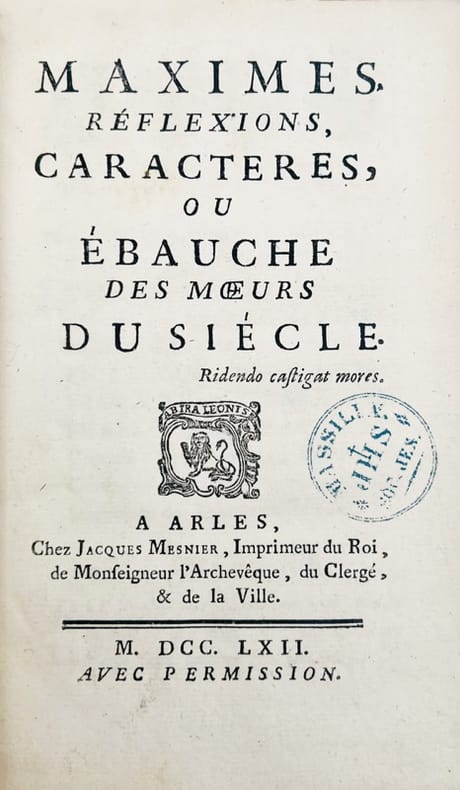
1762ref. 44592Arles, Jacques Mesnier, 1762. In-12 de (8)-235-(1) pp. maroquin rouge, dos lisse orné, roulette, filet et frise dorés d'encadrement sur les plats, armes et devise dorées de la ville d'Arles frappées au centre, tranches dorées (reliure de l'époque).
1572ref. 42366In Venetia, , 1572. In-12 oblong (15 x 20,6 cm) de (4) ff. de texte (43) ff., modèles de calligraphie, titre avec vignette gravée sur bois, veau brun, dos orné à nerfs (reliure du XVIIe siècle). Manque 8 feuillets (signatures D 6 à E 5).
1834ref. 002750Paris, Vimont, 1834
15908vo. (4), 192, (12) pp. With woodcut printer's device to t. p. and four large woodcuts. 18th-c. dark brown calf (damaged). Second edition of the well-known book on Roman dining habits, first published in 1588. Also contains relevant texts by classical authors such as Ovid, Terence, and Propertius. Rare Sanctandreana imprint; usually encountered with Commelin's name on the title page (only two copies thus in VD 16). The large woodcus show various feasts. - Binding rubbed; extremities severyl bumped. Interior somewhat brownstained and with 17th-c. marginalia (trimmed by binder's knife upon rebinding c. 1750); numerous later pencil underlinings. VD 16, ZV 3209. IA 135.411. Adams C 1630. Vicaire 174. Georg 22. Palau 66773. Not in BM-STC German.